It Was Great Speaking With You Today Email: 9 Better Templates
"It was great speaking with you today" is the most-sent, least-read opening line in B2B follow-up. Here's what to send instead — with templates, timing rules, and a table matching each call type to the right recap format.
TL;DR
- "It was great speaking with you today" is not a bad sentence — it is a wasted one. It burns the highest-attention line in the whole email on a pleasantry the reader already knows.
- Post-call follow-ups get read in the preview pane. If the first 60 characters contain no decision, no deadline, and no number, the email gets archived.
- Replace the opener with a one-line recap of what was actually agreed: "Confirming the three things we landed on" beats any variation of "great chatting."
- Send within 24 hours, and send to everyone who was on the call — including the silent people whose addresses you never collected.
- Nine templates below, mapped to discovery, demo, pricing, technical, and post-loss calls.
What Does "It Was Great Speaking With You Today" Actually Signal?#
It signals that you wrote the email from the top down instead of from the outcome back.
Think of a post-call email like the front page of a newspaper. The headline is not "we had a meeting about the fire." It is "three blocks evacuated, cause under investigation." The "it was great speaking with you today" email buries the news under a greeting, which means the only thing visible in the recipient's inbox preview is a courtesy they will not act on.
There is a name for the alternative in military and government writing: BLUF — bottom line up front. Lead with the conclusion, then support it. Your prospect just spent 30 to 45 minutes on a call. They do not need to be reminded that it happened. They need to be reminded what they agreed to do next.
That does not mean warmth is banned. It means warmth goes in position two, not position one. "Confirming the pilot scope we agreed on — and thanks for the candid answers on the migration risk" carries both the substance and the human note, in that order.
Why Do These Follow-Up Emails Get Ignored?#
Four reasons, in rough order of damage:
1. The subject line repeats the opener. If your subject is "Great speaking today" and your first line is "It was great speaking with you today," you have spent your entire preview budget saying nothing. Most inbox clients show roughly 35–70 characters of subject plus 60–100 of preview text. That is your whole ad. Run your options through a subject line generator if you keep defaulting to the same five words.
2. No decision is restated. The single highest-value thing a recap email does is create a written record the buyer can forward internally. If your email contains no scope, no price range, no timeline, and no owner, it cannot be forwarded — so it will not be.
3. It arrives too late. A recap sent 72 hours after the call competes with everything that happened in between. Gartner's research on B2B buying consistently shows buying groups of six to ten people; every day you wait, your call gets re-narrated by someone who was not on it.
4. It only goes to the person who spoke. The champion on the call is rarely the only decision-maker. If the CFO and the security lead never receive the recap, your version of the conversation never reaches them.
What Should Replace the Opening Line?#
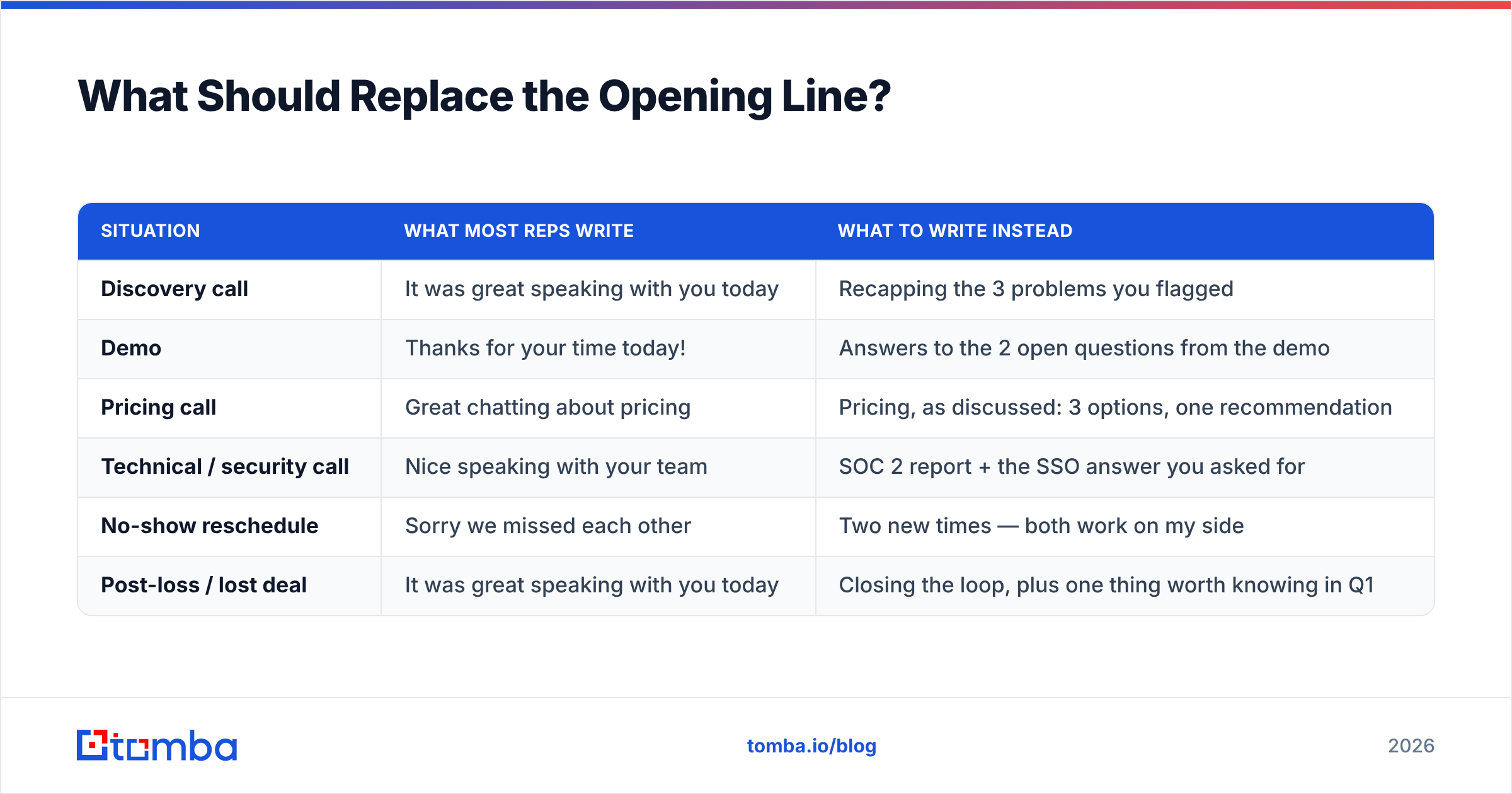
Here is the direct swap table. Every "instead" line is under 60 characters so it survives the preview pane.
| Situation | What most reps write | What to write instead |
|---|---|---|
| Discovery call | It was great speaking with you today | Recapping the 3 problems you flagged |
| Demo | Thanks for your time today! | Answers to the 2 open questions from the demo |
| Pricing call | Great chatting about pricing | Pricing, as discussed: 3 options, one recommendation |
| Technical / security call | Nice speaking with your team | SOC 2 report + the SSO answer you asked for |
| No-show reschedule | Sorry we missed each other | Two new times — both work on my side |
| Post-loss / lost deal | It was great speaking with you today | Closing the loop, plus one thing worth knowing in Q1 |
Notice what the right column has in common: a number, a noun, and an implied action. None of them are clever. Cleverness is a tax the reader pays; specificity is a gift.
What Does a Strong Post-Call Follow-Up Look Like?#
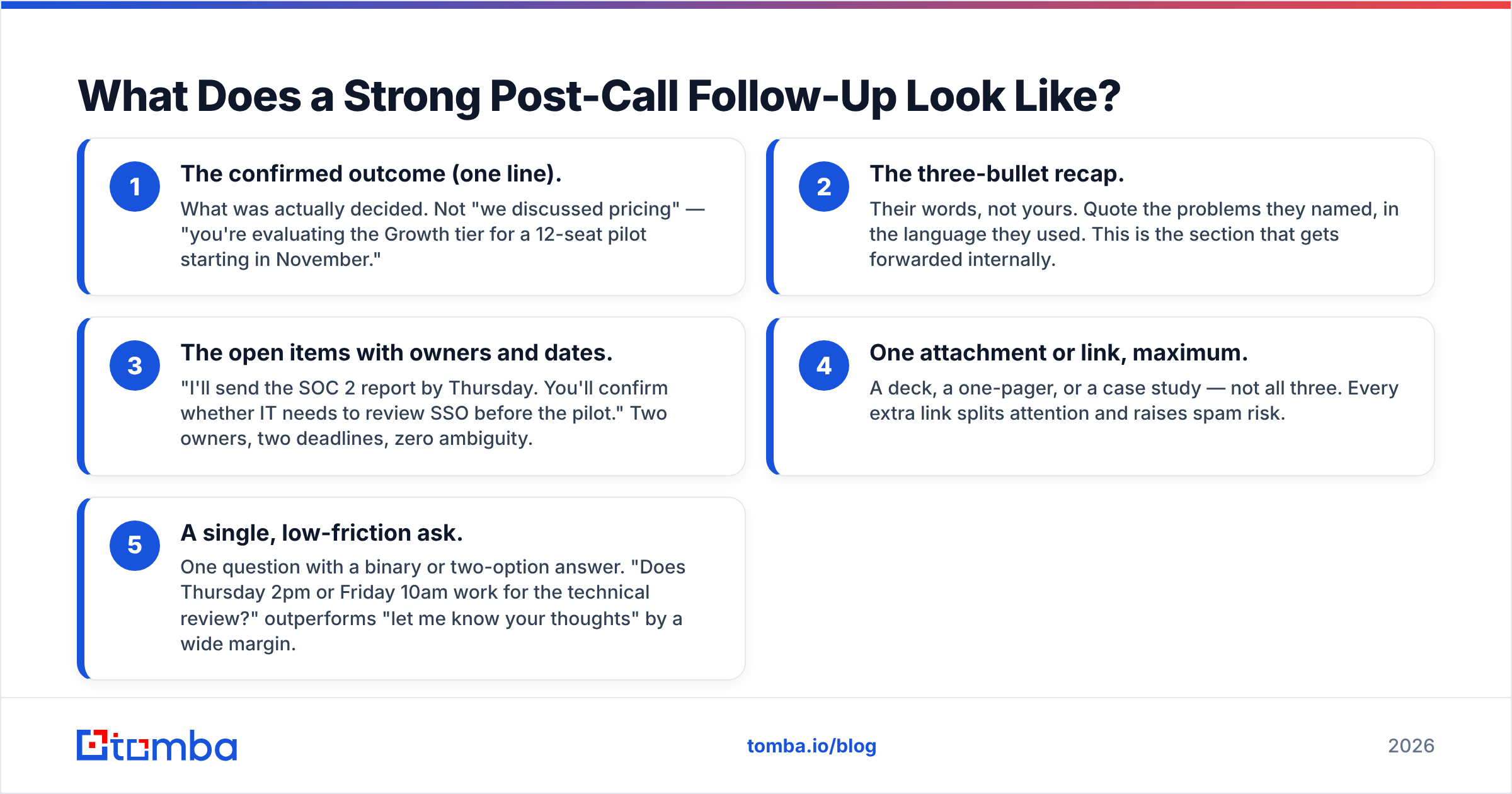
Five parts, in this order. Skip any one of them and the email loses its job.
- The confirmed outcome (one line). What was actually decided. Not "we discussed pricing" — "you're evaluating the Growth tier for a 12-seat pilot starting in November."
- The three-bullet recap. Their words, not yours. Quote the problems they named, in the language they used. This is the section that gets forwarded internally.
- The open items with owners and dates. "I'll send the SOC 2 report by Thursday. You'll confirm whether IT needs to review SSO before the pilot." Two owners, two deadlines, zero ambiguity.
- One attachment or link, maximum. A deck, a one-pager, or a case study — not all three. Every extra link splits attention and raises spam risk.
- A single, low-friction ask. One question with a binary or two-option answer. "Does Thursday 2pm or Friday 10am work for the technical review?" outperforms "let me know your thoughts" by a wide margin.
Length target: 120–180 words for the whole email. If your recap runs past 200 words, you are writing meeting minutes, not a follow-up.
Template 1 — Discovery call#
Subject: Recapping the 3 bottlenecks you flagged
Hi Dana,
Confirming what we landed on: the SDR team is losing roughly 6 hours a week to manual list building, and the bounce rate on purchased lists is sitting near 18%.
The three things you said would have to change:
- One source of truth for contact data instead of four tabs
- Verification before send, not after the bounce report
- Something your two junior reps can run without training
Next steps: I'll send the accuracy benchmark by Wednesday. You'll check with Marcus on whether the CRM sync is in scope for Q4.
Does Thursday 2pm work for a 20-minute walkthrough with Marcus on the call?
Template 2 — Demo follow-up#
Subject: Answers to the 2 open questions from the demo
Hi Priya,
Two things I owed you:
- Yes — bulk enrichment runs on CSV upload, no API work required. Short clip here.
- Catch-all domains: we flag them separately rather than marking them valid, so your bounce rate isn't inflated by guesses.
Everything else from the demo is in the recording link below.
You mentioned wanting to test on 500 of your own records before committing. Want me to set that up this week?
Template 3 — Pricing call#
Subject: Pricing as discussed — 3 options, one recommendation
Hi Tom,
Based on 12 seats and roughly 8,000 lookups a month, the Growth plan is the right fit — the Starter tier would cap you around month two.
Option A: Growth, monthly, cancel anytime.
Option B: Growth, annual, two months free.
Option C: Start on Starter for 30 days, credit applied if you upgrade.
I'd take Option C if procurement needs a proof point before signing anything annual.
Which one do you want me to draft?
The remaining six templates follow the same skeleton — outcome, recap, owners, one ask — adjusted for post-loss re-engagement, no-show reschedules, multi-threading introductions, security reviews, renewal conversations, and referral asks. The skeleton is the product. The wording is decoration.
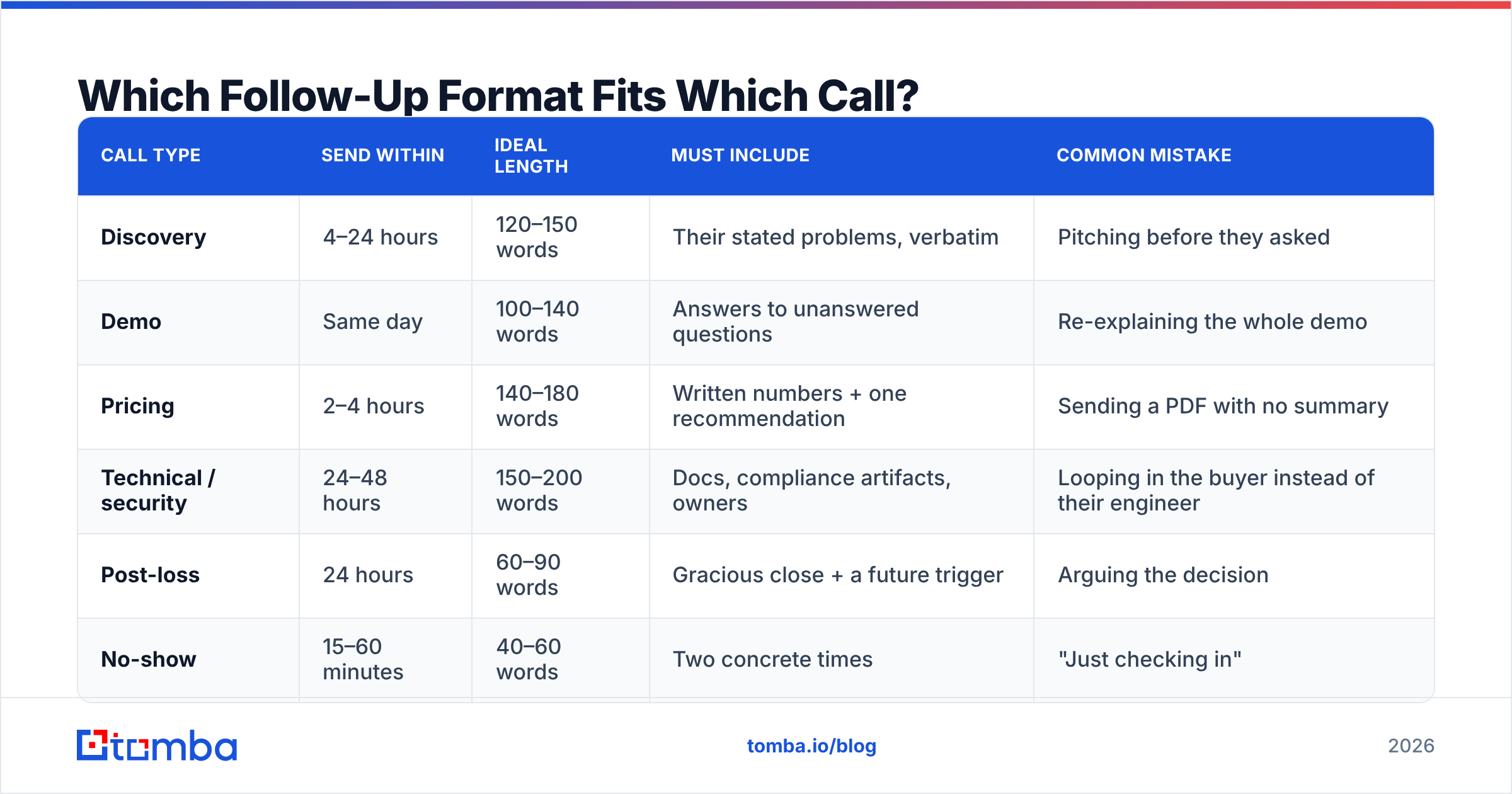
Which Follow-Up Format Fits Which Call?#
| Call type | Send within | Ideal length | Must include | Common mistake |
|---|---|---|---|---|
| Discovery | 4–24 hours | 120–150 words | Their stated problems, verbatim | Pitching before they asked |
| Demo | Same day | 100–140 words | Answers to unanswered questions | Re-explaining the whole demo |
| Pricing | 2–4 hours | 140–180 words | Written numbers + one recommendation | Sending a PDF with no summary |
| Technical / security | 24–48 hours | 150–200 words | Docs, compliance artifacts, owners | Looping in the buyer instead of their engineer |
| Post-loss | 24 hours | 60–90 words | Gracious close + a future trigger | Arguing the decision |
| No-show | 15–60 minutes | 40–60 words | Two concrete times | "Just checking in" |
The pattern: the more technical the call, the longer you can write and the longer you can wait. The more emotional the call — a loss, a no-show — the shorter and faster you go.
How Quickly Should You Send It?#
Within 24 hours, and preferably the same working day.
The reason is not urgency theater. It is that your buyer will be asked "how did the call go?" by someone, and the answer they give will be based on whatever written artifact exists at that moment. If nothing exists, they summarize from memory — and memory compresses your differentiation into "seemed fine, similar to the other one."
A practical rule used by a lot of high-performing teams: block the 10 minutes immediately after the call. Do not schedule back-to-back. The recap written in those 10 minutes is worth more than the one written perfectly three days later. HubSpot's sales resources are full of variations on this, and the mechanism is always the same — speed beats polish because polish has no compounding effect and speed does.
What About the People Who Were on the Call but Never Spoke?#
This is where most recap emails quietly fail.
You had five people on the Zoom. You have one email address — the one that booked the meeting. The security lead who asked one question at minute 34, the ops manager who stayed muted, the VP who dropped off early: none of them get your recap. All of them get an internal summary written by someone else.
Multi-threading a recap is not aggressive. It is basic hygiene, and it is the single highest-leverage change most reps can make to the post-call email. Two practical steps:
- Get the addresses. Names from the attendee list plus the company domain is enough to resolve most work addresses. An email finder that works from name + domain covers the usual corporate patterns, and a domain search shows you the format the company actually uses before you guess.
- Verify before you send. A recap that bounces at the security lead's address is worse than not sending it, because it also nicks your sender reputation right before a sequence. Run new addresses through an email verifier first — it takes seconds and protects the domain you will need for the next 200 emails.
Then adapt the email. Do not blind-CC four strangers on a message written for your champion. Send the champion the full recap, and send each additional stakeholder a two-line version scoped to their concern: the security lead gets the compliance answer, the CFO gets the pricing structure, the ops manager gets the implementation timeline.
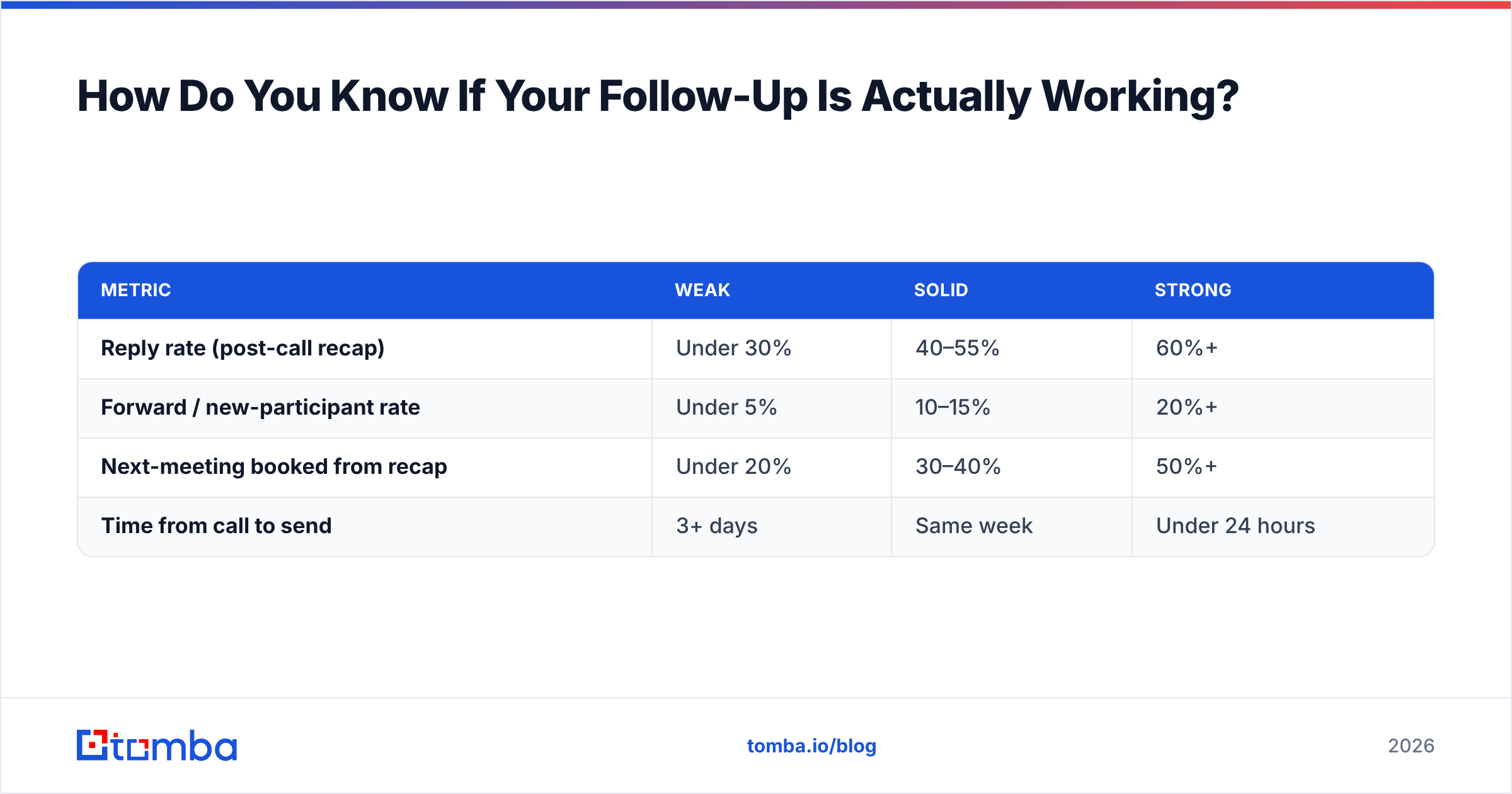
How Do You Know If Your Follow-Up Is Actually Working?#
Reply rate — not open rate. Opens have been unreliable since privacy-protection features started pre-fetching images, and a post-call recap will show inflated opens regardless.
Three metrics worth tracking on recap emails specifically:
| Metric | Weak | Solid | Strong |
|---|---|---|---|
| Reply rate (post-call recap) | Under 30% | 40–55% | 60%+ |
| Forward / new-participant rate | Under 5% | 10–15% | 20%+ |
| Next-meeting booked from recap | Under 20% | 30–40% | 50%+ |
| Time from call to send | 3+ days | Same week | Under 24 hours |
If your response rate on recaps is below 30%, the problem is almost never tone. It is that the email contained no decision the reader had to respond to. Add one binary question and re-measure over 20 sends before changing anything else.
The forward rate is the sleeper metric. When a recap gets forwarded, a new address often appears on the thread — that is your buying group revealing itself. Track it.
What Should You Never Put in a Post-Call Email?#
- "Just following up." It tells the reader the email has no new information.
- "As per our conversation." Stiff, and it still does not say what the conversation concluded.
- "Let me know your thoughts." No deadline, no decision, no owner. Reliably ignored.
- Three attachments and four links. Splits attention and raises the odds of a spam filter.
- A calendar link with no proposed time. Proposing two specific slots converts better than outsourcing the decision.
- A recap that contradicts the call. If you inflate what they committed to, the champion will not forward it — and the forward was the whole point.
The Bottom Line#
"It was great speaking with you today" is not the problem. Spending your most valuable line on it is. Move the pleasantry to position two, lead with the decision, name the owners and dates, ask one answerable question, and send it before the day ends. Then make sure everyone who sat on that call actually receives it.
That last part is a data problem, not a writing problem. When you have four attendee names and one email address, Tomba's Email Finder resolves the rest from name and company domain, verifies them before you hit send, and keeps your recap out of the bounce pile. The free tier covers 25 searches a month — enough to multi-thread your next handful of calls and see whether your forward rate moves. Paid plans start at $49/mo on Starter; full Tomba pricing is public.
Related guides#
// get started
Find, verify and enrich your first contacts today
Start on the free plan with 25 searches a month, then scale when your team is ready.
Free plan · No credit card required · GDPR & CCPA
// about the author