Jet Leads Pro vs Lead411 (2026): Which B2B Data Tool Wins?
One is a low-cost list tool, the other a contract-based intent platform. Here is how Jet Leads Pro and Lead411 actually compare on data accuracy, direct dials, pricing and exit costs in 2026.
TL;DR
- Lead411 is the more established option: a contract-based B2B contact and intent platform with direct dials, Bombora-style buyer intent, and CRM integrations. It is priced for teams, not solo reps.
- Jet Leads Pro sits at the budget end — bulk lead lists and contact exports at a low entry price, with far less public documentation, no meaningful intent layer, and thin third-party review coverage.
- The real decision is workflow, not logo: if you need triggers (funding, hiring, intent) to time outreach, Lead411 earns its price. If you just need accurate emails on a list of domains you already chose, neither tool is the cheapest path.
- Verify before you send, always. Any static database — cheap or expensive — decays roughly 2–3% per month. Bounce rate is a function of your verification step, not your vendor's marketing page.
- Budget reality check: Lead411 is typically an annual commitment in the four-figure range; Tomba's pricing starts at $49/mo with a free tier, and is month-to-month.
What are Jet Leads Pro and Lead411?#
They solve the same surface problem — "get me contacts" — from opposite ends of the market.
Lead411 has been around since the mid-2000s and positions itself as a sales intelligence platform: verified emails, direct-dial mobile numbers, company technographics, growth signals (funding rounds, hiring spikes, new locations) and buyer intent data. You can read the vendor's own framing on lead411.com, and there is a substantial body of user reviews on G2 — useful because it lets you read the complaints, not just the feature list.
Jet Leads Pro is the newer, lighter-weight entrant. It markets bulk B2B lead lists and contact exports at a price point deliberately set below the enterprise data vendors. That is genuinely attractive if your motion is volume-first. It is also the part of this comparison where you should do your own diligence: public documentation, independent review volume, and SLA detail are all thinner than Lead411's. Ask the vendor directly for a sample file before you pay — and run that sample through an independent email verifier rather than trusting the claimed accuracy figure.
One honest caveat up front: pricing and feature sets for both tools change without much fanfare. Treat every number below as "verify on the vendor's page before you sign," not gospel.
How do Jet Leads Pro and Lead411 compare head-to-head?#
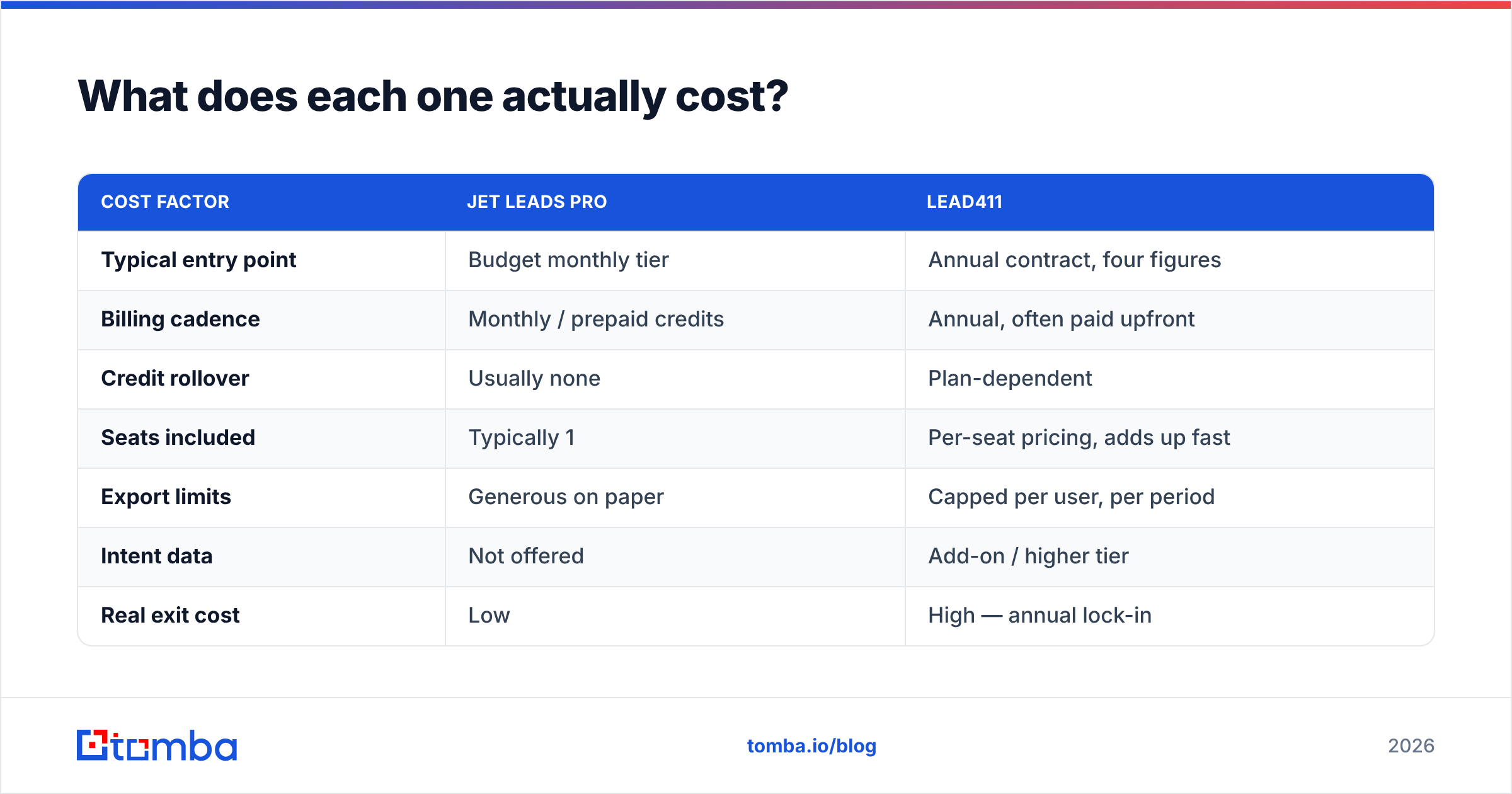
| Dimension | Jet Leads Pro | Lead411 | Tomba |
|---|---|---|---|
| Primary model | Bulk lead lists / exports | Sales intelligence platform | Email finder + verifier API |
| Entry price | Low (budget tier) | Four-figure annual, typically | Free tier, then $49/mo |
| Contract | Usually short / prepaid | Annual commitment common | Month-to-month |
| Direct dial phones | Limited | Yes — a core strength | Yes, via phone finder |
| Buyer intent data | No | Yes | No |
| Growth triggers (funding, hiring) | No | Yes | No |
| Built-in verification | Claimed, unclear method | Yes ("Bounce-free" guarantee) | SMTP + catch-all handling |
| Catch-all domain handling | Unclear | Partial | Dedicated catch-all verifier |
| API access | Limited | Available on higher tiers | Available on all paid tiers |
| Free trial | Varies | Limited free credits | 25 searches/mo, no card |
| Best for | Cheap volume lists | Mid-market teams needing timing signals | Precision lookup + verification |
That table is the whole argument in miniature. Lead411 sells you timing. Jet Leads Pro sells you volume. Neither sells you precision on a named account list as its core job — which is why a lot of teams end up running one of them alongside a dedicated finder.

How accurate is the data in each tool?#
Accuracy claims in this category are close to meaningless until you define the denominator.
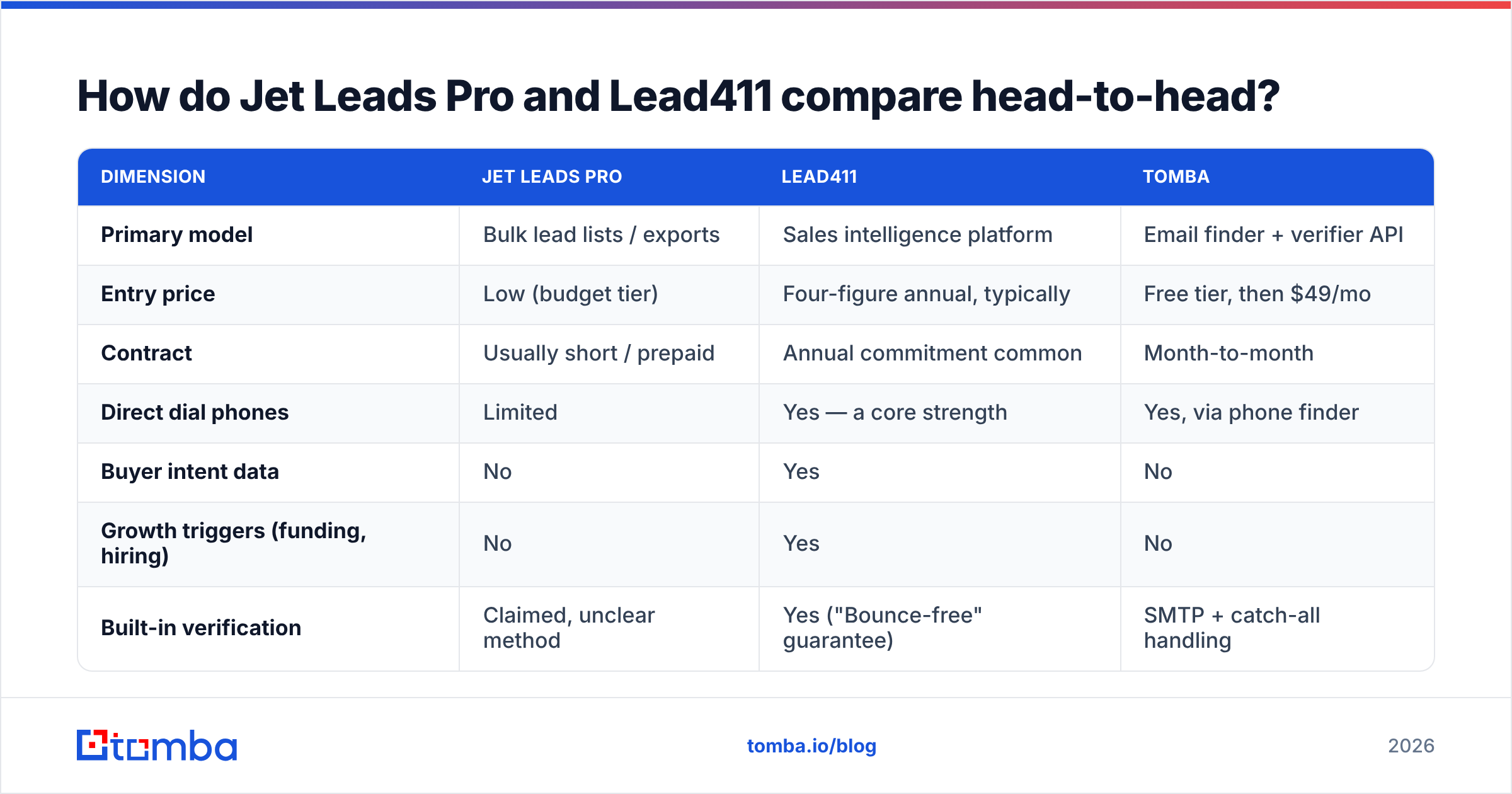
Every vendor quotes something like "95% accurate." What they rarely say is accurate on what population. Accuracy on Fortune 500 CTOs in the US is a different universe from accuracy on 30-person agencies in Portugal. When a list vendor's coverage skews toward big, well-indexed US companies, the headline number looks great — and then your ICP of Series A European SaaS founders bounces at 14%.

Here is the test that actually settles it, and it takes an afternoon:
- Pull 200 real accounts from your ICP — not the vendor's demo list, and not your best-known logos. Include the awkward mid-market names.
- Run the same 200 through each tool and record hit rate (how many returned any contact) separately from accuracy (how many were correct).
- Verify every result with a neutral third party so the vendor is not grading its own homework. A bulk run through an independent email verification pass is the referee.
- Send a small, warm-domain test batch — 50 addresses, spread over three days — and record actual bounces. This is the only number that pays your bills.
- Score cost per usable contact, not cost per credit. A $0.02 record with a 20% bounce rate is more expensive than a $0.08 record at 2%, once you price in domain damage.
- Repeat on catch-all domains separately. Catch-all servers accept everything, so they inflate "valid" counts across every vendor. Segment them or you will fool yourself.
Lead411 markets a bounce guarantee, which is a real commitment and worth something — read the terms on what counts as a qualifying bounce and how credits are refunded. Jet Leads Pro's verification methodology is the thing I would press hardest on in a sales call: ask whether records are SMTP-verified at export time or at ingest time. "Verified in 2024" is not verified.
What does each one actually cost?#
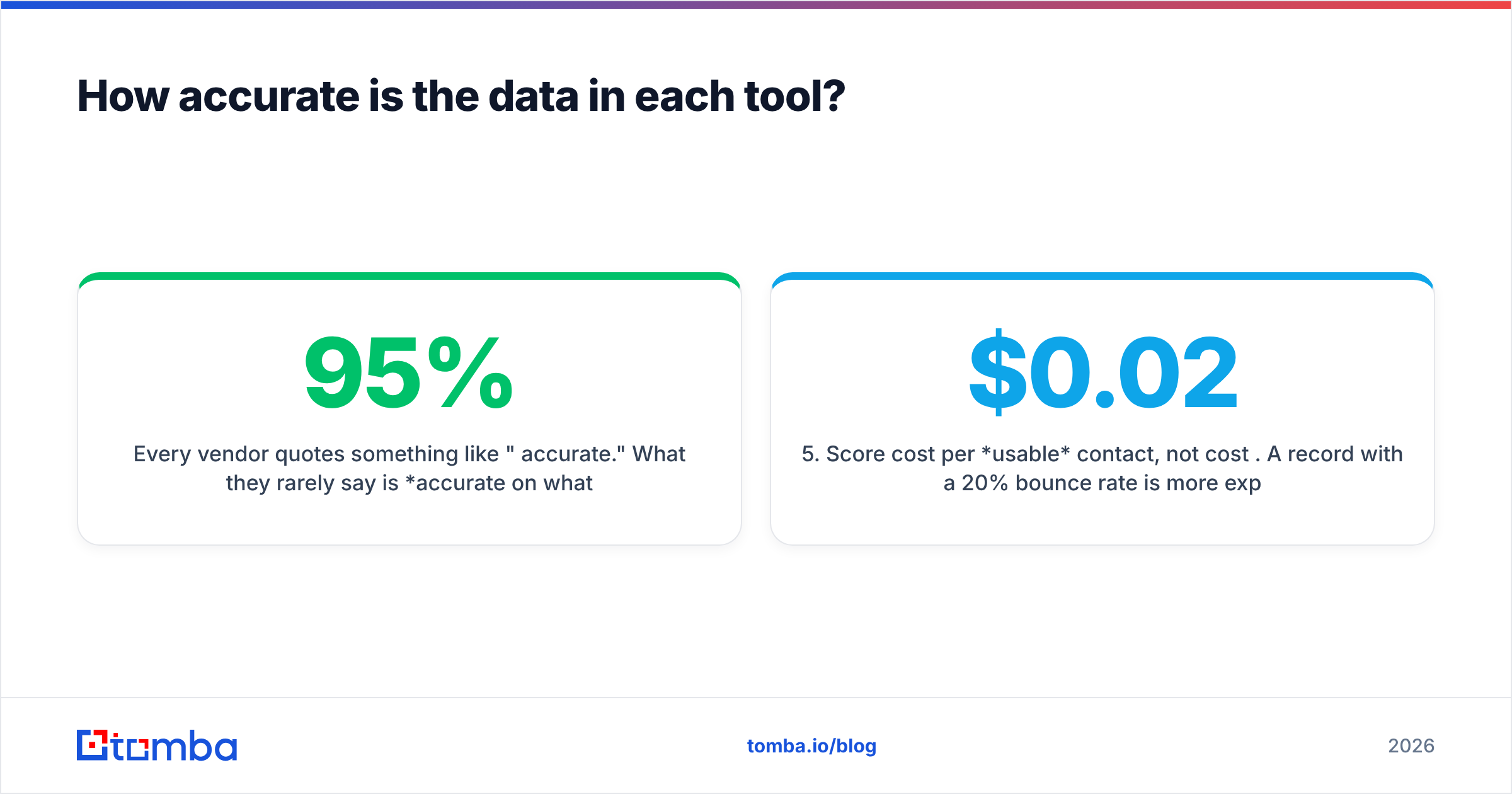
| Cost factor | Jet Leads Pro | Lead411 |
|---|---|---|
| Typical entry point | Budget monthly tier | Annual contract, four figures |
| Billing cadence | Monthly / prepaid credits | Annual, often paid upfront |
| Credit rollover | Usually none | Plan-dependent |
| Seats included | Typically 1 | Per-seat pricing, adds up fast |
| Export limits | Generous on paper | Capped per user, per period |
| Intent data | Not offered | Add-on / higher tier |
| Real exit cost | Low | High — annual lock-in |
The under-discussed line in that table is export limits. Lead411 historically caps how many records a seat can export in a given window, which means the sticker price is not the ceiling — a team that actually uses the product often needs more seats or a higher tier. Budget for the second year, not the demo.
And the under-discussed line for budget tools is deliverability cost. If a cheap list pushes your bounce rate from 2% to 12%, you are not saving money — you are spending it on domain reputation, which is far harder to buy back. The economics of email deliverability are asymmetric: reputation takes weeks to build and one bad send to wreck.

Is Lead411 better than Jet Leads Pro?#
For most funded B2B sales teams, yes — with a specific caveat.
Lead411 is better if any of these are true:
- You sell on timing. Funding rounds, exec hires, office expansions and intent spikes are the difference between a 2% and a 9% reply rate. Jet Leads Pro does not give you this.
- You need mobile numbers. Direct dials are Lead411's strongest single asset. If your team runs a real calling motion, a list of emails is half a product.
- You have a CRM that must stay clean. Lead411's native integrations push data where it needs to go; budget list tools often stop at CSV.
- You want a vendor with a paper trail. Two decades of operating history and hundreds of public reviews is a risk-management feature.
Jet Leads Pro is the better call if:
- Your budget is genuinely a constraint and an annual contract is not happening this quarter.
- You already know your target accounts and just need contacts appended, with no interest in intent scoring.
- You are testing a new market and want a disposable, low-commitment data source before you commit spend.
The caveat: "better" here assumes you actually use what you are paying for. I have watched teams buy intent data, never build a play around it, and renew anyway. If nobody on your team owns the question "what do we do within 48 hours of an intent spike," the intent module is a line item, not a capability.
Where do both tools fall short?#
Both share the same structural weakness: they are databases, and databases decay.
Roughly 25–30% of B2B contact records go stale each year — people change jobs, companies rebrand, domains migrate. A static database is a photograph of a moving thing. That is not a knock on either vendor; it is physics. It does mean that "the list was accurate when we bought it" is a defensible claim and an unhelpful one.
Three practical gaps to plan around:
- Catch-all domains. A large slice of mid-market companies run catch-all mail servers that accept every address. Most databases mark these as "valid" because the SMTP handshake succeeds. They are not valid — they are unknown. Segment them and treat them as a separate, lower-confidence tier, or use a dedicated catch-all finder that scores pattern confidence instead of trusting the handshake.
- Coverage outside the US. Both tools are strongest on North American data. EMEA and APAC coverage is thinner across the whole category, and GDPR-driven suppression makes European B2B data structurally harder to source and maintain.
- The "we have the record, but is it the right person" problem. Neither tool knows your buying committee. A CFO email is worthless if your champion is the RevOps lead.
If you want a second opinion on the category before committing, BookYourData is a well-regarded pay-as-you-go option that avoids annual lock-in entirely — a reasonable middle path if the contract structure is what's blocking you rather than the data itself.

What is the smarter stack for most teams?#
Split the job. Databases are good at discovery; finders are good at precision; verifiers are good at protecting your domain. Buying all three from one vendor usually means overpaying for two of them.
A stack that works:
- Discovery layer — Lead411 (or your existing data provider) for account discovery, intent and direct dials. Use it to decide who and when.
- Precision layer — a dedicated email finder for the named contacts your database missed, plus domain search when you need every relevant contact at a specific company.
- Hygiene layer — verification on every address immediately before send, not at import. The gap between import and send is where records die.
- Enrichment layer — data enrichment to fill in titles, company size and LinkedIn URLs so personalization has something to work with.
This is where Tomba fits without any need to overclaim. Tomba is not an intent platform and does not pretend to be. It is a precision email finder and verifier with a free tier (25 searches/mo), a $49/mo Starter plan, $99/mo Growth, $249/mo Pro, and a Tomba API available on every paid tier — plus a bulk email finder for list work. Month-to-month, no annual commitment, so the cost of being wrong is one month.
Run the parallel test. Take 200 accounts, push them through Lead411, Jet Leads Pro and a Tomba free tier, and compare cost per verified, non-bouncing contact. Whichever wins that number wins your budget. If you want a reference for how mature data operations structure vendor evaluations, HubSpot's sales enablement resources are a decent neutral starting point.
Frequently asked questions#
Does Lead411 have a free trial? Lead411 has historically offered a limited free trial with a small number of credits. Confirm current terms directly with their sales team — trial structures in this category change frequently.
Is Jet Leads Pro GDPR compliant? Ask for their data processing agreement and their lawful-basis documentation in writing before purchasing if you sell into the EU. Do not accept a marketing-page claim as an answer. This applies to every vendor in the category, not just this one.
Can I use both together? Yes, and many teams do — one for discovery and triggers, one for cheap volume. Just deduplicate on email, not on name, and run a single verification pass at the end so you are not double-paying for the same contact.
Which has better phone numbers? Lead411, clearly. Direct dials are a genuine differentiator for them. If calling is central to your motion, that alone may decide it.
Ready to stop paying for bounces?#
Whichever database you pick, the address you send to is the one that has to be right. Start with Tomba Email Finder — 25 free searches a month, no card required — and run it head-to-head against your current list on 50 real accounts from your ICP. If Tomba finds contacts your database missed, or catches addresses that would have bounced, you have your answer in an afternoon rather than after an annual contract you cannot exit.
Related guides#
// get started
Find, verify and enrich your first contacts today
Start on the free plan with 25 searches a month, then scale when your team is ready.
Free plan · No credit card required · GDPR & CCPA
// about the author