Jet Leads Pro vs Mail Rocket (2026): Which Tool Wins?
Jet Leads Pro sells you contacts. Mail Rocket sends to them. Here's an honest head-to-head on data accuracy, deliverability, pricing, and which half of the outbound stack each one actually replaces.
TL;DR
- Jet Leads Pro and Mail Rocket get compared constantly, but they are not the same category. One sells you contact data; the other sends email to it. Buying one expecting the other is the most common mistake we see.
- If your bottleneck is finding and verifying who to contact, a data tool wins. If your bottleneck is sequencing, inbox rotation, and reply handling, a sending tool wins.
- Both vendors are small and move fast, so published plan limits and credit definitions change. Verify pricing on the vendor's own page before you commit to an annual contract.
- Neither tool removes the need for verification. Sending to an unverified list is how you burn a domain in three weeks, regardless of which platform you paid for.
- Most teams under 20 reps end up with a data layer (Tomba, BookYourData, or similar) plus a separate sender — not one all-in-one that does both at 60%.
What Are Jet Leads Pro and Mail Rocket?#
Short answer: Jet Leads Pro positions itself as a lead sourcing and contact database product, and Mail Rocket positions itself as a cold email sending and sequencing platform. They sit on opposite ends of the same pipeline.
Think of it like a restaurant. Jet Leads Pro is the supplier that delivers the ingredients. Mail Rocket is the kitchen that cooks and plates them. A bad supplier ruins a great kitchen, and a great supplier can't save a kitchen that burns everything. You need both functions covered — the only real question is whether one vendor should own both.
Here's where the confusion comes from. Both products market themselves with the same outcome language: "more meetings booked," "pipeline on autopilot," "10x your outbound." Nobody advertises "we are one narrow layer of your stack." So buyers land on two pricing pages that look interchangeable and try to pick a winner, when the honest answer is usually "these solve different problems."
A few ground rules before the comparison:
- Credits are not standardized. One vendor's "credit" might be a single email reveal; another's might cover an enrichment call returning ten fields. Compare cost-per-usable-contact, not cost-per-credit.
- "Verified" is a marketing word. Ask what verification method is behind it — SMTP handshake, MX check, pattern confidence score, or a stale flag from a database refresh cycle.
- Sending limits are the real ceiling on a sender. Mailbox count and daily per-mailbox caps matter far more than the number of "sequences" a plan allows.
- Both categories decay. B2B contact data goes stale at roughly 25-30% per year according to widely cited industry research on data decay, and domain reputation decays when you stop warming.
- Support and refunds matter disproportionately with smaller vendors. Check G2 and Capterra reviews for billing complaints specifically — that's where small tools most often disappoint.

How Do Jet Leads Pro and Mail Rocket Compare Head to Head?#
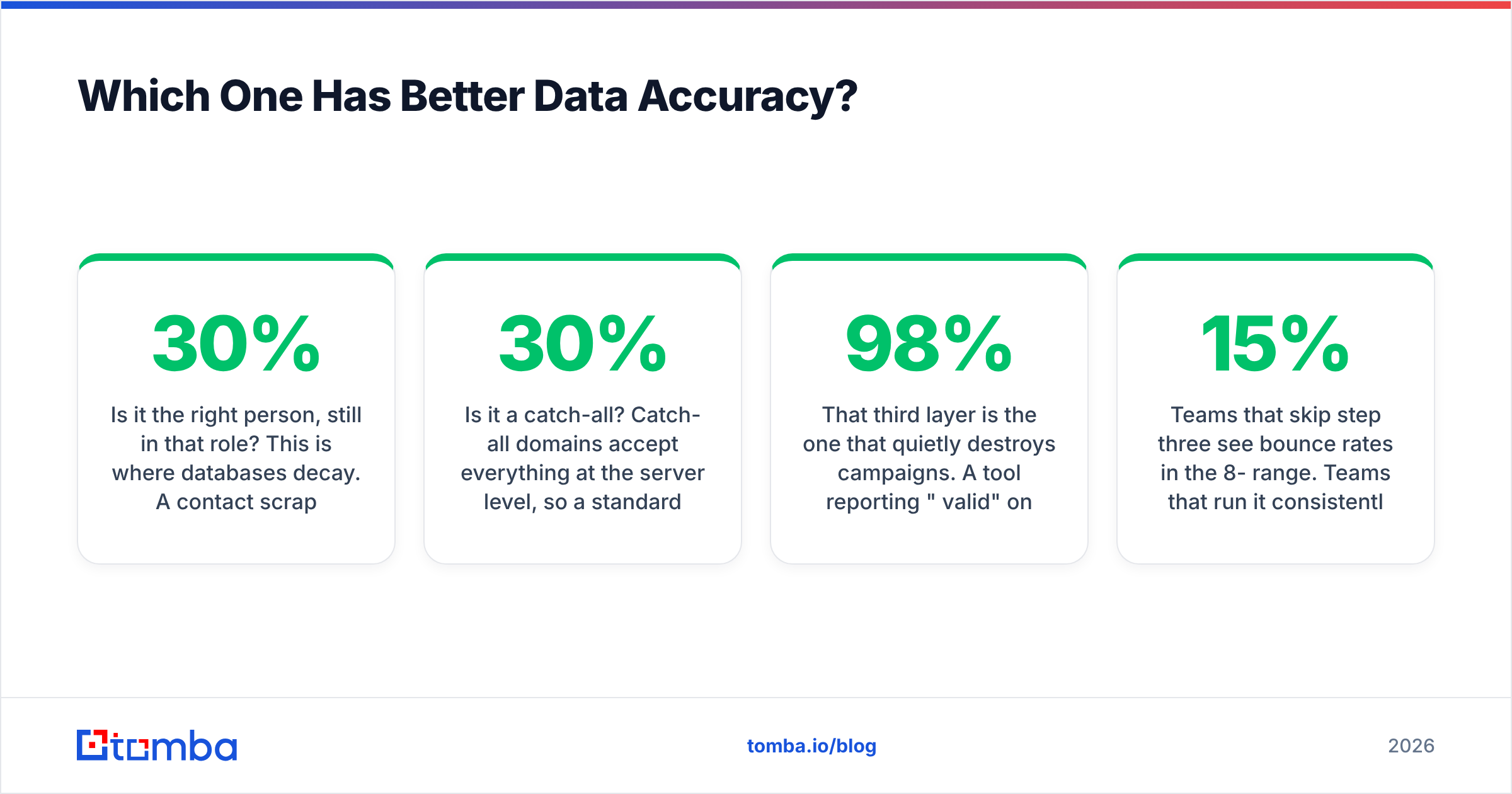
This is the table people come for. Treat the specifics as directional — both vendors revise plans frequently, and you should confirm current numbers on their own site before buying.
| Dimension | Jet Leads Pro | Mail Rocket |
|---|---|---|
| Primary job | Source and export B2B contacts | Send, sequence, and track cold email |
| Core asset | Contact database + search filters | Mailbox rotation + deliverability tooling |
| Email verification | Built-in, typically basic syntax/MX level | Usually bounce-suppression only, post-send |
| Sending capability | None (export to CSV/CRM) | Core product |
| Inbox rotation | Not applicable | Yes, central feature |
| Warmup included | No | Commonly bundled or add-on |
| CRM sync | Via CSV or Zapier-style connectors | Native for major CRMs on higher tiers |
| API access | Usually gated to upper plans | Usually gated to upper plans |
| Best for | SDRs building target lists | SDRs running volume campaigns |
| Weakest point | Data freshness on niche verticals | Nothing to send to without a data source |
The pattern is consistent: each tool is strong exactly where the other is empty. That's why "Jet Leads Pro vs Mail Rocket" is a slightly broken question. The better question is "which of these two gaps is currently costing me more meetings?"
If your reps are sending fine but half the addresses bounce, your gap is data. If your addresses are clean but you're manually pasting into Gmail and hitting spam, your gap is sending infrastructure.
Which One Has Better Data Accuracy?#
Jet Leads Pro wins this by default — Mail Rocket does not meaningfully compete here. But "wins by default" is not the same as "is good enough."
The accuracy question has three layers, and most vendors only address the first:
- Does the address exist? An MX lookup plus SMTP handshake answers this for most domains. Cheap to do, widely offered.
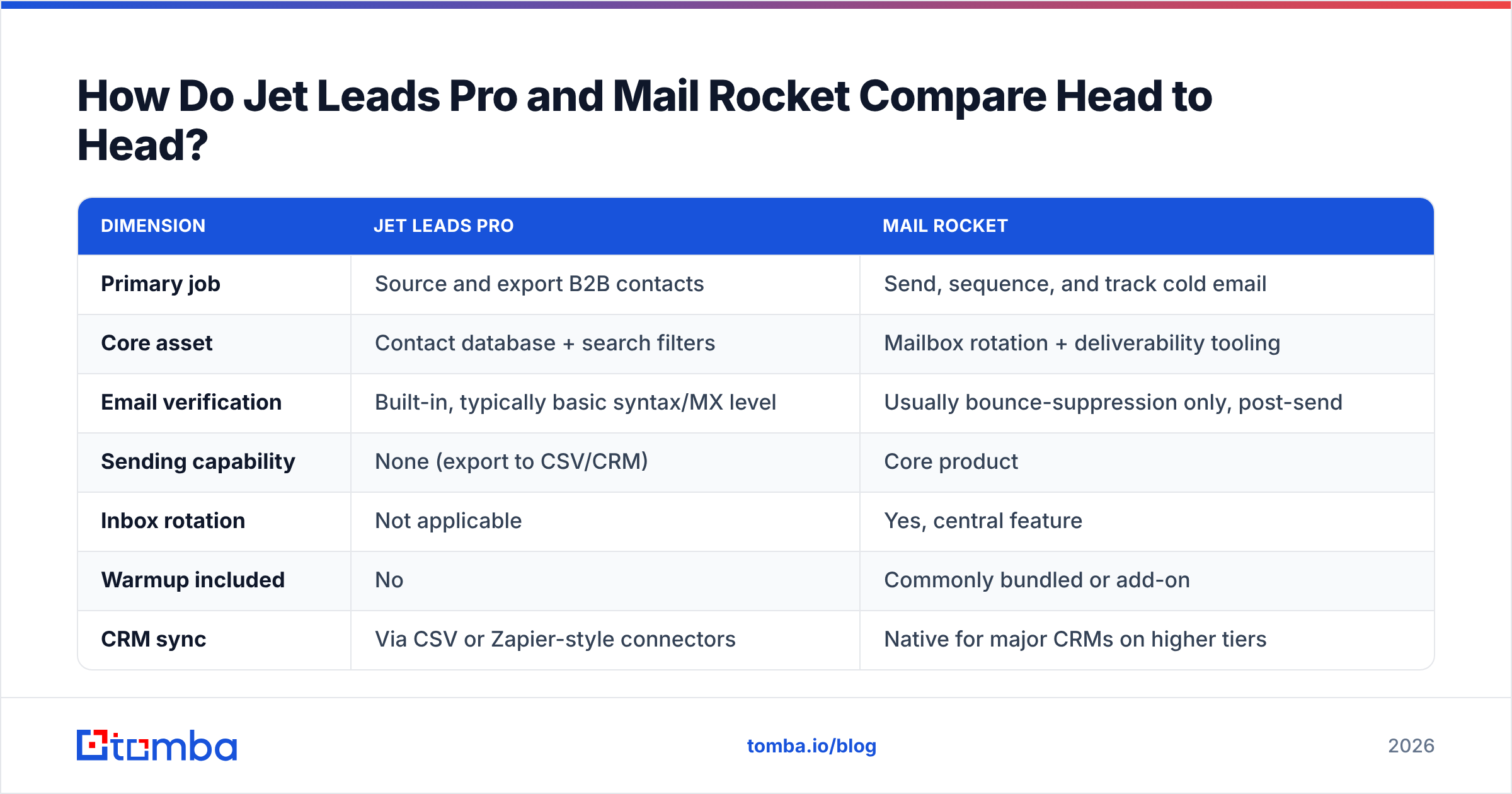
- Is it the right person, still in that role? This is where databases decay. A contact scraped 14 months ago at a company with 30% annual turnover is a coin flip.
- Is it a catch-all? Catch-all domains accept everything at the server level, so a standard verification returns "valid" for addresses that do not exist. If your list skews enterprise, catch-alls can be 20-30% of it.
That third layer is the one that quietly destroys campaigns. A tool reporting "98% valid" on a list that is one-quarter catch-all is reporting a number that means very little. This is why we recommend running exports from any database through an independent email verifier before they ever reach a sending platform, and using a dedicated catch-all verifier for the domains that come back ambiguous.
A practical workflow that works regardless of which vendor you pick:
- Source the contacts (Jet Leads Pro, a database, or a domain-level search).
- Deduplicate against your CRM so you don't email an open opportunity.
- Verify independently — not with the same vendor that sold you the list, for the same reason you don't let a contractor inspect their own work.
- Segment catch-alls into a lower-volume, higher-care sending pool.
- Then load into Mail Rocket or whatever sender you use.
Teams that skip step three see bounce rates in the 8-15% range. Teams that run it consistently sit under 2%. That difference is the entire gap between a domain that works in month six and one that doesn't.
Which One Is Better for Deliverability?#
Mail Rocket, obviously — but with a large caveat that most buyers miss.
A sending platform controls the mechanics of deliverability: mailbox rotation, throttling, custom tracking domains, warmup schedules, spintax to vary content. Those matter. What it cannot control is list hygiene, and list hygiene is the single largest input into email deliverability.
Put plainly: no amount of inbox rotation saves you from a 12% bounce rate. Mailbox providers read hard bounces as a signal that you're sending to a purchased list. Once that signal is established, rotation just spreads the damage across more domains instead of concentrating it in one.
So the honest framing is that Mail Rocket is the better deliverability tool, and Jet Leads Pro is upstream of the biggest deliverability variable. Neither is sufficient alone.
Things worth checking before you commit to any sender, Mail Rocket included:
- Per-mailbox daily caps — anything above 40-50 cold sends per mailbox per day is aggressive in 2026, whatever the platform allows.
- Whether warmup is real or just a peer-to-peer reply network that providers have gotten good at detecting.
- Custom tracking domain support on your plan tier, not just on enterprise.
- Bounce handling — does it auto-pause a campaign at a bounce threshold, or let it run until your domain is cooked?
- Authentication guidance — SPF, DKIM, and DMARC are table stakes. SPF misconfiguration alone accounts for a meaningful share of "mysterious" spam placement.

What Do Jet Leads Pro and Mail Rocket Cost?#
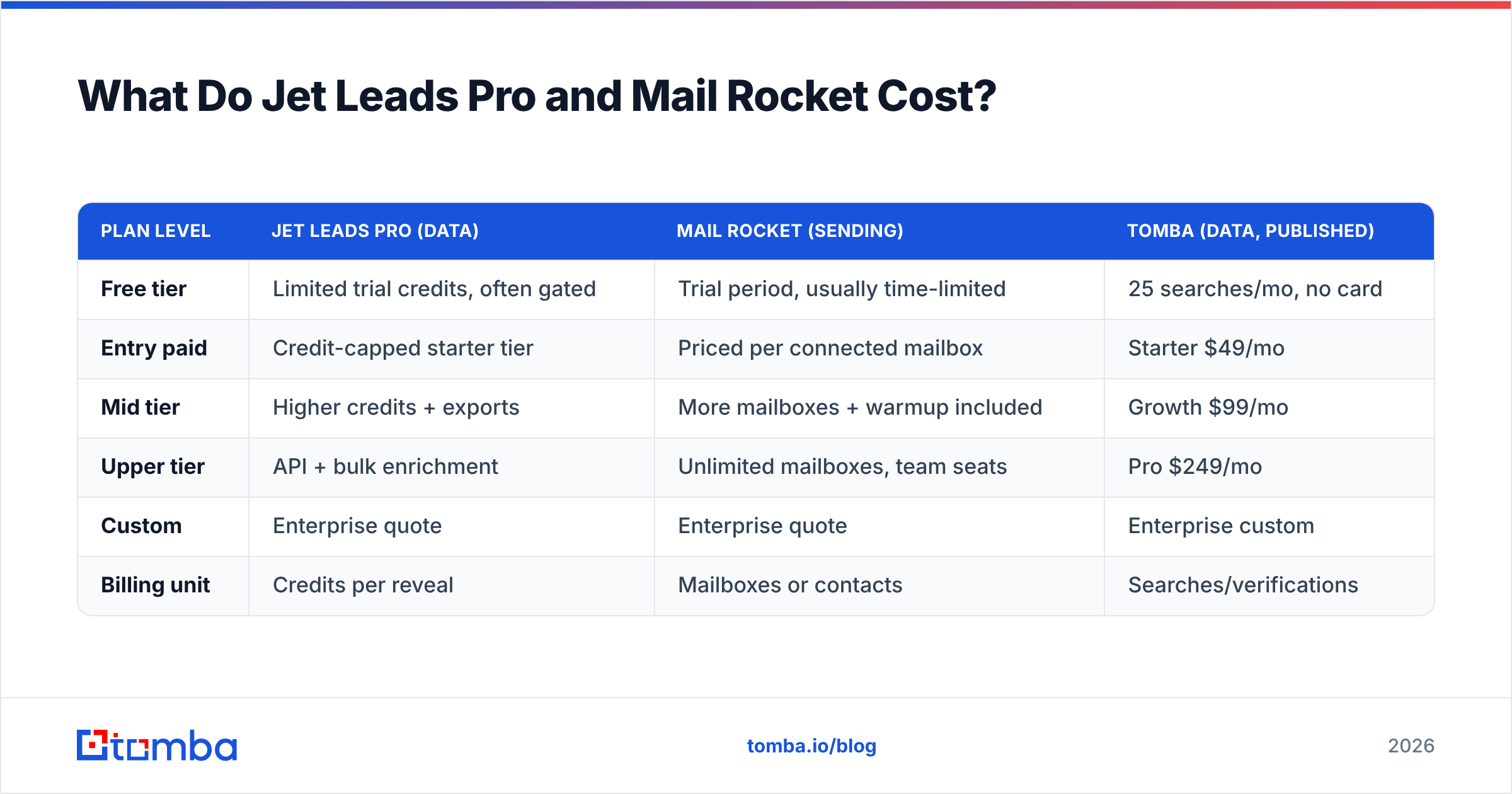
Pricing is where these two look most similar and are most different in what you actually receive. Below is a structural comparison rather than a promise of current list prices — small vendors change plans quarterly.
| Plan level | Jet Leads Pro (data) | Mail Rocket (sending) | Tomba (data, published) |
|---|---|---|---|
| Free tier | Limited trial credits, often gated | Trial period, usually time-limited | 25 searches/mo, no card |
| Entry paid | Credit-capped starter tier | Priced per connected mailbox | Starter $49/mo |
| Mid tier | Higher credits + exports | More mailboxes + warmup included | Growth $99/mo |
| Upper tier | API + bulk enrichment | Unlimited mailboxes, team seats | Pro $249/mo |
| Custom | Enterprise quote | Enterprise quote | Enterprise custom |
| Billing unit | Credits per reveal | Mailboxes or contacts | Searches/verifications |
Two cost traps to watch for:
Credit rollover. Data vendors frequently expire unused credits monthly. If your prospecting is lumpy — heavy in January, light in February — you pay for capacity you never used. Ask explicitly.
Mailbox math. Sending platforms priced per mailbox get expensive fast, because good deliverability in 2026 means more mailboxes at lower volume each. A plan that looks cheap at five mailboxes is not cheap at twenty-five. Model your real mailbox count before comparing headline prices.
For reference on the data side, Tomba pricing publishes its tiers openly with a free tier that doesn't require a card, which makes cost modeling simpler than credit systems that require a sales call to decode. BookYourData is another credible option in this layer, particularly if you prefer buying validated list exports outright rather than metered lookups — different purchasing model, same underlying job.
Is There a Reason to Pick Just One?#
Yes, but only in two situations.
Pick data only if you already have a sending motion that works — an existing sequencer, an SDR team with warmed mailboxes, or a motion that's primarily LinkedIn and phone rather than email. Adding a second sender creates configuration overhead with no new capability. In this case, put every dollar into contact quality: better email finder coverage, bulk verification on exports, and enrichment for personalization variables.
Pick sending only if you have a data source you trust — an inbound list, a partner list, a conference roster, or an existing database subscription. Buying a second data product to feed a sender you just bought doubles your spend before you've validated the channel.
For everyone else, the stack is two layers. The mistake isn't buying both; it's buying an all-in-one that does both at 60% quality and discovering the ceiling three months in, after you've built processes around it.
Which Should You Choose in 2026?#
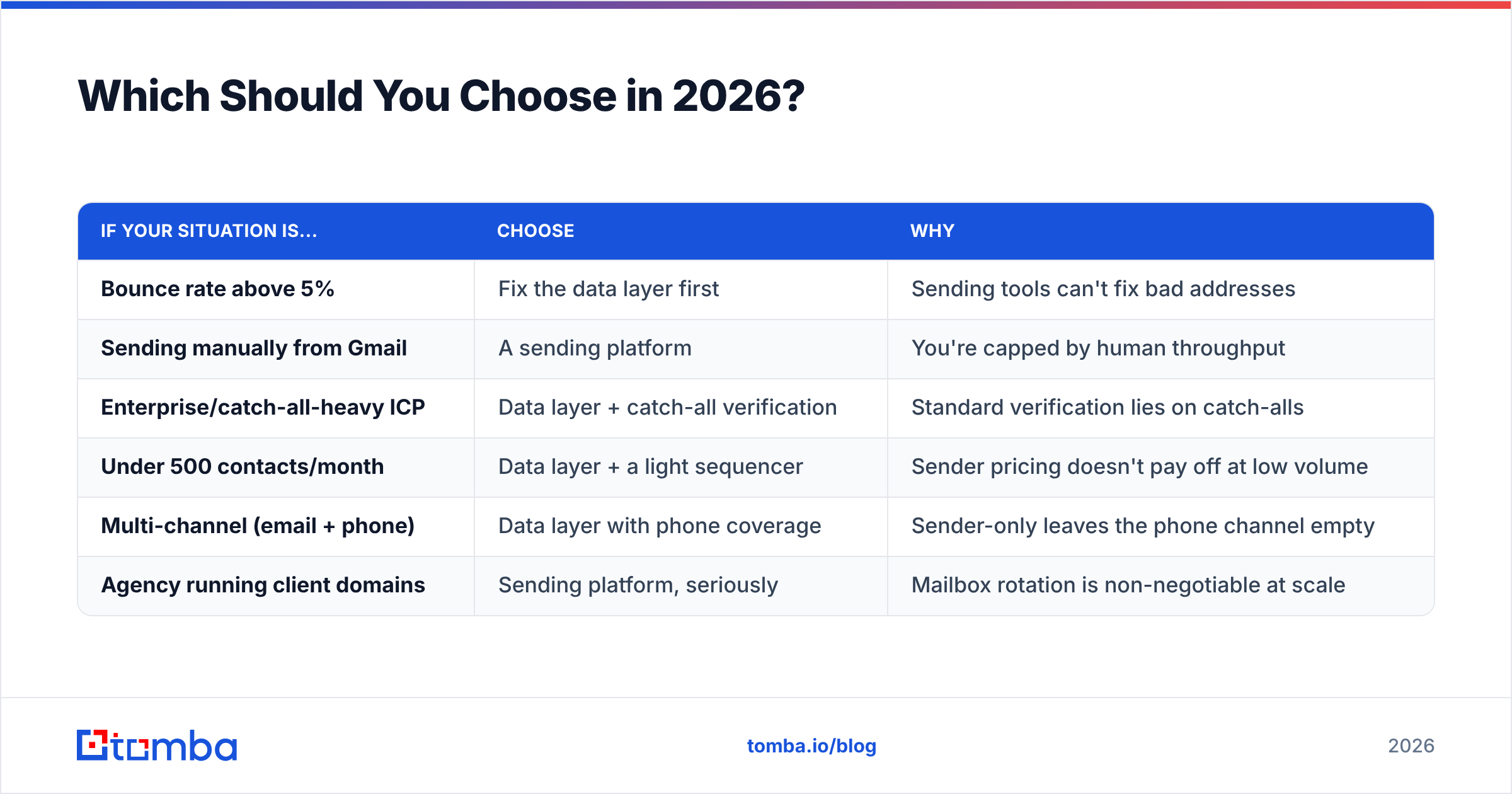
Here's the decision framework, compressed:
| If your situation is... | Choose | Why |
|---|---|---|
| Bounce rate above 5% | Fix the data layer first | Sending tools can't fix bad addresses |
| Sending manually from Gmail | A sending platform | You're capped by human throughput |
| Enterprise/catch-all-heavy ICP | Data layer + catch-all verification | Standard verification lies on catch-alls |
| Under 500 contacts/month | Data layer + a light sequencer | Sender pricing doesn't pay off at low volume |
| Multi-channel (email + phone) | Data layer with phone coverage | Sender-only leaves the phone channel empty |
| Agency running client domains | Sending platform, seriously | Mailbox rotation is non-negotiable at scale |
The uncomfortable truth about "Jet Leads Pro vs Mail Rocket" is that the winner is determined by your current bottleneck, not by a feature checklist. Audit your last 1,000 sends. If more than 3% bounced, your money goes to data. If your bounce rate is clean but your reply rate is under 1% and your open rate is under 30%, your money goes to deliverability infrastructure — or to your copy, which is a third problem neither tool solves.
One more thing worth saying plainly: be skeptical of any vendor in either category claiming 99% accuracy or 90% inbox placement without publishing methodology. Those numbers are achievable on easy segments — tech companies, US-based, standard email patterns — and collapse on hard ones. Run a 200-contact test on your ICP before you scale spend. Every credible vendor will let you.
Where Does Tomba Fit?#
Tomba is a data-layer tool, not a sender, so it competes with the Jet Leads Pro side of this matchup rather than the Mail Rocket side. The relevant difference is verification depth: finding an address is the easy half, and confirming it's deliverable — including on catch-all domains — is where most lists fall apart.
If your outbound is stalling because the addresses are wrong, start with the Tomba Email Finder. Free tier gives you 25 searches a month with no card, which is enough to test coverage against your own target account list before you spend anything. Run the export through verification, hand the clean file to whichever sender you prefer, and you've fixed the half of the stack that actually caps your results.
Related guides#
// get started
Find, verify and enrich your first contacts today
Start on the free plan with 25 searches a month, then scale when your team is ready.
Free plan · No credit card required · GDPR & CCPA
// about the author