Jet Leads Pro vs Quickenrich: Which Lead Tool Wins in 2026?
Both promise cheap B2B contacts and instant enrichment. Neither publishes much proof. Here is what you can actually verify about Jet Leads Pro and Quickenrich — and how to test either one before you spend a cent.
TL;DR
- Jet Leads Pro and Quickenrich are both small, low-visibility lead-data vendors. Neither publishes an independently audited accuracy figure, a documented data-sourcing policy, or a transparent public price list at the level established finders do.
- That absence is the finding. When a vendor will not tell you where the data comes from or what happens to a bad credit, you are buying bounce risk, not leads.
- If you only compare them to each other, you are choosing between two unknowns. Benchmark both against a tool that publishes its sourcing and verification — that is the comparison that actually protects your domain.
- Run the same 100-contact test list through every candidate, then measure real bounce rate in your sending tool. Marketing claims lose to your own SMTP logs every time.
- Best default for most outbound teams: a finder with a free tier, published pricing, and a built-in verifier so found addresses never leave the platform unchecked.
What are Jet Leads Pro and Quickenrich?#
Both names show up in the same corner of the market: budget B2B contact tools that promise "unlimited" or near-unlimited leads, instant enrichment from a domain or a name, and an export straight to CSV or your CRM. Positioning-wise, they sit below the Apollo/ZoomInfo tier and compete on price rather than on data depth.
Here is the honest part, and it matters more than any feature list: neither vendor has a meaningful verifiable public footprint. As of this writing there is no substantial review volume for either on G2's lead intelligence category, no published accuracy methodology, and no third-party audit of match rates. Compare that to how established vendors behave — they publish pricing pages, credit-rollover rules, GDPR/CCPA data-sourcing statements, and API docs you can read before you pay.
So this post is not going to invent spec sheets. Instead it does two things that are actually useful:
- Compares the two on the dimensions you can verify yourself in a 30-minute trial.
- Gives you a benchmark column — a tool with published numbers — so "cheap" can be measured against "accurate."

How do Jet Leads Pro and Quickenrich compare head to head?#
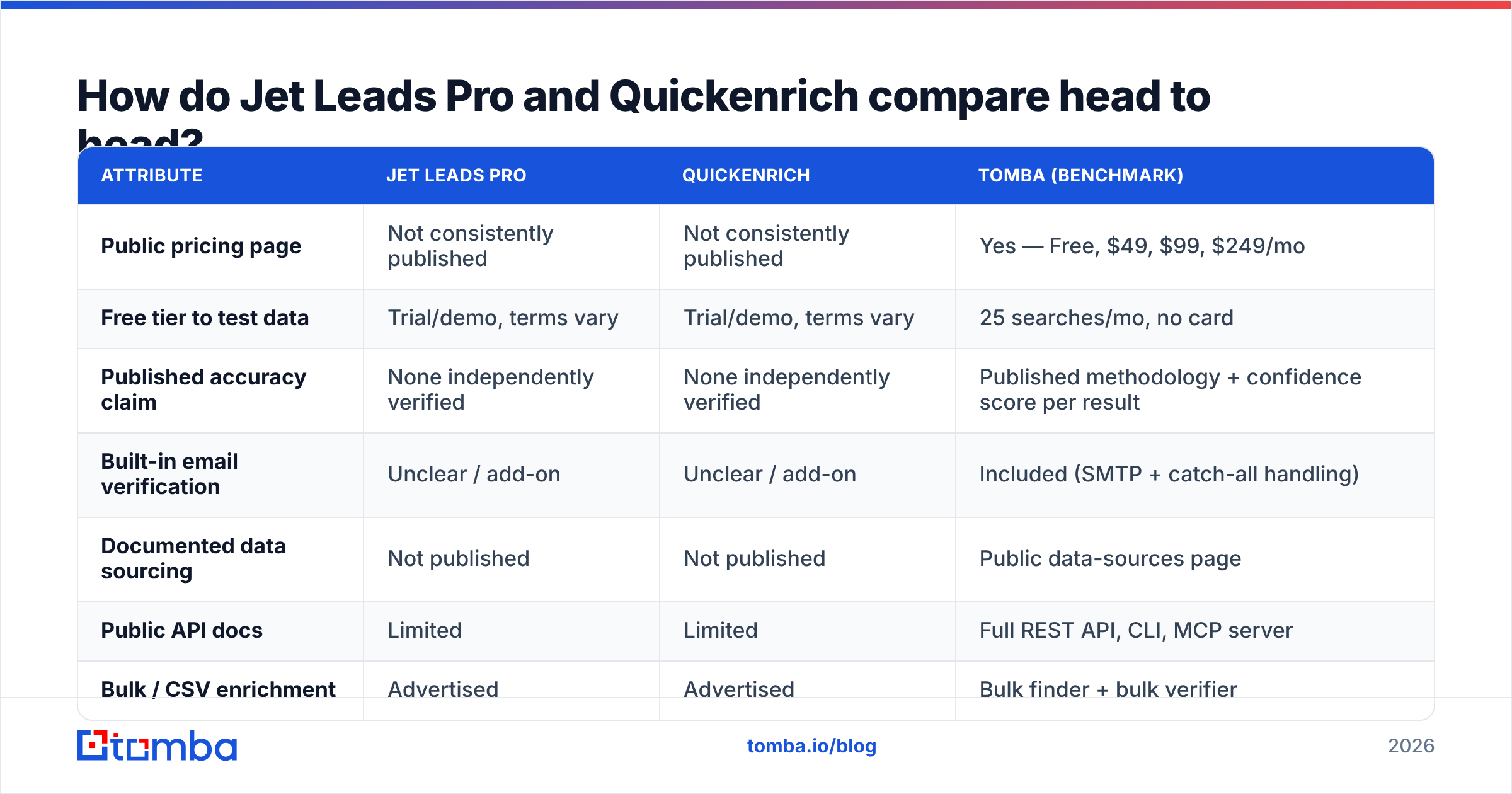
| Attribute | Jet Leads Pro | Quickenrich | Tomba (benchmark) |
|---|---|---|---|
| Public pricing page | Not consistently published | Not consistently published | Yes — Free, $49, $99, $249/mo |
| Free tier to test data | Trial/demo, terms vary | Trial/demo, terms vary | 25 searches/mo, no card |
| Published accuracy claim | None independently verified | None independently verified | Published methodology + confidence score per result |
| Built-in email verification | Unclear / add-on | Unclear / add-on | Included (SMTP + catch-all handling) |
| Documented data sourcing | Not published | Not published | Public data-sources page |
| Public API docs | Limited | Limited | Full REST API, CLI, MCP server |
| Bulk / CSV enrichment | Advertised | Advertised | Bulk finder + bulk verifier |
| Third-party review volume | Very low | Very low | Listed on G2 and Capterra |
Read that table as a risk map, not a scoreboard. Every "Not published" cell is a question you will have to answer with your own credit card and your own sending domain. That is an expensive way to do research.
The one row that should stop you: built-in verification. A finder that returns addresses without verifying them is handing you an unpriced liability. If 18% of a 2,000-contact export bounces, you have not saved money on a cheap plan — you have spent your domain reputation, which costs far more to rebuild than the $50 you saved.
Why does data accuracy matter more than credit count?#
Because credits are the metric vendors control and bounce rate is the metric your mailbox provider controls. Guess which one decides whether your campaign lands.
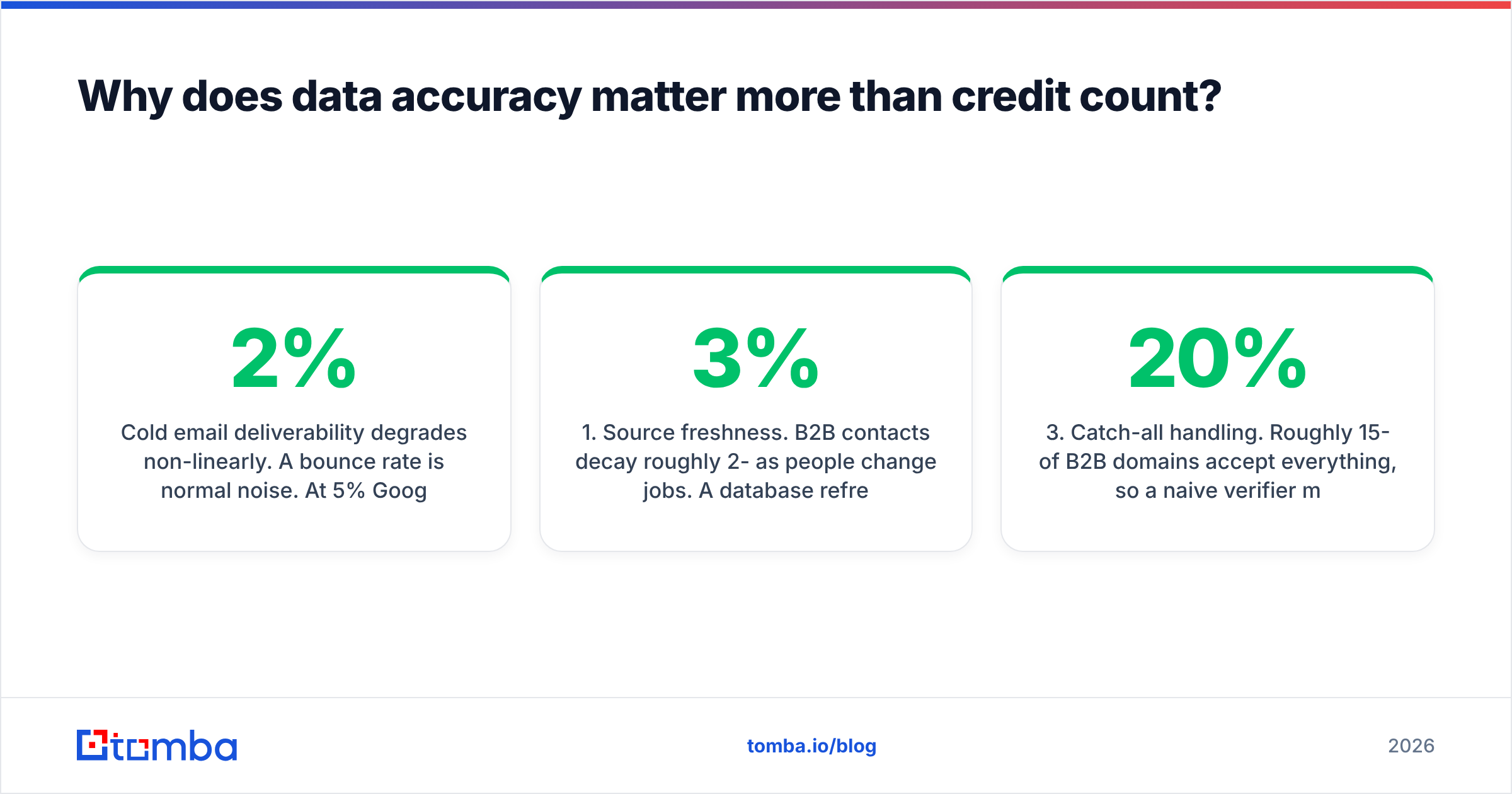
Cold email deliverability degrades non-linearly. A 2% bounce rate is normal noise. At 5% Google and Microsoft start throttling. Past 8-10% you are in filtering territory, and recovery takes weeks of reduced volume. So a tool advertising "10,000 leads for $39" is only cheap if those 10,000 addresses are real. At a 20% invalid rate, you are paying for 8,000 usable contacts and eating a deliverability hit that suppresses the other 8,000.

This is why the accuracy question is the whole ballgame, and why the absence of a published accuracy methodology from both Jet Leads Pro and Quickenrich is disqualifying on its own for anyone sending at volume. The mechanism is not mysterious — SMTP verification, pattern inference, and source recency are all measurable. Vendors who measure them, publish them. Vendors who do not, do not.
Four things that actually move accuracy, in rough order of impact:
- Source freshness. B2B contacts decay roughly 2-3% per month as people change jobs. A database refreshed quarterly is meaningfully worse than one refreshed continuously, regardless of headline size.
- Real-time SMTP checks at find time. Verifying at export, not at ingest, catches the contact who left last Tuesday. Use an email verifier as the last step before any send.
- Catch-all handling. Roughly 15-20% of B2B domains accept everything, so a naive verifier marks them "valid" and you find out the truth from your bounce log. A dedicated catch-all verifier scores these instead of guessing.
- Pattern confidence, not pattern guessing. Generating
first.last@domain.comis trivial. Knowing that this specific company usesflast@and proving it with observed evidence is the actual product.
What does each tool actually cost?#
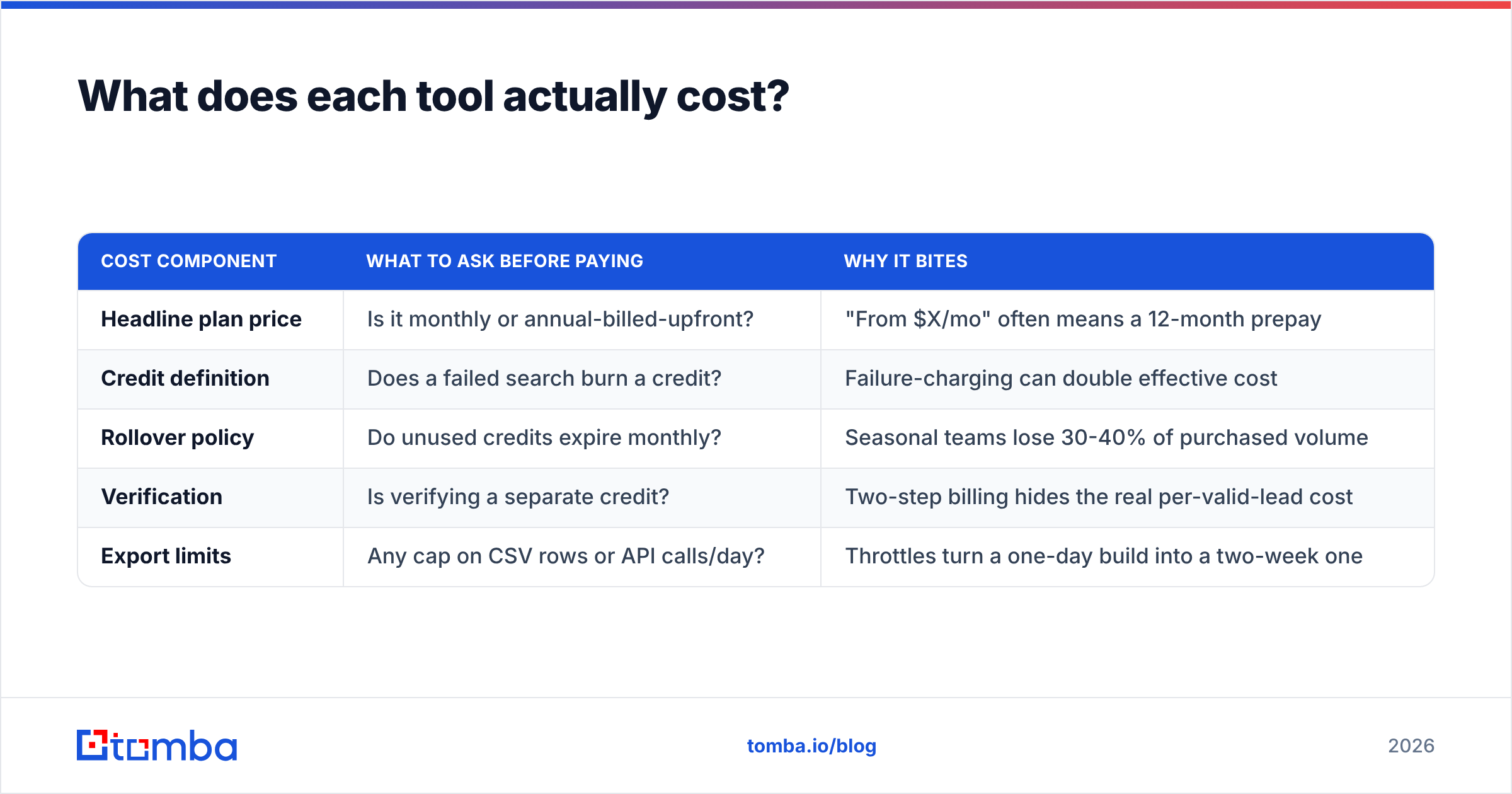
You cannot answer this cleanly for either vendor, and that is the point of the section. Where pricing is not published, the real cost has three hidden components:
| Cost component | What to ask before paying | Why it bites |
|---|---|---|
| Headline plan price | Is it monthly or annual-billed-upfront? | "From $X/mo" often means a 12-month prepay |
| Credit definition | Does a failed search burn a credit? | Failure-charging can double effective cost |
| Rollover policy | Do unused credits expire monthly? | Seasonal teams lose 30-40% of purchased volume |
| Verification | Is verifying a separate credit? | Two-step billing hides the real per-valid-lead cost |
| Export limits | Any cap on CSV rows or API calls/day? | Throttles turn a one-day build into a two-week one |
For contrast, a published ladder looks like this: a free tier at 25 searches/mo, Starter at $49/mo, Growth at $99/mo, Pro at $249/mo, Enterprise on quote — all visible on the Tomba pricing page before you talk to anyone. You can compute cost-per-valid-lead from that in about ninety seconds. You cannot do that arithmetic with a vendor whose plans arrive by email after a sales call.
One more note on fairness: "no public pricing" is not automatically a scam signal. Plenty of legitimate data vendors — including well-regarded ones like BookYourData, which sells verified B2B lists with an explicit accuracy guarantee — run quote-based or pay-as-you-go models and stand behind their data. The difference is that they publish something you can hold them to: a guarantee, a replacement policy, a documented sourcing statement. Ask both Jet Leads Pro and Quickenrich for exactly that in writing. A vendor confident in its data will send it.
Which one fits your use case?#
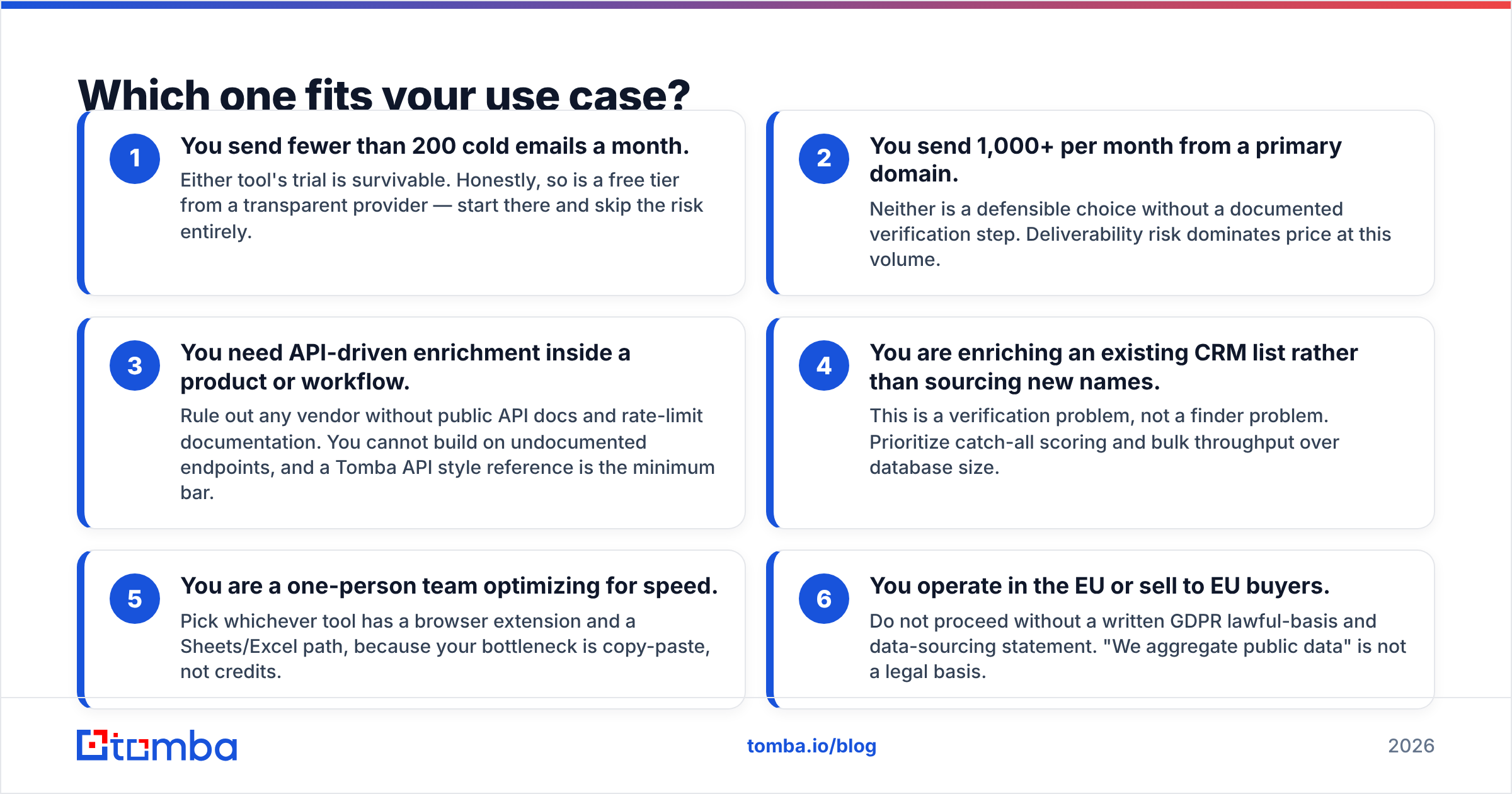
Given what is publicly verifiable, here is how the decision actually breaks down:
- You send fewer than 200 cold emails a month. Either tool's trial is survivable. Honestly, so is a free tier from a transparent provider — start there and skip the risk entirely.
- You send 1,000+ per month from a primary domain. Neither is a defensible choice without a documented verification step. Deliverability risk dominates price at this volume.
- You need API-driven enrichment inside a product or workflow. Rule out any vendor without public API docs and rate-limit documentation. You cannot build on undocumented endpoints, and a Tomba API style reference is the minimum bar.
- You are enriching an existing CRM list rather than sourcing new names. This is a verification problem, not a finder problem. Prioritize catch-all scoring and bulk throughput over database size.
- You are a one-person team optimizing for speed. Pick whichever tool has a browser extension and a Sheets/Excel path, because your bottleneck is copy-paste, not credits.
- You operate in the EU or sell to EU buyers. Do not proceed without a written GDPR lawful-basis and data-sourcing statement. "We aggregate public data" is not a legal basis.
What should you check before you buy either one?#
Run this test. It takes half an hour and it settles the argument better than any review page, including this one.
- Build a 100-row control list. Use contacts you already know are valid — colleagues, customers, past replies — mixed with 30 contacts you need found fresh. You now have ground truth.
- Run it through every candidate, same day. Record match rate (how many returned an address) and precision (how many matched your known-good value).
- Verify the output independently. Push everything through a second, neutral verifier so you are not grading a tool with its own answer key. A free email checker is fine for spot checks.
- Send a 50-contact warm-up batch. Measure hard bounces in your ESP. This is the only number that matters.
- Compute cost per valid, delivered contact. Not per credit. Not per lead. Per contact that actually received your message.
- Check refund and replacement terms in writing. Ask: "What happens if bounce rate exceeds 5%?" The answer tells you everything about how confident the vendor is.
Cross-check anything a salesperson tells you against independent listings on Capterra or G2. If a vendor has no footprint on either, treat every claim as unverified until your own test data says otherwise.
Is there a stronger third option?#
For most outbound teams, yes — and it is not a close call once you weight transparency.

The practical requirements for a cold-outbound data stack in 2026 are unglamorous: published pricing, a free tier you can test without a sales call, verification bundled rather than upsold, documented data sources, and an API you can read the docs for. Tomba meets all five, which is why it works as the benchmark column above rather than as a marketing insert. Its domain search handles account-based prospecting, the bulk email finder handles list builds, and verification runs inside the same credit system so addresses never leave unchecked.
That does not make Jet Leads Pro or Quickenrich worthless. It makes them unmeasured — and unmeasured is a bad property in a tool whose entire job is to be accurate. If either vendor publishes sourcing documentation and an accuracy methodology tomorrow, this comparison changes. Until then, the burden of proof sits with them.
What is the verdict on Jet Leads Pro vs Quickenrich?#
Neither wins outright, because neither has published enough for a win to mean anything. If you forced a choice, pick whichever gives you a genuinely free test on your own control list — the one that lets you verify before you pay is the one treating you like a buyer rather than a mark.
But the better move is to stop framing it as a two-way race. The real comparison is between "cheap and unverified" and "priced in public and verified at source." Your domain reputation is the asset at stake, and it does not have a refund policy.
Start with a free tier, run the 100-row control test, and let bounce data pick the winner. Tomba's Email Finder gives you 25 free searches a month with verification included — enough to run that exact test against Jet Leads Pro, Quickenrich, or anything else on your shortlist, before a single credit card comes out. Build the control list, run it three ways, and let your SMTP logs make the call.
Related guides#
// get started
Find, verify and enrich your first contacts today
Start on the free plan with 25 searches a month, then scale when your team is ready.
Free plan · No credit card required · GDPR & CCPA
Get the Tomba newsletter
Product and data updates
// about the author