Jet Leads Pro vs Saleshandy: Which Cold Outreach Tool Wins in 2026
One is an established cold-email suite with a lead database attached. The other is a newer, thinly documented lead tool. Here is how to compare them honestly before you spend a dollar.
TL;DR
- Saleshandy is the safer default. It is an established cold-email sequencing platform with built-in warmup, unlimited-inbox plans on most tiers, and a bundled B2B lead database. Public pricing, public reviews, public docs.
- Jet Leads Pro is the unknown quantity. As of early 2026 it publishes far less verifiable detail than its competitors: no widely indexed pricing page history, thin third-party review volume, and no published data-sourcing statement. That does not make it bad. It makes it un-auditable, and you should treat it accordingly.
- The two products are not the same shape. Saleshandy's centre of gravity is sending. Jet Leads Pro positions around sourcing. Comparing them on a single scoreboard is how teams end up paying twice for half a stack.
- Data quality is where both get judged. A sequencing tool with a mediocre database and a lead tool with no verification layer fail the same way: bounces, spam folder, dead domain.
- The unbundled setup usually wins on cost and accuracy: a dedicated data provider for contacts, a dedicated sender for sequences.
What are Jet Leads Pro and Saleshandy?#
Start with what each one is actually built to do, because the marketing copy blurs it.
Saleshandy is a cold email outreach platform. Its core loop is: connect mailboxes, warm them, build multi-step sequences with conditional follow-ups, rotate sends across inboxes, track replies, and push positive replies into a CRM. In the last few years it bolted on a lead database (branded Lead Finder) so you can source contacts without leaving the tool. It has been around long enough to accumulate thousands of reviews on G2, which means its failure modes are public knowledge rather than something you discover in month two.
Jet Leads Pro sits in the lead-sourcing category: find B2B contacts, export them, feed them into whatever you send with. That is the positioning. The honest problem is that there is very little independent, verifiable information about it. Thin review counts, no published data-provenance page, no visible engineering blog, no widely referenced API documentation. Every claim about coverage, accuracy, or refresh cadence traces back to the vendor's own site.
That asymmetry is the real story of this comparison, and it is worth saying plainly: we are not comparing two equally documented products. We are comparing a known platform against a product you will have to audit yourself. The rest of this post is largely a method for doing that audit.
How do Jet Leads Pro and Saleshandy compare head-to-head?#
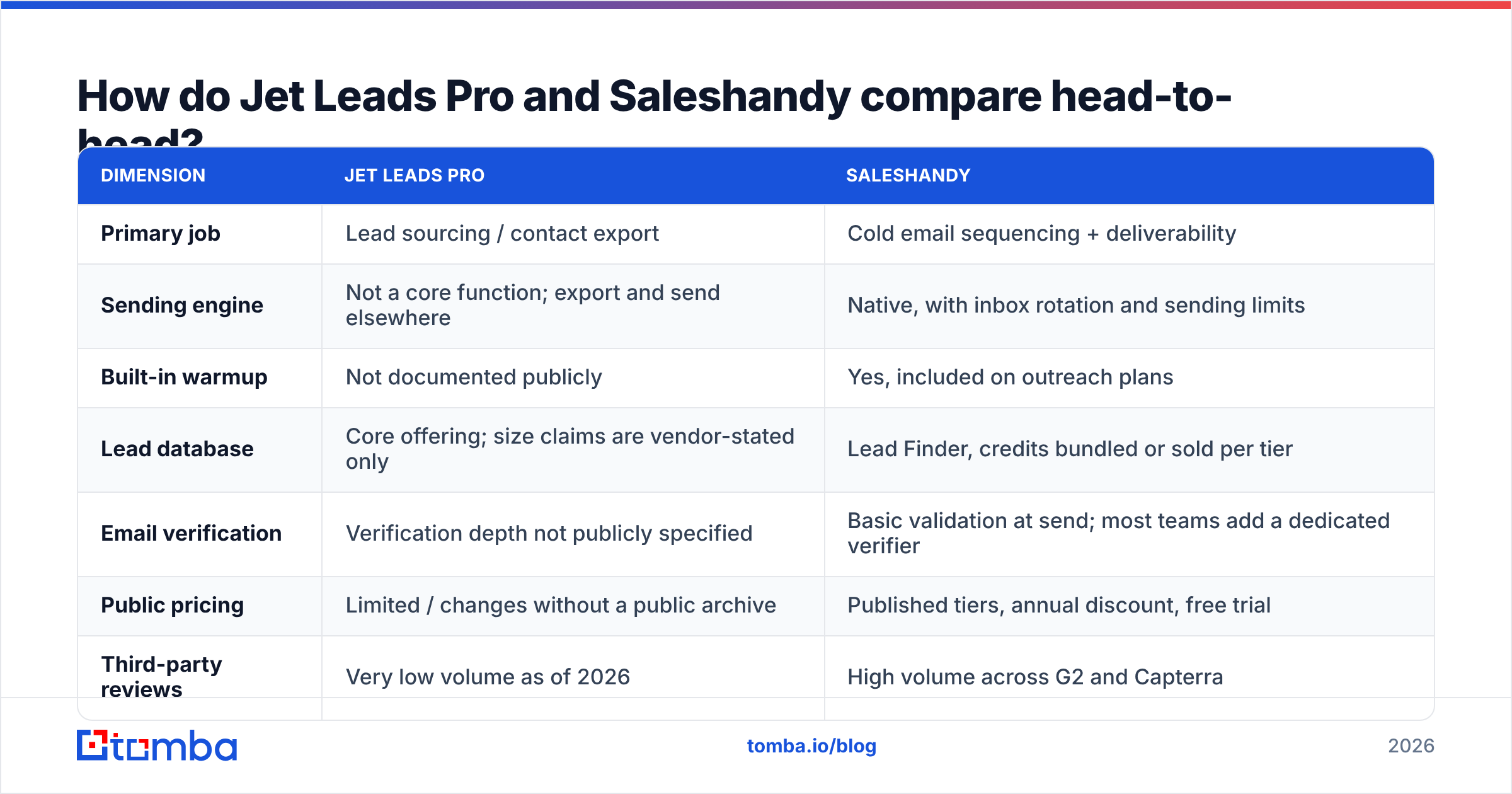
| Dimension | Jet Leads Pro | Saleshandy |
|---|---|---|
| Primary job | Lead sourcing / contact export | Cold email sequencing + deliverability |
| Sending engine | Not a core function; export and send elsewhere | Native, with inbox rotation and sending limits |
| Built-in warmup | Not documented publicly | Yes, included on outreach plans |
| Lead database | Core offering; size claims are vendor-stated only | Lead Finder, credits bundled or sold per tier |
| Email verification | Verification depth not publicly specified | Basic validation at send; most teams add a dedicated verifier |
| Public pricing | Limited / changes without a public archive | Published tiers, annual discount, free trial |
| Third-party reviews | Very low volume as of 2026 | High volume across G2 and Capterra |
| API access | Not publicly documented | Available on higher tiers |
| Best for | Teams willing to pilot an unproven source | Teams that need to send at volume this quarter |
Read that table as a risk profile, not a scoreboard. Saleshandy scores well on verifiability because it has been publicly scrutinised. A newer product scores poorly on verifiability by definition, even if the underlying data turns out to be excellent.
What does Saleshandy actually do well?#
Four things, consistently, based on how teams describe it in the wild:
- Inbox rotation at scale. Most outreach plans let you connect an unlimited number of sending accounts. If your motion is 20 domains × 3 mailboxes, this is the pricing model that does not punish you for it. Tools that charge per connected inbox get expensive fast at that shape.
- Warmup that is included, not upsold. Warmup sits inside the product rather than as a separate subscription. That matters because warmup only works if it runs continuously, and teams cancel add-ons they forget about. If you want to model how long a new domain needs before it carries real volume, run the numbers with an email warmup calculator before you build the sequence.
- Sequence logic that handles reality. Conditional steps, reply detection, auto-pause on out-of-office, sub-sequences for interested replies. This is table stakes at the top of the category, and Saleshandy has it.
- Unified inbox and reply triage. One place to work replies across dozens of mailboxes, rather than tabbing through Gmail accounts.
Where it gets criticised: the bundled Lead Finder database is fine for mid-market SaaS and thinner outside that. Enrichment depth trails dedicated data vendors. And support response times get mixed reviews on lower tiers. None of that is disqualifying, but it is the reason so many Saleshandy users still buy contact data somewhere else.
What should you check before buying Jet Leads Pro?#
If a lead tool is newer or lightly reviewed, you do not reject it on principle. You test it against a standard. Run this sequence before you commit to an annual plan:
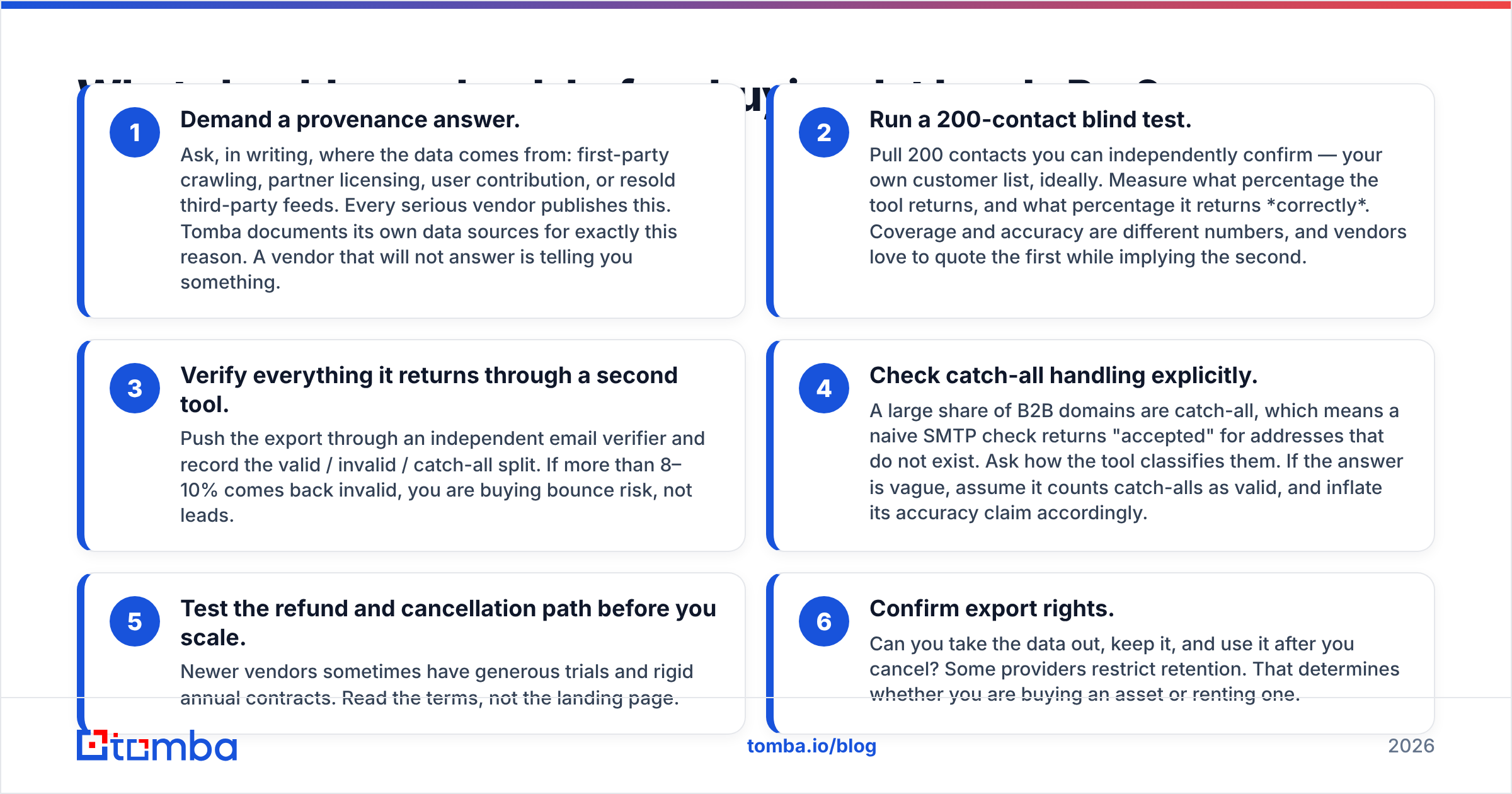
- Demand a provenance answer. Ask, in writing, where the data comes from: first-party crawling, partner licensing, user contribution, or resold third-party feeds. Every serious vendor publishes this. Tomba documents its own data sources for exactly this reason. A vendor that will not answer is telling you something.
- Run a 200-contact blind test. Pull 200 contacts you can independently confirm — your own customer list, ideally. Measure what percentage the tool returns, and what percentage it returns correctly. Coverage and accuracy are different numbers, and vendors love to quote the first while implying the second.
- Verify everything it returns through a second tool. Push the export through an independent email verifier and record the valid / invalid / catch-all split. If more than 8–10% comes back invalid, you are buying bounce risk, not leads.
- Check catch-all handling explicitly. A large share of B2B domains are catch-all, which means a naive SMTP check returns "accepted" for addresses that do not exist. Ask how the tool classifies them. If the answer is vague, assume it counts catch-alls as valid, and inflate its accuracy claim accordingly.
- Test the refund and cancellation path before you scale. Newer vendors sometimes have generous trials and rigid annual contracts. Read the terms, not the landing page.
- Confirm export rights. Can you take the data out, keep it, and use it after you cancel? Some providers restrict retention. That determines whether you are buying an asset or renting one.
That checklist is not anti-Jet-Leads-Pro. It is the same list you should run against any data vendor, including the ones with great reputations. The difference is that for a well-documented vendor, half the answers already exist in public.
How do the pricing models compare?#
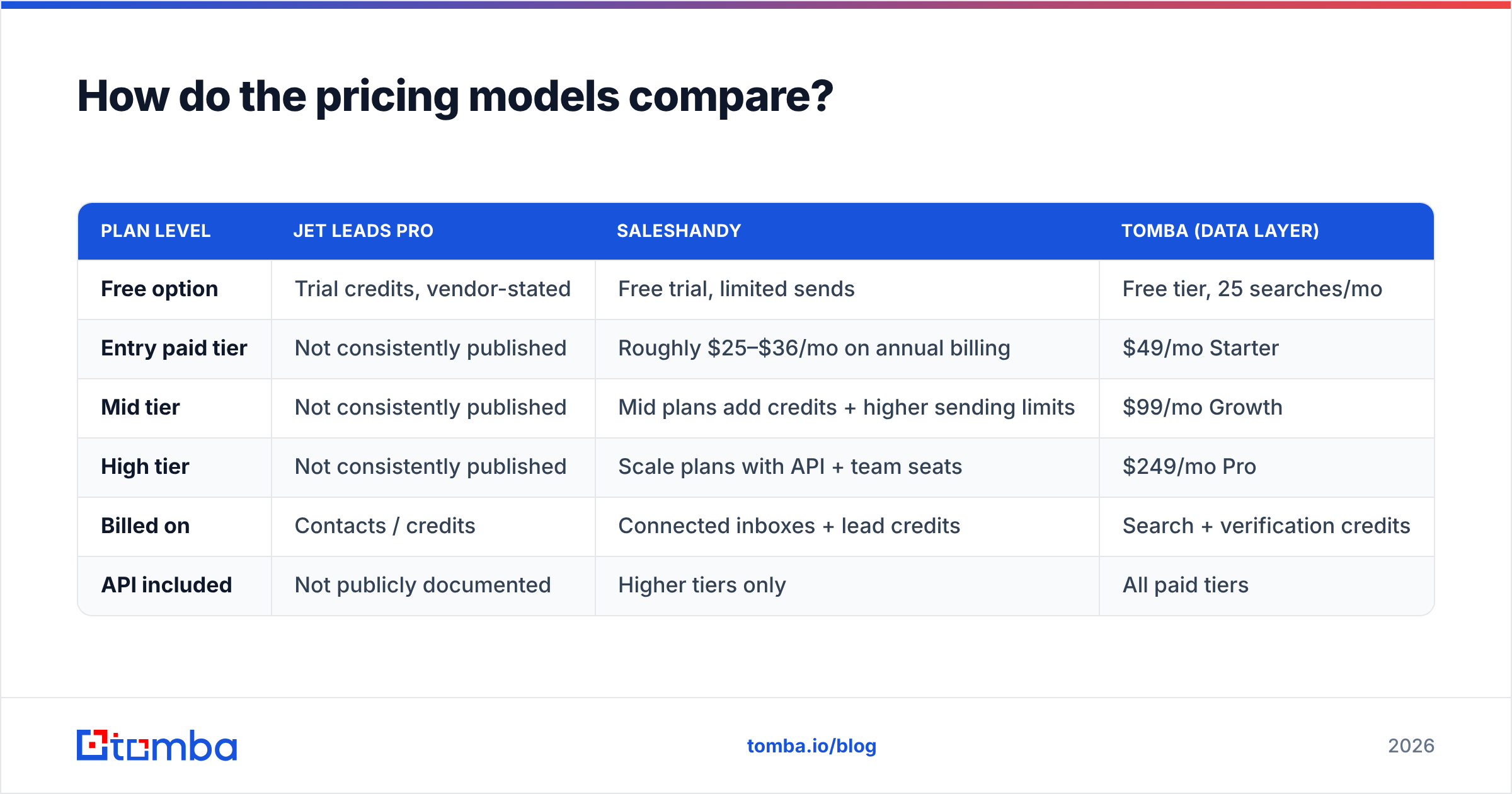
| Plan level | Jet Leads Pro | Saleshandy | Tomba (data layer) |
|---|---|---|---|
| Free option | Trial credits, vendor-stated | Free trial, limited sends | Free tier, 25 searches/mo |
| Entry paid tier | Not consistently published | Roughly $25–$36/mo on annual billing | $49/mo Starter |
| Mid tier | Not consistently published | Mid plans add credits + higher sending limits | $99/mo Growth |
| High tier | Not consistently published | Scale plans with API + team seats | $249/mo Pro |
| Billed on | Contacts / credits | Connected inboxes + lead credits | Search + verification credits |
| API included | Not publicly documented | Higher tiers only | All paid tiers |
Two notes on reading this. First, always confirm current numbers on the vendor's own pricing page; outreach tools reshuffle tiers roughly once a year, and annual-vs-monthly gaps are large enough to change the verdict. You can check Tomba pricing directly rather than trusting a screenshot in a blog post, including this one.
Second, the unit of billing matters more than the headline price. Saleshandy charges primarily around sending capacity. Data tools charge around lookups. If you compare a $36 sending plan to a $49 data plan and conclude one is cheaper, you have compared a hammer to a screwdriver. The real question is what your total stack costs at your actual volume.
Is data quality really the deciding factor?#
Yes, and it is not close.
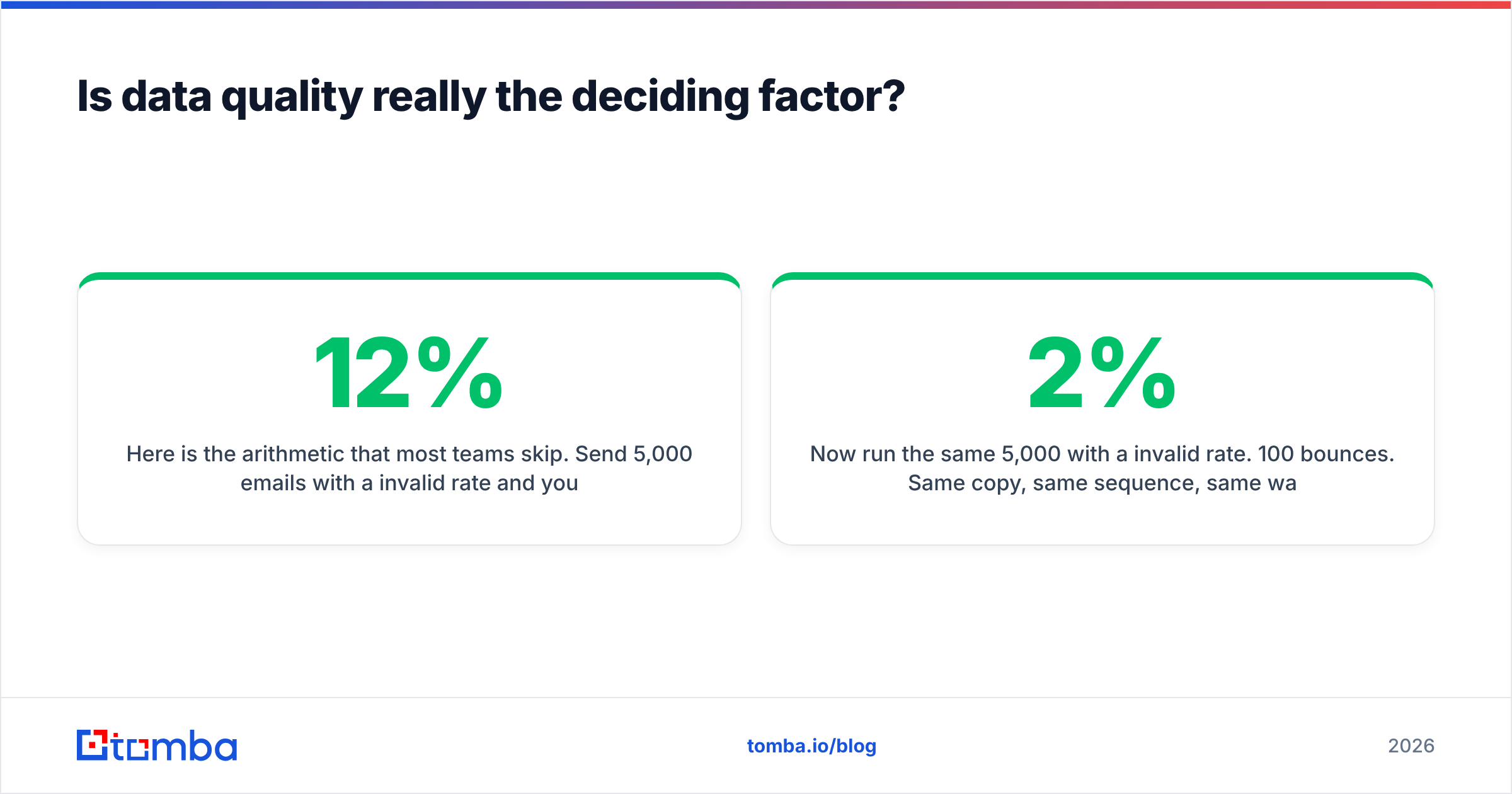
Here is the arithmetic that most teams skip. Send 5,000 emails with a 12% invalid rate and you have generated 600 hard bounces. Google and Microsoft both treat bounce rate as a reputation signal, and Google's bulk sender guidelines are explicit that senders must keep spam complaints under 0.3% and maintain valid recipient lists. Cross those thresholds and your placement collapses across every domain sending from that infrastructure — including the campaigns that were working.
Now run the same 5,000 with a 2% invalid rate. 100 bounces. Same copy, same sequence, same warmup, wildly different outcome. The sending tool did not change. The data did.
This is why the "all-in-one" pitch, from either vendor, deserves scrutiny. Bundled databases are a convenience feature, priced as a convenience feature, and built with a convenience feature's engineering budget. They are rarely the best data on the market, because the vendor's core competency is somewhere else. A sequencing platform is judged on sends. A lead tool is judged on record counts. Neither is judged on whether the address still routes to a human next quarter.
The practical consequence: whichever platform you pick for sending, treat its bundled data as a starting point and put a verification layer in front of your sender. Running a bulk verify pass on every list before import costs a fraction of what a burned domain costs.

Which one fits your team?#
Choose Saleshandy if:
- You are sending meaningful cold volume this quarter and need warmup, rotation, and reply handling in one place.
- You run many mailboxes and want a pricing model that does not scale with inbox count.
- You value a mature product with public documentation and a large user base you can ask questions of.
- You are fine sourcing contacts separately when the bundled database comes up short in your niche.
Consider Jet Leads Pro if:
- Your bottleneck is sourcing, not sending, and you already have an outreach tool you like.
- It covers a segment — a region, an industry, a seniority band — that your incumbent provider misses, and you have verified that with a blind test rather than a demo.
- You are comfortable running a pilot with clear exit criteria and a month-to-month plan.
Pick neither as a single solution if:
- You need high accuracy at volume. In that case, split the stack: a dedicated data provider for contacts, a dedicated sender for delivery. The seam between them is a CSV or an API call, and that seam costs far less than the accuracy you lose by bundling.
Can you build a better stack than either one alone?#
This is the setup most outbound teams converge on after a year of trying all-in-ones:
- Sourcing layer. A dedicated provider that publishes its data sources and gives you a confidence score per result, not just a green checkmark. Domain search to map an account's contact surface, then targeted finding for the specific people on your list.
- Verification layer. Every address checked before it enters a sequence, with catch-all domains flagged rather than silently passed as valid.
- Sending layer. Saleshandy, or whatever sequencer your team already knows. This is the most swappable piece of the stack.
- Automation layer. An API or native integration so the handoff is not a human dragging spreadsheets at 6pm on a Friday.
The unbundled stack is slightly more setup and meaningfully better output. It also means a bad quarter from any one vendor does not take your entire pipeline with it.
The verdict#
If you have to pick one today and you are sending cold email at any real volume, pick Saleshandy. Not because Jet Leads Pro is inferior — there is not enough public evidence to say that — but because Saleshandy is knowable. You can read its pricing, its reviews, its limitations, and its roadmap before you spend anything. Buying software you cannot audit is a risk you take deliberately, with a pilot budget and an exit date, not as your default.
And if you pick Jet Leads Pro, pick it as a supplement to a verified data layer rather than a replacement for one. Run the 200-contact blind test. Verify the export. Keep the receipts.
Ready to fix the data layer first? Start with the Tomba Email Finder — free tier includes 25 searches a month, paid plans start at $49/mo, and every result comes with sources and a confidence score so you can see why an address was returned before you send to it. Whichever sequencer you end up running, better inputs make it better.
Related guides#
// get started
Find, verify and enrich your first contacts today
Start on the free plan with 25 searches a month, then scale when your team is ready.
Free plan · No credit card required · GDPR & CCPA
// about the author