Jet Leads Pro vs Smarte: Which B2B Data Tool Wins in 2026?
Jet Leads Pro and Smarte both promise verified B2B contacts, but they solve different problems. Here's how they compare on accuracy, coverage, pricing and export limits — plus where a cheaper email finder beats both.
TL;DR
- Jet Leads Pro is positioned as a self-serve lead-list builder: filter a database, export a CSV, hand it to your sequencer. Fast, shallow, cheap to start.
- Smarte (smarte.pro) is a sales-intelligence and GTM data platform — account intelligence, intent signals, CRM enrichment — sold mostly through quotes, not a pricing page.
- Neither publishes audited accuracy benchmarks. Treat every "95% accurate" claim from either vendor as marketing until you run your own 200-contact test.
- If your real bottleneck is finding and verifying work emails at a predictable cost, a dedicated email finder like Tomba ($49/mo Starter, free tier at 25 searches) usually beats both on cost-per-valid-contact.
- Pick Smarte if you need account-level intelligence feeding a CRM. Pick Jet Leads Pro if you need volume lists today. Pick a verification-first tool if your bounce rate is the thing that's actually hurting you.
What are Jet Leads Pro and Smarte?#
They are not the same category of product, and that's the first thing most comparison posts get wrong.
Jet Leads Pro sits in the list-building tier of the market — the same shelf as the dozens of database-plus-export tools that appeared after LinkedIn tightened its scraping enforcement. The pitch is straightforward: pick filters (industry, headcount, title, geography), preview the matching records, export. Credits are consumed per revealed contact. There's no meaningful workflow layer; it assumes you already own a sequencer and a CRM.
Smarte is built for a different buyer. It's a B2B data and revenue operations platform focused on account intelligence: company firmographics, technographics, contact discovery, and CRM hygiene. Smarte leans heavily on GDPR/CCPA compliance messaging and sells into teams that care who touched the data and where it came from. Their official site routes most plans through a demo request rather than a checkout page.
So the honest framing of Jet Leads Pro vs Smarte is not "which is better" — it's "which failure mode are you trying to avoid": running out of contacts, or running a pipeline on data your RevOps team doesn't trust.

How do Jet Leads Pro and Smarte compare head to head?#
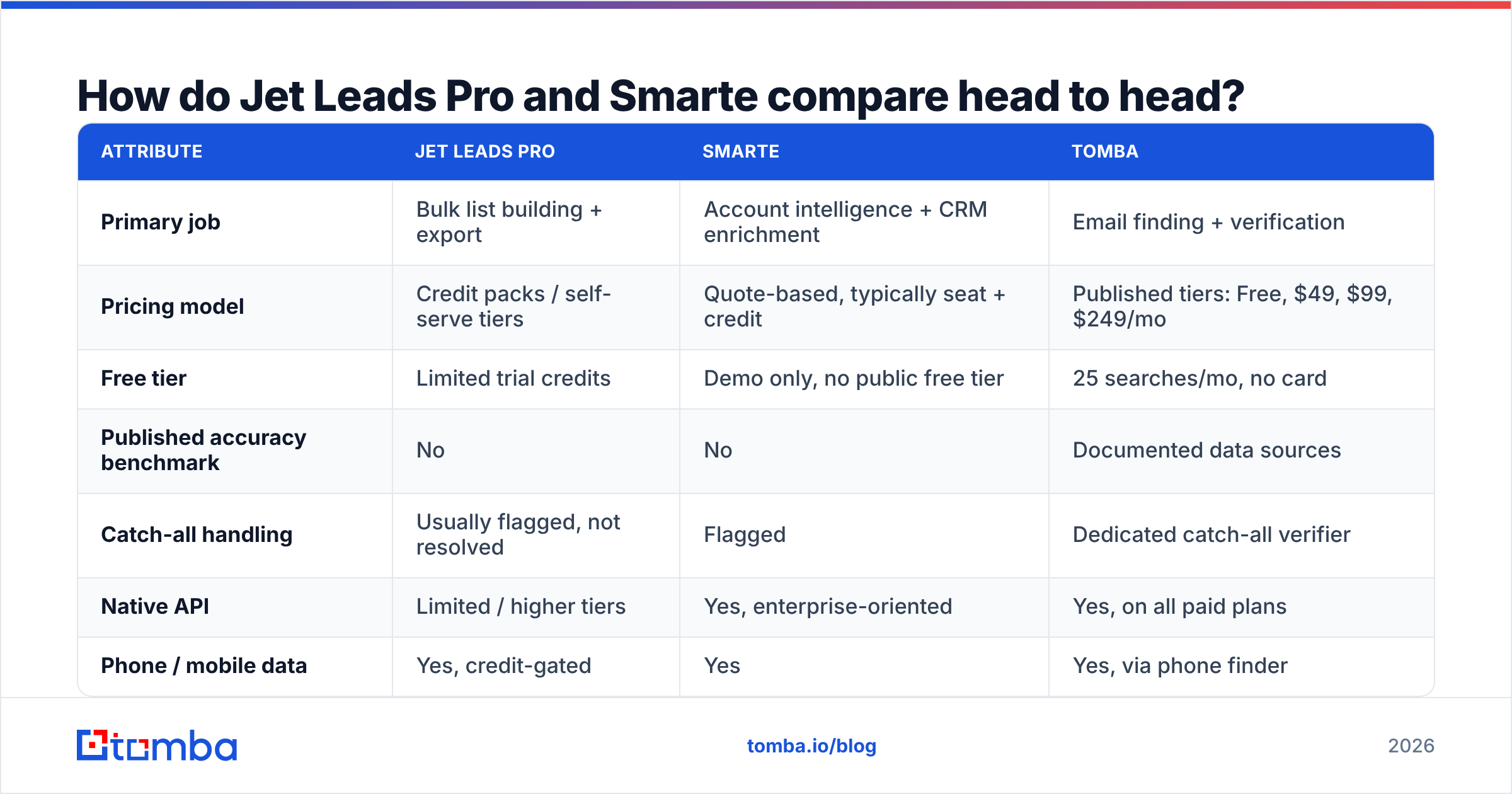
Here's the practical comparison. Where a vendor doesn't publish a number, the cell says so rather than inventing one — that gap is itself a data point when you're budgeting.
| Attribute | Jet Leads Pro | Smarte | Tomba |
|---|---|---|---|
| Primary job | Bulk list building + export | Account intelligence + CRM enrichment | Email finding + verification |
| Pricing model | Credit packs / self-serve tiers | Quote-based, typically seat + credit | Published tiers: Free, $49, $99, $249/mo |
| Free tier | Limited trial credits | Demo only, no public free tier | 25 searches/mo, no card |
| Published accuracy benchmark | No | No | Documented data sources |
| Catch-all handling | Usually flagged, not resolved | Flagged | Dedicated catch-all verifier |
| Native API | Limited / higher tiers | Yes, enterprise-oriented | Yes, on all paid plans |
| Phone / mobile data | Yes, credit-gated | Yes | Yes, via phone finder |
| Best for | SDR teams needing volume fast | RevOps + ABM programs | Teams optimising cost-per-valid-email |
| Contract | Monthly or annual | Typically annual | Monthly, no lock-in |
Two structural differences matter more than any individual row.
First, pricing transparency. Jet Leads Pro and Tomba both let you see the bill before you talk to anyone. Smarte, like most enterprise data vendors, quotes. That isn't a knock — quoted pricing often buys you legal indemnities, a named CSM, and compliance documentation that self-serve tools simply don't offer. But it means you cannot compare them on cost until you've sat through a call, and your procurement cycle grows by three weeks.
Second, what a "credit" buys. In list-builder pricing, one credit usually equals one revealed record, whether or not the email is deliverable. In verification-first pricing, you're charged for a result you can actually use. That single accounting difference is why two tools with identical sticker prices can differ 3x on real cost-per-meeting.
Is Jet Leads Pro or Smarte more accurate?#
Neither company publishes a third-party audit, so the only defensible answer is: test both on your own ICP before you commit.
That said, the underlying mechanics predict a lot. B2B contact data comes from three broad places, and the mix determines where a vendor is strong:
- Contributed / community data — users install an extension and their contact book is pooled. Great recall in crowded segments (SaaS, tech sales in North America), poor coverage for manufacturing, EMEA mid-market, and anything outside the extension's install base.
- Web crawling and pattern inference — the tool learns that a company uses
first.last@, then generates and tests candidates. Strong on domain coverage, weak on people who don't follow the pattern (founders with vanity addresses, acquired-company holdovers). - Licensed and partner datasets — bought in bulk, often 6–18 months stale on job titles, but broad on firmographics.
Smarte's positioning leans toward (2) and (3) with a compliance wrapper. Jet Leads Pro reads like (1) and (3). Neither is wrong; they just fail on different rows of your list.

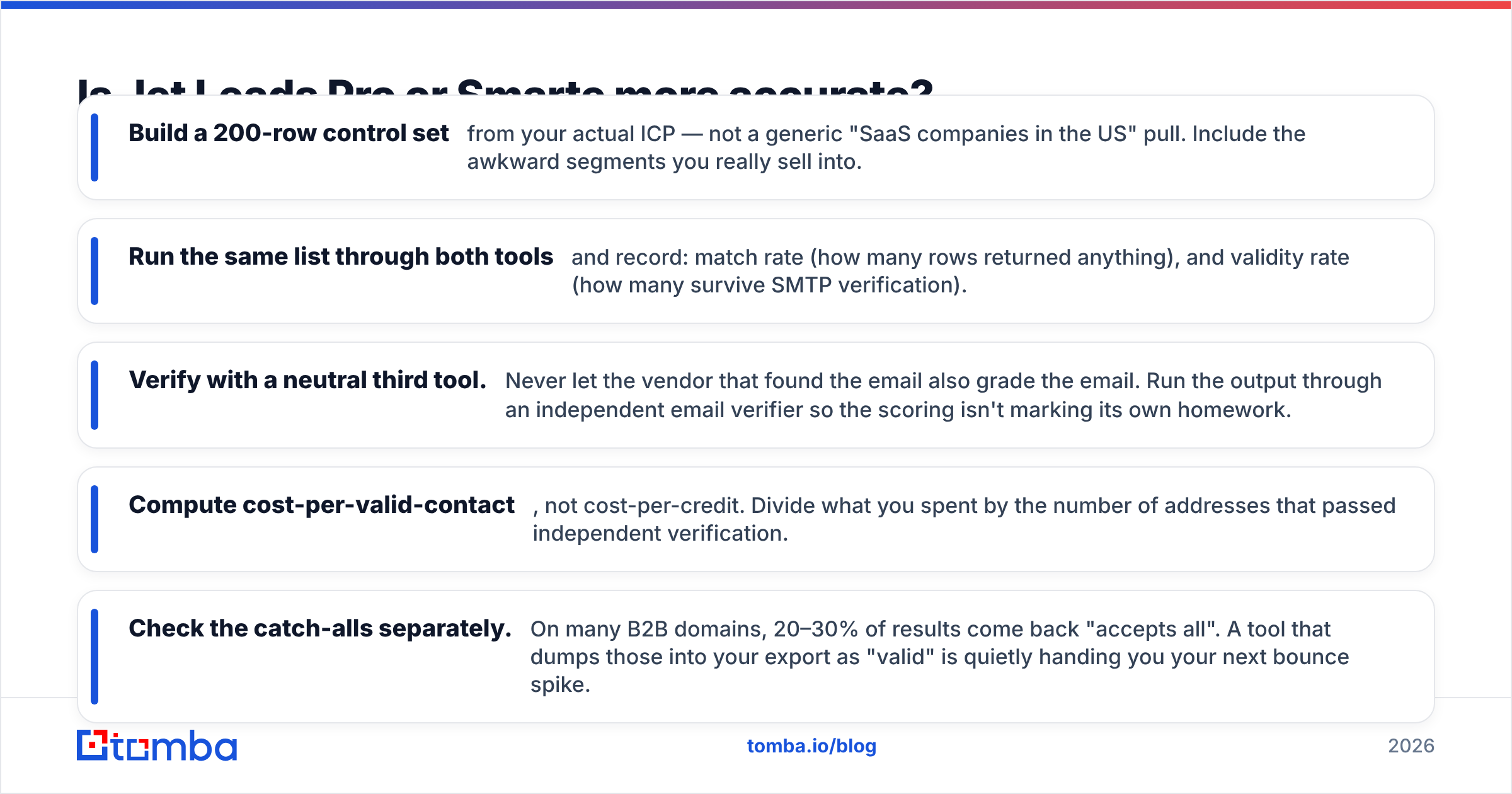
The practical test takes an afternoon:
- Build a 200-row control set from your actual ICP — not a generic "SaaS companies in the US" pull. Include the awkward segments you really sell into.
- Run the same list through both tools and record: match rate (how many rows returned anything), and validity rate (how many survive SMTP verification).
- Verify with a neutral third tool. Never let the vendor that found the email also grade the email. Run the output through an independent email verifier so the scoring isn't marking its own homework.
- Compute cost-per-valid-contact, not cost-per-credit. Divide what you spent by the number of addresses that passed independent verification.
- Check the catch-alls separately. On many B2B domains, 20–30% of results come back "accepts all". A tool that dumps those into your export as "valid" is quietly handing you your next bounce spike.
In our experience running that test across vendors, match rate differences of 10–15 points usually vanish once you weight for validity — the tool that "found more" often found more garbage.

Which pricing model actually costs less?#
Run the arithmetic on a realistic month rather than the sticker price.
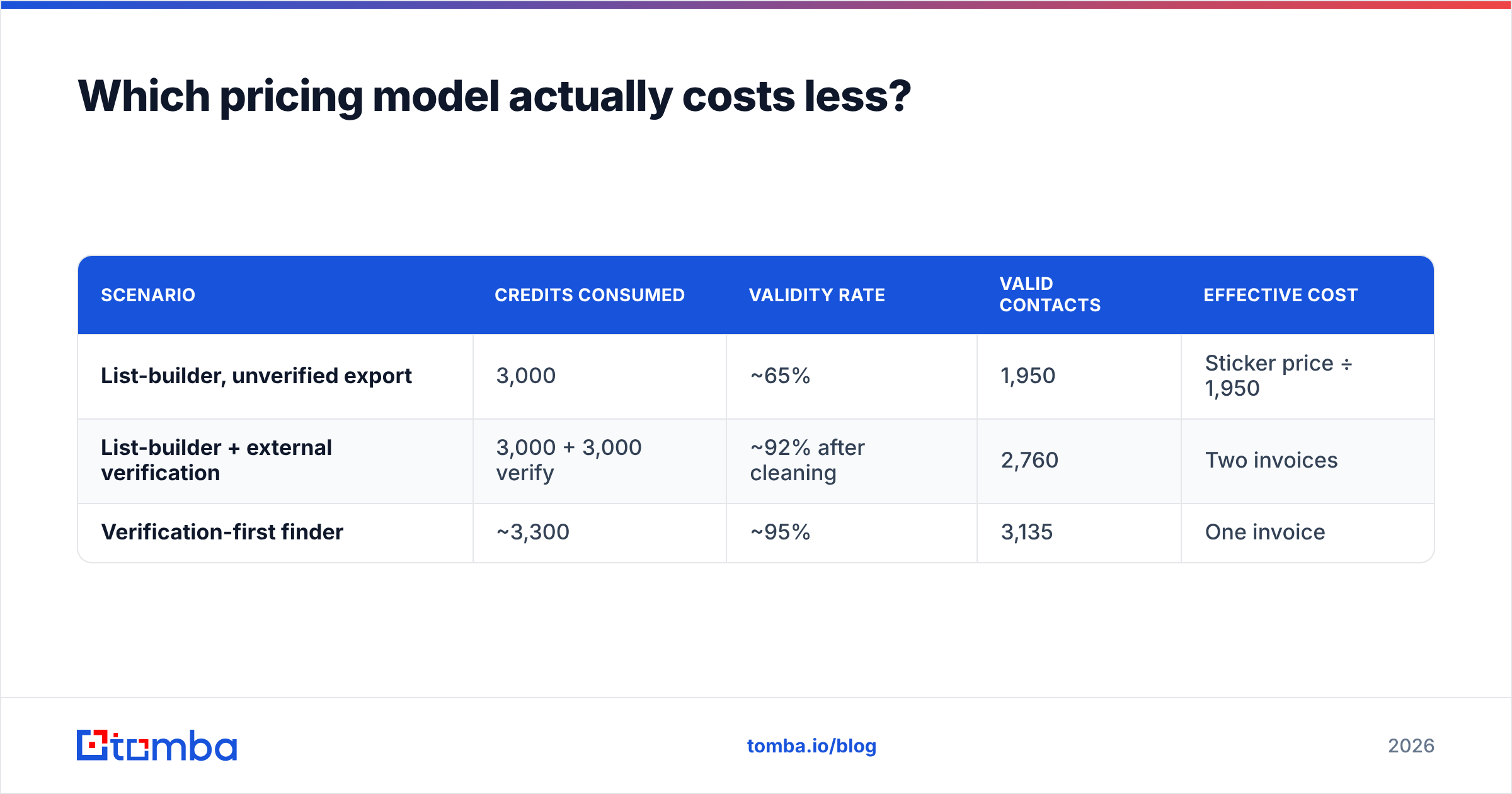
Assume an SDR team needs 3,000 net-new verified contacts per month.
| Scenario | Credits consumed | Validity rate | Valid contacts | Effective cost |
|---|---|---|---|---|
| List-builder, unverified export | 3,000 | ~65% | 1,950 | Sticker price ÷ 1,950 |
| List-builder + external verification | 3,000 + 3,000 verify | ~92% after cleaning | 2,760 | Two invoices |
| Verification-first finder | ~3,300 | ~95% | 3,135 | One invoice |
The middle row is where most teams actually live, and it's the row nobody budgets for. You pay the list vendor, then pay a second vendor to throw away a third of what you just bought. Consolidating those into one workflow is the single biggest line-item saving available in prospecting data — and it's why Tomba's pricing puts finding and verification on the same credit rather than splitting them.
Smarte's quote-based model can win here at scale if your negotiated rate is good and you're genuinely using the account intelligence. If you're using 10% of the platform, you're subsidising nine features to get one.

Which one fits your team?#
Match the tool to the constraint you're actually under:
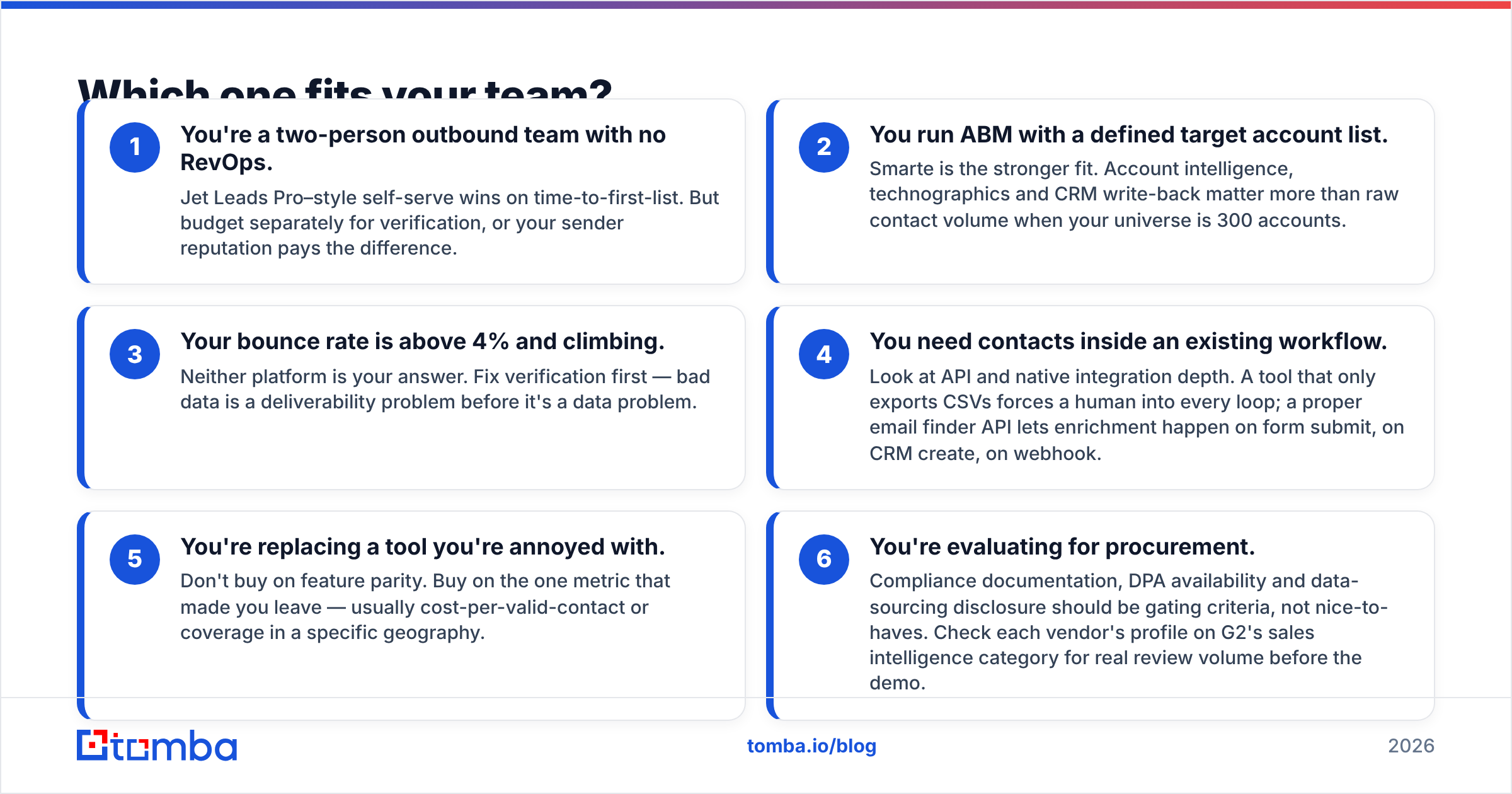
- You're a two-person outbound team with no RevOps. Jet Leads Pro–style self-serve wins on time-to-first-list. But budget separately for verification, or your sender reputation pays the difference.
- You run ABM with a defined target account list. Smarte is the stronger fit. Account intelligence, technographics and CRM write-back matter more than raw contact volume when your universe is 300 accounts.
- Your bounce rate is above 4% and climbing. Neither platform is your answer. Fix verification first — bad data is a deliverability problem before it's a data problem.
- You need contacts inside an existing workflow. Look at API and native integration depth. A tool that only exports CSVs forces a human into every loop; a proper email finder API lets enrichment happen on form submit, on CRM create, on webhook.
- You're replacing a tool you're annoyed with. Don't buy on feature parity. Buy on the one metric that made you leave — usually cost-per-valid-contact or coverage in a specific geography.
- You're evaluating for procurement. Compliance documentation, DPA availability and data-sourcing disclosure should be gating criteria, not nice-to-haves. Check each vendor's profile on G2's sales intelligence category for real review volume before the demo.
What are the credible alternatives?#
The Jet Leads Pro vs Smarte decision often ends with "neither, exactly." Worth putting in the same evaluation:
- BookYourData — a strong option when you want pay-as-you-go, pre-built contact lists with a stated accuracy guarantee rather than a subscription. Good fit for teams that buy data in bursts rather than continuously, and a genuinely competitive peer in this category.
- Tomba — best when the core job is finding and verifying work emails at a known unit cost. Domain search, bulk email finder, catch-all verification and enrichment all draw from one credit pool, with a published price list instead of a quote.
- Apollo-class platforms — if you want database, sequencer and dialer in one bill and don't mind the bundling. Compare the trade-offs on any Apollo alternative breakdown before you sign annual.
The hybrid most mature teams land on: one broad intelligence source for account selection, one precision tool for contact discovery and verification. That's usually cheaper than forcing a single vendor to be excellent at both, and it means a bad renewal on one side doesn't take your whole motion offline. HubSpot's own research on data hygiene makes the same point from the CRM side: decay is continuous, so your enrichment layer has to be too.
How do you run a fair 30-day evaluation?#
Keep it boring and measurable:
- Week 1 — same 200-row control set through both tools, independently verified. Record match rate, validity rate, cost per valid contact.
- Week 2 — send. Identical copy, identical sending domains, split by data source. Track bounce rate and response rate separately per source.
- Week 3 — test the edges. Your worst geography, your smallest company-size band, your most obscure job title. This is where averages hide the truth.
- Week 4 — price the winner at 3x your current volume. Ask each vendor what happens at renewal, whether unused credits roll over, and whether the rate is locked.
If a vendor won't let you run that test on real data before signing, that answer is your answer.
The verdict#
Smarte is the better buy if you're building an account-based motion and need intelligence your RevOps team will trust in the CRM — accept the quote cycle as the cost of entry. Jet Leads Pro is the better buy if you need volume this week, you already own verification, and you want to see the price before you see a salesperson.
But if you re-read your own problem statement and it says "we need accurate work emails, at a price we can forecast, without a second invoice for cleaning them" — you're not really shopping for either. You're shopping for a finder that verifies by default.
That's where Tomba fits. Start free with 25 searches a month, run the 200-row test against whatever you're using now, and compare cost-per-valid-contact rather than cost-per-credit. If it wins, Starter is $49/mo with API access included and no annual lock-in. Try the Tomba Email Finder and let your own bounce rate settle the argument.
Related guides#
// get started
Find, verify and enrich your first contacts today
Start on the free plan with 25 searches a month, then scale when your team is ready.
Free plan · No credit card required · GDPR & CCPA
// about the author