Jet Leads Pro vs Span Global Services: Which Data Wins?
Jet Leads Pro and Span Global Services both sell B2B contact data, but they package it very differently. Here's how pricing, accuracy, compliance and refresh rates compare — and when buying a list is the wrong move entirely.
Jet Leads Pro vs Span Global Services is a choice between two list vendors, not two lookup tools. Both sell you a static file of B2B contacts. Both quote on request. Neither posts a price. Here is how the two compare, and when to buy from neither.
TL;DR
- Both Jet Leads Pro and Span Global Services are list vendors, not live lookup tools. You buy a file, you don't query an index in real time.
- Span Global Services is the older, larger, more documented of the two — appended technographic/industry data, named-account targeting, and a sales-led quote process.
- Jet Leads Pro is the smaller, cheaper, faster-to-buy option. Far less public documentation, far fewer third-party reviews. Treat every accuracy claim as unverified until you test a sample.
- Neither publishes transparent self-serve pricing. Both quote per record or per campaign, which makes true cost-per-usable-contact hard to compute until after you've paid.
- If your ICP is narrow and you already know which companies you want, a live email finder beats both on freshness and cost. Bought lists decay ~25-30% per year; live lookups don't.
What are Jet Leads Pro and Span Global Services?#
Both companies sit in the same category — B2B contact data providers — but they arrived there from different directions.
Span Global Services (spanglobalservices.com) is a long-running data and marketing-services firm. Its core offering is licensed or purchased mailing and email lists segmented by industry, job title, technology installed, company size, and geography. It also sells adjacent services: data appending, data cleansing, and done-for-you email campaign execution. The buying motion is sales-led. You fill in a form, describe your target, and a rep comes back with a count and a quote.
Jet Leads Pro is a smaller, more recent entrant in the same space, positioned around speed and price: pick a segment, get a file. Public documentation is thin. It has no real presence on G2 or comparable review sites today. I could not verify a published accuracy figure, a refresh cadence, or a sourcing method. That isn't automatically disqualifying — plenty of useful vendors are small — but it does shift the burden of proof onto you. Test before you scale.
Here is the honest framing. You are choosing between an established list broker with a sales process and a lightweight list vendor with a fast checkout. Neither one replaces a live data API. Judge both on the same three things: accuracy, cost per usable contact, and compliance posture.

Jet Leads Pro vs Span Global Services: head-to-head comparison#
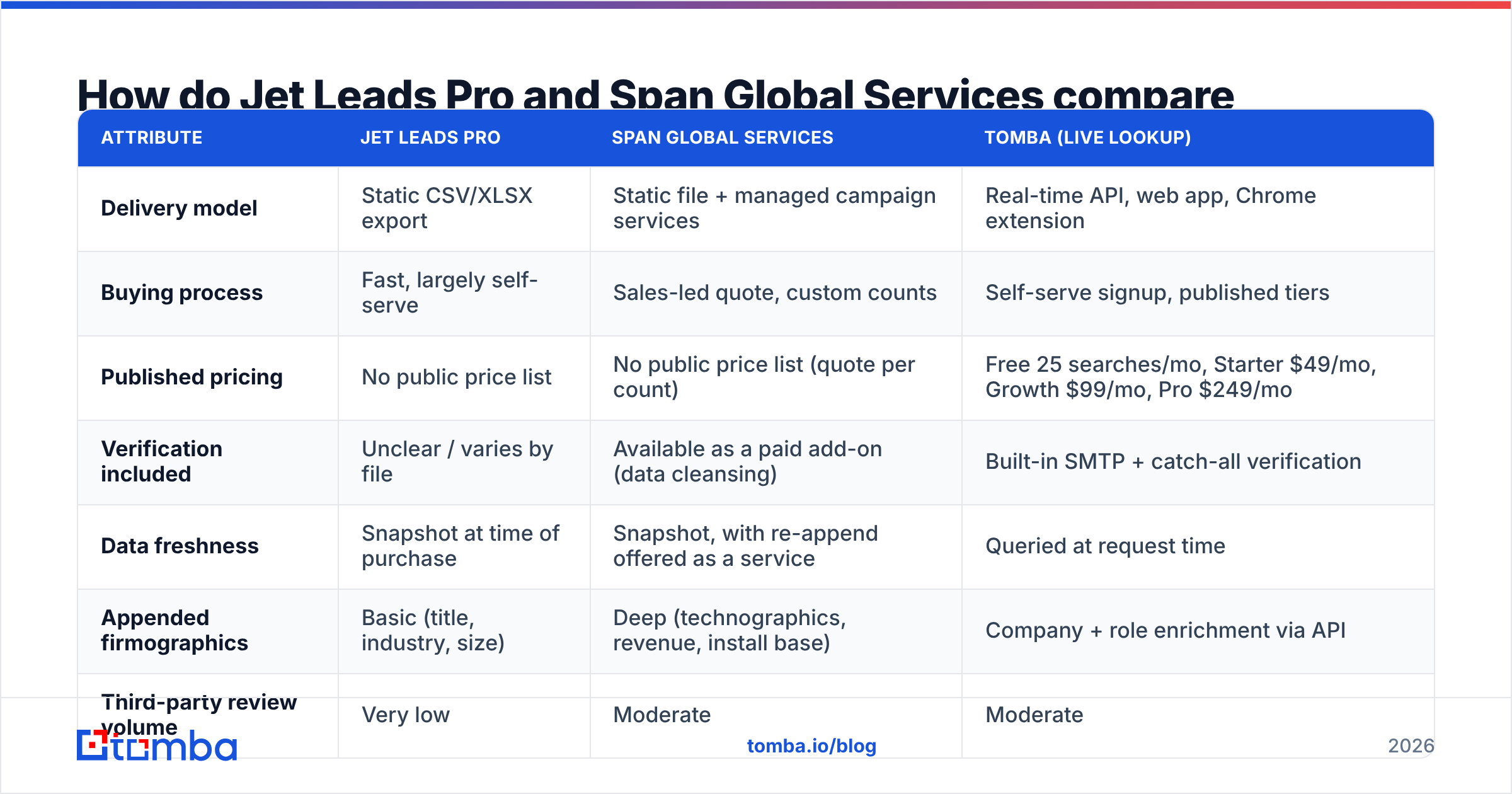
| Attribute | Jet Leads Pro | Span Global Services | Tomba (live lookup) |
|---|---|---|---|
| Delivery model | Static CSV/XLSX export | Static file + managed campaign services | Real-time API, web app, Chrome extension |
| Buying process | Fast, largely self-serve | Sales-led quote, custom counts | Self-serve signup, published tiers |
| Published pricing | No public price list | No public price list (quote per count) | Free 25 searches/mo, Starter $49/mo, Growth $99/mo, Pro $249/mo |
| Verification included | Unclear / varies by file | Available as a paid add-on (data cleansing) | Built-in SMTP + catch-all verification |
| Data freshness | Snapshot at time of purchase | Snapshot, with re-append offered as a service | Queried at request time |
| Appended firmographics | Basic (title, industry, size) | Deep (technographics, revenue, install base) | Company + role enrichment via API |
| Third-party review volume | Very low | Moderate | Moderate |
| Best for | Cheap volume tests | Enterprise ABM list builds with niche filters | Targeted outbound where accuracy per send matters |
Two things jump out of that table.
First, neither list vendor publishes pricing. That is normal for list brokers. It still has a real cost: you cannot work out cost-per-usable-contact in advance. A $0.15/record file at 55% deliverability costs more than a $0.40/record file at 92%. You won't know which one you bought until after the money moves.
Second, verification is a separate line item on both sides. A raw list is not a validated list. Budget for cleaning either way.
What do you actually get when you buy from a list vendor?#
If you've only ever used live lookup tools, the list-broker model works differently. Here's the sequence, and where each step usually breaks:
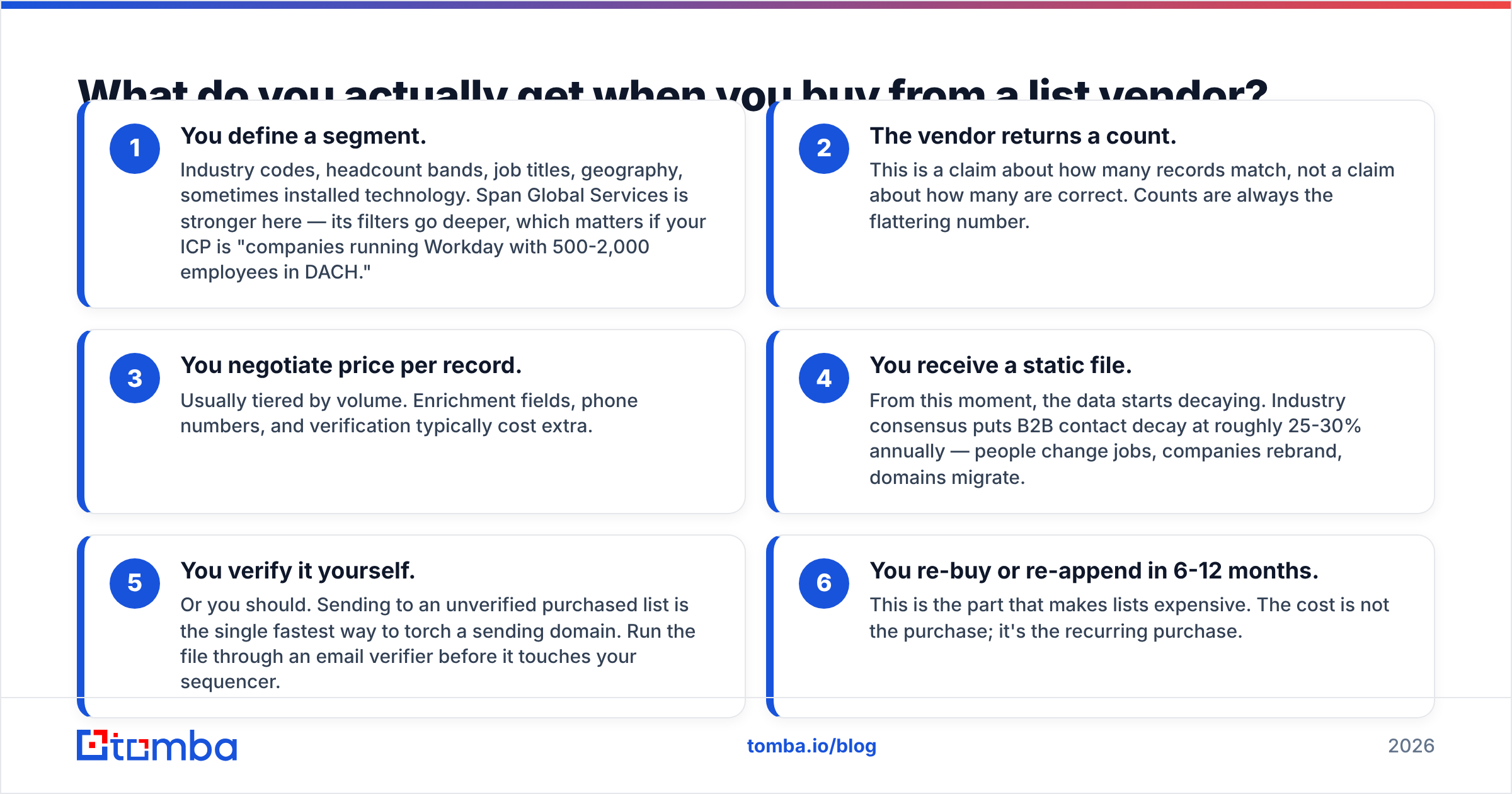
- You define a segment. Industry codes, headcount bands, job titles, geography, sometimes installed technology. Span Global Services is stronger here — its filters go deeper, which matters if your ICP is "companies running Workday with 500-2,000 employees in DACH."
- The vendor returns a count. This is a claim about how many records match, not a claim about how many are correct. Counts are always the flattering number.
- You negotiate price per record. Usually tiered by volume. Enrichment fields, phone numbers, and verification typically cost extra.
The last three steps are where the real cost hides:
- You receive a static file. From this moment, the data starts decaying. Industry consensus puts B2B contact decay at roughly 25-30% annually — people change jobs, companies rebrand, domains migrate.
- You verify it yourself. Or you should. Sending to an unverified purchased list is the single fastest way to torch a sending domain. Run the file through an email verifier before it touches your sequencer.
- You re-buy or re-append in 6-12 months. This is the part that makes lists expensive. The cost is not the purchase; it's the recurring purchase.
That step-6 recurrence is the structural weakness of both vendors relative to a live lookup. A subscription to a lookup tool costs the same next quarter and returns current data; a list costs the same again and returns older data.
Whose data is actually more accurate?#
Nobody can answer this from marketing pages, including me. What you can do is run the same test on both. It takes about two hours and costs less than one bad campaign.
The sample test:
- Request 200-500 records from each vendor in the same segment. Same titles, same industry, same geography. Vendors are very good at looking accurate on easy segments (large US companies, common titles) and much worse on the hard ones.
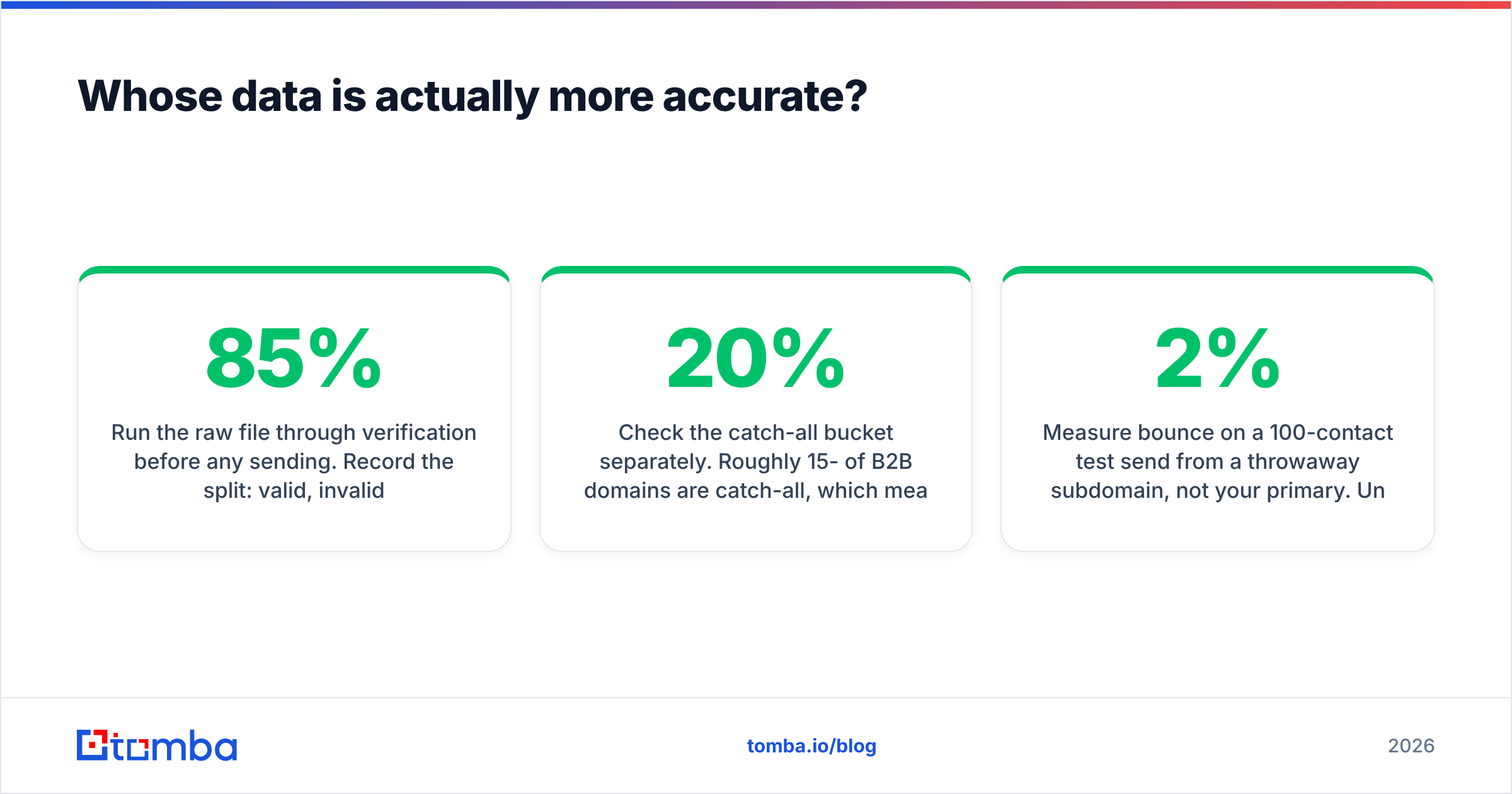
- Run the raw file through verification before any sending. Record the split: valid, invalid, catch-all, unknown. A good purchased file lands at 85%+ valid. Below 70% and you're paying for garbage.
Then check the parts a verifier alone will miss:
- Check the catch-all bucket separately. Roughly 15-20% of B2B domains are catch-all, which means standard verification returns "accept-all" rather than a real verdict. Use a catch-all verifier so those records don't get silently scored as good or silently discarded as bad.
- Spot-check 25 records manually. Open LinkedIn. Is the person still in that role? Is the company still operating under that name? Role-accuracy is where stale lists fail hardest, and verification tools won't catch it. A valid mailbox belonging to someone who left 14 months ago still verifies clean.
- Measure bounce on a 100-contact test send from a throwaway subdomain, not your primary. Under 2% is acceptable. Over 5% means the file is unusable at scale, whatever the verification tool said.
In my experience, the established vendor usually wins on coverage of unusual segments and the cheaper vendor wins on price per raw record. The gap closes or reverses once you compute price per verified, still-employed contact. Run the numbers on that denominator, not the raw one.
One more thing worth checking: ask both vendors where the data comes from. A straight answer about sourcing — opt-in registrations, public web, partner data co-ops, tradeshow lists — tells you more about long-term quality than any accuracy percentage. Vendors who publish their data sources tend to be the ones who can defend them.
Which one is safer on compliance?#
This is where the size gap matters most, and where the cheaper option carries more risk.
Under the CAN-SPAM Act, cold B2B email in the US is legal provided you identify yourself accurately, don't use deceptive headers or subject lines, include a physical address, and honor opt-outs promptly. Buying a list doesn't violate CAN-SPAM by itself.
GDPR is the harder problem. Emailing EU-based people usually needs a lawful basis. For B2B outreach that basis is normally legitimate interest, which means a documented balancing test, a real relevance argument, and a clear opt-out. Purchased lists make this materially harder, because you inherit contacts without inheriting any record of how they were collected.
Practical checks before you sign with either vendor:
- Ask for the data-processing agreement in writing. Not a marketing claim on a webpage — the actual DPA.
- Ask for provenance per record, or at minimum per segment. "Where did this contact come from?" should have an answer.
- Ask about suppression handling. If someone opts out of your campaign, does the vendor suppress them on re-purchase, or will you buy the same person again next year?
- Segment EU records separately and apply stricter rules to them, or exclude them from cold sequences entirely if you don't want to maintain the documentation.
Span Global Services, being the larger and longer-established firm, has the more visible compliance apparatus and a formal contracting process. With a smaller vendor, assume nothing and ask everything. Get the answers in the contract, not in a sales call.

When should you skip both and use a live email finder instead?#
Buying a list makes sense in exactly one scenario: you need broad coverage of a segment you cannot enumerate yourself. Ten thousand HVAC contractors across twelve states, for example. You don't have a company list, and building one manually would cost more than buying it.
For almost every other outbound motion, a live lookup wins on unit economics:
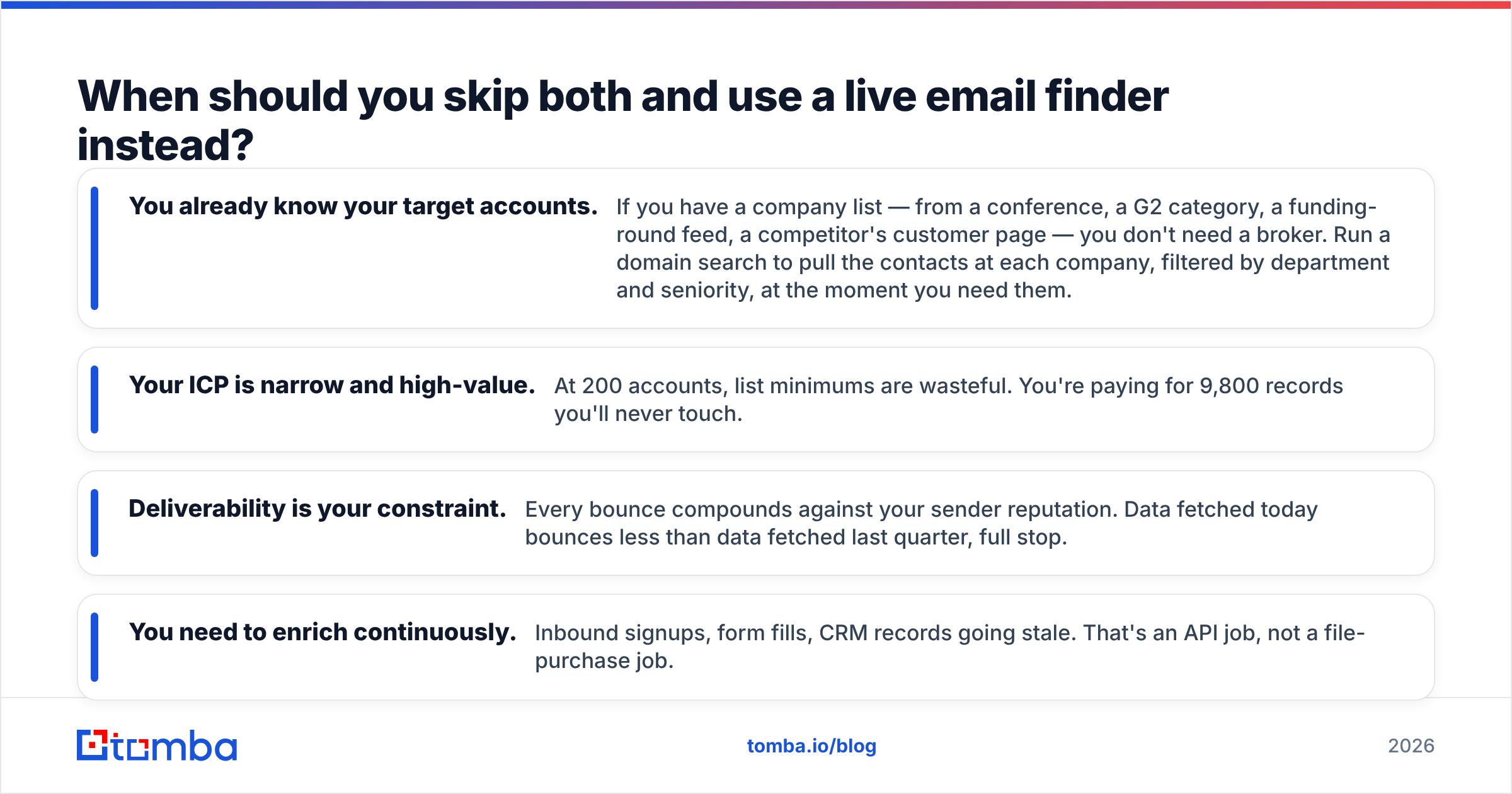
- You already know your target accounts. If you have a company list — from a conference, a G2 category, a funding-round feed, a competitor's customer page — you don't need a broker. Run a domain search to pull the contacts at each company, filtered by department and seniority, at the moment you need them.
- Your ICP is narrow and high-value. At 200 accounts, list minimums are wasteful. You're paying for 9,800 records you'll never touch.
- Deliverability is your constraint. Every bounce compounds against your sender reputation. Data fetched today bounces less than data fetched last quarter, full stop.
- You need to enrich continuously. Inbound signups, form fills, CRM records going stale. That's an API job, not a file-purchase job.
The cost comparison is less lopsided than people expect. A mid-size purchased list, plus verification, plus a re-append cycle often lands in the same annual range as a sub-$100/month lookup subscription. The difference is that the subscription returns current data every single month. You can check current Tomba pricing against whatever quote you receive. The Growth tier at $99/mo covers most two-to-five-person outbound teams, and the free tier gives you 25 searches to sanity-check accuracy before you spend anything.
For batch work, a bulk email finder closes most of the remaining gap: upload your company list, get back verified contacts, skip the broker entirely.
So which should you choose in 2026?#
The short answer on Jet Leads Pro vs Span Global Services: pick by use case, not by list price.
Choose Span Global Services if you need deep segmentation on an unusual ICP, you're running account-based campaigns at enterprise scale, you want appended technographic and firmographic fields, and you have procurement bandwidth for a sales-led purchase with a real contract and DPA. It is the lower-risk of the two list options.
Choose Jet Leads Pro if you want a cheap, fast volume test on a common segment and you are prepared to verify aggressively and discard heavily. Run a paid sample before any commitment, and don't sign an annual deal on a vendor you can't independently validate.
Choose neither if you already know which companies you want to reach. That's the majority of outbound teams, and it's the case where both list vendors are solving a problem you don't have — while charging you for records that started decaying the day they were exported.
The discipline that matters more than the vendor choice: compute cost per verified, still-employed contact, not cost per record. That single metric reorders almost every vendor comparison in this category, and it's the number neither quote will hand you voluntarily.
Ready to stop buying stale files? Start with your existing account list and pull current, verified contacts on demand with the Tomba Email Finder — free tier includes 25 searches a month, no sales call, no minimum order, and no file that expires the moment it lands in your inbox.
Related guides#
// get started
Find, verify and enrich your first contacts today
Start on the free plan with 25 searches a month, then scale when your team is ready.
Free plan · No credit card required · GDPR & CCPA
// about the author