Jiminny Pricing Reviews Pros and Cons: A 2026 Breakdown
Jiminny is one of the cheaper conversation intelligence platforms — but seat minimums, annual terms and add-on data costs change the math. Here's what it really costs in 2026, plus honest pros and cons.
Shopping for a conversation intelligence tool? Here is the short version on Jiminny pricing reviews pros and cons: what a seat really costs, what buyers praise, and where the product falls short.
TL;DR — Jiminny pricing at a glance
- Jiminny is a conversation intelligence and coaching platform. It records calls, transcribes them, writes AI summaries, and syncs the data to your CRM. It competes with Gong, Chorus and Avoma, and it prices below Gong.
- Jiminny does not publish a full self-serve price list. Reported figures cluster around $85/user/month for the full platform. A lighter recording-only tier sits in the $35–$50/user/month range. Every number below is a reported range, not a quote. Confirm it with their sales team.
- The sticker price is not the real cost driver. Seat minimums, annual-only billing and onboarding fees are. So is the fact that you pay full price for people who only watch calls.
TL;DR — reviews and fit
- Reviews are strong on support and easy setup. They are mixed on AI summary quality for accented speech, on the mobile app, and on search depth.
- Conversation intelligence only pays off if your reps talk to enough qualified people. If your pipeline is thin, fix the contact data layer first. It costs a fraction of a CI seat.
What is Jiminny, and who actually buys it?#
Jiminny records your sales calls — Zoom, Teams, Meet and dialer calls. It transcribes them, scores them, and pushes the highlights into your CRM. Think of it as a dashcam for revenue conversations. Nobody watches the footage on a good day. But when a deal dies or a new rep stalls, the tape shows you which turn was missed.
The product splits into three jobs:
- Capture — auto-join meetings, record, transcribe, and log activity back to HubSpot or Salesforce with no rep effort.
- Coach — comment on timestamps, build playlists of great calls, and track talk ratios, monologue length, question rates and filler words.
- Forecast — deal boards, pipeline risk signals and engagement scoring layered over the conversation data.
The typical buyer is a 10–60 seat SMB or mid-market sales team with a real onboarding problem. New AEs ramp too slowly. Discovery is inconsistent. Managers cannot sit on every call. Teams above roughly 150 seats tend to buy Gong instead, and that is procurement gravity rather than a feature gap.
Jiminny is a UK company, which matters for two practical reasons. EU/UK data residency is easier than with several US-only vendors. Support hours also skew to European time zones — a plus in London, a trade-off on Pacific time.
How much does Jiminny cost in 2026?#
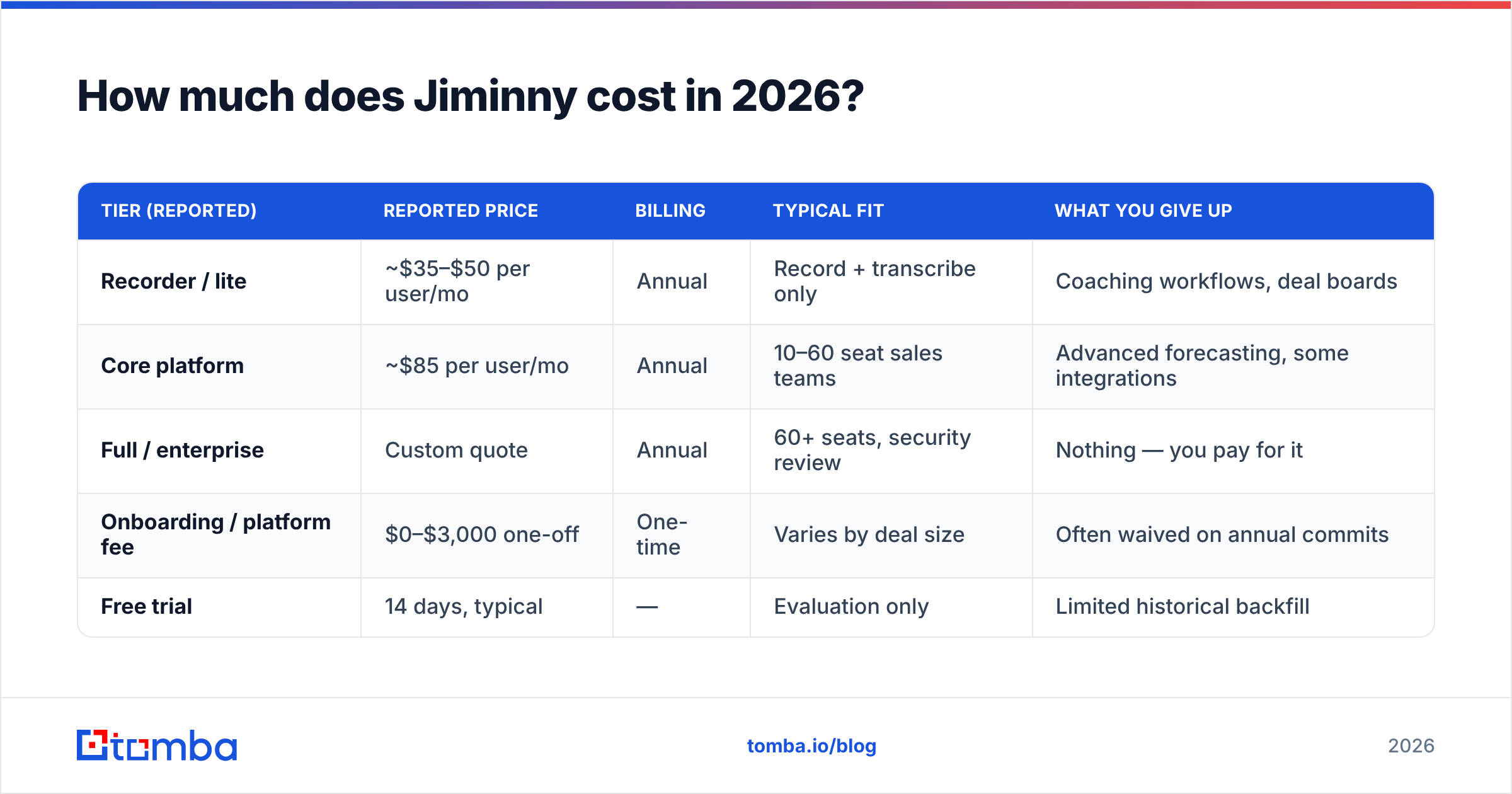
Here is the honest answer first: Jiminny does not publish a complete public price list. Anyone who shows you an exact per-seat figure is quoting a reseller listing, an old review page, or one customer's contract. What follows is the reported range, pulled from vendor directories and buyer reports. Treat it as a starting point for your negotiation, not as a quote.
| Tier (reported) | Reported price | Billing | Typical fit | What you give up |
|---|---|---|---|---|
| Recorder / lite | ~$35–$50 per user/mo | Annual | Record + transcribe only | Coaching workflows, deal boards |
| Core platform | ~$85 per user/mo | Annual | 10–60 seat sales teams | Advanced forecasting, some integrations |
| Full / enterprise | Custom quote | Annual | 60+ seats, security review | Nothing — you pay for it |
| Onboarding / platform fee | $0–$3,000 one-off | One-time | Varies by deal size | Often waived on annual commits |
| Free trial | 14 days, typical | — | Evaluation only | Limited historical backfill |
Three structural details matter more than the per-seat number:
- Annual commitment is the norm. Monthly billing carries a premium where it is offered at all. Below a certain seat count, it is not offered. Budget for a 12-month lock.
- Seat minimums exist. Reported floors sit around 5 seats. A three-person startup team usually cannot buy the platform tier at list price.
- Viewer seats are still seats. Your CEO, two CS leads and a product manager all want to browse call libraries. Most quotes count them. That is the most common source of "why is our invoice 40% higher than we modeled?"

What does a real 2026 quote look like?#
Model it like this before you talk to sales:
- 10 AEs on the core platform at ~$85/seat → roughly $10,200/year.
- Add 4 non-selling viewer seats → roughly $14,280/year.
- Add onboarding → up to $3,000 in year one.
- Add the CRM plan you need for the integration to be useful — HubSpot Sales Pro or Salesforce Enterprise is the usual prerequisite.
The all-in year-one figure for a 14-seat team lands closer to $15,000–$17,000 than to the $10,200 the per-seat math suggests. That is not a Jiminny trick. It is how the whole conversation intelligence category prices. But it should shape how you compare quotes.
How does Jiminny pricing compare to Gong, Chorus and Avoma?#
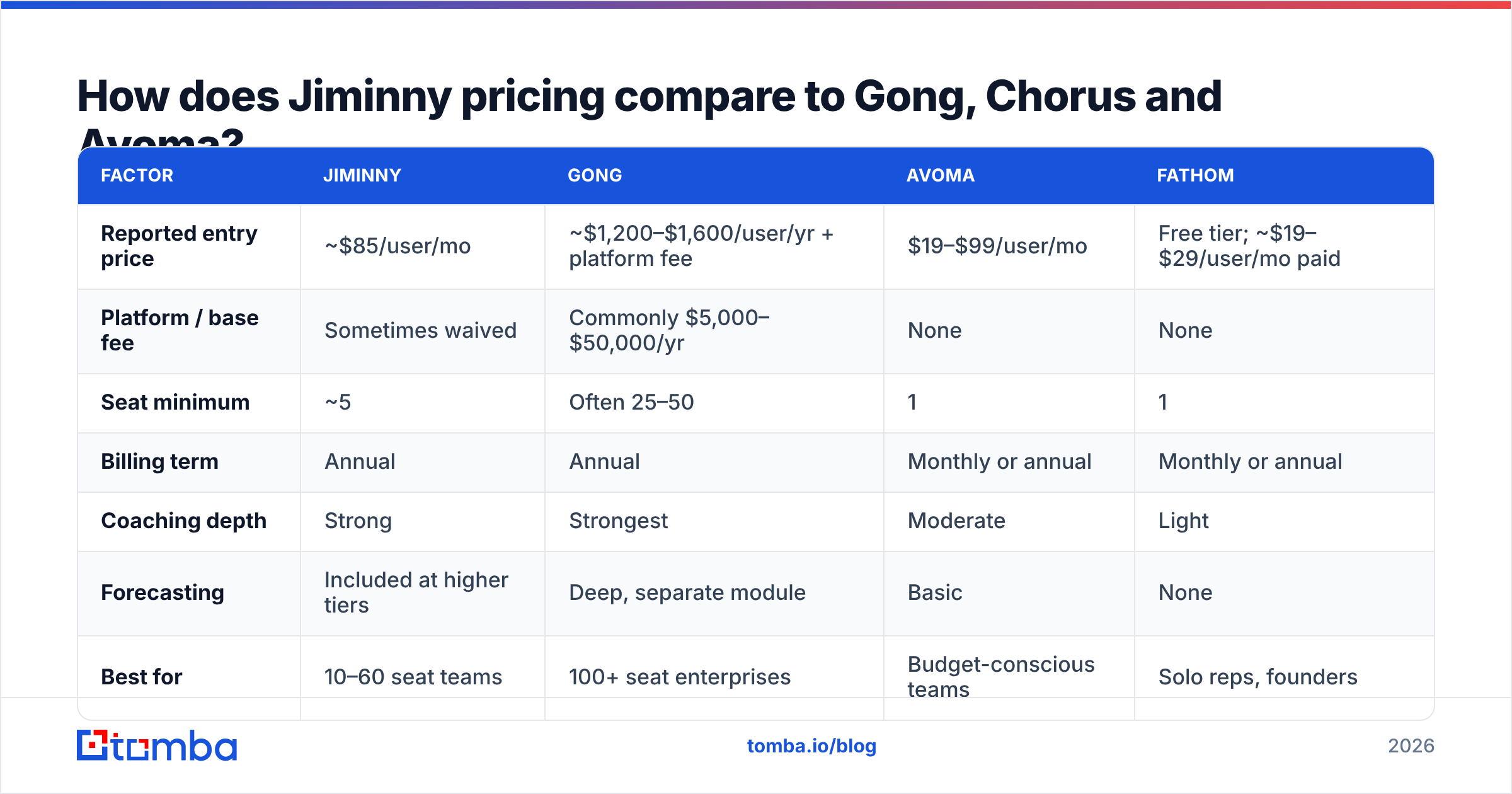
| Factor | Jiminny | Gong | Avoma | Fathom |
|---|---|---|---|---|
| Reported entry price | ~$85/user/mo | ~$1,200–$1,600/user/yr + platform fee | $19–$99/user/mo | Free tier; ~$19–$29/user/mo paid |
| Platform / base fee | Sometimes waived | Commonly $5,000–$50,000/yr | None | None |
| Seat minimum | ~5 | Often 25–50 | 1 | 1 |
| Billing term | Annual | Annual | Monthly or annual | Monthly or annual |
| Coaching depth | Strong | Strongest | Moderate | Light |
| Forecasting | Included at higher tiers | Deep, separate module | Basic | None |
| Best for | 10–60 seat teams | 100+ seat enterprises | Budget-conscious teams | Solo reps, founders |
The pattern is clear. Jiminny sits in the gap between free meeting recorders and enterprise revenue intelligence. You pay about half of Gong's real cost for maybe 80% of the coaching value. You pay about triple Avoma's entry price for a sharper coaching and deal-review workflow.
If you just need transcripts in the CRM, Jiminny is overpriced and a cheaper recorder wins. If your managers must run structured call reviews every week, and you want that data to survive rep turnover, the price is fair. Check current listings on G2 before you negotiate. Review-site pricing tiles move a few times a year, and they give you a useful anchor.
What do Jiminny reviews actually say?#
If you are weighing Jiminny pricing reviews pros and cons, this is the section that matters most. Aggregate sentiment sits above 4.5/5 across the major directories, which is high even for this category. But averages hide the useful detail. Here is what repeats in the written reviews.
What reviewers praise, repeatedly:
- Support and onboarding. This is the most repeated compliment. Named CSMs, fast replies and hands-on setup show up in review after review. For a mid-market team with no RevOps hire, that is worth real money.
- Setup speed. Most teams report being live within days, not weeks. Calendar and CRM connection is the bulk of the work.
- Coaching workflow. Timestamped comments, call playlists and scorecards get used rather than shelved. That is not the norm for enablement tooling.
- Price relative to Gong. Buyers who ran both evaluations often cite Jiminny as the one they could actually get approved.
- CRM hygiene. Automatic activity logging removes a chunk of manual rep admin. That is often the first ROI reviewers point to.
What reviewers complain about, repeatedly:
- Transcription accuracy on accents and cross-talk. Strong regional accents, fast multi-party calls and non-English segments all degrade quality. AI summaries inherit those errors, and they sometimes assert things nobody said.
- Search depth. Finding one specific moment across hundreds of calls is workable, but not as sharp as reviewers expect after using enterprise tools.
- Mobile experience. The mobile app is described as functional rather than good. Managers who coach from the road notice.
- Notification volume. Default alerting is noisy. Most teams spend their first week turning it down.
- Per-seat cost for passive users. The recurring pricing complaint is not the AE seat price. It is paying full freight for people who only watch calls.
None of that is disqualifying. But if your team sells in several languages or across heavy accents, run the trial on your hardest recordings, not your cleanest ones.
What are the hidden costs buyers miss?#
Four line items show up after the contract is signed:
- The CRM prerequisite. Deep two-way sync generally assumes a mid or upper CRM tier. If you are on a starter plan, factor the upgrade into your comparison.
- Storage and retention. Long retention windows on video are an enterprise-tier conversation. Ask what happens to recordings at month 13 of a 12-month contract.
- Admin time. Scorecards, call taxonomies and coaching cadences do not build themselves. Budget 10–20 hours of a manager's time in month one.
- Uplift at renewal. Annual uplift clauses of 5–10% are common across the category. Ask for a cap in writing during the first negotiation, when you have the most leverage.

Is Jiminny worth it for your team?#
Use this as a fast qualification test. Jiminny is likely worth the spend if three or more of these are true:
- You have 8+ quota-carrying reps and at least one dedicated manager.
- New rep ramp time is over 90 days and you cannot explain why.
- Deals die between discovery and proposal, and nobody can reconstruct what happened.
- You run Salesforce or HubSpot properly and want activity data you can trust.
- You evaluated Gong and got blocked on budget, not on capability.
Jiminny is probably not worth it if:
- You have fewer than five reps. Seat minimums and annual terms work against you, and a cheap recorder covers the actual need.
- Your problem is volume of conversations, not quality of conversations. Recording 12 calls a week more carefully will not fix a pipeline that needs 40.
- Nobody is accountable for running coaching sessions. Conversation intelligence with no coaching ritual becomes an expensive archive within two quarters.
That second point is the one most teams get wrong. Conversation intelligence is a magnifying glass, not a faucet. It makes existing conversations more valuable. It does not create them.
What should you budget alongside Jiminny?#
You may spend $15,000 a year to analyze conversations. The cheapest adjacent investment is making sure enough of the right conversations exist to analyze. That is a data problem, and it is priced an order of magnitude lower.
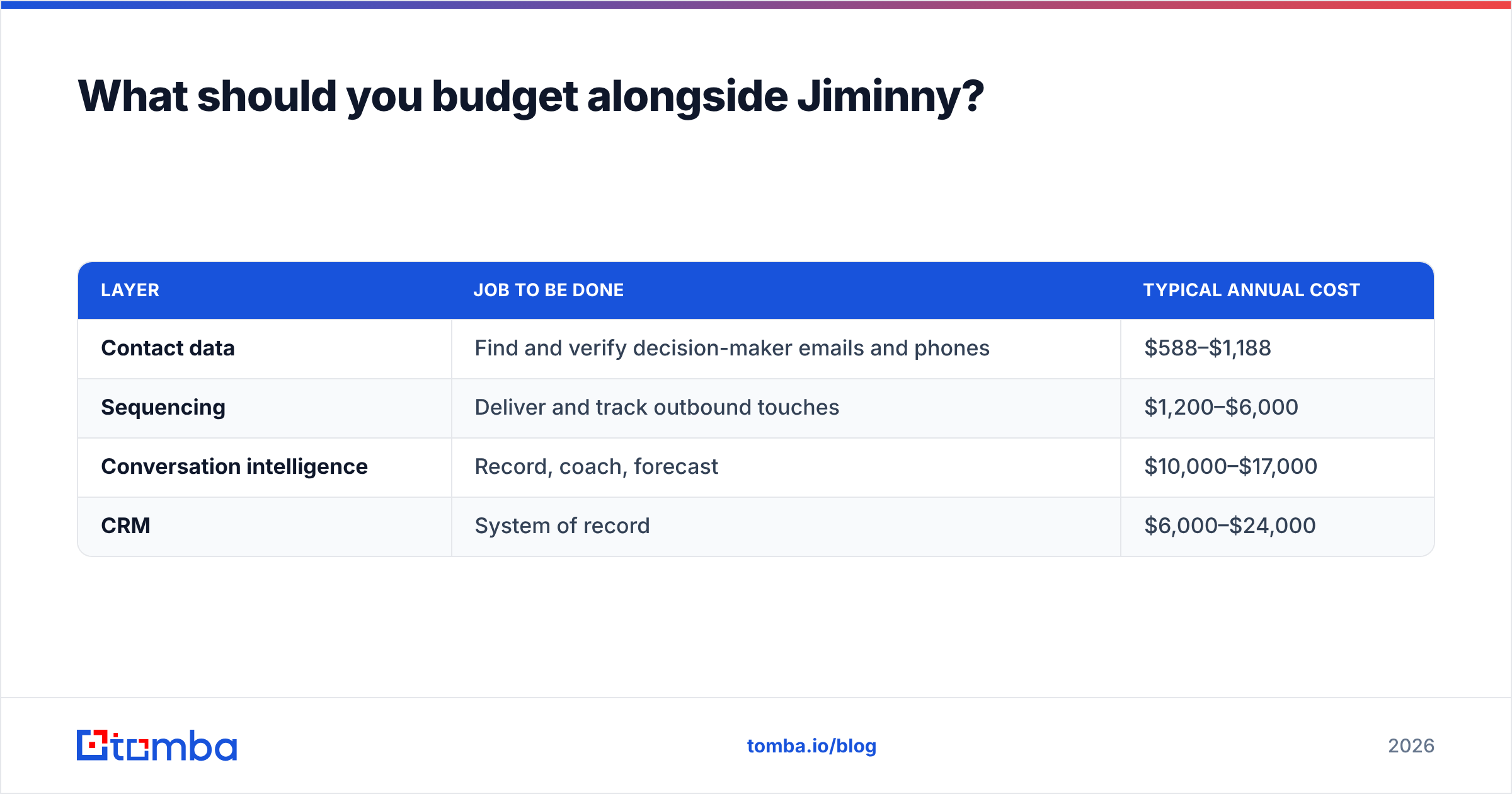
A practical stack for a 10–15 seat team looks like this:
| Layer | Job to be done | Typical annual cost |
|---|---|---|
| Contact data | Find and verify decision-maker emails and phones | $588–$1,188 |
| Sequencing | Deliver and track outbound touches | $1,200–$6,000 |
| Conversation intelligence | Record, coach, forecast | $10,000–$17,000 |
| CRM | System of record | $6,000–$24,000 |
The contact data layer is the smallest line here. It also has the most direct effect on how many calls exist to record. Tomba's email finder resolves verified work addresses by name and domain. The email verifier strips the bounces that wreck sender reputation. The phone finder surfaces direct dials, so your reps connect instead of dialing switchboards.
Tomba starts free at 25 searches a month. Paid plans run $49, $99 and $249 — see the full Tomba pricing breakdown for the credit allowance at each tier.
Put plainly: one Jiminny seat costs about what a full year of solid contact data costs. Get the inputs right before you spend heavily on analyzing the outputs.
How should you negotiate a Jiminny contract?#
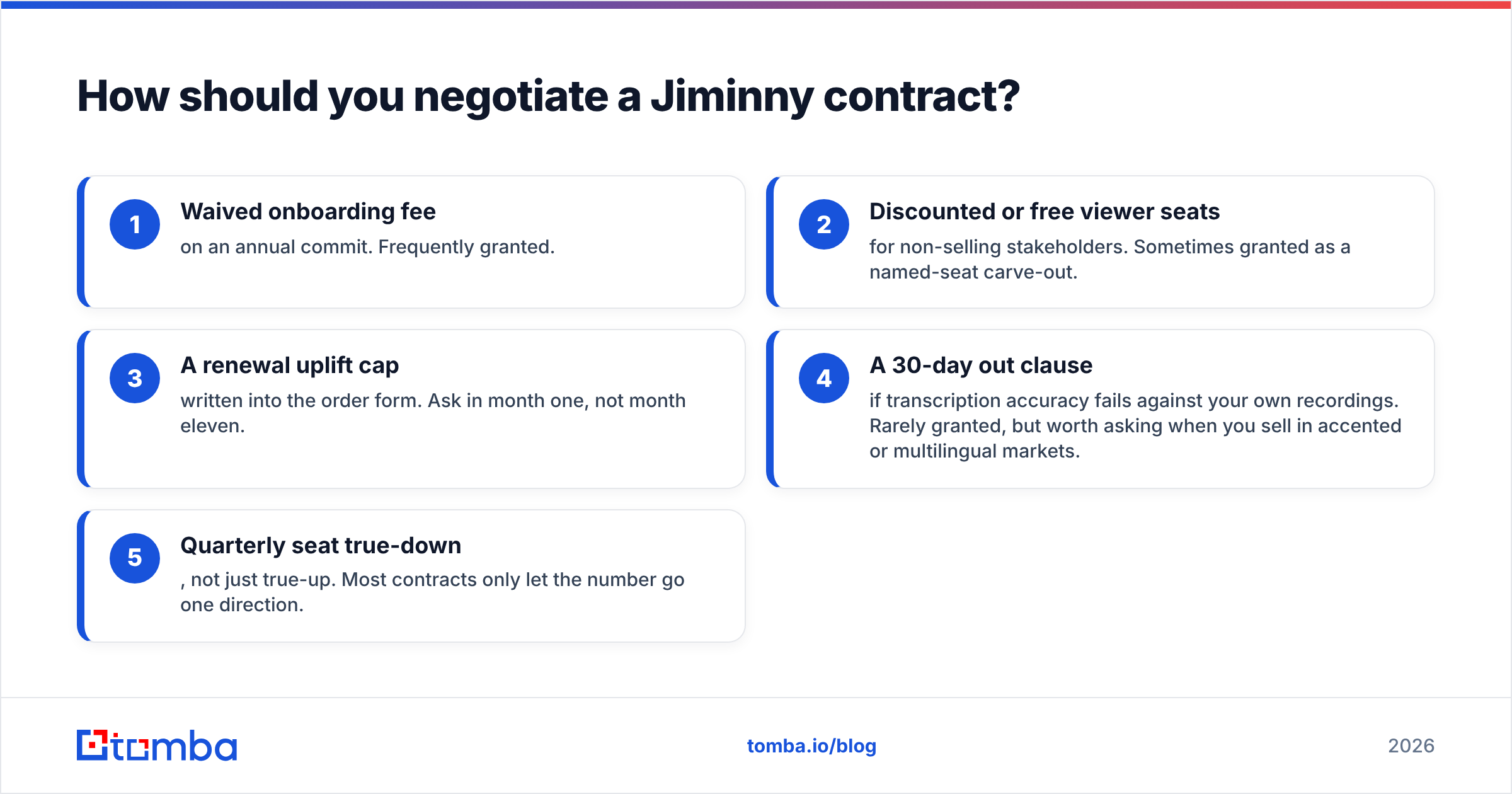
Five things to ask for, in rough order of how often they are granted:
- Waived onboarding fee on an annual commit. Often granted.
- Discounted or free viewer seats for non-selling stakeholders. Sometimes granted as a named-seat carve-out.
- A renewal uplift cap written into the order form. Ask in month one, not month eleven.
- A 30-day out clause if transcription accuracy fails on your own recordings. Rarely granted, but worth asking when you sell in accented or multilingual markets.
- Quarterly seat true-down, not just true-up. Most contracts only let the number move one way.
Run the trial with your hardest calls, your noisiest rooms and your strongest accents. Review-site averages tell you how the product performs for the median buyer, and you are not the median buyer. Directories like Capterra help you spot repeated complaints. But only your own audio tells you whether the AI summaries are trustworthy enough that managers stop re-listening to the raw call.
Jiminny pricing reviews pros and cons: the bottom line#
Jiminny is fairly priced for what it does. It is a mid-market conversation intelligence platform at roughly half the real cost of the enterprise leader, and reviewers rate support as its best feature. The pros are real: fast setup, coaching workflows people actually use, and clean CRM logging. The cons are real too: accent-sensitive transcription, a thin mobile app, per-seat cost for passive viewers, and annual lock-in. Those cons are what your negotiation should target.
Before you sign, make sure the conversations exist. If your reps are running out of qualified people to talk to, start with the data layer. Use the Tomba Email Finder to build verified, decision-maker contact lists from any domain. Then let your conversation intelligence spend go to work on a pipeline that is actually full. Start free with 25 searches a month and scale to $49/mo when the volume justifies it.
Related guides#
// get started
Find, verify and enrich your first contacts today
Start on the free plan with 25 searches a month, then scale when your team is ready.
Free plan · No credit card required · GDPR & CCPA
// about the author