Job Change Sales Prospecting: The 2026 Playbook That Works
Job changes are the highest-intent trigger in B2B. Here is how to catch them in the first 90 days, verify the new work email, and write an outreach sequence that actually converts.
TL;DR
- A job change is the strongest buying trigger in B2B outbound: a new buyer arrives with budget authority, a mandate to change things, and no loyalty to the incumbent vendor.
- The window is roughly days 30–90. Before day 30 they are drowning in onboarding; after day 120 they have already re-signed the vendor they knew.
- Two plays matter: champion tracking (a happy customer moves to a new company) and persona tracking (anyone in your ICP takes a relevant title).
- The whole play collapses if the data layer is wrong. Your CRM still holds their old work email, which now hard-bounces and damages your sender reputation.
- Build the stack in this order: detection signal → new-company resolution → email pattern + verification → a sequence that references the move without being creepy.
What is job change sales prospecting?#
Job change sales prospecting is outbound built around a single event: someone in your addressable market starts a new role. Instead of spraying a static list, you watch for movement and time your outreach to the moment a person has both a fresh problem and fresh authority.
Think of it like a moving truck pulling up to a new house. The day the truck arrives, that household buys a dozen things they never thought about before — internet, a locksmith, lawn care, a new couch. Nobody is going to switch broadband providers on a random Tuesday in year three. They switch the week they move. B2B buyers behave identically: a VP of Revenue Operations who has used a tool for four years will not evaluate an alternative until the day she starts somewhere new and is asked "what stack do you want?"
Two distinct motions sit under the same umbrella, and confusing them is the most common reason these programs underperform.
- Champion tracking — a person who already used, liked, and championed your product leaves Company A for Company B. Your job is to catch them before Company B's procurement cycle closes. This is the highest-converting list you will ever build.
- Persona tracking — someone who has never heard of you takes a title inside your ICP. Lower conversion, far higher volume, and still better than a cold list because the trigger gives you a legitimate reason to write.
- Detractor avoidance — the inverse play nobody documents. If a person churned your product angrily and now runs buying at a target account, flag it so your rep does not walk into a landmine.
- Internal promotions — same company, new scope. Weaker than a move, but a promotion from Director to VP often unlocks a budget line that did not exist last quarter.

Why does the 90-day window matter so much?#
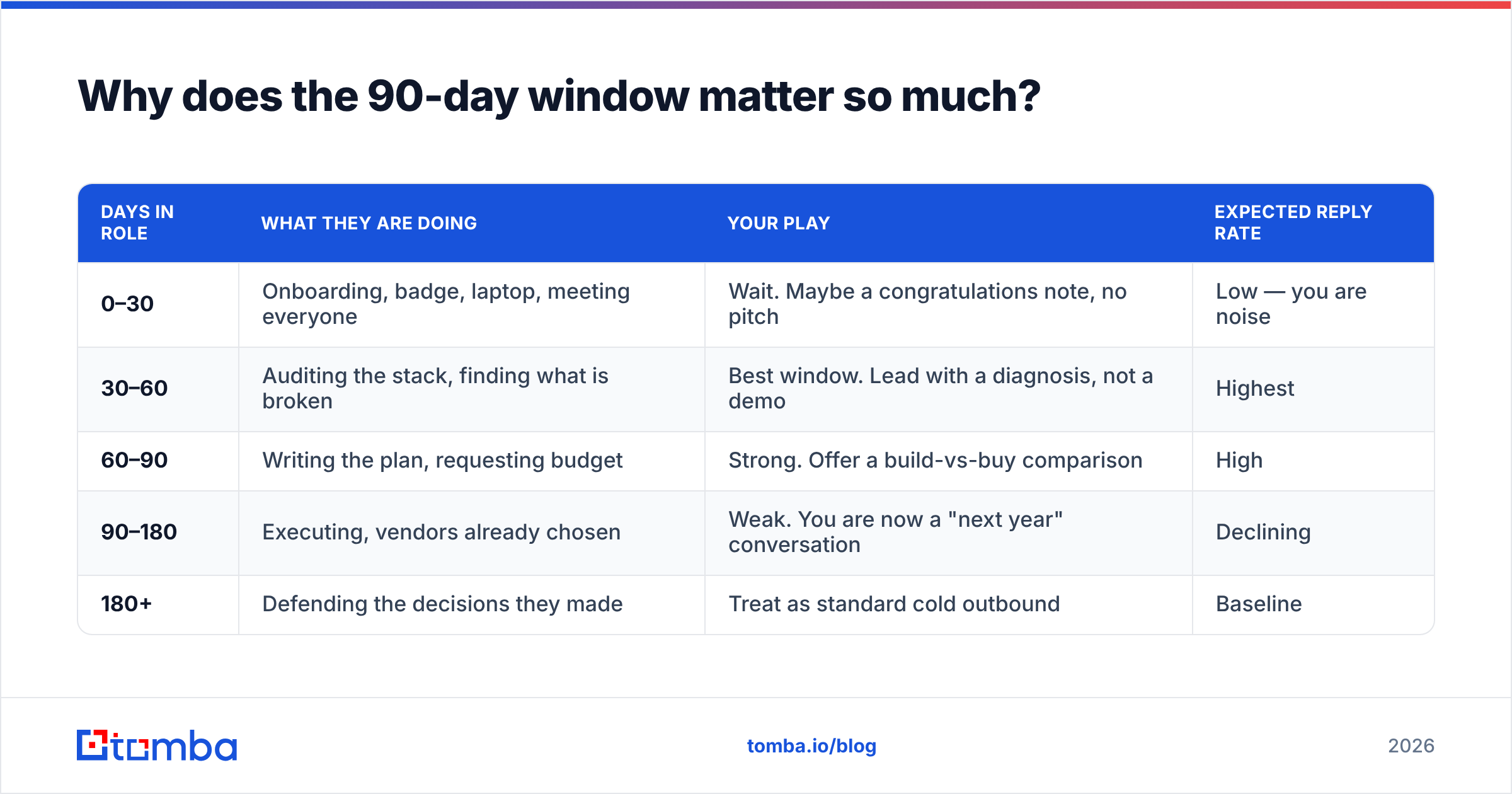
Because new executives buy early and then stop buying. The first quarter of a new role is the only period where changing vendors costs a leader nothing politically — any decision made in month two is inherited wisdom, and any decision made in month ten is their own mistake.
Here is how the timeline realistically breaks down for a mid-market buyer:
| Days in role | What they are doing | Your play | Expected reply rate |
|---|---|---|---|
| 0–30 | Onboarding, badge, laptop, meeting everyone | Wait. Maybe a congratulations note, no pitch | Low — you are noise |
| 30–60 | Auditing the stack, finding what is broken | Best window. Lead with a diagnosis, not a demo | Highest |
| 60–90 | Writing the plan, requesting budget | Strong. Offer a build-vs-buy comparison | High |
| 90–180 | Executing, vendors already chosen | Weak. You are now a "next year" conversation | Declining |
| 180+ | Defending the decisions they made | Treat as standard cold outbound | Baseline |
The practical consequence is that detection latency is your real KPI. If your data source surfaces job changes on a 45-day refresh cycle, you have burned half the window before a rep ever sees the record. A source that is 70% accurate but refreshed weekly will outperform a source that is 95% accurate but refreshed quarterly, because the accurate one keeps handing your reps expired opportunities.
How do you actually detect a job change?#
There is no single perfect feed. In practice teams stack three or four signals and dedupe.
Signal sources, ranked by cost and reliability:
- Profile monitoring on professional networks. The canonical source — people update their own titles. The catch is lag: many people update 2–8 weeks after starting, and some never do. Good for coverage, mediocre for speed.
- Email bounce-backs from your own CRM. Vastly underrated and free. When a previously deliverable contact starts returning a hard bounce or an auto-reply that says "no longer with the company," that is a confirmed departure, usually within days of the actual event. Most teams delete these records. Route them to a "tracked departure" queue instead.
- Company announcement pages and press releases. High precision, low volume, and skewed toward senior hires. Worth monitoring for your top 200 target accounts only.
- Commercial job-change feeds. Vendors like UserGems and LeadIQ sell this as a product, with CRM sync built in. Convenient, expensive, and you are paying for the same underlying public data plus the plumbing.
- Podcast, webinar and article bylines. New leaders do a press tour. An author finder that maps bylines back to contact details will surface people who just took a role and are already publishing under the new company's brand.
For most teams under 50 reps, the honest answer is that the bounce-back queue plus a weekly profile sweep on a tracked list of 2,000–5,000 champions covers 80% of the value at a fraction of the cost of a dedicated platform. Scale into a paid feed once you can prove the sequence converts.
What breaks when someone changes jobs? (The data problem)#
Everything downstream of the person's identity. The record in your CRM is now three-quarters wrong: company, email, phone, title, and often the mailing address. Only the human's name and their historical relationship with you survive.
This is where most job-change programs quietly die. The trigger fires, the rep gets excited, and the sequence goes out to first.last@old-company.com — a mailbox that was disabled the day they left. A hard bounce on a dead domain contributes directly to sender reputation damage, and a handful of them across a sending domain will start pushing your good mail into spam. You have turned your best lead source into a deliverability liability.
The fix is a strict four-step resolution chain that runs before any message is queued:
- Resolve the new company. You have a person and a company name string. Convert it to a canonical domain — "Acme Health, Inc." must become
acmehealth.com, notacmehealth.co.ukor the careers microsite. - Determine the email pattern for that domain. Every company has a dominant format:
first.last@,flast@,first@. A domain search returns known addresses at the domain plus the detected pattern, which is the fastest way to get this right without guessing. - Generate and find the candidate address. Apply the pattern to the person's name. This is what an email finder does natively — you pass a name and a domain and get back an address with a confidence score and the sources that support it.
- Verify before send. Run SMTP-level verification. If the domain is catch-all, the standard verifier will return "accept all" and tell you nothing useful — that is what a catch-all verifier is for, since roughly a fifth of B2B domains sit behind catch-all configurations.
Skipping step four is the single most expensive shortcut in this entire playbook. Verification costs a fraction of a cent per record. A blacklisted sending domain costs you a quarter.

Which tools should you use for the data layer?#
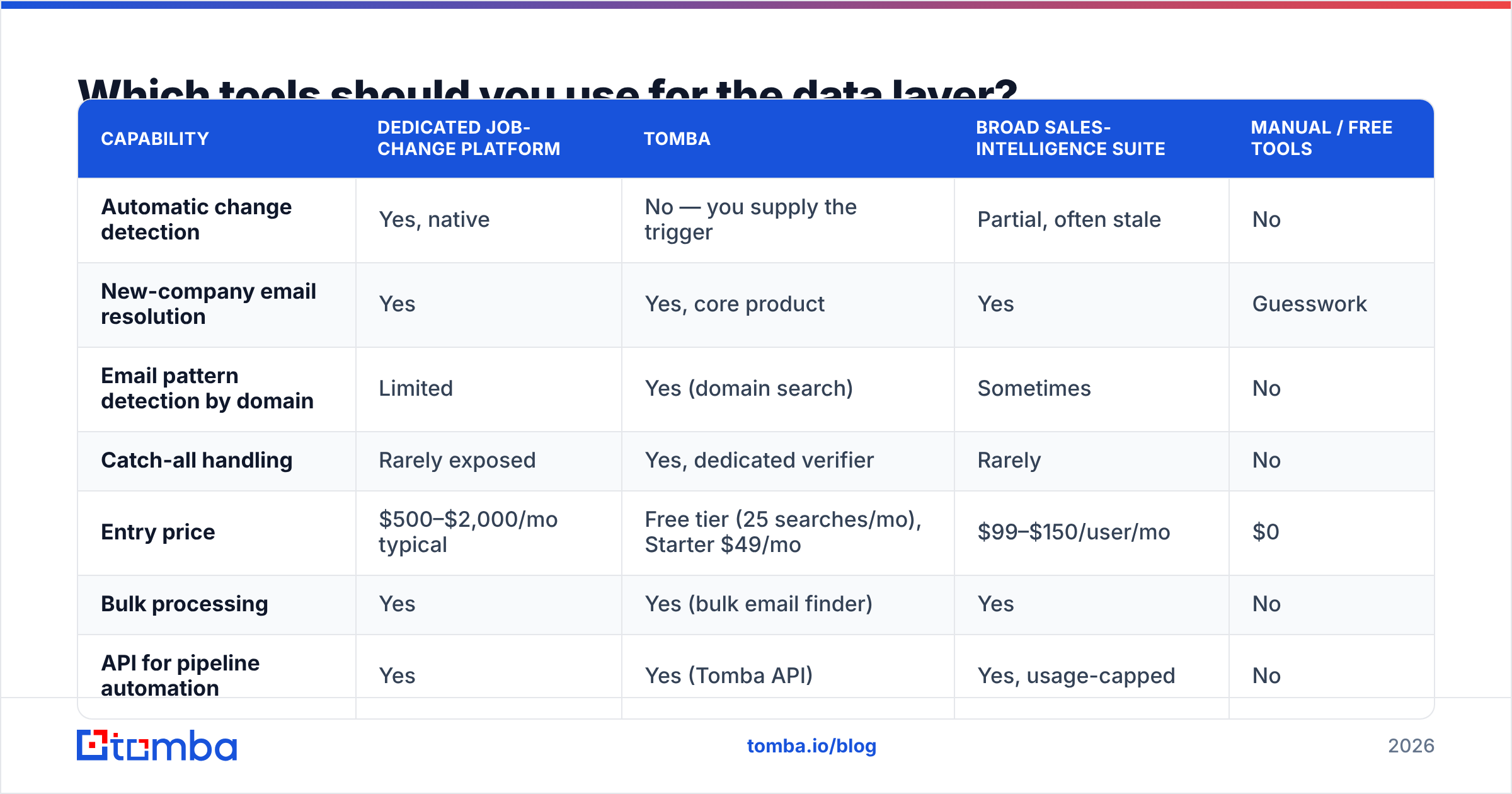
It depends on whether you need the signal, the contact data, or both. Dedicated job-change platforms bundle detection with enrichment and charge for the bundle. Email-finding platforms give you the resolution layer at a much lower unit cost, and you supply the trigger.
| Capability | Dedicated job-change platform | Tomba | Broad sales-intelligence suite | Manual / free tools |
|---|---|---|---|---|
| Automatic change detection | Yes, native | No — you supply the trigger | Partial, often stale | No |
| New-company email resolution | Yes | Yes, core product | Yes | Guesswork |
| Email pattern detection by domain | Limited | Yes (domain search) | Sometimes | No |
| Catch-all handling | Rarely exposed | Yes, dedicated verifier | Rarely | No |
| Entry price | $500–$2,000/mo typical | Free tier (25 searches/mo), Starter $49/mo | $99–$150/user/mo | $0 |
| Bulk processing | Yes | Yes (bulk email finder) | Yes | No |
| API for pipeline automation | Yes | Yes (Tomba API) | Yes, usage-capped | No |
| CRM write-back | Native | Via integrations | Native | Manual |
A note on prebuilt B2B databases: providers such as BookYourData are a legitimate complement here rather than a competitor to the trigger motion. If you need to build the watchlist in the first place — say, every RevOps leader at 500 companies in a vertical — a curated database is a faster starting point than scraping. The job-change layer then runs on top of that list over time. Different jobs, both needed.
The pragmatic architecture for most teams: build the watchlist from a database or your own closed-won history, detect changes with a cheap signal, and resolve contact data through an API call at the moment the trigger fires. Paying a premium platform to store contact data that goes stale at 25–30% per year is a worse deal than resolving on demand. Compare the unit economics on the Tomba pricing page against a per-seat intelligence suite before you sign anything annual.

How do you write the outreach without sounding like a stalker?#
Reference the role, not the surveillance. "Congrats on the move — saw you announced it last week" is fine. "I've been tracking you since you left Acme" is not, even though it is more honest.
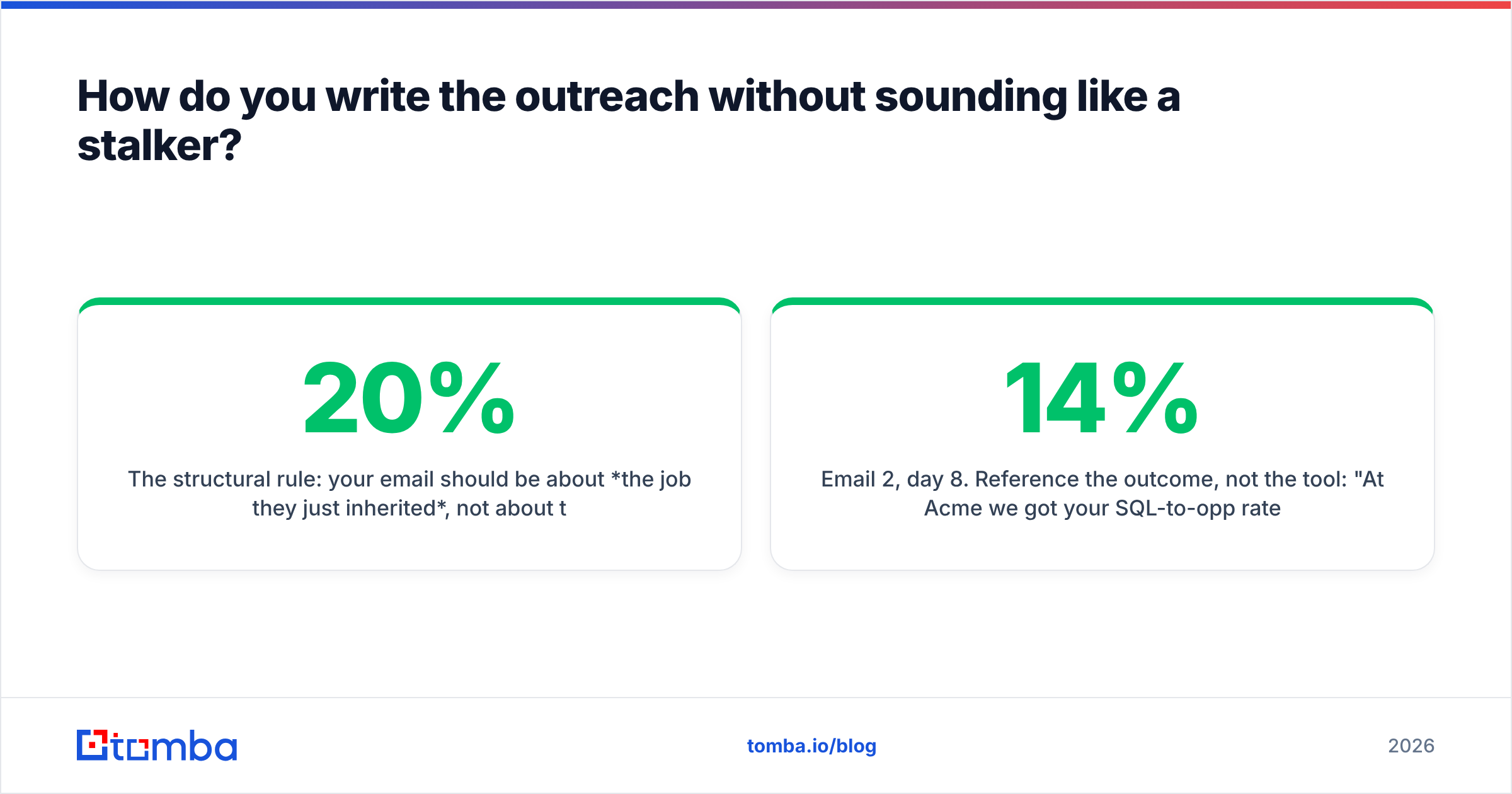
The structural rule: your email should be about the job they just inherited, not about the fact that they changed jobs. A new VP of Demand Gen does not care that you noticed. She cares that she has 60 days to explain to a CRO why pipeline is down 20%.
A sequence that works for the champion play (they know you):
- Email 1, day 3 of detection. Two sentences. Congratulations, plus one specific line recalling what you built together at the last company. No ask, no link, no calendar. The goal is a reply, not a meeting.
- Email 2, day 8. Reference the outcome, not the tool: "At Acme we got your SQL-to-opp rate from 14% to 22% in two quarters. Worth seeing if the same play applies here?" Now a soft ask.
- Email 3, day 15. Make it easy administratively — offer to send the security review docs and the procurement package up front, because that is the actual blocker for a new exec, not conviction.
- Email 4, day 25. Break-up with a resource. Share the benchmark or template they will need regardless of whether they buy.
For the persona play (cold, but triggered):
- Email 1. Lead with the problem the role owns in the first 90 days. No congratulations — it reads as filler from a stranger.
- Email 2. One proof point from a company that looks like theirs, with a number.
- Email 3. A specific, low-commitment ask: a 12-minute call, a teardown, an audit.
Whatever you do, do not paste a generic template. If you need a starting structure, work from proven cold email templates and rewrite the first line by hand for every champion — for that list, and only that list, manual personalization pays for itself. HubSpot's ongoing sales statistics research is a reasonable reality check on what reply rates to expect before you tell your board something optimistic.

How do you measure whether it is working?#
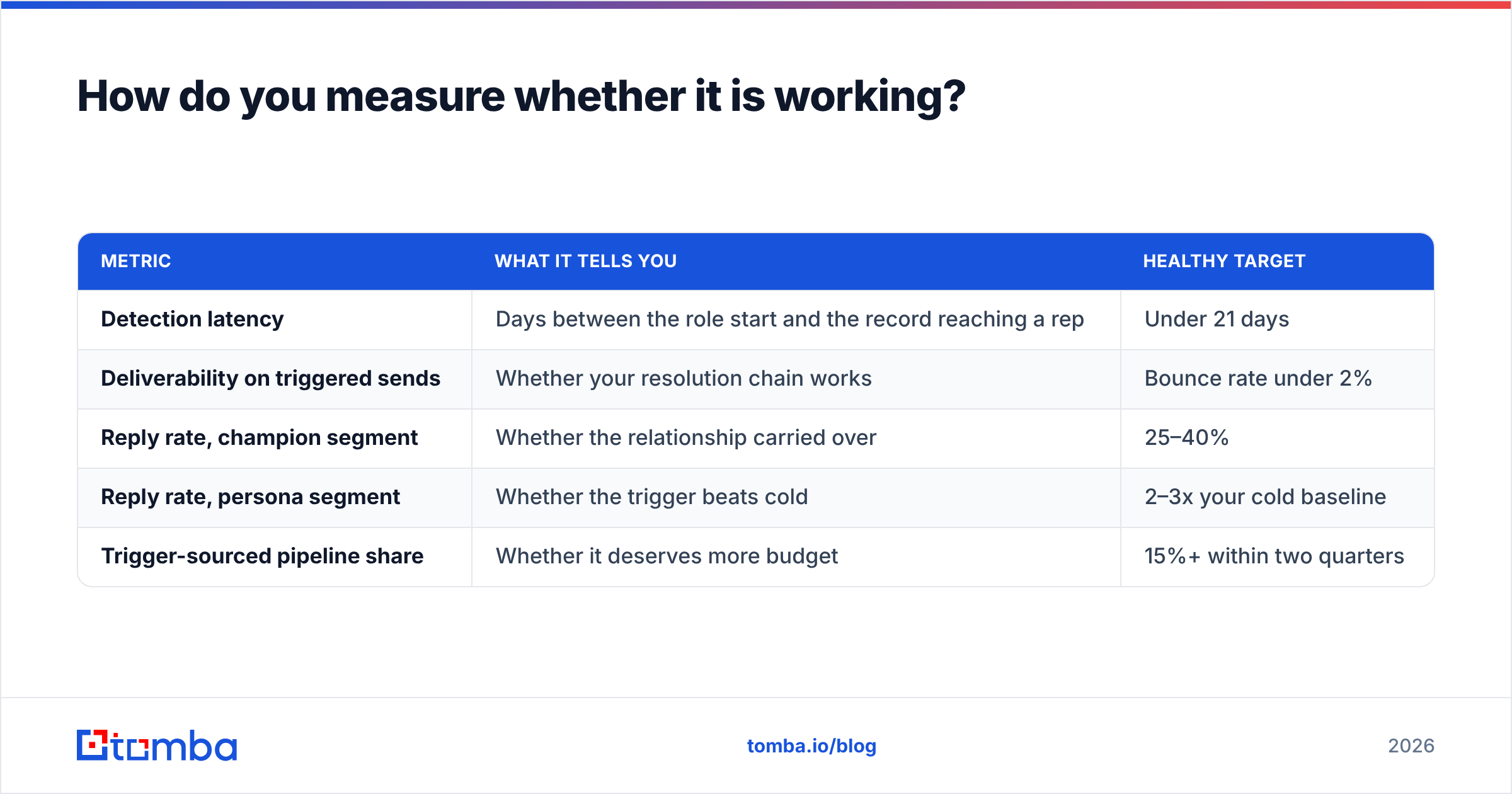
Three metrics, in this order:
| Metric | What it tells you | Healthy target |
|---|---|---|
| Detection latency | Days between the role start and the record reaching a rep | Under 21 days |
| Deliverability on triggered sends | Whether your resolution chain works | Bounce rate under 2% |
| Reply rate, champion segment | Whether the relationship carried over | 25–40% |
| Reply rate, persona segment | Whether the trigger beats cold | 2–3x your cold baseline |
| Trigger-sourced pipeline share | Whether it deserves more budget | 15%+ within two quarters |
If the champion segment is not clearing 25% replies, the problem is almost never the sequence — it is that your "champions" are actually just contacts. A champion is someone who advocated internally, defended the renewal, or referred you. Build that list from your customer success team's knowledge, not from a CRM export of everyone who ever attended a QBR. Two hundred real champions outperform 5,000 contact records every time.
Second diagnostic: if bounce rate on triggered sends is above 2%, your resolution chain is broken at step two or three, not step four. Verification catches bad addresses; it does not create good ones. Fix the pattern detection first.
When does this play not work?#
Be honest about the limits. Job change prospecting underperforms when:
- Your ACV is under roughly $5,000. The manual research overhead per contact does not clear the margin. Run volume plays instead.
- Your buyer is a founder or owner-operator. They do not change jobs. SMB and local-services markets have almost no trigger volume.
- Your product requires a long committee evaluation. A new exec in their first 90 days cannot push a 9-month, seven-stakeholder purchase through. You will get warm meetings and no deals.
- You have no champion history. If you are pre-product-market-fit with 15 customers, the champion list is too small to matter and the persona play is just cold email with better timing. Still worth doing, but do not build a team around it.
The play is strongest for mid-market and enterprise SaaS with $20k+ ACV, a defined buying persona, and at least two years of customer history to mine for champions. G2's category research is a fair place to sanity-check which vendors in this space are actually reviewed by companies that look like yours, rather than by their own customer marketing team.
What does a working stack look like end to end?#
Put together, the pipeline is six steps and can be built in an afternoon with an API and a spreadsheet:
- Watchlist — every closed-won champion from the last three years plus every ICP-title contact at your top accounts. Store name, old company, old email.
- Detection — weekly sweep for title changes, plus an automated route for hard bounces and "no longer with the company" auto-replies into the same queue.
- Resolution — for each detected change, resolve the new company domain, detect the email pattern, and find the address. This is one API call if you use a Tomba API call per record, or a batch upload if you prefer to run it weekly.
- Verification — verify every address, with catch-all handling for the ~20% of domains that need it. Drop anything below your confidence floor rather than sending to it.
- Enrichment and routing — add the new company's firmographics, score the account against ICP, assign to the rep who owned the original relationship. That last detail matters more than any tooling choice: the rep who knows them should be the one to write.
- Sequence — champion template or persona template, sent from a warmed domain, capped at a volume your email deliverability setup can support.
The only step teams routinely skip is number four, and it is the one that protects everything else. You can rebuild a sequence in an hour. You cannot rebuild a burned sending domain in under a month.
The bottom line#
Job change sales prospecting is not a growth hack — it is a timing discipline. The signal is public, the window is short, and the competitive advantage is entirely in how fast you go from "she started a new role" to "a verified message landed in her new inbox." Teams that treat it as a data-quality problem win. Teams that treat it as a copywriting problem send beautiful emails to dead mailboxes.
Start with the layer that everything else depends on. Point Tomba Email Finder at the new domain, let it detect the pattern and return a verified address with a confidence score, and route it straight into your sequence — the free tier gives you 25 searches a month to test the flow on your first batch of champions before you commit to anything.
Related guides#
// get started
Find, verify and enrich your first contacts today
Start on the free plan with 25 searches a month, then scale when your team is ready.
Free plan · No credit card required · GDPR & CCPA
Get the Tomba newsletter
Product and data updates
// about the author