Jordan Belfort Sales Script: The Straight Line System Breakdown
The Jordan Belfort sales script still gets copied into B2B pitch decks 30 years later. Here's the actual structure, what survives modern buying committees, and what will get you blocked.
TL;DR
- The Jordan Belfort sales script is not a word-for-word script. It is a four-part call structure — open, gather intel, present, loop objections — that Belfort later branded the Straight Line System.
- Three mechanics genuinely transfer to modern B2B: the four-second tonality open, the "three tens" certainty model, and objection looping instead of objection handling.
- Three mechanics will destroy you in 2026: assumed-close pressure on committee deals, fabricated scarcity, and the original boiler-room qualification standard (a pulse and a phone).
- The script assumes you already reached a real decision-maker. On a bad list, the best script on earth converts at zero — tonality cannot fix a wrong phone number or a bounced email.
- Use the structure for discovery-to-demo flow, strip the pressure tactics, and put your effort into list quality first.
Belfort's script is the most pirated sales artifact in history. It is in sales-floor binders at SaaS companies whose reps were toddlers when The Wolf of Wall Street was in theaters. Most of those binders contain a mangled transcript of the Aerotyne cold call and nothing else — which is roughly like studying a chess game by memorizing one opening move.
This is the actual structure, what it was engineered to do, and an honest read on which parts survive contact with a 2026 buying committee.
What is the Jordan Belfort sales script?#
The Jordan Belfort sales script is the call framework used at Stratton Oakmont in the late 1980s and early 1990s, later formalized and sold as the Straight Line System after Belfort's conviction and release. The "straight line" metaphor is the core idea: a sale runs from open (point A) to close (point B), and every prospect tries to drag the conversation off that line. The rep's job is to let them wander just far enough to reveal information, then steer back.
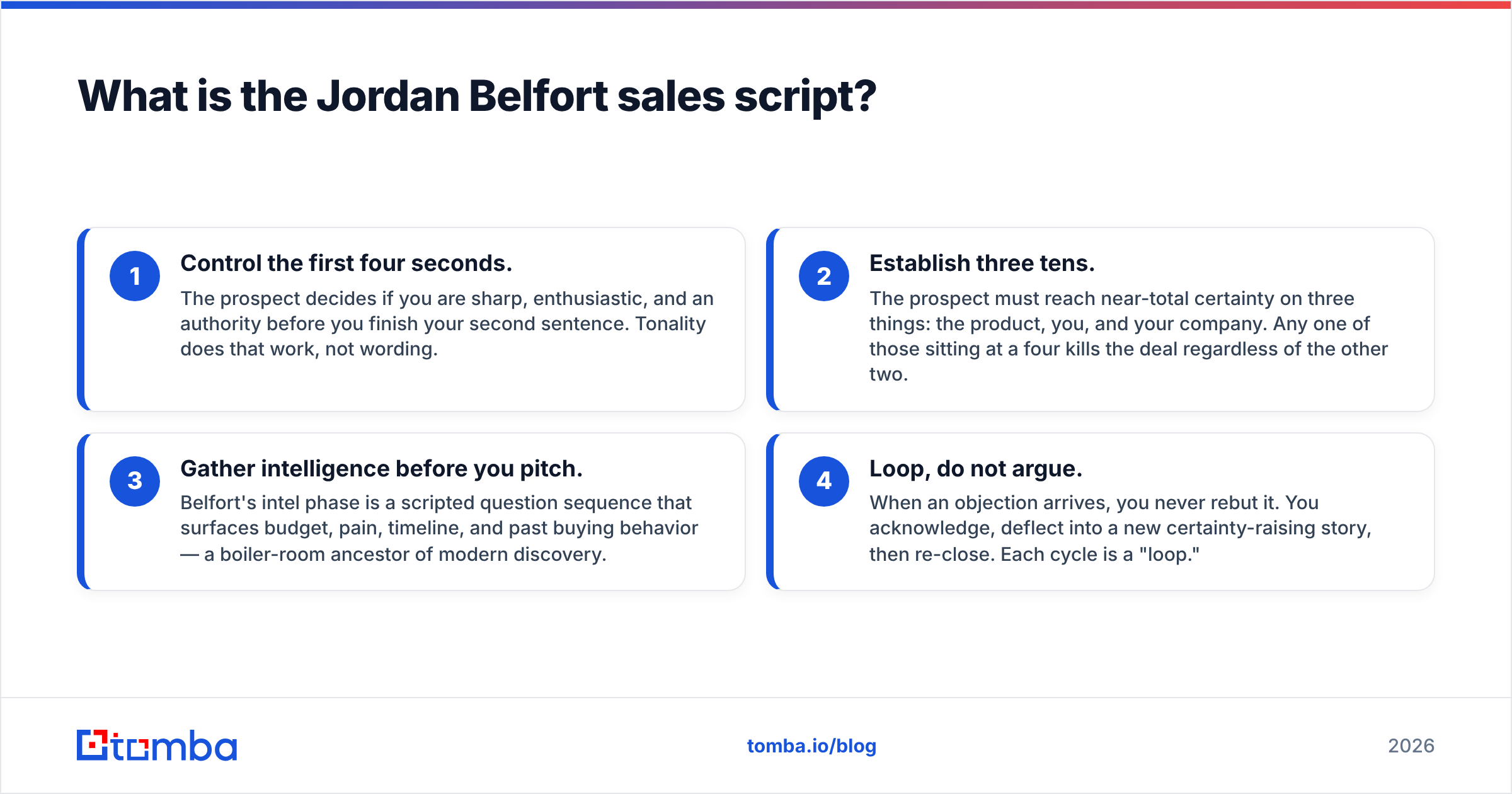
The system rests on four pillars Belfort repeats in nearly every training he has published:
- Control the first four seconds. The prospect decides if you are sharp, enthusiastic, and an authority before you finish your second sentence. Tonality does that work, not wording.
- Establish three tens. The prospect must reach near-total certainty on three things: the product, you, and your company. Any one of those sitting at a four kills the deal regardless of the other two.
- Gather intelligence before you pitch. Belfort's intel phase is a scripted question sequence that surfaces budget, pain, timeline, and past buying behavior — a boiler-room ancestor of modern discovery.
- Loop, do not argue. When an objection arrives, you never rebut it. You acknowledge, deflect into a new certainty-raising story, then re-close. Each cycle is a "loop."
Worth naming plainly: Stratton Oakmont was a securities fraud operation, Belfort pleaded guilty, and investors lost roughly $200 million. The Wikipedia record is unambiguous. The script is a real piece of persuasion engineering, and it was used to sell garbage. Both things are true, and the second one is exactly why you should audit every tactic before you paste it into your own playbook.

What are the four parts of the Belfort call structure?#
Here is the skeleton, stripped of the Long Island theatrics.
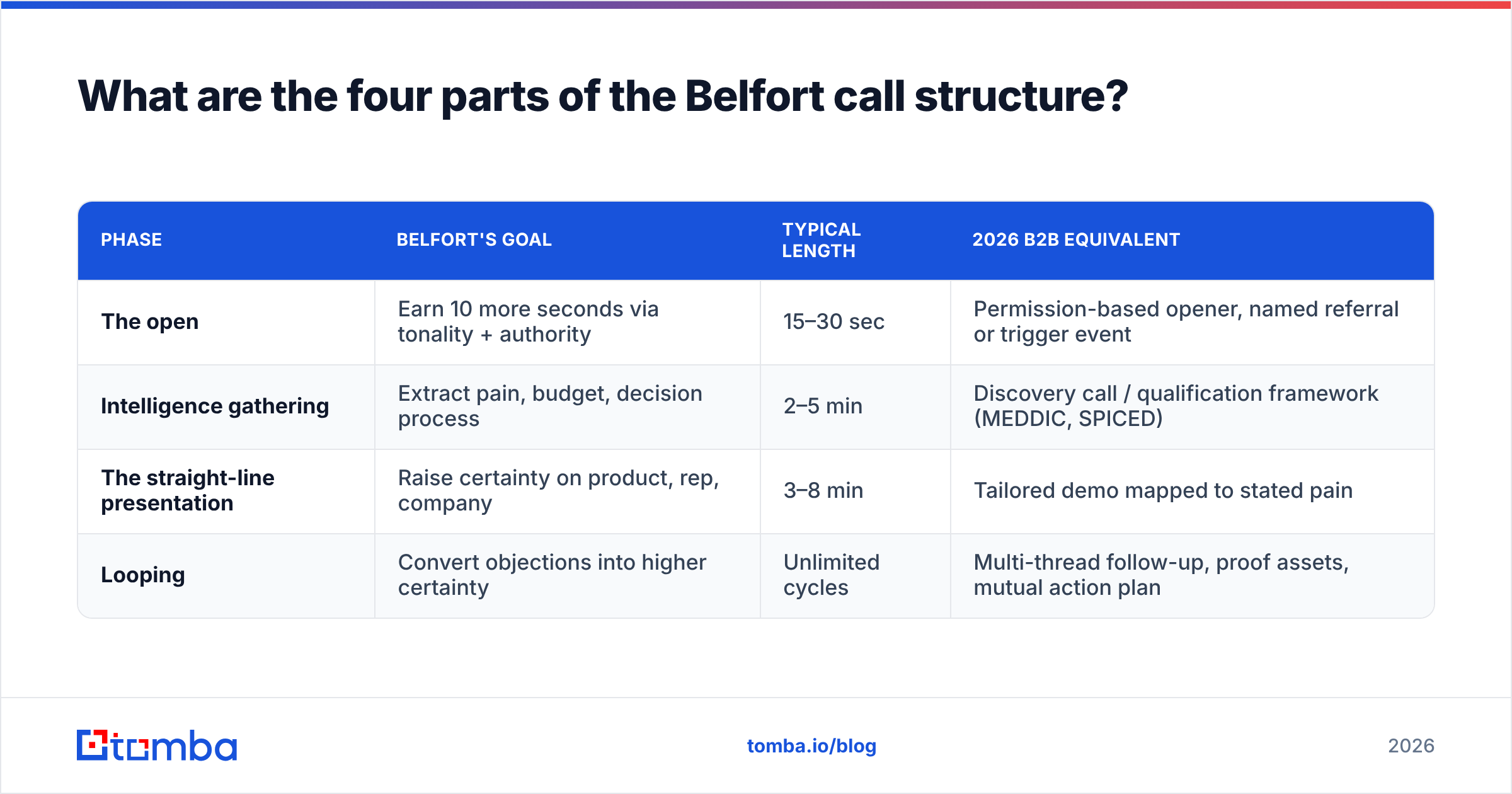
| Phase | Belfort's goal | Typical length | 2026 B2B equivalent |
|---|---|---|---|
| The open | Earn 10 more seconds via tonality + authority | 15–30 sec | Permission-based opener, named referral or trigger event |
| Intelligence gathering | Extract pain, budget, decision process | 2–5 min | Discovery call / qualification framework (MEDDIC, SPICED) |
| The straight-line presentation | Raise certainty on product, rep, company | 3–8 min | Tailored demo mapped to stated pain |
| Looping | Convert objections into higher certainty | Unlimited cycles | Multi-thread follow-up, proof assets, mutual action plan |
The open is where most imitators fail. Belfort's opener is three beats — name, company, reason for the call — delivered with what he calls "enthusiasm as a subtext." The words are nearly generic on purpose. Read the Aerotyne transcript cold and it is unremarkable. The delivery carried it.
The intelligence phase is the part nobody copies and the part that actually matters. Belfort scripts a question ladder that moves from low-threat ("how long have you been investing?") to high-threat ("what would you need to see to move on this today?"). Every answer becomes ammunition for the presentation. Modern discovery frameworks did not invent this; they formalized it and added a compliance layer.
The presentation is short by modern standards. Belfort caps it deliberately because every extra minute invites an off-line tangent. The rule survives: if your demo runs 40 minutes before a single question, you are not presenting, you are broadcasting.
Looping is the signature move. Objection arrives → "I hear you, and that's exactly why..." → new proof point → soft re-close → repeat. Belfort claims a competent rep runs five to seven loops before the prospect either buys or hard-stops. In B2B, those loops stretch across weeks and channels instead of minutes, but the logic — never argue, always raise certainty — is sound.
Which parts of the script still work in 2026?#
The tonality discipline. This is the most transferable piece and the least copied, because it cannot be written down. Belfort isolates roughly ten tonal patterns — declarative-as-question, the "I genuinely care" downshift, scarcity urgency, absolute certainty. Record your own calls for a week and score the first four seconds on energy alone. The delta between your best and worst openers will be larger than anything a new email template gives you.
The three-tens certainty model. It maps cleanly onto modern B2B, where the "company" ten now means security review, SOC 2, references, and Glassdoor. Check where you actually sit. A prospect at a ten on product and a four on your company does not need another feature walkthrough — they need a customer reference call and a security doc.
Looping instead of rebutting. Gartner's research on buyer enablement consistently lands on the same conclusion: buyers who feel pushed disengage, and information that helps them build internal confidence advances deals. Gartner's sales research frames this as reducing purchase difficulty rather than increasing persuasion pressure. That is looping with better vocabulary.
Short, pain-mapped presentations. Still correct. Still ignored by most demo-first sales teams.
Which parts will get you blocked?#
Assumed-close pressure. Belfort's script assumes one decision-maker with signing authority reachable by phone. The average B2B purchase now involves six to ten stakeholders. Pressure applied to a single champion in that structure does not close the deal — it makes your champion look reckless in front of their committee, and champions who feel exposed go quiet.
Manufactured scarcity. "This is the only block I have left" was fraud at Stratton Oakmont and is a credibility grenade today. Any buyer can verify your pricing page in eight seconds.
Zero qualification. The original operation dialed anyone. In 2026 that behavior gets you spam-flagged, domain-blacklisted, and in some jurisdictions fined. Run a blacklist checker after any high-volume outbound push and you will see how fast reputation damage compounds.
Tonality substituting for relevance. Enthusiasm on a call to the wrong persona is just noise at higher volume.
How does the Straight Line compare to modern frameworks?#
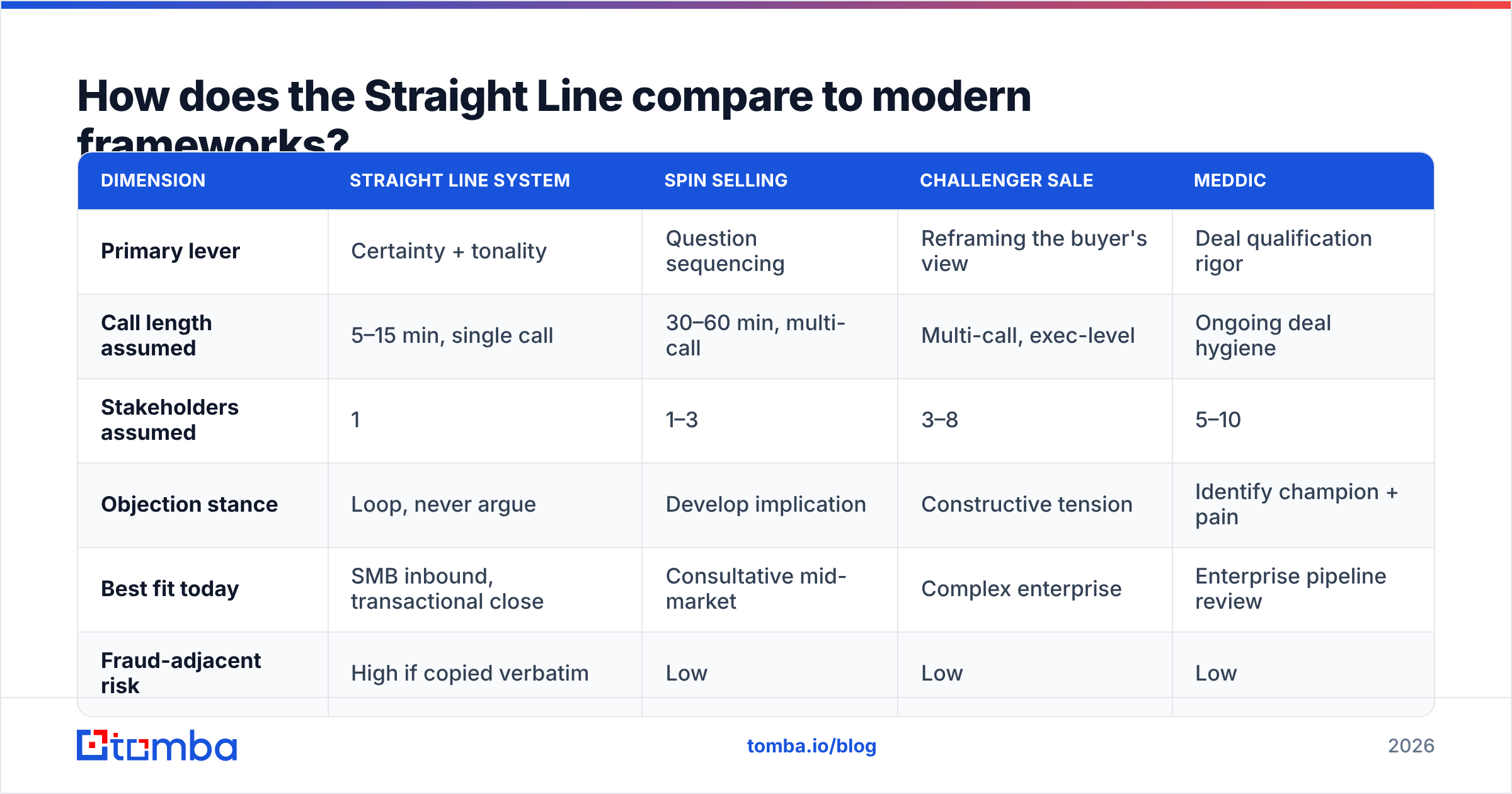
| Dimension | Straight Line System | SPIN Selling | Challenger Sale | MEDDIC |
|---|---|---|---|---|
| Primary lever | Certainty + tonality | Question sequencing | Reframing the buyer's view | Deal qualification rigor |
| Call length assumed | 5–15 min, single call | 30–60 min, multi-call | Multi-call, exec-level | Ongoing deal hygiene |
| Stakeholders assumed | 1 | 1–3 | 3–8 | 5–10 |
| Objection stance | Loop, never argue | Develop implication | Constructive tension | Identify champion + pain |
| Best fit today | SMB inbound, transactional close | Consultative mid-market | Complex enterprise | Enterprise pipeline review |
| Fraud-adjacent risk | High if copied verbatim | Low | Low | Low |
The honest read: Straight Line is a closing system wearing a full-cycle costume. It is excellent at the last 15 percent of a transactional deal and weak everywhere upstream. HubSpot's sales methodology overview makes the same structural point about transactional versus consultative frameworks. Pair the looping mechanics with a real qualification framework and you get something usable. Use it alone on a $120k enterprise deal and you will burn the relationship in two calls.
What does the script assume that nobody mentions?#
That you are already talking to the right human.
Every Belfort demo starts mid-call. The list is a given. In the actual Stratton Oakmont operation, lists were bought, scraped, and dialed indiscriminately — the model absorbed a horrific contact rate because the commission on a single close covered thousands of dead dials.
You do not have that economics. If your cold email bounces or your dial hits a disconnected line, your tonality score is irrelevant. Certainty cannot be transmitted to an inbox that does not exist.

This is the piece to fix before you rehearse a single loop:
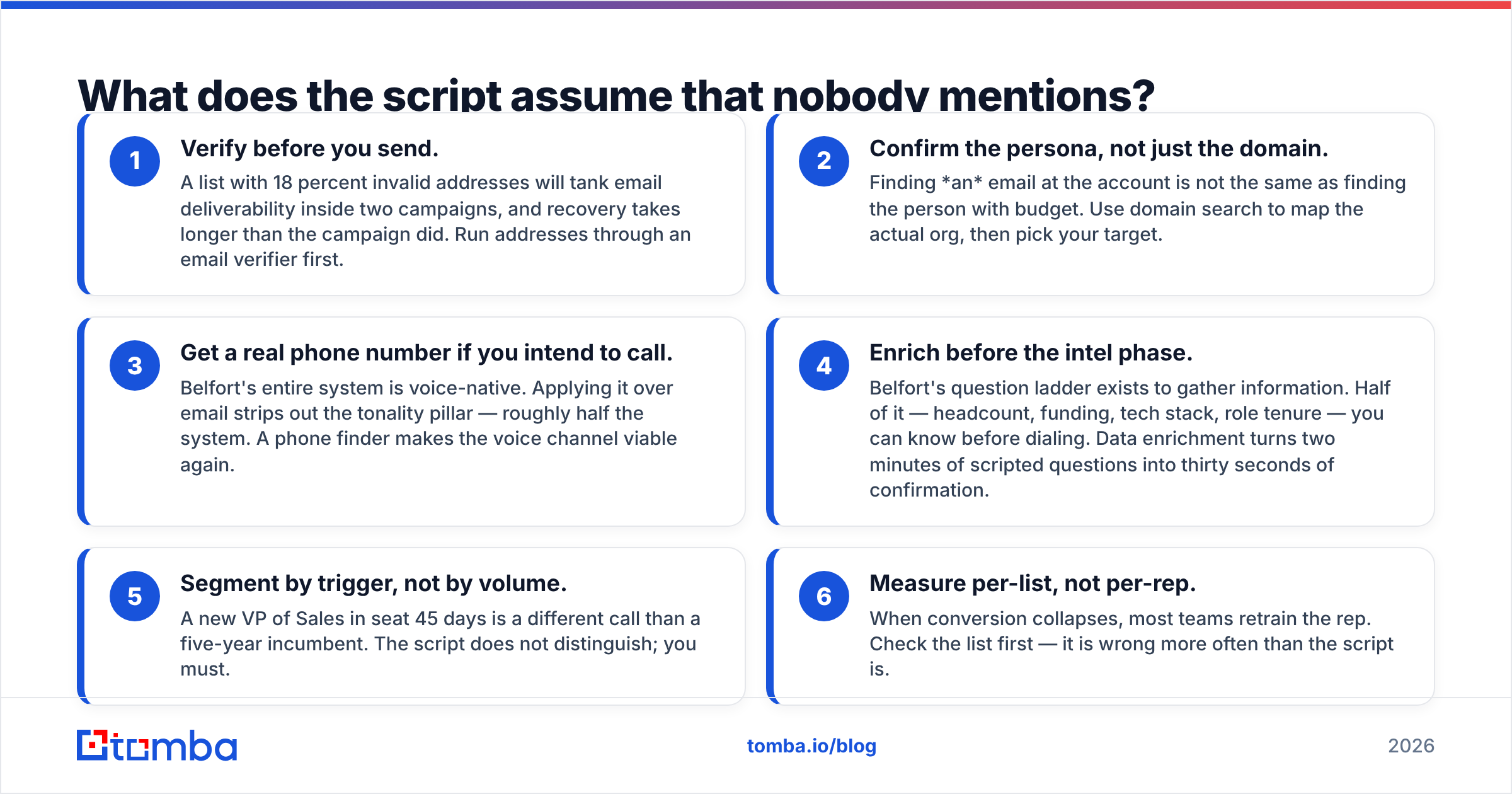
- Verify before you send. A list with 18 percent invalid addresses will tank email deliverability inside two campaigns, and recovery takes longer than the campaign did. Run addresses through an email verifier first.
- Confirm the persona, not just the domain. Finding an email at the account is not the same as finding the person with budget. Use domain search to map the actual org, then pick your target.
- Get a real phone number if you intend to call. Belfort's entire system is voice-native. Applying it over email strips out the tonality pillar — roughly half the system. A phone finder makes the voice channel viable again.
- Enrich before the intel phase. Belfort's question ladder exists to gather information. Half of it — headcount, funding, tech stack, role tenure — you can know before dialing. Data enrichment turns two minutes of scripted questions into thirty seconds of confirmation.
- Segment by trigger, not by volume. A new VP of Sales in seat 45 days is a different call than a five-year incumbent. The script does not distinguish; you must.
- Measure per-list, not per-rep. When conversion collapses, most teams retrain the rep. Check the list first — it is wrong more often than the script is.
How should you actually adapt the script?#
Rewrite it as a discovery-to-demo flow with the pressure removed.
Open (15 seconds). Keep the three beats: name, company, reason. Replace fabricated enthusiasm with a specific trigger — funding round, new hire, product launch, job posting. "I saw you opened a second SDR team in Austin" outperforms any tonal trick, because it proves you did work.
Intel (5–8 minutes). Keep Belfort's ladder shape — low threat to high threat — but let enrichment data pre-answer the factual questions. Spend the saved time on the questions data cannot answer: what happens if they do nothing, who else has to agree, what killed the last vendor evaluation.
Present (5 minutes, max). Map strictly to what they said. Three points, not twelve. Belfort's length discipline is one of the better things in the system.
Loop (across weeks). Every objection gets a proof asset, not a rebuttal. Pricing objection → ROI model. Trust objection → reference call. Timing objection → mutual action plan with dates. This is looping translated into enterprise tempo, and it is the single highest-value idea Belfort produced.
Never do: invent scarcity, pressure a single champion, or close past a clear no. Not for ethics-lecture reasons — because they measurably reduce response rate and torch referral paths that compound over years.
Is the Straight Line System worth studying at all?#
Yes, with a filter.
Study it for tonality, loop mechanics, and presentation discipline. Do not study it for prospecting, qualification, or deal strategy — the era it came from had none of the accountability structures modern B2B buying committees impose. Reviews on G2 and Capterra make the state of play obvious: buyers now research vendors independently before a rep ever speaks, which means most of the "certainty" Belfort built on a call is now built or destroyed before the call happens.
The script is a scalpel for the final conversation. It was never a system for finding who to have that conversation with — and in 2026, finding who is most of the job.
Fix the input before you rehearse the pitch. The Straight Line System only runs if there's a live human on the other end who actually owns the problem you solve. Tomba Email Finder locates verified professional addresses by name, domain, or company, so your scripted open lands in a real inbox instead of a bounce log. Start on the free tier at 25 searches a month, or move to Starter at $49/mo when you're running volume — full Tomba pricing is public, no scarcity tactics required.
Related guides#
// get started
Find, verify and enrich your first contacts today
Start on the free plan with 25 searches a month, then scale when your team is ready.
Free plan · No credit card required · GDPR & CCPA
// about the author