karmaCRM Pricing, Reviews, Pros and Cons: 2026 Buyer Guide
A neutral breakdown of karmaCRM pricing, reviews, pros and cons — what each seat really costs, where the plan limits bite, and which teams should buy something else.
TL;DR
- karmaCRM is a small-business CRM built around simplicity: contacts, deals, tasks, and light email — not a full revenue platform. It sits at the low end of the per-seat market.
- Published pricing runs roughly $9–$49 per user per month, tiered by automation depth and support level, with annual billing discounts and a free trial. Confirm current rates on the vendor site before you budget.
- Reviewers consistently praise the onboarding curve and responsive support; the recurring complaints are limited native integrations, a dated UI in places, and reporting that stops short of pipeline forecasting.
- The real cost is rarely the seat price. It is the data you pour into it — a CRM full of stale or invalid contacts costs more in wasted rep hours than any tier upgrade.
- Buy karmaCRM if you are a 2–20 person team that wants a CRM live this week. Look elsewhere if you need multi-touch attribution, native sequencing at scale, or a deep app marketplace.
What is karmaCRM, and who is it actually built for?#
karmaCRM is a hosted customer relationship management tool aimed at small businesses, consultancies, agencies, and solo operators who have outgrown a spreadsheet but do not want to administer Salesforce. Its positioning has been consistent for years: fewer features, less configuration, faster time to value.
That positioning matters more than any feature list. Most CRM buying regret comes from mismatch, not from missing checkboxes. A five-person agency that buys an enterprise platform ends up paying for an admin they do not have. A 60-person sales org that buys a lightweight CRM ends up rebuilding half of it in spreadsheets within a year.
Here is the honest profile of a good karmaCRM fit:
- Team size 2–20. Below that, a shared inbox may still work. Above that, seat math and reporting gaps start to hurt.
- Relationship-led selling. Long cycles, named accounts, repeat clients — not high-volume transactional inbound.
- Low integration surface. You use email, a calendar, and maybe one billing tool. You are not wiring a six-tool GTM stack together.
- No dedicated ops person. Nobody on staff wants to own field mapping, validation rules, or a sandbox environment.
- Budget discipline. You would rather spend $500/year on CRM and $2,000/year on data and outreach than the reverse.
If three or more of those describe you, karmaCRM belongs on your shortlist. If fewer than two do, keep reading — the alternatives section will save you a migration.
What does karmaCRM pricing actually look like in 2026?#
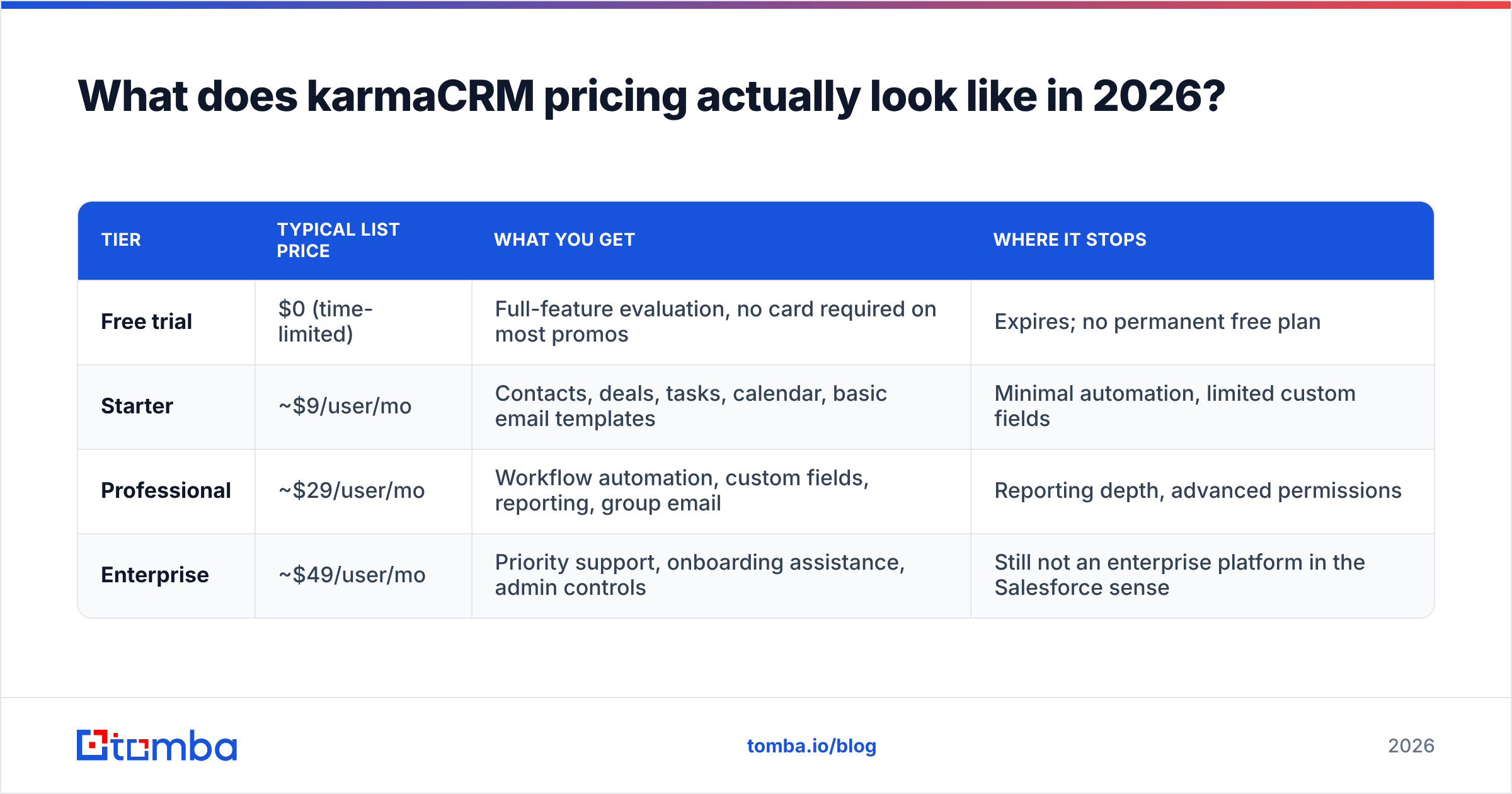
karmaCRM prices per user, per month, in three published tiers plus a trial. The pattern is standard for SMB CRM: the entry tier gives you the core object model, the middle tier unlocks automation and customization, and the top tier adds support guarantees and admin controls.
Treat the figures below as list prices at the time of writing. SMB CRM vendors reprice more often than enterprise ones, and annual commitments typically shave 15–20% off monthly rates. Always verify on karmacrm.com before you sign a purchase order.
| Tier | Typical list price | What you get | Where it stops |
|---|---|---|---|
| Free trial | $0 (time-limited) | Full-feature evaluation, no card required on most promos | Expires; no permanent free plan |
| Starter | ~$9/user/mo | Contacts, deals, tasks, calendar, basic email templates | Minimal automation, limited custom fields |
| Professional | ~$29/user/mo | Workflow automation, custom fields, reporting, group email | Reporting depth, advanced permissions |
| Enterprise | ~$49/user/mo | Priority support, onboarding assistance, admin controls | Still not an enterprise platform in the Salesforce sense |
The headline math is friendly. A five-person team on Professional lands near $145/month, or roughly $1,450–$1,750 per year depending on billing term. That is meaningfully cheaper than most mid-market alternatives, and it is the single strongest argument in karmaCRM's favor.
The math that trips teams up is the second line item. A CRM does nothing on its own — it stores what you feed it. Teams routinely spend three to five times their CRM subscription on the contact data, enrichment, and outreach tooling that actually fills the pipeline. Budget for the whole stack, not the cheapest box in it.

How does karmaCRM pricing compare to other small-business CRMs?#
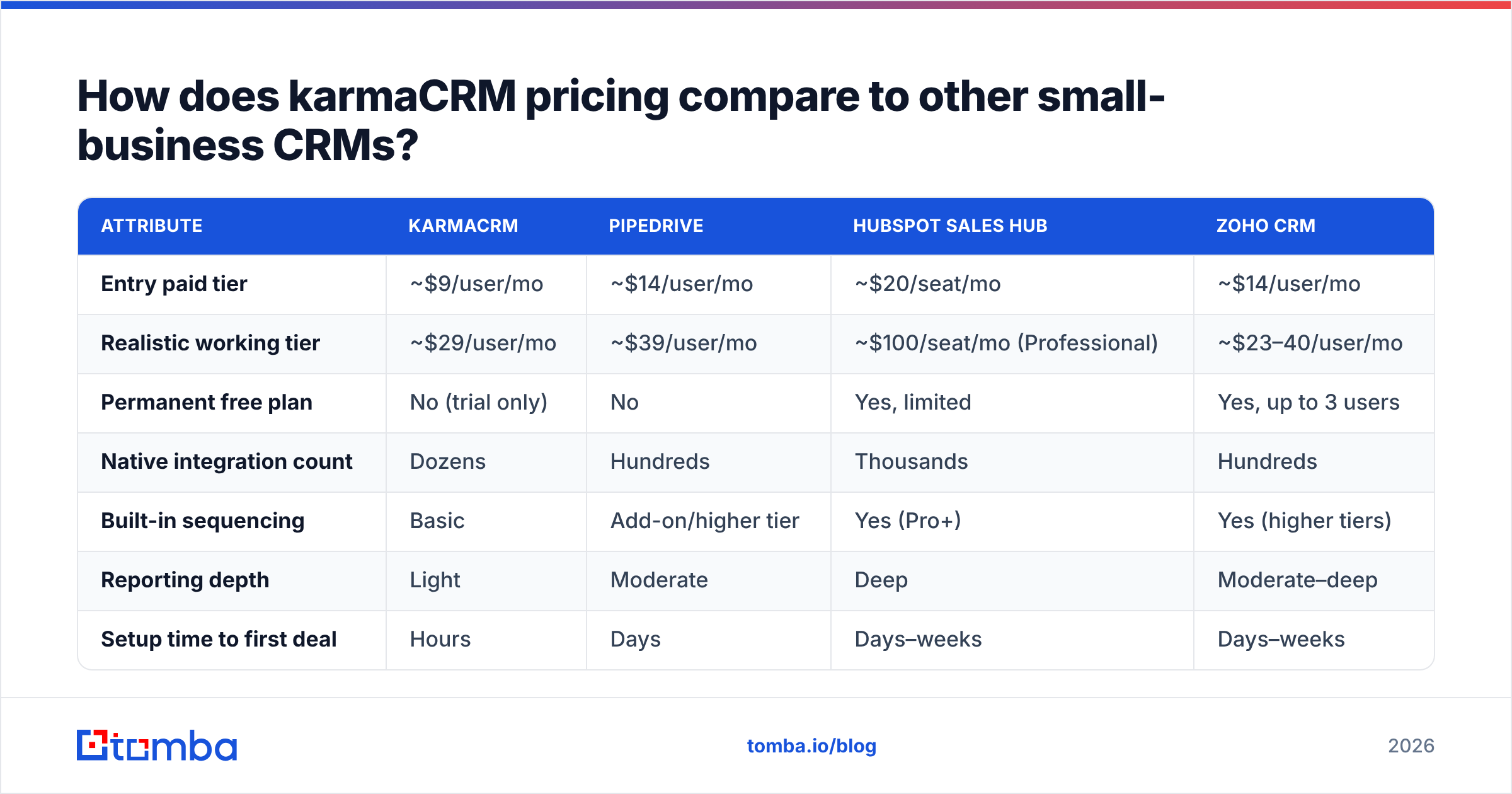
Per-seat price alone is a bad comparison metric. What matters is price at the feature level you will actually run on. Nearly every team ends up on the middle tier, so that is the honest comparison row.
| Attribute | karmaCRM | Pipedrive | HubSpot Sales Hub | Zoho CRM |
|---|---|---|---|---|
| Entry paid tier | ~$9/user/mo | ~$14/user/mo | ~$20/seat/mo | ~$14/user/mo |
| Realistic working tier | ~$29/user/mo | ~$39/user/mo | ~$100/seat/mo (Professional) | ~$23–40/user/mo |
| Permanent free plan | No (trial only) | No | Yes, limited | Yes, up to 3 users |
| Native integration count | Dozens | Hundreds | Thousands | Hundreds |
| Built-in sequencing | Basic | Add-on/higher tier | Yes (Pro+) | Yes (higher tiers) |
| Reporting depth | Light | Moderate | Deep | Moderate–deep |
| Setup time to first deal | Hours | Days | Days–weeks | Days–weeks |
| Best for | 2–20 person teams | 5–50 person sales teams | Marketing + sales alignment | Cost-sensitive multi-tool shops |
Read that table as a trade curve, not a scoreboard. karmaCRM wins on price and setup speed. It loses on integration breadth and reporting depth. Every row is a consequence of the same design decision — keep it small — so you cannot cherry-pick.
If you want an independent second opinion before committing, the CRM category on G2 and the CRM listings on Capterra aggregate verified buyer reviews with filters for company size, which is the only filter that matters here.
What do karmaCRM reviews consistently say?#
Review patterns are more useful than review scores. Across public review sites, the same themes repeat year after year.
What reviewers praise:
- Onboarding speed. Users repeatedly describe getting a working pipeline the same day. For teams migrating off spreadsheets, that is the whole ballgame.
- Support responsiveness. Small-vendor support is a genuine differentiator; reviewers mention reaching a human quickly and getting configuration help without a paid services tier.
- Interface simplicity. Reps who refuse to use "real" CRMs tend to actually log activity here, which is the only adoption metric that counts.
- Price-to-value at the low tier. At sub-$10 entry pricing, the bar for "worth it" is low and karmaCRM generally clears it.
What reviewers criticize:
- Integration gaps. The app directory is a fraction of what Pipedrive, HubSpot, or Zoho offer. Teams frequently end up routing through Zapier or Make, which adds a second subscription and a second failure point.
- Reporting ceilings. You get activity and pipeline views, not cohort analysis, multi-touch attribution, or forecast modeling. Sales leaders who live in dashboards will feel the wall.
- UI dating. Parts of the interface look like the era they were designed in. Functional, not fashionable.
- Mobile experience. Field-heavy teams report the mobile app lags the web app in capability.
- Scaling friction. The most common churn story is not "it broke" — it is "we outgrew it," usually somewhere between 20 and 40 seats.
None of these are disqualifying for the target buyer. All of them are disqualifying for someone buying a CRM they expect to keep for a decade of growth.
What are the real pros and cons of karmaCRM?#
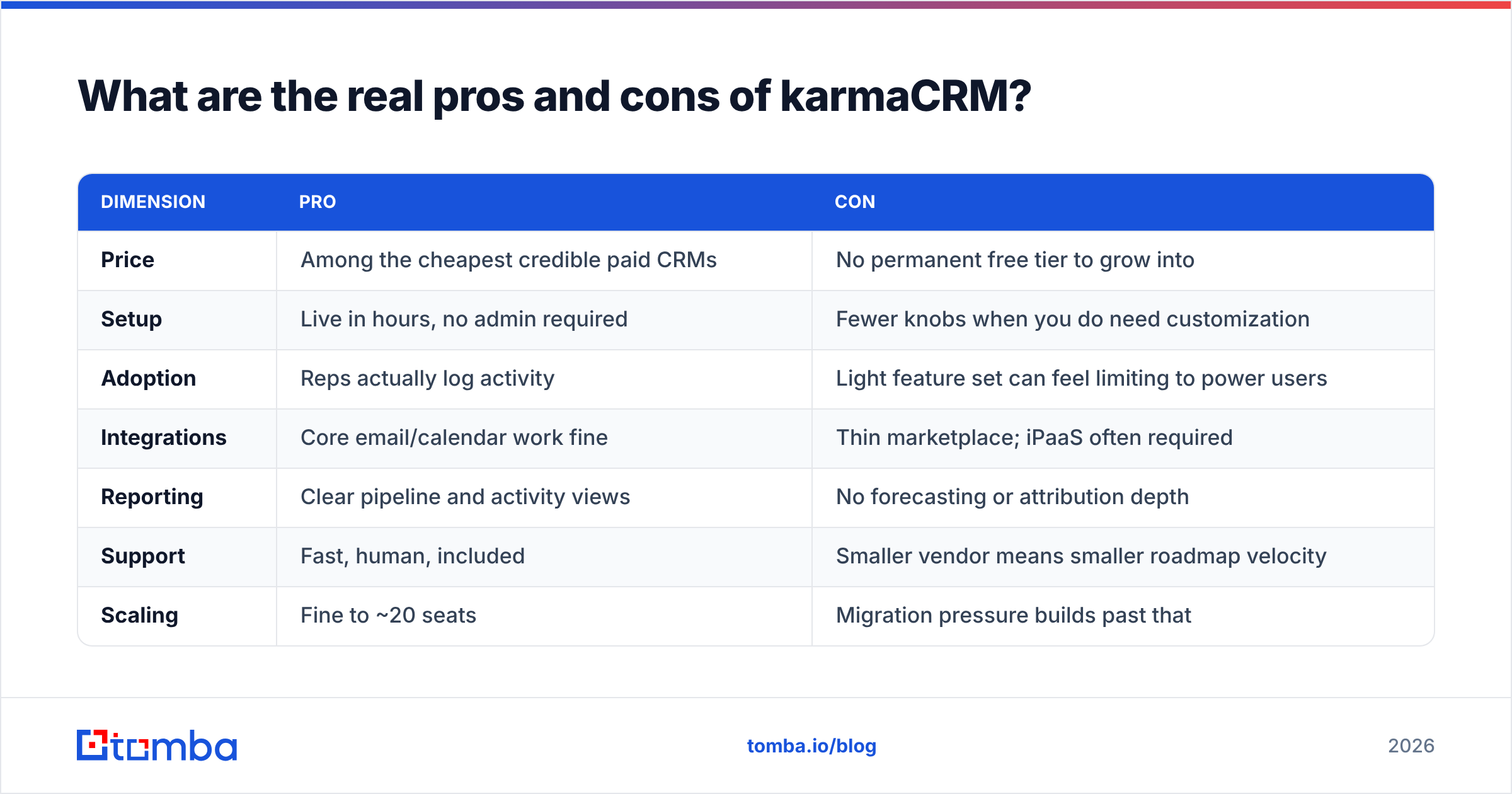
| Dimension | Pro | Con |
|---|---|---|
| Price | Among the cheapest credible paid CRMs | No permanent free tier to grow into |
| Setup | Live in hours, no admin required | Fewer knobs when you do need customization |
| Adoption | Reps actually log activity | Light feature set can feel limiting to power users |
| Integrations | Core email/calendar work fine | Thin marketplace; iPaaS often required |
| Reporting | Clear pipeline and activity views | No forecasting or attribution depth |
| Support | Fast, human, included | Smaller vendor means smaller roadmap velocity |
| Scaling | Fine to ~20 seats | Migration pressure builds past that |
The summary verdict: karmaCRM is honestly priced for what it is, and what it is happens to be exactly what a large slice of small businesses need. The failure mode is not the product — it is buyers who evaluate it against enterprise platforms and then act surprised when it behaves like a $29 tool.
Why is your data budget more important than your CRM budget?#
Here is the part most pricing posts skip. The difference between a CRM that pays for itself and one that becomes a graveyard is not the tier you bought. It is the quality of what enters it.
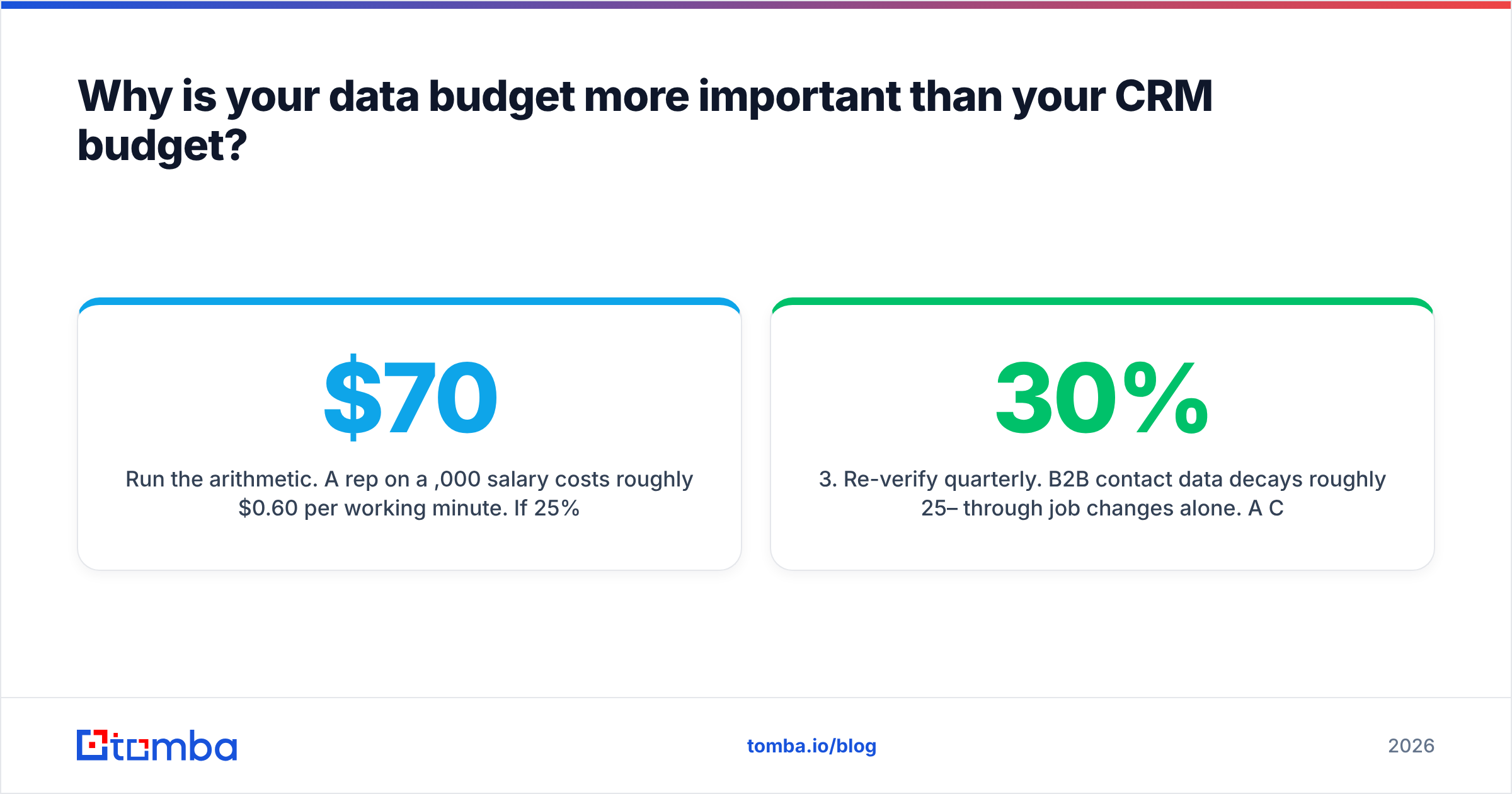
Run the arithmetic. A rep on a $70,000 salary costs roughly $0.60 per working minute. If 25% of the contacts in your CRM carry an invalid email address, and each bounce plus follow-up investigation burns four minutes, a list of 2,000 contacts quietly vaporizes about 2,000 minutes — roughly $1,200 — before anyone books a meeting. That is nearly a year of Professional seats for a five-person team, spent on nothing.
Three habits fix most of it:
- Verify before import, not after bounce. Run every address through an email verifier at the point of entry. Rejected records never pollute your reporting or your sender reputation.
- Enrich at creation. A contact record with title, company size, and a working phone number is worth several times one with a name and a guessed address. Automated data enrichment at record creation beats manual research at deal stage.
- Re-verify quarterly. B2B contact data decays roughly 25–30% per year through job changes alone. A CRM you never re-verify is a CRM that gets less accurate every quarter, no matter which tier you pay for.

Deliverability compounds this. Every hard bounce nudges your sender reputation downward, which quietly lowers inbox placement for the clean contacts too. The cheap CRM plan does not look so cheap when half your outbound never gets seen.
How should you decide — and what should you do first?#
Work through this in order, not in parallel:
- Count seats honestly. Include anyone who will need read access. Multiply by the middle tier, not the entry tier, because that is where you will land within two quarters.
- List your non-negotiable integrations. Check each one against karmaCRM's directory before the trial, not during it. A missing integration discovered in week three is the most expensive kind.
- Run a real trial with real data. Import 200 actual contacts and 10 actual deals. Empty-CRM trials always feel great and prove nothing.
- Test the reporting you will present to leadership. If you cannot reproduce next month's pipeline review inside the trial, that is your answer.
- Price the whole stack. CRM plus data plus outreach plus any iPaaS glue. Compare that total against alternatives — not the seat price in isolation.
- Set a re-evaluation date. Put a calendar reminder at 18 months. Outgrowing a lightweight CRM is a success condition, not a failure, as long as you plan the exit.
If steps 1–4 clear cleanly, karmaCRM is a reasonable, defensible purchase at a price that leaves budget for the things that actually generate pipeline. If any of them fail, the migration cost of choosing wrong exceeds the price delta of choosing right — pick the heavier tool now.
The bottom line#
karmaCRM prices itself accurately. It is a small, fast, well-supported CRM for small teams, and it does not pretend to be more than that. The pros — speed, price, adoption, support — are real. The cons — integrations, reporting, scaling ceiling — are equally real and entirely predictable from the positioning.
Whichever CRM you land on, the constraint on your revenue is the same: you cannot close contacts you cannot reach. Fill your pipeline with verified, enriched, deliverable contact data and even a $9 seat earns its keep; fill it with guesses and no amount of software fixes the outcome.
Start with the data layer. Use the Tomba Email Finder to source verified professional email addresses by name, company, or domain, push them into karmaCRM already validated, and let your reps spend their minutes on conversations instead of bounce forensics. The free tier covers 25 searches a month so you can test accuracy against your own target accounts before spending anything — see Tomba pricing for the full plan breakdown.
Related guides#
// get started
Find, verify and enrich your first contacts today
Start on the free plan with 25 searches a month, then scale when your team is ready.
Free plan · No credit card required · GDPR & CCPA
Get the Tomba newsletter
Product and data updates
// about the author