Kaspr vs Apollo.io in 2026: Phone Data, Emails, and Cost
Kaspr is a LinkedIn phone-number machine. Apollo.io is a whole outbound platform. They overlap just enough to confuse buyers — here is the honest breakdown of data, credits, pricing, and who should pick which.
TL;DR
- Kaspr vs Apollo.io in one line: Kaspr is a contact-data extension, Apollo.io is a go-to-market platform. Kaspr pulls phone numbers and emails off LinkedIn profiles. Apollo bundles a database, sequences, dialer, and CRM-ish workflow into one seat.
- Kaspr wins on mobile numbers in EMEA. It was built for European prospecting and is owned by Cognism. Its phone coverage in France, Benelux, DACH, and the UK is its strongest asset.
- Apollo wins on breadth and price-per-feature. One $49–$99 seat gets you search, enrichment, sequencing, and a dialer. Nothing Kaspr does replaces that.
- Neither is a clean email-accuracy winner. Both ship unverified or stale addresses at volume. That is why most teams run a separate verification layer before sending.
- The cheapest real-world stack is usually hybrid: a dedicated finder/verifier for email, plus whichever of these two covers the channel you actually use.
Kaspr vs Apollo.io: what each tool actually does#
They get compared constantly, but they were built to solve different problems.
Kaspr (kaspr.io) is a Chrome extension first and a web app second. Open a LinkedIn profile, a Sales Navigator list, or a LinkedIn group. Click the Kaspr widget. It returns mobile numbers, direct dials, and email addresses for that person. Cognism (cognism.com) acquired it in 2022, and the product still reflects its origin: a fast, narrow tool for SDRs who live inside LinkedIn and want to call people.
Apollo.io (apollo.io) is a sales engagement platform with a contact database attached. You search a database the company describes as hundreds of millions of contacts. You filter by title, headcount, tech stack, and intent signals. Then you push those contacts into a sequence, send email from a connected inbox, call through the built-in dialer, and sync it all to HubSpot or Salesforce. The Chrome extension exists, but it's a satellite of the platform, not the main event.
That difference drives everything below. Comparing them on "who has better data" alone misses the point. You're really choosing between a scalpel for LinkedIn phone numbers and a Swiss Army knife for outbound.
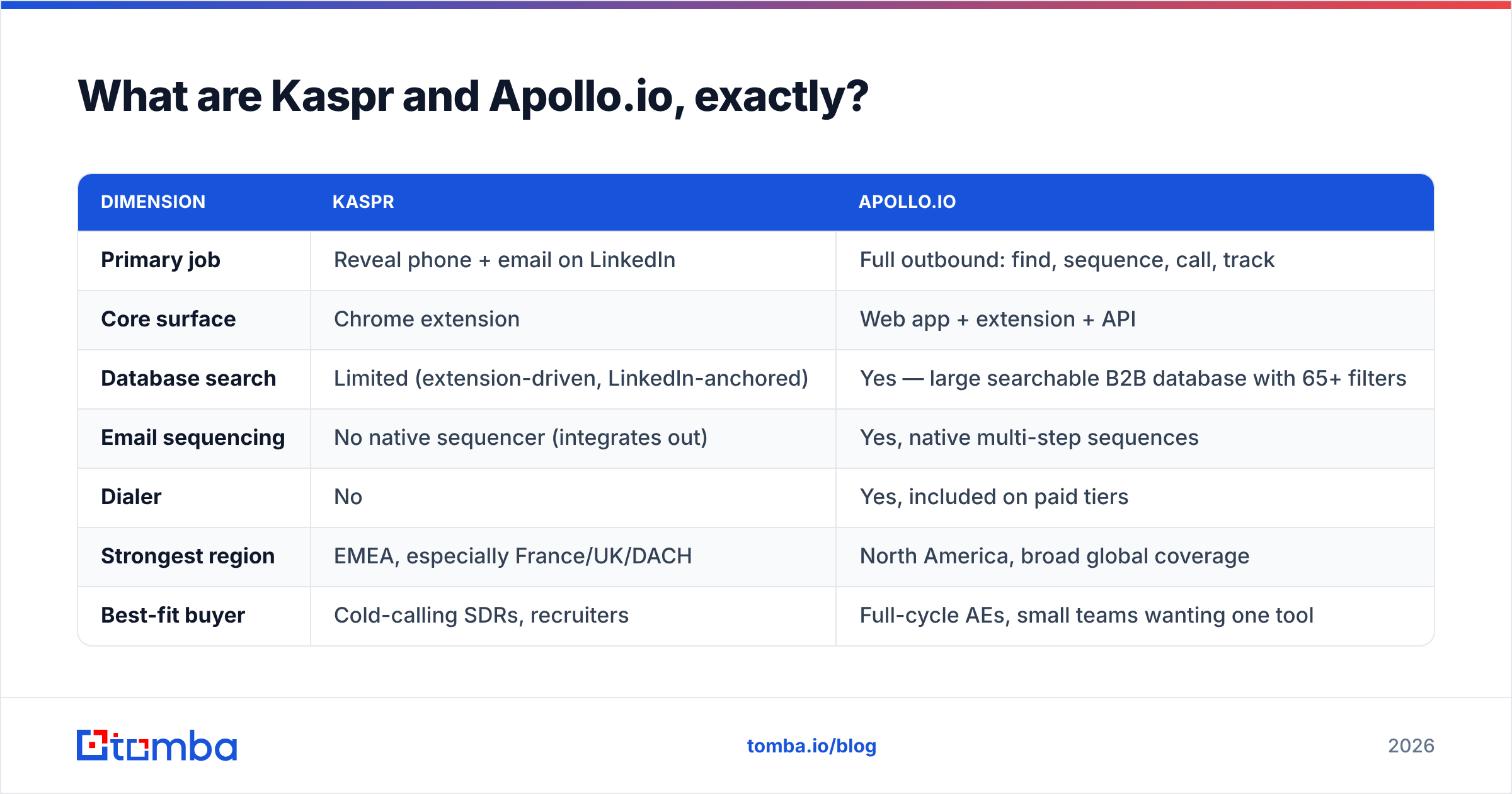
| Dimension | Kaspr | Apollo.io |
|---|---|---|
| Primary job | Reveal phone + email on LinkedIn | Full outbound: find, sequence, call, track |
| Core surface | Chrome extension | Web app + extension + API |
| Database search | Limited (extension-driven, LinkedIn-anchored) | Yes — large searchable B2B database with 65+ filters |
| Email sequencing | No native sequencer (integrates out) | Yes, native multi-step sequences |
| Dialer | No | Yes, included on paid tiers |
| Strongest region | EMEA, especially France/UK/DACH | North America, broad global coverage |
| Best-fit buyer | Cold-calling SDRs, recruiters | Full-cycle AEs, small teams wanting one tool |
| Free plan | Yes, small credit allowance | Yes, limited credits and sequencing |
How do Kaspr and Apollo.io compare on data quality?#
Here's the honest Kaspr vs Apollo.io answer that no landing page will give you: both are good at one data type and mediocre at the other.
Kaspr's phone data is its reason to exist. It sources numbers through a community model plus partnerships. The Cognism relationship adds access to Diamond-Data-style verified mobile inventory in Europe. If your ICP is a French CTO or a UK operations director, Kaspr will often return a mobile that Apollo simply doesn't have. Reviews on G2 cite phone accuracy as the top-rated attribute and hit rate as the top complaint. Coverage is excellent when it hits and empty when it doesn't.
Apollo's email data is broader but noisier. The database is huge, so a job-title search returns thousands of contacts instantly. But a meaningful slice of those records are stale: people who left roles, emails that were guessed rather than checked, and catch-all domains marked "verified" because the server accepts everything. Apollo does run its own verification and label confidence levels. Still, "verified" in a big aggregated database is not the same as "verified against the mail server five minutes ago."

The practical implication is simple. If you pull 2,000 contacts from Apollo and push them straight into a sequence, expect a bounce rate that will hurt your domain. Running the list through an email verifier before the first send is not optional in 2026. Google and Yahoo's bulk sender rules cap spam complaints and treat repeated hard bounces as a reputation signal.


Kaspr vs Apollo.io pricing: which is cheaper in practice?#
Both publish per-seat pricing, and both have a gap between sticker price and real cost. Check the live numbers on the Apollo pricing page and Kaspr's own pricing page before you sign anything. These tiers move.
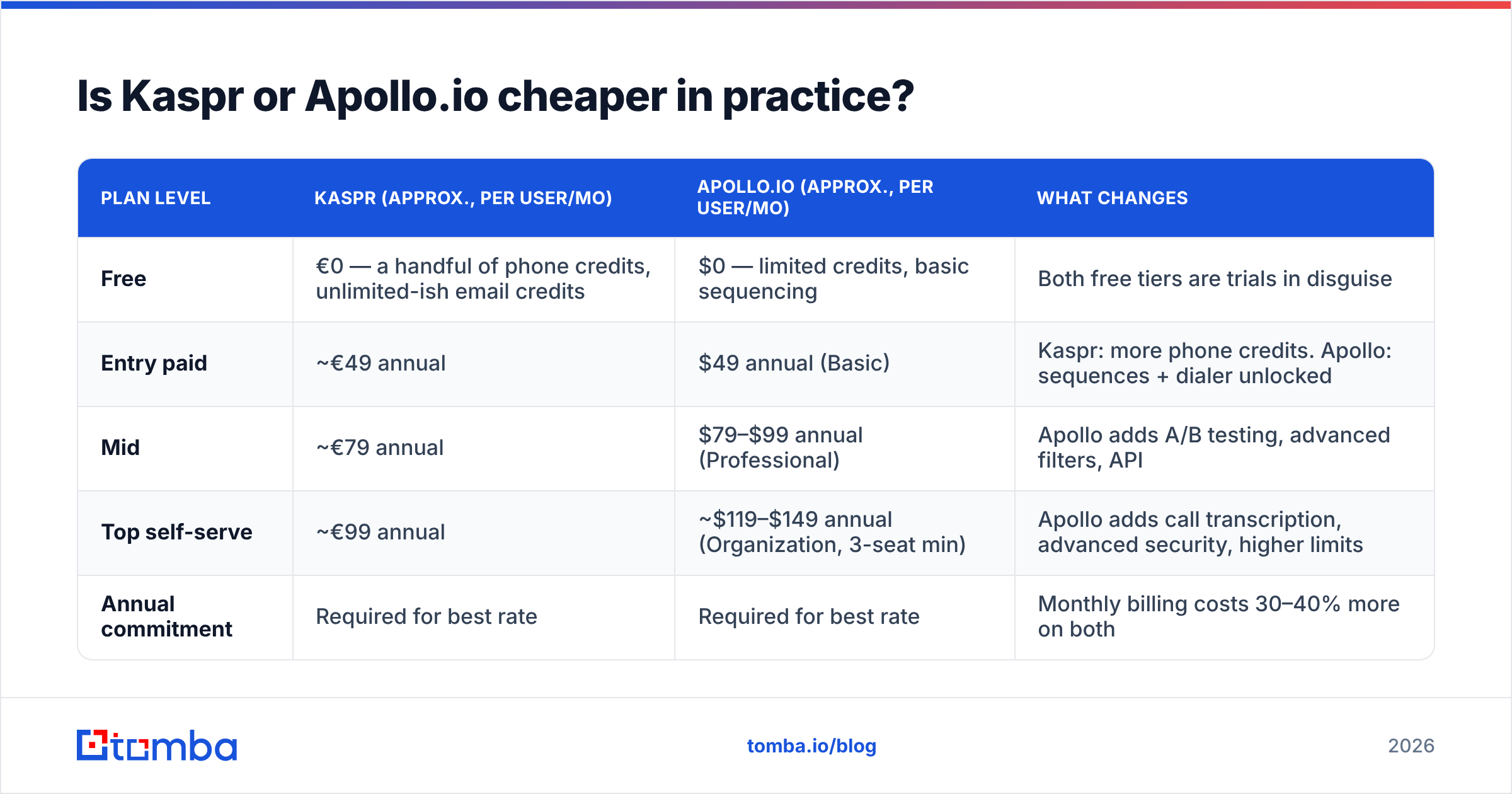
| Plan level | Kaspr (approx., per user/mo) | Apollo.io (approx., per user/mo) | What changes |
|---|---|---|---|
| Free | €0 — a handful of phone credits, unlimited-ish email credits | $0 — limited credits, basic sequencing | Both free tiers are trials in disguise |
| Entry paid | ~€49 annual | $49 annual (Basic) | Kaspr: more phone credits. Apollo: sequences + dialer unlocked |
| Mid | ~€79 annual | $79–$99 annual (Professional) | Apollo adds A/B testing, advanced filters, API |
| Top self-serve | ~€99 annual | ~$119–$149 annual (Organization, 3-seat min) | Apollo adds call transcription, advanced security, higher limits |
| Annual commitment | Required for best rate | Required for best rate | Monthly billing costs 30–40% more on both |
Three cost traps worth naming:
- Credits are per-seat, not pooled by default. A five-person team doesn't get a shared bucket on entry tiers. Unused credits on one seat don't help the SDR who ran out on Tuesday.
- Phone credits and email credits are separate currencies on Kaspr. The generous email allowance masks a tight phone allowance, and phones are the reason you bought it.
- Apollo's seat minimums bite at the top tier. The per-user price looks fine until you're forced into three seats you don't need.
- Neither price includes verification. If you add a verification tool to protect deliverability, that's a real line item on top of both.
Which one is better for LinkedIn prospecting?#
Kaspr, for calling. Apollo, for everything else.
Say your motion is find a person on Sales Navigator → get their mobile → call them today. Kaspr is the tighter workflow. The extension sits on the profile, one click enriches, and you can push straight to your CRM or a Kaspr list. There's no context switch. Recruiters get outsized value here, because a mobile number beats an email in that market almost every time.
Now say your motion is build a list of 400 accounts → enrich → sequence over three weeks. Kaspr becomes clumsy. You're clicking profile by profile, or paying for bulk enrichment that's gated behind higher tiers. Apollo handles that scenario natively: filter, select all, sequence.
A third path works for a lot of teams: export the LinkedIn list, then run it through a dedicated tool. A LinkedIn finder maps profiles to verified work emails, and a bulk email finder handles the CSV. You get the same outcome without paying per-seat for a platform you only use one module of.
Which one is better for full-cycle outbound?#
Apollo, and it isn't close — but with a caveat.
Apollo replaces four tools: your data provider, your sequencer, your dialer, and a chunk of your reporting. For a startup sales team of two to ten people, that consolidation is genuinely worth the money. One login, one credit pool, one place to look at reply rates.
The caveat is deliverability risk from tool consolidation. When your data source and your sending engine are the same product, the pressure to be picky about list quality drops. It gets easy to sequence a list you never validated. Teams who sequence straight out of Apollo without a verification step are the same teams filing support tickets about a 9% bounce rate a month later. Protecting email deliverability means treating your data source and your send decision as two separate gates.
Kaspr, by contrast, doesn't send anything. It hands you data and gets out of the way. If you already own Instantly, Smartlead, Lemlist, or Outreach, Kaspr slots in without overlap. Apollo would duplicate half your stack.
What are the real limitations of each tool?#
Kaspr's limitations:
- Coverage drops outside EMEA. US mobile hit rates are noticeably weaker than European ones. If your ICP is American, you're paying for a strength you won't use.
- No native sequencing or sending. It's an input to your stack, never the whole stack.
- Credit allowances run out fast. Phone credits in particular disappear quickly on entry tiers, and top-ups are priced for enterprise budgets.
- LinkedIn-anchored workflow. If a prospect has no LinkedIn presence — common in trades, manufacturing, and parts of the public sector — Kaspr has nothing to give you.
Apollo.io's limitations:
- Data staleness at scale. Big databases decay at roughly 2–3% per month as people change jobs. Apollo refreshes, but you'll still hit dead records.
- Catch-all domains marked confidently. A "verified" flag on a catch-all domain means the server accepts everything, not that the mailbox exists. A catch-all verifier is the only way to resolve those properly.
- Feature sprawl. Onboarding a new rep into Apollo takes real time. Kaspr takes ten minutes.
- Credit math is opaque. Export credits, email credits, and mobile credits behave differently, and hitting a limit mid-campaign is a familiar Apollo experience.
Where does a dedicated email finder fit alongside these?#
Neither Kaspr nor Apollo was designed to be an accuracy-first email layer. That's the gap most hybrid stacks fill.
A dedicated finder does one job. Give it a name and a domain, and it returns an address that will actually deliver. The address is checked at lookup time, and the pattern and SMTP result are shown rather than hidden behind a confidence badge. That's a different engineering problem from maintaining a 275-million-record database or pulling mobiles off LinkedIn.

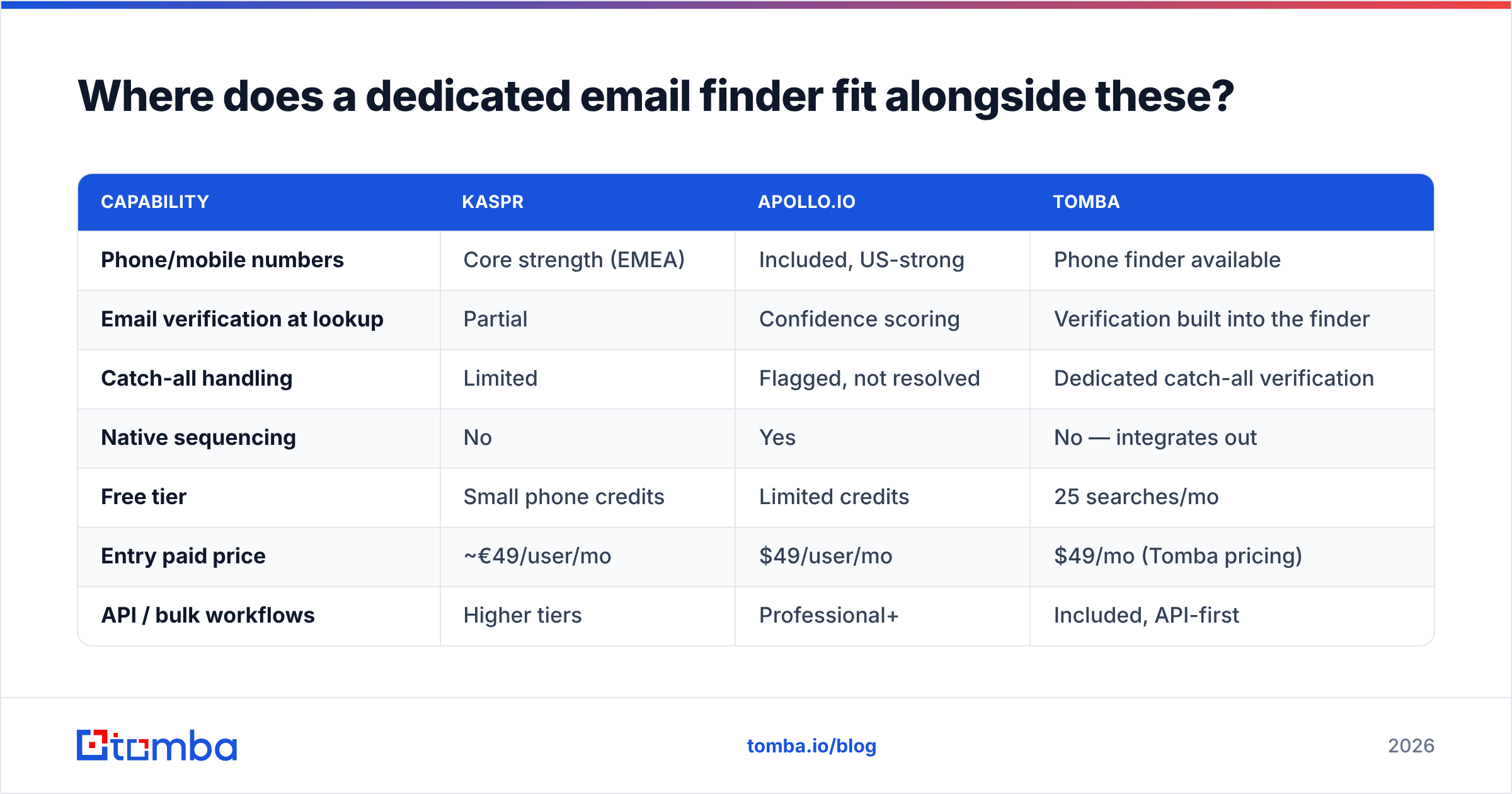
| Capability | Kaspr | Apollo.io | Tomba |
|---|---|---|---|
| Phone/mobile numbers | Core strength (EMEA) | Included, US-strong | Phone finder available |
| Email verification at lookup | Partial | Confidence scoring | Verification built into the finder |
| Catch-all handling | Limited | Flagged, not resolved | Dedicated catch-all verification |
| Native sequencing | No | Yes | No — integrates out |
| Free tier | Small phone credits | Limited credits | 25 searches/mo |
| Entry paid price | ~€49/user/mo | $49/user/mo | $49/mo (Tomba pricing) |
| API / bulk workflows | Higher tiers | Professional+ | Included, API-first |
The pattern that works for most teams: use the platform for discovery and the finder for delivery. Source the account list in Apollo. Source the mobiles in Kaspr if you're calling EMEA. Then resolve and verify every email address through a finder before a single message leaves your domain. If Apollo is the piece you're questioning, the Apollo alternative breakdown covers the swap in more detail.
Kaspr vs Apollo.io: so which should you actually buy?#
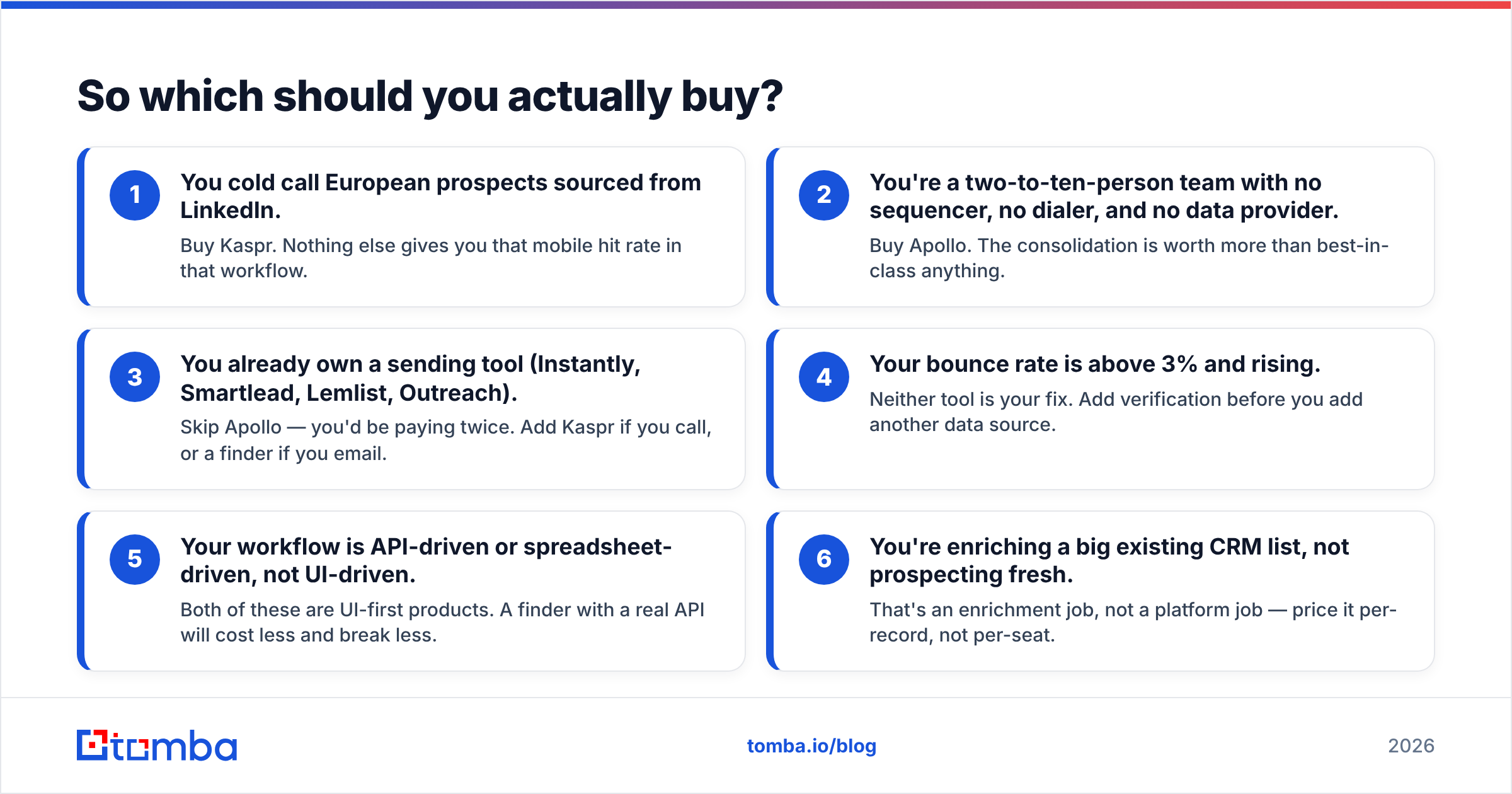
Run through these in order and stop at the first one that describes you:
- You cold call European prospects sourced from LinkedIn. Buy Kaspr. Nothing else gives you that mobile hit rate in that workflow.
- You're a two-to-ten-person team with no sequencer, no dialer, and no data provider. Buy Apollo. The consolidation is worth more than best-in-class anything.
- You already own a sending tool (Instantly, Smartlead, Lemlist, Outreach). Skip Apollo — you'd be paying twice. Add Kaspr if you call, or a finder if you email.
- Your bounce rate is above 3% and rising. Neither tool is your fix. Add verification before you add another data source.
- Your workflow is API-driven or spreadsheet-driven, not UI-driven. Both of these are UI-first products. A finder with a real API will cost less and break less.
- You're enriching a big existing CRM list, not prospecting fresh. That's an enrichment job, not a platform job — price it per-record, not per-seat.
The mistake to avoid: buying both at full seat price for a five-person team. You end up spending $700 a month to send email that bounces. The data layer and the sending layer need separate scrutiny.
Ready to fix the email half of the equation?#
Whichever platform you land on, the emails it hands you still need to survive contact with a mail server. Tomba Email Finder turns a name and domain into a verified work address. It checks the address at lookup time instead of shipping a confidence badge. You get the result through an API, a Chrome extension, Sheets, and bulk CSV. The free tier gives you 25 searches a month. Run your last Apollo or Kaspr export through it and compare the bounce rates yourself. That's the only benchmark that matters.
Related guides#
// get started
Find, verify and enrich your first contacts today
Start on the free plan with 25 searches a month, then scale when your team is ready.
Free plan · No credit card required · GDPR & CCPA
// about the author