Kaspr vs Leadmine (2026): Which Email Finder Actually Wins?
Kaspr sells LinkedIn-native mobile numbers. Leadmine sells cheap bulk email search. They solve different problems badly for each other's use case — here's the honest breakdown, credit math included.
TL;DR
- Kaspr is a phone-first, LinkedIn-native reveal tool. You work inside a LinkedIn profile or Sales Navigator list, click the extension, and it surfaces mobile numbers and emails. It is not built for bulk domain-level prospecting.
- Leadmine is an email-first search-and-export tool. You filter a B2B database by title, industry, and location, or paste a name plus a company domain, and export a CSV. It does not meaningfully compete on mobile numbers.
- On price, Leadmine is cheaper per email; Kaspr is cheaper per phone number. Kaspr's per-seat model punishes small teams that want one shared credit pool.
- Neither tool treats verification as a first-class product. If your bounce rate matters, you will end up bolting a dedicated verifier onto whichever one you pick.
- If you mostly need email at volume with an API and real verification, neither is the obvious default — a dedicated finder like Tomba ($49/mo Starter, free tier at 25 searches) covers that lane more directly.
What are Kaspr and Leadmine, actually?#
They get compared because both return a contact's email address. That is where the similarity stops.
Kaspr is a French contact-reveal product, acquired by Cognism in 2022. Its center of gravity is the Chrome extension: you open a LinkedIn profile, a sidebar appears, and Kaspr shows mobile numbers, direct dials, and email addresses. It also lets you push contacts into HubSpot, Pipedrive, Salesforce, or a sequencer without leaving the tab. The whole product is designed around a rep who lives in Sales Navigator.
Leadmine is a smaller, quieter B2B data tool with two halves: a searchable lead database (filter by job title, company, industry, location) and an email finder that takes a full name plus a company domain and returns the most likely address. There is a Chrome extension and an API, but the primary motion is search, select, export CSV.
Here is the split that actually decides this for most teams:
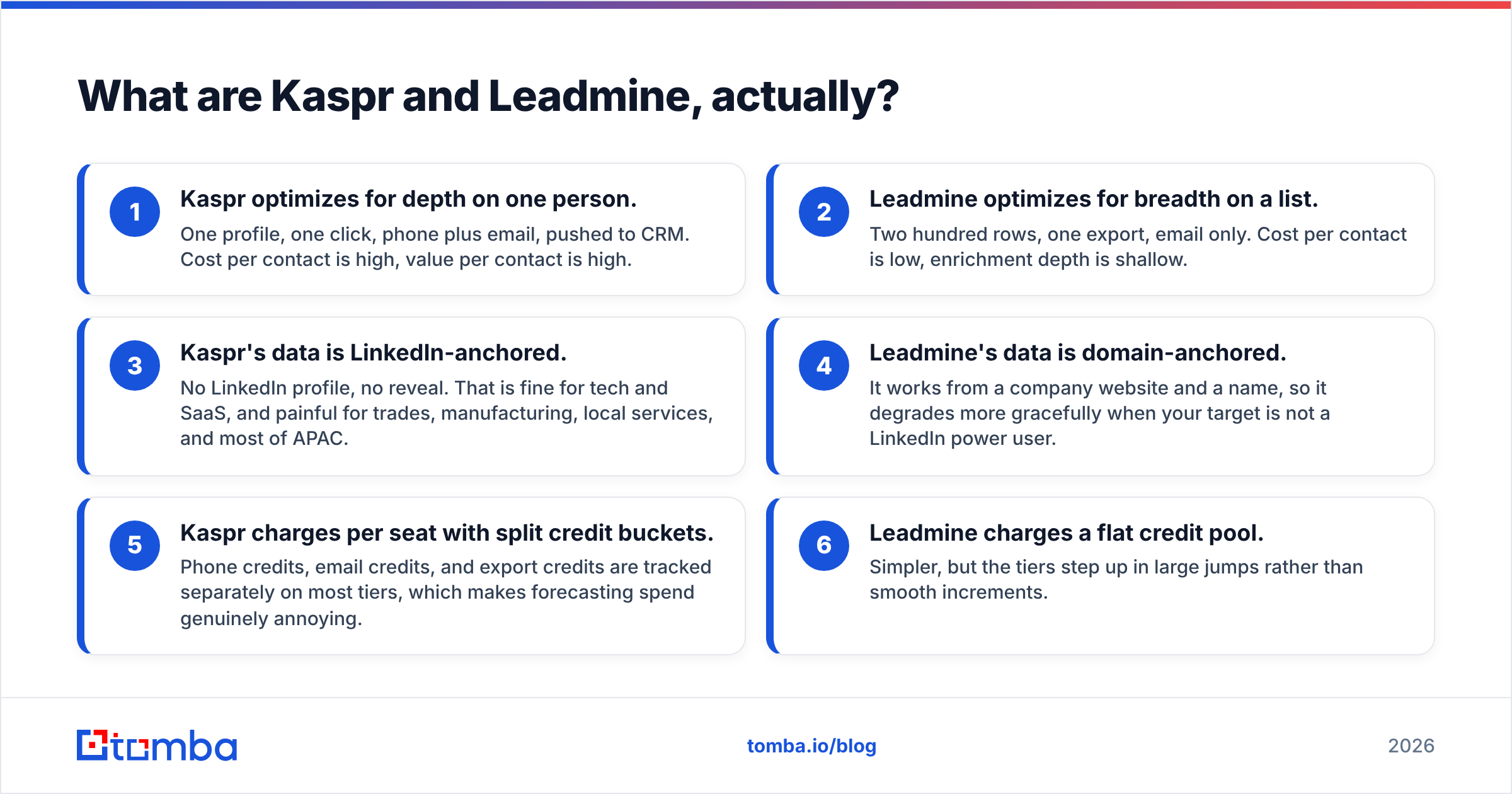
- Kaspr optimizes for depth on one person. One profile, one click, phone plus email, pushed to CRM. Cost per contact is high, value per contact is high.
- Leadmine optimizes for breadth on a list. Two hundred rows, one export, email only. Cost per contact is low, enrichment depth is shallow.
- Kaspr's data is LinkedIn-anchored. No LinkedIn profile, no reveal. That is fine for tech and SaaS, and painful for trades, manufacturing, local services, and most of APAC.
- Leadmine's data is domain-anchored. It works from a company website and a name, so it degrades more gracefully when your target is not a LinkedIn power user.
- Kaspr charges per seat with split credit buckets. Phone credits, email credits, and export credits are tracked separately on most tiers, which makes forecasting spend genuinely annoying.
- Leadmine charges a flat credit pool. Simpler, but the tiers step up in large jumps rather than smooth increments.

How do Kaspr and Leadmine compare on features and pricing?#
Pricing on both tools moves, and Kaspr in particular prices in euros with annual-commitment discounts that change the headline number substantially. Treat the figures below as a shape, not a quote, and confirm on each vendor's own pricing page before you buy.
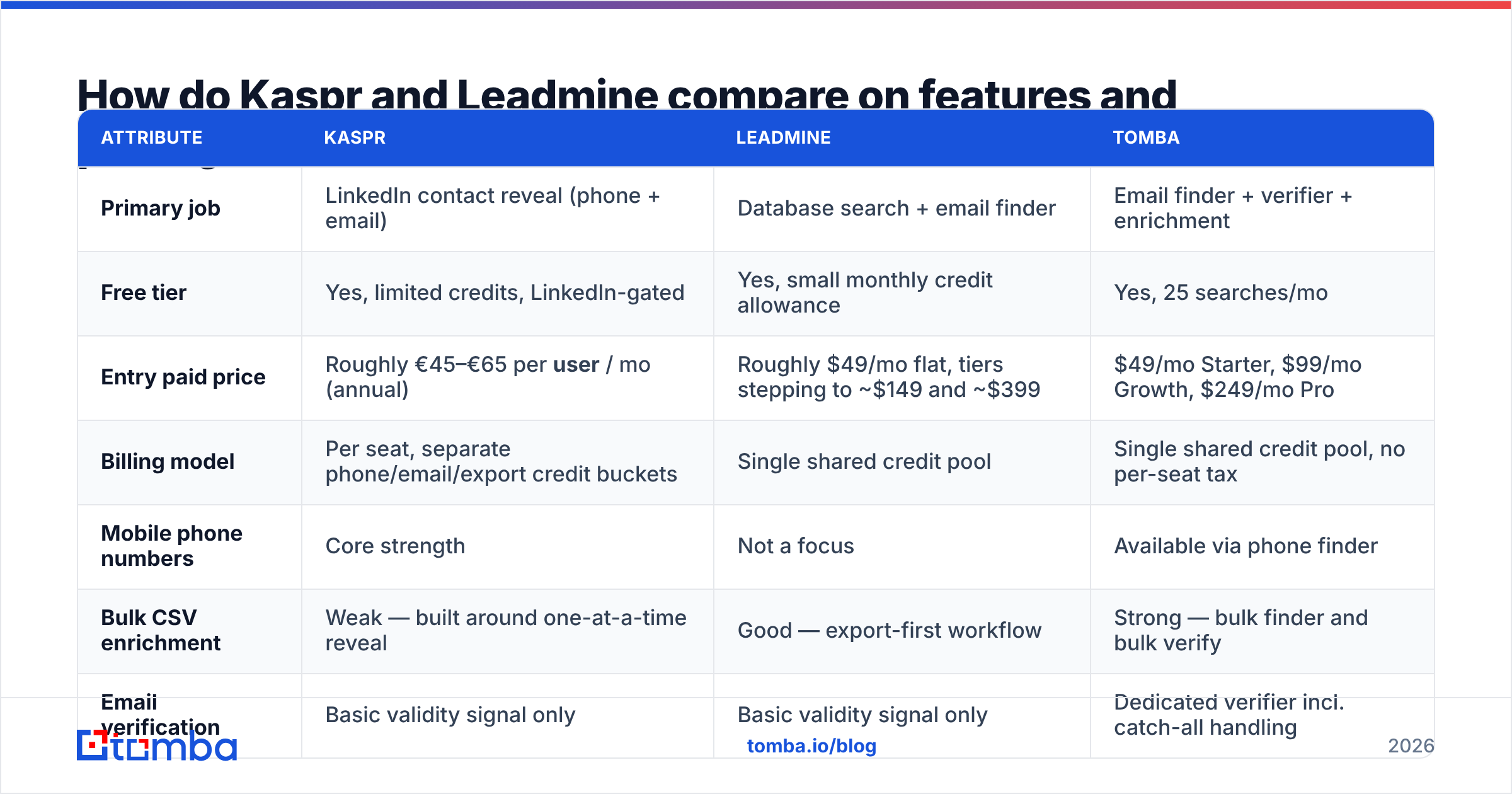
| Attribute | Kaspr | Leadmine | Tomba |
|---|---|---|---|
| Primary job | LinkedIn contact reveal (phone + email) | Database search + email finder | Email finder + verifier + enrichment |
| Free tier | Yes, limited credits, LinkedIn-gated | Yes, small monthly credit allowance | Yes, 25 searches/mo |
| Entry paid price | Roughly €45–€65 per user / mo (annual) | Roughly $49/mo flat, tiers stepping to ~$149 and ~$399 | $49/mo Starter, $99/mo Growth, $249/mo Pro |
| Billing model | Per seat, separate phone/email/export credit buckets | Single shared credit pool | Single shared credit pool, no per-seat tax |
| Mobile phone numbers | Core strength | Not a focus | Available via phone finder |
| Bulk CSV enrichment | Weak — built around one-at-a-time reveal | Good — export-first workflow | Strong — bulk finder and bulk verify |
| Email verification | Basic validity signal only | Basic validity signal only | Dedicated verifier incl. catch-all handling |
| Public API | Limited | Yes | Yes, plus CLI, Sheets, Excel, MCP |
| Works without LinkedIn | No | Yes | Yes |
| Best for | AE/SDR doing LinkedIn-led outbound | Lean teams building cheap email lists | Teams needing email volume + deliverability hygiene |
The per-seat line is the one that surprises people. If you have four reps and each needs their own Kaspr login, your real monthly cost is four times the sticker price, and unused credits generally do not pool across seats. Leadmine's flat credit model is friendlier to a three-person team sharing one workflow — but you will hit a wall the moment you need a phone number.
For a like-for-like look at how flat-pool pricing compares, Tomba pricing publishes credits per tier with no seat multiplier, which is the structure most teams should be benchmarking against.
Which one has better data accuracy?#
Neither vendor's marketing number should be taken at face value. Kaspr talks about coverage across a large European contact base; Leadmine has historically advertised accuracy in the mid-90s. Both claims are measured on the vendor's own sample, which is not your ICP.
What holds up in practice:
- Kaspr is stronger on European mobile numbers than almost anything at its price point. That is the thing it genuinely does well, and it is why Cognism bought it.
- Kaspr's email accuracy is middling. Emails feel like a secondary output. You will see role-based addresses and stale records, especially at companies that have been through a rebrand or acquisition.
- Leadmine's email accuracy is respectable for pattern-derived addresses at companies with a clean, predictable format (first.last@, f.last@). It gets shakier on catch-all domains, where it tends to return an address it cannot actually confirm.
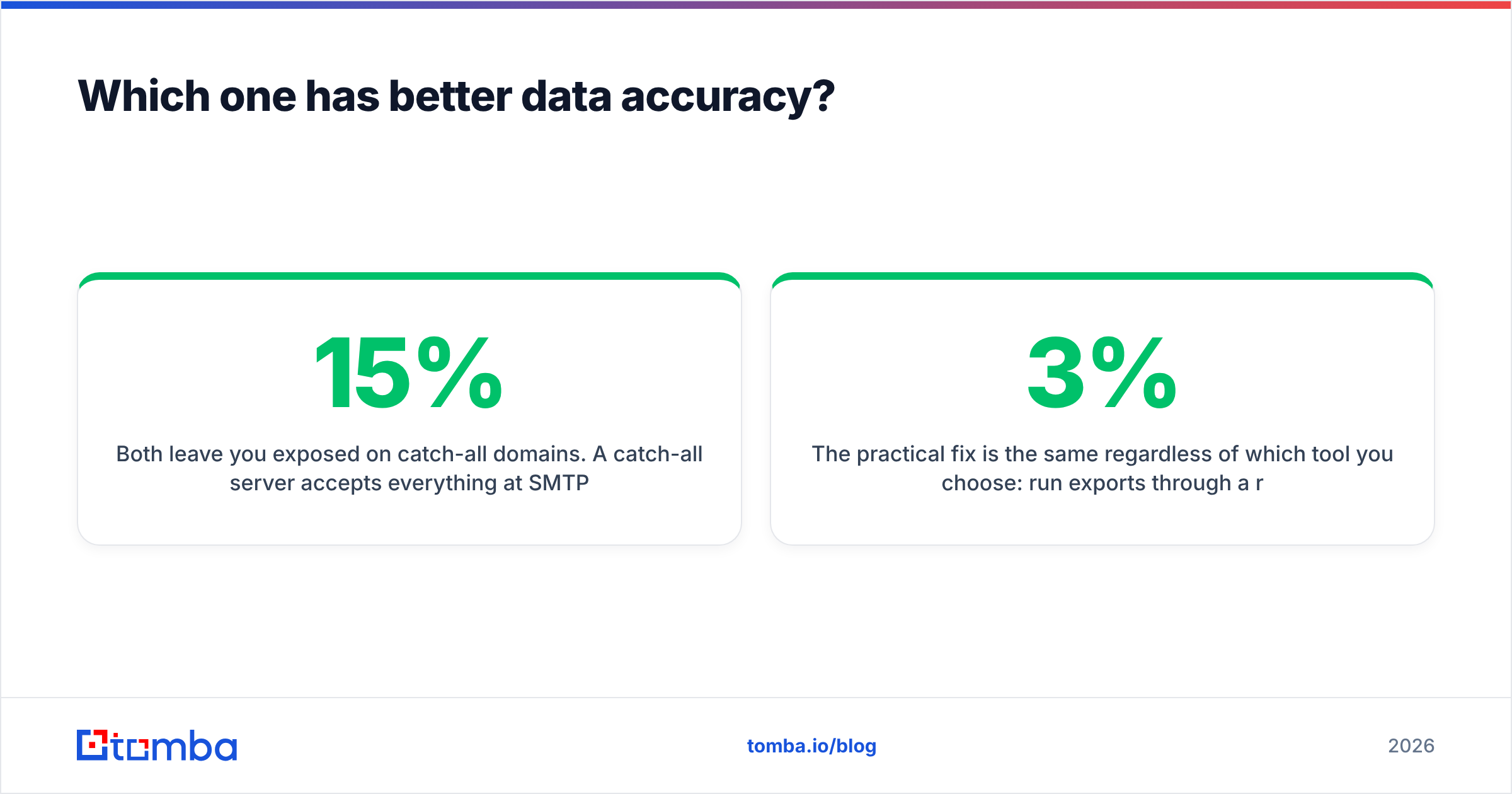
- Both leave you exposed on catch-all domains. A catch-all server accepts everything at SMTP, so "valid" means nothing. Somewhere between 15% and 25% of B2B domains are catch-all, and that is where most silent bounce damage originates.

The practical fix is the same regardless of which tool you choose: run exports through a real email verifier before they touch a sequencer. A dedicated catch-all verifier matters more than another point of finder accuracy, because a 3% hard-bounce rate does more damage to your domain than a 3% coverage gap does to your pipeline. Google and Yahoo's bulk-sender requirements put the practical hard-bounce ceiling well under 2%, and neither Kaspr nor Leadmine is architected to keep you there on its own.
Is Kaspr worth it for phone numbers?#
If phone is part of your motion, yes — with two caveats.
The first is geography. Kaspr's coverage is noticeably denser in France, Benelux, DACH, the UK, and Nordics than in North America. US teams frequently find that the mobile hit rate does not justify the credit burn, and end up comparing it unfavorably against US-centric providers. Run a trial against fifty real accounts from your own territory list before committing to an annual plan. Do not trial it against a generic list of well-known SaaS companies — those are the easiest records in any database.
The second is the credit structure. Phone credits are the scarce resource, and on lower tiers you get few enough of them that a rep can exhaust a month in two afternoons of Sales Navigator work. Teams routinely underestimate this and upgrade mid-quarter, which is arguably the point of the design.
Where Kaspr is genuinely good: the workflow. The extension is fast, the CRM push works, and there is no context switch. For an SDR who is already prospecting on LinkedIn eight hours a day, saving fifteen seconds per contact is real money. If you want the phone layer without the per-seat structure, a standalone phone finder plus a phone validator can cover the same job in a bulk workflow rather than a one-click one.
Is Leadmine better for bulk email prospecting?#
For the narrow job of "turn a list of names and companies into a list of emails cheaply," Leadmine holds up better than its low profile suggests. The database search is usable, the export is clean, and the credit model does not punish you for adding a teammate.
Its limits show up in three places:
- Database size and freshness. Leadmine's index is materially smaller than Apollo's, Cognism's, or ZoomInfo's. On mid-market and enterprise targets in mainstream industries it is fine. On long-tail SMB or non-English markets, coverage thins fast.
- No real enrichment layer. You get the email, and often a title and company. You do not get the firmographic and technographic depth that a modern data enrichment workflow assumes — which means another tool in the stack.
- Support and roadmap velocity. It is a small operation. That is not a criticism of the product, but it is a procurement risk if this becomes load-bearing infrastructure for your pipeline.

The uncomfortable truth about this whole category: most email finders, Kaspr and Leadmine included, are doing some combination of pattern inference and SMTP probing over a cached corpus. The differentiator is rarely magic data — it is the size of the verified corpus, how aggressively stale records get retired, and whether the vendor is honest about confidence scores instead of returning a guess with a green checkmark. Vendors that publish where their data comes from are easier to trust than vendors that do not.
What does the credit math actually look like?#
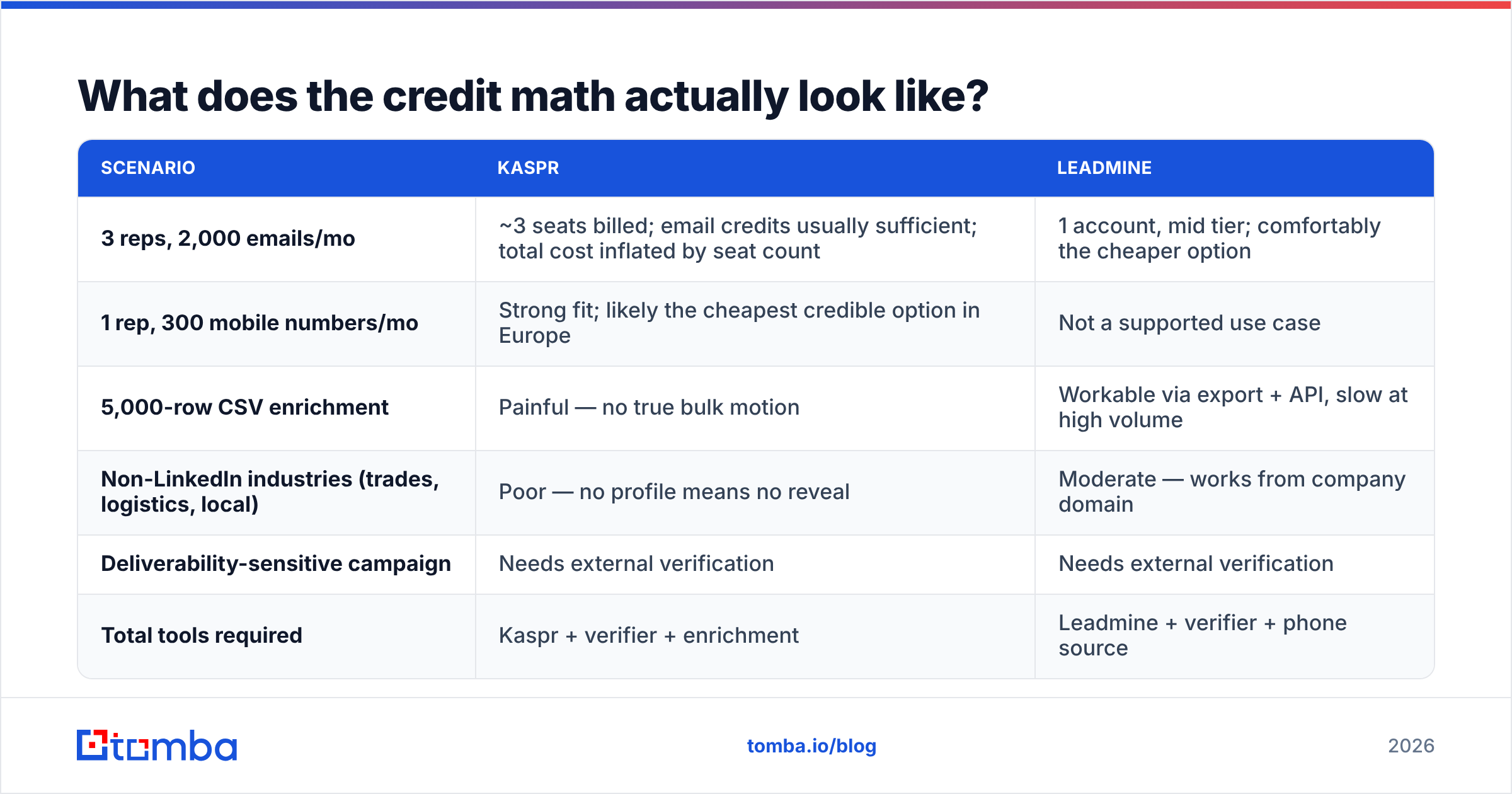
Run the cost per usable contact, not the cost per credit. A credit spent on an address that bounces is worse than no credit at all, because it also costs you sender reputation.
| Scenario | Kaspr | Leadmine |
|---|---|---|
| 3 reps, 2,000 emails/mo | ~3 seats billed; email credits usually sufficient; total cost inflated by seat count | 1 account, mid tier; comfortably the cheaper option |
| 1 rep, 300 mobile numbers/mo | Strong fit; likely the cheapest credible option in Europe | Not a supported use case |
| 5,000-row CSV enrichment | Painful — no true bulk motion | Workable via export + API, slow at high volume |
| Non-LinkedIn industries (trades, logistics, local) | Poor — no profile means no reveal | Moderate — works from company domain |
| Deliverability-sensitive campaign | Needs external verification | Needs external verification |
| Total tools required | Kaspr + verifier + enrichment | Leadmine + verifier + phone source |
Notice that both rows end the same way: you add a verifier. That is the hidden line item in this comparison. Budget for it up front rather than discovering it after your first campaign gets throttled.

Which should you pick for your team?#
Pick Kaspr if: your outbound is LinkedIn-led, you sell into Europe, phone is a real channel for you, and you can stomach per-seat pricing. It is the better tool for a rep-centric, high-touch motion where each contact is worth several dollars of data spend.
Pick Leadmine if: you are a lean team building email lists on a budget, your targets are findable by domain, and you do not need phone numbers. It is the better tool for a list-centric, volume motion where cost per row is the binding constraint.
Pick neither if: you need programmatic access at scale. Both tools are workflow products first. If your requirement is "enrich 20,000 rows a month through an API, verified, with catch-all handling," you are shopping in the wrong aisle. That is a job for a bulk email finder with a documented API, not a Chrome extension.
Before you commit to an annual contract on either, do two things. First, read recent reviews on a third-party site like G2 filtered to your company size — the enterprise reviews and the ten-person-startup reviews describe genuinely different products. Second, run the same 100-contact test list through both free tiers and measure three numbers: match rate, bounce rate after verification, and minutes of manual work per 100 contacts. The winner is usually obvious within an hour, and it is frequently not the tool with the better marketing site.
What are the honest alternatives to both?#
The category around Kaspr and Leadmine is crowded, and the right substitute depends on which half of the job you care about.
- For phone-heavy European outbound: Cognism (Kaspr's parent) is the step up, at meaningfully higher cost.
- For large US databases with sequencing built in: Apollo, with the usual caveat that data quality is uneven and you are paying for the sequencer as much as the data.
- For verified B2B email lists with transparent sourcing: BookYourData is a solid, well-regarded option when you want a purchased list with clear provenance rather than a self-serve search tool.
- For email finding plus verification as one pipeline: a dedicated finder-and-verifier stack, which is where Tomba sits.
The bottom line#
Kaspr and Leadmine are not really competitors — they are two tools that happen to overlap on one output field. Kaspr wins the phone-and-LinkedIn lane. Leadmine wins the cheap-bulk-email lane. Both leave verification to you, and both will cost more than the sticker price once you account for seats, credit buckets, and the second tool you inevitably add.
If your actual constraint is email volume with clean deliverability — finding the right address, confirming it is real, handling catch-all domains, and doing it through an API instead of a browser tab — start with the Tomba Email Finder. The free tier gives you 25 searches a month to run a real match-rate test against your own list, Starter is $49/mo with a shared credit pool and no per-seat surcharge, and the verifier is part of the same platform rather than a separate invoice. Test it against your own accounts, not a demo list, and let the bounce rate pick the winner.
Related guides#
// get started
Find, verify and enrich your first contacts today
Start on the free plan with 25 searches a month, then scale when your team is ready.
Free plan · No credit card required · GDPR & CCPA
// about the author