Kaspr vs PrivCo (2026): Contact Data vs Company Intel
Kaspr sells mobile numbers scraped off LinkedIn. PrivCo sells private company financials. They get compared constantly, yet they solve completely different problems — here's which one your pipeline actually needs, and what each really costs.
TL;DR
- Kaspr vs PrivCo is not a like-for-like fight. Kaspr is a LinkedIn-first contact finder (mobile numbers and emails, one prospect at a time). PrivCo is a private-company financial research database (revenue, funding, M&A, ownership). Buying one because you read a comparison of the other is the most common mistake here.
- Kaspr wins if your bottleneck is "I can't reach this person." It is per-seat, browser-extension-driven, and strongest on European mobile numbers thanks to its Cognism ownership.
- PrivCo wins if your bottleneck is "I don't know whether this company can afford us." It estimates revenue for private US companies that never file public numbers.
- Neither is a full prospecting stack. Kaspr gives you contacts but no financial qualification. PrivCo gives you accounts but almost no contact-level reach.
- Cost gap is enormous. Kaspr starts free and runs roughly €49–€99 per user per month. PrivCo sits in the low four figures per year, per seat. Budget accordingly.
What is the real difference between Kaspr and PrivCo?#
One is a phone book. The other is a credit report.
That analogy is worth holding onto, because the entire Kaspr vs PrivCo decision collapses into it. When you open Kaspr, you are asking: what is this person's mobile number and work email? When you open PrivCo, you are asking: how much money does this private company actually make, who funded it, and is it growing?
Both are legitimately "B2B data" tools, which is why they end up on the same shortlists and the same G2 category pages. But they sit at opposite ends of the go-to-market workflow. PrivCo helps you decide which accounts deserve effort. Kaspr helps you touch the humans inside those accounts. If you buy one expecting the other's job, you will be disappointed within a week.
Here is the practical framing: PrivCo answers account-level questions, Kaspr answers contact-level questions, and most teams eventually need both layers — usually assembled from cheaper parts than either vendor's flagship plan.
How does Kaspr work?#
Kaspr is a Chrome extension first, a web app second. You open a LinkedIn profile, a LinkedIn Sales Navigator list, or a LinkedIn group, click the Kaspr widget, and it returns the contact's phone numbers and email addresses. Credits are consumed per reveal, with phone credits and email credits metered separately on most plans.
A few things define how it behaves in practice:
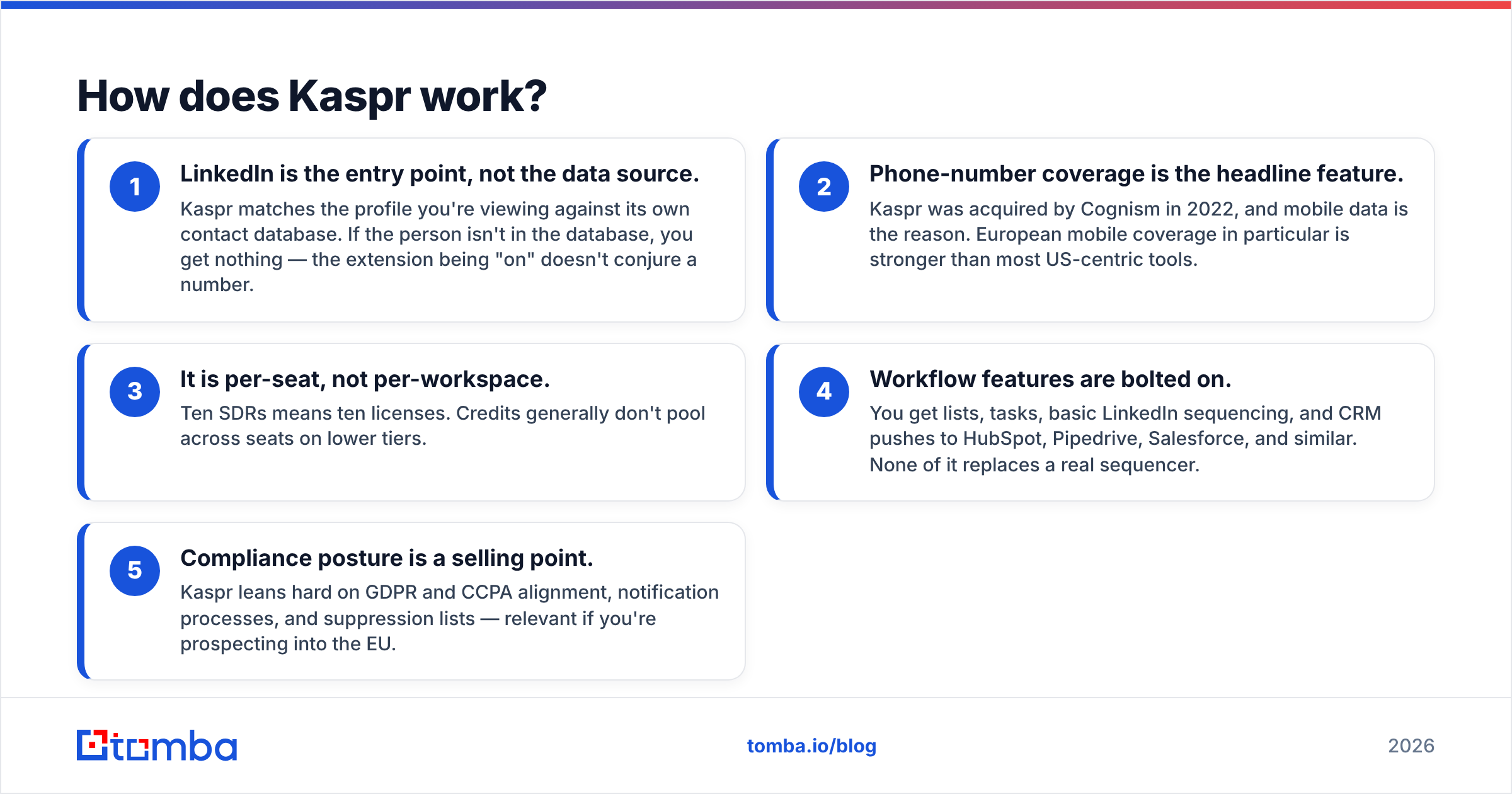
- LinkedIn is the entry point, not the data source. Kaspr matches the profile you're viewing against its own contact database. If the person isn't in the database, you get nothing — the extension being "on" doesn't conjure a number.
- Phone-number coverage is the headline feature. Kaspr was acquired by Cognism in 2022, and mobile data is the reason. European mobile coverage in particular is stronger than most US-centric tools.
- It is per-seat, not per-workspace. Ten SDRs means ten licenses. Credits generally don't pool across seats on lower tiers.
- Workflow features are bolted on. You get lists, tasks, basic LinkedIn sequencing, and CRM pushes to HubSpot, Pipedrive, Salesforce, and similar. None of it replaces a real sequencer.
- Compliance posture is a selling point. Kaspr leans hard on GDPR and CCPA alignment, notification processes, and suppression lists — relevant if you're prospecting into the EU.
The extension model is genuinely fast for one-off research. It is genuinely slow for building a 5,000-row list, which is where per-domain and API-driven approaches like domain search pull ahead.

How does PrivCo work?#
PrivCo is a research database, and it behaves like one. You search a private company — say a 300-person logistics firm in Ohio that has never filed with the SEC — and PrivCo returns an estimated revenue range, employee counts over time, funding history, investor list, valuation signals, M&A activity, and growth indicators.
The core value proposition is modeling the unmodellable. Public companies publish everything. Private companies publish nothing, and PrivCo's business is building defensible estimates for the ones above roughly $1M in revenue, with a strong US bias.
Typical users are not SDRs. They are:
- Investment bankers and PE associates sourcing targets and sizing them before outreach.
- Corporate development teams scanning acquisition pipelines.
- Market researchers sizing categories where most players are private.
- Enterprise sales teams doing account qualification on non-public prospects.
What PrivCo does not do well is give you people. There are executive names and some contact details, but no one runs a 200-touch outbound campaign off a PrivCo export. It was never built for that.
Kaspr vs PrivCo: how do they compare head-to-head?#
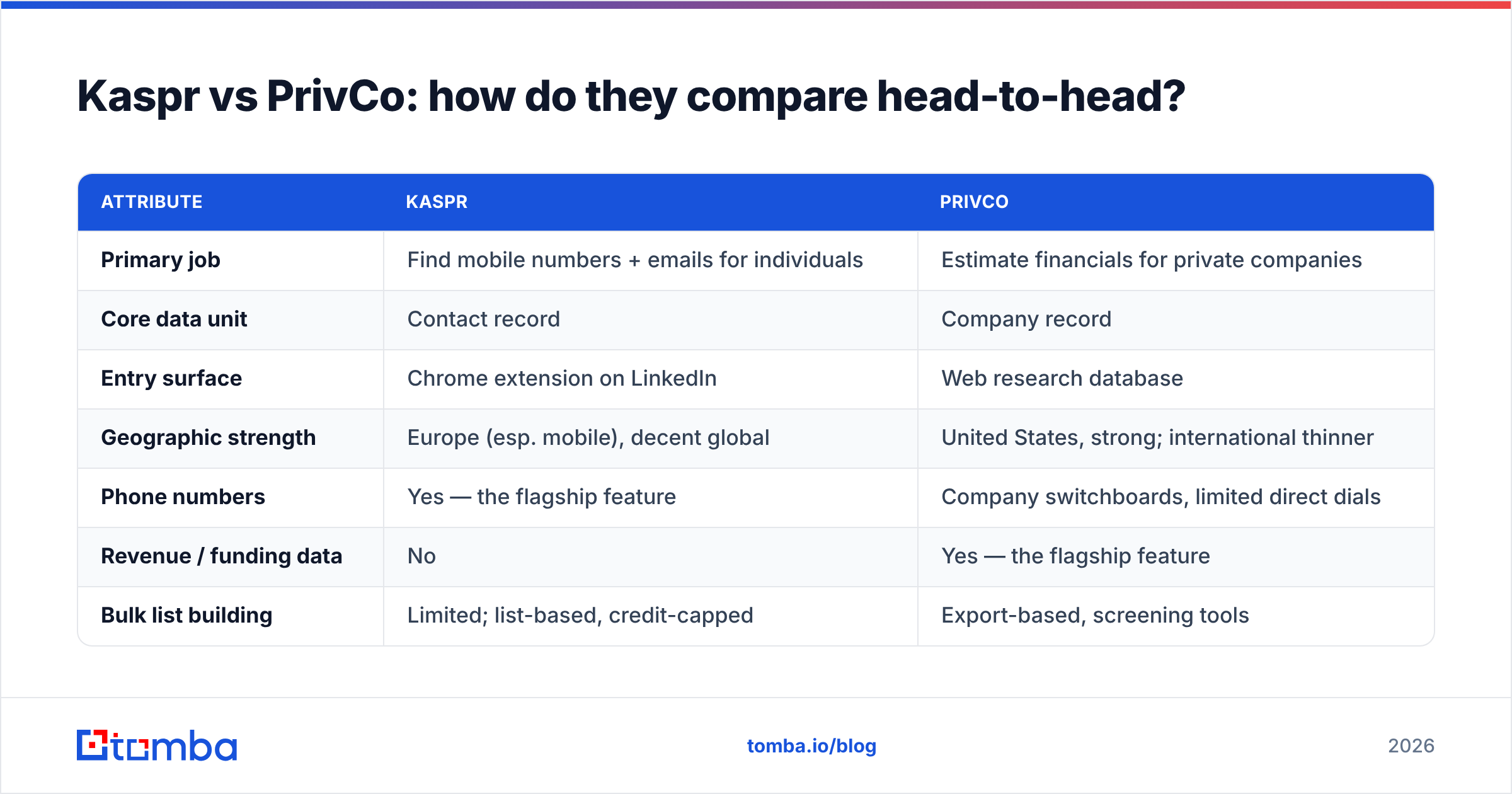
| Attribute | Kaspr | PrivCo |
|---|---|---|
| Primary job | Find mobile numbers + emails for individuals | Estimate financials for private companies |
| Core data unit | Contact record | Company record |
| Entry surface | Chrome extension on LinkedIn | Web research database |
| Geographic strength | Europe (esp. mobile), decent global | United States, strong; international thinner |
| Phone numbers | Yes — the flagship feature | Company switchboards, limited direct dials |
| Revenue / funding data | No | Yes — the flagship feature |
| Bulk list building | Limited; list-based, credit-capped | Export-based, screening tools |
| API access | Available on higher tiers | Available, enterprise-oriented |
| Typical buyer | SDR, AE, recruiter, founder | Analyst, PE/banker, corp dev, market researcher |
| Free option | Yes — limited free plan | No meaningful free tier |
| Entry price | ~€49/user/mo | Low four figures/year/seat |
Read that table twice before you compare pricing, because the price gap only makes sense once you accept these are different product categories. You are not paying 20x more for "better data." You are paying for a different kind of data with a much smaller buyer pool.
Which one has better data accuracy?#
Wrong question — but here's the honest version of the answer.
Kaspr's accuracy is measured in connect rates. The metric that matters is: of 100 revealed mobile numbers, how many ring the right person? Kaspr's Cognism-backed phone data performs well in Western Europe, more variably in the US, and thinly in APAC and LATAM. Email accuracy is solid but not category-leading; several dedicated finders beat it on verified-email hit rate, and most teams end up running a second pass through an email verifier before sending anyway.
PrivCo's accuracy is measured in estimate confidence. Revenue figures for private companies are modeled, not reported. PrivCo labels confidence levels, and directionally the estimates are useful — good enough to decide "this is a $50M company, not a $5M company." They are not good enough to underwrite a deal without diligence, and PrivCo doesn't claim otherwise. Coverage thins fast below the $1M revenue line and outside the US.
Both vendors publish accuracy claims. Both sets of claims are best read alongside user reviews on G2, where the recurring themes are consistent: Kaspr users complain about credit burn and dead numbers in specific regions; PrivCo users complain about stale records and gaps on smaller private firms.
The useful takeaway: verify contact data before you send, and treat financial estimates as a filter, not a fact.
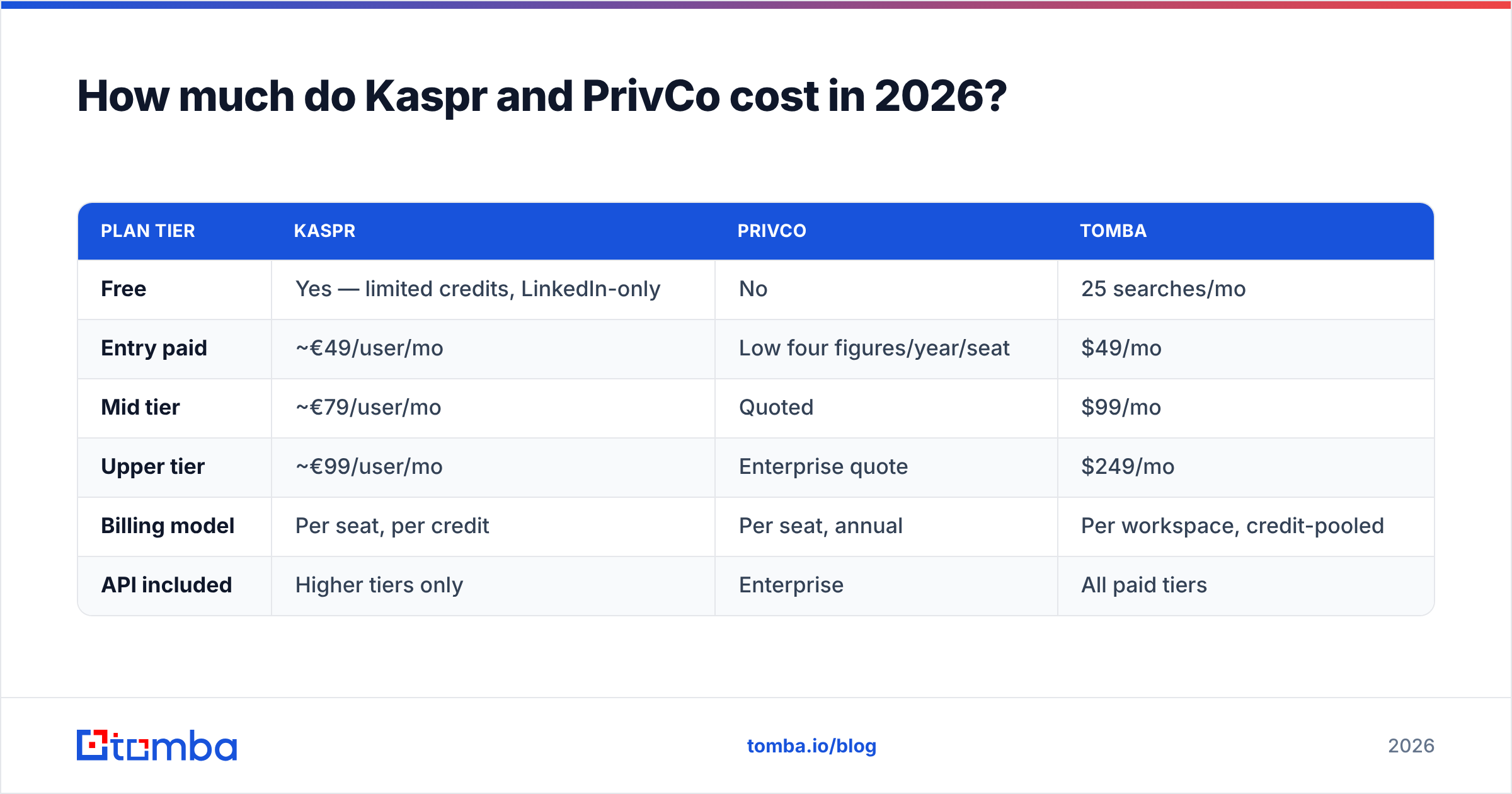
How much do Kaspr and PrivCo cost in 2026?#
| Plan tier | Kaspr | PrivCo | Tomba |
|---|---|---|---|
| Free | Yes — limited credits, LinkedIn-only | No | 25 searches/mo |
| Entry paid | ~€49/user/mo | Low four figures/year/seat | $49/mo |
| Mid tier | ~€79/user/mo | Quoted | $99/mo |
| Upper tier | ~€99/user/mo | Enterprise quote | $249/mo |
| Billing model | Per seat, per credit | Per seat, annual | Per workspace, credit-pooled |
| API included | Higher tiers only | Enterprise | All paid tiers |
Always confirm current numbers on each vendor's own pricing page — both companies have changed packaging in the last 24 months, and PrivCo in particular quotes rather than publishes at the upper end.
The structural point matters more than the exact figures. Kaspr charges per human using it. PrivCo charges per human using it, annually, at research-tool prices. Neither scales gracefully when you want to enrich 50,000 rows once, because both are priced for continuous seat usage, not burst workloads. That's a real budget trap for RevOps teams doing quarterly list builds — compare against flat Tomba pricing before you sign an annual seat contract.

Which should you choose for your use case?#
Pick by bottleneck, not by feature list.
- You're an SDR team dialing European prospects. Kaspr, clearly. Mobile coverage is the whole game, and PrivCo won't help you reach anyone. Budget one seat per rep.
- You're a PE or corp dev analyst sourcing targets. PrivCo, clearly. You need revenue estimates and ownership structure. Contact data is a secondary step you can solve for a fraction of the cost elsewhere.
- You're doing enterprise account qualification before outbound. PrivCo for the filter, then a cheaper contact layer for reach. Paying Kaspr seat fees for every rep on top of PrivCo seats is how data budgets quietly hit six figures.
- You're a founder or solo operator doing manual outbound. Neither at full price. Start with Kaspr's free tier for phone spot-checks and a free-tier finder for emails, then scale the layer that actually runs out.
- You're a RevOps team enriching a CRM in bulk. Neither, honestly. Both are interactive tools. You want an API and pooled credits — that's a data enrichment job, not a browser-extension job.
- You're recruiting. Kaspr, with caveats. Phone numbers matter, but check regional coverage against your actual candidate market before committing to annual seats.
Where do Kaspr and PrivCo fall short?#
Kaspr's weak points are credit economics and workflow ceiling. Credits deplete fast when you're revealing both phone and email on every profile, and the per-seat model punishes growing teams. The built-in sequencing is thin enough that most buyers run it alongside a real outbound platform — meaning Kaspr is an add-on cost, not a consolidation play. Bulk work is awkward: you're clicking through LinkedIn rather than submitting a domain list.
PrivCo's weak points are coverage depth and contact reach. Ask it about a 40-person private company in Portugal and you'll likely get a shell record. Ask it for the CFO's mobile number and you're out of scope entirely. The annual commitment also means you pay through the quarters where nobody logs in — a real problem for teams with lumpy research cycles.
Shared weak point: neither tool gives you a verified, send-ready email list at volume without a second vendor. Kaspr's emails need verification before a cold campaign. PrivCo's contact fields are sparse by design. That gap is where most stacks end up adding a dedicated finder.
Can you replace either one with something cheaper?#
Partially — and it depends which half you're replacing.
You cannot replace PrivCo's revenue modeling cheaply. Private-company financial estimation is genuinely hard, and the vendors who do it well charge accordingly. If that's your bottleneck, pay for it, or accept public-signal proxies (headcount growth, job postings, funding announcements) as a rough substitute.
You can replace a lot of Kaspr's job cheaply, because contact discovery is a more competitive market. A domain-first email finder covers the "find everyone at this company" workflow that extensions handle badly, at a workspace price rather than a per-seat one. Pair it with a phone finder when direct dials matter, and route everything through an API if you're enriching in bulk. For teams comparing the whole contact-data category rather than just these two names, providers like BookYourData take a purchased-list approach that suits one-time campaign builds, while API-first tools suit continuous enrichment — different shapes, both valid.
The honest hybrid for most mid-market teams: PrivCo (or a cheaper firmographic source) for account selection, a flat-priced finder plus verifier for contact reach, and Kaspr only for the reps who genuinely live on the phone in Europe.
Frequently asked questions#
Is Kaspr owned by Cognism? Yes. Cognism acquired Kaspr in 2022, and the phone data lineage traces back to that relationship.
Does PrivCo cover international companies? Some, but US coverage is substantially deeper. Non-US private companies below mid-market size are frequently thin or missing.
Can I use Kaspr without LinkedIn? The web app offers search and list features, but the extension on LinkedIn is where the product is strongest. Without LinkedIn, you're using a diminished version.
Do I need an email verifier if I use Kaspr? Yes, for cold outbound. Any finder's output drifts, and bouncing 8% of a campaign damages sender reputation faster than the extra verification step costs you.
Which is better for cold calling? Kaspr, without question. PrivCo is a research tool.
The bottom line#
Kaspr vs PrivCo is a category mismatch wearing a comparison headline. Choose Kaspr when you need to reach people and you're calling into Europe. Choose PrivCo when you need to size private companies before you spend effort on them. Choose both only when you've confirmed the seat math survives contact with your headcount.
And if the actual problem is that you need verified work emails at volume — across domains, in bulk, through an API, without paying per seat — that's a narrower problem with a cheaper answer. Start with the Tomba Email Finder free tier (25 searches a month, no card), run a sample of your target domains, and compare hit rate against whatever quote is sitting in your inbox. Then spend the budget on the layer you genuinely can't build yourself.
Related guides#
// get started
Find, verify and enrich your first contacts today
Start on the free plan with 25 searches a month, then scale when your team is ready.
Free plan · No credit card required · GDPR & CCPA
// about the author