Kaspr vs Pubrio (2026): Which B2B Contact Data Tool Wins?
Kaspr sells LinkedIn mobile numbers. Pubrio sells AI-driven lead search. They overlap less than the category page suggests — and the wrong pick costs you a quarter of bounced sequences. Here's the honest breakdown.
TL;DR
- Kaspr is a LinkedIn-first contact revealer. Its strongest asset is European mobile numbers surfaced from a LinkedIn profile, Sales Navigator list, or group. It is owned by Cognism, and its data posture is built around EU/GDPR compliance.
- Pubrio is an AI-first lead search platform. You describe an ICP in natural language, it builds the list, then enriches it with emails and firmographics. The LinkedIn extension is a feature, not the product.
- They are not really substitutes. Kaspr answers "who is this person and what's their mobile?" Pubrio answers "who should I be talking to at all?"
- Pricing models differ more than sticker prices. Kaspr charges per seat with separate credit pools for phones and emails. Pubrio bundles credits across search and enrichment, which is cheaper for one operator running lists and worse for a ten-rep floor.
- If your bottleneck is deliverable email at scale, neither is optimized for it. A dedicated finder plus verifier (Tomba starts at $49/mo with a free tier) usually beats bolting bulk email work onto a phone tool or a list builder.
What is Kaspr, and who actually uses it?#
Kaspr is a Chrome extension and web app that reveals contact details — mobile numbers, direct dials, and email addresses — from LinkedIn profiles. You install the extension, open a profile or a Sales Navigator search, and it surfaces whatever it holds for that person. It was acquired by Cognism in 2022 and now sits as the self-serve, SMB-facing layer of that data stack.
The typical Kaspr user is an SDR or founder doing manual, high-intent prospecting. You have already decided who you want to call. You need the number. Kaspr's pitch is that it has European mobile coverage most US-centric databases treat as an afterthought, with a consent and takedown process designed to survive a GDPR question from procurement.
What Kaspr is not: a discovery engine. There is list building inside the app, and there are LinkedIn-based workflows and basic sequencing, but you are still fundamentally starting from a LinkedIn search you built yourself.
What is Pubrio, and how is it different?#
Pubrio approaches the same revenue problem from the opposite end. Instead of "here is a person, get me their number," it is "here is a description of my ideal customer, build me the list." You type something like Series A fintech companies in the UK with 20–100 employees hiring compliance staff, and the AI search layer resolves that into a company and contact set, which you then enrich.
Its feature set skews toward:
- AI-driven prospect search — natural-language ICP queries rather than a wall of filters
- Company and technology signals — tech stack, hiring, funding-style attributes to segment on
- Contact enrichment — emails first, with phone data available but not the headline
- Bulk workflows and API access — designed for enriching CSVs and CRM records, not just one profile at a time
The practical difference: Kaspr makes an individual outreach attempt possible. Pubrio makes a campaign possible. If you already know your 200 accounts, Pubrio's core differentiator is wasted on you. If you don't, Kaspr will leave you doing the hard part in a LinkedIn tab.

Kaspr vs Pubrio: how do they compare at a glance?#
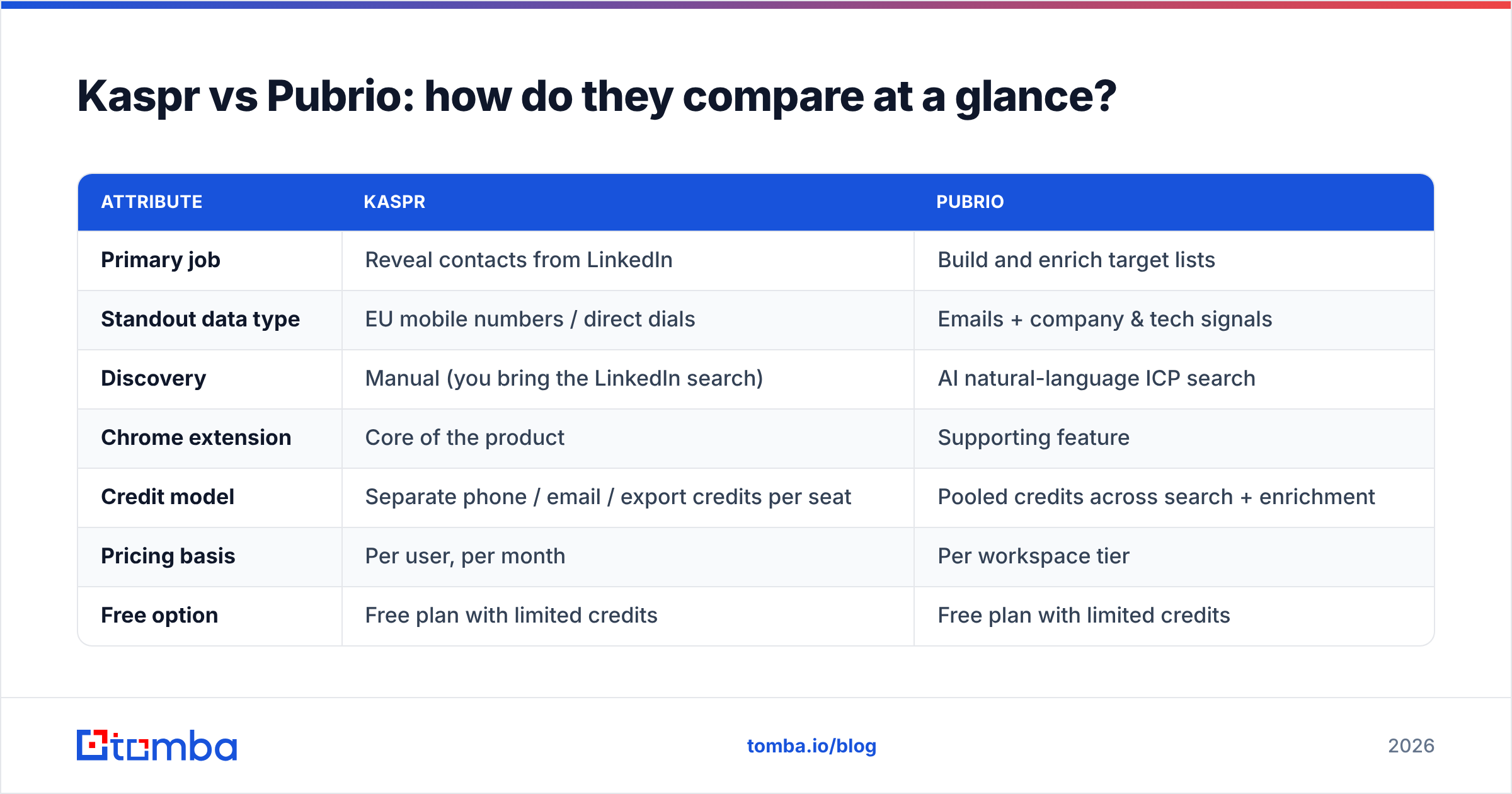
| Attribute | Kaspr | Pubrio |
|---|---|---|
| Primary job | Reveal contacts from LinkedIn | Build and enrich target lists |
| Standout data type | EU mobile numbers / direct dials | Emails + company & tech signals |
| Discovery | Manual (you bring the LinkedIn search) | AI natural-language ICP search |
| Chrome extension | Core of the product | Supporting feature |
| Credit model | Separate phone / email / export credits per seat | Pooled credits across search + enrichment |
| Pricing basis | Per user, per month | Per workspace tier |
| Free option | Free plan with limited credits | Free plan with limited credits |
| Best fit | SDRs calling into EU markets | Founders/RevOps building lists from scratch |
| Weak spot | Little discovery; seat costs stack | Phone coverage is not its strength |
| Compliance posture | GDPR-forward, EU-based | Standard B2B data compliance |
Read that table as two different purchases that happen to appear in the same G2 category. Buyers who churn off one of these tools usually bought it to do the other one's job.
Which one has better email accuracy?#
Neither vendor publishes a third-party audited accuracy figure you can hold them to, so treat marketing percentages from both sides as directional. What you can do is test both on a control list.
Here is the method that actually settles it, and it takes about twenty minutes:
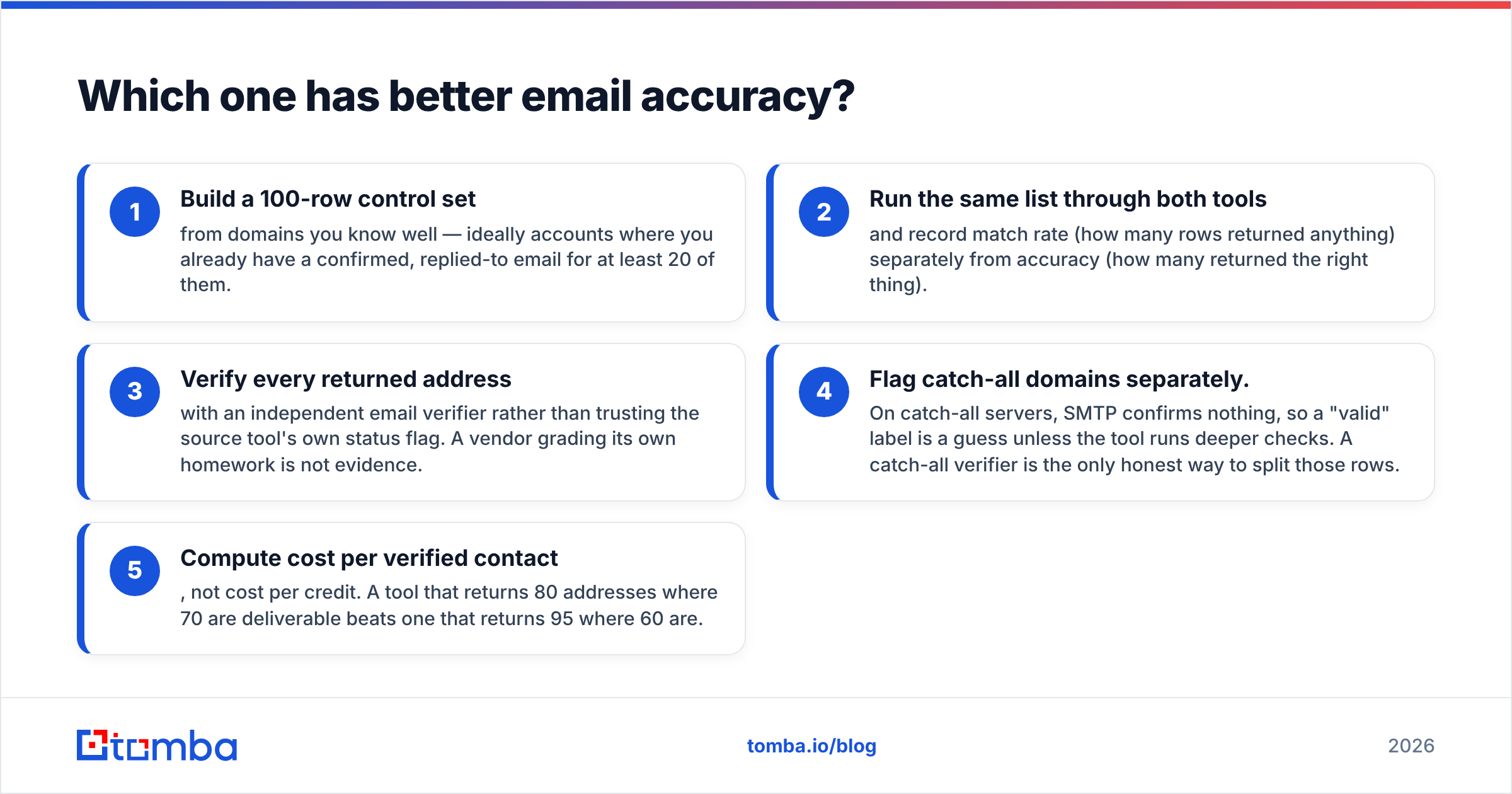
- Build a 100-row control set from domains you know well — ideally accounts where you already have a confirmed, replied-to email for at least 20 of them.
- Run the same list through both tools and record match rate (how many rows returned anything) separately from accuracy (how many returned the right thing).
- Verify every returned address with an independent email verifier rather than trusting the source tool's own status flag. A vendor grading its own homework is not evidence.
- Flag catch-all domains separately. On catch-all servers, SMTP confirms nothing, so a "valid" label is a guess unless the tool runs deeper checks. A catch-all verifier is the only honest way to split those rows.
- Compute cost per verified contact, not cost per credit. A tool that returns 80 addresses where 70 are deliverable beats one that returns 95 where 60 are.

In practice, tools built around LinkedIn revelation tend to show high match rates and softer deliverability, because a profile-linked email is often a personal or stale address rather than a current work inbox. Tools built around domain patterns plus verification tend to show lower match rates and higher deliverability. Kaspr leans toward the first profile; Pubrio sits closer to the second. Your bounce rate — not the dashboard — is the scoreboard.
What does each one actually cost?#
Both vendors run a free tier and publish paid pricing, but the structures are not comparable line-for-line, which is exactly how comparison fatigue sets in. Verify current numbers on kaspr.io and pubrio.com before you budget — both have repriced within the last eighteen months.
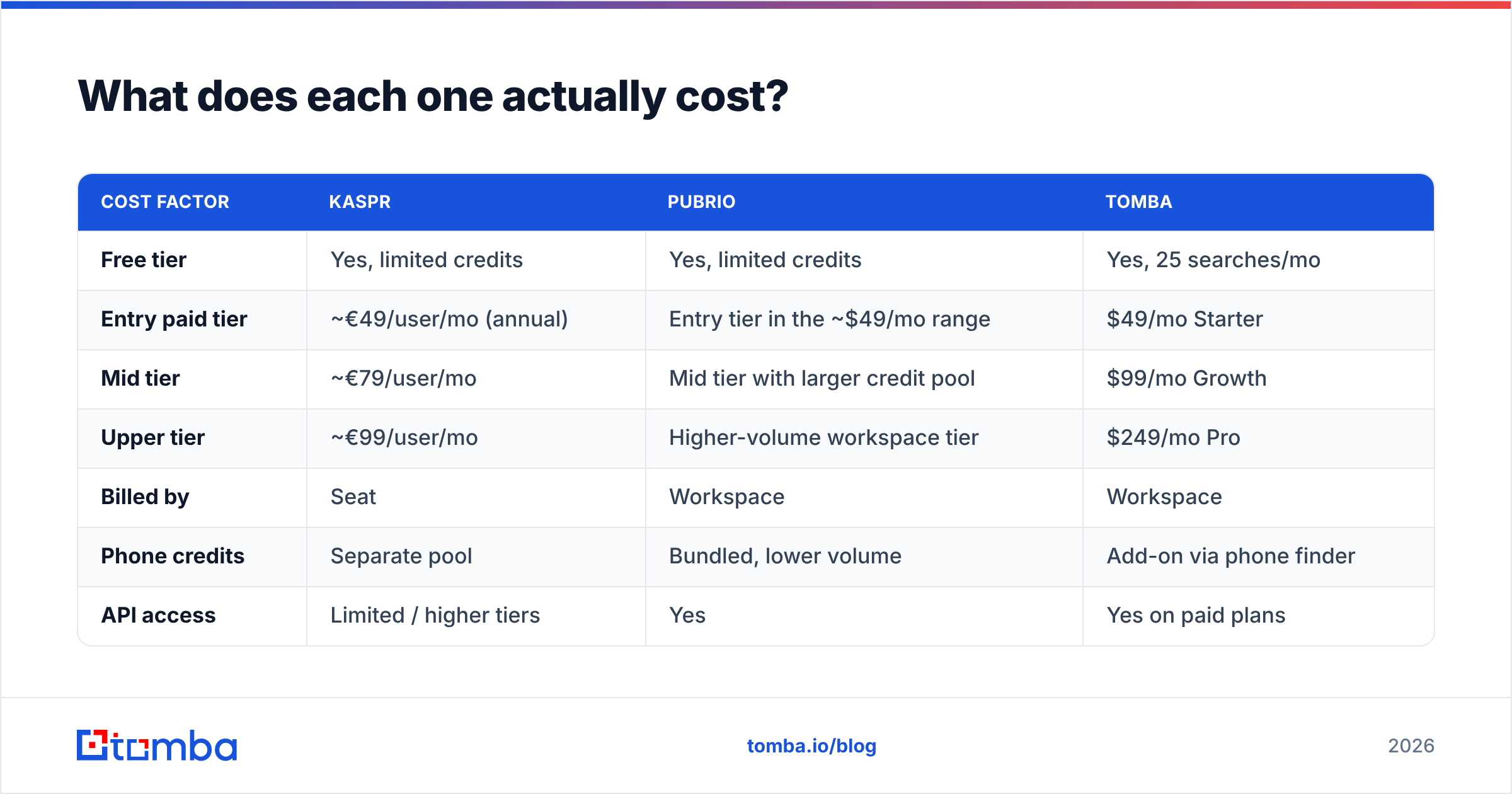
| Cost factor | Kaspr | Pubrio | Tomba |
|---|---|---|---|
| Free tier | Yes, limited credits | Yes, limited credits | Yes, 25 searches/mo |
| Entry paid tier | ~€49/user/mo (annual) | Entry tier in the ~$49/mo range | $49/mo Starter |
| Mid tier | ~€79/user/mo | Mid tier with larger credit pool | $99/mo Growth |
| Upper tier | ~€99/user/mo | Higher-volume workspace tier | $249/mo Pro |
| Billed by | Seat | Workspace | Workspace |
| Phone credits | Separate pool | Bundled, lower volume | Add-on via phone finder |
| API access | Limited / higher tiers | Yes | Yes on paid plans |
| Annual discount | Yes, sizeable | Yes | Yes |
The seat-based model is the thing to model carefully. Kaspr at roughly €49/user looks cheap until you put six reps on it and discover you are spending more per month than a workspace-priced tool that would have covered the whole team. Conversely, if exactly one person does all the prospecting, per-seat pricing is the cheaper structure and pooled workspace credits are overkill.
Also check export limits before you sign. Both platforms cap what leaves the system on lower tiers, and a contact you can see but cannot export into your sequencer is a contact you do not have. Compare that against transparent Tomba pricing where the credit is the unit and export is not separately metered.
Is Kaspr better than Pubrio for phone numbers?#
Yes — if your market is Europe, this is the clearest verdict in the whole comparison.
Kaspr's mobile coverage in France, the UK, DACH, and Benelux is its reason to exist, and it is measurably stronger there than general-purpose enrichment platforms. If your motion is cold calling into EU mid-market and your reps live in LinkedIn all day, Kaspr is the more defensible purchase, and the compliance story is a genuine asset when a German prospect asks where you got their number.
Pubrio returns phone data, but it is a supporting field rather than the flagship. Buying Pubrio primarily for mobiles is buying it for its weakest column.
Two caveats before you treat this as settled:
- North America flips the result. US mobile coverage is a crowded market and Kaspr's European edge narrows considerably. Check a sample of your own accounts rather than assuming the EU strength transfers.
- Phone numbers decay fast. Any number older than about twelve months deserves validation before a rep burns a dial on it. A phone validator pass on your export protects connect rates regardless of vendor.

Which workflow fits your team?#
Pick based on where your pipeline actually stalls, not on the feature grid.
- You know exactly who to call, and you need the mobile. Kaspr. The extension-driven workflow is faster than any list-builder for one-at-a-time revelation, and the EU phone data is the differentiator you are paying for.
- You don't know who to call yet. Pubrio. The AI search layer replaces an afternoon of filter-fiddling, and the enrichment is good enough to go straight into a sequencer for testing.
- You have a list of domains and need deliverable inboxes at volume. Neither. This is a bulk email finder job — upload domains and roles, get verified addresses, done in one pass instead of two tools and a CSV merge.
- You need contact data inside your own product or workflow. Whichever offers the API terms you can live with. Pubrio exposes API access more openly at lower tiers than Kaspr does; a dedicated email finder API is the cleanest option if the use case is programmatic rather than rep-facing.
- You need a pre-verified list you can buy outright. Neither model fits. Peers like BookYourData serve that specific need well — a purchased, verified list with a bounce guarantee is a different product from a live enrichment subscription, and there is no shame in buying the right shape.
- You're running multi-channel and need email plus phone plus LinkedIn. Budget for a stack, not a single vendor. No tool in this price bracket is best-in-class across all three data types, and vendors that claim otherwise are averaging their weakest column into their strongest.
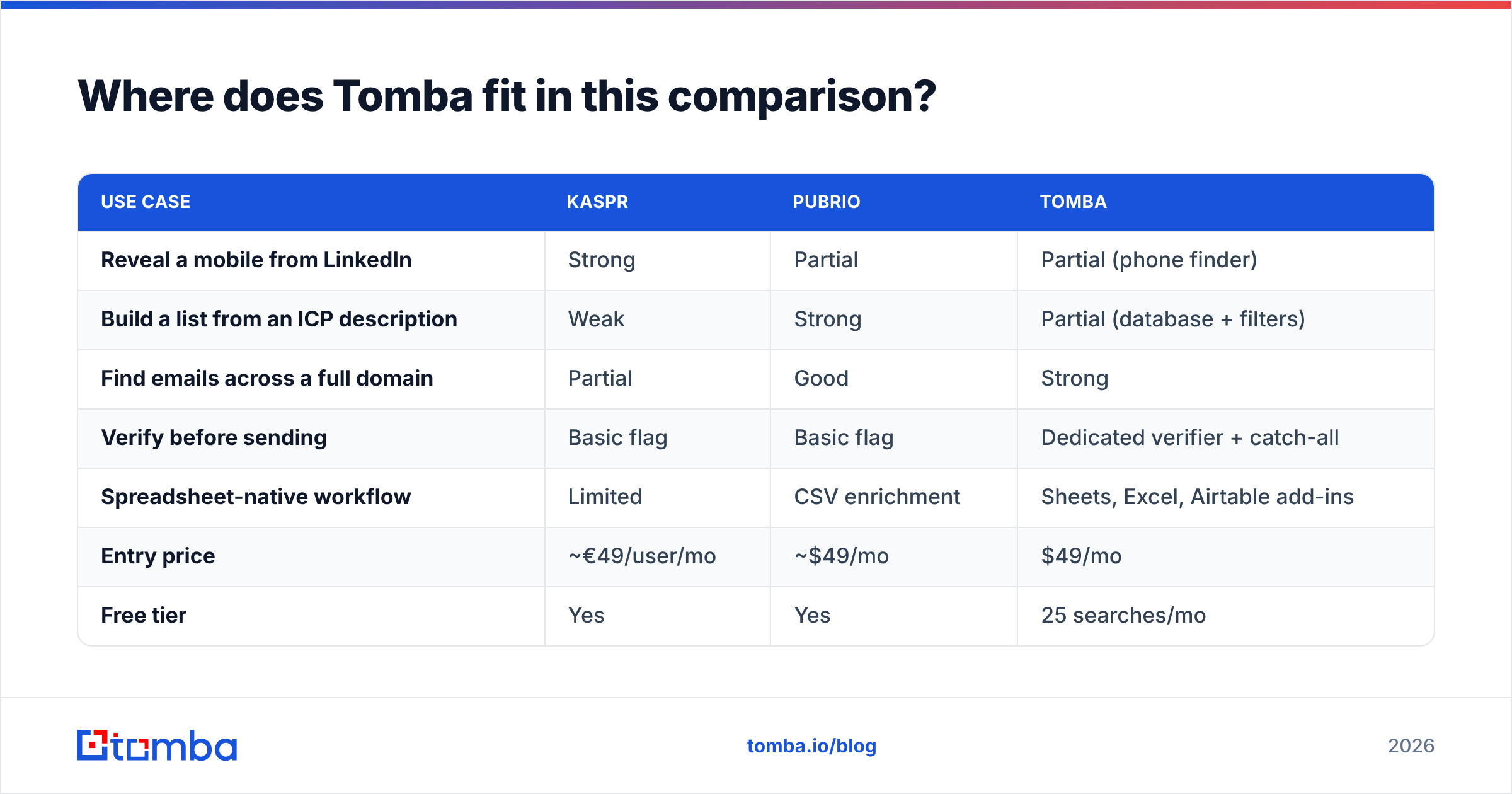
Where does Tomba fit in this comparison?#
Honestly: in a narrower lane than either, and that's the point.
Tomba is not trying to be a list-building AI or a LinkedIn phone revealer. It is an email finder with verification built into the same pass, plus domain search for mapping every reachable contact at a company, catch-all handling, and enrichment around the edges. If deliverable B2B email is the specific thing you are short of, that focus tends to beat a broader platform where email is one of nine features.

| Use case | Kaspr | Pubrio | Tomba |
|---|---|---|---|
| Reveal a mobile from LinkedIn | Strong | Partial | Partial (phone finder) |
| Build a list from an ICP description | Weak | Strong | Partial (database + filters) |
| Find emails across a full domain | Partial | Good | Strong |
| Verify before sending | Basic flag | Basic flag | Dedicated verifier + catch-all |
| Spreadsheet-native workflow | Limited | CSV enrichment | Sheets, Excel, Airtable add-ins |
| Entry price | ~€49/user/mo | ~$49/mo | $49/mo |
| Free tier | Yes | Yes | 25 searches/mo |
The realistic stack for a European outbound team is not "pick one." It is Kaspr for dials, a focused finder-plus-verifier for the email channel, and whichever list-building layer you prefer feeding both. The teams that overspend are the ones who buy a broad platform to avoid a second subscription, then pay for it in bounce rate.
What should you check before you commit?#
Run these five checks during the trial, not after the invoice:
- Bounce a real campaign, not a sample. 200 addresses through your actual sequencer tells you more than any dashboard metric. Anything above a 3% hard bounce rate puts your sender reputation at risk regardless of which logo supplied the data.
- Test your worst segment first. Every vendor looks good on US SaaS mid-market. Test the vertical and geography where you actually struggle.
- Read the credit rollover and refund policy. Does a failed lookup consume a credit? Do unused credits expire monthly? These two clauses swing effective cost more than tier price.
- Check export ceilings per tier. Seeing data and owning data are different products.
- Confirm the compliance paperwork your buyers will demand. If you sell into the EU, ask both vendors for their DPA and opt-out process in writing. Kaspr is unusually strong here; hold others to the same bar. Cross-check user-reported experiences on G2 rather than taking either vendor's word for it.
The verdict#
Kaspr wins if you're an EU-focused caller working profile by profile. Pubrio wins if you don't have a list yet and want AI to build one. Those are different companies at different stages, which is why "kaspr vs pubrio" rarely has a universal answer.
If your real problem is neither of those — if you have the accounts, you have the roles, and what you're missing is deliverable work email at volume without a per-seat tax — start with a tool built for exactly that. Tomba Email Finder gives you 25 free searches a month to test against your own domains before you spend anything, with verification, catch-all handling, and domain search in the same workspace. Run it on your control list alongside your trials of both tools, compare cost per verified contact, and let the bounce rate pick the winner.
Related guides#
// get started
Find, verify and enrich your first contacts today
Start on the free plan with 25 searches a month, then scale when your team is ready.
Free plan · No credit card required · GDPR & CCPA
// about the author