Kaspr vs Salesbot (2026): Pricing, Data, and Our Pick
Kaspr finds the contact. Salesbot talks to it. They get compared constantly, but they solve opposite halves of the pipeline — here is the honest breakdown of cost, data quality, and which one your team actually needs first.
TL;DR
- Kaspr and Salesbot are not really competitors. Kaspr is a contact-data tool (phone numbers and emails pulled from LinkedIn profiles). Salesbot is a conversation-automation layer (a rules-and-AI bot that qualifies and replies inside a CRM pipeline).
- Pick Kaspr if your bottleneck is "I can see the prospect but I can't reach them." Pick Salesbot if your bottleneck is "leads come in and nobody answers them fast enough."
- Kaspr is priced per seat, which punishes teams. Salesbot is usually bundled into CRM seats, which means you pay for the whole CRM whether you use the rest or not.
- Neither one is a full prospecting data source. Kaspr is LinkedIn-tethered; Salesbot has no data layer at all.
- If you want contact data at the API level instead of one profile at a time, a dedicated email finder covers the sourcing half at a lower unit cost — then let a bot handle the replies.
What are Kaspr and Salesbot, exactly?#
The reason "Kaspr vs Salesbot" is a confusing search is that the two tools live on opposite ends of the same funnel.
Kaspr is a LinkedIn-first contact-data tool. You install the Chrome extension, open a prospect's LinkedIn profile or a Sales Navigator list, and Kaspr surfaces mobile numbers, direct emails, and company details. It was acquired by Cognism in 2022 and now feeds off a shared European-heavy data pool. Its identity is speed-of-access: you are already on the profile, one click gets you the phone number. You can see the current feature set on the official Kaspr site.
Salesbot is a different animal. In most 2026 search results, "Salesbot" refers to the built-in bot builder inside Kommo CRM — a visual, no-code flow builder that answers inbound messages across WhatsApp, Instagram, Telegram, web chat, and email, tags leads, moves cards through pipeline stages, and books meetings. More broadly, "salesbot" has become a category label for any AI agent that handles the conversational layer of sales.
So one tool creates the ability to start a conversation. The other manages the conversation once it exists. Treating them as substitutes is how teams end up buying the wrong thing and blaming the tool.
How do Kaspr and Salesbot compare head-to-head?#
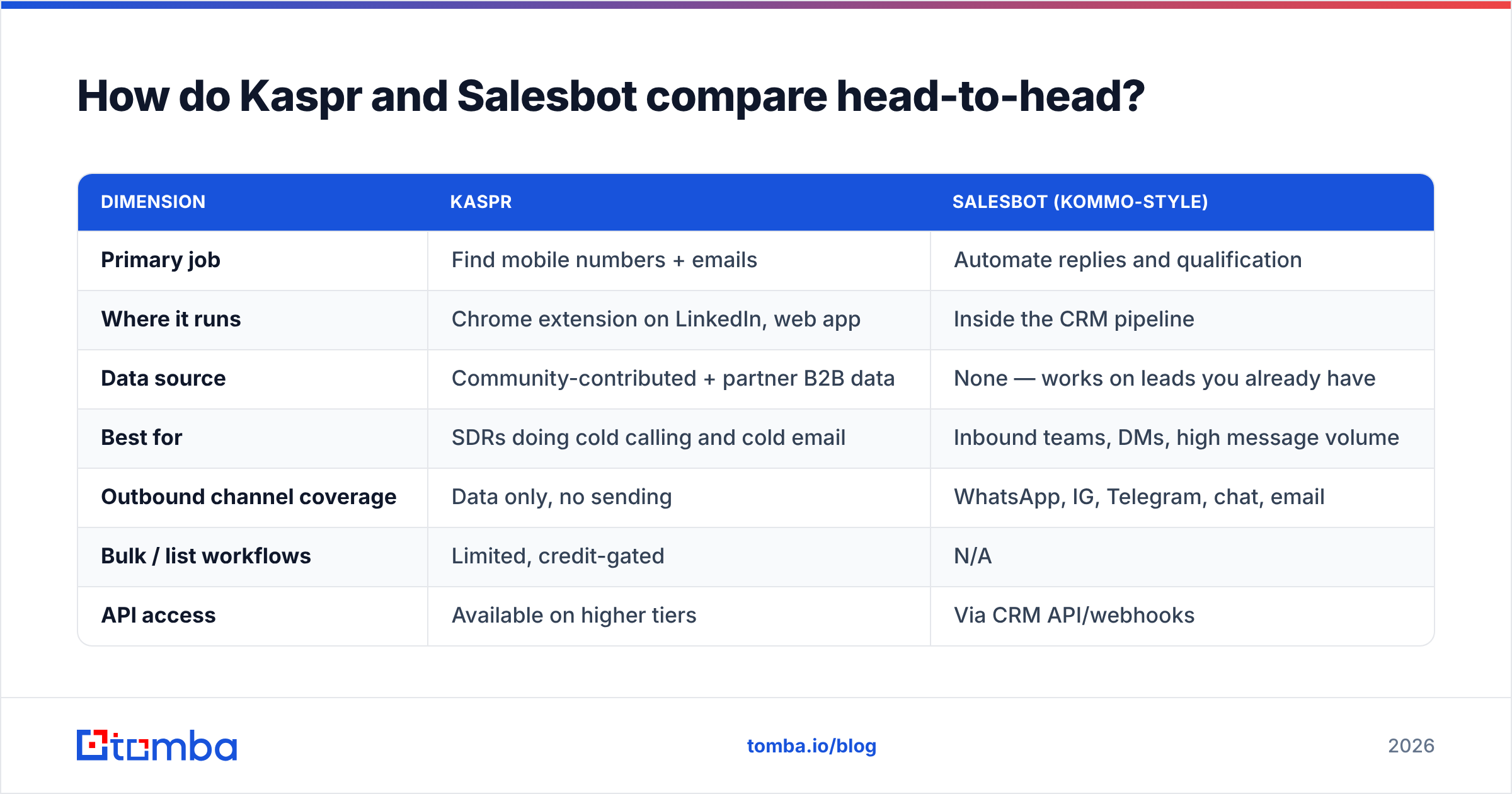
Here is the honest side-by-side. Note that several rows are structurally "not applicable" — that gap is the answer for most buyers.
| Dimension | Kaspr | Salesbot (Kommo-style) |
|---|---|---|
| Primary job | Find mobile numbers + emails | Automate replies and qualification |
| Where it runs | Chrome extension on LinkedIn, web app | Inside the CRM pipeline |
| Data source | Community-contributed + partner B2B data | None — works on leads you already have |
| Best for | SDRs doing cold calling and cold email | Inbound teams, DMs, high message volume |
| Outbound channel coverage | Data only, no sending | WhatsApp, IG, Telegram, chat, email |
| Bulk / list workflows | Limited, credit-gated | N/A |
| API access | Available on higher tiers | Via CRM API/webhooks |
| Pricing model | Per user, per month | Bundled into CRM seat price |
| Free option | Yes, small monthly credit allowance | Trial via CRM, not a permanent free tier |
| Learning curve | Minutes | Hours — flow logic takes design work |
The table makes the strategic point better than a paragraph can: there is exactly one row where they overlap (both touch "leads"), and zero rows where they compete on the same outcome.
What does Kaspr actually do well?#
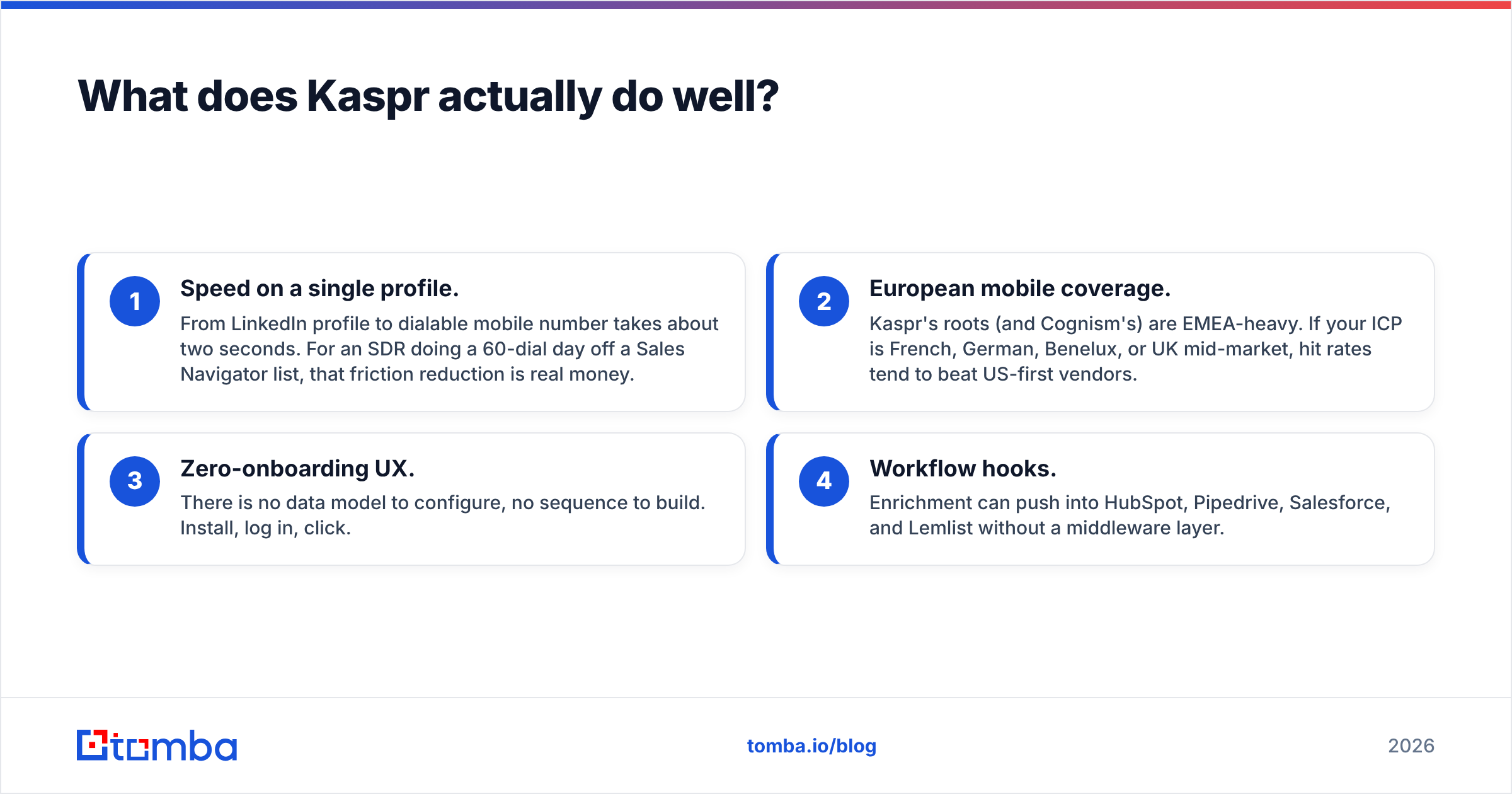
Four things, honestly stated:
- Speed on a single profile. From LinkedIn profile to dialable mobile number takes about two seconds. For an SDR doing a 60-dial day off a Sales Navigator list, that friction reduction is real money.
- European mobile coverage. Kaspr's roots (and Cognism's) are EMEA-heavy. If your ICP is French, German, Benelux, or UK mid-market, hit rates tend to beat US-first vendors.
- Zero-onboarding UX. There is no data model to configure, no sequence to build. Install, log in, click.
- Workflow hooks. Enrichment can push into HubSpot, Pipedrive, Salesforce, and Lemlist without a middleware layer.
Where it gets weaker is scale. Kaspr is a per-profile, per-seat tool. The moment your motion becomes "enrich 4,000 domains from a spreadsheet" rather than "look up this one person," the extension model becomes the constraint. That is when teams start pairing it with a bulk email finder or a domain search that works on companies rather than individual LinkedIn URLs.
The second weakness is source dependence. Kaspr's coverage is strongest where LinkedIn profiles are rich and active. Prospects in trades, manufacturing, local services, and much of APAC are systematically under-covered — not because the vendor is bad, but because the underlying signal isn't there.
Where does Salesbot fit in an outbound stack?#
Salesbot earns its keep in a narrow but valuable window: the first five minutes after a lead raises a hand.
Research on lead response time has been consistent for over a decade — contact rates collapse when first response drifts past the first few minutes. A bot that acknowledges, asks two qualifying questions, and books a slot while the prospect is still on the page captures meetings that a human queue loses by lunchtime. HubSpot's sales research library has published extensively on this pattern.
What Salesbot is genuinely good at:
- Always-on inbound triage across chat and messaging apps, including outside business hours and across time zones.
- Deterministic qualification. Because flows are rules-based, you can guarantee that every lead gets the same three questions — something human SDRs never do consistently.
- Pipeline hygiene. Auto-tagging, stage moves, and task creation happen without a rep remembering to do them.
- Nurture on autopilot. Time-delayed follow-ups fire from the CRM without a separate sequencing tool.
What it cannot do: create demand. A bot with no leads to talk to is an expensive decision tree. This is the failure mode we see most often — a team buys conversation automation to fix a pipeline problem that is actually a sourcing problem, then wonders why the bot has nothing in its queue.
How much do Kaspr and Salesbot cost in 2026?#
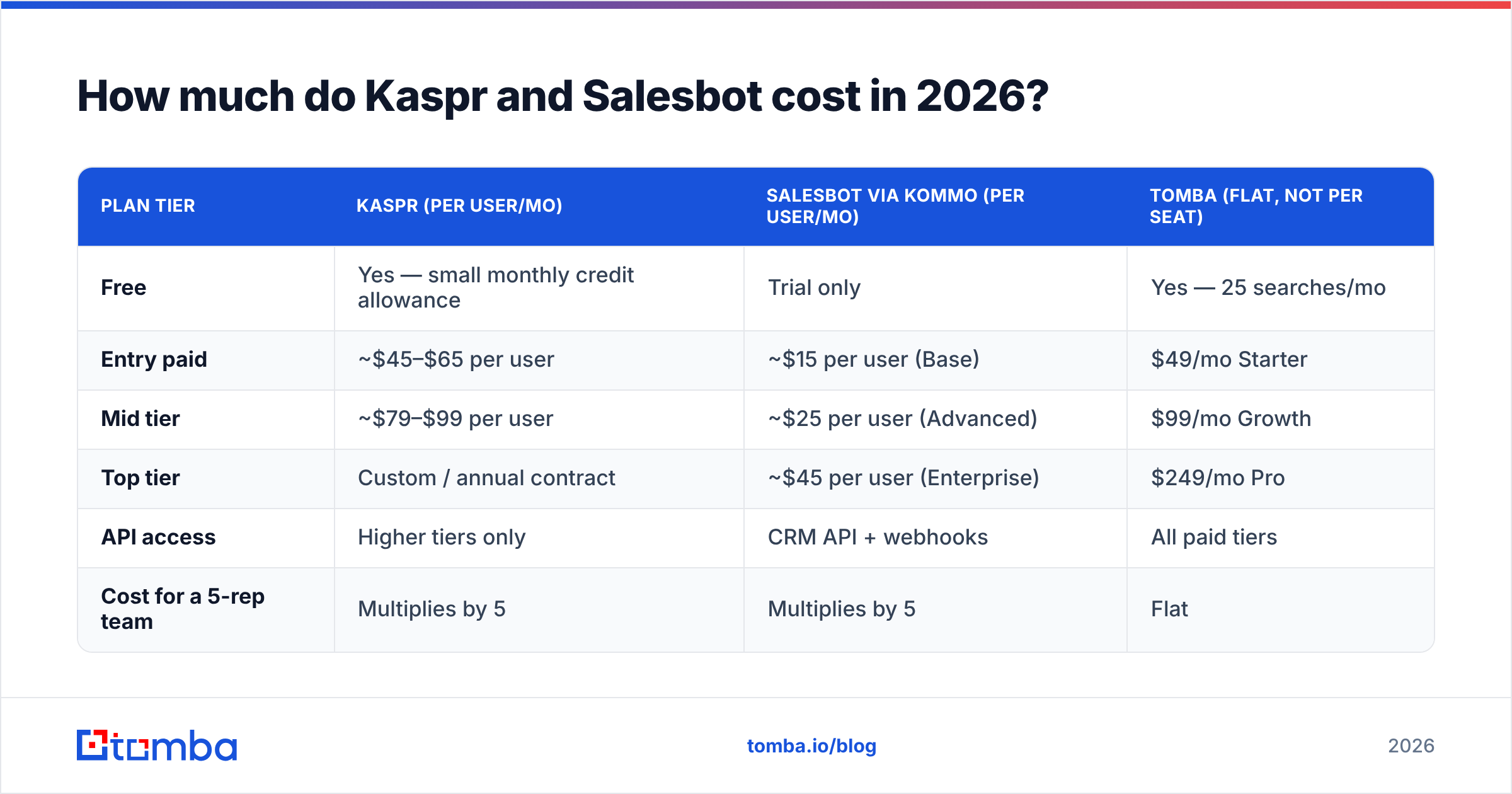
Pricing on both sides moves, and both vendors run promotional annual rates, so verify on their own pages before you sign. The shape of the cost, however, is stable — and the shape matters more than the sticker.
| Plan tier | Kaspr (per user/mo) | Salesbot via Kommo (per user/mo) | Tomba (flat, not per seat) |
|---|---|---|---|
| Free | Yes — small monthly credit allowance | Trial only | Yes — 25 searches/mo |
| Entry paid | ~$45–$65 per user | ~$15 per user (Base) | $49/mo Starter |
| Mid tier | ~$79–$99 per user | ~$25 per user (Advanced) | $99/mo Growth |
| Top tier | Custom / annual contract | ~$45 per user (Enterprise) | $249/mo Pro |
| API access | Higher tiers only | CRM API + webhooks | All paid tiers |
| Cost for a 5-rep team | Multiplies by 5 | Multiplies by 5 | Flat |
Two structural notes that buyers miss:
Per-seat pricing punishes exactly the teams that need data most. Kaspr's model means a 5-person SDR pod pays roughly five times what a solo founder pays for the same underlying database. Credit pooling helps, but seats are still the unit.
Bundled bot pricing hides the real bill. Salesbot is "free" in the sense that it ships with the CRM — but you are migrating your CRM to get it. If you already run Salesforce or HubSpot, the true cost of adopting Salesbot is a CRM replacement project, not a $15 seat.
If neither shape fits, flat-rate credit pricing is the third option. You can compare the tiers directly on the Tomba pricing page — the relevant difference is that credits are account-level, so adding the sixth rep costs nothing extra.
Which one should you pick for your situation?#
Skip the feature matrices and answer one question: what breaks first when you add more pipeline?
- You have a target list but can't reach anyone. → Kaspr, or a dedicated finder. Your problem is contact data. A bot cannot help you talk to people whose numbers you don't have.
- You get 200 inbound DMs a week and answer them in 6 hours. → Salesbot. Your problem is response latency, and it is costing you booked meetings every day.
- You run a high-volume cold-calling motion in EMEA. → Kaspr has a genuine regional edge on mobile numbers. Test it against one other provider on the same 100 contacts before committing.
- You run US-heavy cold email at list scale. → Neither tool is ideal alone. You want domain-level sourcing plus verification, then a sending tool. Route your list through an email verifier before the first send.
- You are a two-person team doing both. → Start with data. Pipeline you can't source is a permanent ceiling; slow replies are a temporary leak.
- You already own a CRM you like. → Salesbot's value drops sharply, because most modern CRMs ship a comparable automation layer. Do not switch CRMs for a bot.
What about data accuracy and compliance?#
This is where the comparison stops being symmetrical, because only one of the two tools makes accuracy claims at all.
Kaspr, like every contact-data vendor, publishes accuracy figures that should be read as directional, not contractual. Independent buyer reviews on G2 consistently describe the same pattern across this entire category: strong coverage in the vendor's home region, weaker coverage outside it, and mobile-number accuracy that lags email accuracy by a meaningful margin. That is a category truth, not a Kaspr-specific flaw.
The right way to evaluate any of them is a blind bounce test. Take 200 contacts from your real ICP — not the vendor's demo list — pull data from two providers, verify both sets with a neutral third-party checker, and compare. Coverage rate (how many rows came back filled) and accuracy rate (how many of those were correct) are different numbers, and vendors love to quote the one that flatters them.
On compliance: Kaspr operates under GDPR with documented opt-out and data-subject request handling, which matters if you are calling EU mobiles. Salesbot's compliance exposure is different in kind — it concerns consent for automated messaging on WhatsApp and Instagram, where platform policy is stricter than most teams realize. Read the platform rules, not just the vendor's marketing.
For any provider you evaluate, ask for documentation on where the data originates. Tomba publishes its data sources publicly; if a vendor won't tell you, treat that as information.
Can you use Kaspr and Salesbot together?#
Yes, and for a reasonably sized go-to-market team, that is actually the correct answer.
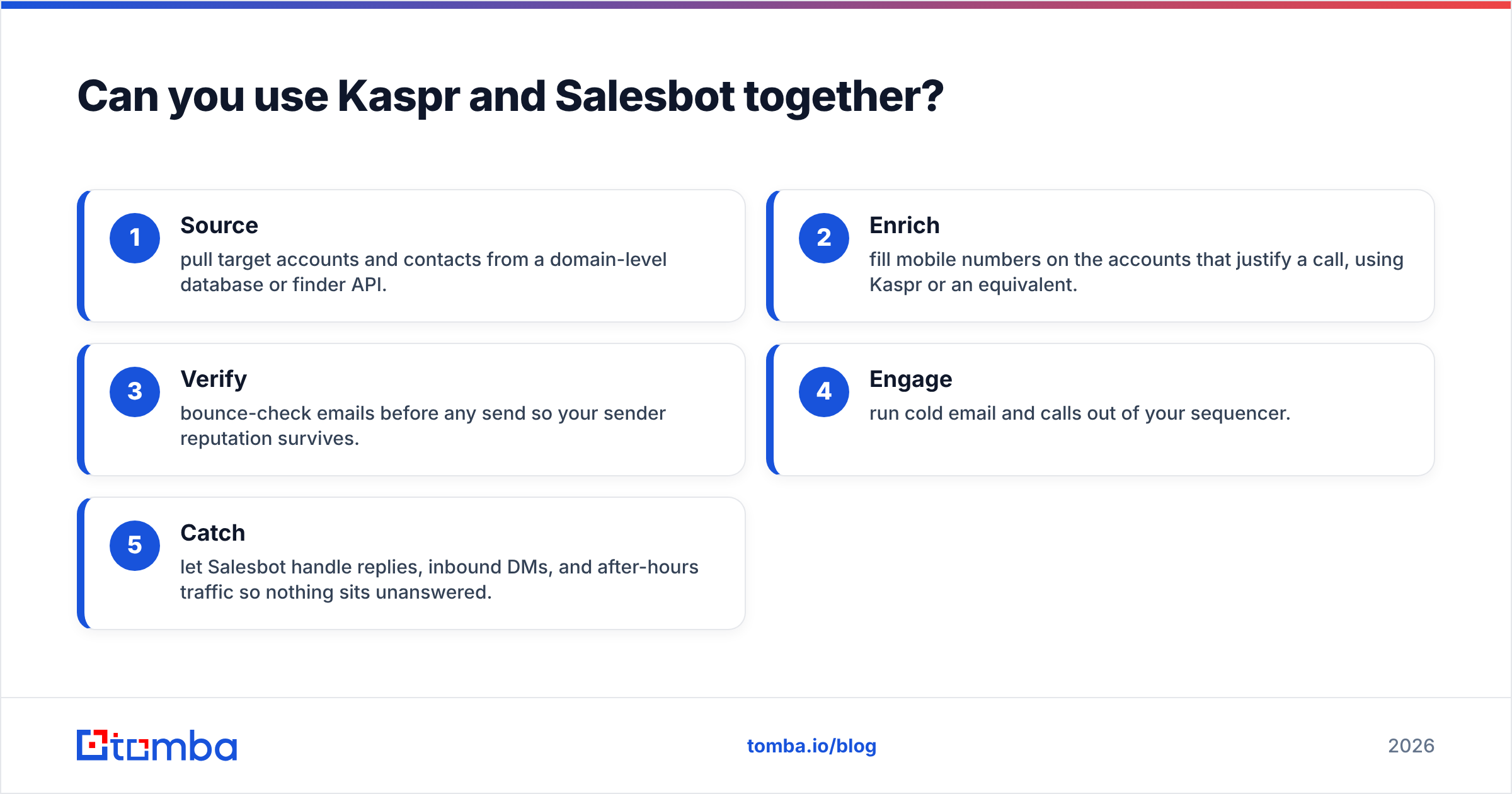
A coherent stack looks like this:
- Source — pull target accounts and contacts from a domain-level database or finder API.
- Enrich — fill mobile numbers on the accounts that justify a call, using Kaspr or an equivalent.
- Verify — bounce-check emails before any send so your sender reputation survives.
- Engage — run cold email and calls out of your sequencer.
- Catch — let Salesbot handle replies, inbound DMs, and after-hours traffic so nothing sits unanswered.
The failure mode is buying step 5 before step 1 exists. Bots amplify a working pipeline; they do not create one.
Cost-wise, the smart version of this stack pushes as much volume as possible to the flat-rate layer (bulk sourcing and verification) and reserves per-seat tools for the high-value, one-at-a-time lookups where they genuinely save a rep time. That single sequencing decision usually cuts a mid-market data bill by 40–60% without losing a single contact.
Final verdict: Kaspr vs Salesbot#
Kaspr wins if you are an outbound team whose reps are staring at LinkedIn profiles they can't dial, especially in Europe. It is fast, it is simple, and it does one job honestly. Budget for the per-seat math before you scale the team.
Salesbot wins if inbound volume is real and your response time is embarrassing. It is not a prospecting tool and never claimed to be — judge it on reply speed and pipeline hygiene, not on lead generation.
Neither wins if the actual problem is that your list is 3,000 companies and you need contacts for all of them by Friday. That is a sourcing-at-scale problem, and it needs a sourcing-at-scale tool with an API, bulk upload, and flat pricing.
That is the gap worth filling first. The Tomba Email Finder handles the sourcing half of this stack — find verified professional emails by domain, name, or company, in bulk or over the API, on flat pricing that doesn't multiply when you hire the next rep. Start on the free tier with 25 searches, run it against the same 200 contacts you'd test Kaspr on, and let the bounce rate decide. Then add a bot to catch the replies.
Related guides#
// get started
Find, verify and enrich your first contacts today
Start on the free plan with 25 searches a month, then scale when your team is ready.
Free plan · No credit card required · GDPR & CCPA
Get the Tomba newsletter
Product and data updates
// about the author