Kaspr vs Salesripe in 2026: Which B2B Contact Data Tool Wins?
Kaspr is a LinkedIn-first phone and email extension. Salesripe is a static B2B list database. They solve different problems badly for each other's users — here is which one fits your outbound motion, and what neither does well.
TL;DR
- Kaspr and Salesripe are not really competitors. Kaspr is a LinkedIn-first Chrome extension that reveals phone numbers and emails on profiles you are already looking at. Salesripe is a static searchable database you filter and export from.
- Pick Kaspr if your reps live inside LinkedIn Sales Navigator and you need mobile numbers for cold calling. Pick Salesripe if you want cheap, filterable list-building for SMB-heavy markets in North America.
- Pricing models differ more than prices do: Kaspr charges per seat with credit buckets, Salesripe charges per plan with lead caps. Per-seat pricing punishes teams; lead caps punish volume.
- Neither is built for programmatic enrichment. If you need an API, bulk verification, or CI-grade email validation, both will frustrate you.
- Data accuracy is the deciding factor for email-led outbound. Verify whatever you export from either tool before you send — a third-party verifier is not optional in 2026.
What is Kaspr and who actually uses it?#
Kaspr is a contact-data Chrome extension owned by Cognism. You install it, open a LinkedIn profile or a Sales Navigator list, and Kaspr surfaces phone numbers, mobile numbers, and email addresses for those people. It also does light workflow: lead lists, tags, basic enrichment, and integrations with HubSpot, Pipedrive, Salesforce, and Lemlist.
The product has one defining characteristic: it is profile-triggered. Kaspr does not really want you to define an abstract ICP filter and pull 5,000 records. It wants you to be looking at a person, then hand you that person's mobile. That makes it excellent for SDRs who prospect visually — scroll a Sales Navigator search, reveal, add to sequence — and awkward for RevOps teams who want a repeatable, queryable pipeline.
Kaspr's strongest single asset is European mobile coverage. Because of its French origins and Cognism's EU data posture, it indexes phone numbers in France, Benelux, DACH, and the UK better than most US-first vendors. If you cold call into Europe, that matters more than any feature bullet.
Its weakest point is the pricing model. Credits are split by type (phone credits, email credits, export credits), plans are priced per user, and the free tier is deliberately thin. Two reps on the same team cannot share a credit pool the way they can in a database-style tool.

What is Salesripe and how is it different?#
Salesripe is a B2B contact and company database with a web app on top. You log in, set filters — industry, job title, company size, revenue, location, technology, SIC code — and it returns a result set you can export or work through inside the tool. It also ships lightweight CRM-ish features: lists, notes, basic tracking. The pitch is "lead database plus a place to work the leads" at a price point below Apollo or ZoomInfo.
The mental model is completely different from Kaspr. Salesripe is a warehouse, Kaspr is a scanner. You go to the warehouse when you know the shape of what you want and you want a lot of it. You use the scanner when you have already found the specific thing and need its details.
Salesripe's coverage skews heavily toward US and Canadian SMBs — local services, regional manufacturers, franchises, professional practices. If you sell into that market, the filters feel well-matched. If you sell into European mid-market or APAC, the record density thins out fast, and phone data outside North America is not competitive.
The trade-off is freshness. Static databases decay. Job-change rates in B2B run roughly 20–30% annually depending on the segment, so a record set assembled 18 months ago is meaningfully wrong today. Every database vendor fights this; cheaper vendors fight it with fewer refresh cycles.
Kaspr vs Salesripe: how do they compare head-to-head?#
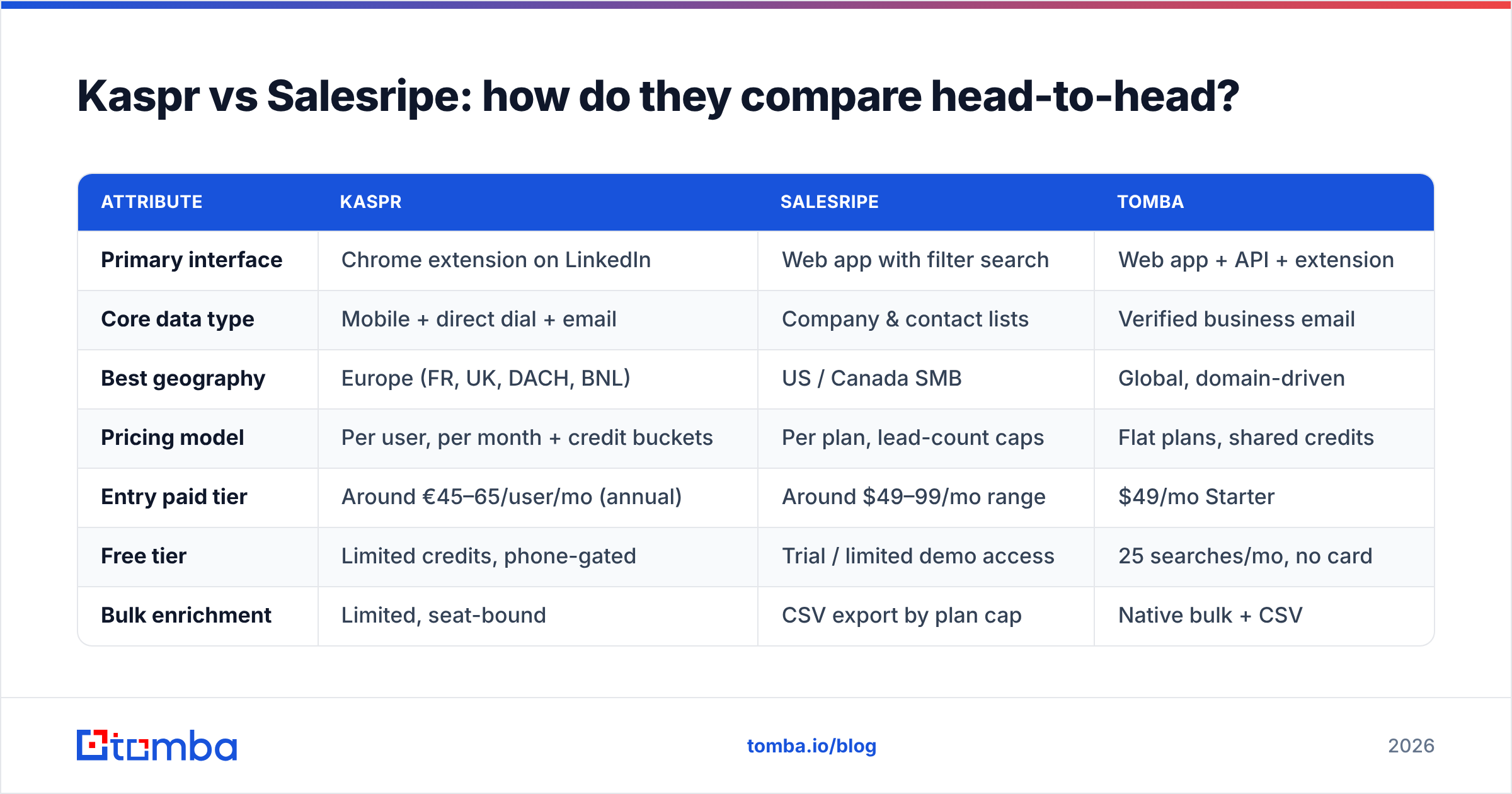
Here is the practical comparison, feature by feature. Pricing figures move — check kaspr.io and salesripe.com before you budget.
| Attribute | Kaspr | Salesripe | Tomba |
|---|---|---|---|
| Primary interface | Chrome extension on LinkedIn | Web app with filter search | Web app + API + extension |
| Core data type | Mobile + direct dial + email | Company & contact lists | Verified business email |
| Best geography | Europe (FR, UK, DACH, BNL) | US / Canada SMB | Global, domain-driven |
| Pricing model | Per user, per month + credit buckets | Per plan, lead-count caps | Flat plans, shared credits |
| Entry paid tier | Around €45–65/user/mo (annual) | Around $49–99/mo range | $49/mo Starter |
| Free tier | Limited credits, phone-gated | Trial / limited demo access | 25 searches/mo, no card |
| Bulk enrichment | Limited, seat-bound | CSV export by plan cap | Native bulk + CSV |
| Public API | Restricted | Limited | Full REST API |
| Built-in verification | Basic | Minimal | Dedicated verifier + catch-all |
| Works without LinkedIn | No | Yes | Yes |
The row that decides most evaluations is the last one. Kaspr's value collapses if your prospecting does not start on LinkedIn. Salesripe's value collapses if your ICP is not in its index. Neither limitation is a flaw — they are design choices — but they are the choices you are actually buying.

Which one has better data accuracy?#
Neither wins outright, because they are accurate about different things.
Kaspr is stronger on phone accuracy, particularly mobile numbers in Europe. Community-contributed and partner-sourced phone data, refreshed against active usage, tends to beat a static database's phone column. Reported connect rates from Kaspr users in EU markets are consistently better than from generic list vendors.
Salesripe is stronger on firmographic completeness for US SMBs. If you need revenue band, employee count, SIC code, and a plausible contact at a 40-person HVAC company in Ohio, it will usually have a row. Whether that row's email still resolves is the open question.
For email specifically, both sit below dedicated email-finding infrastructure. That is not a knock — it is a specialization gap. A tool that indexes phone numbers or builds firmographic lists is not running per-domain SMTP validation, catch-all detection, and pattern inference at query time. A dedicated email verifier is.

The practical rule: treat any exported email from a general-purpose contact platform as a candidate, not a verified address. Run it through validation before it enters a sending tool. Bounce rates above 3% start dragging sender reputation, and above 5% you are risking domain-level damage that takes weeks to unwind.

How does pricing actually work for each tool?#
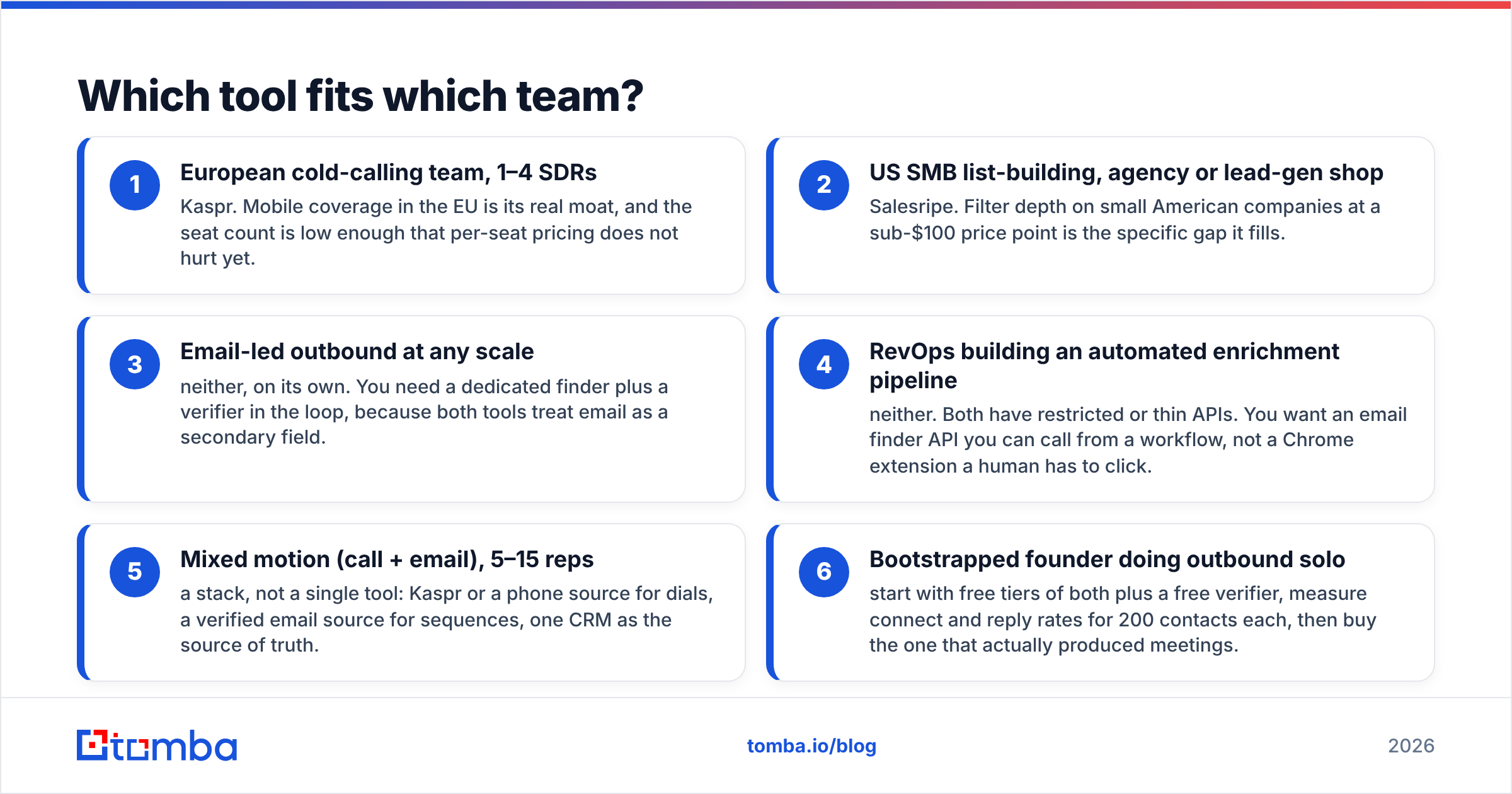
This is where evaluations go wrong. Both vendors publish a monthly number, but the number is not the cost.
| Cost factor | Kaspr | Salesripe |
|---|---|---|
| Unit of billing | Per seat | Per account |
| Scaling penalty | Every new rep = full seat price | Hitting the lead cap = tier upgrade |
| Credit rollover | Generally no | N/A (lead caps reset) |
| Hidden cost 1 | Phone and email credits metered separately | Exported-but-dead records still count |
| Hidden cost 2 | Annual commitment for best rate | Verification tooling bought separately |
| Team of 5 reality | 5× the sticker price | Usually one upgraded tier |
Kaspr's per-seat model is fine for a two-person founding sales team and painful at eight reps. Salesripe's cap model is fine at low volume and painful when a campaign needs 20,000 records in one month.
For comparison, flat-plan tools price on data volume rather than headcount. Tomba pricing runs Free (25 searches/month), Starter $49/mo, Growth $99/mo, Pro $249/mo, Enterprise custom — credits are shared across the whole workspace, so adding a rep does not change the bill. Whether that model is better depends entirely on whether your constraint is people or records.
Which tool fits which team?#
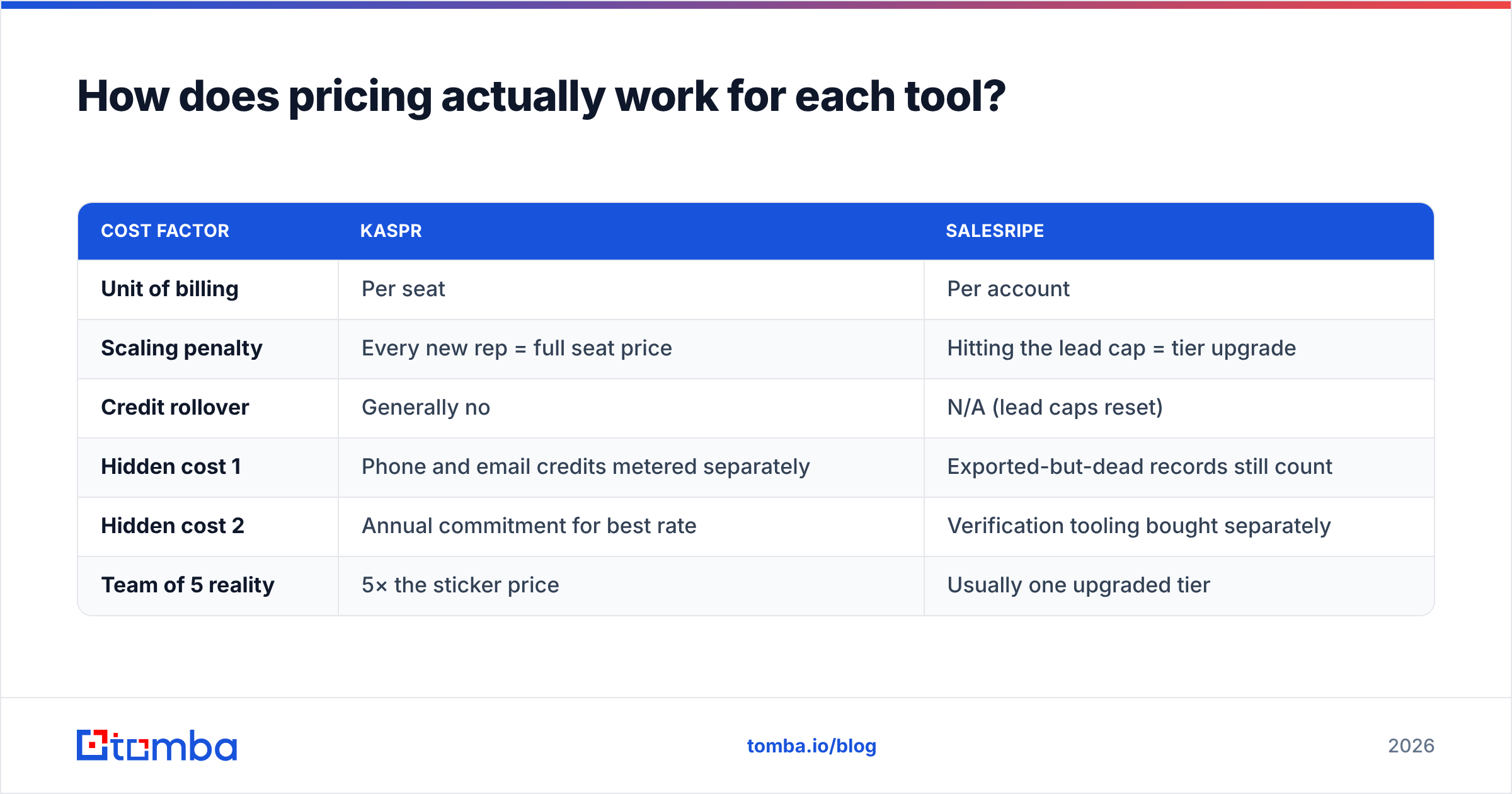
Use this as a decision shortcut rather than reading another 40 G2 reviews:
- European cold-calling team, 1–4 SDRs — Kaspr. Mobile coverage in the EU is its real moat, and the seat count is low enough that per-seat pricing does not hurt yet.
- US SMB list-building, agency or lead-gen shop — Salesripe. Filter depth on small American companies at a sub-$100 price point is the specific gap it fills.
- Email-led outbound at any scale — neither, on its own. You need a dedicated finder plus a verifier in the loop, because both tools treat email as a secondary field.
- RevOps building an automated enrichment pipeline — neither. Both have restricted or thin APIs. You want an email finder API you can call from a workflow, not a Chrome extension a human has to click.
- Mixed motion (call + email), 5–15 reps — a stack, not a single tool: Kaspr or a phone source for dials, a verified email source for sequences, one CRM as the source of truth.
- Bootstrapped founder doing outbound solo — start with free tiers of both plus a free verifier, measure connect and reply rates for 200 contacts each, then buy the one that actually produced meetings.
What do reviewers actually say about each?#
Public review patterns are consistent enough to be useful. On G2, Kaspr's recurring praise is speed and EU phone quality; the recurring complaint is credit confusion and per-seat cost at scale. Salesripe's recurring praise is price-to-volume and filter granularity; the recurring complaint is data staleness — bounced emails and disconnected numbers on older records.
Both patterns are what you would predict from the architecture. A live extension that queries on demand has fresher but narrower data. A static database has broader but older data. Neither vendor is being dishonest; you are seeing the physics of the model.
Read reviews from the last nine months only. Contact-data vendors rebuild their pipelines constantly, and a 2023 complaint about coverage tells you nothing about 2026 coverage.
Where do both tools fall short?#
Three gaps show up in almost every evaluation:
No serious verification layer. Both return emails. Neither runs the full validation chain — syntax, MX, SMTP handshake, catch-all detection, role-address flagging, disposable-domain screening. Catch-all domains in particular are where naive tools report "valid" and you find out otherwise at send time. A catch-all verifier exists as a separate product category precisely because this is hard.
Weak programmatic access. If your GTM runs on workflows — Clay, n8n, Make, a Python script, a CRM trigger — you need an API with predictable rate limits and clean responses. Both vendors treat API access as an enterprise afterthought. That is fine for a human-in-the-loop team and disqualifying for an automated one.
Bulk operations are second-class. Uploading a 10,000-row CSV of company domains and getting back verified contacts is a routine job. In Kaspr it is seat-constrained; in Salesripe it is cap-constrained. Tools built around bulk email finder workflows treat it as the primary path, not an export button.
Is there a better third option?#
Honestly: it depends on which half of the job you care about.
If your bottleneck is phone numbers in Europe, Kaspr is genuinely hard to replace, and a third tool will not fix that. Buy it, accept the per-seat math, and move on.
If your bottleneck is finding and verifying business email addresses at volume — which is the bottleneck for most email-led outbound teams — a dedicated email-finding platform outperforms both. That means domain-based discovery, pattern inference, live SMTP verification, catch-all handling, bulk processing, and an API you can actually automate against. Tomba's domain search returns every discoverable address at a company with confidence scores and sources, which is a different operation from "reveal this one LinkedIn profile" and from "filter a static list."
The realistic 2026 stack for a mixed-motion team is two or three specialized tools, not one platform pretending to do everything. Pay for phone data where phone data is your constraint. Pay for verified email where email is your constraint. Do not pay twice for the overlap.
How should you run the evaluation?#
Give yourself two weeks and a controlled test:
- Pull the same 200 target accounts through both tools.
- Measure match rate (records returned / records requested), not claimed database size.
- Verify every returned email through an independent checker and record the true valid rate.
- Dial 50 phone numbers from each and log connect rate.
- Calculate cost per verified, reachable contact — not cost per credit.
That last number is the only one that predicts pipeline. Vendors quote database size because it is flattering and unfalsifiable. Your match rate on your ICP is the number that decides the contract.
Start with the part that actually blocks your pipeline#
If your outbound stalls because you cannot reliably get a working email for the people you have already identified, fix that first — it is cheaper and faster than replatforming your whole stack. The Tomba Email Finder finds professional addresses by domain, name, or company, verifies them before they reach your sequencer, and runs on flat workspace pricing that does not charge you again every time you hire a rep. Start on the free tier with 25 searches, run it against the same accounts you tested in Kaspr and Salesripe, and let the verified match rate decide.
Related guides#
// get started
Find, verify and enrich your first contacts today
Start on the free plan with 25 searches a month, then scale when your team is ready.
Free plan · No credit card required · GDPR & CCPA
// about the author