Kaspr vs SourceScrub: Which B2B Data Tool Fits Your Team?
Kaspr sells contact data off LinkedIn. SourceScrub sells private-company intelligence to dealmakers. They get compared constantly and they solve different problems — here is the honest breakdown, with pricing, coverage, and a decision framework.
TL;DR
- Kaspr is a LinkedIn-first contact-data tool: install the extension, open a profile, pull a phone number and an email. It sells people data to SDRs and recruiters.
- SourceScrub is a private-company intelligence platform: it indexes millions of bootstrapped and non-institutionally-backed companies plus conference lists and growth signals. It sells company data to private equity, VC, and M&A teams.
- They are not really competitors. If you are comparing Kaspr vs SourceScrub, you probably have two different jobs to do and are hoping one budget line covers both. It usually does not.
- Kaspr is per-seat and cheap enough to expense; SourceScrub is annual, quote-only, and priced like a deal-sourcing system of record.
- If your actual need is "find verified work emails at scale, in bulk, through an API," neither is the shortest path — a dedicated email finder costs a fraction of either.
What are Kaspr and SourceScrub, actually?#
Kaspr is a Chrome extension and web app that reveals contact details — mobile numbers, direct dials, and business emails — from LinkedIn profiles, search results, groups, and event attendee lists. It was acquired by Cognism in 2022 and now functions as the lighter, self-serve end of that ecosystem. The target user is an SDR working a LinkedIn list, or a recruiter chasing a candidate who will not reply to an InMail. You can see the current product scope on kaspr.io.
SourceScrub is a different animal entirely. It is a private-company database built for deal origination: firms use it to find companies that have never taken institutional money, track headcount and web traffic growth, scrape conference exhibitor lists and "top 50 fastest-growing" awards, and push all of that into Salesforce, DealCloud, or Affinity. The company positions itself as a founder-led-company data platform — details at sourcescrub.com.
Here is the clean way to hold the distinction in your head: Kaspr answers "how do I reach this person?" SourceScrub answers "which companies are even worth reaching?" One is the phone book. The other is the map.
That difference explains almost every other gap between them — pricing model, data refresh cadence, compliance posture, and who signs the contract.
How do Kaspr and SourceScrub compare head-to-head?#
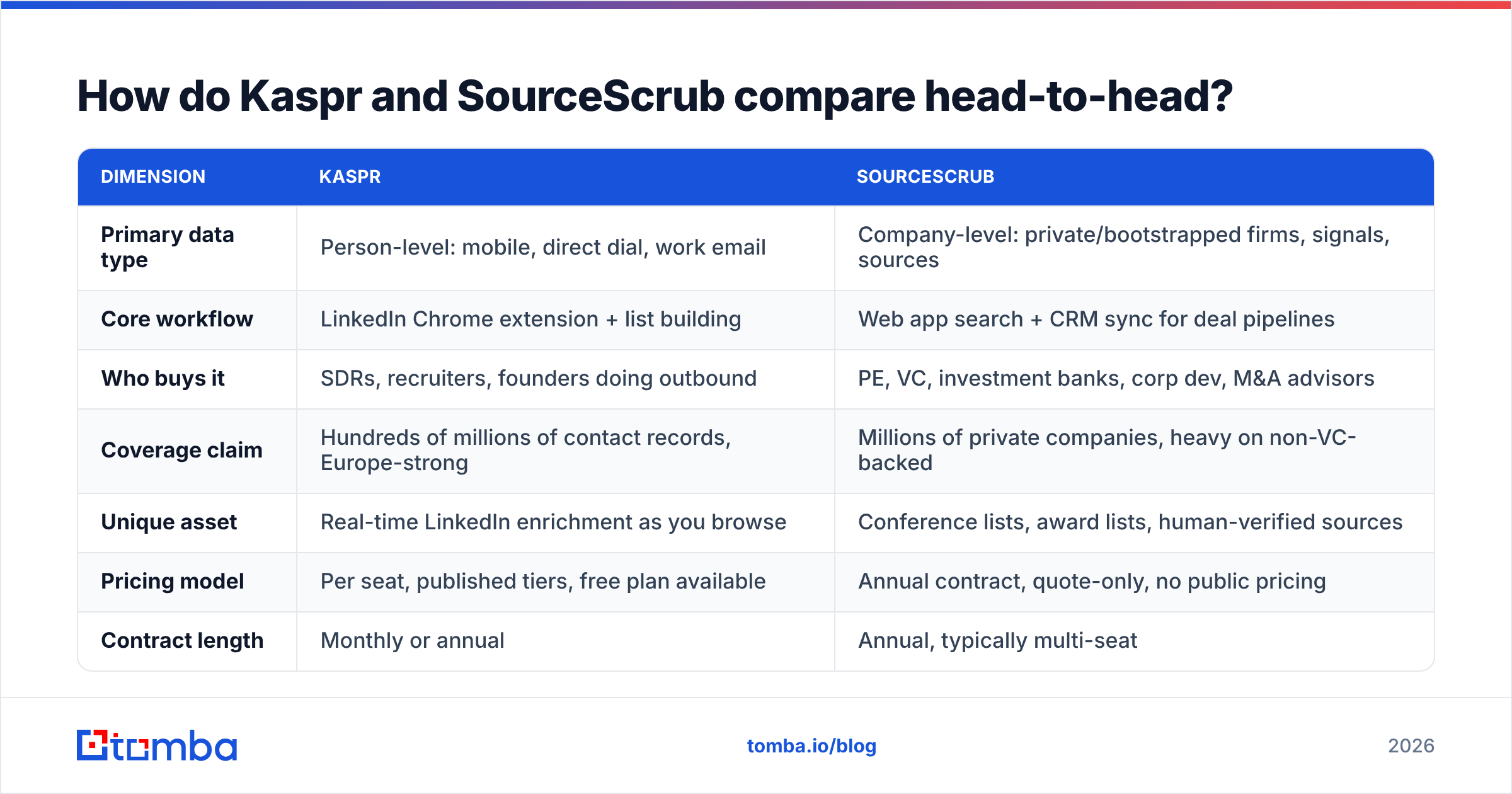
| Dimension | Kaspr | SourceScrub |
|---|---|---|
| Primary data type | Person-level: mobile, direct dial, work email | Company-level: private/bootstrapped firms, signals, sources |
| Core workflow | LinkedIn Chrome extension + list building | Web app search + CRM sync for deal pipelines |
| Who buys it | SDRs, recruiters, founders doing outbound | PE, VC, investment banks, corp dev, M&A advisors |
| Coverage claim | Hundreds of millions of contact records, Europe-strong | Millions of private companies, heavy on non-VC-backed |
| Unique asset | Real-time LinkedIn enrichment as you browse | Conference lists, award lists, human-verified sources |
| Pricing model | Per seat, published tiers, free plan available | Annual contract, quote-only, no public pricing |
| Contract length | Monthly or annual | Annual, typically multi-seat |
| Entry cost | Roughly €45–€65 per user per month | Five figures per year in most published reports |
| API access | Limited; extension-centric | Available on higher tiers / enterprise |
| Best-fit team size | 1–50 reps | Investment teams, 5–100 seats |
Read that table twice before you shortlist either one. If more than two rows in the "SourceScrub" column describe work you do not do, you are not actually shopping for SourceScrub — you are shopping for contact data, and you should be comparing Kaspr to other contact-data tools instead.

What does Kaspr do best?#
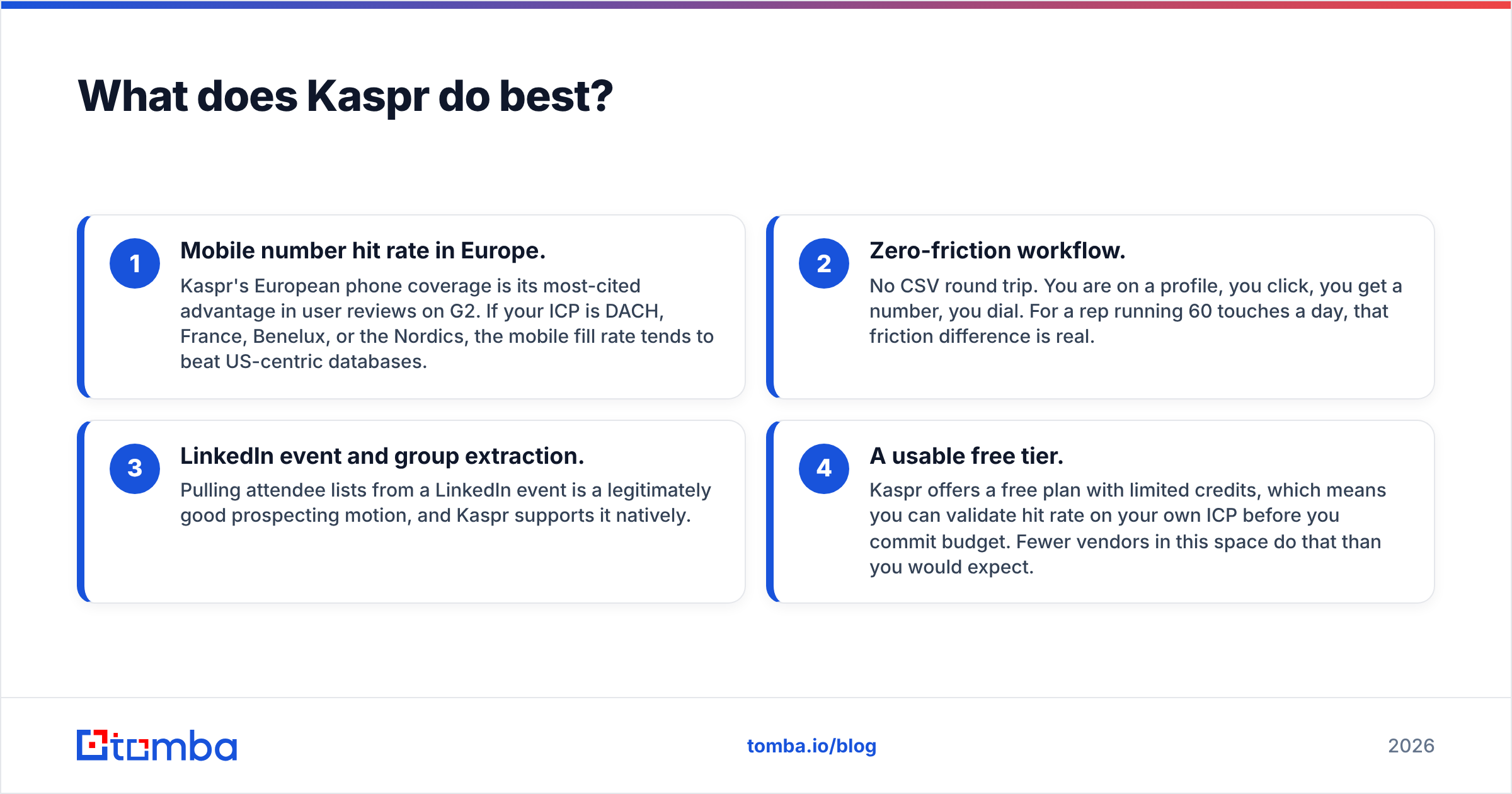
Kaspr's strength is speed at the individual-profile level. Four things it genuinely does well:
- Mobile number hit rate in Europe. Kaspr's European phone coverage is its most-cited advantage in user reviews on G2. If your ICP is DACH, France, Benelux, or the Nordics, the mobile fill rate tends to beat US-centric databases.
- Zero-friction workflow. No CSV round trip. You are on a profile, you click, you get a number, you dial. For a rep running 60 touches a day, that friction difference is real.
- LinkedIn event and group extraction. Pulling attendee lists from a LinkedIn event is a legitimately good prospecting motion, and Kaspr supports it natively.
- A usable free tier. Kaspr offers a free plan with limited credits, which means you can validate hit rate on your own ICP before you commit budget. Fewer vendors in this space do that than you would expect.
Where it gets weaker: bulk work. Kaspr is built around one-profile-at-a-time enrichment. If you need to enrich 40,000 rows from a CRM export, the extension model fights you, and per-seat credit limits make the unit economics awkward. That is the point where teams start layering in a bulk email finder or an API-first provider underneath.
Also worth flagging: credit systems in this category are rarely one-credit-per-contact. Phone credits and email credits are often pooled or capped separately, and unused credits typically do not roll over indefinitely. Read the plan page line by line before you assume a number.
What does SourceScrub do best?#
SourceScrub's moat is not the company records themselves — plenty of vendors have company records. It is the sourcing layer on top of them.
- Non-institutional company coverage. Most B2B databases over-index on funded startups because funding events are easy to scrape. SourceScrub deliberately indexes the companies nobody has funded: family-owned manufacturers, profitable services firms, regional software businesses. That is exactly the universe a lower-middle-market PE firm needs.
- Source lists. Conference exhibitor rosters, industry association directories, "fastest growing company" awards, trade publication rankings. These are curated and tagged, so you can search "companies that exhibited at three or more logistics conferences since 2024."
- Growth signals. Headcount trajectory, web traffic, job posting velocity, and similar proxies for momentum in companies that publish no financials.
- Deal-CRM integration. Native sync into DealCloud and Affinity matters enormously to investment teams, because the company record needs to live where the deal pipeline lives.
Where it gets weaker: contact data. SourceScrub will tell you a company exists, is growing 40% year over year, and has never raised outside capital. Getting the founder's direct email is a thinner part of the offering, and many firms bolt on a separate contact provider for exactly that reason. It is also not a tool you buy on a Tuesday afternoon — expect a demo cycle, a security review, and an annual commitment.
How do they differ on data coverage and accuracy?#
Accuracy claims in this category are close to meaningless out of context, because the two products measure entirely different things.
Kaspr's accuracy question is: does this phone number ring the right human, and does this email bounce? That is testable in an afternoon. Pull 200 contacts in your ICP, run them through an independent email verifier, and dial 50 of the mobiles. You will know your real hit rate before the trial ends. Most vendors quote 90%+ accuracy; your ICP-specific number is the only one that matters.
SourceScrub's accuracy question is: is this company profile current, and is the revenue estimate defensible? Private-company data has no filing requirement behind it, so estimates come from models plus human research. SourceScrub leans harder on human verification than most, which is part of why it costs what it costs — but you should still spot-check 20 companies you already know well during any evaluation.
One practical warning that applies to both: catch-all domains break naive verification. A large share of mid-market company domains accept mail for any address, so a "valid" result from a basic SMTP check tells you nothing. If a meaningful chunk of your list sits behind catch-alls, you need a catch-all verifier in the workflow, not just a green checkmark from whatever tool produced the address.
What do Kaspr and SourceScrub cost in 2026?#
This is where the comparison stops being apples-to-apples in a way that surprises people.
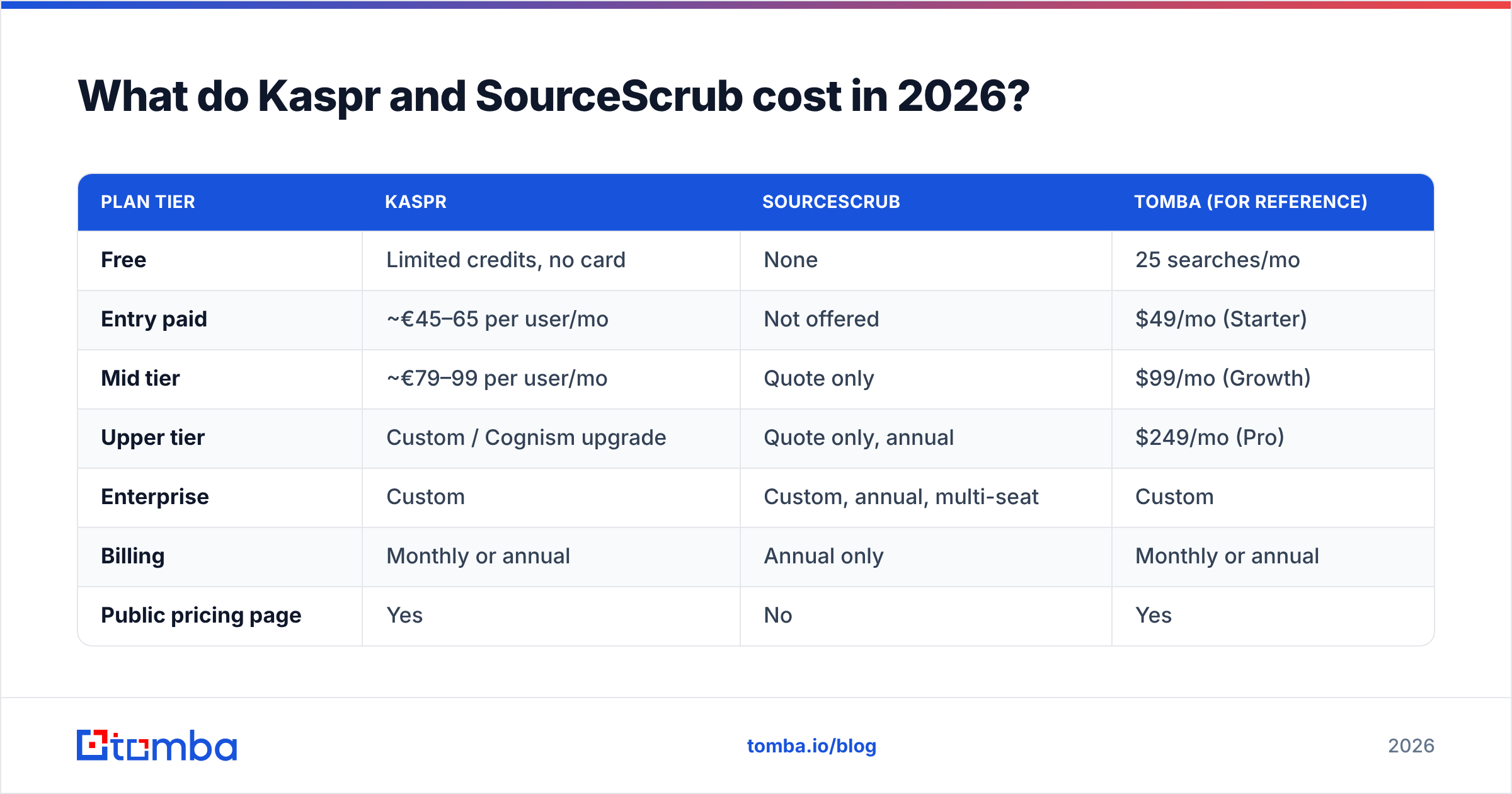
| Plan tier | Kaspr | SourceScrub | Tomba (for reference) |
|---|---|---|---|
| Free | Limited credits, no card | None | 25 searches/mo |
| Entry paid | ~€45–65 per user/mo | Not offered | $49/mo (Starter) |
| Mid tier | ~€79–99 per user/mo | Quote only | $99/mo (Growth) |
| Upper tier | Custom / Cognism upgrade | Quote only, annual | $249/mo (Pro) |
| Enterprise | Custom | Custom, annual, multi-seat | Custom |
| Billing | Monthly or annual | Annual only | Monthly or annual |
| Public pricing page | Yes | No | Yes |
Vendor pricing changes; treat the Kaspr and SourceScrub figures as directional and confirm on their sites. Two structural points hold regardless of the exact numbers:
Kaspr charges per seat, and seats scale linearly. Ten reps is roughly ten times one rep. There is no "shared pool" discount in the way an API-metered tool gives you. Some tiers also carry minimum seat counts on annual terms.
SourceScrub does not publish pricing because it is not a self-serve product. Public reporting and buyer forums consistently put it in the five-figure annual range, scaling with seats and modules. If you are a three-person sales team, that number is not going to land — and that is fine, because you are not the customer it was built for.

Which one should you choose?#
Skip the feature matrix and answer one question: what is the unit of work your team actually pursues?
- You pursue people. SDRs working named accounts, recruiters sourcing candidates, founders doing manual outbound. → Kaspr, or a contact-data tool in its class. SourceScrub will not give you a dial tone.
- You pursue companies. Deal origination, thesis-driven sourcing, M&A pipeline building in markets with no funding data. → SourceScrub. Nothing in Kaspr replicates conference-list sourcing.
- You pursue both, with a small budget. → SourceScrub's price floor will decide this for you. Start with contact data, layer company intelligence when the deal volume justifies it.
- You need volume, not browsing. Enriching tens of thousands of rows, running nightly jobs, feeding a data warehouse. → Neither. You want an API-first provider with predictable per-lookup economics. An extension-based tool priced per seat is the wrong shape for that job.
- You need one verified email per known contact, fast. → A dedicated email finder does this for a fraction of either tool's cost, and pairs with whichever company-intelligence source you already have.
- You are replacing a contract, not starting fresh. → Map which of your existing workflows actually consume the data. Most teams discover 70% of usage sits in one workflow that a $49/mo tool covers.
Can you use them together?#
Yes, and for investment teams it is the common pattern. SourceScrub identifies a shortlist of 400 bootstrapped companies matching a thesis. That shortlist arrives with company names and domains but thin contact data. You then need founder and executive contact details for all 400.
Running that through a per-seat browsing tool is slow. Running it through a domain search or a bulk enrichment API is fast: feed in domains, get back verified addresses and patterns, push to the CRM. The company-intelligence platform stays the system of record for who to chase; a contact-data layer handles how to reach them.
The same logic applies in reverse for sales teams. If Kaspr is already giving your reps good numbers on LinkedIn, you do not need SourceScrub to do outbound — you need better account selection, which is usually a firmographic filter problem, not a $30k platform problem.
What should you test during a trial?#
Run the same five-step evaluation on either vendor. It takes half a day and beats any review site.
- Pull 200 records in your exact ICP — not a generic sample, your actual target segment and geography.
- Verify independently. Never let a vendor grade its own homework. Run emails through a third-party checker and hand-dial a sample of phones.
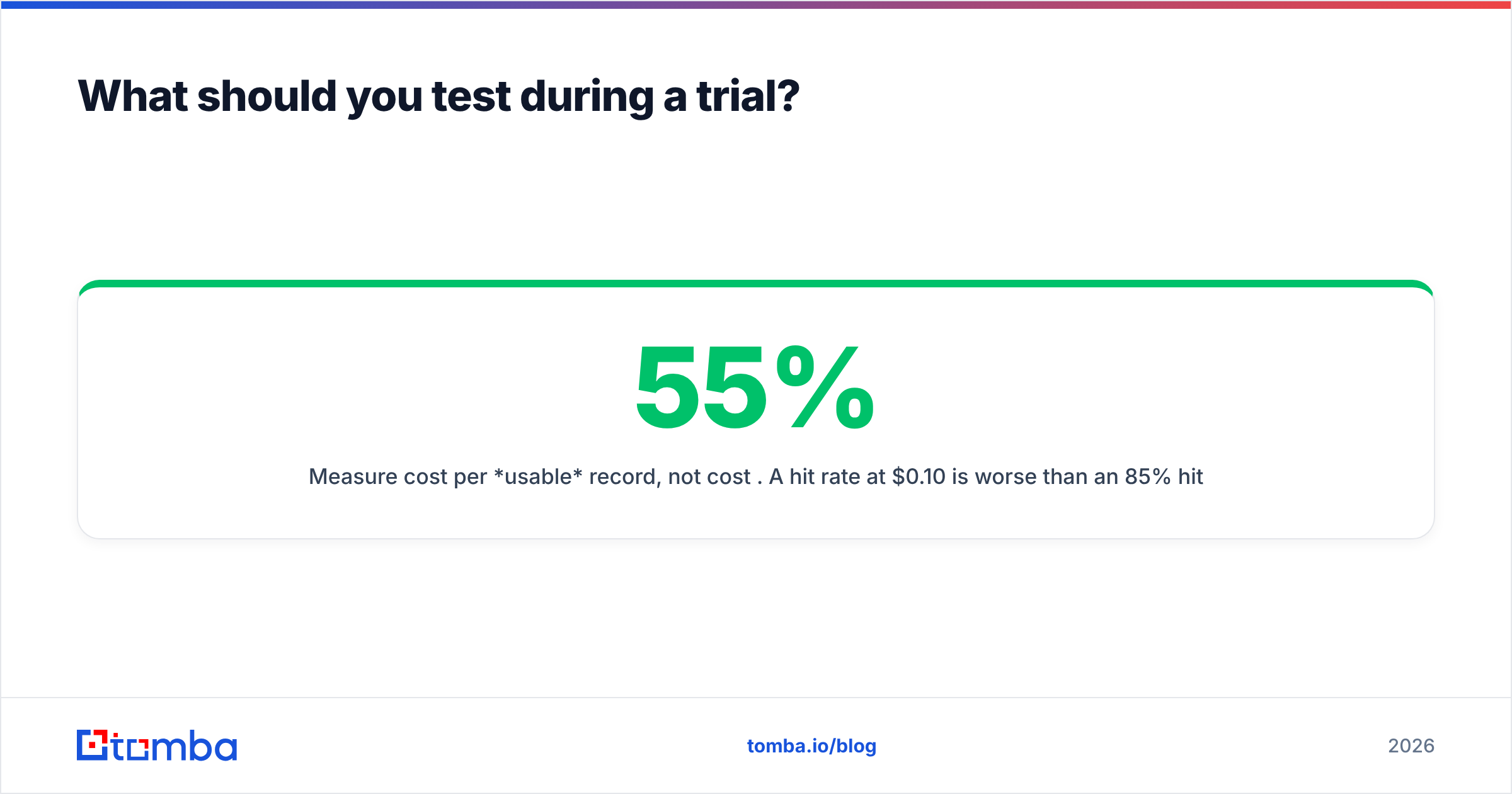
- Measure cost per usable record, not cost per credit. A 55% hit rate at $0.10 is worse than an 85% hit rate at $0.14.
- Test the export path. Can you get data out cleanly, in bulk, without a support ticket? Check CSV, CRM sync, and API in that order.
- Read the credit rollover and seat-minimum terms. This is where annual contracts quietly cost more than the sticker price suggested.
If you want to sanity-check the economics before any sales call, the published Tomba pricing tiers give you a clean reference point for what contact-level data costs when it is not bundled into a per-seat platform.
The honest verdict#
Kaspr wins if your bottleneck is reaching people you have already identified, especially in Europe, especially over the phone, especially one profile at a time. It is cheap, it is self-serve, and the free tier lets you prove hit rate before you pay.
SourceScrub wins if your bottleneck is finding companies that do not show up in funding databases — and if you have a deal-sourcing budget that justifies an annual enterprise contract. For a lower-middle-market PE firm, it is a serious tool with a genuine data moat.
Neither wins if your real job is producing verified work emails at volume, on a predictable budget, through an API your engineers can wire into a pipeline. That job has its own category of tool, and paying platform prices for it is the most common overspend we see in this comparison.
If that last description sounds like your situation, start with the Tomba Email Finder. Search by name and domain, get a confidence score and verification status on every result, and run it from the web app, a spreadsheet add-on, or the API — starting free with 25 searches a month, then $49/mo when you need volume. Use it alongside whatever company-intelligence source you already trust, and stop paying enterprise rates for an email address.
Related guides#
// get started
Find, verify and enrich your first contacts today
Start on the free plan with 25 searches a month, then scale when your team is ready.
Free plan · No credit card required · GDPR & CCPA
// about the author