Kaspr vs Wiza (2026): Which LinkedIn Data Tool Wins?
Kaspr pulls mobile numbers off LinkedIn profiles one at a time. Wiza exports entire Sales Navigator lists. Here's which one belongs in your stack in 2026 — and where both quietly leave money on the table.
TL;DR
- Kaspr is a LinkedIn Chrome extension built around mobile phone numbers, strongest in EMEA, sold per seat. Wiza is a Sales Navigator list exporter built around bulk CSV output, strongest in North America, sold per credit.
- Pick Kaspr if your reps live inside LinkedIn and cold call. Pick Wiza if you build lists in Sales Navigator and push them into a sequencer.
- Neither is a great fit for API-driven enrichment, domain-wide discovery, or high-volume verification — that's where a dedicated email finder costs less per record.
- Both publish "verified" email claims. Both still need an independent email verifier pass before you send, especially on catch-all domains.
- Real cost comparison only works when you normalize to cost-per-usable-contact, not cost-per-credit. Seat-based pricing distorts the math badly for teams under five reps.
What Are Kaspr and Wiza, Exactly?#
They look similar in a G2 category grid and behave nothing alike in practice.
Kaspr (kaspr.io) is a French contact-data tool acquired by Cognism in 2022. Its core surface is a Chrome extension that overlays LinkedIn: you open a profile, the widget reveals mobile numbers, direct dials, and email addresses, and you push the contact to a CRM or a list. The product is optimized for one motion — a rep looking at a human being on LinkedIn who wants to call that human being today. Kaspr's phone coverage in Western Europe is genuinely strong, which is the single most defensible thing about it.
Wiza (wiza.co) is a Canadian tool built around a different verb: export. You run a LinkedIn Sales Navigator search that returns 2,400 results, hit the Wiza extension, and it grinds through the list and hands back a CSV with names, titles, companies, and email addresses it claims to have verified in real time. Wiza also has a standalone prospecting database and an API, but list export is what people buy it for.
The distinction matters more than any feature table. Kaspr is a depth tool — one contact, maximum channels. Wiza is a breadth tool — many contacts, one channel. Teams that buy the wrong one usually describe the same symptom: "we're paying for credits we can't use."
How Do Kaspr and Wiza Compare Head-to-Head?#
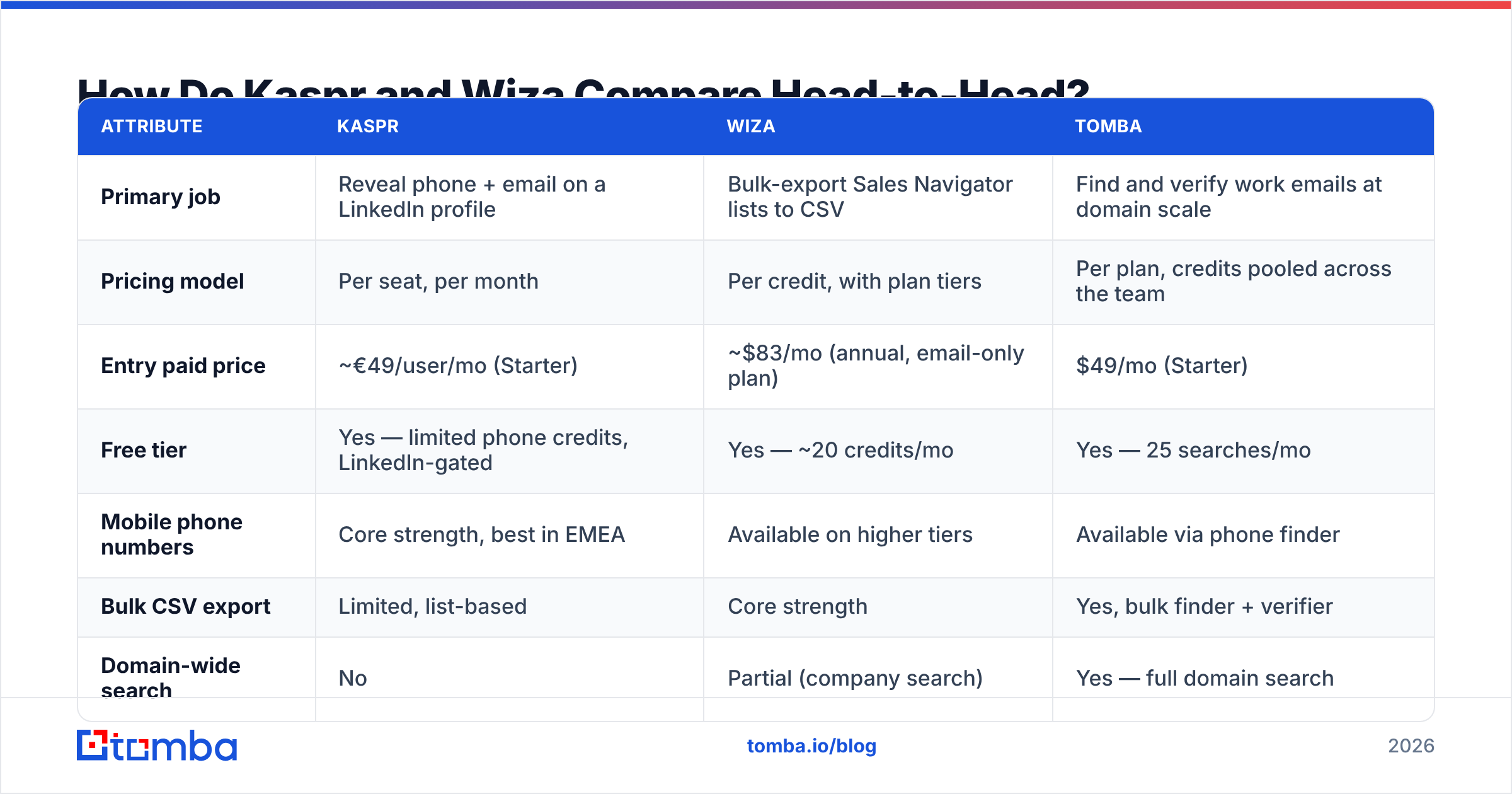
Here is the honest side-by-side. Pricing figures reflect publicly listed plans as of early 2026 and both vendors change them — verify on their own pages before you sign anything.
| Attribute | Kaspr | Wiza | Tomba |
|---|---|---|---|
| Primary job | Reveal phone + email on a LinkedIn profile | Bulk-export Sales Navigator lists to CSV | Find and verify work emails at domain scale |
| Pricing model | Per seat, per month | Per credit, with plan tiers | Per plan, credits pooled across the team |
| Entry paid price | ~€49/user/mo (Starter) | ~$83/mo (annual, email-only plan) | $49/mo (Starter) |
| Free tier | Yes — limited phone credits, LinkedIn-gated | Yes — ~20 credits/mo | Yes — 25 searches/mo |
| Mobile phone numbers | Core strength, best in EMEA | Available on higher tiers | Available via phone finder |
| Bulk CSV export | Limited, list-based | Core strength | Yes, bulk finder + verifier |
| Domain-wide search | No | Partial (company search) | Yes — full domain search |
| Catch-all handling | Not exposed to user | Flags risky, limited detail | Dedicated catch-all verifier |
| Public API | Limited | Yes | Yes, full REST API + CLI + MCP |
| Data geography bias | Europe-heavy | North America-heavy | Global, domain-pattern driven |
| Best for | SDRs who cold call from LinkedIn | List builders feeding a sequencer | Devs, RevOps, and anyone enriching at scale |
Read that table by column, not by row. Kaspr wins the "I need to call this person in ten minutes" column outright. Wiza wins the "I need 3,000 rows by Friday" column. Neither wins the "I need this to run automatically inside our data pipeline" column, because neither was designed for it.
Which Tool Has Better Data Accuracy?#
Accuracy claims in this category are close to meaningless until you define the denominator.
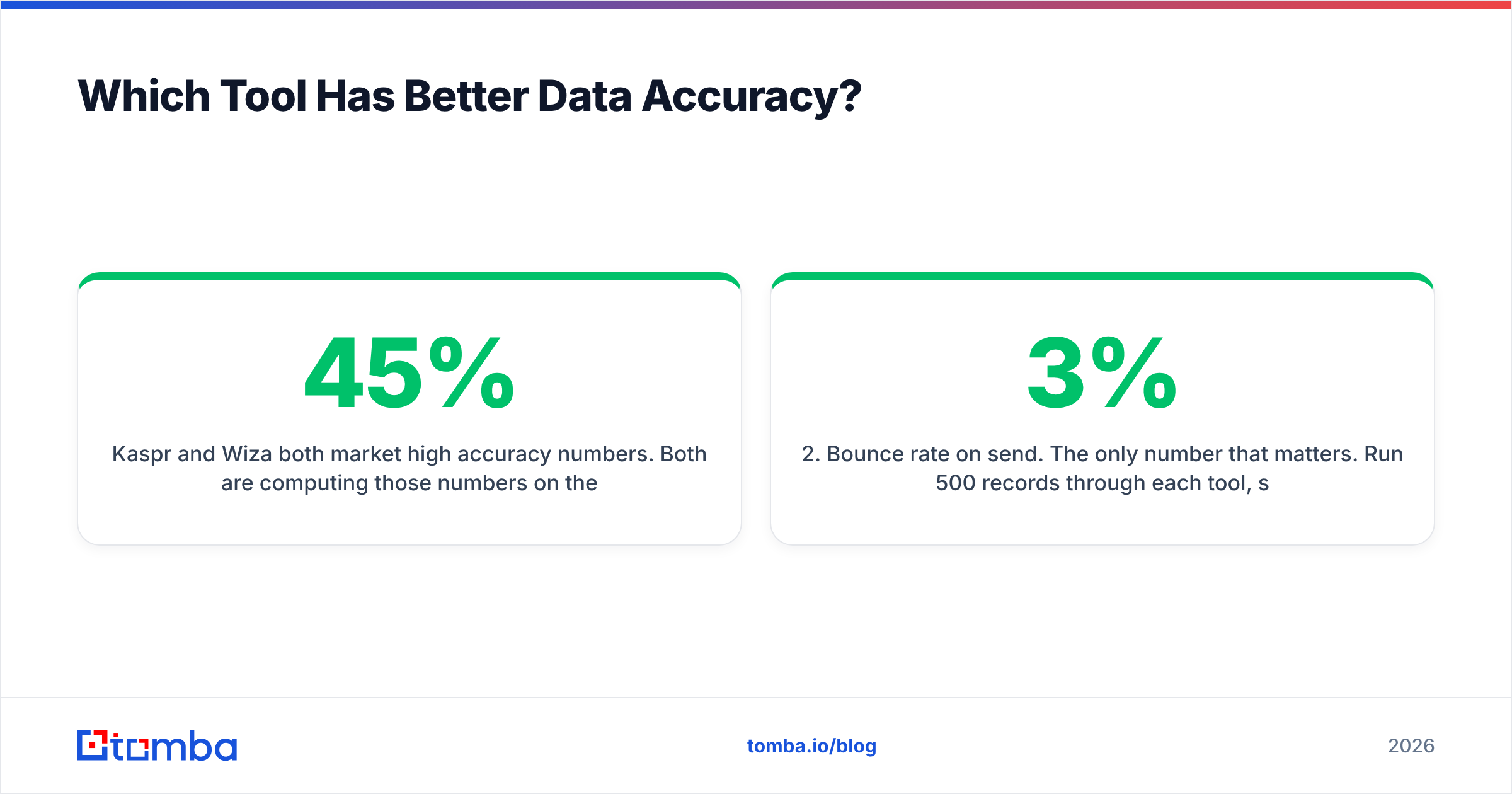
Kaspr and Wiza both market high accuracy numbers. Both are computing those numbers on the records they chose to return — not on the records you asked for. A tool that returns an email for 45% of your list and gets 95% of those right has a 43% usable-contact rate. A tool that returns 80% of your list at 88% accuracy gives you 70%. The second tool is far better and the first one has the prettier marketing number.

Three things reliably separate real accuracy from claimed accuracy:
- Coverage rate (hit rate). What percentage of your input list returns any contact at all? Ask both vendors to run your actual list in trial, not a curated sample.
- Bounce rate on send. The only number that matters. Run 500 records through each tool, send from a warmed domain, and compare hard bounces. Under 3% is acceptable; over 5% is a deliverability liability.
- Catch-all treatment. Roughly a fifth of B2B domains accept everything at the SMTP layer. Tools that silently mark these "valid" inflate accuracy and destroy your sender reputation. Tools that mark them "unknown" look worse on paper and protect you. Ask which one each vendor does.
In practice, Wiza's real-time verification on export is a meaningful design choice — it verifies at the moment of extraction rather than serving a cached record from six months ago. Kaspr's email data is decent but is not the reason anyone buys Kaspr. If email quality is your deciding factor, both should be paired with an independent verification pass; a second opinion from a catch-all verifier is the cheapest deliverability insurance you can buy.
How Do Kaspr and Wiza Pricing Models Differ?#
This is where most buying decisions actually get made, and where the two tools are least comparable.
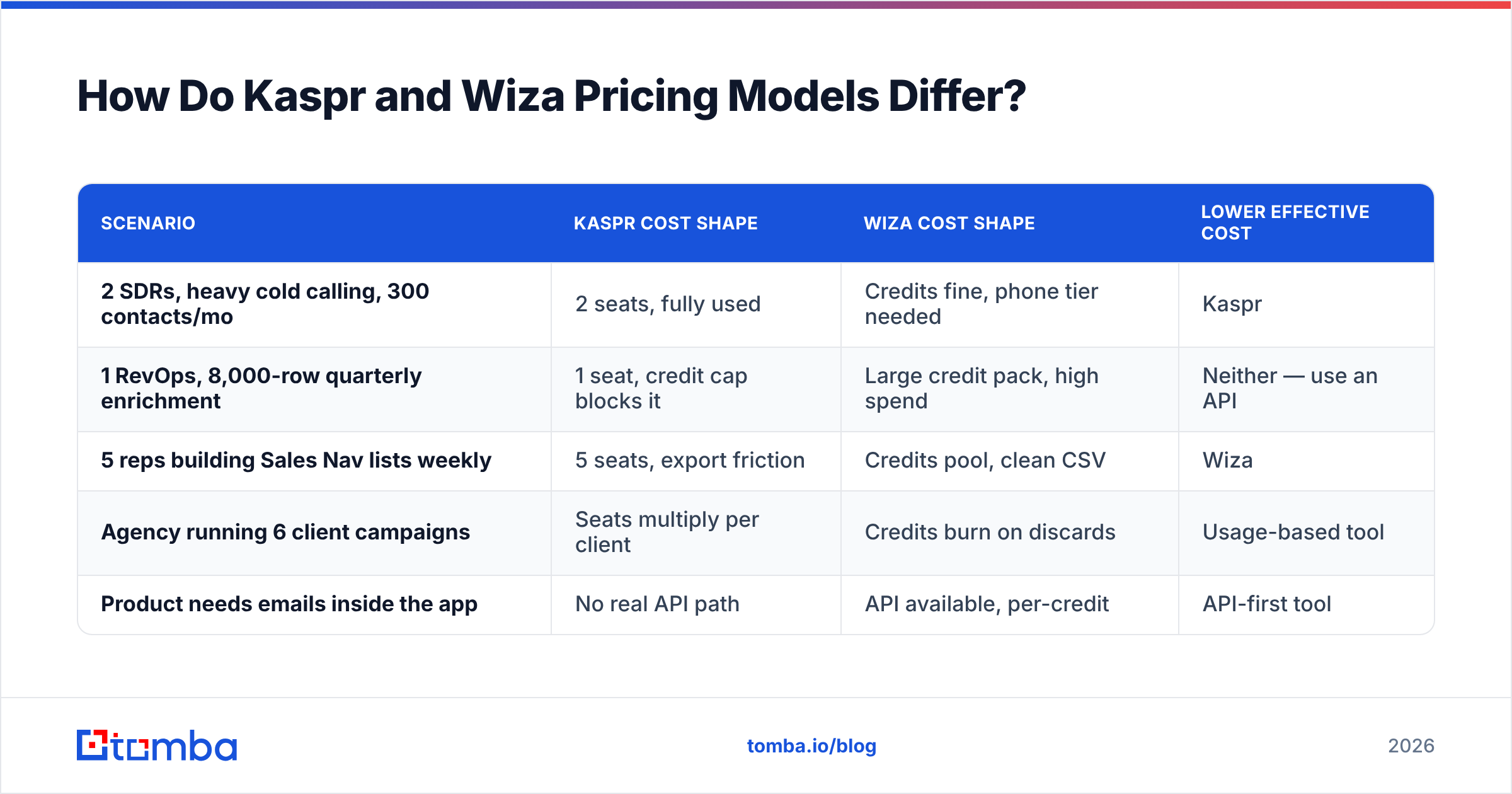
Kaspr charges per seat. Every rep who needs the extension needs a license. Credits are typically allocated per user and don't pool well across a team. That model is fine at ten reps who each work their own territory. It's punishing at three reps, and it's actively hostile to a RevOps person who wants to enrich a 10,000-row list once a quarter — you'd be paying for a calling tool to do a batch job.
Wiza charges per credit within plan tiers. That's friendlier to bursty usage, but the entry price for a meaningful volume is higher than it looks, and credits consumed on a Sales Navigator export include rows you'll discard (wrong title, wrong region, left the company). Your effective cost per kept contact is often 2-3x the sticker rate.
| Scenario | Kaspr cost shape | Wiza cost shape | Lower effective cost |
|---|---|---|---|
| 2 SDRs, heavy cold calling, 300 contacts/mo | 2 seats, fully used | Credits fine, phone tier needed | Kaspr |
| 1 RevOps, 8,000-row quarterly enrichment | 1 seat, credit cap blocks it | Large credit pack, high spend | Neither — use an API |
| 5 reps building Sales Nav lists weekly | 5 seats, export friction | Credits pool, clean CSV | Wiza |
| Agency running 6 client campaigns | Seats multiply per client | Credits burn on discards | Usage-based tool |
| Product needs emails inside the app | No real API path | API available, per-credit | API-first tool |
Two rows in that table point at neither vendor. That's not a rhetorical trick — it's the most common outcome. Once your use case is "enrich a lot of records programmatically," you're buying infrastructure, not a Chrome extension, and the per-record economics change completely. Tomba pricing starts at $49/mo for Starter with $99/mo Growth and $249/mo Pro tiers, all with pooled credits and full API access at every paid level — which is why it keeps appearing in Wiza alternative shortlists from technical teams rather than from SDR managers.

Is Kaspr Better Than Wiza for Phone Numbers?#
Yes, for European mobile data, and it isn't close.
Kaspr's dataset was built in Europe and the GDPR-compliant sourcing is part of the product's identity. If your ICP sits in France, the Benelux, DACH, or the UK, Kaspr will surface direct dials and mobiles that North American-first tools simply don't hold. Cognism's ownership reinforces this — Cognism's Diamond Data phone verification is one of the more rigorous processes in the category, and the two products share organizational DNA.
Wiza does offer phone numbers on higher tiers, and its North American coverage is respectable. But phones are an add-on to Wiza's identity, not the center of it. If your entire outbound motion is cold calling into EMEA accounts, Kaspr is the more rational purchase and this article should not talk you out of it.
The caveat worth stating plainly: phone data decays faster than email data. People change mobile numbers less often than jobs, but the association between a number and a current employer breaks the moment they move. Any phone dataset — Kaspr's, Wiza's, or a phone finder from anywhere else — needs a validation step before a dialer touches it, or your connect rate and your carrier reputation both suffer.

Which Tool Fits Your Workflow?#
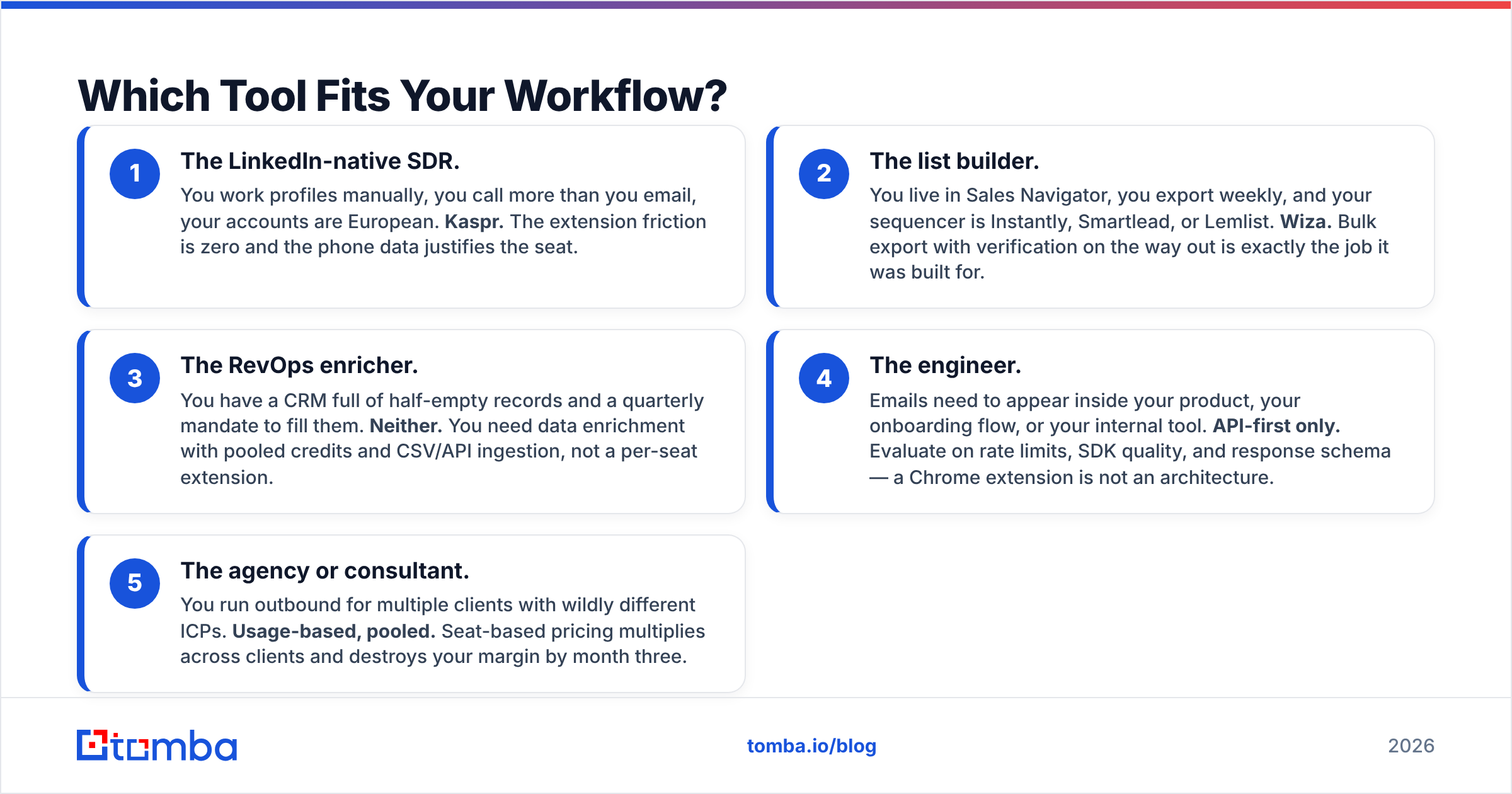
Match the tool to the motion, not to the feature list. Five patterns cover almost everyone:
- The LinkedIn-native SDR. You work profiles manually, you call more than you email, your accounts are European. Kaspr. The extension friction is zero and the phone data justifies the seat.
- The list builder. You live in Sales Navigator, you export weekly, and your sequencer is Instantly, Smartlead, or Lemlist. Wiza. Bulk export with verification on the way out is exactly the job it was built for.
- The RevOps enricher. You have a CRM full of half-empty records and a quarterly mandate to fill them. Neither. You need data enrichment with pooled credits and CSV/API ingestion, not a per-seat extension.
- The engineer. Emails need to appear inside your product, your onboarding flow, or your internal tool. API-first only. Evaluate on rate limits, SDK quality, and response schema — a Chrome extension is not an architecture.
- The agency or consultant. You run outbound for multiple clients with wildly different ICPs. Usage-based, pooled. Seat-based pricing multiplies across clients and destroys your margin by month three.
If you land on 3, 4, or 5, the Kaspr vs Wiza question was the wrong question. That's not a knock on either vendor — it's a scope mismatch, and recognizing it early saves a wasted annual contract.
What Are the Hidden Limits of Both Tools?#
Every tool in this category has constraints that don't appear in the pricing table. These are the ones that generate refund requests.
LinkedIn dependency. Both products draw heavily from LinkedIn profile context. That means both inherit LinkedIn's rate limits, its periodic crackdowns on extensions, and its account-restriction risk. Heavy scraping through a Sales Navigator seat carries real exposure — LinkedIn has restricted accounts for it. Neither vendor can indemnify you against that, and neither claims to.
Credit burn on misses. Read the fine print on whether a failed lookup consumes a credit. Policies differ, change, and matter enormously at volume. A 55% hit rate with credits charged on misses is nearly double the effective price of a 55% hit rate with credits charged only on hits.
Weak domain-level discovery. Neither tool is built to answer "give me every reachable contact at acme.com." Both start from a person. If your motion is account-based — you know the company, you don't know the people — you want domain search rather than a profile-by-profile reveal.
Export and ownership terms. Check what happens to data you've already pulled if you downgrade or cancel. Some tools in this category restrict export on lower tiers.
Geographic blind spots. Kaspr thins out fast outside Europe. Wiza thins out fast outside North America and English-language profiles. Both are weak in APAC, LATAM, and the Middle East. If your ICP is global, plan for a second source or accept a large coverage gap.
For a broader sense of where these tools sit against the field, independent review aggregators like G2 are useful for spotting consistent complaints across hundreds of reviews — far more reliable than any single vendor's case-study page.
Are There Better Alternatives to Kaspr and Wiza?#
"Better" depends entirely on whether your bottleneck is discovery, accuracy, or cost per record.
If your bottleneck is phone coverage in Europe, Kaspr is close to the ceiling and you should just buy it.
If your bottleneck is turning a Sales Navigator search into a clean CSV, Wiza does that as well as anything and the workflow is genuinely tight. Competitors in that lane include Evaboot and Findymail, and honest buyers should trial at least two.
If your bottleneck is cost per verified email at volume, both tools are structurally expensive for the job, because you're paying for a LinkedIn interface layer you don't need. This is where domain-driven finders win: you submit a company domain and a name, you get a pattern-validated address, and you pay for records rather than seats. Tomba sits here, alongside options like BookYourData for teams that prefer buying a pre-built, verified list outright rather than running lookups themselves — a legitimately different and often faster path when your ICP is well defined.
If your bottleneck is engineering time, the deciding factor is the API, the Tomba CLI, and whether the tool drops cleanly into your stack. A Chrome extension can't be scheduled, can't be versioned, and can't be tested.
What's the Verdict on Kaspr vs Wiza?#
Kaspr for callers. Wiza for list builders. Neither for pipelines.
Kaspr earns its seat price if your reps dial European prospects daily and the extension is the first thing they open. Wiza earns its credit spend if your weekly ritual is a Sales Navigator search and a CSV handoff to a sequencer. Both are competent, both are honestly priced for what they do, and both are the wrong shape for programmatic enrichment, domain-wide discovery, or agency-scale multi-client work.
Before you commit to an annual plan on either, run the only test that predicts outcomes: take 500 real records from your actual ICP, push them through both trials plus one API-first option, send from a warmed domain, and compare hard bounce rates and connect rates. The tool with the best marketing accuracy number is frequently not the tool with the best result on your list.
Start there. If your test shows the gap is in email coverage and cost per record rather than phone data, run the same 500 records through the Tomba Email Finder — 25 free searches a month, no seat fees, pooled credits across your whole team, and the same REST API powering every plan from Starter at $49/mo upward. Compare the bounce rates yourself, then decide.
Related guides#
// get started
Find, verify and enrich your first contacts today
Start on the free plan with 25 searches a month, then scale when your team is ready.
Free plan · No credit card required · GDPR & CCPA
// about the author