Kiamo Pricing Reviews Pros and Cons: A 2026 Buyer's Guide
Kiamo doesn't publish a price list, which makes budgeting hard. Here's how its quote-only model actually works, what reviewers praise and complain about, and where it fits against Genesys, Five9 and Talkdesk.
Kiamo pricing reviews pros and cons come up on every shortlist for this tool, and the answers are not on the vendor site. Kiamo sells by quote. This guide shows how that quote is built, what buyers praise, what they complain about, and who should walk away.
TL;DR
- Kiamo is a French omnichannel contact center platform. It covers voice, email, chat, social, and SMS through one routing engine. It is built for mid-market and enterprise support teams, not for outbound sales reps.
- Kiamo does not publish a price list. Every deal starts with a demo and ends in a custom quote. Your cost depends on agent count, channel mix, telephony setup, and deployment model.
- Reviewers praise the routing rules, the supervision dashboards, and the local support. They complain about the dated admin UI, the setup effort, and the missing prices.
- Licences are not the whole bill. Budget for integration work, telephony and SIP costs, training, and a professional-services engagement.
- Kiamo handles inbound conversations. It does not find or enrich the contact data your outbound team needs. That is a separate line item.
What is Kiamo?#
Kiamo is an omnichannel contact center tool. It routes phone calls, emails, web chat, SMS, social messages, and callbacks through one engine. An agent works one queue instead of five inboxes. It started in France and is used across French-speaking Europe. It now belongs to the Efficy group, which pairs it with CRM.
Here is the everyday analogy. Most support stacks are a building with five front doors and no receptionist. Whoever stands near a door answers it. Kiamo is the receptionist. She sees all five doors, knows who is free, knows who speaks German, and knows who helped this customer last month. Then she sends the visitor to the right desk.
Technically, that receptionist is a rules-based routing engine. It layers on skills, priorities, and service-level targets. That is why the price is not a number on a web page. The engine is configured per customer.
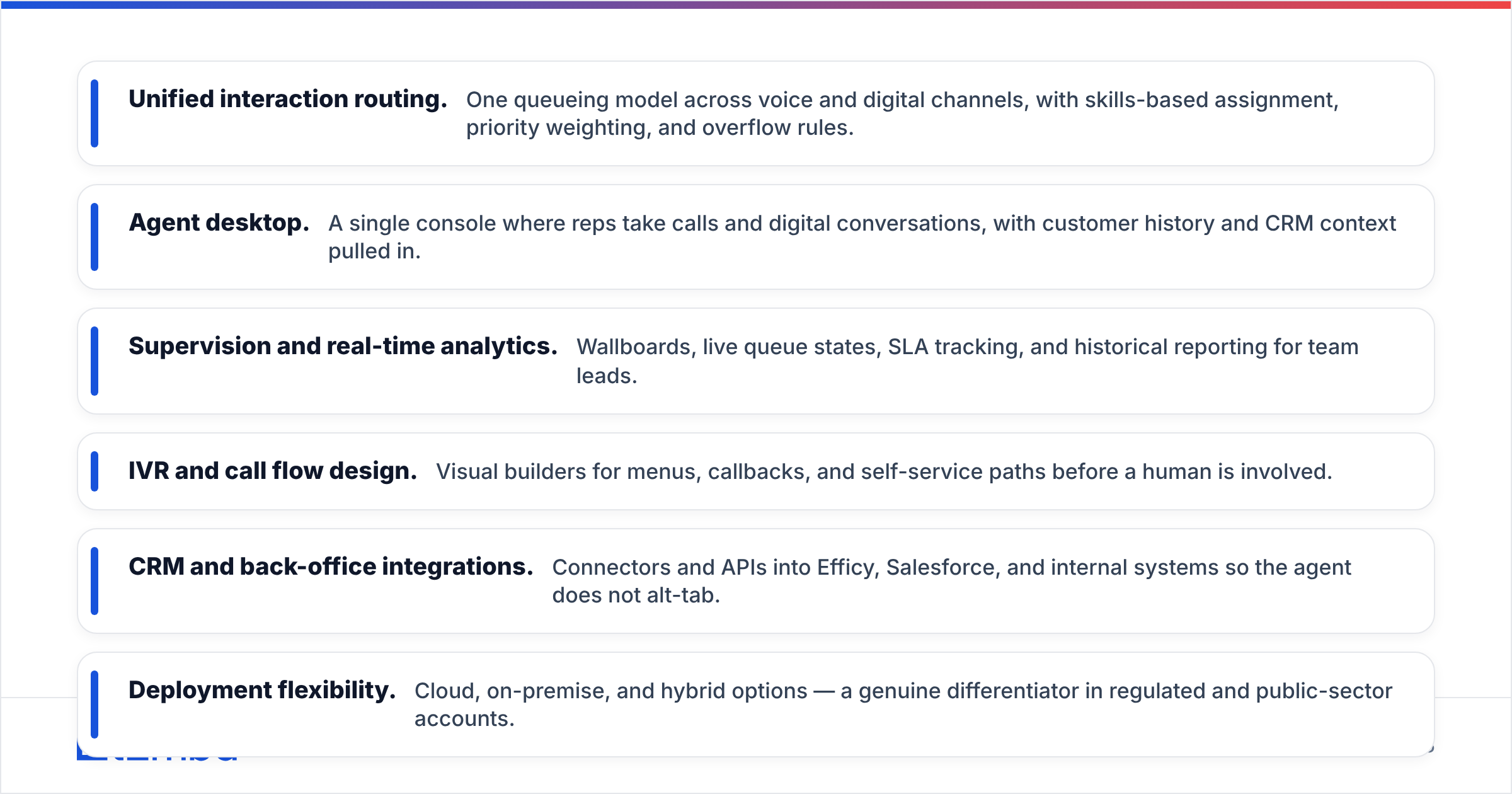
Here is what you buy when you buy Kiamo:
- Unified interaction routing. One queue model across voice and digital channels, with skills-based assignment, priority weighting, and overflow rules.
- Agent desktop. One console for calls and digital chats, with customer history and CRM context pulled in.
- Supervision and real-time analytics. Wallboards, live queue states, SLA tracking, and history reports for team leads.
- IVR and call flow design. Visual builders for menus, callbacks, and self-service paths before a human is involved.
- CRM and back-office integrations. Connectors and APIs into Efficy, Salesforce, and in-house systems, so agents stop alt-tabbing.
- Deployment flexibility. Cloud, on-premise, and hybrid. That is a real edge in regulated and public-sector deals.

How does Kiamo pricing work in 2026?#
Kiamo pricing is quote-only. There is no self-serve checkout, no public per-agent rate, and no free tier. You book a demo. A consultant scopes your channel mix and agent count. Then you get a proposal.
That is normal for the contact-center-as-a-service (CCaaS) market. Genesys, NICE, and Odigo work the same way at the enterprise end. Still, it changes how you budget.
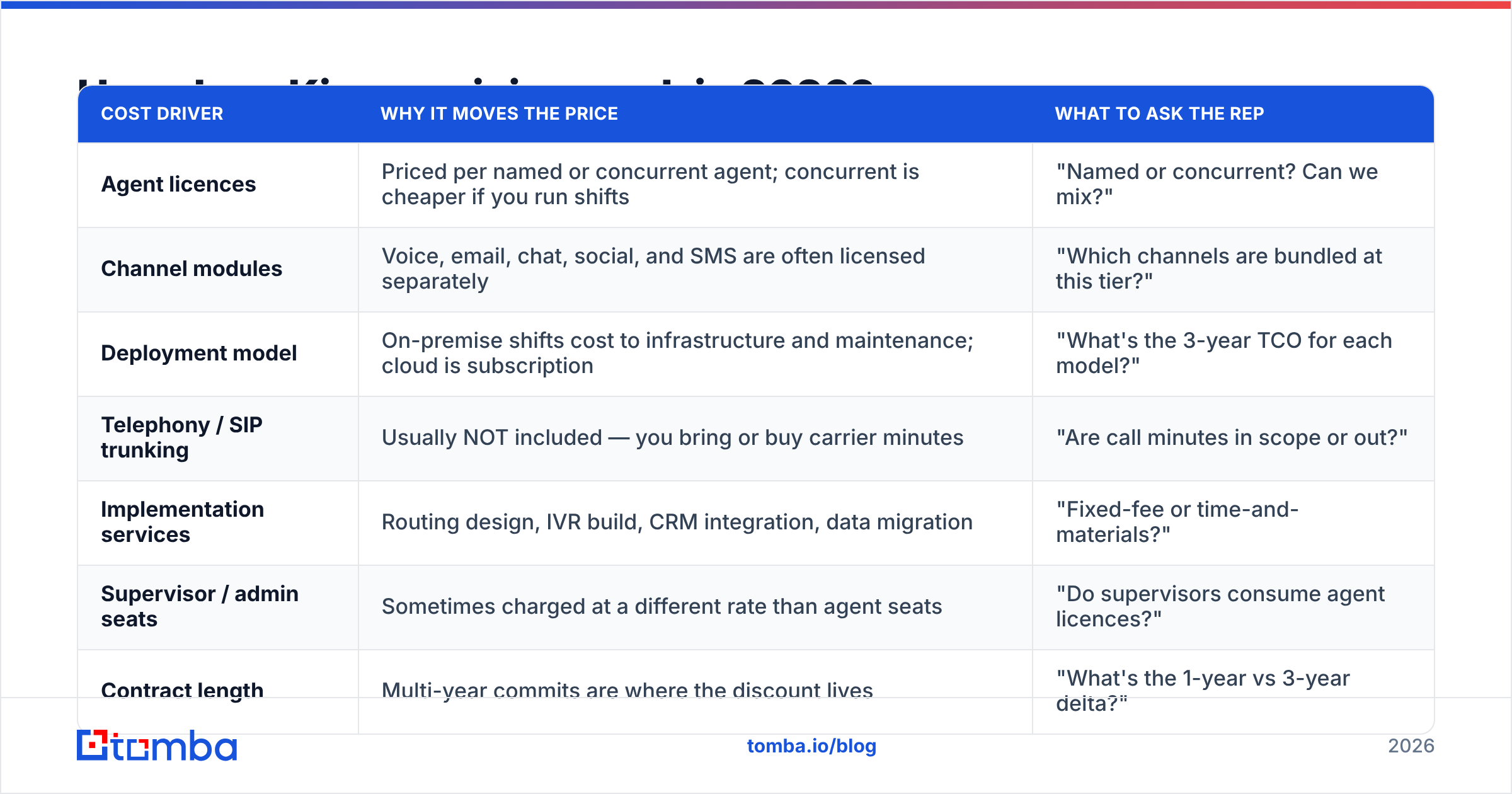
The variables that move a Kiamo quote:
| Cost driver | Why it moves the price | What to ask the rep |
|---|---|---|
| Agent licences | Priced per named or concurrent agent; concurrent is cheaper if you run shifts | "Named or concurrent? Can we mix?" |
| Channel modules | Voice, email, chat, social, and SMS are often licensed separately | "Which channels are bundled at this tier?" |
| Deployment model | On-premise shifts cost to infrastructure and maintenance; cloud is subscription | "What's the 3-year TCO for each model?" |
| Telephony / SIP trunking | Usually NOT included — you bring or buy carrier minutes | "Are call minutes in scope or out?" |
| Implementation services | Routing design, IVR build, CRM integration, data migration | "Fixed-fee or time-and-materials?" |
| Supervisor / admin seats | Sometimes charged at a different rate than agent seats | "Do supervisors consume agent licences?" |
| Contract length | Multi-year commits are where the discount lives | "What's the 1-year vs 3-year delta?" |
A rule of thumb for this market: the software is about half to two-thirds of your year-one spend. Setup, telephony, and staff time make up the rest. If a quote lists only licences, the number is incomplete.
What should you budget?#
Kiamo has not published rates. So anyone quoting you a Kiamo per-agent price online is guessing. You can still anchor the talk. Compare the published list prices of similar platforms. Expect Kiamo to land in the same range, with more freedom on deployment.
| Platform | Published entry price | Pricing transparency | Deployment options |
|---|---|---|---|
| Kiamo | Quote only — not published | Low (demo required) | Cloud, on-premise, hybrid |
| Genesys Cloud CX | ~$75/user/mo (CX 1, list) | Medium (tiers published) | Cloud |
| Five9 | ~$119/user/mo (core digital/voice, list) | Medium | Cloud |
| Talkdesk | ~$85/user/mo (Essentials, list) | Medium | Cloud |
| Zendesk Talk | Bundled into Suite plans from ~$55/agent/mo | High | Cloud |
List prices come from each vendor and change often. Treat them as a starting point, not a quote. Check the current numbers before you build a business case.
What do Kiamo reviews actually say?#
Kiamo has fewer reviews than the US-centric giants. That is a data point in itself. It is a strong regional player, not a global default. Check current sentiment on G2 and Capterra before you commit. Weight recent reviews most, because contact center UIs change fast.
These themes come up again and again in public reviews:
What reviewers like
- Routing depth. The distribution rules are granular. Teams with complex skill matrices, many languages, or strict escalation paths say Kiamo models cases that simpler tools cannot.
- One console, many channels. Agents stop juggling tabs. This is the operational win people cite most.
- Supervision tooling. Team leads get live queue views and SLA tracking they use every day, not a dashboard nobody opens.
- Support responsiveness. European buyers mention same-timezone, French-language help. US vendors route escalations across an ocean.
- On-premise option. For public sector, health, and finance with data-residency rules, the choice to stay off cloud can decide the deal.
What reviewers criticise
- Admin interface feels dated. The agent console is fine. The config back-end draws comments about density and learning curve.
- Implementation is a project, not a signup. Plan for weeks, not days. Routing logic has to be designed before it is built.
- Pricing opacity. Buyers cannot benchmark without entering a sales cycle. This is the top complaint in any pros and cons list.
- Smaller integration marketplace. There are fewer ready-made connectors than with Zendesk or Genesys. More work lands on your API team.
- Reporting customisation. Standard reports are solid. Custom reports often need vendor help.
Kiamo pricing reviews pros and cons in one table#
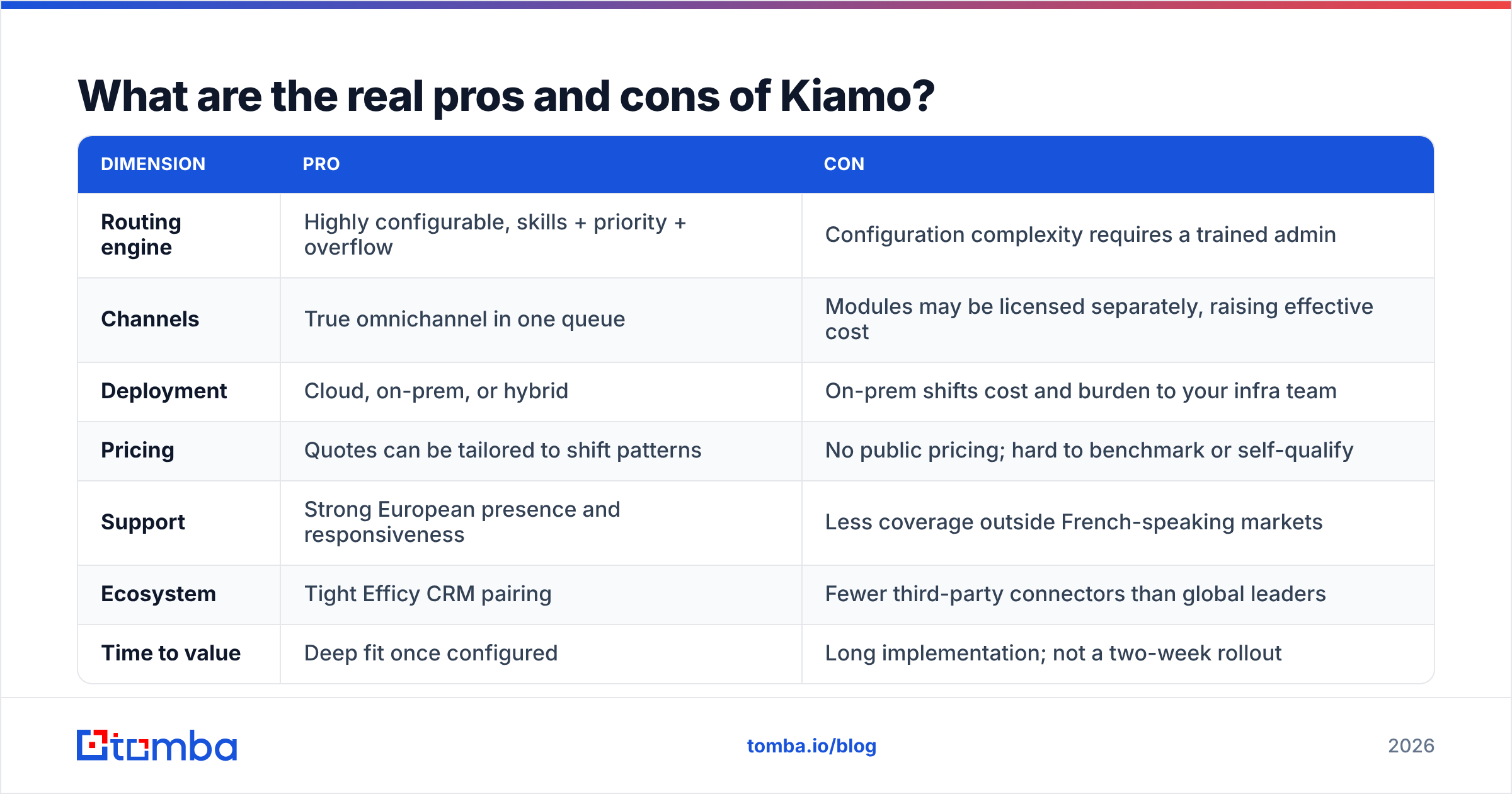
Here is the trade-off in one view. Each row pairs a strength with the cost that comes with it.
| Dimension | Pro | Con |
|---|---|---|
| Routing engine | Highly configurable, skills + priority + overflow | Configuration complexity requires a trained admin |
| Channels | True omnichannel in one queue | Modules may be licensed separately, raising effective cost |
| Deployment | Cloud, on-prem, or hybrid | On-prem shifts cost and burden to your infra team |
| Pricing | Quotes can be tailored to shift patterns | No public pricing; hard to benchmark or self-qualify |
| Support | Strong European presence and responsiveness | Less coverage outside French-speaking markets |
| Ecosystem | Tight Efficy CRM pairing | Fewer third-party connectors than global leaders |
| Time to value | Deep fit once configured | Long implementation; not a two-week rollout |
Who should buy Kiamo — and who should not?#
Good fit: a European service team of 30–500 agents. You have multichannel volume, complex routing rules, data-residency needs, and staff who can own the setup. If you already run Efficy CRM, the case gets stronger.
Poor fit: a five-person startup desk that wants to go live on Monday. A US-only team with no data-residency rules and a taste for published pricing. And above all, an outbound sales team. Kiamo is built for conversations that arrive. It does not source prospects. It does not tell you who to call. It does not check whether an address still works.
That line matters more than most buyers expect during procurement. Analyst frameworks from firms like Gartner split CCaaS from sales engagement and B2B data. The reason is simple. They solve opposite halves of the revenue problem.

What does Kiamo not cover in your GTM stack?#
Three gaps show up in almost every Kiamo rollout. None of them are faults. They are scope limits.
- Contact discovery. Kiamo routes the people who contact you. Finding buyers who have never heard of you is another job. That is what an email finder does: it maps a name and domain to a verified work address.
- Outbound phone data. Your dialler is only as good as its numbers. Kiamo connects calls. It does not source direct lines. A dedicated phone finder feeds that list.
- Record enrichment. Inbound tickets arrive with an email address and little else. Adding firmographics, job titles, and company size is the job of data enrichment, not the routing engine.
The budgeting mistake is to assume the CCaaS licence covers the data layer. It does not. Finding that out in month three means a new line item in a frozen budget.
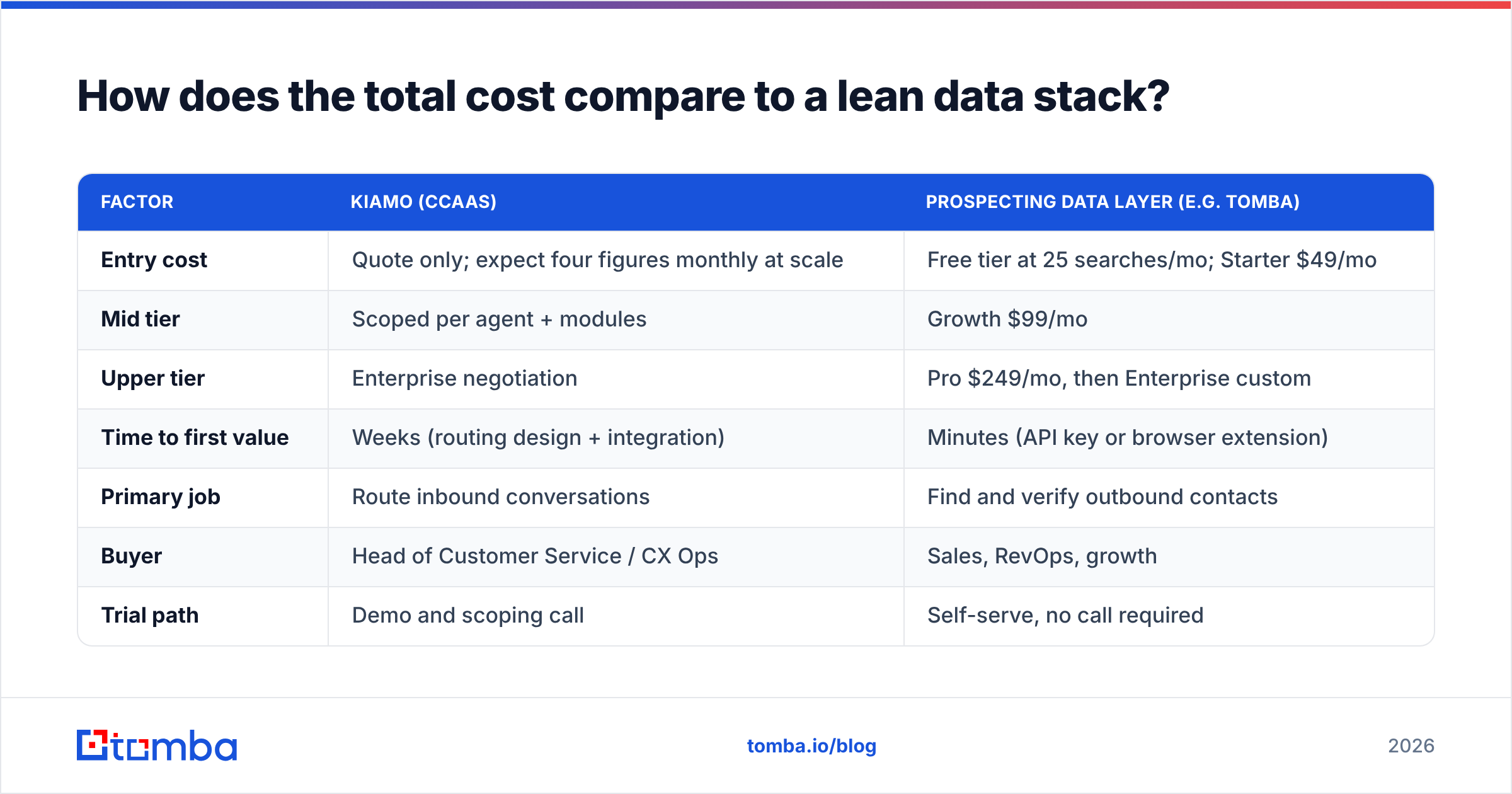
How does the total cost compare to a lean data stack?#
Here is the honest contrast. It is not apples to apples, and that is the point. These tools solve different problems, and most teams need both. It does explain why a contact center quote arrives with an extra zero.
| Factor | Kiamo (CCaaS) | Prospecting data layer (e.g. Tomba) |
|---|---|---|
| Entry cost | Quote only; expect four figures monthly at scale | Free tier at 25 searches/mo; Starter $49/mo |
| Mid tier | Scoped per agent + modules | Growth $99/mo |
| Upper tier | Enterprise negotiation | Pro $249/mo, then Enterprise custom |
| Time to first value | Weeks (routing design + integration) | Minutes (API key or browser extension) |
| Primary job | Route inbound conversations | Find and verify outbound contacts |
| Buyer | Head of Customer Service / CX Ops | Sales, RevOps, growth |
| Trial path | Demo and scoping call | Self-serve, no call required |
Full Tomba pricing is public for the same reason CCaaS pricing is not. A per-search product can be listed. A per-deployment product has to be scoped. Neither model is dishonest. But if transparency matters in your buying process, know which half of your stack will give it to you.
How do you run a Kiamo evaluation without wasting a quarter?#
Treat the quote-only model as a process problem. Solve it with structure.
- Write your routing rules before the demo. Bring five real cases: a VIP escalation, an out-of-hours callback, a multilingual overflow. Ask the vendor to build them live. Generic demos hide weak spots.
- Ask for a three-year total cost, not a monthly rate. Licences, setup, telephony, training, and year-two uplift on one page.
- Get the uplift clause in writing. You can cap annual increases at signature. You cannot cap them later.
- Benchmark against two published-price rivals. Even if you prefer Kiamo, a Genesys or Talkdesk list price gives your quote a reference point.
- Separate the data budget. Set your prospecting and enrichment spend on its own. Otherwise it gets absorbed into the CX line, then cut.
- Talk to a reference in your language and sector. Regional strength is Kiamo's main edge. Test it.
Is Kiamo worth it in 2026?#
Yes, for the buyer it was built for. Run a multichannel European service desk with real routing complexity, data-residency rules, or an Efficy footprint, and Kiamo earns its place. The quote-only model will likely give you a better-fitted deal than a rigid published tier would.
No, if you are small, in a hurry, US-centric, or hoping a contact center suite will fill your pipeline. It will not, and the setup effort will hurt.
So the Kiamo pricing reviews pros and cons balance comes down to one sentence. You get deep routing and real deployment choice. You pay for it with lost transparency and a long setup.
Fill the pipeline Kiamo was never built to fill#
Kiamo handles the conversations that arrive. Your growth still depends on the ones you start. Before you route a single outbound call, you need verified addresses and direct numbers that connect. You do not need a scoping call to get them.
Start with the Tomba Email Finder. Search by name and domain. Get a verified work email with a confidence score. Test it on the free tier at 25 searches a month before you spend anything. When it proves out, Starter is $49/mo, and the API drops into the CRM your agents already use.
Related guides#
// get started
Find, verify and enrich your first contacts today
Start on the free plan with 25 searches a month, then scale when your team is ready.
Free plan · No credit card required · GDPR & CCPA
// about the author