Kipplo vs Revli: Honest 2026 Comparison for B2B Teams
Kipplo and Revli both show up in prospecting-tool shortlists, but almost nothing about either is independently verifiable. Here's how to test them properly — and what to use instead if they fail.
TL;DR
- Kipplo and Revli are both low-footprint vendors. Neither publishes the kind of documentation, third-party review volume, or accuracy methodology that a serious buyer can check before paying.
- That absence is itself the finding. When you cannot verify a data vendor, you do not "pick the better one" — you run a bounce test on your own list and let the numbers decide.
- The single test that matters: 200 contacts from your real ICP, run through each tool, then verified and sent. Track bounce rate and catch-all share, not the vendor's claimed coverage.
- Budget-wise, assume you will pay twice. Most email-finder pricing is credit-based, and a credit burned on an unverifiable address is money spent on a bounce.
- If you need something you can audit today — documented API, published data sources, free tier to test before paying — an established finder like Tomba Email Finder gives you a baseline to measure Kipplo and Revli against.
Who are Kipplo and Revli?#
Short answer: nobody outside their own customer bases really knows, and you should treat that as a data point rather than an inconvenience.
Both names circulate in B2B prospecting-tool roundups and affiliate listicles as email finders or lead-sourcing tools. What neither has, as of this writing, is the trail an established vendor leaves behind: a substantial profile on G2's sales intelligence category, a comparable presence on Capterra, public API reference docs, a documented data-sourcing policy, or independent accuracy benchmarks anyone has reproduced.
That does not make either tool bad. Plenty of good software starts with a thin public footprint. It does mean that a "Kipplo vs Revli" comparison built on marketing copy would be fiction, and you would be making a purchasing decision on fiction.
So this post does the useful thing instead: it gives you the evaluation framework that works on any unknown data vendor, applies it to both, and shows you what a verifiable baseline looks like so you have something to measure against.
What should you actually compare when two vendors are this new?#
When public information is thin, stop comparing feature lists and start comparing verifiability. Six things separate a data vendor you can trust from one you are gambling on:
- Published data sourcing. Can you read where the addresses come from — crawled public web, opt-in contributions, partner feeds, scraped LinkedIn? Vendors that will not say usually have a reason. Tomba publishes its data sources; most unknowns do not.
- A real free tier, not a demo call. Testing costs nothing if the vendor lets you test. A gated "book a demo" wall on a $49-tier product is a signal that the numbers only look good in a controlled walkthrough.
- Documented API with error codes. An email finder API reference with rate limits, response schemas, and status codes tells you the product was built for integration. No docs means no integration plan, and no way to leave later.
- Verification built in or adjacent. Finding an address and confirming it is deliverable are two different jobs. If a tool returns addresses without a confidence score or an SMTP-level check, you are buying half a product.
- Catch-all handling. Roughly a fifth of B2B domains are catch-all, which means the mail server accepts everything and verifies nothing. A vendor that reports catch-alls as "valid" is inflating its own accuracy number.
- Credit refund policy on bad data. Serious vendors do not charge for addresses they could not confirm. Ask the question in writing before you pay, and keep the answer.
Run Kipplo and Revli through those six. Whichever one answers more of them in public, without a sales call, is the one worth a trial.
How do Kipplo and Revli compare on paper?#
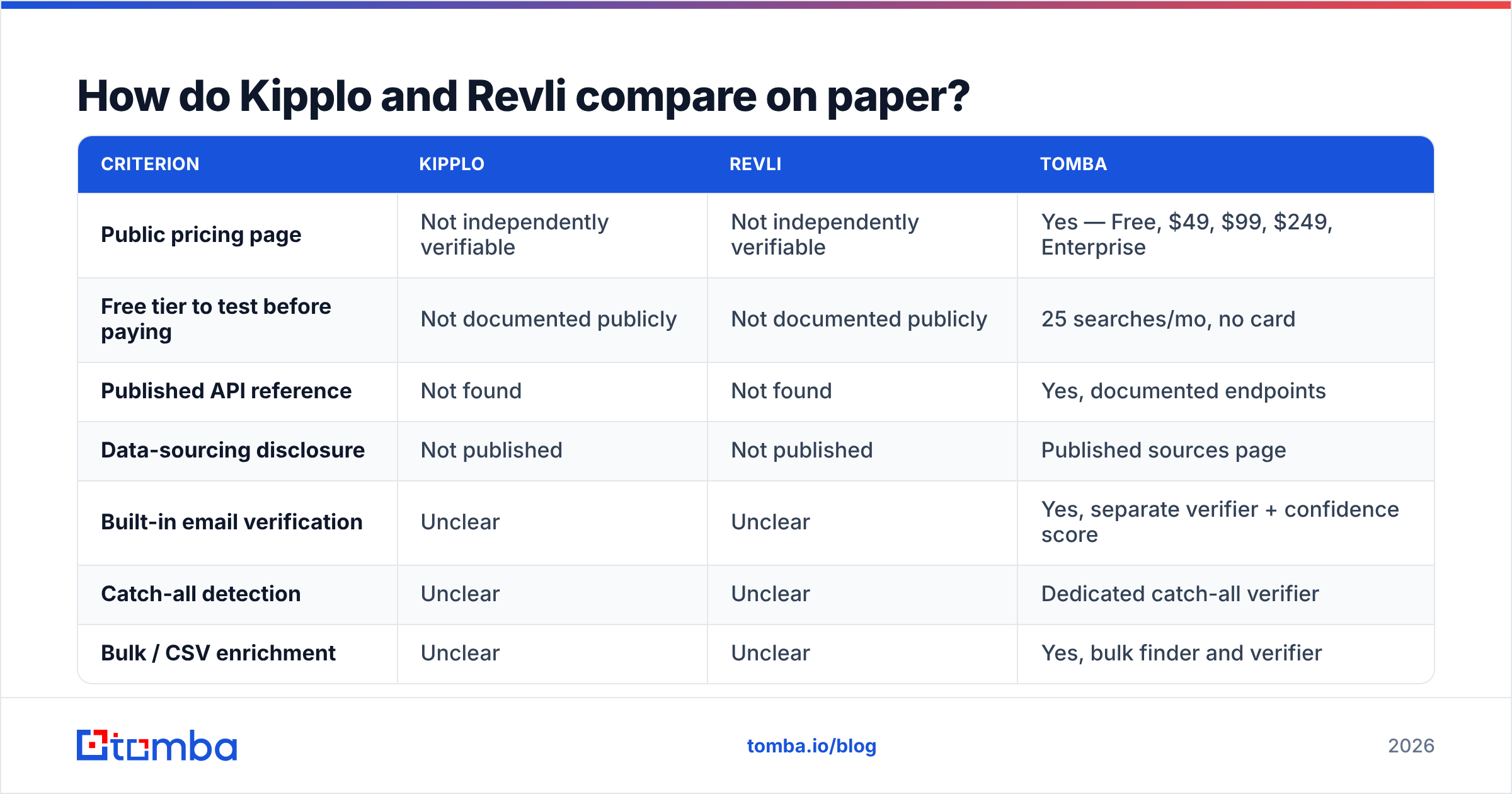
Here is the honest state of the comparison, with an established vendor in the third column so the empty cells have context.
| Criterion | Kipplo | Revli | Tomba |
|---|---|---|---|
| Public pricing page | Not independently verifiable | Not independently verifiable | Yes — Free, $49, $99, $249, Enterprise |
| Free tier to test before paying | Not documented publicly | Not documented publicly | 25 searches/mo, no card |
| Published API reference | Not found | Not found | Yes, documented endpoints |
| Data-sourcing disclosure | Not published | Not published | Published sources page |
| Built-in email verification | Unclear | Unclear | Yes, separate verifier + confidence score |
| Catch-all detection | Unclear | Unclear | Dedicated catch-all verifier |
| Bulk / CSV enrichment | Unclear | Unclear | Yes, bulk finder and verifier |
| Independent review volume | Minimal | Minimal | Established across G2/Capterra |
| Native integrations (CRM, Sheets) | Not documented | Not documented | HubSpot, Salesforce, Pipedrive, Sheets, Zapier |

Read that table the way a procurement analyst would. A column of "unclear" is not neutral. Every one of those cells represents a question you will have to answer with your own credit card and your own sender reputation.
If Kipplo or Revli publishes any of this after you read this post, great — update the row and re-score. The framework survives the vendor changing.
How accurate is the data, and how do you find out?#
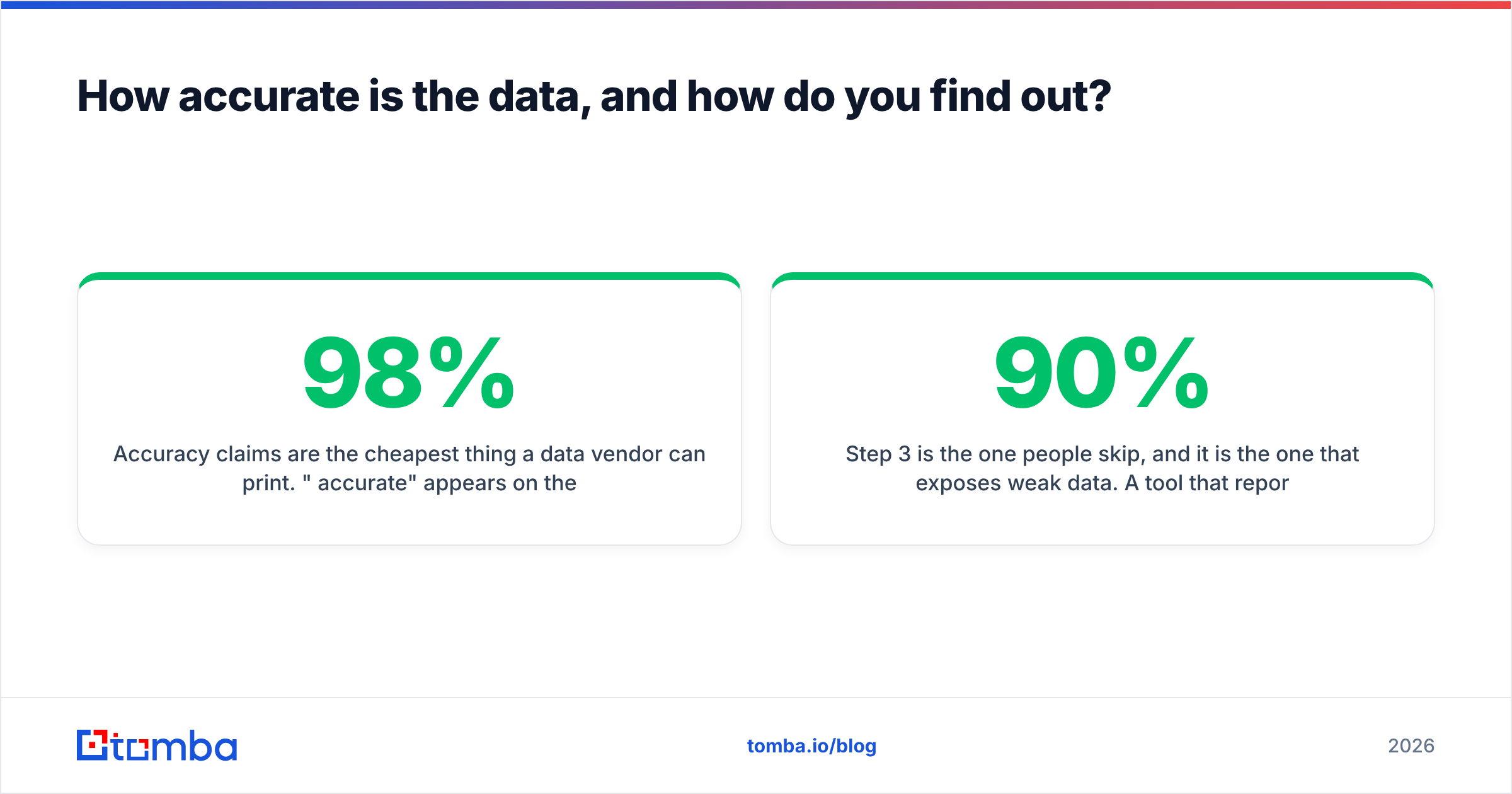
Accuracy claims are the cheapest thing a data vendor can print. "98% accurate" appears on the homepage of tools whose real bounce rate on a niche vertical is closer to 15%, because the claim is measured on the easy half of the internet: large US tech companies with predictable firstname.lastname patterns and non-catch-all mail servers.
Your ICP is probably not that. So measure it yourself.
The 200-contact bounce test:
- Pull 200 real prospects from your actual target segment — right country, right company size, right seniority. Not a sample of Fortune 500 CTOs.
- Run all 200 through Kipplo. Run the same 200 through Revli. Run them through a control tool you already trust.
- Record three numbers per tool: hit rate (how many returned an address at all), catch-all share (how many came back as unverifiable catch-all), and confirmed-valid rate (how many passed an independent email verifier run by a different vendor).
- Send a small, warm, plain-text sequence to the confirmed-valid set. Record the real bounce rate after 48 hours.
- Divide total spend by confirmed-valid contacts. That is your true cost per usable contact — the only pricing number that means anything.
Step 3 is the one people skip, and it is the one that exposes weak data. A tool that reports a 90% hit rate but where a third of those addresses fail independent verification has a real hit rate of 60%, and it charged you for the other 30%.

One nuance on catch-alls: a catch-all result is not automatically a bad address. It means the receiving server will accept mail for any local part, so SMTP-level verification cannot confirm the mailbox exists. Some of those addresses are real. A catch-all verifier uses pattern confidence and secondary signals to grade them instead of shrugging. If neither Kipplo nor Revli distinguishes catch-all from confirmed, their accuracy numbers are not comparable to anyone else's.
What does pricing really look like for either tool?#
Assume credit-based, because nearly everything in this category is, and understand the three places credit pricing quietly costs more than the sticker.
Where the money actually goes:
- Failed lookups. Some vendors charge a credit whether or not they return an address. Ask.
- Unverified returns. A returned address that fails independent verification cost you a credit and produced nothing.
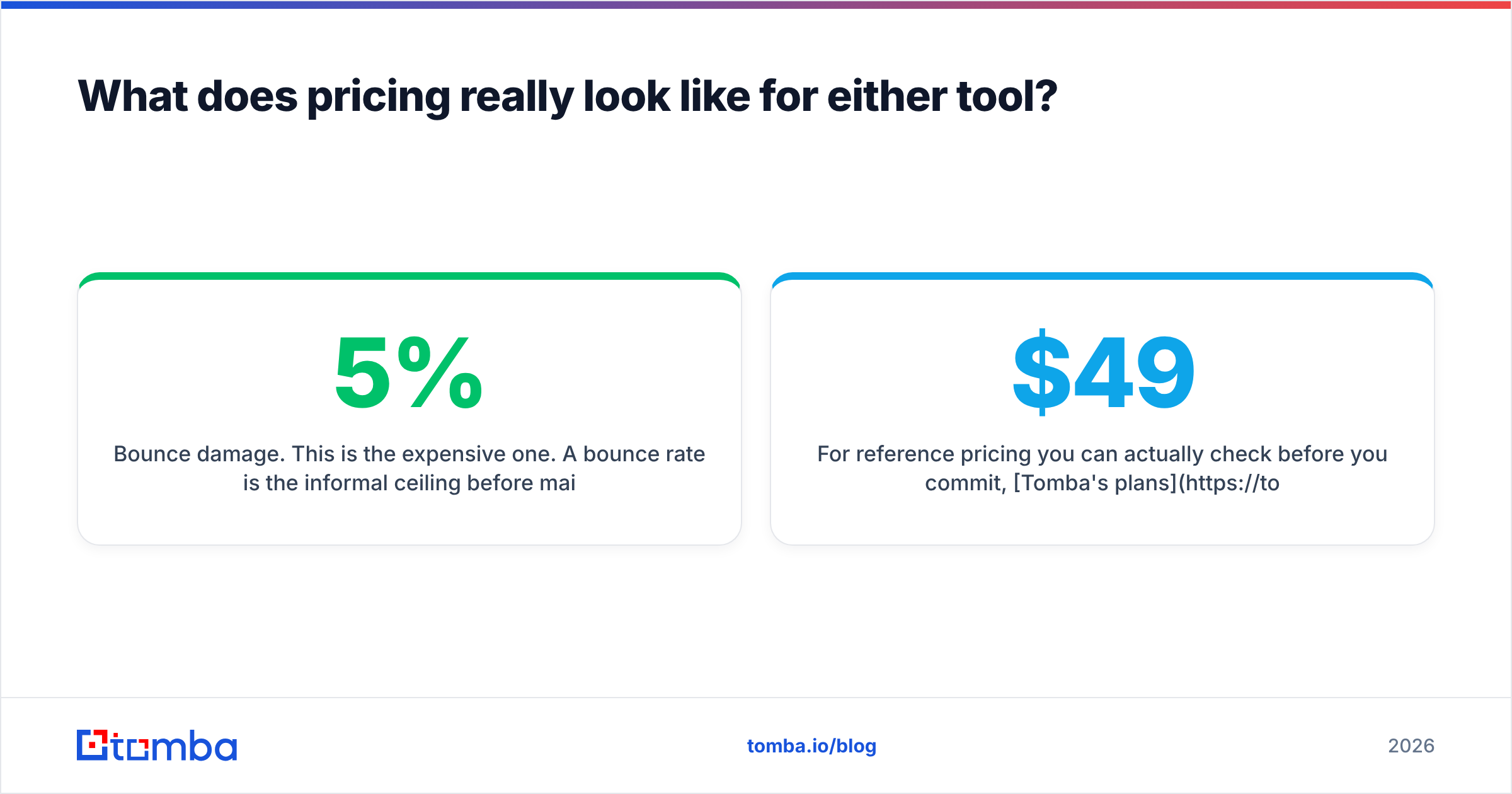
- Bounce damage. This is the expensive one. A 5% bounce rate is the informal ceiling before mailbox providers start throttling you; past that you are paying in deliverability, and recovering sender reputation takes weeks, not hours.
- Rollover and expiry. Monthly credits that expire punish uneven prospecting cycles. Annual commitments on an unproven vendor compound the risk.
For reference pricing you can actually check before you commit, Tomba's plans run a free tier at 25 searches per month, Starter at $49/mo, Growth at $99/mo, and Pro at $249/mo, with Enterprise quoted. Use those as the market anchor: if Kipplo or Revli quotes you materially more without published accuracy methodology, ask what you are paying the premium for. If either quotes materially less, ask where the data comes from — cheap B2B contact data is usually recycled, and recycled data is stale data.

Which one should you pick for your use case?#
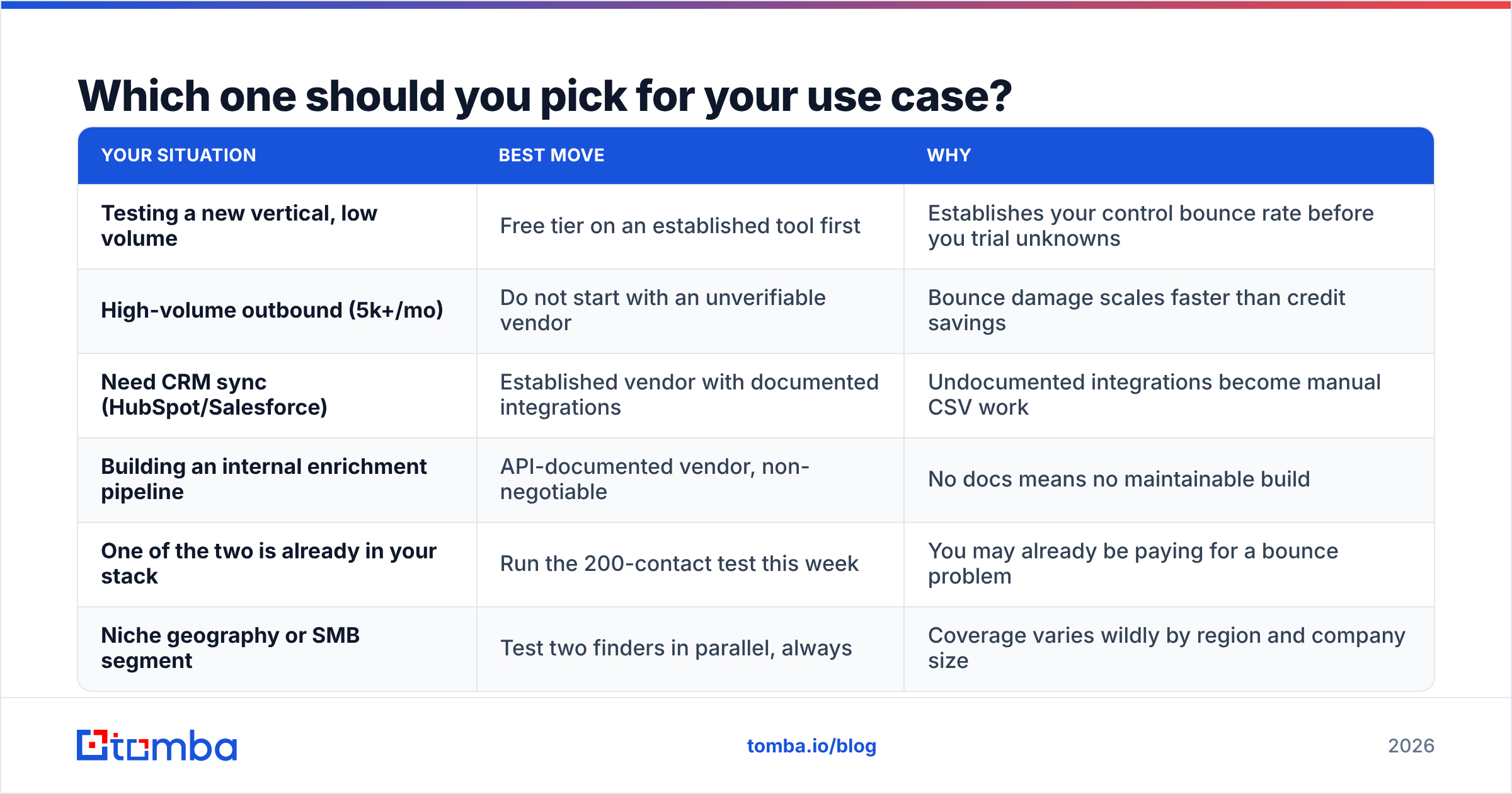
Given what is publicly knowable, here is the decision grid.
| Your situation | Best move | Why |
|---|---|---|
| Testing a new vertical, low volume | Free tier on an established tool first | Establishes your control bounce rate before you trial unknowns |
| High-volume outbound (5k+/mo) | Do not start with an unverifiable vendor | Bounce damage scales faster than credit savings |
| Need CRM sync (HubSpot/Salesforce) | Established vendor with documented integrations | Undocumented integrations become manual CSV work |
| Building an internal enrichment pipeline | API-documented vendor, non-negotiable | No docs means no maintainable build |
| One of the two is already in your stack | Run the 200-contact test this week | You may already be paying for a bounce problem |
| Niche geography or SMB segment | Test two finders in parallel, always | Coverage varies wildly by region and company size |
A note on the broader market: not every lesser-known vendor is a risk. BookYourData, for example, is a smaller name than the category giants but publishes its pricing, its verification approach, and a pay-as-you-go model you can test without a contract — which is exactly the transparency standard Kipplo and Revli have not yet met. The problem is not being small. The problem is being opaque.
What's the safer default in 2026?#
Pick the tool whose claims you can falsify.
That is not a plug for any particular vendor; it is the only rule that has held up across a decade of B2B data buying. A vendor that publishes its sources, documents its API, offers a free tier, grades catch-alls honestly, and shows up in independent review corpora is a vendor whose claims you can check. One that does none of those things is asking for trust it has not earned, and your sender reputation is the collateral.
Practically, that means a three-week sequence:
- Week one: establish a baseline. Run your 200-contact test through a verifiable tool. Record hit rate, confirmed-valid rate, bounce rate, cost per usable contact.
- Week two: trial Kipplo and Revli against the same 200. Same metrics, same verifier, same sequence.
- Week three: compare cost per confirmed-valid contact — not per credit, not per returned row. Keep whichever wins. If the unknowns win on your data, they have earned the spot honestly, and you will have the numbers to defend the choice internally.
If you want to compare on something other than email volume, apply the same discipline to adjacent data: phone numbers, firmographic enrichment fields, and LinkedIn-sourced contacts all have their own accuracy failure modes, and none of them are free of the same verification problem. The tool that is honest about one is usually honest about the rest.
For a deeper primer on how mail servers actually accept or reject an address — the mechanism every verifier depends on — the SMTP overview on Wikipedia is a better ten minutes than any vendor whitepaper. And for outbound benchmarks to sanity-check your own numbers against, HubSpot's sales research publishes reply and bounce data you can actually cite in a deck.
Ready to run the test?#
You cannot fix a data problem you have not measured. Start by getting a control number: run 25 of your real prospects through Tomba Email Finder on the free tier, verify the results, and send. Whatever bounce rate you get is now the bar. Trial Kipplo, trial Revli, trial anything else on your shortlist — and keep the one that beats it on cost per confirmed-valid contact, not the one with the best homepage.
That is how you turn "Kipplo vs Revli" from a guess into a decision you can defend.
Related guides#
// get started
Find, verify and enrich your first contacts today
Start on the free plan with 25 searches a month, then scale when your team is ready.
Free plan · No credit card required · GDPR & CCPA
// about the author