Kipplo vs Salutary Data: B2B Contact Data Compared 2026
Kipplo sells self-serve contact lookups. Salutary Data licenses vetted B2B files. They solve different problems at very different price points — here's which one your pipeline actually needs.
Kipplo vs Salutary Data is a choice between two buying models, not two feature lists. One sells lookups by the credit. The other licenses a contact file under contract. Here is how they compare on coverage, accuracy, price, and fit.
TL;DR
- Kipplo is a self-serve B2B contact lookup tool. You search a company or a person, you get an email, you pay per credit. Fast to start, easy to cancel.
- Salutary Data is a data licensing company. You buy a vetted, permission-aware contact file (or an API feed) under a contract. Expect a real minimum spend and a sales call.
- They are not really rivals. They chase the same budget line, but they solve different problems: ad-hoc prospecting versus building a database.
- Choose Kipplo-style tooling if reps need contacts today. Choose Salutary-style licensing if RevOps has to fill a CRM, a data warehouse, or an ABM platform at scale.
- Want per-lookup economics with API and bulk access on one plan? An email finder like Tomba covers the middle ground where most teams live.
What are Kipplo and Salutary Data?#
Kipplo is a B2B contact-finding tool for individual sellers, recruiters, and small outbound teams. The pitch is the usual one in this category. Type in a domain or a name. Get back a work email address, and often a phone number or LinkedIn URL. Then export it or push it into your sequencer. It is all self-serve, credit-metered, and usable minutes after signup. You can check current details on kipplo.com.
Salutary Data sits at the other end of the market. It sells data, not a search box. The positioning leans on data quality, US coverage, phone-verified mobile numbers, and clean compliance. Those are the things procurement asks about when you license millions of records. They matter far less when you look up forty people before a Tuesday call block. Deals are negotiated. You scope a segment, get a sample file, sign an agreement, and the data arrives as a file drop, an API, or a connector into your stack.
That structural difference drives almost everything else in this comparison. One is a tool. The other is a supply contract.

Kipplo vs Salutary Data: how do they actually differ?#
Here is the practical breakdown, in the order it tends to matter when you evaluate.
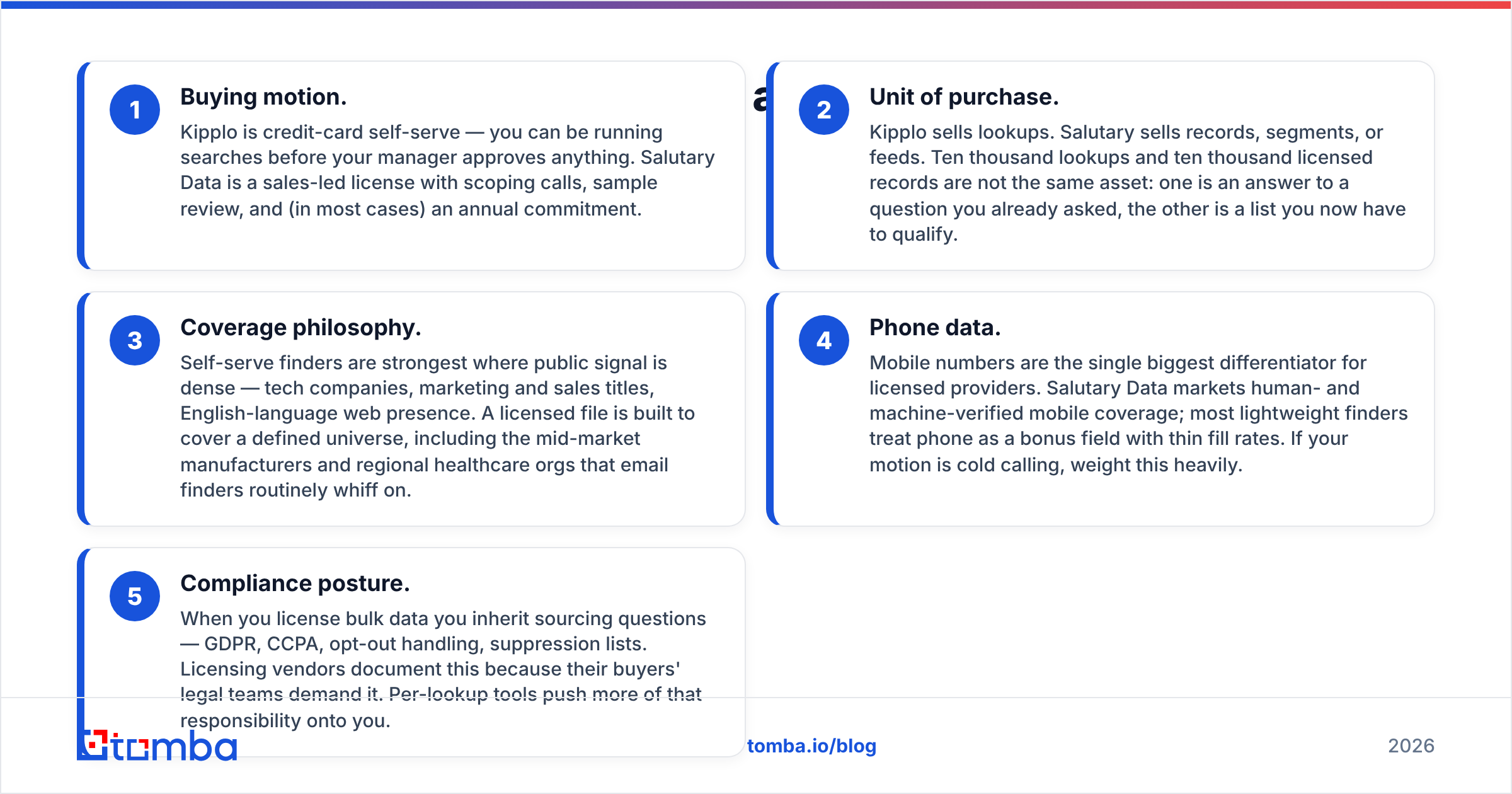
- Buying motion. Kipplo is credit-card self-serve. You can run searches before your manager approves anything. Salutary Data is a sales-led license, with scoping calls, a sample review, and in most cases an annual commitment.
- Unit of purchase. Kipplo sells lookups. Salutary sells records, segments, or feeds. Ten thousand lookups and ten thousand licensed records are not the same asset. One answers a question you already asked. The other is a list you still have to qualify.
The next three points decide how well each source fits your market, your channel, and your legal team.
- Coverage philosophy. Self-serve finders are strongest where public signal is dense: tech companies, sales and marketing titles, English-language web presence. A licensed file is built to cover a defined universe. That includes the mid-market manufacturers and regional healthcare orgs that email finders routinely miss.
- Phone data. Mobile numbers are the single biggest gap between the two models. Salutary Data markets human- and machine-verified mobile coverage. Most lightweight finders treat phone as a bonus field, and fill rates are thin. If your motion is cold calling, weight this heavily.
- Compliance posture. License bulk data and you inherit sourcing questions: GDPR, CCPA, opt-out handling, suppression lists. Licensing vendors document all of it, because their buyers' legal teams ask. Per-lookup tools leave more of that work to you.
None of those five points crowns a winner. They tell you which question you are answering. "How do I reach this person?" Or "how do I build a database of everyone like this person?"
Which one has better data accuracy?#
Honest answer: they are accurate at different things. Neither one publishes an audited number you should take at face value.
Licensed providers like Salutary Data compete on accuracy. That is why they lead with method: multi-source checks, refresh cadence, human validation on phones. Buy a file and you usually get a bounce guarantee or a replacement clause. That is a promise in a contract, and at scale it is worth real money.
Self-serve finders compete on hit rate, the share of searches that return something. Hit rate and accuracy are not the same metric, and vendors love to blur the two. A tool can return a guessed pattern address for 95% of searches. Great hit rate. Terrible bounce rate.

Three rules for testing either vendor without getting sold to:
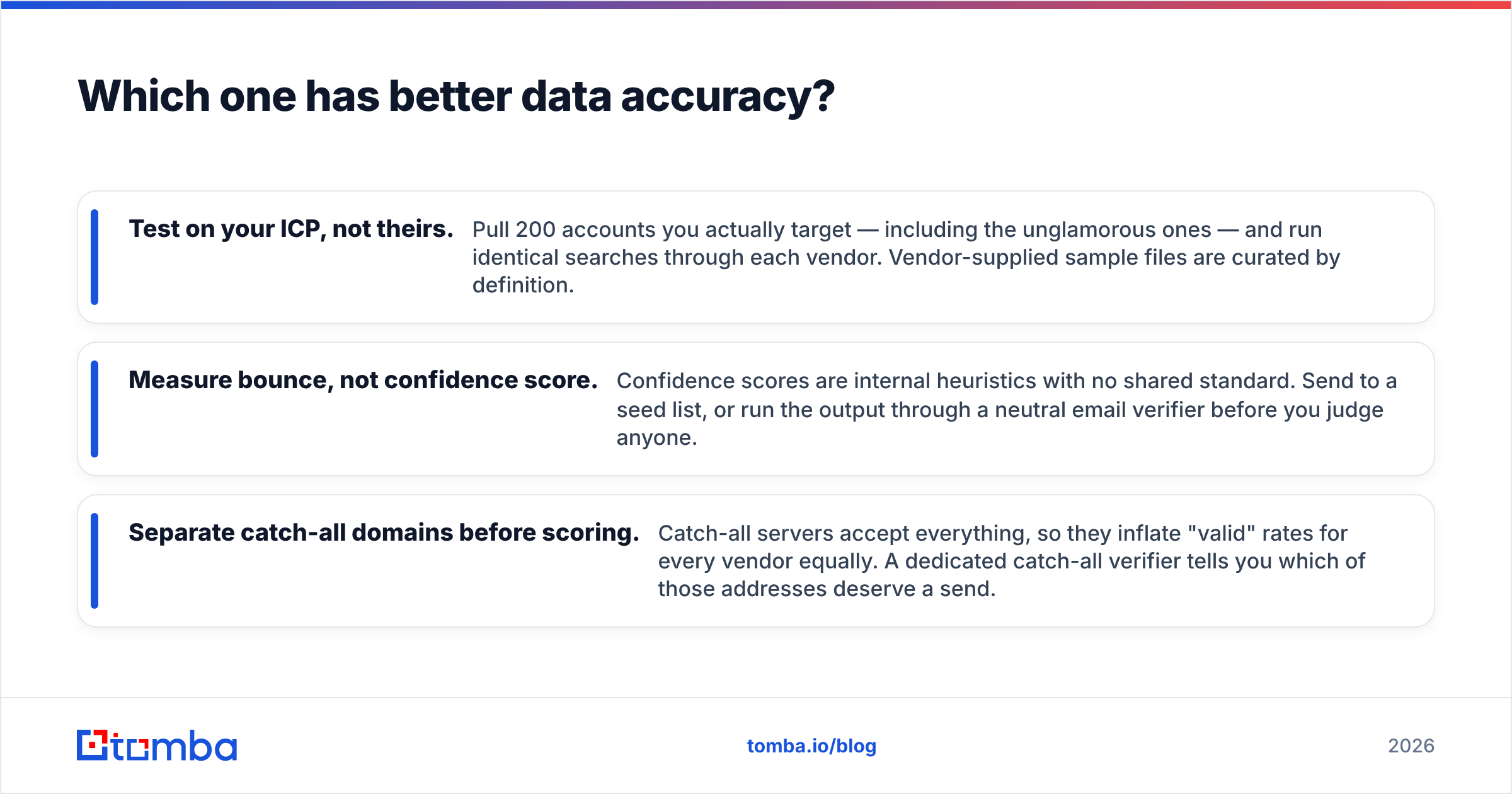
- Test on your ICP, not theirs. Pull 200 accounts you actually target, including the unglamorous ones. Run identical searches through each vendor. Vendor sample files are curated by definition.
- Measure bounce, not confidence score. Confidence scores are internal heuristics with no shared standard. Send to a seed list, or run the output through a neutral email verifier before you judge anyone.
- Separate catch-all domains before scoring. Catch-all servers accept everything, so they inflate "valid" rates for every vendor equally. A dedicated catch-all verifier tells you which of those addresses deserve a send.
Run that test and the marketing claims stop mattering. You will have your own numbers.
How do the two compare on pricing?#
This is where the two models split hardest, and where budget owners get surprised.
Kipplo publishes self-serve tiers with credit allowances. It is the standard SaaS shape: a low three-figure monthly bill at the entry tier, cancel anytime. Salutary Data publishes no rate card. Licensed data pricing depends on volume, fields, exclusivity, refresh frequency, and term length. Expect a quote, expect a minimum, and expect the per-record price to drop steeply as volume climbs.
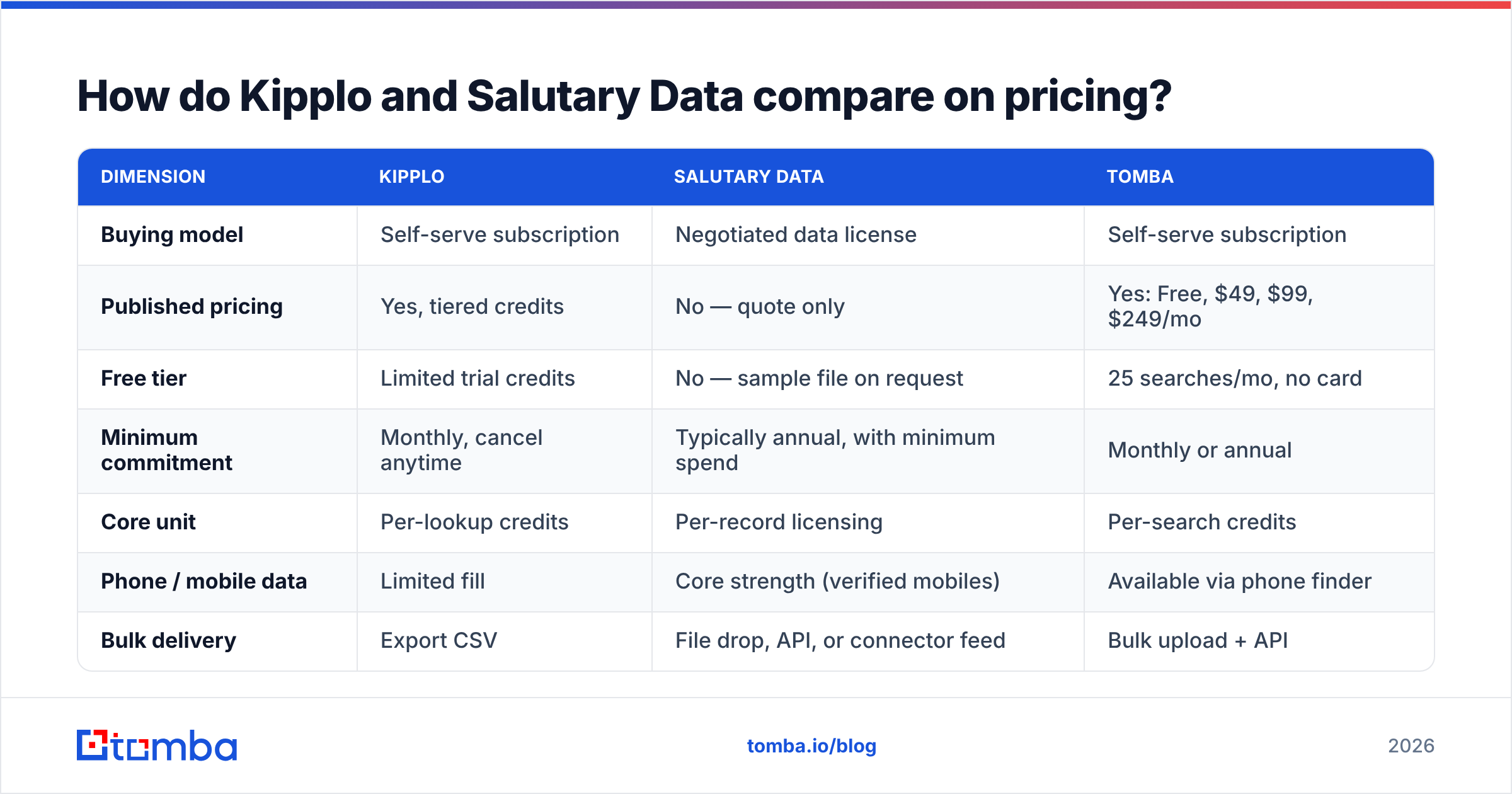
| Dimension | Kipplo | Salutary Data | Tomba |
|---|---|---|---|
| Buying model | Self-serve subscription | Negotiated data license | Self-serve subscription |
| Published pricing | Yes, tiered credits | No — quote only | Yes: Free, $49, $99, $249/mo |
| Free tier | Limited trial credits | No — sample file on request | 25 searches/mo, no card |
| Minimum commitment | Monthly, cancel anytime | Typically annual, with minimum spend | Monthly or annual |
| Core unit | Per-lookup credits | Per-record licensing | Per-search credits |
| Phone / mobile data | Limited fill | Core strength (verified mobiles) | Available via phone finder |
| Bulk delivery | Export CSV | File drop, API, or connector feed | Bulk upload + API |
| API access | On paid tiers | Enterprise feed | All paid tiers |
| Best for | Individual reps, small teams | RevOps, data teams, calling orgs | SMB to mid-market outbound teams |
| Time to first record | Minutes | Days to weeks | Minutes |

The number that matters is not the sticker price. It is cost per meeting booked. A $0.03 record that bounces one time in five burns your sender reputation. That costs more than a $0.30 record that lands. Run the math downstream, not at the invoice.
For a sense of where self-serve pricing sits, Tomba pricing starts free at 25 searches per month. Starter is $49/mo, Growth is $99/mo, and Pro is $249/mo. Every paid tier includes API access, which is unusual in this price band.
Which should you choose for outbound in 2026?#
Match the tool to the motion.
Pick Kipplo (or any self-serve finder) when:
- You have fewer than ten reps and no dedicated ops person.
- Your targets are found one at a time, from LinkedIn, events, or inbound signals.
- Volume is under roughly 5,000 contacts a month.
- You need to start this week and prove ROI before anyone signs a contract.
Pick Salutary Data (or a licensing provider) when:
- You are filling a CRM or warehouse as a system of record, not a campaign list.
- Cold calling is a primary channel and mobile fill rate drives revenue.
- Legal or procurement requires documented sourcing and compliance terms.
- You are buying 100,000+ records and per-record economics dominate your CAC model.
- You need coverage in segments the open web under-indexes.
The uncomfortable middle is where most teams sit: 10-40 reps, 10k-50k contacts a quarter, a CRM that needs enriching, and no appetite for a six-figure annual data deal. That gap is what self-serve platforms with real API and bulk capability were built for. You get programmatic access and bulk email finder throughput without a procurement cycle.
How do you evaluate either vendor without wasting a quarter?#
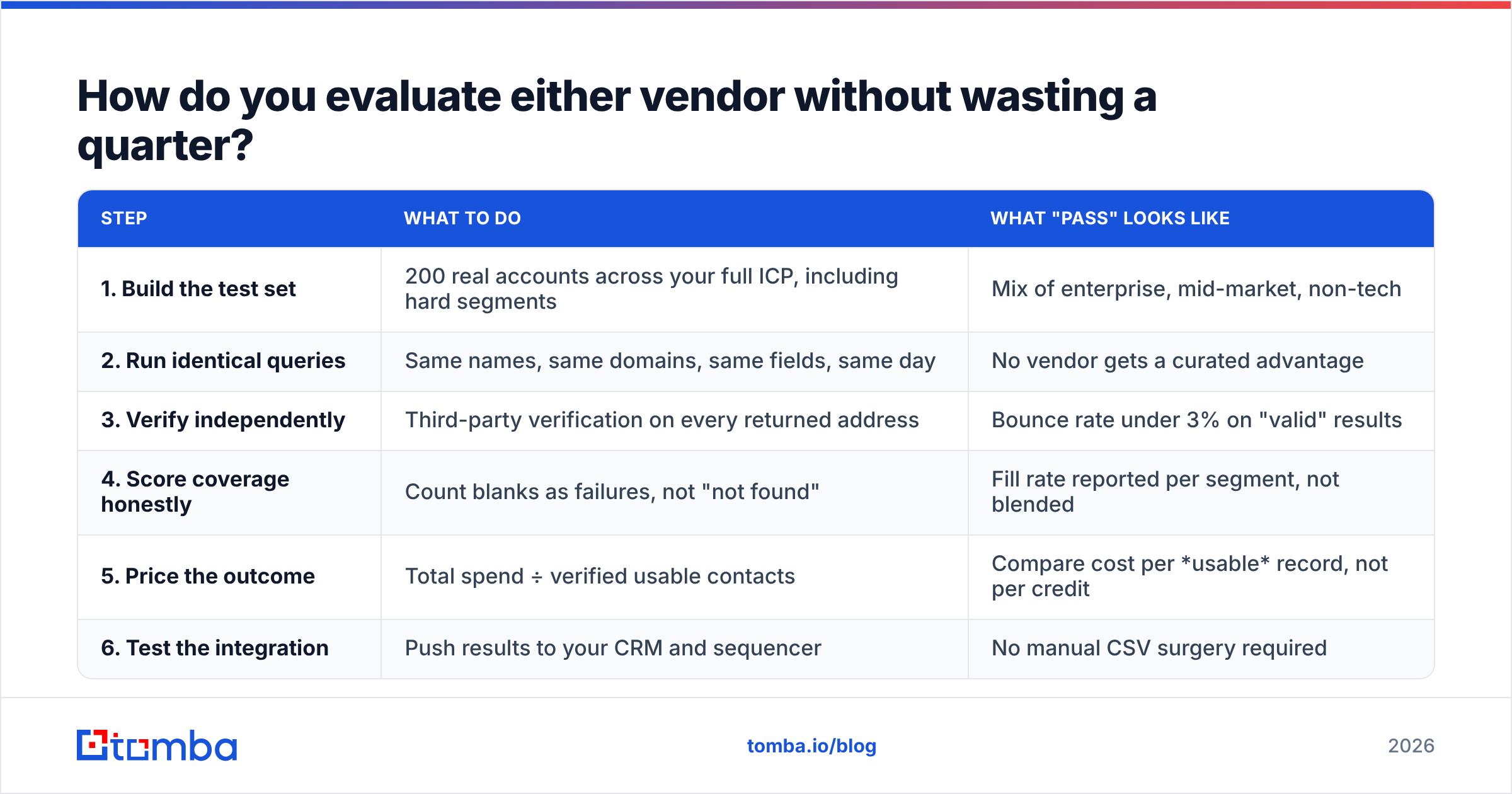
Run a structured bake-off. It takes about a week, and it saves you from a year-long contract you regret. The Kipplo vs Salutary Data question is easy to settle with your own data.
| Step | What to do | What "pass" looks like |
|---|---|---|
| 1. Build the test set | 200 real accounts across your full ICP, including hard segments | Mix of enterprise, mid-market, non-tech |
| 2. Run identical queries | Same names, same domains, same fields, same day | No vendor gets a curated advantage |
| 3. Verify independently | Third-party verification on every returned address | Bounce rate under 3% on "valid" results |
| 4. Score coverage honestly | Count blanks as failures, not "not found" | Fill rate reported per segment, not blended |
| 5. Price the outcome | Total spend ÷ verified usable contacts | Compare cost per usable record, not per credit |
| 6. Test the integration | Push results to your CRM and sequencer | No manual CSV surgery required |
Two things people forget. First, test refresh. Pull the same 50 records 60 days apart and count how many changed. B2B contact data decays roughly 2-3% per month as people change jobs, so refresh cadence matters more than launch-day accuracy. Second, test support during the trial, because that is the best it will ever be.
For outside signal on either vendor, G2 category reviews beat case studies. Filter to reviewers whose company size matches yours, and read the two-star reviews first. That is where the fill-rate complaints live.
What about enrichment and the rest of the stack?#
Whichever source you pick, the record you buy is rarely the record you use. Plan for three more steps:
- Enrichment. Firmographics, tech stack, headcount, funding. A data enrichment layer fills the fields your source leaves blank, so your scoring model has something to work with.
- Deduplication. Two sources always overlap. Merge on domain plus normalized name before anything hits the CRM. Skip it and you will double-sequence prospects and look sloppy.
- Suppression. Existing customers, open opportunities, unsubscribes, and competitor domains. This is non-negotiable if you license bulk files. Nothing torches trust faster than a cold email to an active account.
Pulling contacts by company rather than by name? A domain search workflow is usually faster than either vendor's UI. One domain in, every discoverable address plus the company's email pattern out. Then you can extrapolate the contacts you could not find directly.
The verdict: Kipplo vs Salutary Data#
Kipplo wins on speed and access. It is a rep tool. No contract, no scoping call, no minimum. If your problem is "I need this person's email before my 2pm block," that is the answer.
Salutary Data wins on depth and defensibility. It is an ops purchase. Verified mobiles, documented sourcing, accuracy commitments in writing, and coverage in the segments the open web ignores. If your problem is "we need a reliable contact layer under our whole GTM motion," that is the answer.
The mistake is buying one when you need the other. Do not pay for an annual license to support forty lookups a week. Do not ask a credit-metered tool to be a system of record. Diagnose the motion first, then buy.
Need per-lookup economics without the contract? The Tomba Email Finder returns verified work email addresses by name, domain, or company. API access comes with every paid tier, and bulk processing is built in. Start free with 25 searches a month, no card and no scoping call. Then run it head-to-head against whichever vendor is in your inbox right now. Your own bounce rate is the only benchmark that counts.
Related guides#
// get started
Find, verify and enrich your first contacts today
Start on the free plan with 25 searches a month, then scale when your team is ready.
Free plan · No credit card required · GDPR & CCPA
// about the author