Kipplo vs Seamless.AI: Which B2B Data Tool Wins in 2026?
Kipplo and Seamless.AI both promise contact data at scale, but they buy, verify, and price that data in very different ways. Here is the honest breakdown — accuracy, credits, contracts, and who each one actually fits.
TL;DR
- Seamless.AI is the bigger, louder, sales-led platform: a large real-time contact search engine bundled with a Chrome extension, buyer intent, and a writer tool — sold mostly on annual contracts through a rep.
- Kipplo is the smaller, self-serve challenger: credit-based B2B contact lookup with a lighter UI, lower entry cost, and far less sales friction. Less mature, fewer integrations, thinner coverage outside core markets.
- Accuracy is the real fight. Seamless.AI generates candidate emails in real time, which means volume is high but bounce rates swing hard by region and seniority. Kipplo leans on a smaller verified pool, so you get fewer hits with cleaner results.
- Contracts matter more than list price. Seamless.AI's advertised per-seat pricing rarely reflects what teams actually sign; multi-year commitments and credit rollover rules are where budgets break.
- If you mostly need accurate emails, not a whole GTM suite, a focused finder + verifier stack (Tomba starts at $49/mo with a free 25-search tier) usually beats paying suite prices for one feature.
What are Kipplo and Seamless.AI?#
Two tools, two philosophies of where B2B contact data comes from.
Seamless.AI launched in 2017 and built its reputation on a "real-time search engine for leads" pitch. Instead of serving you a static database snapshot, it crawls and assembles contact records on demand, then scores each email it produces. The platform has since expanded into intent data, a job-change tracker, an AI writer, and buyer profiles — a full go-to-market suite aimed at mid-market SDR teams. It is heavily sales-assisted: most buyers talk to a rep before they see a real number.
Kipplo sits at the other end. It is a newer, self-serve B2B contact platform built around credit-based lookups — you search a company or a person, you spend a credit, you get an email and sometimes a phone. The UI is deliberately thin. There is no intent scoring, no dialer, no sequencing engine. The pitch is simple: pay less, get data, move on.
That difference in ambition explains almost every trade-off below. Seamless.AI wants to be the system your SDRs live in. Kipplo wants to be the tab they open for ninety seconds.
One practical warning before you budget: Kipplo is young enough that its plan structure and credit allowances change several times a year. Verify the current numbers on its own site before you commit — anything you read in a comparison post (including this one) is a snapshot, not a contract.
How do Kipplo and Seamless.AI actually differ?#
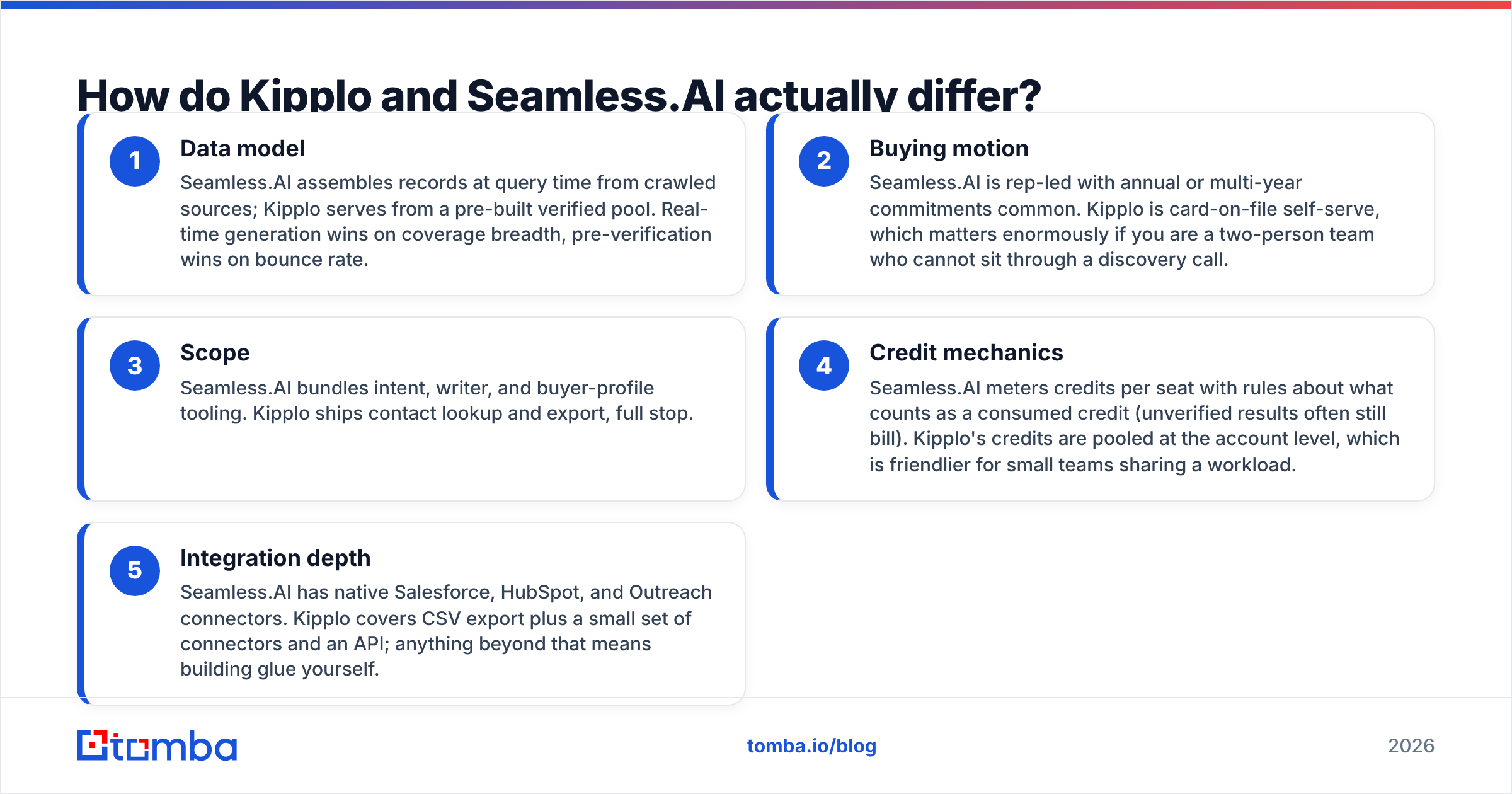
Five differences do most of the work when teams choose between them:
- Data model — Seamless.AI assembles records at query time from crawled sources; Kipplo serves from a pre-built verified pool. Real-time generation wins on coverage breadth, pre-verification wins on bounce rate.
- Buying motion — Seamless.AI is rep-led with annual or multi-year commitments common. Kipplo is card-on-file self-serve, which matters enormously if you are a two-person team who cannot sit through a discovery call.
- Scope — Seamless.AI bundles intent, writer, and buyer-profile tooling. Kipplo ships contact lookup and export, full stop.
- Credit mechanics — Seamless.AI meters credits per seat with rules about what counts as a consumed credit (unverified results often still bill). Kipplo's credits are pooled at the account level, which is friendlier for small teams sharing a workload.
- Integration depth — Seamless.AI has native Salesforce, HubSpot, and Outreach connectors. Kipplo covers CSV export plus a small set of connectors and an API; anything beyond that means building glue yourself.
Neither model is objectively correct. If your reps need a workspace, thin tools feel like a downgrade. If your reps already live in a sequencer, a suite is a second login they will resent.
Which has better data accuracy?#
Accuracy is where "real-time generation" gets expensive.
Seamless.AI's engine produces a lot of addresses, and it labels confidence on each one. In practice, teams report a meaningful split: verified-flagged emails perform acceptably, while the "likely" and pattern-guessed tier bounces at rates that will damage your domain if you send to it unfiltered. Scan the Seamless.AI reviews on G2 and the pattern is consistent — people praise the volume and complain about list hygiene. That is not a defect so much as a design consequence: generating candidates on demand inevitably produces plausible-but-wrong results, and the burden of filtering lands on you.
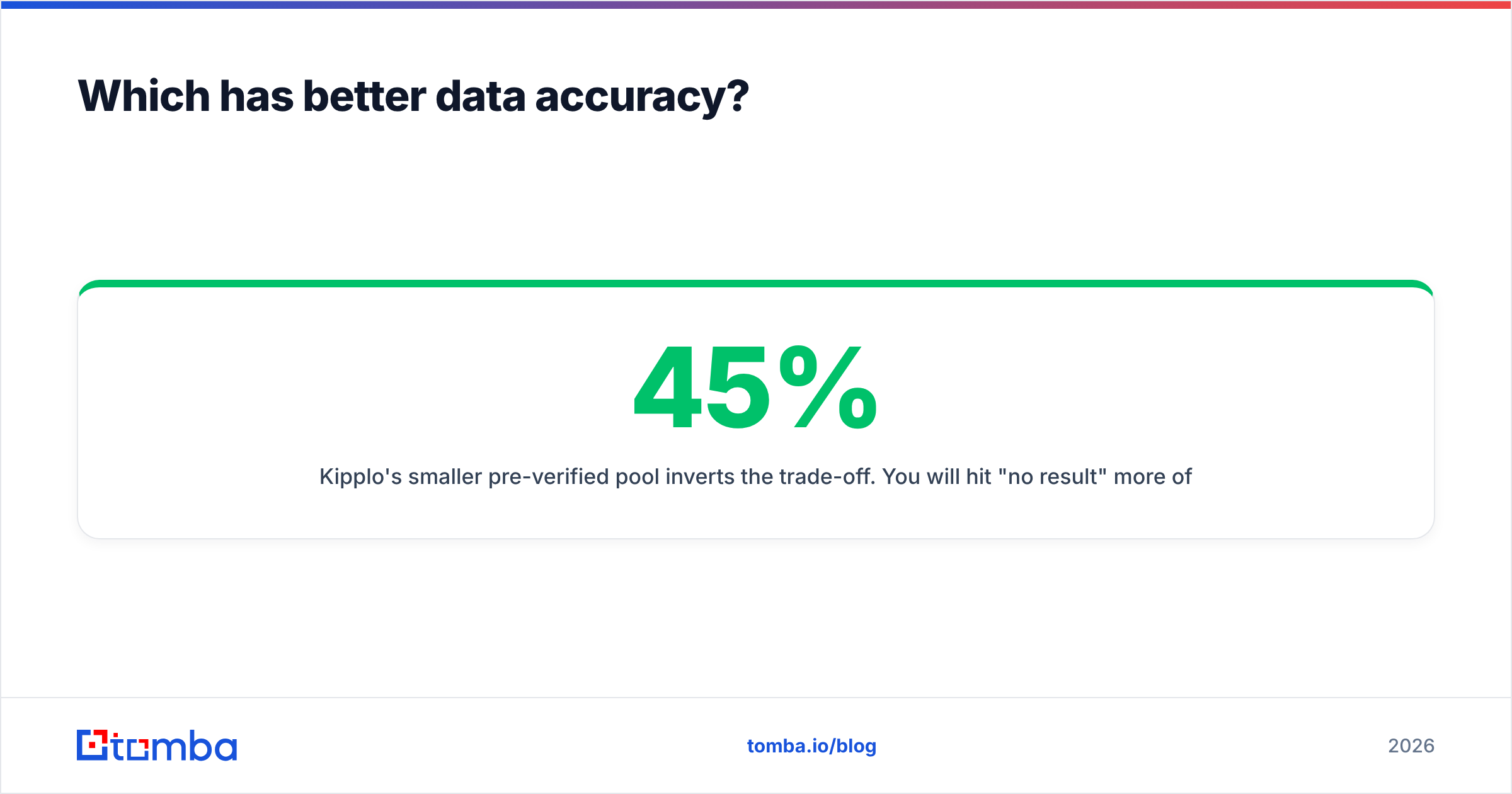
Kipplo's smaller pre-verified pool inverts the trade-off. You will hit "no result" more often, especially for non-US contacts, mid-size private companies, and anyone below director level at a firm with no public email footprint. But the records you do get come back cleaner. For a founder sending 200 highly targeted emails a month, a 45% hit rate with a 2% bounce rate beats a 78% hit rate with a 12% bounce rate. For an SDR team that needs 5,000 contacts loaded this quarter, the math flips.

The rule that survives every vendor comparison: never trust a provider's own verification flag as your only gate. Whichever tool you pick, run exports through an independent email verifier before they touch your sending domain. A second-opinion pass costs pennies per thousand and is the single cheapest insurance against a deliverability spiral. Catch-all domains deserve extra care — a standard SMTP check returns "accept" for everything, so you need a dedicated catch-all verifier to separate real mailboxes from black holes.
How does Kipplo vs Seamless.AI pricing compare?#
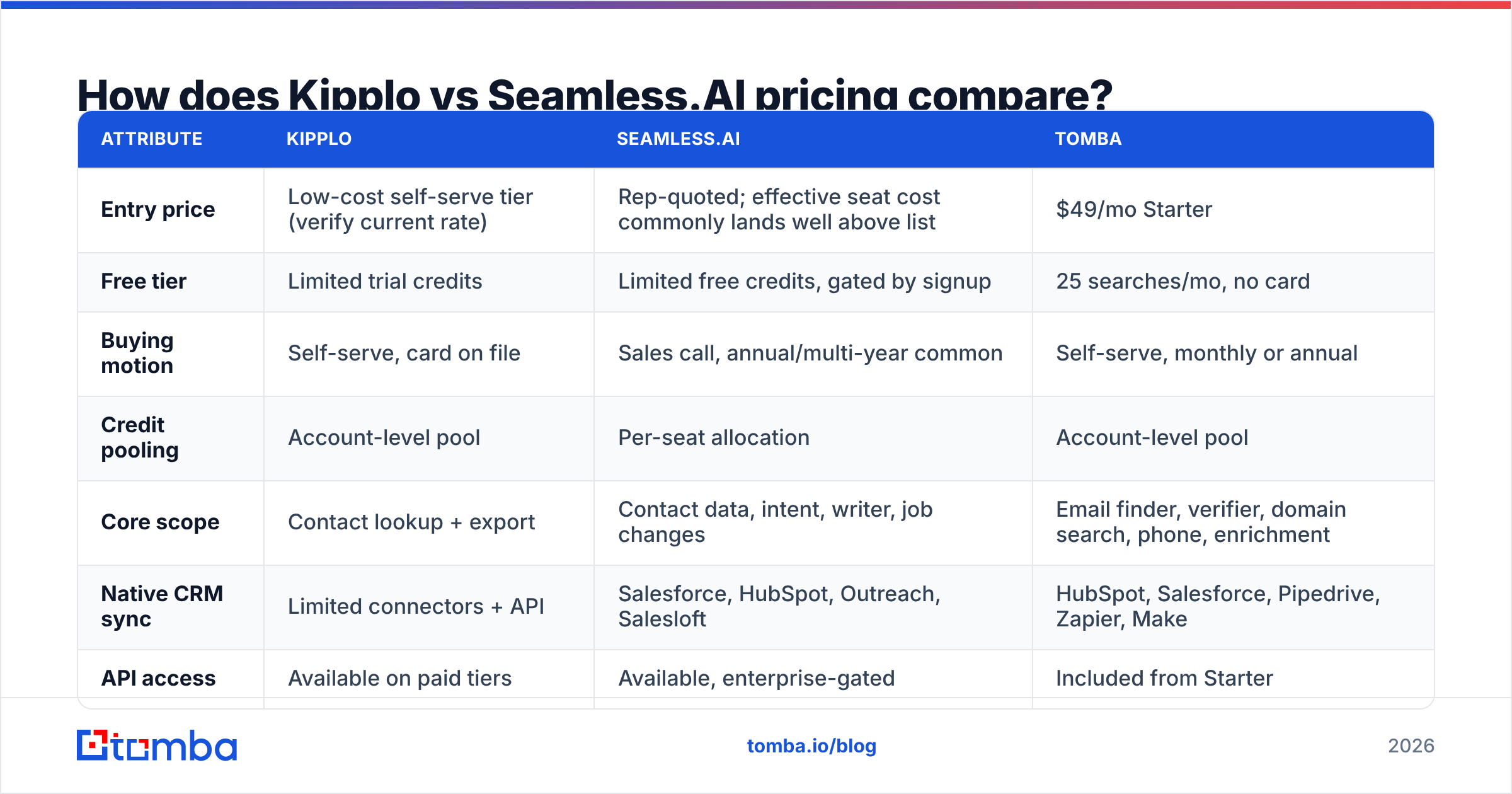
Here is the honest side-by-side, with Tomba included as the focused-tool reference point.
| Attribute | Kipplo | Seamless.AI | Tomba |
|---|---|---|---|
| Entry price | Low-cost self-serve tier (verify current rate) | Rep-quoted; effective seat cost commonly lands well above list | $49/mo Starter |
| Free tier | Limited trial credits | Limited free credits, gated by signup | 25 searches/mo, no card |
| Buying motion | Self-serve, card on file | Sales call, annual/multi-year common | Self-serve, monthly or annual |
| Credit pooling | Account-level pool | Per-seat allocation | Account-level pool |
| Core scope | Contact lookup + export | Contact data, intent, writer, job changes | Email finder, verifier, domain search, phone, enrichment |
| Native CRM sync | Limited connectors + API | Salesforce, HubSpot, Outreach, Salesloft | HubSpot, Salesforce, Pipedrive, Zapier, Make |
| API access | Available on paid tiers | Available, enterprise-gated | Included from Starter |
| Contract escape | Cancel anytime | Renewal terms a frequent complaint | Cancel anytime |
| Best fit | Solo founders, lean agencies | Mid-market SDR orgs with budget | Teams who need accurate emails, not a suite |

Two line items deserve more attention than the headline price.
Credit consumption rules. Ask every vendor, in writing: does a search that returns an unverified or low-confidence result consume a credit? With Seamless.AI, the answer has historically been yes, which means your effective cost per usable contact is meaningfully higher than your cost per credit. Kipplo's pre-verified model makes that gap smaller simply because it returns fewer junk results to charge you for.
Renewal terms. The most common complaint across Seamless.AI's Capterra listing and G2 is not the product — it is auto-renewal and the difficulty of downgrading mid-term. That is a procurement problem, not a data problem, but it costs real money. If you are signing anything longer than twelve months, get the cancellation clause reviewed before the discount seduces you.
For reference, Tomba's pricing runs Free (25 searches/mo), Starter $49/mo, Growth $99/mo, Pro $249/mo, and custom Enterprise — all self-serve, all cancellable, with the API included from the paid tiers rather than held back as an upsell.
Which one fits your team?#
Match the tool to your actual motion, not to your aspirational one.
Choose Seamless.AI if: you run a team of five or more SDRs, you need intent signals and job-change alerts in the same place as contact data, you have a CRM admin who will maintain the native sync, and you have budget approval for an annual commitment. The breadth is real. If you will genuinely use the intent and buyer-profile features, the bundle economics work.
Choose Kipplo if: you are one to three people, you want to start today without a sales call, your ICP sits in markets Kipplo covers well, and your volume is in the hundreds-per-month range rather than thousands. The lower ceiling is irrelevant when you are nowhere near it.
Choose neither if: your actual problem is "I have a list of companies and names and I need correct email addresses for them." That is a narrower job than either platform is priced for, and it is the job a dedicated finder does better and cheaper.
What does a focused stack look like instead?#
Most teams evaluating Kipplo vs Seamless.AI are buying a suite to solve one problem. Before you sign, price out the unbundled version.
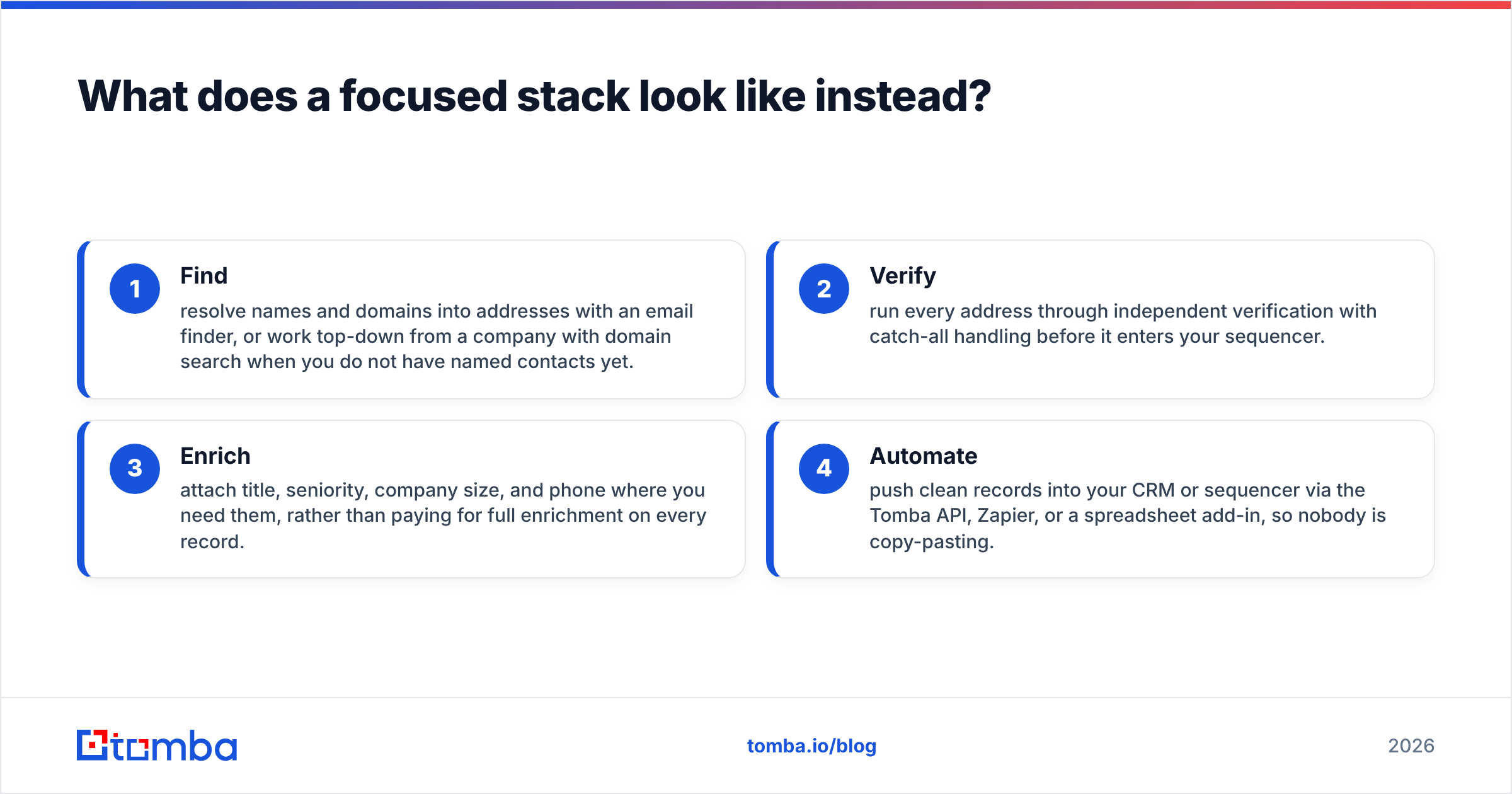
A focused stack has four parts:
- Find — resolve names and domains into addresses with an email finder, or work top-down from a company with domain search when you do not have named contacts yet.
- Verify — run every address through independent verification with catch-all handling before it enters your sequencer.
- Enrich — attach title, seniority, company size, and phone where you need them, rather than paying for full enrichment on every record.
- Automate — push clean records into your CRM or sequencer via the Tomba API, Zapier, or a spreadsheet add-in, so nobody is copy-pasting.
The reason this usually wins on cost: you only pay suite prices for the features you use. A 1,000-contact month through a focused finder-plus-verifier stack typically costs a fraction of a single Seamless.AI seat, and you keep the freedom to swap any layer without renegotiating a contract.
The reason it sometimes loses: you own the orchestration. If you have no one willing to wire two tools together, a suite's single login has genuine value. Be honest about which camp you are in.
What should you test before you commit?#
Run the same evaluation against both, and against any third option. Ninety minutes of testing beats any comparison article, including this one.
- Build a 100-row control list from your actual ICP — real companies, real names, mixed seniority, mixed geography. Do not use a vendor's sample list.
- Run it through each tool and record hit rate (rows returned) separately from accuracy (rows that survive independent verification).
- Send to 50 verified addresses from each source and measure the true bounce rate after 48 hours. Provider-reported accuracy and inbox-observed accuracy are different numbers.
- Price per usable contact, not per credit. Divide total spend by rows that passed verification and did not bounce.
- Test the exit. Try exporting your data and cancelling on a trial. How hard that is tells you how the renewal conversation will go.
If a vendor will not let you run this test before signing, that is information too.
The verdict#
Seamless.AI is the stronger platform if you need a platform — the breadth, intent layer, and native CRM connectors are genuinely useful to a staffed SDR org with budget. Kipplo is the better pick for a lean operator who wants credits, a CSV, and no sales call. Neither is a scam; they are priced for different companies.
But if you came to this comparison because you need reliable email addresses and the suite features are incidental, buy the narrow tool. Start free with Tomba's Email Finder — 25 searches a month with no card, then $49/mo when you outgrow it — run your own control list against it alongside whichever platform you were about to sign, and let the bounce rate decide. That is the only benchmark that bills you later.
Related guides#
// get started
Find, verify and enrich your first contacts today
Start on the free plan with 25 searches a month, then scale when your team is ready.
Free plan · No credit card required · GDPR & CCPA
// about the author