Kipplo vs The Data City: Which B2B Data Tool Wins in 2026
One tool hands you a verified inbox. The other tells you which 400 UK companies are building in a sector that does not have a SIC code yet. Here is how Kipplo and The Data City actually differ, and which one belongs in your stack.
TL;DR
- Kipplo vs The Data City is not really a head-to-head. Kipplo sells contact data for outbound. The Data City sells company classification and market intelligence, mostly on UK registered companies.
- If your question is who do I email on Monday, Kipplo is the closer fit. If your question is which UK companies are doing quantum computing, only The Data City answers it.
- The Data City reads company websites instead of trusting the SIC code someone typed in at incorporation. That matters, because SIC codes go stale by design.
- Pricing models differ more than features do. One side is self-serve monthly credits. The other is a quoted annual licence.
- Most teams run a market-mapping layer and a contact layer separately. A dedicated email finder at $49/mo is usually the cheaper way to fill the contact layer.
What are Kipplo and The Data City, actually?#
Start here, because the names do not help you. Kipplo vs The Data City looks like a head-to-head. It is not one.
The Data City is a UK company-intelligence platform. Its core idea is simple. Official industry codes are a bad way to find companies.
A firm may have incorporated in 2016 as other business support services. Today it might be an AI startup. Nothing in the official record will tell you that.
So The Data City crawls company websites and other live signals. It then sorts firms into what it calls Real-Time Industrial Classifications. Those are sectors like net zero, agri-tech, creative industries, or advanced materials. None of them map cleanly onto the old code lists. You can see the positioning on their own site.
The typical buyer is an economic development team, a university, an investor, a policy unit, or a corporate strategy group. The output is a list of companies with firm details, growth signals, and sector tags.
Kipplo sits on the other side of the funnel. It is a self-serve B2B contact and lead database. You search for people by company, role, or industry. It returns work emails and company details.
You can push those straight into a sequencer or CRM. Kipplo is younger and smaller than the big names in that space.
One honest caveat: feature lists and prices at that end of the market move fast. Check the current vendor page before you sign anything. Treat the comparison below as a structural read, not a price sheet.
So the real question behind Kipplo vs The Data City is not which product is better built. It is which layer of your go-to-market data problem you need to solve.
How do these two tools differ at the data layer?#
Five differences drive almost every Kipplo vs The Data City decision.
- Unit of record. The Data City counts companies. Kipplo counts people at companies. Everything else follows from that. You cannot email a company. You can only email an inbox.
- Classification method. The Data City works out sector membership from live web text and machine learning. That is why it can name new sectors that no official list covers yet. Contact databases like Kipplo inherit industry tags from data vendors. Those tags usually trace back to Standard Industrial Classification buckets.
- Geographic depth. The Data City is deep on UK registered companies, built off the public register. If your buyers are US mid-market SaaS firms, that depth does nothing for you. Contact databases are broader and shallower.
- Refresh cadence. Company data ages slowly. A firm does not stop being an agri-tech company this quarter. Contact data ages fast. Roughly a quarter of B2B contact records go bad each year. That should change how you think about contract length, not just accuracy.
- Deliverable. The Data City hands you a market map you can defend in a board pack. Kipplo hands you a CSV you can load into a sending tool that afternoon. Both are useful. Neither replaces the other.
Kipplo vs The Data City: how do they compare feature by feature?#
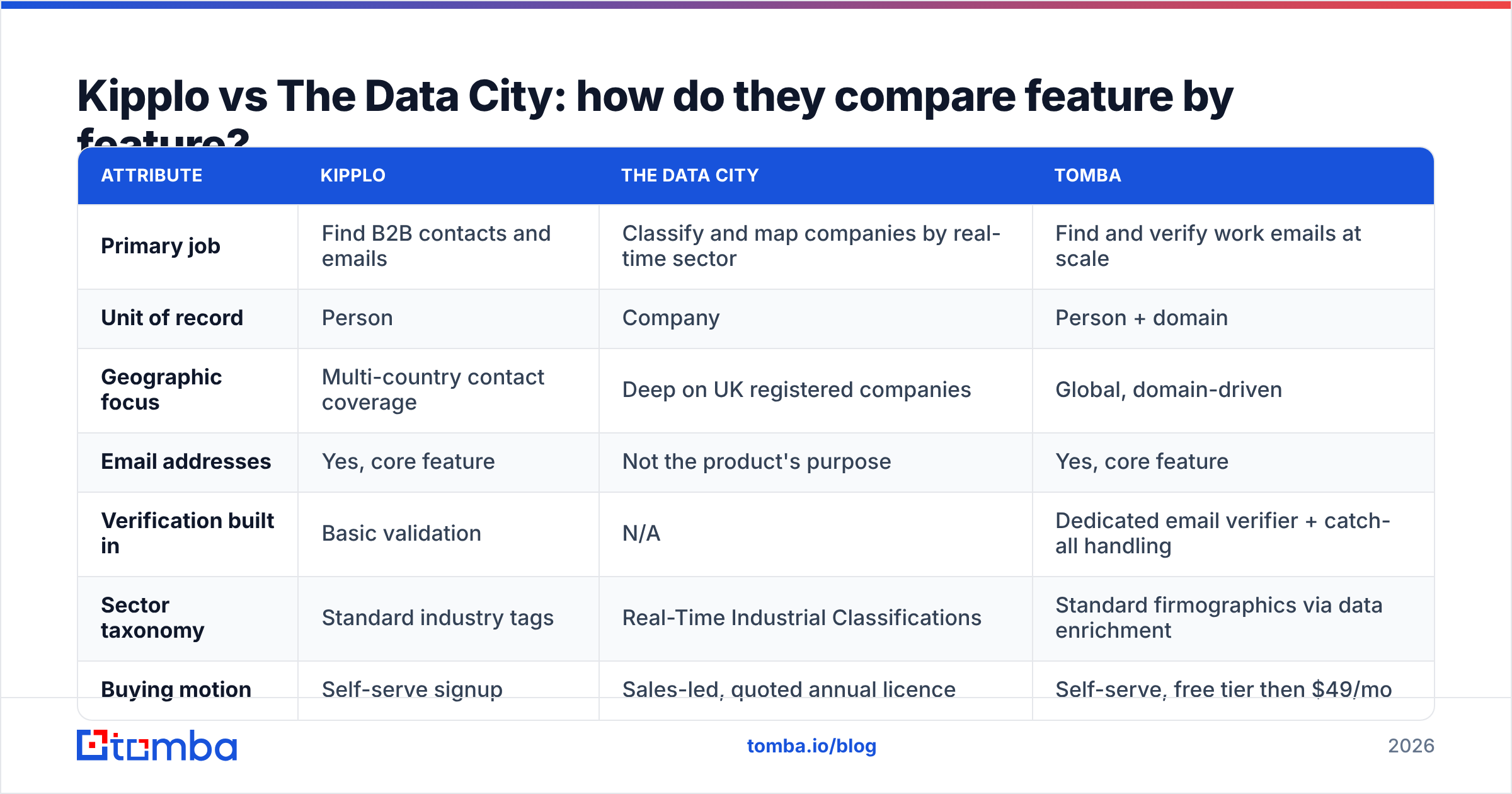
| Attribute | Kipplo | The Data City | Tomba |
|---|---|---|---|
| Primary job | Find B2B contacts and emails | Classify and map companies by real-time sector | Find and verify work emails at scale |
| Unit of record | Person | Company | Person + domain |
| Geographic focus | Multi-country contact coverage | Deep on UK registered companies | Global, domain-driven |
| Email addresses | Yes, core feature | Not the product's purpose | Yes, core feature |
| Verification built in | Basic validation | N/A | Dedicated email verifier + catch-all handling |
| Sector taxonomy | Standard industry tags | Real-Time Industrial Classifications | Standard firmographics via data enrichment |
| Buying motion | Self-serve signup | Sales-led, quoted annual licence | Self-serve, free tier then $49/mo |
| Typical buyer | SDR lead, founder, agency | Economic development, policy, investors, strategy | SDR lead, RevOps, growth engineer |
| API access | Available on paid plans | Available, enterprise-oriented | Public email finder API, CLI, and MCP |
| Time to first list | Minutes | Days to weeks (scoping + onboarding) | Minutes |
The Kipplo vs The Data City table makes an awkward truth visible. There is exactly one row where the two genuinely overlap. That row is gives you a list of companies. Every other row is a different job.
Is The Data City worth it if you just need leads?#
Probably not, and the vendor would likely agree.
The Data City earns its fee when the sector definition is the hard part. Say you run partnerships at a battery-materials firm. You need every UK company working on cathode chemistry.
That includes the eleven that incorporated last year and call themselves advanced materials consultancy on Companies House. No contact database will surface those cleanly. None of them has a tag for it. An engine that reads website copy will.
Where it stops helping is the last mile. A solid market map of 340 companies is a strategy asset. It is not a campaign.
To run outbound against it, you still need a named decision maker and a working inbox for each domain. That is a separate purchase. Running a domain search against the exported domain list is the usual bridge, and it costs a fraction of a market-intelligence seat.
Be honest about which question you are funding. Teams that buy market intelligence and hope it doubles as a prospecting database tend to feel burned. The fault is in the expectation, not the product.
Is Kipplo enough on its own for outbound?#
The Kipplo vs The Data City debate usually lands here: how much do you trust one source? For any single contact database, the answer is less than you would like.
Contact databases are aggregation plays. Coverage swings wildly by segment. A tool that looks great on US software firms can return 30% coverage on European manufacturing.
You will not find that out until you have paid for credits. This is not a knock on Kipplo alone. It is true across the category, which is why buyers on G2 often run two providers at once.
The common failure is not a missing email. It is an email that looks fine and then bounces. Every bounce above a few percent drags down your sender reputation. Once your domain is flagged, better copy will not save you. So verification is non-negotiable, wherever the address came from.

Three habits fix most of it:
- Verify at import, not at send. Run every list through verification before it touches your sequencer. Catch-all domains need their own handling. That is what a catch-all verifier is for.
- Re-verify quarterly. Contact decay never stops. A list verified in January is much worse by April.
- Track bounce rate per source. If you run two providers, per-source bounce data tells you which contract to cut. Most teams never measure this, then renegotiate on vibes.
How do the pricing models actually compare?#
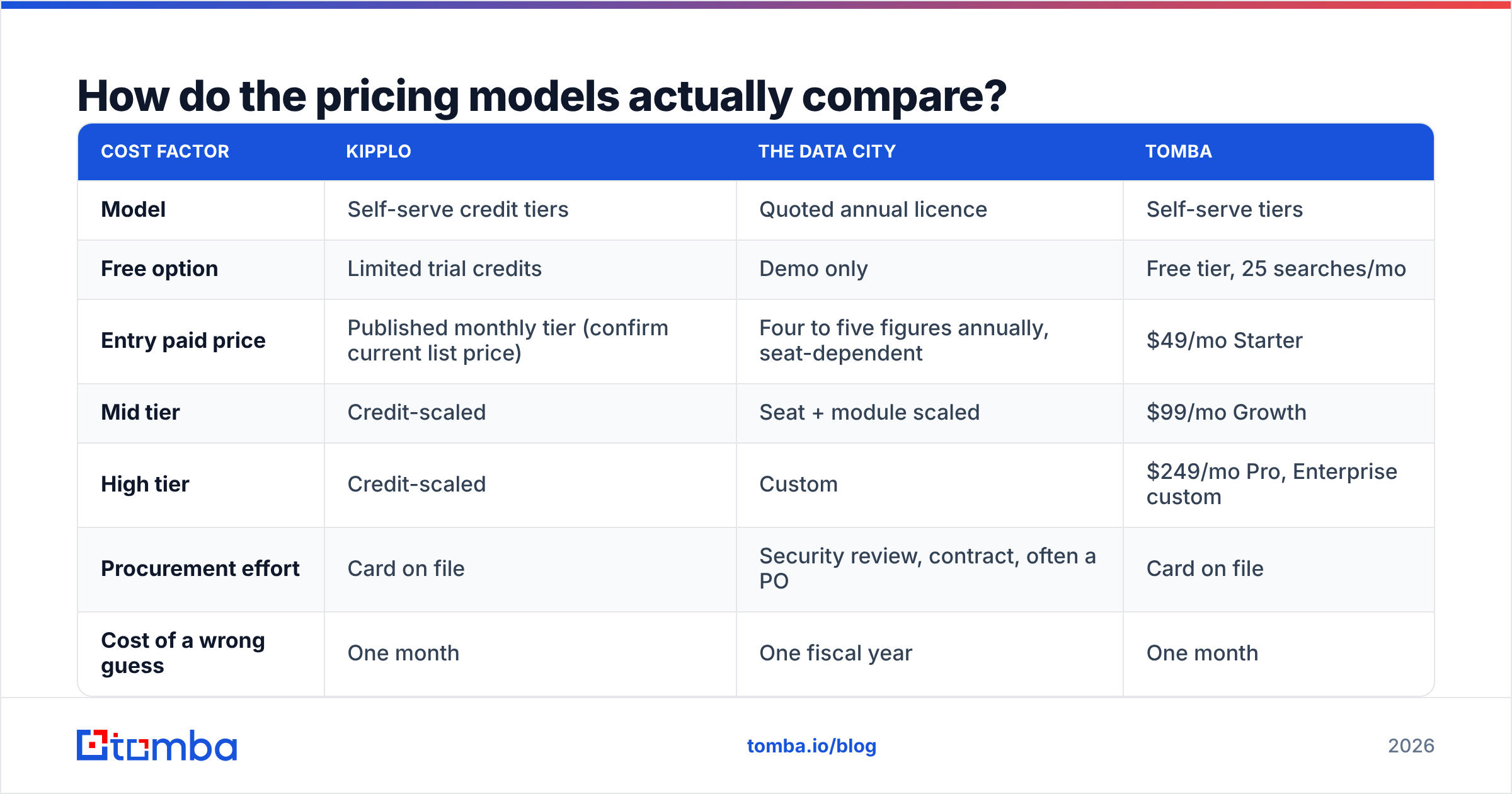
Pricing is where Kipplo vs The Data City splits hardest.
| Cost factor | Kipplo | The Data City | Tomba |
|---|---|---|---|
| Model | Self-serve credit tiers | Quoted annual licence | Self-serve tiers |
| Free option | Limited trial credits | Demo only | Free tier, 25 searches/mo |
| Entry paid price | Published monthly tier (confirm current list price) | Four to five figures annually, seat-dependent | $49/mo Starter |
| Mid tier | Credit-scaled | Seat + module scaled | $99/mo Growth |
| High tier | Credit-scaled | Custom | $249/mo Pro, Enterprise custom |
| Procurement effort | Card on file | Security review, contract, often a PO | Card on file |
| Cost of a wrong guess | One month | One fiscal year | One month |
That last row is the one people underrate. A self-serve tool you regret costs you a month. An annual licence you regret costs you a budget cycle and an awkward chat with finance.
If you are not sure the sector-mapping problem is real for your team, the self-serve side is the safer bet. Full Tomba pricing is public for exactly this reason.
Which tool should you pick for your use case?#
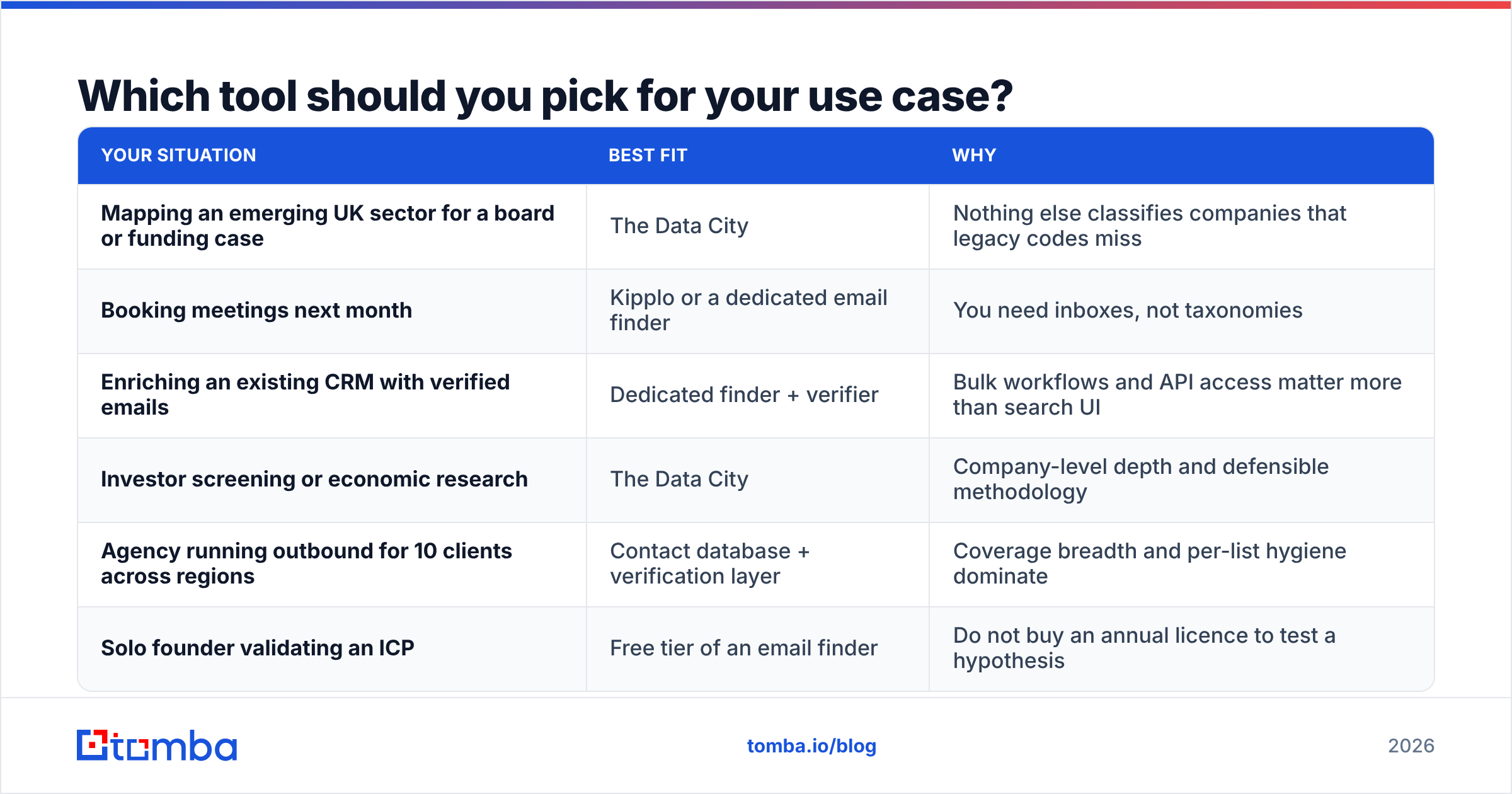
Kipplo vs The Data City is really a question about the job in front of you.
| Your situation | Best fit | Why |
|---|---|---|
| Mapping an emerging UK sector for a board or funding case | The Data City | Nothing else classifies companies that legacy codes miss |
| Booking meetings next month | Kipplo or a dedicated email finder | You need inboxes, not taxonomies |
| Enriching an existing CRM with verified emails | Dedicated finder + verifier | Bulk workflows and API access matter more than search UI |
| Investor screening or economic research | The Data City | Company-level depth and defensible methodology |
| Agency running outbound for 10 clients across regions | Contact database + verification layer | Coverage breadth and per-list hygiene dominate |
| Solo founder validating an ICP | Free tier of an email finder | Do not buy an annual licence to test a hypothesis |
How should you test either one before buying?#
Run the same benchmark on both, and on whatever you use today. Test Kipplo vs The Data City side by side. It takes an afternoon and saves you whole quarters.
- Build a 100-row truth set. Pick 100 companies you know well, ideally ones where you already hold a verified contact. Use real accounts from your pipeline, not a random sample.
- Measure coverage first, then accuracy. How many of the 100 does each tool return anything for? 95% accuracy on 40% coverage is worse than 88% accuracy on 90% coverage.
- Bounce-test the emails. Run the addresses through a verifier. Record hard bounces separately from unknowns. Unknowns on catch-all domains are not failures. They are a different bucket.
- Check the sector tags by hand. For The Data City, pull 20 companies from one classification and read their websites. This is where the real-time approach proves itself or does not. It is worth the twenty minutes.
- Time the export-to-CRM path. If loading data into HubSpot or Salesforce needs an engineer, that is a recurring cost. Check the integrations list before you buy, not after.
Vendors will quote their own accuracy number. Every vendor measures on a sample that flatters them. Your number is the only one that reflects your buyers.
What is the honest verdict on Kipplo vs The Data City?#
Buy The Data City when the hard problem is definition. You cannot name the companies in your market, because the official categories do not describe it. That is a genuinely hard problem, and few tools answer it well in the UK.
Buy a contact database like Kipplo when the hard problem is reach. You already know who you want. You need working inboxes fast.
Most GTM teams find they have both problems, in sequence. The second one is cheaper to solve than they assumed. A market-intelligence licence plus a light finder-and-verifier layer beats forcing either product to do the other's job.
So the Kipplo vs The Data City answer is usually both, at different layers.
If the contact layer is your gap, start with the Tomba Email Finder. The free tier gives you 25 searches a month. That is enough to run the 100-row benchmark above before you spend a penny. Starter is $49/mo when you are ready to scale.
Feed it the domain list from whatever market map you trust. Verify everything before it hits your sequencer. Then let the intelligence platform do what it is good at.
Related guides#
// get started
Find, verify and enrich your first contacts today
Start on the free plan with 25 searches a month, then scale when your team is ready.
Free plan · No credit card required · GDPR & CCPA
// about the author