Kipplo vs VC-Backed Sales Tools: Which Wins in 2026?
Funding model is not a feature, but it quietly sets your price, your roadmap and your renewal leverage. Here is how a Kipplo-style independent vendor stacks up against a VC-backed sales platform in 2026.
TL;DR
- "Kipplo vs VC-backed" is not really a feature fight. It is a question about which vendor's business model matches your budget cycle, your data needs and your tolerance for price changes at renewal.
- Independent, profitable vendors tend to win on transparent pricing, credit flexibility and direct support. Venture-funded platforms tend to win on breadth, integrations, compliance paperwork and enterprise procurement readiness.
- The hidden cost of VC-backed tooling is rarely the sticker price — it is seat minimums, annual prepay, credit expiry and 15-30% renewal uplifts once you are embedded.
- The hidden cost of a small independent vendor is coverage gaps, thinner SOC 2 / DPA documentation and single-point-of-failure risk if the founder moves on.
- Practical answer for most teams under 50 reps: buy data from a focused, transparently priced provider (Tomba starts free and moves to $49/mo), and only pay platform prices when you genuinely need the platform.
Before anything else: verify current specifics on any vendor's own site before you sign. Smaller tools iterate fast, and pricing pages change more often than blog posts do. This article compares the two models — an independent, Kipplo-style vendor versus a venture-funded platform — and gives you the questions that decide the purchase.
What does "Kipplo vs VC-backed" actually mean?#
It means you are choosing between two incentive structures, not two logos.
A Kipplo-style vendor is the independent end of the market: small team, revenue-funded or lightly funded, narrow product surface, pricing published on the site, and a founder who still answers support tickets. The company's goal is to be profitable at its current size. Bootstrapping forces that discipline — every customer has to pay for itself this quarter.
A VC-backed platform sits at the other end: institutional funding, aggressive hiring, a product that expands from one wedge (say, contact data) into sequencing, dialers, intent, conversation intelligence and CRM enrichment. The goal is growth rate, because the next round prices off it. That is not a moral failing — it is the contract the company signed with its investors, and it produces genuinely useful things like 24/7 support, regional data residency and a 400-item integration catalogue.
Both models ship good software. They just fail in different places, at different moments, in ways that are completely predictable once you know which model you bought.
Why does a vendor's funding model change what you pay?#
Funding shapes pricing mechanics far more than it shapes feature lists. Here is the causal chain, in the order it hits your budget:
- Growth targets set list prices. A venture-funded vendor needs net revenue retention above 110%. The cleanest way to get there is annual expansion on existing accounts — so contracts are built to grow: seat minimums, tiered credit blocks, usage overages billed at premium rates. An independent vendor priced for profitability has no such mandate.
- Land-and-expand creates discount cliffs. Year one often lands at 40-60% off list to win the logo. Year two normalises. Teams that budgeted off the year-one invoice get an unpleasant surprise; the increase was always in the plan.
- Credit expiry is a margin lever. Monthly credits that do not roll over are effectively breakage revenue. Independent vendors more often allow rollover or simple top-ups because they are not optimising a usage-forecast model.
- Support is a cost centre at scale. At 50 customers a founder replies in an hour. At 50,000 customers that is a tier-1 queue with an SLA, which is better if you need 3am coverage and worse if you need someone who actually understands your data problem.
- Roadmaps follow the largest contracts. Enterprise logos drive the backlog at funded platforms. If you are a 12-person team, your feature request competes with a 900-seat deployment — and loses. At a small vendor, your request may ship in a fortnight.
- Acquisition and sunset risk cuts both ways. Funded companies get acquired and products get folded, repriced or killed. Independent companies get abandoned when the founder burns out. Neither risk is zero; ask about it explicitly.

How do Kipplo-style tools and VC-backed platforms compare?#
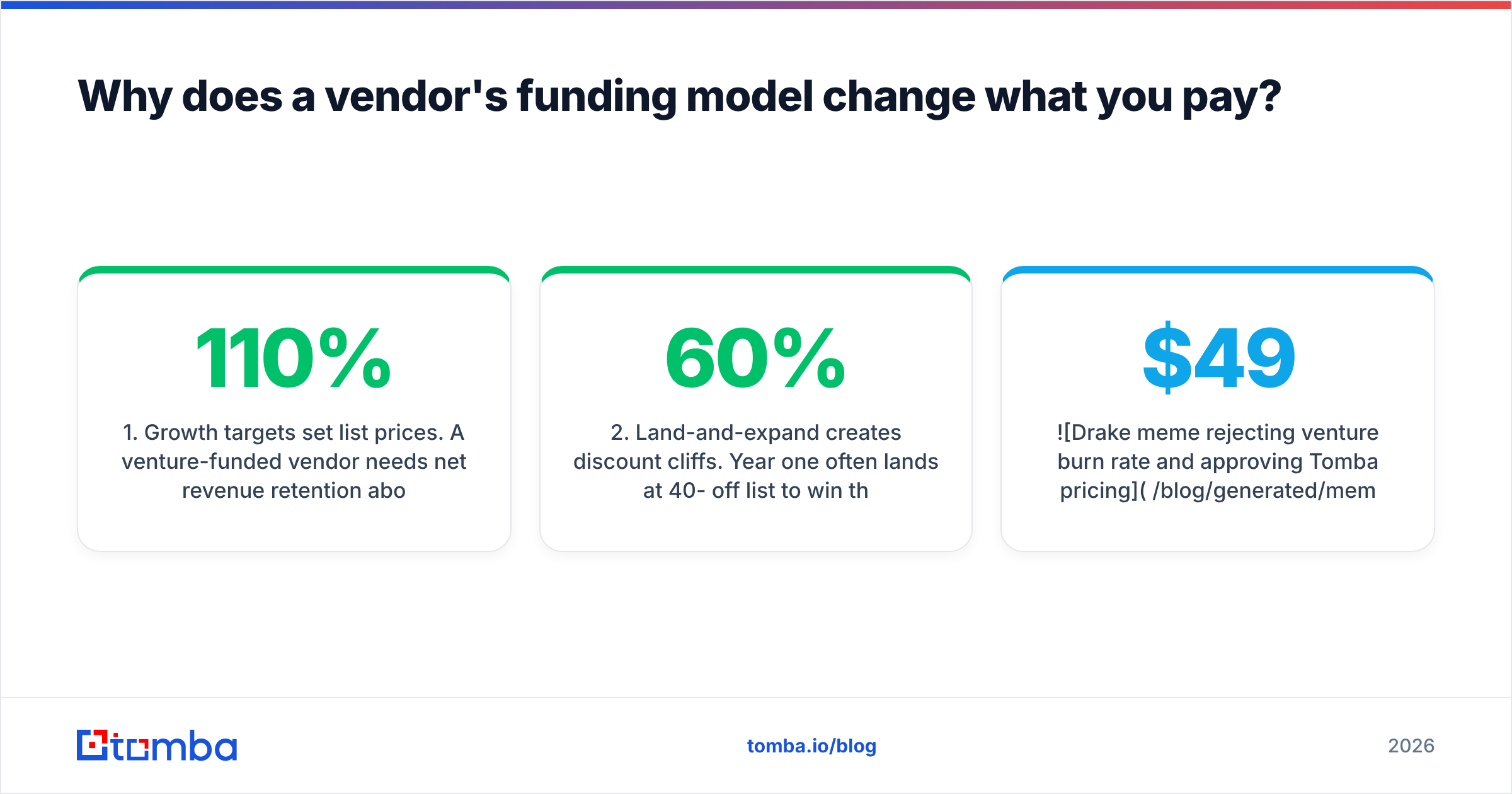
The table below compares the two models on the dimensions that actually appear in procurement reviews, with Tomba as a reference point for the transparently priced, independent end of the market.
| Dimension | Kipplo-style independent vendor | VC-backed platform | Tomba |
|---|---|---|---|
| Entry price | Usually $20-60/mo, published | Often "contact sales" below the top tier | Free tier (25 searches/mo), Starter $49/mo |
| Contract term | Monthly, cancel anytime | Annual prepay common; multi-year pushed | Monthly or annual, self-serve |
| Seat minimums | Rare | 3-5 seats typical on mid tiers | None on self-serve plans |
| Credit behaviour | Top-ups, frequent rollover | Monthly expiry is the norm | Plan credits across finder, verifier and enrichment |
| Product surface | One job done well | Data + sequencing + dialer + intent | Email finder core, with verifier, domain search, phone finder, enrichment |
| Support model | Founder or small team, direct | Tiered queue, SLA on higher plans | Direct support, docs and API reference |
| Compliance docs | Often lighter (ask for DPA, SOC 2) | Usually complete and audit-ready | DPA available, documented data sources |
| Renewal risk | Low — price is public | Moderate to high — uplift is standard | Low — published Tomba pricing |
| Failure mode | Coverage gaps, slower roadmap | Cost creep, feature bloat, forced bundling | Narrow by design; you add other tools around it |
Read that table twice. Nothing in the right-hand columns says "better software." It says different exposure. If your buying committee cares most about audit paperwork and a single vendor of record, the funded platform is genuinely the lower-friction purchase. If your buying committee is you and a company card, it usually is not.
Is data quality actually better at VC-backed vendors?#
Not reliably — and this is the most expensive assumption in the category.
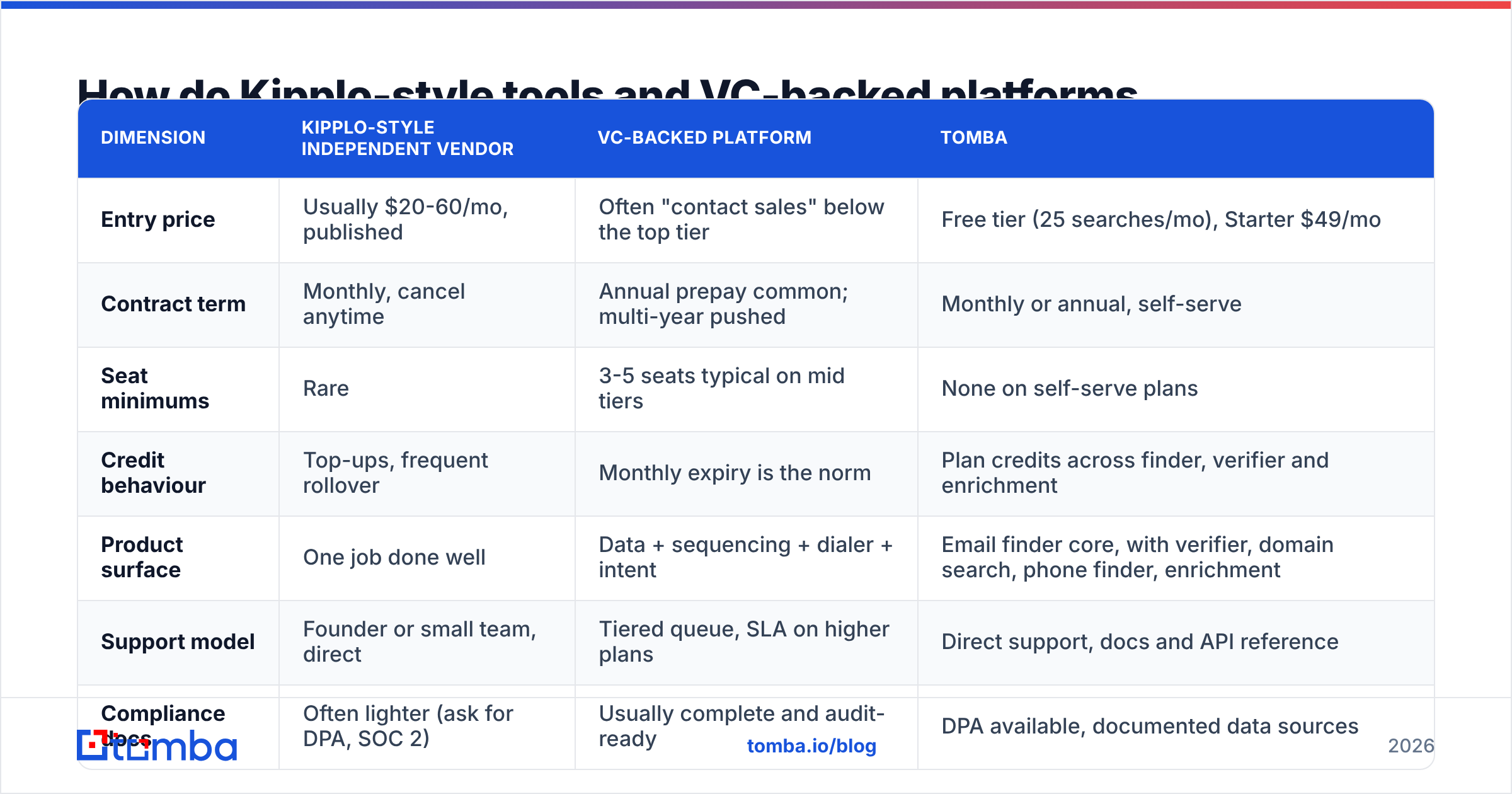
Contact data quality is a function of source mix and verification discipline, not balance sheet size. Large funded vendors do have more crawl infrastructure and more contributory data from user email integrations, which helps coverage on long-tail companies. But coverage and accuracy are different metrics. A database of 300 million contacts with 62% deliverable emails produces more bounces than a database of 60 million contacts at 95% deliverable, and you pay for the bounces twice: once in credits, once in sender reputation.
What actually predicts accuracy:
- Recency of verification. Ask when each record was last SMTP-checked, not when it was last "updated."
- Catch-all handling. Roughly a fifth of B2B domains accept everything. A vendor that marks those "valid" is inflating its accuracy number. A dedicated catch-all verifier is the honest answer.
- Bounce guarantee mechanics. "97% accuracy" means nothing without a credit-refund policy attached to it.
- Source disclosure. Vendors that will not describe where records come from are a compliance problem waiting for your legal team.
Run the same test list through both vendors before you buy. Take 200 contacts you already know are deliverable, split them evenly, and measure hit rate, bounce rate and time-to-result. That 30-minute exercise beats every G2 badge — though G2's sales intelligence category is still a reasonable place to read unfiltered complaints about renewal pricing before you shortlist.
Independent data specialists hold their own here. BookYourData, for example, has built a strong reputation in B2B contact data on a pay-as-you-go model with an explicit bounce guarantee — proof that the funding label tells you very little about whether the records are good.
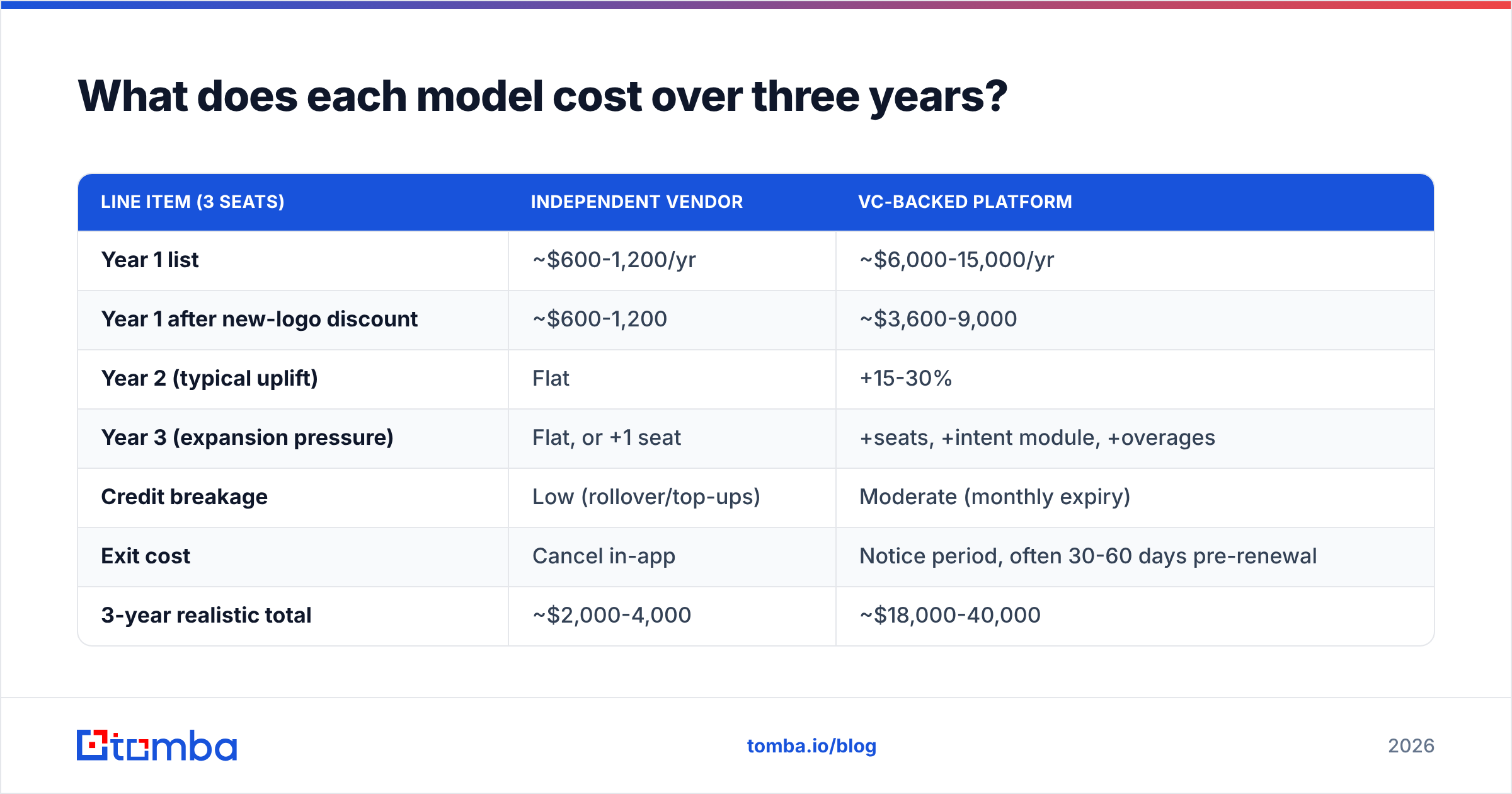
What does each model cost over three years?#
Sticker price is the wrong unit. Model the three-year total, including the renewal uplift that funded vendors plan for and independents generally do not apply.
| Line item (3 seats) | Independent vendor | VC-backed platform |
|---|---|---|
| Year 1 list | ~$600-1,200/yr | ~$6,000-15,000/yr |
| Year 1 after new-logo discount | ~$600-1,200 | ~$3,600-9,000 |
| Year 2 (typical uplift) | Flat | +15-30% |
| Year 3 (expansion pressure) | Flat, or +1 seat | +seats, +intent module, +overages |
| Credit breakage | Low (rollover/top-ups) | Moderate (monthly expiry) |
| Exit cost | Cancel in-app | Notice period, often 30-60 days pre-renewal |
| 3-year realistic total | ~$2,000-4,000 | ~$18,000-40,000 |
Those ranges reflect typical published and reported list pricing in the category, not any single vendor's quote — get your own numbers in writing. The point is the shape of the curve. Independent pricing is roughly flat; platform pricing compounds. Over three years that gap funds a full-time SDR, which may or may not be a better use of the money than the platform. That is the real comparison.
Gartner's sales research has been making a related point for years: most revenue teams under-use the platforms they buy. Seat utilisation below 60% is common. Paying platform prices for email-finder usage is the single most frequent overspend we see in stack audits.

When is the VC-backed platform the right call?#
Buy the platform when at least two of these are true:
- You have more than 40 reps and the admin overhead of stitching tools together costs more than the licence delta.
- Procurement requires a single vendor of record with SOC 2 Type II, ISO 27001 and regional data residency.
- You need native conversation intelligence or intent data that small vendors genuinely cannot replicate — intent especially requires a bidstream or co-op that only scale buys.
- Your CRM hygiene depends on continuous enrichment across hundreds of thousands of records, not on-demand lookups.
- You have a dedicated RevOps owner who will drive adoption. Without one, platform spend becomes shelfware within two quarters.
If none of those apply, you are buying insurance you will not claim.
When is a Kipplo-style independent tool the better buy?#
Choose the independent vendor when your actual job-to-be-done is narrow and measurable:
- You need verified work emails for a target list you already built. That is a domain search and verification problem, not a platform problem.
- Your volume is spiky — 8,000 lookups in March, 400 in April. Pay-as-you-go and rollover credits beat annual seat licences every time.
- You want to pipe results into tools you already own rather than migrate to a new system of record. A clean email finder API, a Chrome extension and a Sheets add-on cover most of it.
- You want to test a channel before committing budget. A free tier that runs 25 searches tells you more than a demo call.
- You are price-sensitive and honest about it. There is no strategic penalty for buying the cheaper tool that does the job.
What should you verify before signing either contract?#
Run this checklist against both vendors. It takes an afternoon and routinely saves five figures.
- Get the renewal mechanics in writing. Ask directly: what is the maximum year-two increase, and is it capped in the contract? A vendor that will not cap it has told you the answer.
- Test the data, do not read about it. Same 200-contact list, both tools, measure bounce rate after a real send. Use an email verifier as a neutral referee on both outputs.
- Read the credit policy line by line. Rollover? Overage rate? Do failed lookups consume credits? Do re-verifications?
- Ask for the DPA and the subprocessor list. If the vendor cannot produce both within a day, your legal review will stall regardless of price.
- Check the exit path. Can you export your enriched records in a usable format, or is the data locked to the platform? Ask before you load anything in.
- Confirm who answers when it breaks. A named human beats a ticket portal for anything data-related, and both models can offer either.
So which one actually wins?#
For most B2B teams in 2026, the honest verdict is: buy narrow, buy transparent, and upgrade only when a specific constraint forces you to.
The VC-backed platform is not overpriced because it is greedy — it is priced for a buyer with enterprise procurement requirements and a RevOps team to run it. If that is you, pay it and get value. If it is not you, you are subsidising features you will never open, and you will feel it most at renewal, when your leverage is lowest.
The independent vendor wins on exactly the dimensions that matter to a lean team: published prices, no seat minimums, credits you can actually use, and a support reply from someone who understands the product. What you give up is breadth, and breadth is easy to add later with point tools that each do one thing well.
If the job you are hiring a tool for is "find and verify work emails so my outbound actually lands," start with the Tomba Email Finder. The free tier gives you 25 searches a month — enough to run the 200-contact bake-off described above — and Starter is $49/mo when you are ready, with Growth at $99/mo and Pro at $249/mo if volume climbs. No seat minimum, no annual prepay, no sales call required. Test it against whatever platform quote is sitting in your inbox, then decide with data instead of a deck.
Related guides#
Ready to find emails that actually work?
Join 150,000+ professionals who stopped guessing and started sending. Free credits on signup — no credit card required.
Get the Tomba newsletter
Practical outbound tactics and product updates — once every two weeks.
About the author