Kipplo vs Xverum: Which B2B Data Platform Wins in 2026?
One sells you a prospecting seat, the other sells you a data feed. Here's how Kipplo and Xverum actually differ on coverage, accuracy, delivery and real cost — and which one your team should sign.
TL;DR
- Kipplo is a seat-based prospecting platform. You log in, filter people and companies, reveal emails and phones, export a CSV. Credits are consumed per revealed contact (1 email = 1 credit, 1 phone = 5).
- Xverum is a data vendor, not an app. You buy datasets — roughly 750M people profiles, 50M+ company records, job postings, POIs — delivered as JSON/CSV drops or via API into your own warehouse.
- They almost never compete for the same buyer. An SDR team wants Kipplo. A data or ML team building an internal product wants Xverum.
- Pricing models are incompatible. Kipplo sells monthly plans with a default cap around 5,000 credits; Xverum quotes volume contracts that commonly land in the $1,800–$2,000/month range and scale toward six figures annually.
- If all you actually need is a verified work email at the moment of outreach, neither model is efficient — a per-lookup email finder starting at $49/mo does that job without a data contract or a credit-burning UI.
What are Kipplo and Xverum, exactly?#
Start with the category, because "B2B data provider" hides the difference that matters.
Kipplo is a B2B contact intelligence platform. It gives you a searchable index of decision-makers — the company claims 500M+ profiles — plus a people/company search UI, a LinkedIn Chrome extension, CSV enrichment, and an enrichment API. The pitch is that it replaces the prospecting stack for a fraction of what Apollo or ZoomInfo cost. You buy a seat, you work inside the product.
Xverum sells structured web data. Its catalog covers roughly 750M people profiles, 54M companies, 9M job listings and 320M points of interest, with 40+ firmographic attributes and 90+ enrichment attributes. Delivery is dataset-shaped: bulk files, scheduled refreshes, S3/GCS drops, or real-time search APIs. There is a web UI for managing feeds, but nobody on your sales team is going to open it.
That's the whole comparison in one line: Kipplo ships a workflow, Xverum ships a file.
The confusion exists because both market themselves with the same three nouns — coverage, accuracy, compliance — and both quote 98% accuracy. Those claims are measured differently and mean different things, which we'll get to.
How do Kipplo and Xverum compare head-to-head?#
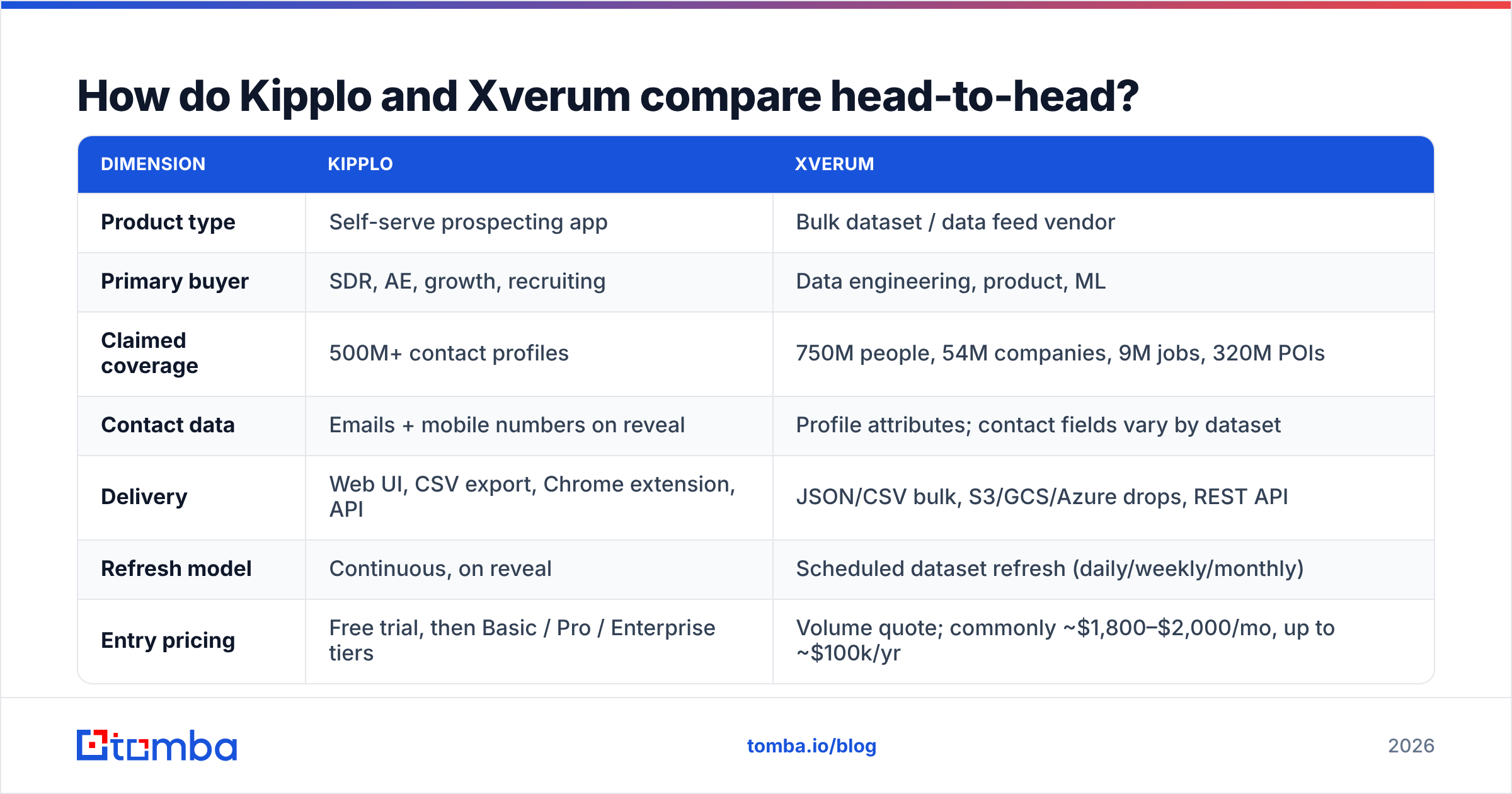
| Dimension | Kipplo | Xverum |
|---|---|---|
| Product type | Self-serve prospecting app | Bulk dataset / data feed vendor |
| Primary buyer | SDR, AE, growth, recruiting | Data engineering, product, ML |
| Claimed coverage | 500M+ contact profiles | 750M people, 54M companies, 9M jobs, 320M POIs |
| Contact data | Emails + mobile numbers on reveal | Profile attributes; contact fields vary by dataset |
| Delivery | Web UI, CSV export, Chrome extension, API | JSON/CSV bulk, S3/GCS/Azure drops, REST API |
| Refresh model | Continuous, on reveal | Scheduled dataset refresh (daily/weekly/monthly) |
| Entry pricing | Free trial, then Basic / Pro / Enterprise tiers | Volume quote; commonly ~$1,800–$2,000/mo, up to ~$100k/yr |
| Credit system | 1 email = 1 credit, 1 phone = 5 credits; ~5,000 credits/mo default cap | Priced per record (from ~$2.50 / 1,000) or flat subscription |
| Free evaluation | Free trial | Free data samples |
| Best for | Building target lists this week | Powering a product, model, or internal graph |
| Worst for | Millions of rows into a warehouse | A rep who needs 40 emails before Friday |
Two rows deserve underlining.
The credit cap. Kipplo's published terms note that paying accounts run against a 5,000 credit per month limit unless a separate agreement says otherwise. Because phones cost 5 credits each, a rep doing heavy mobile-number work can exhaust a month in roughly 1,000 reveals. That is fine for one SDR working a tight ICP; it is a real constraint for a team of six.
The Xverum floor. Xverum lists products on Datarade with a stated range of $2.50 per 1,000 records at the low end up to $100,000/year at the high end. The low unit price is seductive, but it applies to volume you probably can't use. Most practical contracts start in the low-thousands per month — and you still need somewhere to put the data.
Which one has better data coverage and accuracy?#
Xverum has more rows. Kipplo has more usable contacts per row. Both statements can be true at once, and both are less interesting than the question you should actually ask: what percentage of the records you touch this quarter will bounce?
Coverage numbers are the least meaningful metric in this category. A 750M-profile dataset counts every scraped public profile, including people who left the company in 2021, records with no email at all, and duplicates across source systems. A 500M-profile prospecting index counts profiles that the product will let you search — not profiles where a reveal will succeed.
Three things determine whether the data works for you:
- Reveal rate on your ICP, not overall. A provider with weak coverage of German mid-market manufacturers is useless to you even if it has 90% coverage of US SaaS. Test both tools on 200 accounts from your actual target list.
- Freshness relative to job changes. B2B contact data decays roughly 25–30% per year, and job-change churn is the biggest driver. Xverum's value here is the scheduled refresh; Kipplo's is that reveals happen at query time.
- Whether the email was verified or inferred. This is the gap that quietly kills campaigns. A pattern-guessed address (first.last@domain.com) is a guess until an SMTP check confirms it. If your provider doesn't tell you which is which, you are paying to send to a guess.
That third point is why most teams end up running an independent email verifier over any purchased list, regardless of vendor. It costs a fraction of the data itself and it's the only thing standing between a fresh domain and a spam-folder reputation.
How does pricing actually work for each?#
Very differently, and the difference has consequences beyond the invoice.
Kipplo prices like a SaaS app: free trial, then Basic, Pro, or Enterprise. Credits renew at the start of each billing cycle. Because credits are only consumed on reveal — not on search — you can prospect and filter freely, then spend only where you commit. That's a genuinely fair model and better than tools that charge you for browsing. Current tier details are on Kipplo's pricing page and cross-checked on G2.
Xverum prices like a data vendor. Everything is negotiated against record count, attribute depth, refresh frequency and contract length. There is no credit card checkout. Expect a scoping call, a sample delivery, then a quote. Free samples are genuinely free and genuinely useful — take them before any commitment.
The hidden cost nobody puts in the comparison table: Xverum's real total cost includes the engineering work. Budget for ingestion, deduplication against your CRM, schema drift handling when attributes change, and a scheduled job to reconcile the refresh. That's typically a few weeks of a data engineer's time up front and ongoing maintenance after. If your company doesn't have that engineer, the dataset sits in a bucket.
Kipplo's hidden cost is subtler: the credit cap turns into a queue. When a team shares 5,000 credits, someone starts rationing phone reveals in the third week of the month, and rationing prospecting inputs is a bad way to run pipeline.
Which delivery model fits your team?#
Pick based on where the data has to end up, not on which brand tests better.
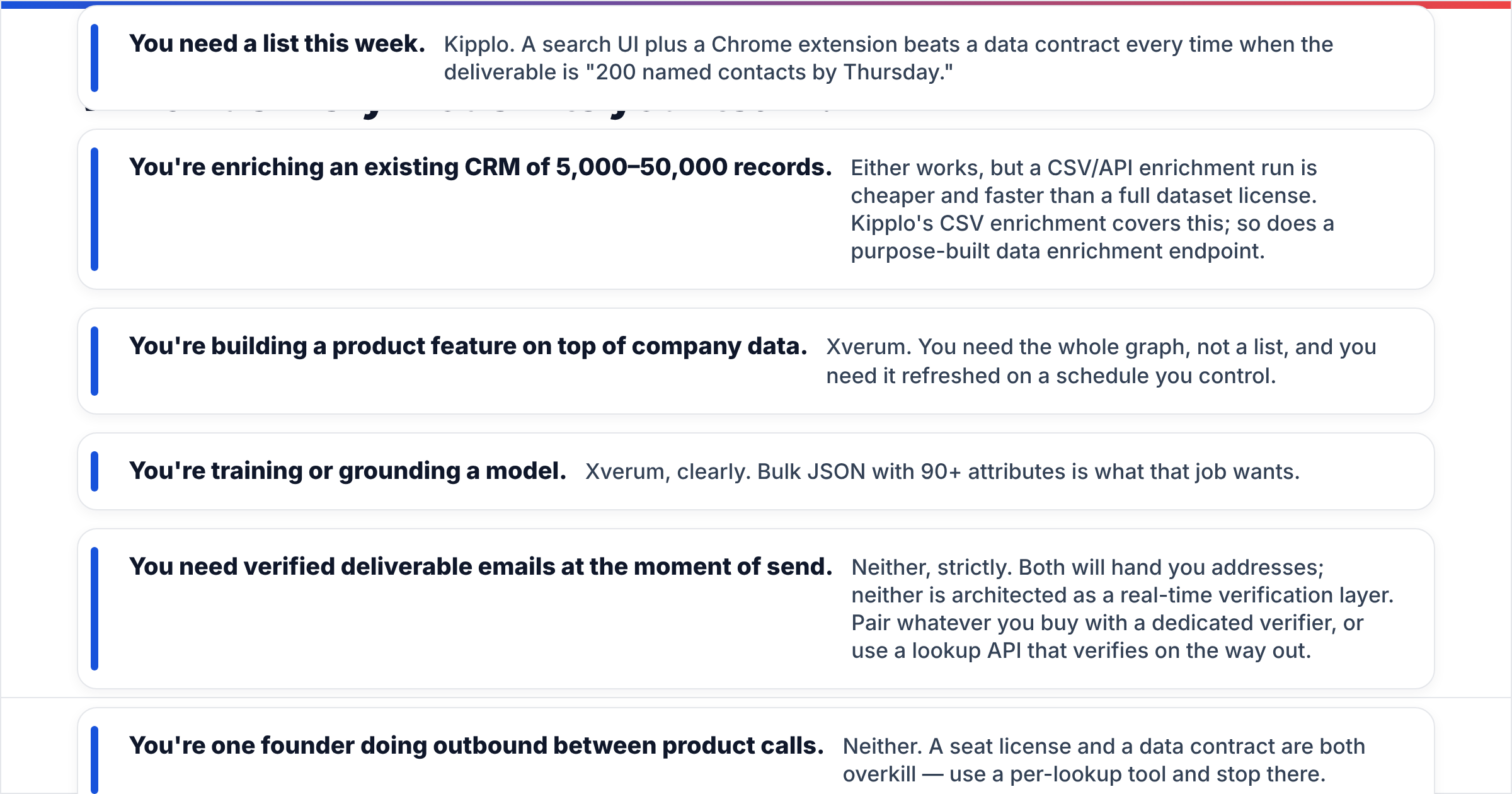
- You need a list this week. Kipplo. A search UI plus a Chrome extension beats a data contract every time when the deliverable is "200 named contacts by Thursday."
- You're enriching an existing CRM of 5,000–50,000 records. Either works, but a CSV/API enrichment run is cheaper and faster than a full dataset license. Kipplo's CSV enrichment covers this; so does a purpose-built data enrichment endpoint.
- You're building a product feature on top of company data. Xverum. You need the whole graph, not a list, and you need it refreshed on a schedule you control.
- You're training or grounding a model. Xverum, clearly. Bulk JSON with 90+ attributes is what that job wants.
- You need verified deliverable emails at the moment of send. Neither, strictly. Both will hand you addresses; neither is architected as a real-time verification layer. Pair whatever you buy with a dedicated verifier, or use a lookup API that verifies on the way out.
- You're one founder doing outbound between product calls. Neither. A seat license and a data contract are both overkill — use a per-lookup tool and stop there.
Where does each tool break down?#
Kipplo's weak points. The credit ceiling is the main one — 5,000/month as a default cap is modest for a team, and phone reveals eat it five times faster than emails. Coverage outside North America and Western Europe is thinner than the headline 500M suggests, which is true of nearly every contact platform. And like all reveal-based tools, you find out whether a record is good only after you've spent the credit.
Xverum's weak points. Nothing about it is self-serve. Time to first usable record is measured in weeks, not minutes. Contact fields — specifically verified work emails and direct dials — are not uniformly populated across the people dataset, so if your use case is outbound rather than analytics, you may buy 750M rows and still need an email-resolution step afterward. And the minimum commitment means a failed evaluation is expensive.
What both share. Neither is a sending tool, neither is a CRM, and neither will save you from a bad ICP. Data quality problems in outbound are usually targeting problems wearing a data costume.
Kipplo vs Xverum: which should you pick?#
Pick Kipplo if your buyer is a sales or recruiting team, you want to be productive on day one, your monthly contact volume is in the hundreds-to-low-thousands, and you value a Chrome extension over an S3 bucket.
Pick Xverum if your buyer is engineering, you need millions of records with deep firmographic attributes, you have a warehouse and someone to maintain the pipeline, and your use case is a product or a model rather than a campaign.
Pick neither if your actual job is smaller than both products assume. Most teams shopping in this category describe their need as "a B2B data platform" when what they do every day is: take a name and a company, get a work email, confirm it's deliverable, put it in the sequence. That workflow doesn't need 750M rows or a 5,000-credit monthly allowance. It needs an accurate lookup and a verification step, priced per use.
What's the leaner third option?#
A focused email-finding and verification stack. Instead of licensing a dataset or renting a prospecting UI, you resolve contacts on demand: give it a domain and get every published address on it, give it a name and company and get one verified address back.
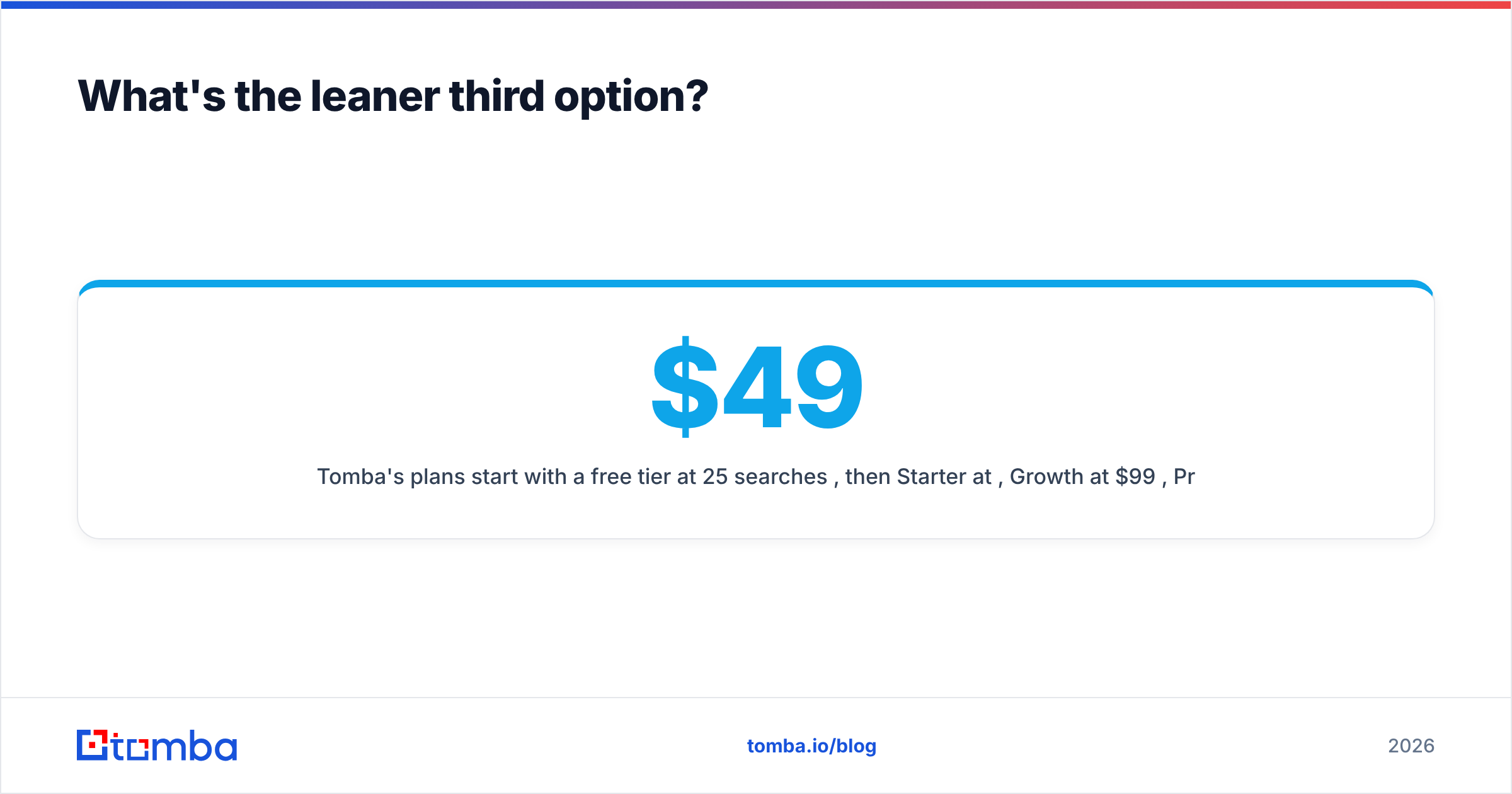
Tomba's plans start with a free tier at 25 searches/month, then Starter at $49/mo, Growth at $99/mo, Pro at $249/mo, and custom Enterprise — full details on Tomba pricing. The same functions are available through the Tomba API if you'd rather script it, which covers a meaningful chunk of what teams buy Xverum for without the contract. For list-scale work, bulk email finder runs the same logic across a CSV.
It isn't a full data platform, and it shouldn't pretend to be. If you need firmographic depth for an ML pipeline, buy from a dataset vendor. If you need a prospecting workspace with saved searches and team seats, buy a platform. But if the honest answer is "I need correct email addresses and I need to know they'll land," the leanest tool wins on both cost and deliverability.
Ready to test the cheap path first?#
Before you sit through a Xverum scoping call or commit to a Kipplo seat, run 25 free lookups against your real target accounts with the Tomba Email Finder. Take the 50 hardest names on your list — the ones your current tool misses — and see what comes back verified. If the hit rate covers your workflow, you just saved yourself a data contract. If it doesn't, you've got a concrete benchmark to hold both vendors against during their trials, which is a better negotiating position than anything on a pricing page.
Related guides#
// get started
Find, verify and enrich your first contacts today
Start on the free plan with 25 searches a month, then scale when your team is ready.
Free plan · No credit card required · GDPR & CCPA
// about the author