7 Best Klazify Alternatives in 2026: Compared and Tested
Klazify does website categorization, logos and company data from a URL. But credit limits, taxonomy gaps and thin contact data push teams to switch. Here are 7 alternatives, what each is actually good at, and how to migrate without breaking production.
TL;DR
- Klazify is a URL-in, data-out API: give it a domain and it returns a content category, a logo, some company firmographics and social links. It is convenient, but it is a generalist.
- Most teams leave for one of three reasons: taxonomy mismatch (IAB categories do not map to their ICP), credit burn on bulk enrichment, or the fact that categorization alone does not produce a contact you can email.
- There is no single drop-in replacement. Pick by job: classification (DNSFilter WebShrinker, zvelo), brand assets (Brandfetch), firmographics (The Companies API, Diffbot, Clearbit/Breeze), contactable GTM data (Tomba, BookYourData).
- If your end goal is pipeline rather than filtering, a domain-to-contact stack beats a domain-to-label stack. Tomba starts at $49/mo with a free tier of 25 searches.
- Migrate behind a feature flag, run both APIs in shadow mode on 500 known domains, and compare labels before you cut over.
What is Klazify and what does it actually do?#
Klazify is a website classification API. You send a domain or URL, and it returns a content category (mapped to the IAB taxonomy), plus a handful of adjacent endpoints: logo extraction, company data, social media profiles, and email-to-domain lookup.
The everyday analogy: Klazify is a librarian who can glance at a book's cover and tell you which shelf it belongs on. That is genuinely useful when you have 200,000 unlabeled books. It is much less useful when what you actually needed was the author's phone number.
That distinction is the whole reason people search for Klazify alternatives. The product is aimed at two very different buyers at once:
- Security and adtech teams who need URL filtering, brand-safety checks, or contextual ad targeting at web scale.
- Go-to-market teams who need to segment a lead list, enrich a CRM, or route inbound signups by industry.
Klazify serves the first group well and the second group only partially. Group two tends to churn.
Why do teams look for Klazify alternatives?#
Five recurring complaints, based on what shows up in G2 reviews, support threads, and migration conversations:
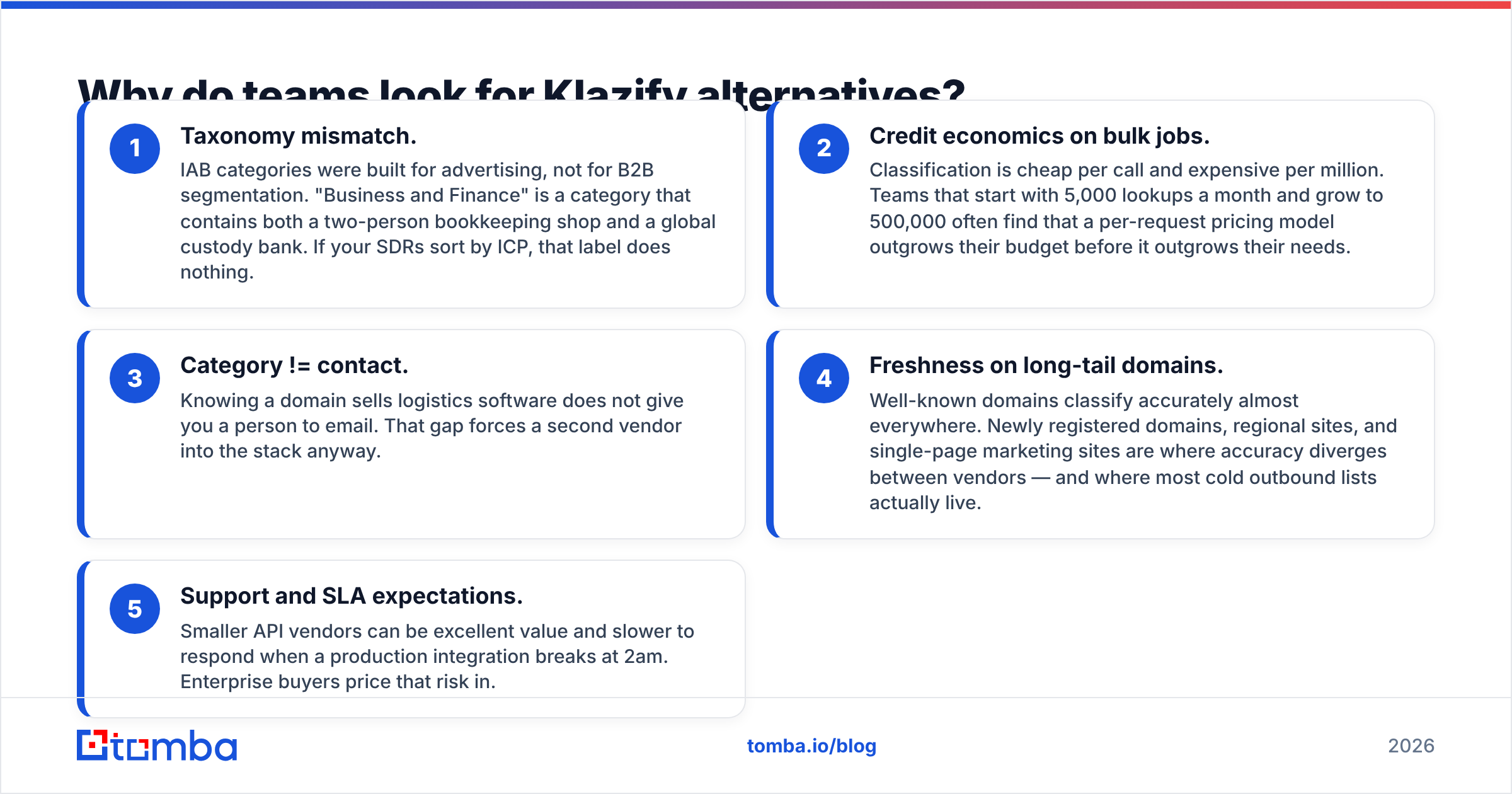
- Taxonomy mismatch. IAB categories were built for advertising, not for B2B segmentation. "Business and Finance" is a category that contains both a two-person bookkeeping shop and a global custody bank. If your SDRs sort by ICP, that label does nothing.
- Credit economics on bulk jobs. Classification is cheap per call and expensive per million. Teams that start with 5,000 lookups a month and grow to 500,000 often find that a per-request pricing model outgrows their budget before it outgrows their needs.
- Category != contact. Knowing a domain sells logistics software does not give you a person to email. That gap forces a second vendor into the stack anyway.
- Freshness on long-tail domains. Well-known domains classify accurately almost everywhere. Newly registered domains, regional sites, and single-page marketing sites are where accuracy diverges between vendors — and where most cold outbound lists actually live.
- Support and SLA expectations. Smaller API vendors can be excellent value and slower to respond when a production integration breaks at 2am. Enterprise buyers price that risk in.
What should you compare before switching?#
Before you look at any vendor page, write down which of these five you actually need. Most teams over-buy because they never separate them.
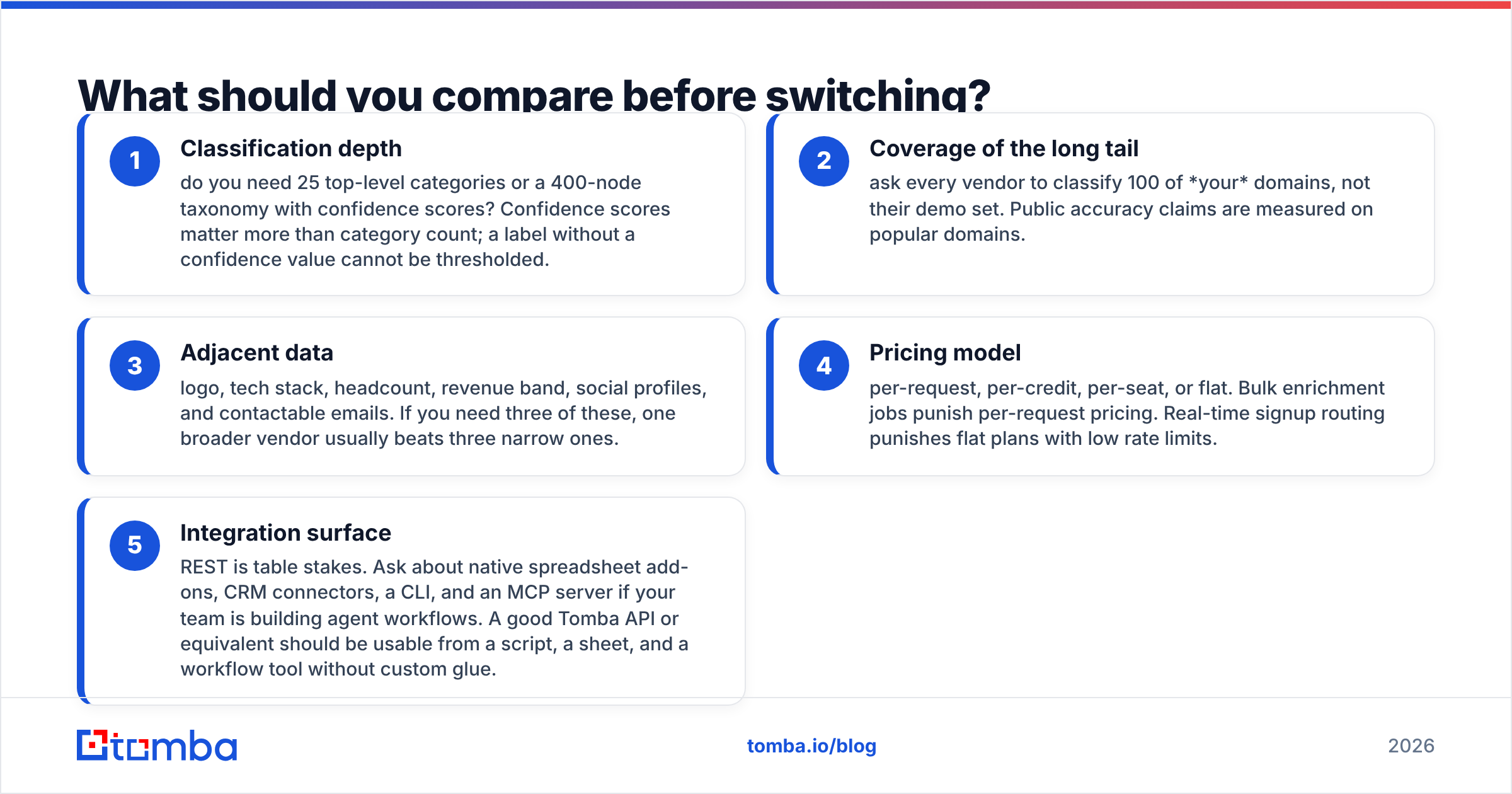
- Classification depth — do you need 25 top-level categories or a 400-node taxonomy with confidence scores? Confidence scores matter more than category count; a label without a confidence value cannot be thresholded.
- Coverage of the long tail — ask every vendor to classify 100 of your domains, not their demo set. Public accuracy claims are measured on popular domains.
- Adjacent data — logo, tech stack, headcount, revenue band, social profiles, and contactable emails. If you need three of these, one broader vendor usually beats three narrow ones.
- Pricing model — per-request, per-credit, per-seat, or flat. Bulk enrichment jobs punish per-request pricing. Real-time signup routing punishes flat plans with low rate limits.
- Integration surface — REST is table stakes. Ask about native spreadsheet add-ons, CRM connectors, a CLI, and an MCP server if your team is building agent workflows. A good Tomba API or equivalent should be usable from a script, a sheet, and a workflow tool without custom glue.
Which Klazify alternatives are worth evaluating in 2026?#
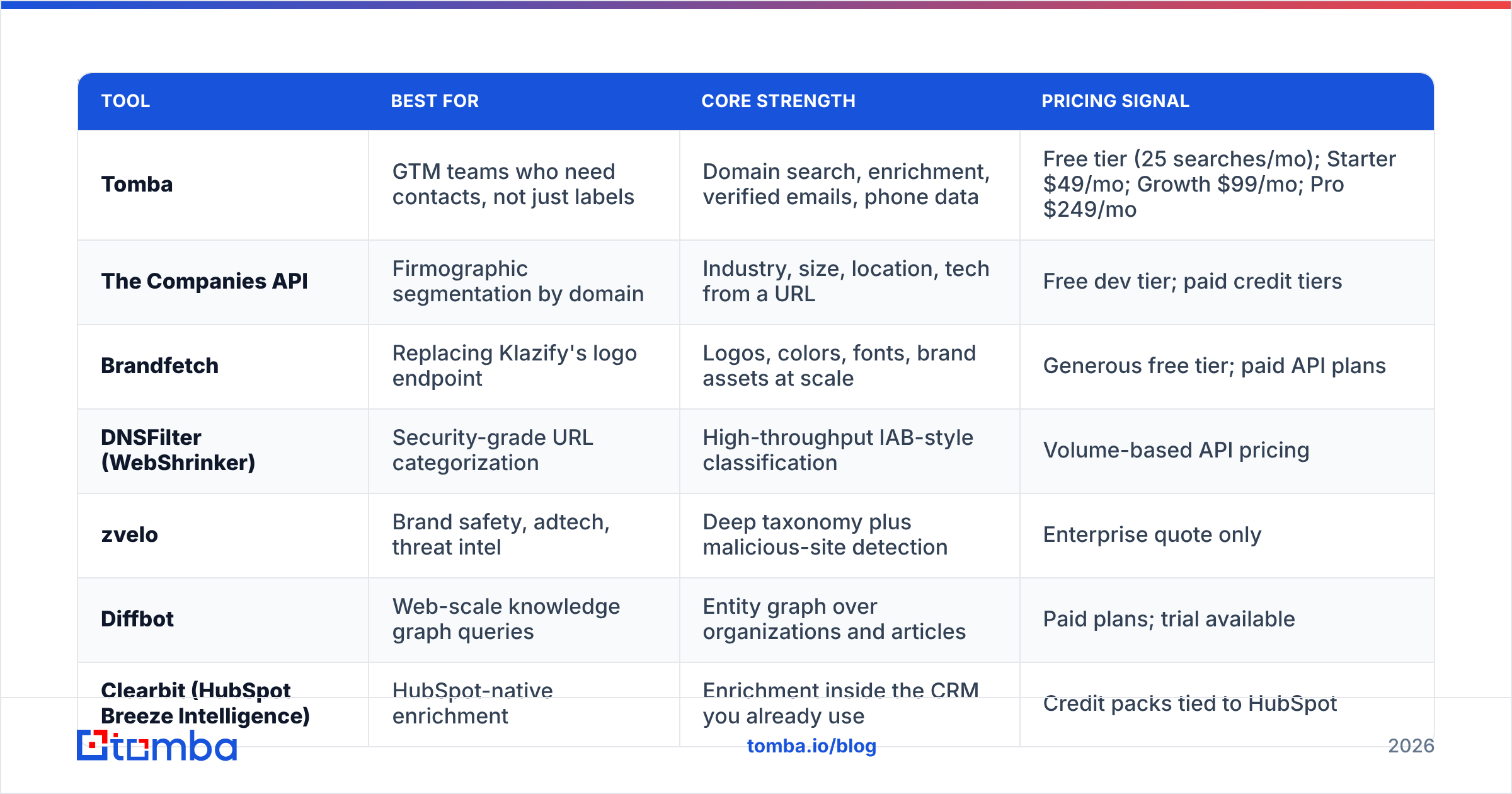
| Tool | Best for | Core strength | Pricing signal |
|---|---|---|---|
| Tomba | GTM teams who need contacts, not just labels | Domain search, enrichment, verified emails, phone data | Free tier (25 searches/mo); Starter $49/mo; Growth $99/mo; Pro $249/mo |
| The Companies API | Firmographic segmentation by domain | Industry, size, location, tech from a URL | Free dev tier; paid credit tiers |
| Brandfetch | Replacing Klazify's logo endpoint | Logos, colors, fonts, brand assets at scale | Generous free tier; paid API plans |
| DNSFilter (WebShrinker) | Security-grade URL categorization | High-throughput IAB-style classification | Volume-based API pricing |
| zvelo | Brand safety, adtech, threat intel | Deep taxonomy plus malicious-site detection | Enterprise quote only |
| Diffbot | Web-scale knowledge graph queries | Entity graph over organizations and articles | Paid plans; trial available |
| Clearbit (HubSpot Breeze Intelligence) | HubSpot-native enrichment | Enrichment inside the CRM you already use | Credit packs tied to HubSpot |
| BookYourData | Buying ready-built verified lists | Pay-as-you-go B2B contact data, no subscription required | Pay-per-record |
Vendor pricing changes often. Treat the figures above as a starting point and confirm on each vendor's own page before you commit.
Is Tomba a real Klazify alternative?#
Partly — and the honest framing matters. Tomba does not sell IAB content classification. If your job is "label 10 million URLs for a brand-safety filter," Tomba is the wrong tool and DNSFilter or zvelo is the right one.
What Tomba replaces is the other half of Klazify: the company-data and email-to-domain endpoints that GTM teams actually use. Where Klazify answers "what kind of site is this?", domain search answers "who works here and how do I reach them?" — returning the email pattern for a domain plus named contacts with roles and departments.
The practical stack looks like this: use data enrichment to expand a raw domain list into firmographics and contacts, verify the results, then push to CRM. If you specifically needed Klazify's logo endpoint, Tomba's free company logo tool covers the simple case.
| Capability | Klazify | Tomba |
|---|---|---|
| IAB content categories | Yes | No |
| Logo from domain | Yes | Yes (free tool + API) |
| Company firmographics | Yes | Yes |
| Named contacts per domain | Limited | Yes (domain search) |
| Email verification | No | Yes (dedicated verifier) |
| Catch-all handling | No | Yes |
| Phone numbers | No | Yes |
| Free tier | Limited trial | 25 searches/mo |
| Entry paid price | Check vendor page | $49/mo |
Is The Companies API better for firmographics?#
For pure "domain in, industry and size out," The Companies API is one of the cleanest swaps. It was built for B2B segmentation rather than ad targeting, so its taxonomy speaks in industries and business types instead of content genres. That single difference solves complaint #1 above for most revenue teams.
Trade-off: it is a firmographics product, not a classification engine. If you need to know that a URL hosts gambling content, this is not your vendor.
Is Brandfetch the right replacement for logo extraction?#
If you migrated to Klazify mainly for logos — a surprisingly common path, because logo-from-domain is a deceptively hard problem — Brandfetch is the specialist. It returns logos in multiple formats, plus brand colors and typefaces, which is more than most classification APIs bother with.
Use it when your product renders company logos in-app (customer directories, CRM avatars, ABM dashboards). Do not use it as a general enrichment source; that is not what it is.
Are DNSFilter and zvelo overkill?#
For a 5,000-domain marketing list, yes. For anything where a misclassification has a security or compliance consequence, no.
DNSFilter's WebShrinker and zvelo both classify at a scale and latency profile built for DNS-layer filtering — millions of lookups, sub-100ms responses, plus malicious and phishing domain detection that marketing-oriented APIs do not attempt. If you are building content filtering, parental controls, brand-safety checks, or ad-fraud screening, these are the serious answers.
Cost is the catch. Both price for volume and zvelo is quote-only, so short evaluations are harder to run than with a self-serve API.
What about Diffbot and Clearbit?#
Diffbot is a different shape entirely: a knowledge graph built by crawling and structuring the web. You can query it for organizations, people, articles, and the relationships between them. If your use case is research or market mapping rather than per-request lookups, it is more powerful than anything else on this list — and priced accordingly.
Clearbit, now folded into HubSpot as Breeze Intelligence, is the pragmatic choice if your company already lives in HubSpot. Enrichment happens inside the CRM with no integration work. The trade-off is lock-in: the data is easiest to use where HubSpot decides it is useful, and credits are tied to your HubSpot subscription rather than sold independently.

Where does BookYourData fit?#
BookYourData solves an adjacent problem well: instead of enriching a domain list you already have, you buy a targeted contact list built to your filters, pay per record, and skip the subscription entirely. For teams running a one-off campaign into a new segment — where you have no domain list to classify yet — that is a faster path than any API.
It sits beside categorization tools rather than replacing them. A common pattern is to buy the initial list, then use an API layer for ongoing enrichment of inbound signups.
How accurate is website categorization, really?#
Treat every published accuracy number with suspicion, including good ones. Here is why.
Classification accuracy is measured against a labeled test set, and the vendor chooses the set. Popular domains are easy — every engine on earth classifies a major retailer correctly. The variance appears on:
- Single-page sites with under 100 words of copy
- Domains under 90 days old
- Non-English sites
- Parked or redirected domains
- Companies whose product does not match their content (a fintech blog that reads like a media site)
The only benchmark that means anything is your own. Pull 300 domains from your actual pipeline, label 100 of them by hand, and score each vendor's output against your labels. Budget an afternoon. It will change your shortlist more than any review site will.
Apply the same skepticism to contact data. An email that looks plausible is worthless; an email that passes SMTP-level verification is an asset. Whatever vendor you choose, keep a verification step between enrichment and send.
How do you migrate off Klazify without breaking production?#
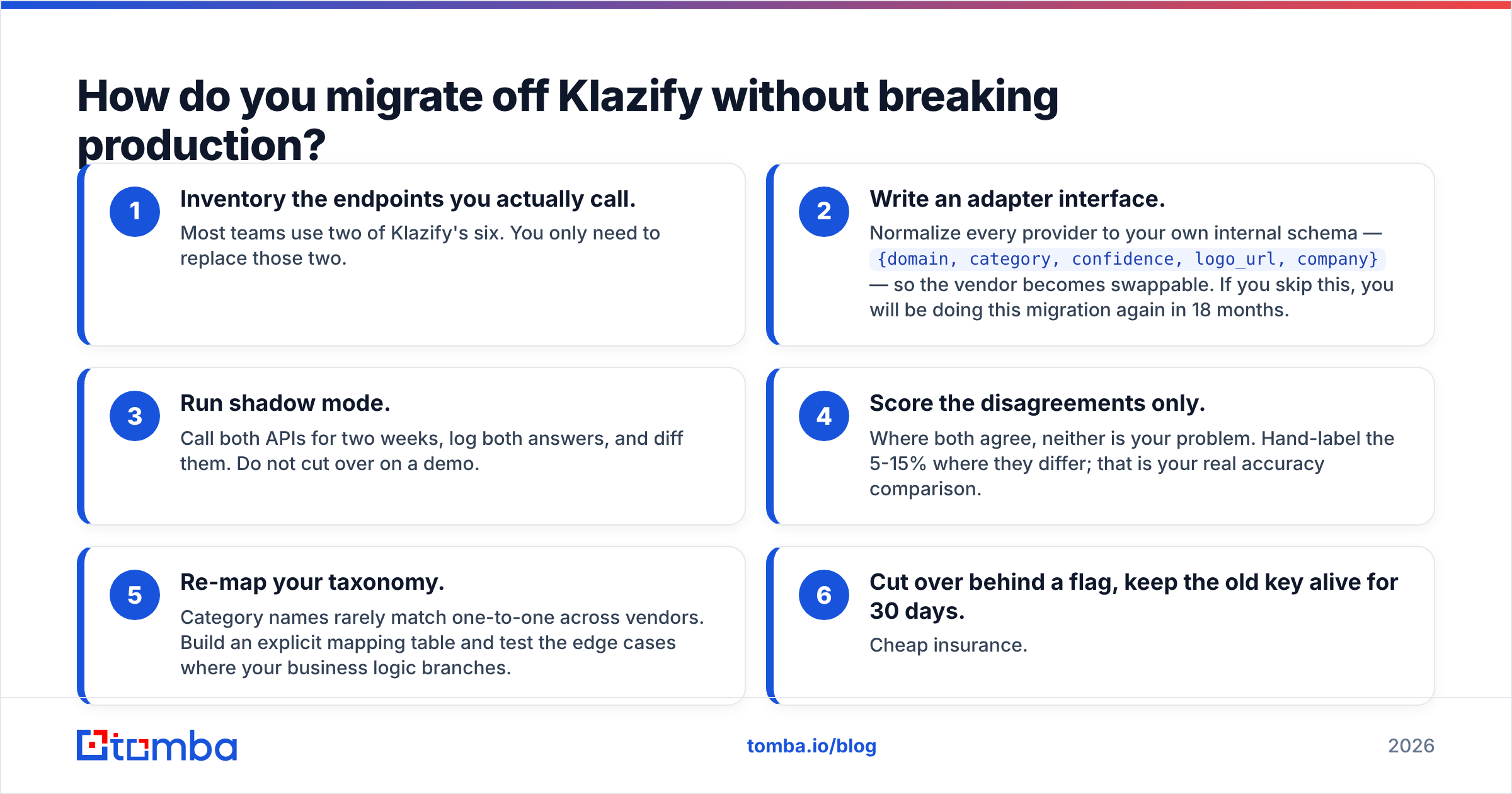
Six steps, in order:
- Inventory the endpoints you actually call. Most teams use two of Klazify's six. You only need to replace those two.
- Write an adapter interface. Normalize every provider to your own internal schema —
{domain, category, confidence, logo_url, company}— so the vendor becomes swappable. If you skip this, you will be doing this migration again in 18 months. - Run shadow mode. Call both APIs for two weeks, log both answers, and diff them. Do not cut over on a demo.
- Score the disagreements only. Where both agree, neither is your problem. Hand-label the 5-15% where they differ; that is your real accuracy comparison.
- Re-map your taxonomy. Category names rarely match one-to-one across vendors. Build an explicit mapping table and test the edge cases where your business logic branches.
- Cut over behind a flag, keep the old key alive for 30 days. Cheap insurance.
Which Klazify alternative should you pick?#
- You need labels at web scale, with security implications → DNSFilter or zvelo.
- You need B2B industry segmentation → The Companies API.
- You need logos and brand assets → Brandfetch.
- You live in HubSpot → Breeze Intelligence.
- You need a research-grade entity graph → Diffbot.
- You need a list right now, with no infrastructure → BookYourData.
- You need domains turned into people you can actually contact → Tomba.
That last case is the most common one hiding behind a "Klazify alternatives" search. Teams think they have a classification problem. They usually have a contactability problem wearing a classification costume.
Start with the outcome, not the label#
If your categorization API exists so that a rep can eventually send an email or make a call, skip a step. Point Tomba Email Finder at a domain and get verified addresses, roles, and company context back in one call — then verify before you send. The free tier gives you 25 searches a month to test it against your own domain list, and paid plans start at $49/mo if it holds up. Check current Tomba pricing before you commit, and run it side by side with whatever you use today for a week. Your own domains are the only benchmark that counts.
Related guides#
Ready to find emails that actually work?
Join 150,000+ professionals who stopped guessing and started sending. Free credits on signup — no credit card required.
Get the Tomba newsletter
Practical outbound tactics and product updates — once every two weeks.
About the author