Klazify Pricing 2026: Reviews, Pros, Cons, and Real Costs
Klazify classifies domains, pulls logos, and reads tech stacks — but what does it really cost once your call volume grows? A neutral breakdown of plans, limits, reviews, and the gaps you'll need to fill elsewhere.
TL;DR
- Klazify is a website and domain classification API: give it a URL or an email domain, get back an IAB-style category, a logo, social profiles, tech stack signals, and basic company metadata.
- Klazify pricing is call-based and tiered. There's a free trial tier for evaluation, mid-tier monthly plans for small production workloads, and custom enterprise quotes above that. The cost that bites you is not the sticker price — it's the per-call ceiling.
- Reviews are thin but consistent: people like the breadth of endpoints and the speed of integration; they complain about category granularity on small or non-English sites and about overage behavior.
- Klazify does not give you people-level contact data. If your goal is pipeline, you still need an email finder and verifier on top.
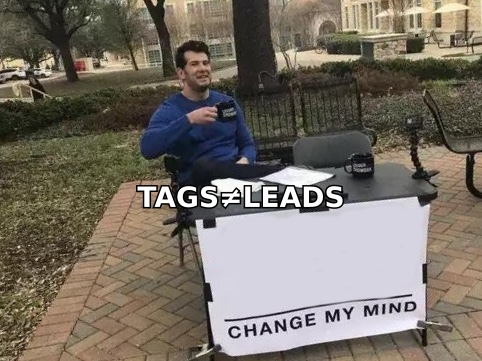
- Best fit: adtech, fintech merchant classification, content filtering, and firmographic tagging. Worst fit: teams who think a category tag is a lead.
What is Klazify, and what does it actually do?#
Klazify is a domain intelligence API. You send it a website URL or an email domain; it sends back structured facts about that domain. Think of it as a librarian, not a phone book — it tells you which shelf a company belongs on, not who works there.
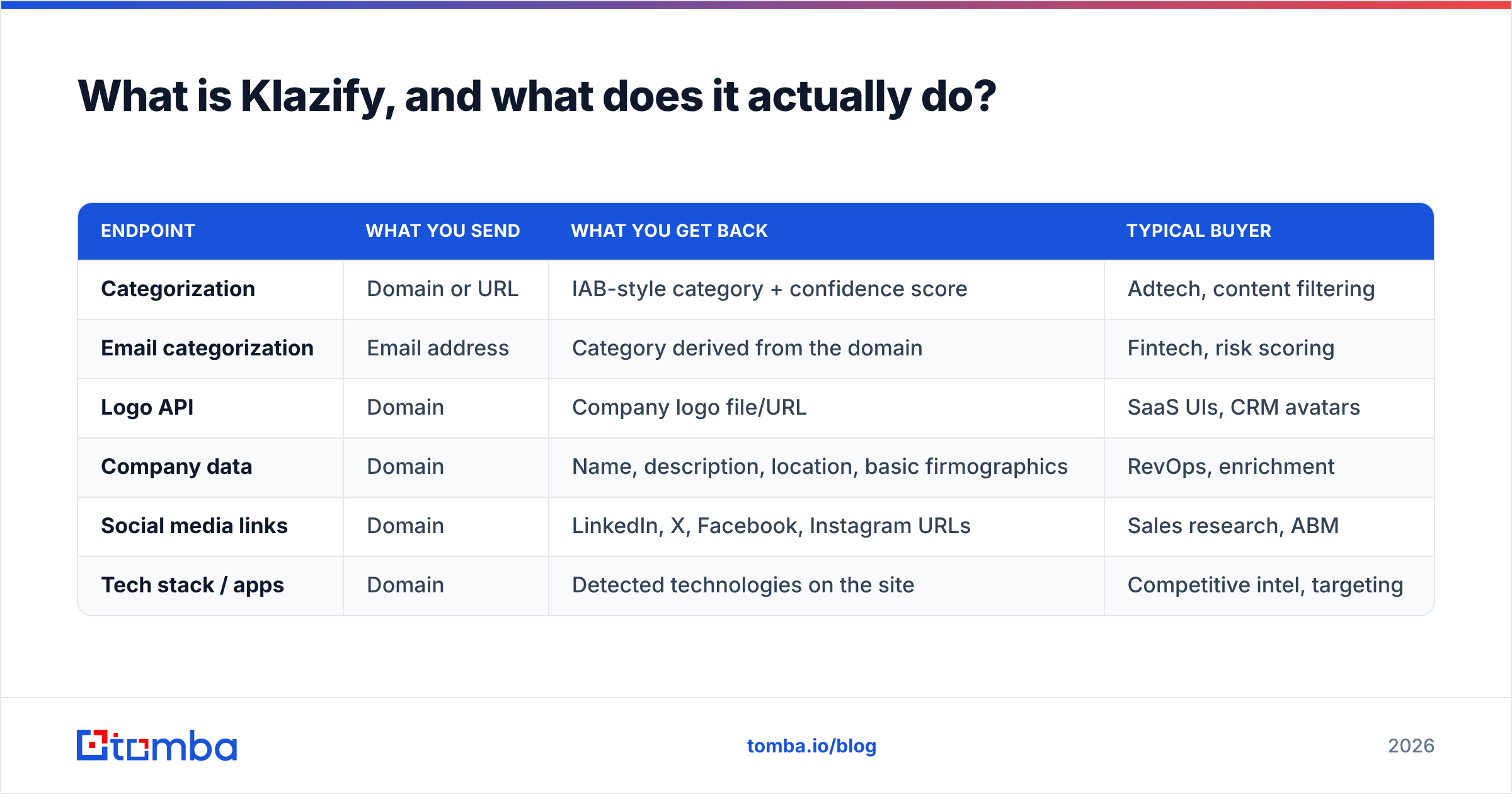
The product is really a bundle of endpoints sitting behind one API key. That matters for pricing, because most plans meter all of them from the same pool of calls.
| Endpoint | What you send | What you get back | Typical buyer |
|---|---|---|---|
| Categorization | Domain or URL | IAB-style category + confidence score | Adtech, content filtering |
| Email categorization | Email address | Category derived from the domain | Fintech, risk scoring |
| Logo API | Domain | Company logo file/URL | SaaS UIs, CRM avatars |
| Company data | Domain | Name, description, location, basic firmographics | RevOps, enrichment |
| Social media links | Domain | LinkedIn, X, Facebook, Instagram URLs | Sales research, ABM |
| Tech stack / apps | Domain | Detected technologies on the site | Competitive intel, targeting |
The categorization engine leans on the IAB Content Taxonomy, which is the same standard ad platforms use to classify inventory. If your downstream system already speaks IAB, that alignment saves you a mapping layer — a real, underrated advantage.
What Klazify is not: a contact database. There are no verified work emails, no direct dials, no job titles attached to named humans. That boundary is the single most important thing to understand before you look at a price list.
How does Klazify pricing work in 2026?#
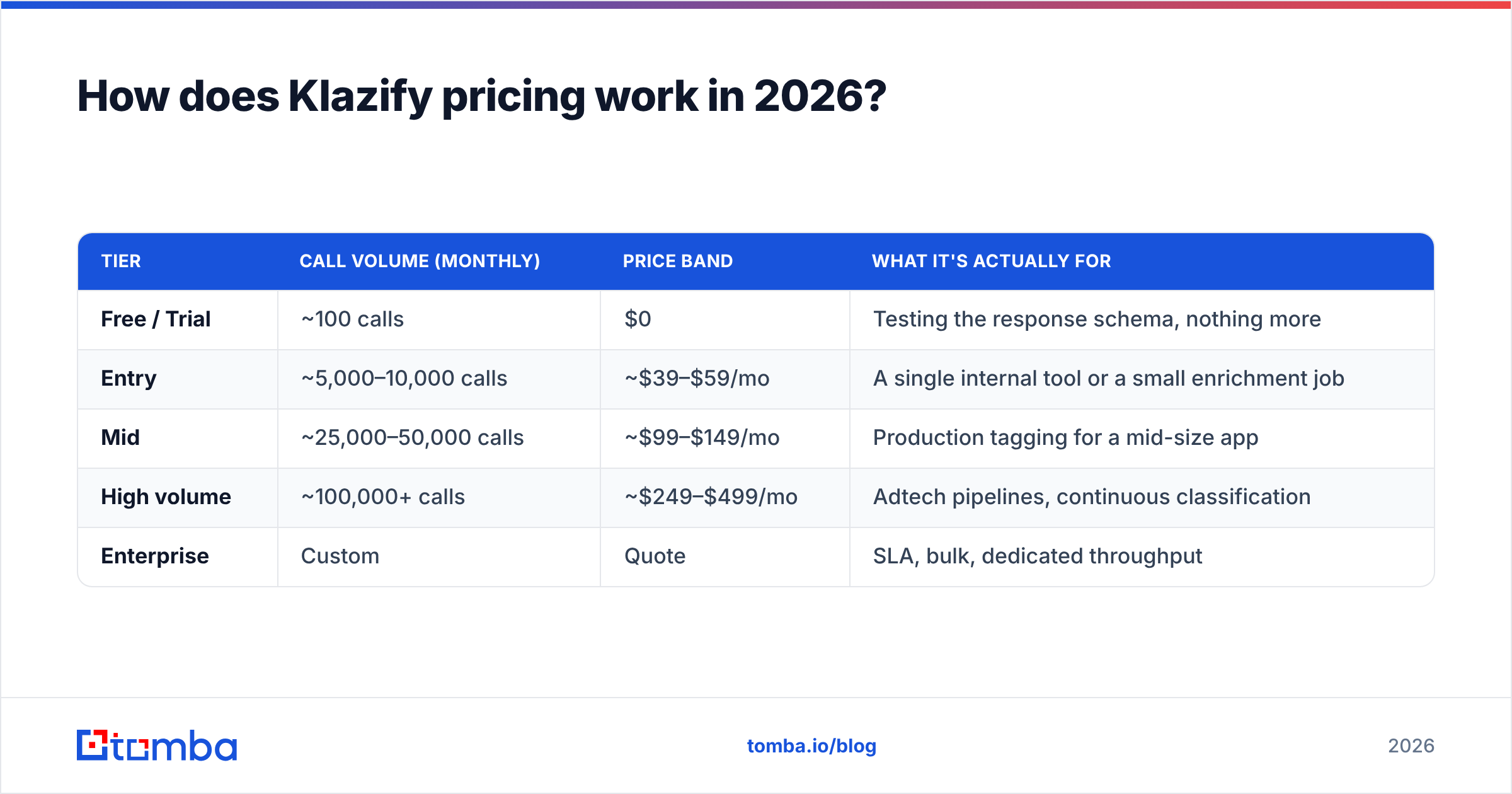
Klazify prices on API calls per month, not seats. Every plan is a bucket of calls; when the bucket empties, you either upgrade or your requests start failing.
A caution before the numbers: Klazify changes list pricing and repackages tiers more often than most vendors, and it sells through both its own site and API marketplaces at different rates. Treat the bands below as the shape of the pricing, and confirm the live figure on the official Klazify pricing page before you commit a budget.
| Tier | Call volume (monthly) | Price band | What it's actually for |
|---|---|---|---|
| Free / Trial | ~100 calls | $0 | Testing the response schema, nothing more |
| Entry | ~5,000–10,000 calls | ~$39–$59/mo | A single internal tool or a small enrichment job |
| Mid | ~25,000–50,000 calls | ~$99–$149/mo | Production tagging for a mid-size app |
| High volume | ~100,000+ calls | ~$249–$499/mo | Adtech pipelines, continuous classification |
| Enterprise | Custom | Quote | SLA, bulk, dedicated throughput |
Three mechanics drive your real bill:
- Every endpoint spends from the same bucket. Fetching a logo costs you the same call as running a categorization. If your product shows logos in a list view, you can burn a month of credits rendering one dashboard.
- Cache misses are the tax. Klazify responses for a given domain rarely change week to week. Teams that don't cache locally pay two to five times what they need to. Build a cache on day one.
- Overage is a wall, not a slope. On most tiers you don't get charged an overage rate — you get throttled or blocked. That's friendlier to the wallet and brutal to a live pipeline that assumed the data would be there.
Compare that to seat-based enrichment tools, where you pay for people who may or may not run a query this month. Klazify's model is honest in that respect: you pay for what you call. It just punishes sloppy engineering harder than most.
What do Klazify reviews actually say?#
Review volume is low. Klazify is a developer tool with a small footprint on G2 and Capterra, so you're reading a handful of reviews plus developer forum chatter rather than a statistically meaningful sample. Weigh that accordingly.
The recurring positives:
- Time to first response is short. Most reviewers get a working call in under fifteen minutes. The docs are plain and the schema is predictable.
- Coverage on well-known domains is strong. For any site with real traffic and an English-language homepage, categorization lands where you'd expect.
- The logo endpoint is quietly the favorite feature. Several reviewers say they came for categorization and stayed for logos, because the alternative is scraping favicons and hating your life.
- Support responds. Slower than enterprise vendors, faster than most $49/mo tools.
The recurring complaints:
- Granularity flattens on niche sites. A specialized B2B manufacturer often lands in a broad "Business" bucket rather than something actionable. If your segmentation depends on tier-3 categories, test your own domain list before you buy.
- Non-English and low-traffic domains are weaker. Classification quality tracks how much public content the site has. Thin sites produce thin answers.
- Company data is shallow. You get a name, a description, a country. You don't get headcount bands, revenue, or funding at the depth a firmographic provider gives you.
- Pricing changes surprise people. More than one reviewer mentions repackaged tiers between renewal cycles.
None of that is disqualifying. It's the normal profile of a focused API priced under $100/mo. The mistake is buying it expecting a full data platform.
What are the pros of Klazify?#
- One key, many endpoints. Categorization, logos, socials, and tech detection behind a single integration is genuinely convenient. Buying those four capabilities separately costs more and triples your vendor management.
- IAB alignment out of the box. If you're doing anything adjacent to advertising, brand safety, or content filtering, getting standard taxonomy codes instead of a vendor's proprietary labels removes a whole mapping project.
- Email-domain classification is a real risk tool. Fintech and marketplace teams use it to sort merchant signups by industry before a human ever looks. That's a legitimate, high-ROI use case that most enrichment vendors handle worse.
- Pricing starts small and scales linearly. No mandatory annual contract at the entry tiers, no seat minimums. You can prove value on $50 before you ask for $500.
- Response schema is stable. Boring, but it means your parser doesn't break monthly. Several competing classification APIs cannot say the same.
What are the cons and hidden costs?#
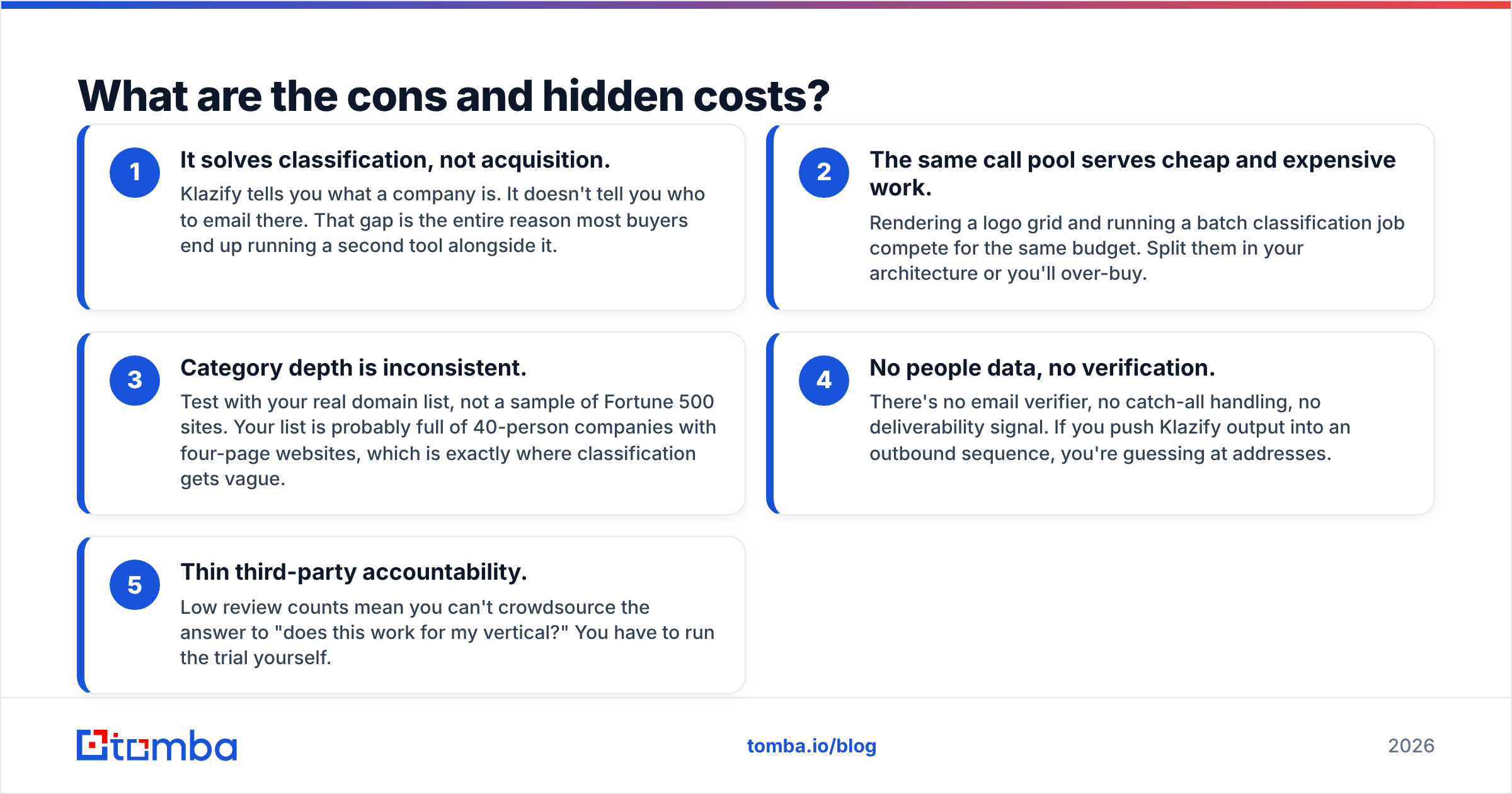
- It solves classification, not acquisition. Klazify tells you what a company is. It doesn't tell you who to email there. That gap is the entire reason most buyers end up running a second tool alongside it.
- The same call pool serves cheap and expensive work. Rendering a logo grid and running a batch classification job compete for the same budget. Split them in your architecture or you'll over-buy.
- Category depth is inconsistent. Test with your real domain list, not a sample of Fortune 500 sites. Your list is probably full of 40-person companies with four-page websites, which is exactly where classification gets vague.
- No people data, no verification. There's no email verifier, no catch-all handling, no deliverability signal. If you push Klazify output into an outbound sequence, you're guessing at addresses.
- Thin third-party accountability. Low review counts mean you can't crowdsource the answer to "does this work for my vertical?" You have to run the trial yourself.
Klazify vs. the alternatives: which tool fits which job?#
The comparison most buyers actually need isn't Klazify versus another classifier. It's Klazify versus the thing they're really trying to accomplish.
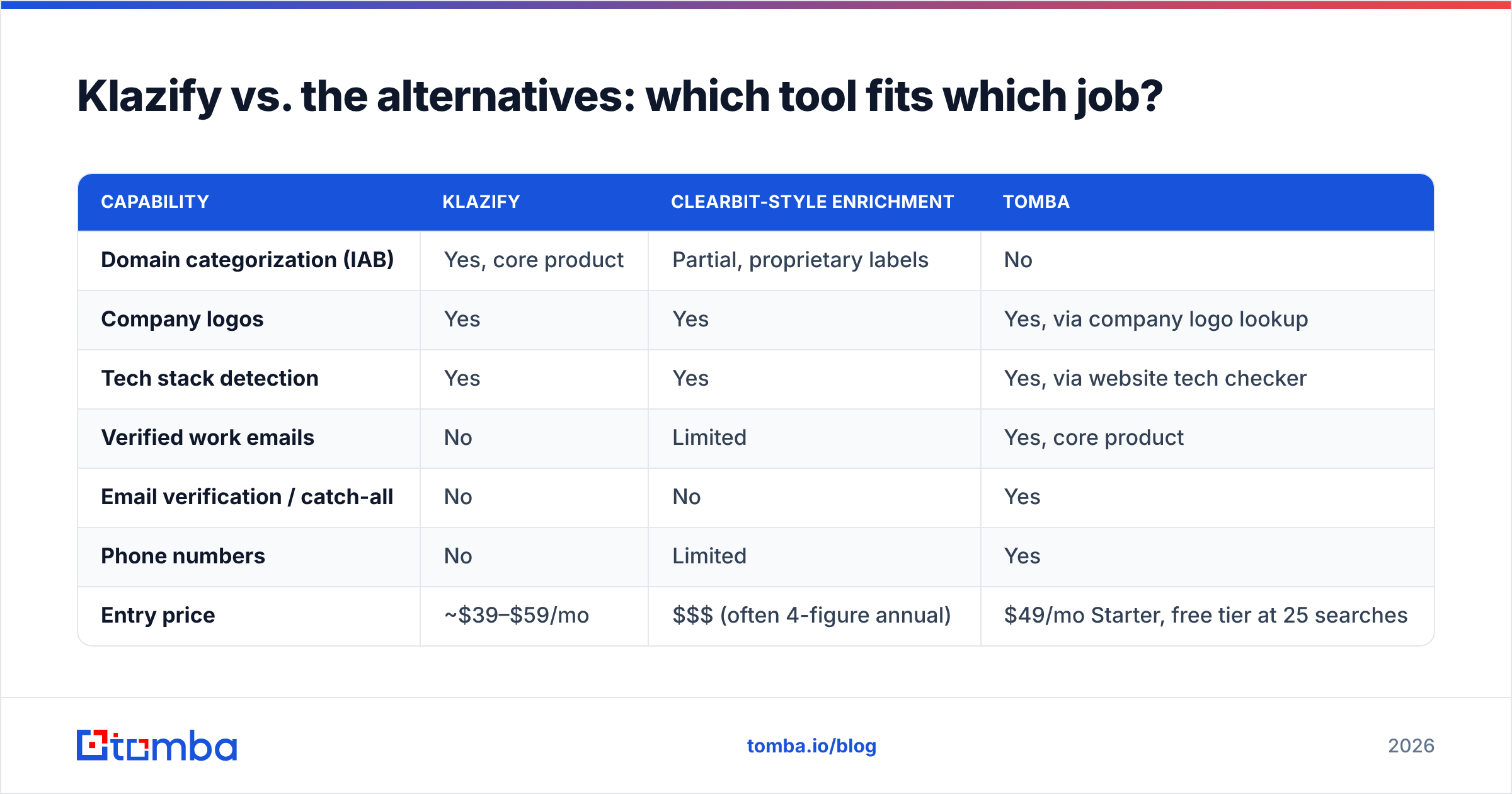
| Capability | Klazify | Clearbit-style enrichment | Tomba |
|---|---|---|---|
| Domain categorization (IAB) | Yes, core product | Partial, proprietary labels | No |
| Company logos | Yes | Yes | Yes, via company logo lookup |
| Tech stack detection | Yes | Yes | Yes, via website tech checker |
| Verified work emails | No | Limited | Yes, core product |
| Email verification / catch-all | No | No | Yes |
| Phone numbers | No | Limited | Yes |
| Entry price | ~$39–$59/mo | $$$ (often 4-figure annual) | $49/mo Starter, free tier at 25 searches |
| Pricing model | Calls/mo | Seats + credits, annual | Credits, monthly or annual |
| Best for | Classification, filtering, adtech | Full firmographic platforms | Finding and verifying contacts |
Read that table as a division of labor, not a knockout. A mature go-to-market stack often runs a classifier and a contact-data provider, because they answer different questions. Klazify answers "what is this domain?" A contact tool answers "who do I email, and will it bounce?"
If your evaluation started because someone asked for "better lead data," Klazify is probably the wrong shelf entirely. If it started because someone asked "can we auto-tag 200,000 signup domains by industry," Klazify is a strong, cheap answer.
Who should buy Klazify — and who shouldn't?#
Buy it if:
- You process high volumes of domains or email domains and need consistent category labels.
- You work in adtech, brand safety, content filtering, or merchant risk.
- You need logos and social links inside a product UI and don't want to build scrapers.
- Your engineering team can cache aggressively.
Skip it if:
- Your KPI is meetings booked. Classification doesn't book meetings.
- You need deep firmographics — headcount, revenue, funding, hiring signals.
- Your target list is dominated by tiny or non-English domains.
- You need one vendor to cover both company data and contact data. Klazify covers half.
How do you pair Klazify with a contact-data stack?#
The practical pattern is a two-stage pipeline, and it's cheaper than it sounds.
Stage one — classify and filter. Run your raw domain list through Klazify. Drop anything outside your target categories. If you started with 50,000 domains and your ICP is three IAB categories, you might exit this stage with 6,000. You just cut your downstream contact-data spend by 88 percent.
Stage two — find and verify the humans. Feed the surviving domains into a contact layer. This is where a domain search turns a company into named people with role-mapped email addresses, and where a verifier decides which of those addresses will actually land. Running verification here, after filtering, is the single biggest cost control in the whole pipeline — you never pay to verify contacts at companies you were going to ignore anyway.
Stage three — enrich and route. Merge both payloads into one record: Klazify's category and tech signals plus the contact layer's emails, titles, and phone data. That combined record is what your CRM and scoring model actually want. Data enrichment fills the remaining blanks, and an email finder API keeps the whole thing running without a human touching a CSV.
Sequence matters more than tool choice here. Classify first, enrich second, verify last. Teams that reverse the order routinely pay three times more for the same result.
Is Klazify worth it in 2026?#
Yes — for the job it does. Priced against building your own classifier, scraping logos, and maintaining a tech-detection library, a sub-$150/mo API is a bargain. Priced against the expectation of "lead data," it will disappoint you, and no amount of tier-shopping fixes that.
The honest buying advice: run the free trial against 500 domains from your own list, not a sample. Measure two things — how many come back with a category specific enough to act on, and how many you'd have to re-check manually. If that hit rate clears 80 percent, buy the tier above what you think you need and cache everything. If it doesn't, the problem is category depth, and a bigger plan won't help.
Then be clear about what's still missing. A category tag doesn't have an inbox.
Ready to turn filtered domains into people you can actually contact? Once Klazify has told you which companies fit, Tomba Email Finder finds the verified work emails behind those domains — by company, by name, or in bulk — with a free tier at 25 searches a month and Starter at $49/mo. Check Tomba pricing and run your filtered list through it before you spend another dollar on classification volume you don't need.
Related guides#
// get started
Find, verify and enrich your first contacts today
Start on the free plan with 25 searches a month, then scale when your team is ready.
Free plan · No credit card required · GDPR & CCPA
// about the author