9 Knock AI Alternatives for AI Outbound Teams in 2026
Knock AI bundles prospecting, research, and outreach into one agent, but it is not the only option. Here are nine alternatives compared on data quality, pricing, and how much control you keep over your outbound stack.
TL;DR
- Most teams leave Knock AI for one of three reasons: contact data that does not hold up at scale, pricing that jumps when seat count or credit usage grows, or an agent that writes copy they end up rewriting anyway.
- There is no single drop-in replacement. The honest answer is that "Knock AI alternatives" splits into two camps: all-in-one AI SDR platforms (Regie, Artisan, 11x, Clay-style orchestration) and data-first stacks you assemble yourself (a finder + verifier + your own sequencer).
- If your bottleneck is copy and workflow, an all-in-one agent is a reasonable swap. If your bottleneck is bounce rate and wrong contacts, no agent fixes that. Fix the data layer first.
- Budget reality: all-in-one AI SDR tooling generally starts around $300–$1,500/mo. A data-first stack built on a finder like Tomba ($49/mo Starter, $99/mo Growth) plus a sequencer usually lands well under that.
- Run any shortlist through the same test: 200 real target accounts, same ICP, same week. Measure valid-email rate, cost per verified contact, and reply rate. Demos lie; a 200-row bake-off does not.
What is Knock AI, and why are teams looking for alternatives?#
Knock AI sits in the AI sales-agent category: software that takes an ICP definition, sources accounts and contacts, researches them, drafts personalized outreach, and pushes it into a sequence with minimal human keystrokes. It is the same promise the whole AI sales assistant category has been making since 2024 — compress the SDR workflow into one agent.
The promise is genuinely useful. The friction shows up in three predictable places.
First, data provenance. Agentic tools resell contact data from upstream providers. When an agent hands you an email address, you often cannot tell whether it was verified this week, inferred from a pattern, or scraped eighteen months ago. That matters because your sending domain absorbs the cost of every bad address.
Second, pricing shape. Agent platforms tend to price per "workflow," per agent, or per enriched record, and those units are easy to burn through once you scale from one rep to a team. Teams that budgeted for a pilot often see a very different number at renewal.
Third, output control. An agent that drafts 500 emails a week is only helpful if you ship those emails. Many teams discover they are editing 80% of the output, at which point the agent is an expensive first draft generator rather than an SDR.
If any of those three describe your experience, the shortlist below is worth an hour.
What should you actually compare in a Knock AI alternative?#
Ignore feature-count marketing. Five variables predict whether a switch works:
- Verified-email rate on YOUR ICP, not the vendor's benchmark. A tool that hits 95% on US mid-market SaaS may hit 60% on European manufacturing or Gulf-region logistics. Test on your accounts.
- Cost per verified contact, not per credit. If a platform charges one credit per lookup and 35% of lookups return unusable data, your real unit cost is roughly 1.5x the sticker.
- Where the agent stops and you start. Some tools draft and stop. Some send autonomously. Decide which you want before the demo, because reversing that decision mid-deployment is painful.
- Sequencer lock-in. If the AI layer owns your sending infrastructure, switching later means rebuilding sequences, reputations, and reporting. Separated layers cost slightly more to wire up and are dramatically cheaper to leave.
- API and workflow access. Can you call the data layer from your own scripts, Clay tables, or n8n flows? Teams with a RevOps function almost always end up wanting this. An email finder API that you can hit programmatically is worth more over two years than a prettier UI.
A useful gut check from HubSpot's sales research: the constraint on most outbound teams is not volume of messages sent, it is relevance and reachability. Tools that improve targeting and deliverability beat tools that improve raw output.
Which Knock AI alternatives are worth shortlisting in 2026?#
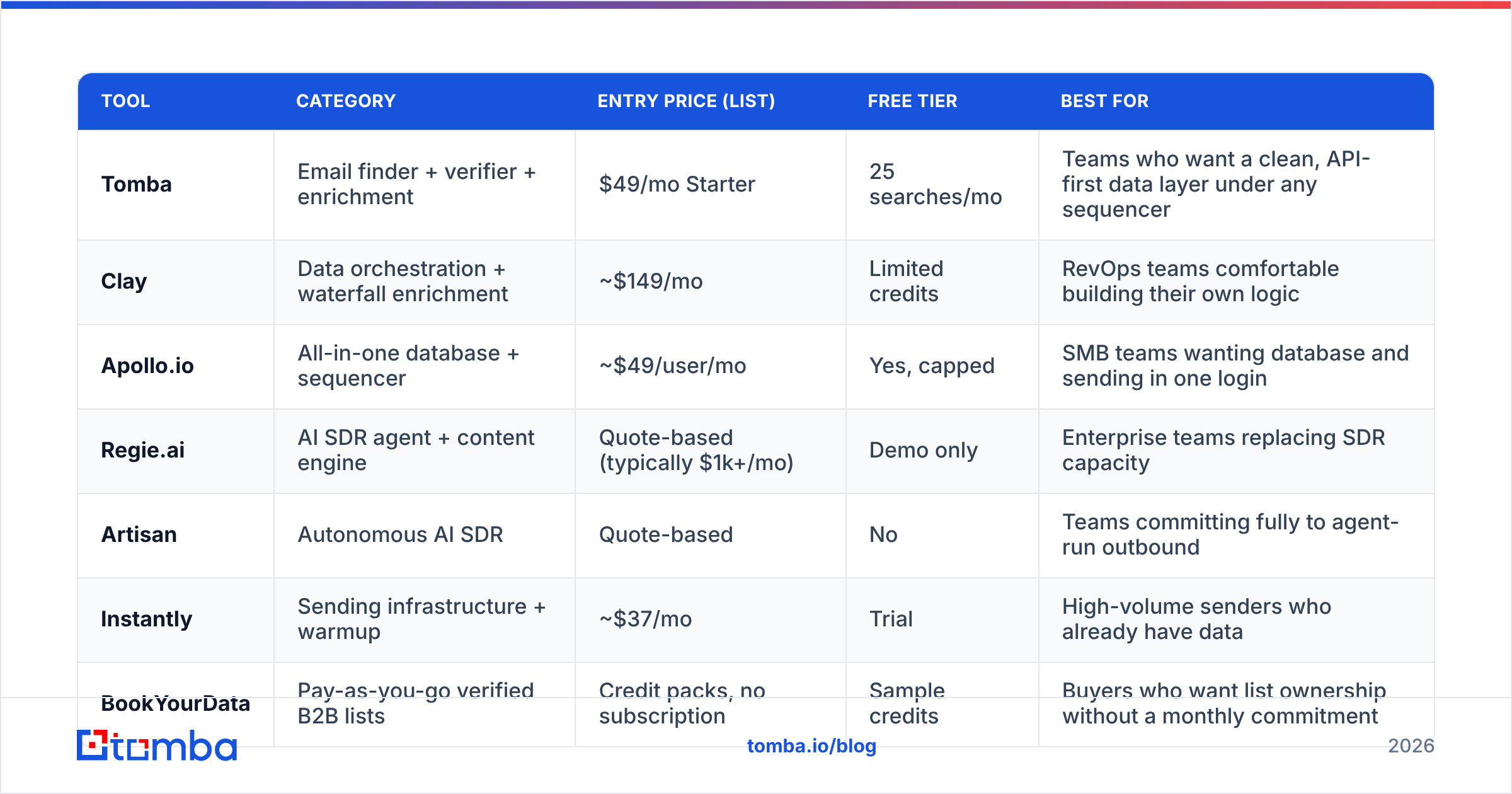
Here is the head-to-head. Pricing reflects publicly listed entry tiers at the time of writing and changes frequently — confirm on each vendor's own pricing page before you commit.
| Tool | Category | Entry price (list) | Free tier | Best for |
|---|---|---|---|---|
| Tomba | Email finder + verifier + enrichment | $49/mo Starter | 25 searches/mo | Teams who want a clean, API-first data layer under any sequencer |
| Clay | Data orchestration + waterfall enrichment | ~$149/mo | Limited credits | RevOps teams comfortable building their own logic |
| Apollo.io | All-in-one database + sequencer | ~$49/user/mo | Yes, capped | SMB teams wanting database and sending in one login |
| Regie.ai | AI SDR agent + content engine | Quote-based (typically $1k+/mo) | Demo only | Enterprise teams replacing SDR capacity |
| Artisan | Autonomous AI SDR | Quote-based | No | Teams committing fully to agent-run outbound |
| Instantly | Sending infrastructure + warmup | ~$37/mo | Trial | High-volume senders who already have data |
| BookYourData | Pay-as-you-go verified B2B lists | Credit packs, no subscription | Sample credits | Buyers who want list ownership without a monthly commitment |
| Lemlist | Multichannel sequencer with light enrichment | ~$69/mo | Trial | Small teams blending email and LinkedIn |
| Smartlead | Deliverability-focused sending at scale | ~$39/mo | Trial | Agencies running many mailboxes |
Read that table as two clusters, not nine competitors. Regie and Artisan compete with Knock AI head-on. Everything else replaces part of it — and usually for less money combined.
Is an all-in-one AI SDR better than a data-first stack?#
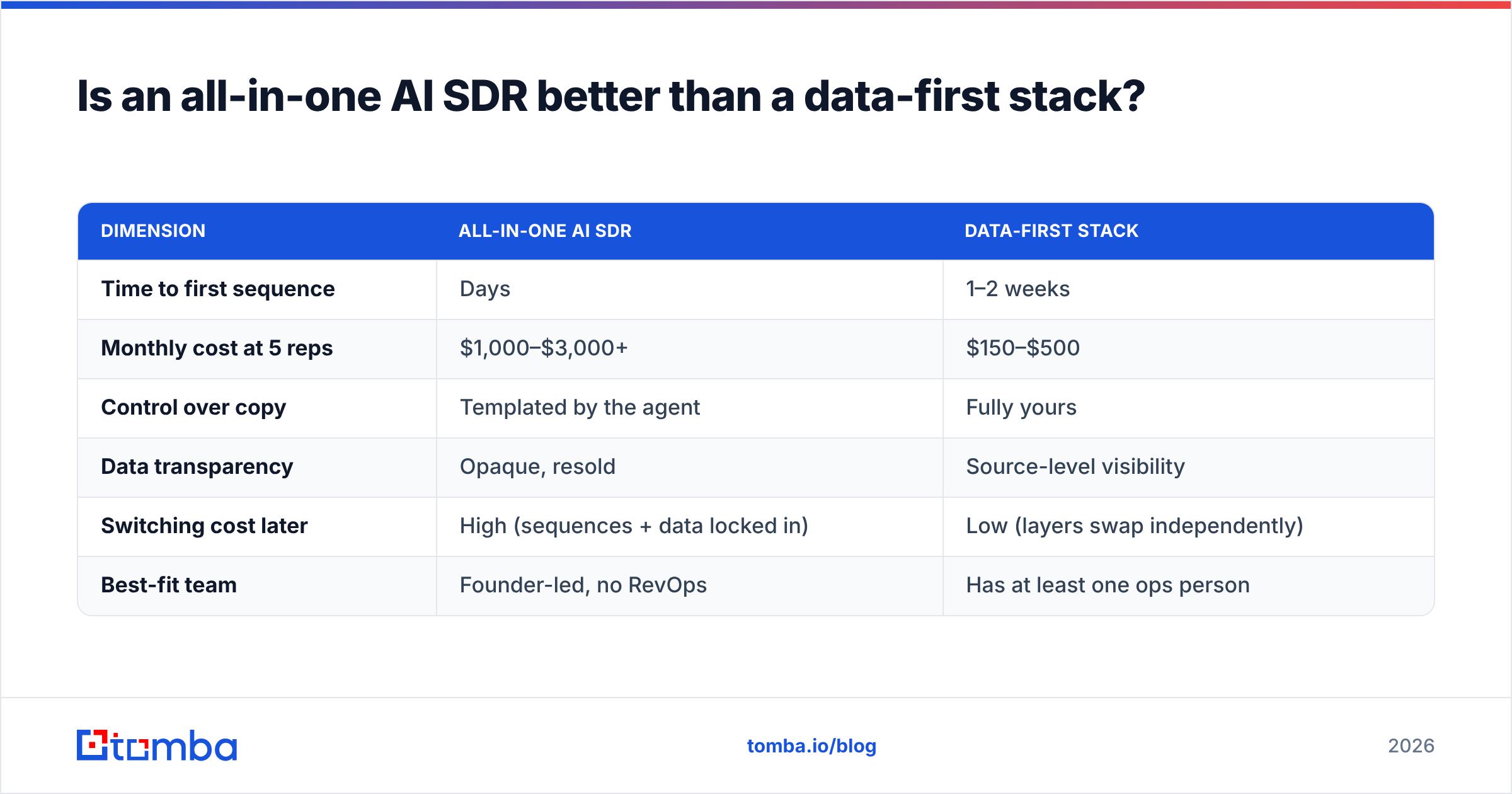
Short answer: an all-in-one agent is better when your team is small and your process is undefined. A data-first stack is better once you know what works and want to control unit economics.
Here is the tradeoff laid bare:
| Dimension | All-in-one AI SDR | Data-first stack |
|---|---|---|
| Time to first sequence | Days | 1–2 weeks |
| Monthly cost at 5 reps | $1,000–$3,000+ | $150–$500 |
| Control over copy | Templated by the agent | Fully yours |
| Data transparency | Opaque, resold | Source-level visibility |
| Switching cost later | High (sequences + data locked in) | Low (layers swap independently) |
| Best-fit team | Founder-led, no RevOps | Has at least one ops person |
The mistake teams make is assuming the agent's personalization makes up for weak contact data. It does not. A perfectly personalized email to john.smith@ at a domain where the format is actually jsmith@ bounces exactly as hard as a generic one. Gartner's sales research has been consistent on this for years: data quality is the input that gates every downstream metric.
That is the argument for putting a dedicated email verifier in front of whatever sending layer you choose, regardless of which alternative you pick.
How do the individual alternatives actually differ?#
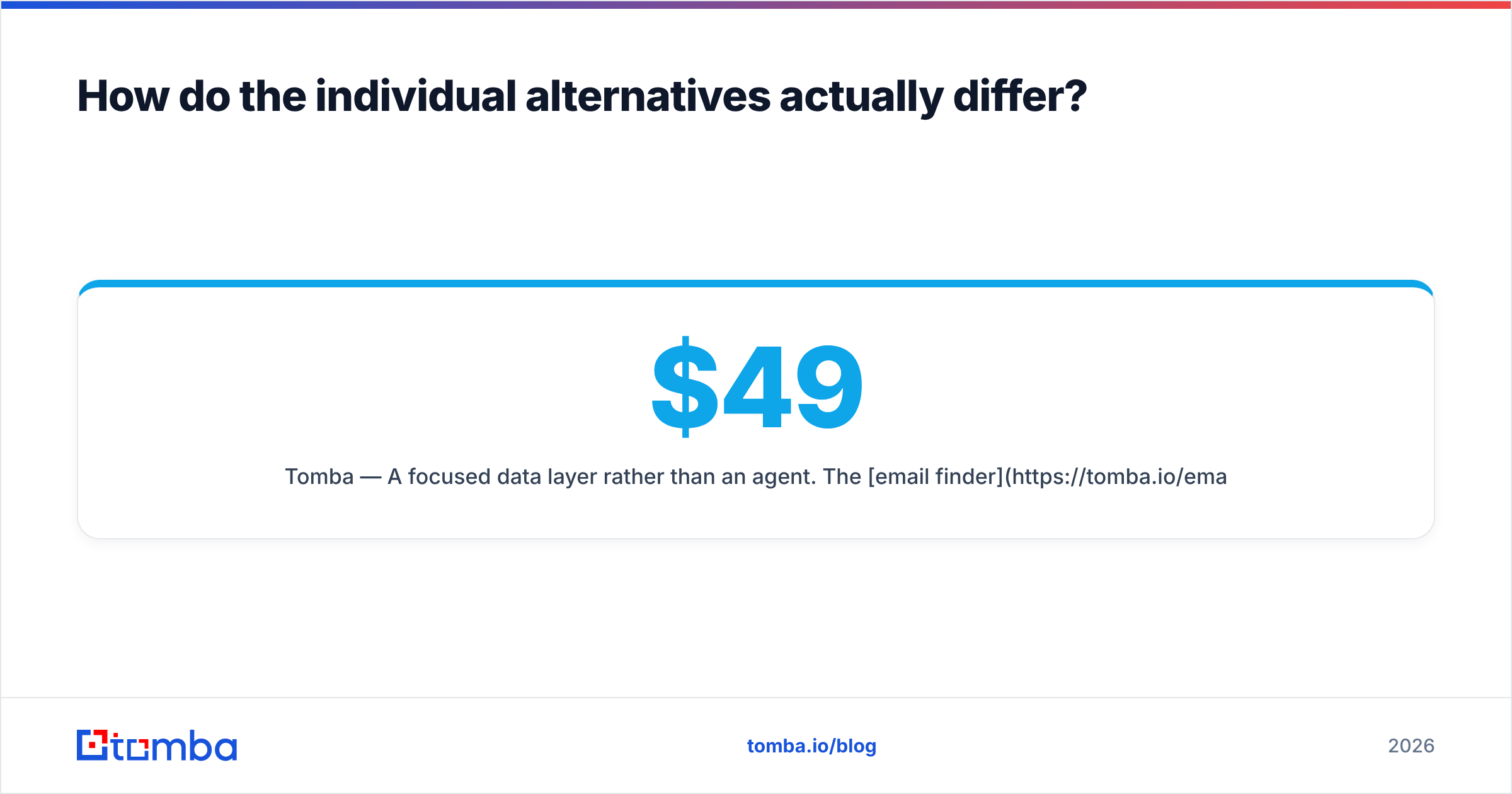
Tomba — A focused data layer rather than an agent. The email finder resolves contacts by domain, name, or company; verification, catch-all checking, phone lookup, and data enrichment sit alongside it. Free tier is 25 searches/mo, Starter is $49/mo, Growth $99/mo, Pro $249/mo, Enterprise custom. There is no built-in sequencer, which is the point: you keep your sending stack and swap the data underneath it. Strongest fit if you want API, CLI, Sheets, and CRM access to the same dataset.
Clay — The most flexible option on the list and the steepest curve. Clay waterfalls across multiple data vendors, which raises coverage but makes cost per record harder to predict. Excellent if you have someone who enjoys building tables. Overkill if you just need emails.
Apollo.io — Database plus sequencer plus dialer in one seat-priced product. Convenient for SMB teams; the usual complaint is data staleness in smaller markets and credit limits that bind faster than expected. If you like the model but not the execution, the Apollo alternative breakdown covers the substitution in detail.
Regie.ai and Artisan — The true head-to-head replacements for Knock AI. Both run agent-led prospecting with human-in-the-loop review. Both are priced as headcount substitutes, meaning four figures monthly. Evaluate them against the fully loaded cost of an SDR, not against a software budget, or the number will look absurd.
Instantly and Smartlead — Sending infrastructure, not data. They solve mailbox rotation, warmup, and deliverability. Pair either with a verified data source and you have covered most of what an agent platform bundles, at a fraction of the cost.
BookYourData — A different purchasing model worth knowing about: pay-as-you-go credits for verified B2B contacts with no subscription. For teams doing occasional campaigns rather than always-on outbound, one-off list purchases can be more rational than a monthly platform fee. It is a legitimate fit for spiky demand.
Lemlist — Multichannel sequencing with a friendly UI and decent LinkedIn integration. Light on data depth, strong on execution ergonomics.
How do you migrate off Knock AI without losing pipeline?#
Do it in parallel, never as a cutover. A five-step sequence that works:
- Export everything first. Contacts, sequences, reply history, and any custom fields. Do this while your account is still active — export access frequently disappears at cancellation.
- Re-verify the exported list. Assume nothing in it is current. Run the whole file through bulk verification and watch the invalid rate; that number tells you how good your old data actually was.
- Run a 200-account bake-off. Same ICP, same offer, same week, two sources. Compare valid-email rate, cost per verified contact, and reply rate. Two weeks of data beats two hours of demos.
- Rebuild sequences in a sender you own. If you are moving to a data-first stack, get the sending layer stable before you increase volume. Warm up new domains properly.
- Cancel only after 30 days of overlap. Paying twice for one month is cheaper than a pipeline gap in the next quarter.
Step two is where most teams get their real answer. If a meaningful share of your existing contacts fails verification, the problem was never the AI copywriting.
What does the switch actually cost?#
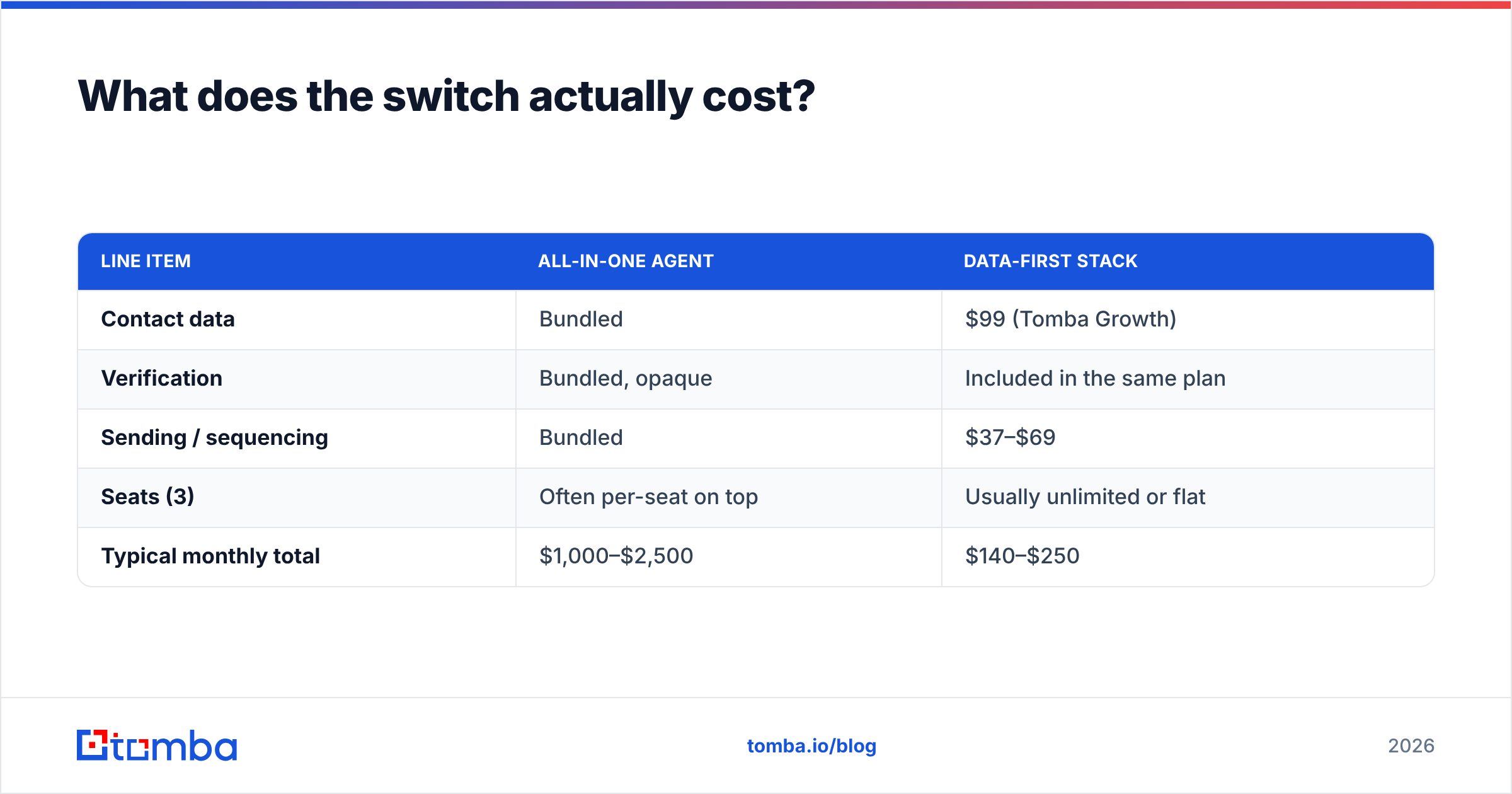
A representative three-rep team, monthly:
| Line item | All-in-one agent | Data-first stack |
|---|---|---|
| Contact data | Bundled | $99 (Tomba Growth) |
| Verification | Bundled, opaque | Included in the same plan |
| Sending / sequencing | Bundled | $37–$69 |
| Seats (3) | Often per-seat on top | Usually unlimited or flat |
| Typical monthly total | $1,000–$2,500 | $140–$250 |
The gap is not free money. You are trading dollars for setup time and an ops owner. If nobody on your team will own that wiring, the agent platform is genuinely the better buy. Be honest about which situation you are in — see the full Tomba pricing breakdown if you want to model the data-layer side precisely.
Which alternative should you pick?#
- You have no RevOps and need pipeline next month: Regie.ai or Artisan. Pay for the capacity.
- You have an ops person and a defined ICP: Tomba for data, Instantly or Smartlead for sending. Lowest long-run cost, most control.
- Your outbound is seasonal or campaign-based: BookYourData credits, no subscription overhead.
- You want one login and accept some data staleness: Apollo.io.
- You want to build custom enrichment logic: Clay, with a verified finder underneath it.
Ready to fix the data layer first?#
Whichever agent, sequencer, or platform you land on, it inherits the quality of the contacts you feed it. Start with the Tomba Email Finder — find and verify professional email addresses by domain, name, or company, test it free with 25 searches a month, and see what your real valid-email rate looks like before you sign another annual contract. Then pick the agent that fits what the data actually supports.
Related guides#
// get started
Find, verify and enrich your first contacts today
Start on the free plan with 25 searches a month, then scale when your team is ready.
Free plan · No credit card required · GDPR & CCPA
// about the author