Knock AI Pricing, Reviews, Pros and Cons: A 2026 Breakdown
Knock AI promises AI-driven visitor identification and outbound in one platform — but the price list is quote-gated. Here is what buyers actually report paying, where the tool earns its keep, and where a cheaper stack wins.
TL;DR
- Knock (knock2.ai) is an AI-native GTM platform: it de-anonymizes website traffic, enriches those visitors into contactable records, and fires AI-assisted outreach. It is not Knock CRM, the multifamily leasing product — different company, different buyer.
- Knock AI pricing is quote-gated. There is no self-serve price list, which means your cost depends on traffic volume, seat count, and how hard you negotiate.
- Reviews cluster around two themes: the visitor-identification match rate is genuinely good on US B2B traffic, and the contract/onboarding experience is heavier than a typical PLG tool.
- The honest pros: one workflow instead of four tools, decent intent signal, real time savings for small teams. The honest cons: opaque pricing, credit math that surprises people, match rates that collapse outside the US, and lock-in.
- If your bottleneck is contact data rather than visitor intent, a $49/mo finder-plus-verifier stack does 80% of the job for roughly a tenth of the spend.
What is Knock AI, and who is it actually for?#
Start with the name problem, because it costs buyers real time. Search "Knock AI" and you will hit at least three products: Knock CRM (multifamily leasing software, now under RealPage), Knock the notifications infrastructure API, and Knock — the GTM platform at knock2.ai that most B2B sales teams mean when they say "Knock AI." This post is about the last one.
Knock's pitch is a loop rather than a feature. Anonymous traffic hits your site. Knock matches a share of those sessions to companies and, in some cases, individual people. It enriches them with firmographic and contact data. Then it scores them against your ICP and hands them to an AI agent that drafts and sequences outreach — or pushes them into your CRM and sequencer of choice.
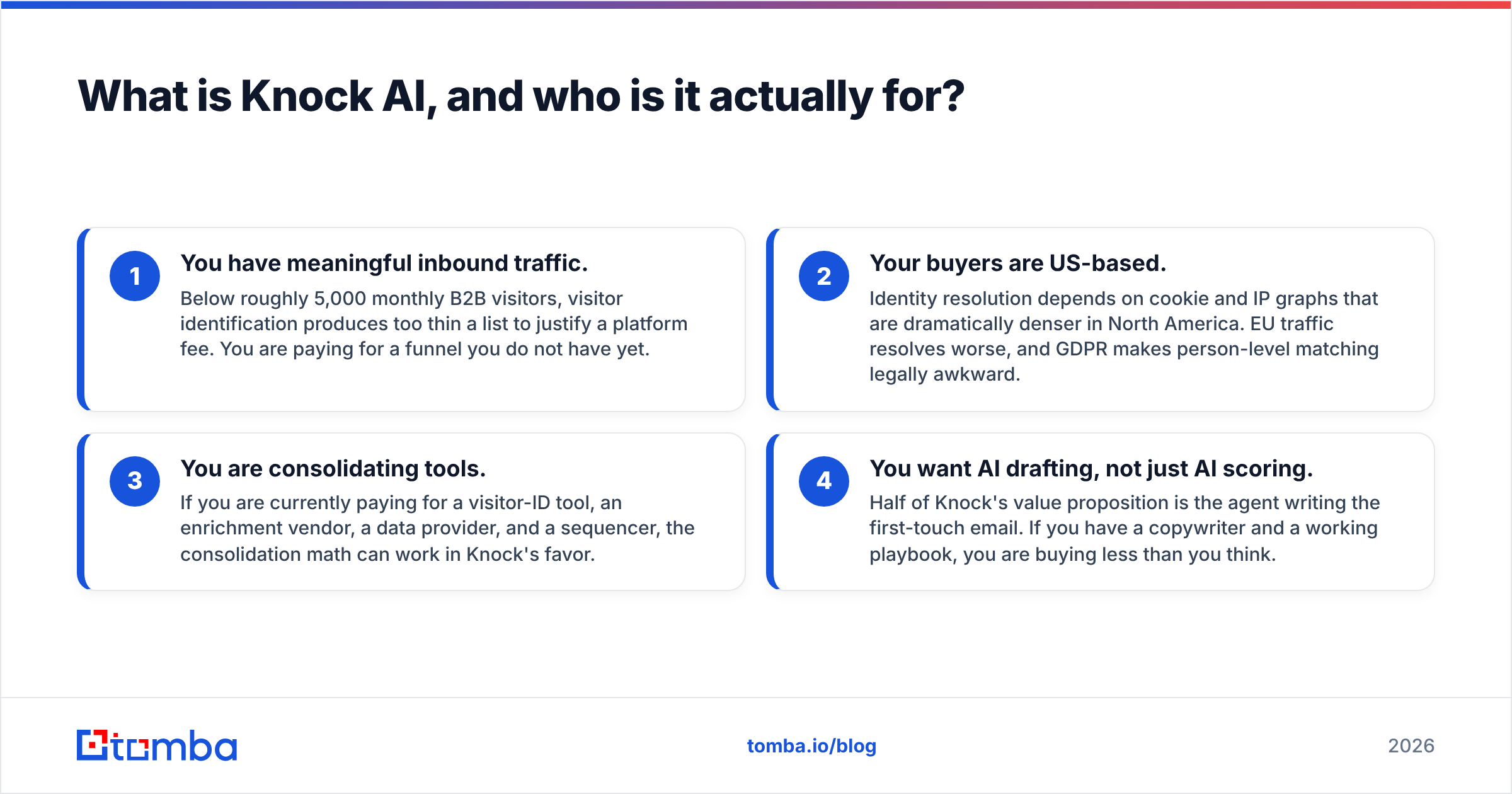
That loop matters because it changes who the product is for. Knock is a strong fit if:
- You have meaningful inbound traffic. Below roughly 5,000 monthly B2B visitors, visitor identification produces too thin a list to justify a platform fee. You are paying for a funnel you do not have yet.
- Your buyers are US-based. Identity resolution depends on cookie and IP graphs that are dramatically denser in North America. EU traffic resolves worse, and GDPR makes person-level matching legally awkward.
- You are consolidating tools. If you are currently paying for a visitor-ID tool, an enrichment vendor, a data provider, and a sequencer, the consolidation math can work in Knock's favor.
- You want AI drafting, not just AI scoring. Half of Knock's value proposition is the agent writing the first-touch email. If you have a copywriter and a working playbook, you are buying less than you think.
If none of those four describe you, keep reading — the alternatives section is where your answer lives.
How does Knock AI pricing actually work?#
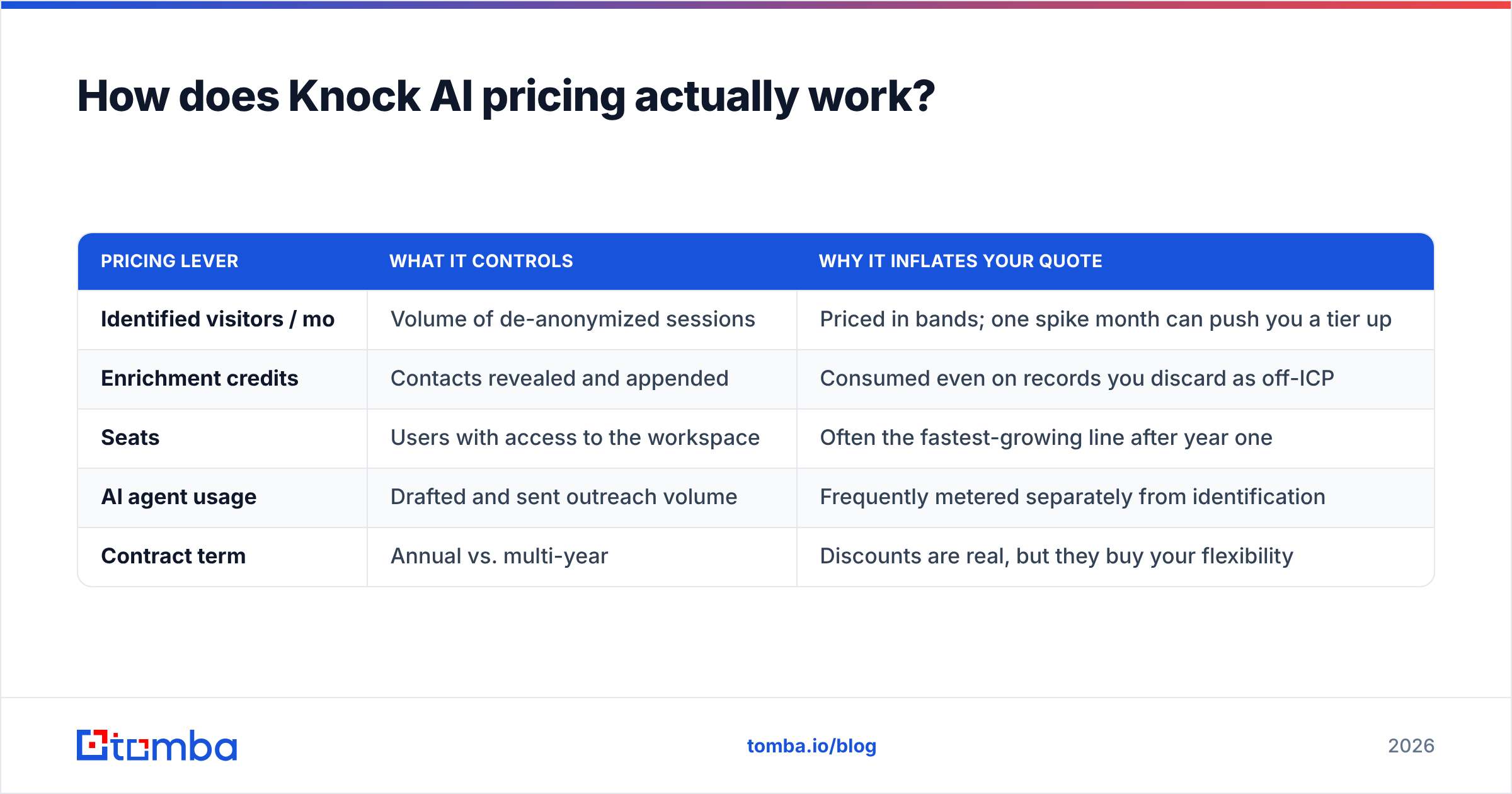
Here is the part every buyer wants and no vendor page gives you: Knock does not publish a self-serve price list. Every tier routes through a sales conversation, and the quote you get is assembled from three variables rather than one.
| Pricing lever | What it controls | Why it inflates your quote |
|---|---|---|
| Identified visitors / mo | Volume of de-anonymized sessions | Priced in bands; one spike month can push you a tier up |
| Enrichment credits | Contacts revealed and appended | Consumed even on records you discard as off-ICP |
| Seats | Users with access to the workspace | Often the fastest-growing line after year one |
| AI agent usage | Drafted and sent outreach volume | Frequently metered separately from identification |
| Contract term | Annual vs. multi-year | Discounts are real, but they buy your flexibility |
Two practical consequences follow from that structure.
First, your effective cost per usable lead is not your invoice divided by identified visitors. It is your invoice divided by identified visitors who match your ICP, resolve to a real person, and have a deliverable email. In buyer conversations, that ratio is routinely 10–25% of the raw identified count. Model it that way before you sign.
Second, credit-based pricing punishes exploration. You burn the same credit on a perfect-fit VP of Engineering and on a student researching your category for a class project. Tools that let you filter before spending credits have a structural cost advantage here, which is why the enrichment step is worth separating from the identification step in your own stack design.
When you request a quote, ask for these five things in writing: the overage rate per credit, whether unused credits roll over, whether seats are hard-capped, the exact definition of an "identified" visitor, and the mid-term downgrade policy. Vendors who answer all five quickly are usually the ones worth buying from.
What do Knock AI reviews say?#
Public review volume is still thin compared to incumbents, which is itself a signal — treat any tool with fewer than 50 verified reviews as a bet rather than a consensus. Scan the profiles on G2 and Capterra and you will find the same four themes repeating.
What reviewers praise:
- Speed to first signal. Install the script, and within days you see companies you did not know were evaluating you. That "aha" is real and it is why the product demos well.
- Consolidation. Teams replacing three subscriptions with one report genuine admin relief, even when the net spend is flat.
- Support responsiveness. Early-stage vendors tend to over-serve, and reviewers notice.
What reviewers criticize:
- Pricing opacity. The single most common complaint about any quote-gated GTM tool, and Knock is not exempt. Buyers dislike discovering the credit model after the demo.
- Person-level match rates. Company-level identification is solid; individual-contact identification is far more variable, and reviewers who expected the latter feel oversold.
- International coverage. APAC and EU traffic resolves noticeably worse than US traffic.
- AI copy quality out of the box. The drafts are competent and generic. Teams that win with them rewrite the prompts heavily.
None of this makes Knock a bad product. It makes it a product with a specific shape: strong on US inbound intent, weaker as a general-purpose contact database.
What are the real pros and cons of Knock AI?#
Stripping the marketing away, here is the balance sheet.
Pros
- One loop, one vendor. Identification → enrichment → scoring → outreach in a single workspace removes the integration tax that kills most homegrown stacks.
- Intent is a genuinely better filter than firmographics. A visitor who read your pricing page twice this week outranks a perfect-ICP contact who has never heard of you. That is the strongest argument for the category.
- Fast time-to-value for small teams. A two-person sales team with no RevOps function gets further with Knock in week one than with four stitched-together tools in month one.
- AI drafting removes the blank-page problem. Even mediocre drafts beat unsent emails.
Cons
- You cannot budget without a sales call. For finance-gated orgs, this alone delays purchase by weeks.
- Credit waste is structural. You pay to discover that a lead is unqualified.
- Geographic blind spots. If a third of your pipeline is European, a third of your spend underperforms.
- Data you cannot take with you. Identification is a stream, not an asset. Cancel the contract and the signal stops immediately — unlike a verified contact list, which you keep.
- Deliverability sits outside the tool. Knock finding the person does not mean your domain can reach them. That remains your problem, and it is the one that most often caps reply rates.

Is Knock AI worth it versus a leaner stack?#
This is the decision most teams actually face: buy the integrated AI platform, or assemble a cheaper stack around a contact-data core. Here is the comparison with published numbers where published numbers exist.
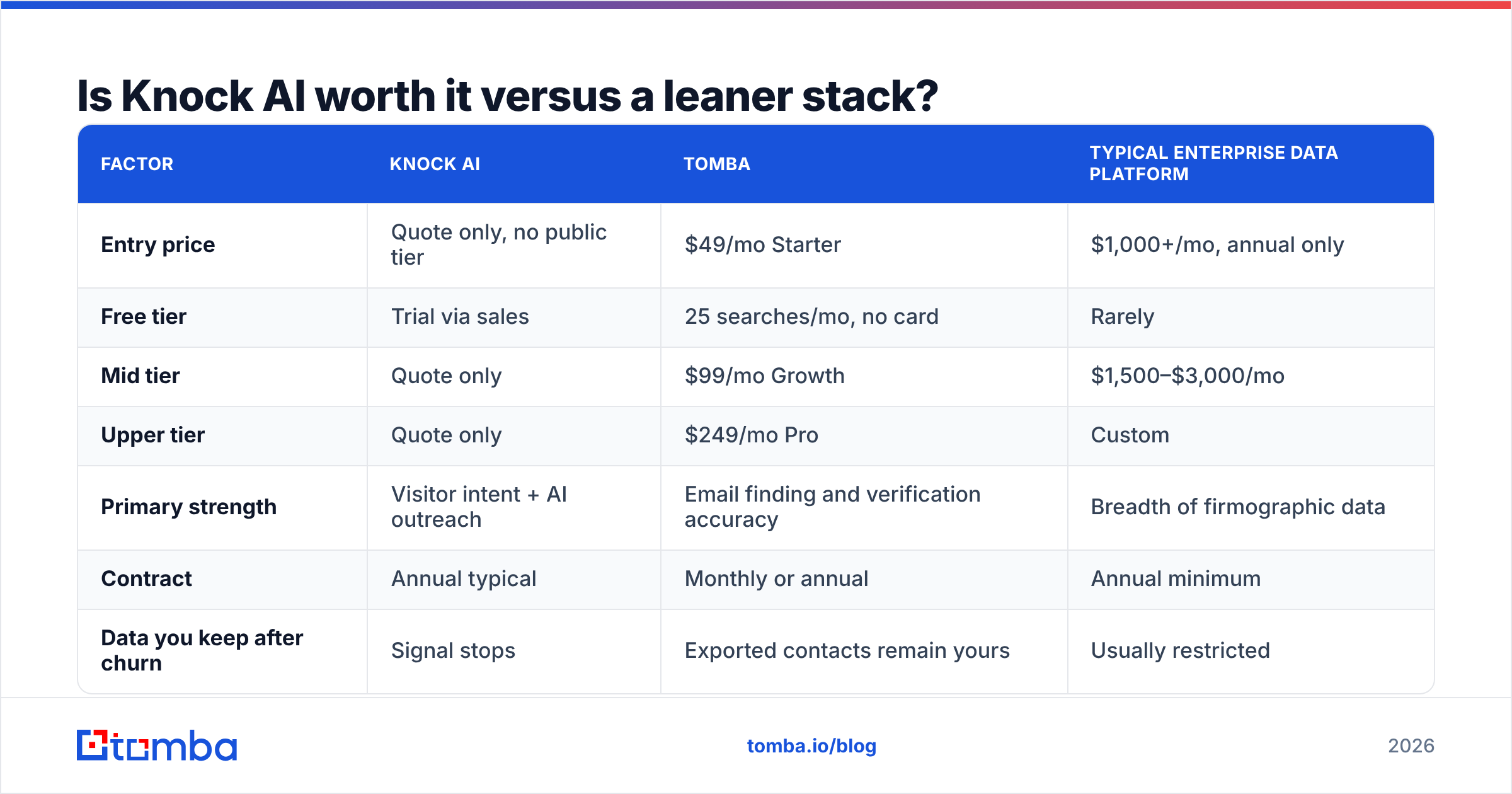
| Factor | Knock AI | Tomba | Typical enterprise data platform |
|---|---|---|---|
| Entry price | Quote only, no public tier | $49/mo Starter | $1,000+/mo, annual only |
| Free tier | Trial via sales | 25 searches/mo, no card | Rarely |
| Mid tier | Quote only | $99/mo Growth | $1,500–$3,000/mo |
| Upper tier | Quote only | $249/mo Pro | Custom |
| Primary strength | Visitor intent + AI outreach | Email finding and verification accuracy | Breadth of firmographic data |
| Contract | Annual typical | Monthly or annual | Annual minimum |
| Data you keep after churn | Signal stops | Exported contacts remain yours | Usually restricted |
| Best for | US inbound-heavy teams | Outbound teams needing verified contacts | Enterprise RevOps |
The honest read: these are not substitutes. Knock answers "who is interested right now?" A finder-and-verifier stack answers "how do I reach the right person at all?" Teams with real inbound volume benefit from the first. Teams building pipeline from scratch — which is most teams under $5M ARR — are better served by the second, because intent data on 800 monthly visitors is a rounding error.
A defensible middle path: run outbound on a bulk email finder plus verification, prove your ICP and messaging convert, then layer visitor identification once inbound traffic justifies the platform fee. Buying intent tooling before you have intent is the most common way teams waste a GTM budget.
If you do want visitor-level signal without a quote-gated contract, website visitor reveal covers the identification layer, and you can keep your existing sequencer instead of migrating outreach into a new system.
How should you budget for an AI GTM stack in 2026?#
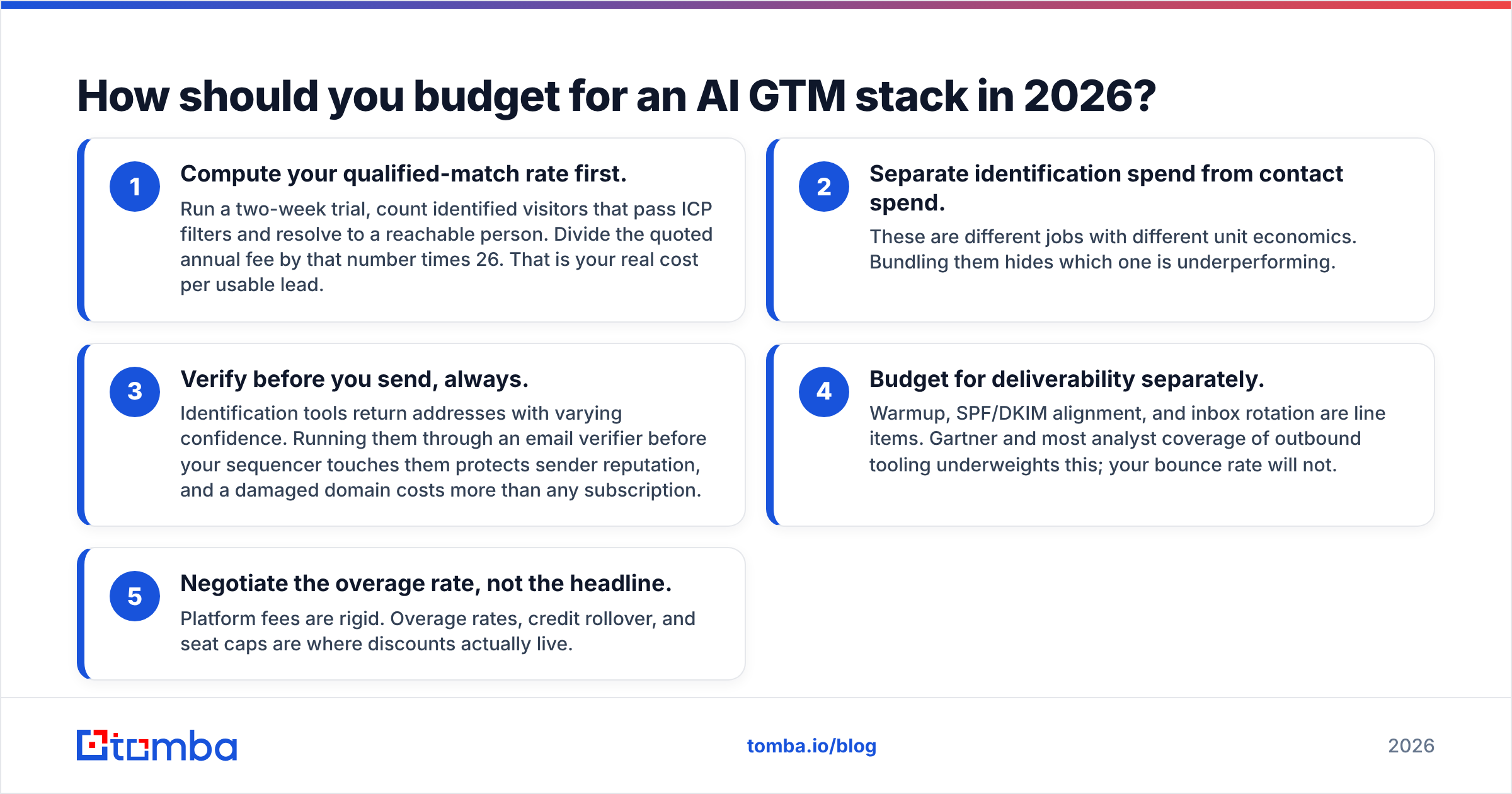
Work backward from cost per booked meeting, not per contact. Five checks before you sign anything:
- Compute your qualified-match rate first. Run a two-week trial, count identified visitors that pass ICP filters and resolve to a reachable person. Divide the quoted annual fee by that number times 26. That is your real cost per usable lead.
- Separate identification spend from contact spend. These are different jobs with different unit economics. Bundling them hides which one is underperforming.
- Verify before you send, always. Identification tools return addresses with varying confidence. Running them through an email verifier before your sequencer touches them protects sender reputation, and a damaged domain costs more than any subscription.
- Budget for deliverability separately. Warmup, SPF/DKIM alignment, and inbox rotation are line items. Gartner and most analyst coverage of outbound tooling underweights this; your bounce rate will not.
- Negotiate the overage rate, not the headline. Platform fees are rigid. Overage rates, credit rollover, and seat caps are where discounts actually live.
What is the verdict on Knock AI?#
Knock AI is a legitimate product solving a real problem, sold in a way that makes it hard to evaluate. If you have US-heavy inbound traffic above roughly 10,000 monthly visitors, a team too small to run four tools, and a willingness to sit through a pricing call, it can consolidate your stack and surface pipeline you were otherwise throwing away. Ask for the credit math in writing, pilot on a single segment, and insist on a downgrade clause.
If your traffic is thin, your buyers are international, or your bottleneck is simply finding and reaching the right people, the platform fee buys you signal you cannot act on. Spend it on contact accuracy and deliverability instead, and revisit intent tooling when your inbound funnel earns it.
Either way, do not sign an annual contract off a demo. Trial it, measure qualified matches, and compare against Tomba pricing so you know what the cheaper half of the stack actually costs before you commit to the expensive half.
Ready to test the cheaper path first? Start with the Tomba Email Finder — 25 free searches a month, no card required, and verified contact data you keep whether or not you renew. Prove your ICP and messaging convert on real, deliverable addresses; then decide whether an AI GTM platform is buying you signal or just buying you software.
Related guides#
// get started
Find, verify and enrich your first contacts today
Start on the free plan with 25 searches a month, then scale when your team is ready.
Free plan · No credit card required · GDPR & CCPA
Get the Tomba newsletter
Product and data updates
// about the author