Knowlarity vs MyOperator: Cloud Telephony Compared 2026
Both run India's cloud calling stack, but they solve different problems. Here's an honest Knowlarity vs MyOperator breakdown on pricing, IVR depth, CRM integrations, WhatsApp and outbound fit — plus the data gap neither one fills.
Knowlarity vs MyOperator is really one question: do you want to be live this week, or do you need contact-center depth? Both run India's cloud calling stack. They just serve different teams. Here is the honest breakdown.
TL;DR
- MyOperator is the easier, more self-serve option. You get published plans, fast onboarding, a clean call dashboard, and a strong WhatsApp Business API story for SMB and mid-market teams.
- Knowlarity (now part of Gupshup) is the enterprise play. It offers deeper contact-center features, speech analytics, wider global number coverage, and a sales-led, quote-based buying process.
- Pricing is not apples-to-apples. MyOperator lists entry plans in public. Knowlarity mostly quotes. Both bill numbers, minutes, and add-ons on top, so the sticker price is never the real price.
- Neither tool finds you contacts. They route, record, and report on calls. Your connect rate still lives or dies on data quality.
- Pick MyOperator if you want to be live this week. Pick Knowlarity if you need multi-country numbers and contact-center depth.
Knowlarity vs MyOperator: what are these two platforms?#
Both are cloud telephony platforms built for the Indian market. Both replace the same three things: a desk phone system, a PRI line, and a spreadsheet where call notes go to die.
Knowlarity launched in 2009. It was one of the first serious cloud communication providers in South Asia. Its flagship product, SuperReceptionist, gave small businesses a virtual number with IVR routing. Over time it grew into a full cloud contact center with call analytics, speech intelligence, and outbound dialer options.
Gupshup bought Knowlarity in 2021. That move pulled it into a much larger messaging ecosystem: WhatsApp, RCS, chatbots, and campaign tools.
MyOperator started in 2013 out of Noida. It took the opposite path: serve the mid-market, publish pricing, make setup fast. It built its name on a clean call dashboard, reliable IVR, and a support team that answers.
Since then it has added a cloud contact center product, WhatsApp Business API, and Heyo Phone. Heyo is for very small businesses that just want a business number on a mobile.
The practical difference is simple. Knowlarity feels like software you buy through a sales cycle. MyOperator feels like software you sign up for.
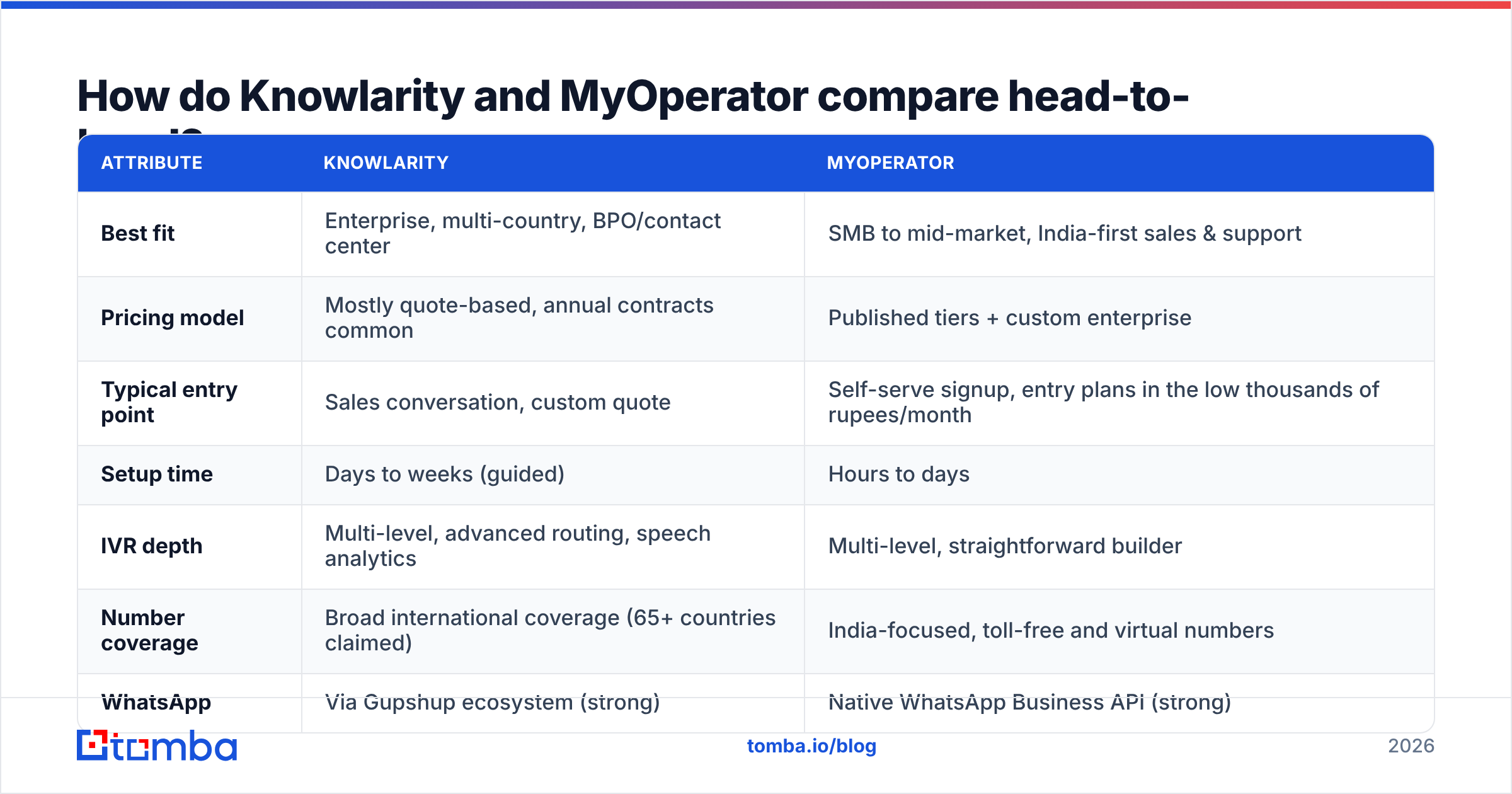
Knowlarity vs MyOperator: how do they compare head-to-head?#
| Attribute | Knowlarity | MyOperator |
|---|---|---|
| Best fit | Enterprise, multi-country, BPO/contact center | SMB to mid-market, India-first sales & support |
| Pricing model | Mostly quote-based, annual contracts common | Published tiers + custom enterprise |
| Typical entry point | Sales conversation, custom quote | Self-serve signup, entry plans in the low thousands of rupees/month |
| Setup time | Days to weeks (guided) | Hours to days |
| IVR depth | Multi-level, advanced routing, speech analytics | Multi-level, straightforward builder |
| Number coverage | Broad international coverage (65+ countries claimed) | India-focused, toll-free and virtual numbers |
| Via Gupshup ecosystem (strong) | Native WhatsApp Business API (strong) | |
| Call recording | Included on most plans | Included on most plans |
| CRM integrations | Salesforce, Zoho, LeadSquared, Freshsales, API | Zoho, LeadSquared, HubSpot, Freshdesk, Zapier, API |
| Reporting | Deeper analytics, speech/sentiment add-ons | Clean real-time dashboards, agent-level reports |
| Support reputation | Mixed — good for enterprise accounts, slower for SMB | Consistently rated a strength on review sites |
Read the reviews before you sign anything. Both vendors have hundreds of them on G2 and Capterra, and the pattern is steady. Knowlarity wins on capability and loses on response times for small accounts. MyOperator wins on support and onboarding, but gets stretched at very high call volume.
Knowlarity vs MyOperator pricing: what does each one cost?#
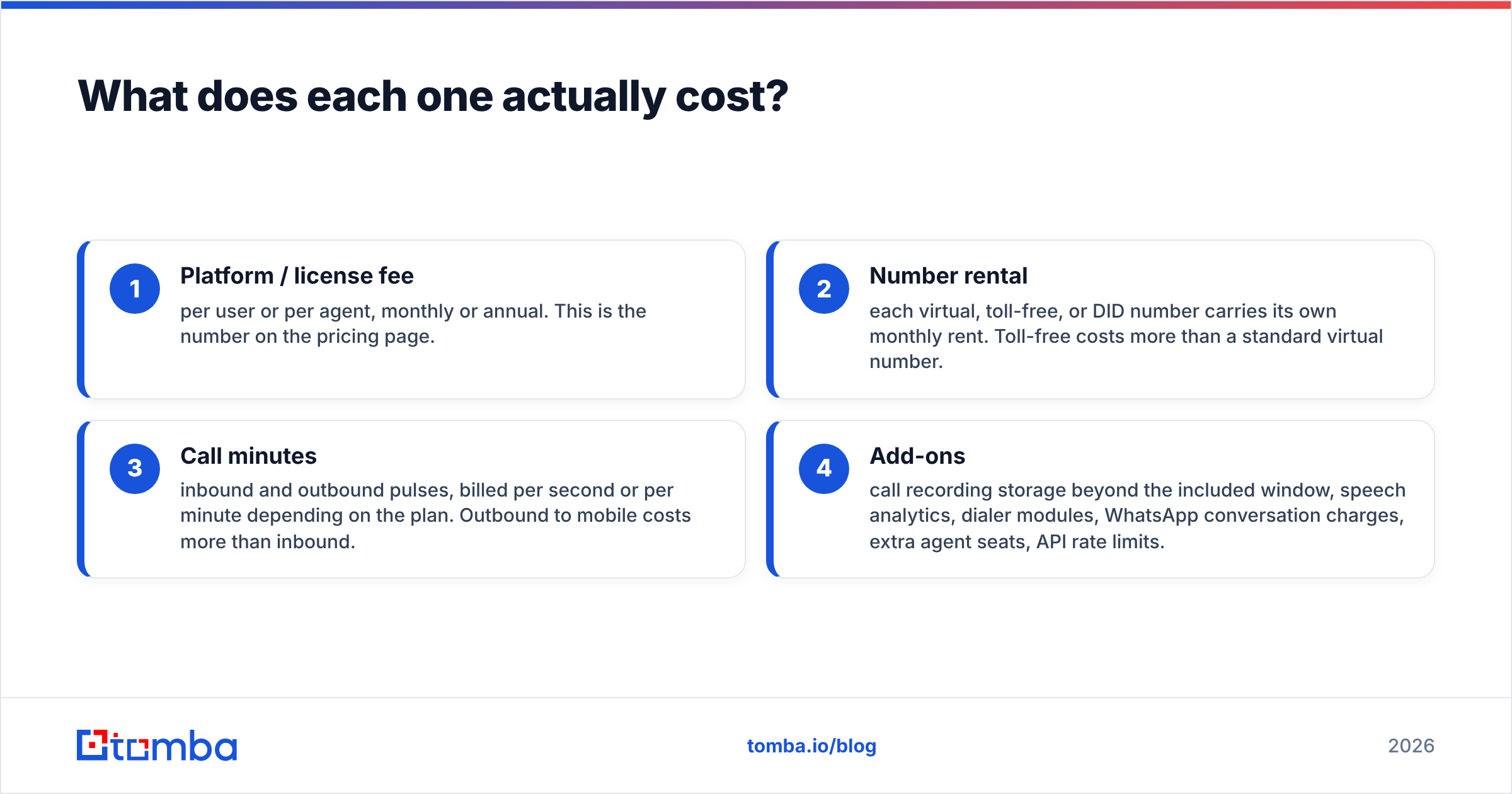
Neither vendor's headline number is what you pay. Cloud telephony pricing in India stacks in four layers. Both companies use the same structure:
- Platform or license fee — per user or per agent, billed monthly or yearly. This is the number on the pricing page.
- Number rental — every virtual, toll-free, or DID number carries its own monthly rent. Toll-free costs more than a standard virtual number.
- Call minutes — inbound and outbound pulses, billed per second or per minute. Outbound to mobile costs more than inbound.
- Add-ons — extra recording storage, speech analytics, dialer modules, WhatsApp conversation charges, extra agent seats, and API limits.
MyOperator publishes tiered plans. For a team of 5–25 agents it is usually the cheaper and more predictable entry point. Knowlarity quotes instead. Your price depends on volume, contract length, and how well you negotiate. That is good if you have scale, and frustrating if you just want to try it.
Two rules save real money:
- Model your annual minutes before you compare licenses. A team making 400 outbound calls a day will spend more on pulses than on seats within six months. The cheaper license is often the more expensive contract.
- Ask what happens to your recordings at renewal. Storage windows differ between vendors. Exporting years of call audio at the last minute makes for a bad week.
Confirm current rates with each vendor. Telephony pricing in India shifts with TRAI rules and carrier costs, so any figure in a blog post — including this one — ages fast.
Which platform has better IVR and call routing?#
Both handle multi-level IVR well. The split shows up at the edges:
- Knowlarity — advanced routing logic. Skill-based routing, sticky agent mapping, time and location rules, and queue overflow that holds up in a 100-seat center. If your call flow has more than a dozen branches, this is the safer platform.
- MyOperator — speed of change. Editing an IVR tree, adding a department, or changing after-hours behavior takes minutes in the dashboard. No support ticket needed. For marketing teams running campaign numbers, that beats exotic routing.
- Knowlarity — speech analytics. Transcription, keyword spotting, and sentiment scoring on recorded calls, sold as an add-on. Useful for QA at scale. Overkill for a team of ten.
- MyOperator — agent experience. Mobile app, live call monitoring, whisper and barge, and dashboards a sales manager can read without training.
- Both — recording and missed-call handling. Auto-recording, missed-call alerts by SMS or email, and callback triggers are table stakes now.
If your problem is "we drop inbound leads after 7 PM," either tool fixes it. If your problem is "we run three campaign queues, two languages, and an escalation tier," lean Knowlarity.
Which integrates better with your CRM and outbound stack?#
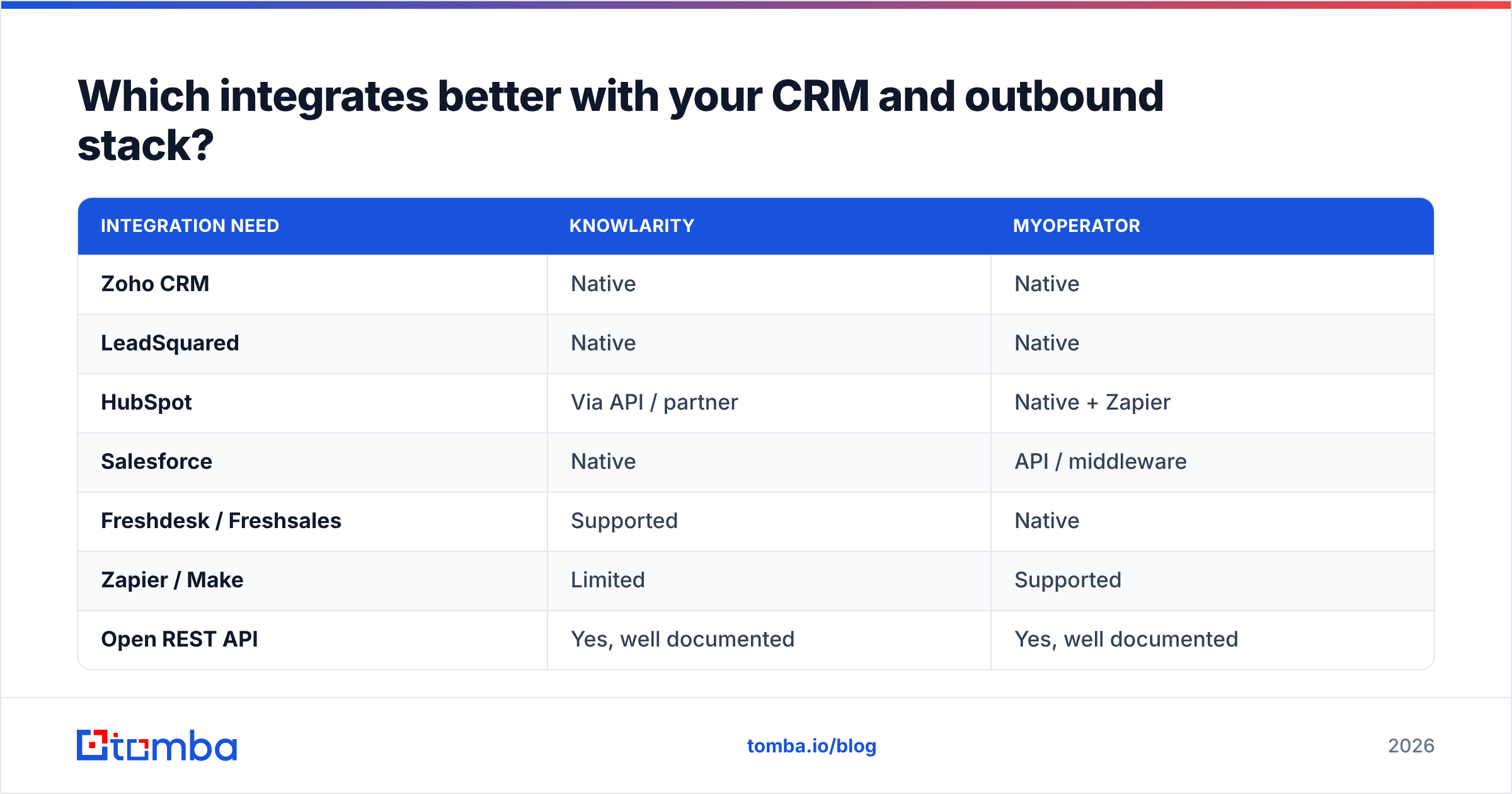
| Integration need | Knowlarity | MyOperator |
|---|---|---|
| Zoho CRM | Native | Native |
| LeadSquared | Native | Native |
| HubSpot | Via API / partner | Native + Zapier |
| Salesforce | Native | API / middleware |
| Freshdesk / Freshsales | Supported | Native |
| Zapier / Make | Limited | Supported |
| Open REST API | Yes, well documented | Yes, well documented |
| Webhooks for call events | Yes | Yes |
The honest read: MyOperator is friendlier to a no-code stack. Zapier, webhooks, and native HubSpot cover most mid-market setups. Knowlarity is stronger if Salesforce is your system of record and you have a developer to own the integration.
If HubSpot is your CRM of record, read HubSpot's own calling documentation before you commit. Logging behavior and call-object mapping differ between a native integration and a webhook bridge. The gap shows up six months later, when someone asks for a dials-to-meetings report.
Knowlarity vs MyOperator for outbound sales teams: which wins?#
For pure outbound — SDRs working a list — three things decide it: dialer modes, number reputation, and how clean your contact data is.
Knowlarity wins on dialer modes and multi-country numbers. If you call across APAC and the Gulf, or need predictive dialing at volume, it is the more complete tool.
MyOperator wins on time to first call and cost per seat. A five-person SDR pod can be live, recording, and reporting inside a day.
Here is the part neither vendor leads with: your dialer is not the problem. Most outbound teams in 2026 sit at a 3–8% connect rate. Routing logic is rarely the cause. A third of the numbers in the list are wrong, disconnected, or belong to someone who left the company a year ago. Great telephony on bad data is an expensive way to reach voicemail.
So the smarter outbound stacks now put a data layer in front of the dialer:
- Verify numbers before they enter the queue with a phone validator. Agents stop burning hours on dead lines.
- Source direct-dial numbers for named accounts with a phone finder instead of scraping switchboard numbers off websites.
- Run contact enrichment so the agent sees title, company, and context before the call connects. That is the biggest lever on call quality.

What about WhatsApp and omnichannel?#
This is where the two split most sharply in 2026.
Knowlarity inherits Gupshup's messaging stack. That means WhatsApp Business API, RCS, chatbot flows, and campaign tools from a company built on messaging. If your roadmap includes WhatsApp commerce, alerts at scale, or bot-led qualification, that ecosystem runs deep.
MyOperator built its own WhatsApp Business API product. It plugs straight into call flows. A missed call can trigger a WhatsApp follow-up, and the chat history sits next to the call log. For a team that wants voice and WhatsApp in one screen, this is the tighter fit.
Neither is wrong. Ask one question. Is messaging a feature of your phone system (MyOperator), or is your phone system a feature of your messaging strategy (Knowlarity and Gupshup)?
Where do both platforms leave gaps?#
Three gaps show up in almost every rollout:
- No contact sourcing. Both platforms assume you already have the numbers. Neither will find the mobile number of a VP you have never spoken to.
- No email layer. Calls convert better when they follow or lead an email. Both tools are voice-first, so email lives elsewhere. Contact records rarely match cleanly across the two systems.
- Data decay. B2B contact data goes stale at roughly 2–3% a month through job changes alone. Neither vendor refreshes your list. That is on you.
The fix is dull, but it works. Keep a clean, enriched contact layer outside the phone system. Push verified records into the dialer. Re-verify on a schedule. Pair each phone number with a verified work email: you can find email addresses for the same contacts and run a call-then-email sequence that survives a job change. Building lists at scale? A bulk email finder run against your target accounts gives you both channels from one upload.
Which one should you choose?#
Choose MyOperator if:
- You have 5–50 agents and want to be live this week
- Your calling is India-focused
- You want published pricing and fast support without an enterprise contract
- WhatsApp and voice in one dashboard is the goal
- Your CRM is Zoho, HubSpot, LeadSquared, or Freshsales
Choose Knowlarity if:
- You run a contact center with complex routing or 100+ seats
- You need numbers across several countries
- Speech analytics and deep call QA are on the roadmap
- Salesforce is your system of record
- You already use Gupshup for messaging
Choose neither yet if:
- Your connect rate problem is a data problem. Fix the list first. The dialer will look twice as good on the same platform.
A fair test: run a two-week pilot on both with the same 500-contact list. Measure connect rate, answer-to-meeting rate, and how many support tickets you filed. The platform that needed fewer tickets usually wins the year.
Frequently asked questions#
Which is better, Knowlarity vs MyOperator? It depends on your size. Knowlarity vs MyOperator comes down to contact-center depth against speed and price. Pick Knowlarity above 100 seats or across several countries. Pick MyOperator for a fast, India-first rollout.
Is MyOperator cheaper than Knowlarity? Usually at the entry level, yes. MyOperator publishes plans and targets SMBs. At enterprise volume the gap narrows, because Knowlarity negotiates. Model total cost with number rental and minutes, not license fees alone.
Can I port my existing number to either platform? Both support number porting, subject to carrier and TRAI processes. Budget 1–3 weeks. Get the timeline in writing before you cancel anything.
Do either of them find phone numbers for prospects? No. Both are telephony platforms, not data providers. Sourcing and verifying numbers is a separate layer in your stack.
Which has better uptime? Both publish strong uptime figures, and both have had incidents. Ask each vendor for a 12-month incident history and an SLA with credits attached, not a marketing number.
Start with better data, then pick your dialer#
However the Knowlarity vs MyOperator decision goes, the platform only multiplies what you feed it. Clean, verified contacts turn an average dialer into a good one. Stale lists make the best contact center in India look broken.
The Tomba Email Finder gives you verified work emails by name, domain, or company. Every account you call also gets a reliable email path, so every rep has a second shot when the phone goes to voicemail. Start free with 25 searches a month, or check Tomba pricing for Starter at $49/mo, Growth at $99/mo, and Pro at $249/mo. Fix the data layer first. Then let your cloud telephony do what it is actually good at.
Related guides#
// get started
Find, verify and enrich your first contacts today
Start on the free plan with 25 searches a month, then scale when your team is ready.
Free plan · No credit card required · GDPR & CCPA
Get the Tomba newsletter
Product and data updates
// about the author