Knowlarity vs Ozonetel: Cloud Telephony Compared for 2026
Knowlarity vs Ozonetel: both power a big share of India's cloud telephony, but they are built for different buyers. Here is how they compare on pricing, AI, CRM integrations and outbound calling in 2026.
Knowlarity vs Ozonetel is one of the most common shortlists in Indian cloud telephony. Both platforms move your calls to the cloud. But they are built for different buyers. Here is how they compare on pricing, call quality, IVR, dialling, CRM sync and support.
TL;DR
- Knowlarity fits better if you want virtual numbers, IVR and click-to-call live fast. It is a strong match if you already use Gupshup for WhatsApp. Gupshup bought Knowlarity in 2021.
- Ozonetel fits better if you run a real contact centre. Think blended inbound and outbound, predictive dialling, workforce reporting, and the CXi AI layer for call scoring and transcripts.
- Neither publishes a full rate card. Both sell quote-first. Your real bill is a platform fee, plus a licence per agent, plus per-minute telecom. It is never the number on the landing page.
- Ozonetel has a bigger US footprint. Knowlarity leans India and South-East Asia, with closer WhatsApp ties.
- Either way, the dialler is only as good as your data. A predictive dialler on stale numbers just fails faster. Fix the contact layer first.
What are Knowlarity and Ozonetel?#
Both are cloud telephony platforms born in India. Both replaced the same thing: an on-premise PBX box in a server room. Changing one IVR menu on that box took six weeks and a vendor engineer.
Knowlarity launched in 2009. It built its name on SuperReceptionist, a virtual number product. You get one line for the business, it routes to a team, records the call and logs it. The company later added cloud contact centre, click-to-call, number masking and IVR surveys. In 2021, Gupshup acquired it. That pulled voice and WhatsApp into one contract.
Ozonetel started in 2007 in Hyderabad with KooKoo, a telephony API for developers. It then built CloudAgent, a full contact centre suite, on top. It chased the enterprise seat from day one: ACD, predictive and progressive dialling, quality monitoring and supervisor dashboards. CXi, its newer AI layer, adds transcription, sentiment and auto-QA. It also pushed into North America harder than most India-born rivals.
The short version: Knowlarity began as a phone number and grew into a contact centre. Ozonetel began as a telephony API and grew into a contact centre. That origin still shows in the product.
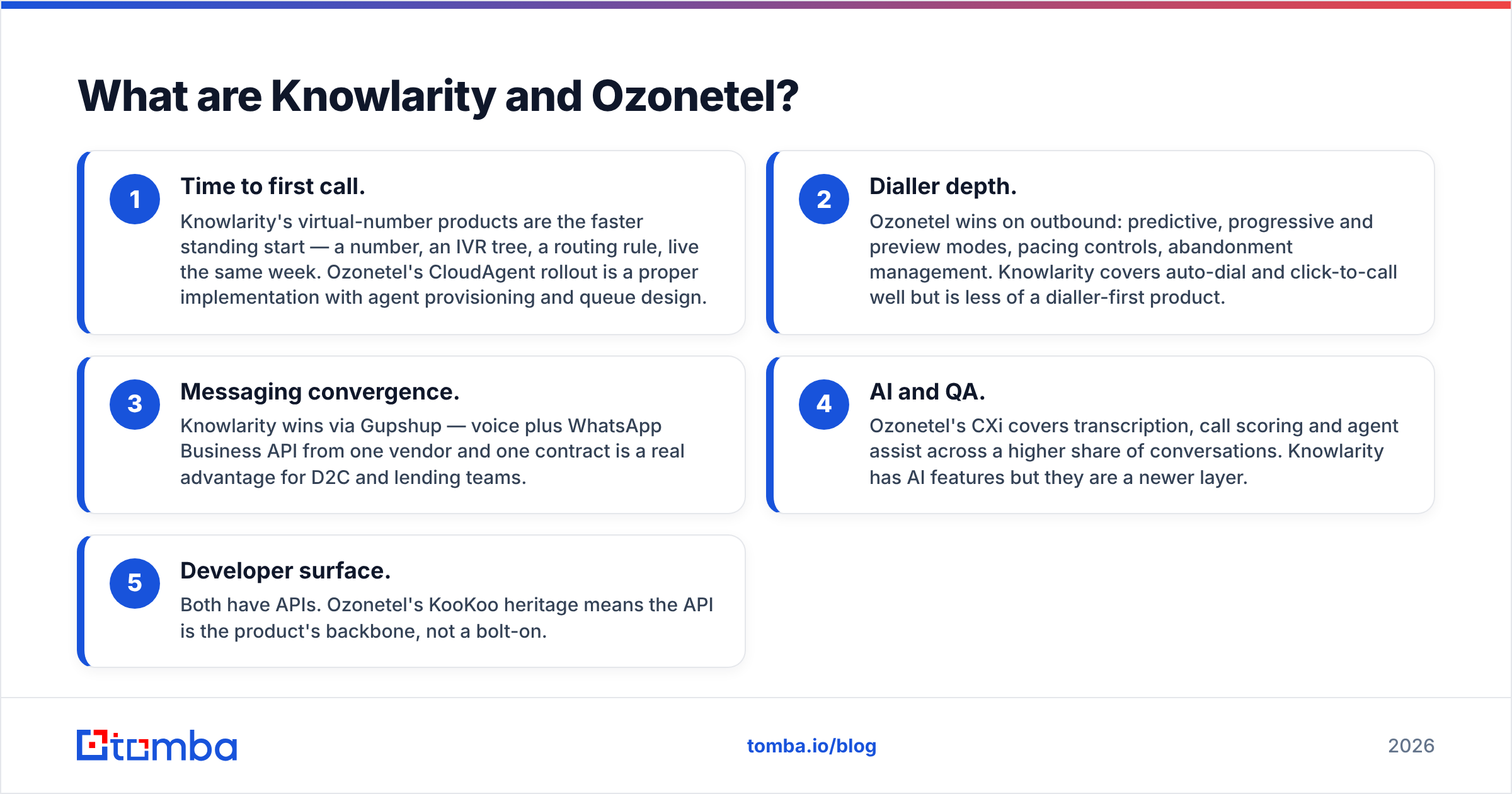
Here is how the two land against the criteria that actually decide these deals:
- Time to first call. Knowlarity starts faster. A number, an IVR tree and a routing rule can go live the same week. An Ozonetel CloudAgent rollout is a proper project, with agent setup and queue design.
- Dialler depth. Ozonetel wins on outbound. You get predictive, progressive and preview modes, pacing controls and abandonment limits. Knowlarity does auto-dial and click-to-call well, but it is not a dialler-first product.
- Messaging. Knowlarity wins here, thanks to Gupshup. Voice plus the WhatsApp Business API from one vendor and one contract is a real advantage for D2C and lending teams.
- AI and QA. Ozonetel's CXi covers transcription, call scoring and agent assist on more of your calls. Knowlarity has AI features, but the layer is newer.
- Developer surface. Both have APIs. Ozonetel's KooKoo roots mean the API is the backbone, not a bolt-on.
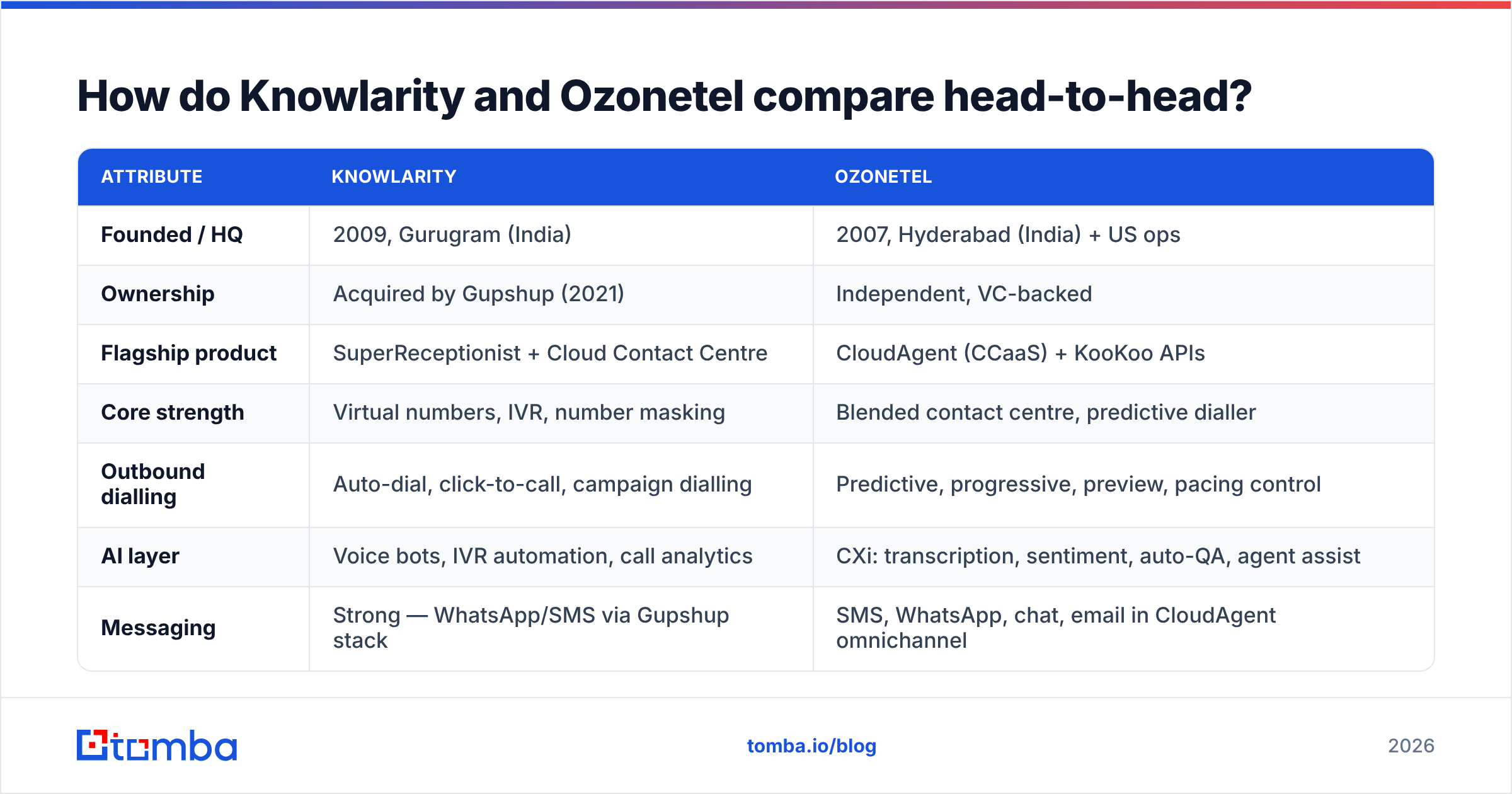
Knowlarity vs Ozonetel: how do they compare head-to-head?#
| Attribute | Knowlarity | Ozonetel |
|---|---|---|
| Founded / HQ | 2009, Gurugram (India) | 2007, Hyderabad (India) + US ops |
| Ownership | Acquired by Gupshup (2021) | Independent, VC-backed |
| Flagship product | SuperReceptionist + Cloud Contact Centre | CloudAgent (CCaaS) + KooKoo APIs |
| Core strength | Virtual numbers, IVR, number masking | Blended contact centre, predictive dialler |
| Outbound dialling | Auto-dial, click-to-call, campaign dialling | Predictive, progressive, preview, pacing control |
| AI layer | Voice bots, IVR automation, call analytics | CXi: transcription, sentiment, auto-QA, agent assist |
| Messaging | Strong — WhatsApp/SMS via Gupshup stack | SMS, WhatsApp, chat, email in CloudAgent omnichannel |
| Geographic focus | India, SEA, MENA | India + meaningful US/North America base |
| Deployment options | Cloud | Cloud, private cloud, on-prem hybrid |
| Typical buyer | SMB to mid-market sales and support teams | Mid-market to enterprise contact centres |
| Pricing model | Quote-first, plan + per-minute telecom | Quote-first, per-agent + per-minute telecom |
Read that table as a fork, not a scoreboard. Say your team is twelve reps on one number who must never miss a lead. Then the Ozonetel feature set is capacity you pay for and never use. Now say you run 150 agents across three queues with a compliance-recorded outbound campaign. Then Knowlarity's simplicity stops being a feature.
Which platform handles outbound sales calling better?#
Ozonetel, on the mechanics. On the dialler itself, it is not close.
Predictive dialling is the difference. The dialler predicts connect rates and agent availability, then dials ahead. Reps spend their minutes talking instead of hearing ring tones. At scale, that is the single biggest lever on talk time per agent-hour. Ozonetel lets you tune pacing ratios, abandonment limits and retry rules. An ops manager needs exactly that when regulators cap dropped calls.
Knowlarity handles outbound well enough. You get campaign dialling, click-to-call from the CRM, call recording and disposition codes. But its centre of gravity is inbound capture and routing. For a founder-led sales team or a 20-rep inside sales pod, that is often plenty. The faster launch is worth more than dialler settings nobody will tune.
Three questions decide it for most teams:
- What is your connect rate? Below roughly 15%, predictive dialling pays for itself. Above 40% on a warm, well-researched list, preview dialling with real call prep converts better than raw volume.
- Do you need live supervisor barge-in and whisper coaching? Ozonetel treats both as table stakes. It matters far more at 100 agents than at 15.
- Is WhatsApp part of the follow-up sequence? If yes, the Gupshup and Knowlarity bundle removes a vendor and a contract from your life.
What do Knowlarity and Ozonetel actually cost?#
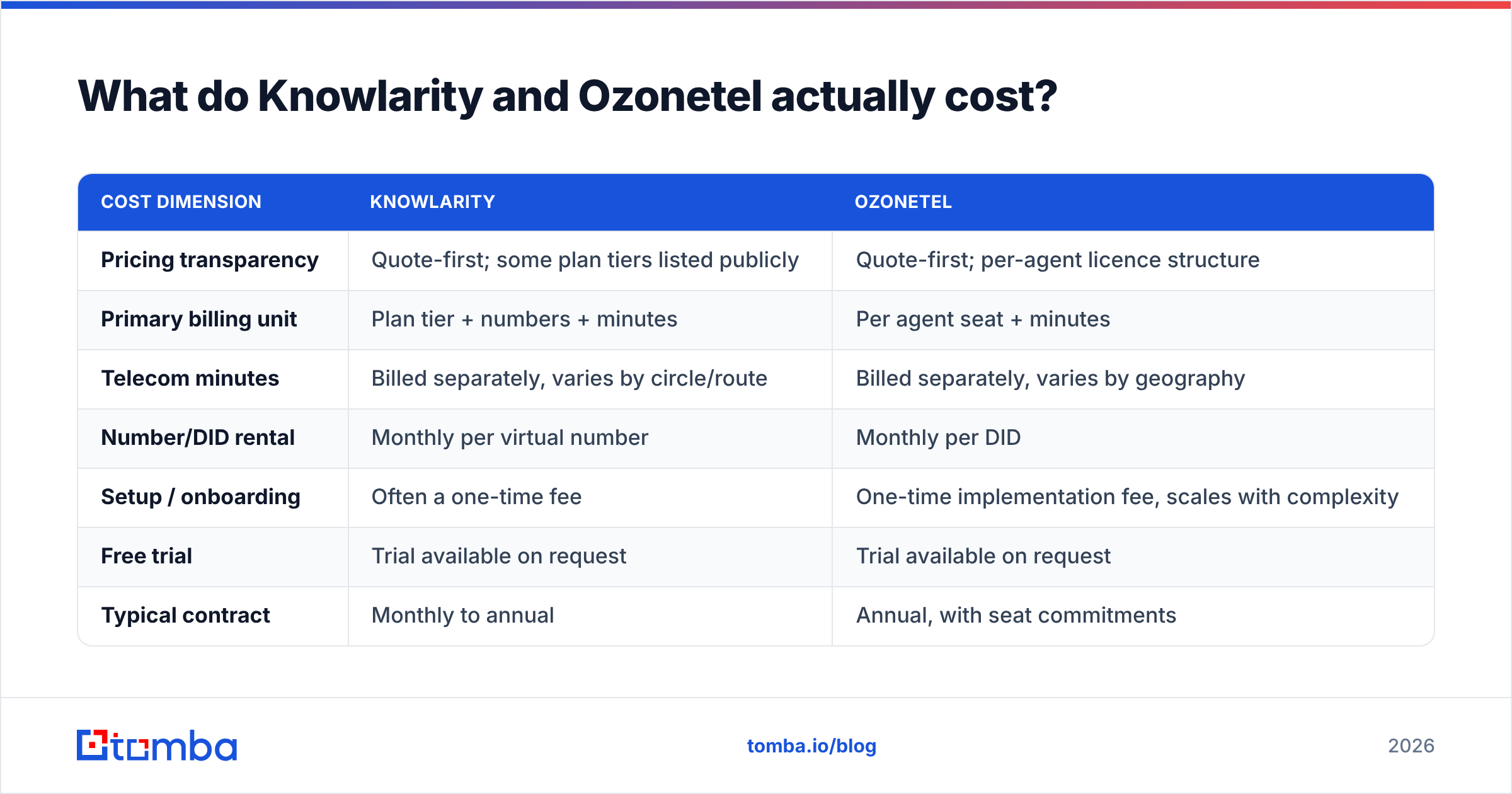
Neither company publishes a full self-serve rate card. Any number you see quoted in a listicle goes stale within two quarters. What you can compare reliably is the shape of the bill.
| Cost dimension | Knowlarity | Ozonetel |
|---|---|---|
| Pricing transparency | Quote-first; some plan tiers listed publicly | Quote-first; per-agent licence structure |
| Primary billing unit | Plan tier + numbers + minutes | Per agent seat + minutes |
| Telecom minutes | Billed separately, varies by circle/route | Billed separately, varies by geography |
| Number/DID rental | Monthly per virtual number | Monthly per DID |
| Setup / onboarding | Often a one-time fee | One-time implementation fee, scales with complexity |
| Free trial | Trial available on request | Trial available on request |
| Typical contract | Monthly to annual | Annual, with seat commitments |
| Hidden line items | Recording storage, extra numbers, IVR flows | Add-on AI modules, integration builds, storage |
The practical advice: normalise every quote to cost per connected minute at your expected volume, not cost per seat. A cheap seat with costly minutes loses badly to the reverse once your reps are really talking. Ask both vendors for a 12-month projection at your forecast volume. Include recording storage and any AI module you would realistically switch on. Then read the recent reviews on G2 for what customers say about renewal pricing. That is where the surprises live.
How do they compare on integrations and CRM sync?#
Both plug into the usual suspects: Salesforce, HubSpot, Zoho, Freshsales and LeadSquared. Both offer REST APIs and webhooks for anything not on the list.
The differences that matter in practice:
- Depth inside the CRM. Ozonetel goes deeper on the agent-in-CRM experience for Salesforce and Zoho. You get a softphone inside the record, auto-logged dispositions and a screen-pop on an inbound match. Knowlarity covers click-to-call and call logging cleanly, but the embedded agent view is thinner.
- Messaging in the same thread. Knowlarity keeps voice and WhatsApp in one commercial relationship through Gupshup. If your CRM timeline needs both channels stitched together, that is one less integration to maintain.
- Developer ergonomics. Ozonetel's KooKoo lineage makes custom IVR logic and call-flow scripting first-class. That matters if your engineers will build a bespoke routing flow.
- Middleware fallback. Both work through Zapier-style middleware for long-tail apps. If your stack is unusual, budget for a connector build either way.
Run one test during the evaluation. Create a lead in your CRM, dial it from the softphone, hang up, then look at the record 30 seconds later. Is the recording URL there? The duration? The disposition? The transcript? Whatever is missing is what your RevOps team will patch by hand for the next three years.
Does either one solve your data problem? No.#
Here is the part vendor demos skip. Both platforms are excellent at connecting a call to a number you supply. Neither knows whether that number belongs to a decision-maker. Neither knows whether the person still works there, or whether the line is a dead switchboard extension.
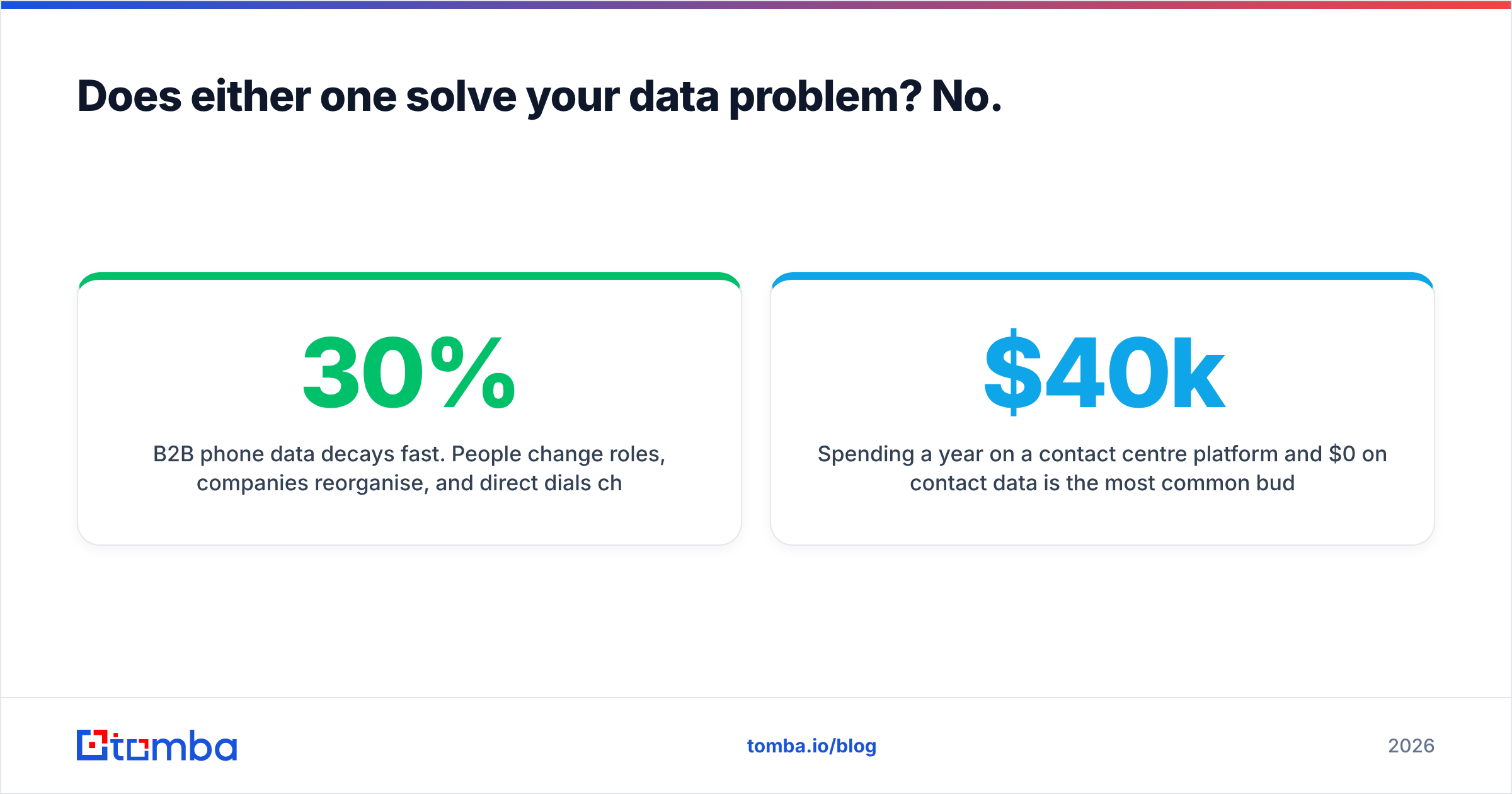
B2B phone data decays fast. People change roles, companies reorganise, and direct dials churn faster than corporate emails. Point a predictive dialler at a list that is 30% stale and you have built a very efficient way to reach voicemail. Meanwhile your abandonment metrics and your carrier reputation quietly slide.
A dialler-agnostic data layer fixes this upstream:
- Source direct dials, not switchboards. A phone finder returns a verified mobile or direct line. That beats a main-office number that routes to a gatekeeper.
- Validate before the list loads. A phone validator checks line type, carrier and reachability. Disconnected numbers never enter the campaign.
- Enrich for context. Data enrichment gives the rep a title, a company size and a reason to call. That is the gap between a preview dial that converts and a predictive dial that annoys.
- Keep an email fallback. Not every contact answers. Pair the dial with a verified email so the sequence keeps moving when the call does not connect.
Spending $40k a year on a contact centre platform and $0 on contact data is the most common budget mistake in outbound. The platform multiplies your list quality, in both directions.
What about TRAI, DLT and compliance?#
If you dial Indian numbers, compliance is not optional. It is also not the vendor's problem alone.
Both Knowlarity and Ozonetel hold Indian telecom licences. Both support the duties that come with them: DND scrubbing, consent capture, call recording retention, and DLT registration on the SMS side. Both will hand you documentation for an audit. Neither will stop you from uploading a list you had no right to call.
A practical checklist before you sign either contract:
- Confirm recording retention windows and where the audio is stored. Some regulated buyers need in-country storage guarantees in writing.
- Ask about abandoned-call limits in the predictive dialler. Does the platform enforce them, or only report on them?
- Verify DND and opt-out handling. How fast does a suppression spread across every campaign?
- Check number masking if you handle marketplace or gig-economy calls where neither party should see the other's number.
- Get the data-processing terms reviewed if you also serve EU or US customers under GDPR or TCPA.
Failures here are not a slap on the wrist. They are number blocks. A blocked outbound range takes your whole campaign down for days.
So which should you choose in 2026?#
The Knowlarity vs Ozonetel call comes down to your call volume and the shape of the work.
Pick Knowlarity if:
- You need virtual numbers, IVR and lead-capture routing live in days, not months.
- Your team is under roughly 50 agents and inbound-weighted.
- WhatsApp is a core channel and the Gupshup bundle consolidates vendors for you.
- You want less implementation overhead and a simpler admin screen.
Pick Ozonetel if:
- Outbound volume is the business: collections, lending, insurance, high-velocity inside sales.
- You need predictive dialling with real pacing control, supervisor tooling and workforce reporting.
- You want AI transcription and automated QA across a large share of calls.
- You operate in the US as well as India and want one vendor across both.
And be honest about the third option. If you are a ten-person SaaS team making 200 calls a week from a CRM, both of these are heavier than you need. A light dialler inside your existing CRM will cost less and ship sooner.
What should you do before the first demo?#
Run this sequence and you will negotiate from a much stronger position:
- Pull your last 90 days of call data: attempts, connects, average talk time, conversion by segment. That is your baseline.
- Work out your current cost per connected conversation. Measure every vendor claim against that one number.
- Audit list quality on a 200-record sample. How many numbers are direct, current and reachable? Under 70% means the dialler is not your bottleneck.
- Write down the three integrations you cannot live without. Make both vendors demo them live, on your CRM instance, not a sandbox.
- Ask for a reference customer at your size, in your industry, on your continent.
Fix the data layer before you sign the telephony contract#
The fastest way to make either Knowlarity or Ozonetel look brilliant is simple. Feed it contacts that are real, current and reachable. The fastest way to make either look expensive is to point it at a list you scraped nine months ago.
So start with the contact layer. Use Tomba Email Finder to build verified, decision-maker contact lists from any company domain. Then layer phone data and enrichment on top, before a single record touches your dialler. The free tier gives you 25 searches a month, so you can test the accuracy yourself. Paid plans start at $49/month on Starter and run to $99/month on Growth. See Tomba pricing for the full breakdown, or wire it into your stack with the Tomba API so every new lead is verified before it is ever dialled.
Related guides#
Ready to find emails that actually work?
Join 150,000+ professionals who stopped guessing and started sending. Free credits on signup — no credit card required.
Get the Tomba newsletter
Practical outbound tactics and product updates — once every two weeks.
About the author