Koncert Alternatives: 9 Best Sales Dialers for 2026
Koncert is a solid parallel dialer, but it is not the only one — and for some teams it is not the cheapest or the easiest to run. Here are nine alternatives compared on dial mode, pricing model, CRM depth and the data that feeds them.
TL;DR
- Koncert is a multi-mode outbound dialer (click, power, parallel, agent-assisted) aimed at SDR teams that live on the phone. Most teams who leave it do so over pricing opacity, seat minimums, or a want for tighter native CRM/sequencing.
- The strongest direct replacements for parallel dialing are Orum, Nooks and ConnectAndSell. For SMB teams, Kixie, JustCall and PhoneBurner are cheaper and faster to deploy.
- If your calls already live inside a sequencer, Salesloft or Close may replace Koncert entirely rather than sit beside it.
- Dial mode matters less than you think. Connect rate is mostly a function of direct-dial accuracy — a 9-line parallel dialer on bad numbers just reaches voicemail nine times faster.
- Budget for the data layer separately. A verified direct dial + verified email pair is what makes any of these tools pay back.
What does Koncert actually do?#
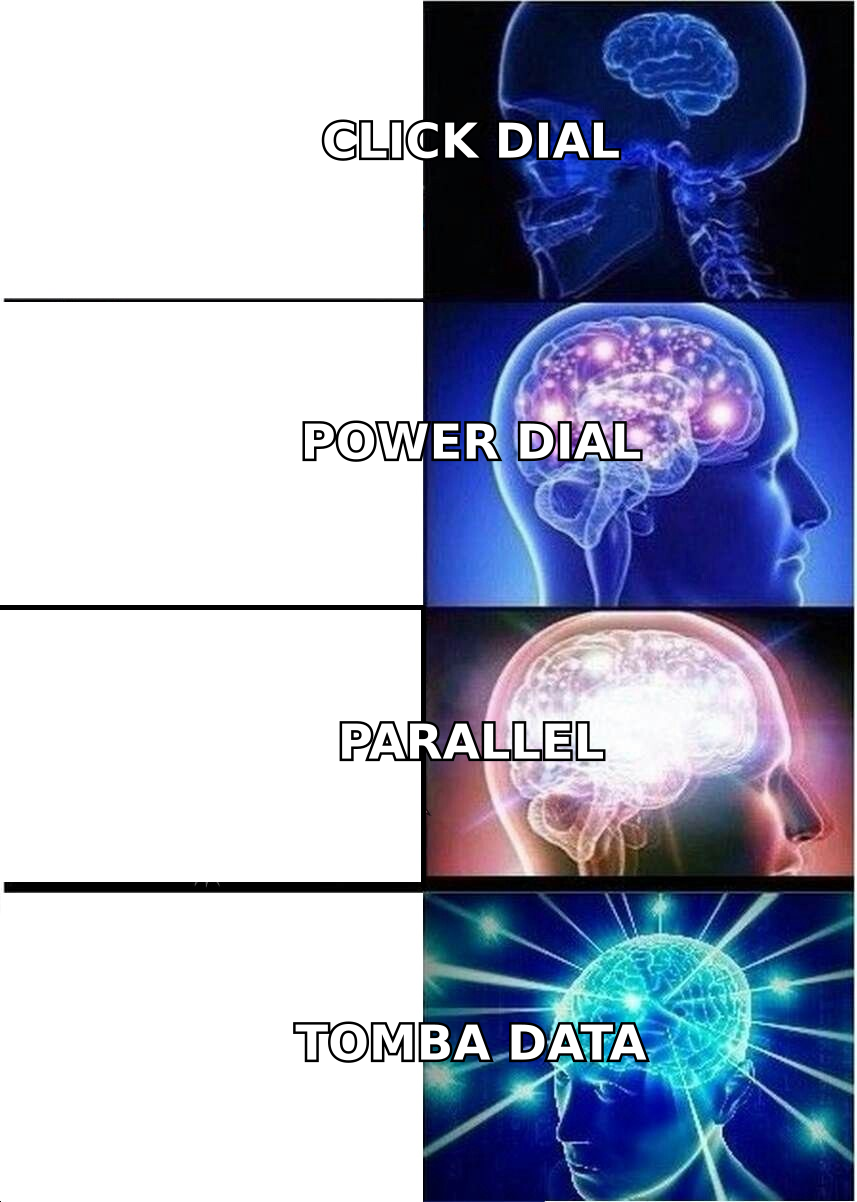
Koncert (formerly ConnectLeader) sells a suite of outbound dialers rather than a single product. The lineup on koncert.com covers four dial modes — Click Dialer, Flow Dialer (power), AI Parallel Dialer (multi-line), and an Agent-Assisted Dialer where human agents navigate gatekeepers and hand off live conversations — plus Koncert Cadence for multichannel sequencing and a remote coaching module for live call listening and whisper.
The pitch is straightforward: one vendor, four dialing speeds, so a team can run click-to-call for named accounts and parallel dialing for volume lists without stitching two tools together. It's a credible product with a long track record in enterprise SDR orgs.
So why do people shop around?
Why do teams look for Koncert alternatives?#
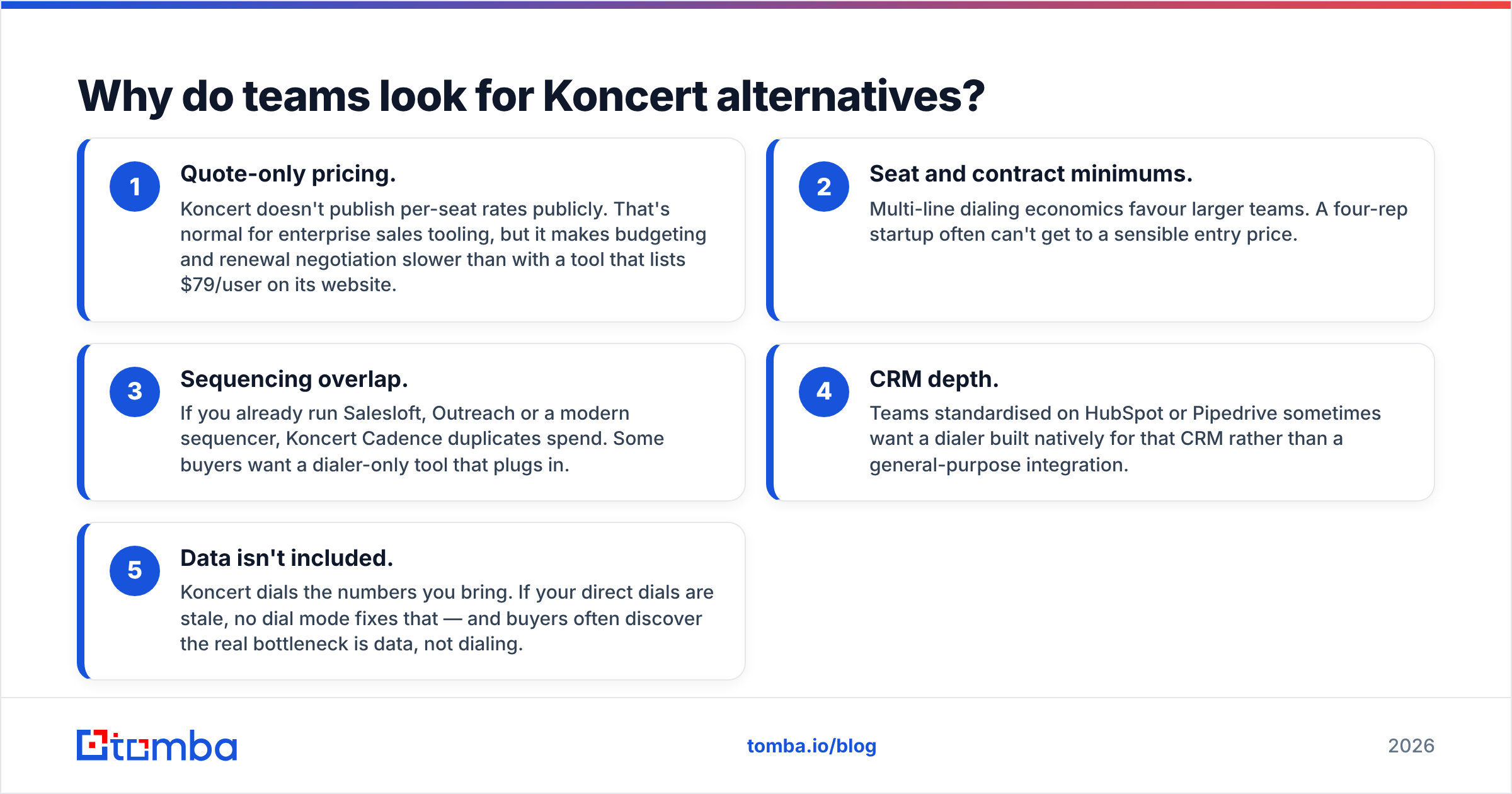
Five reasons come up repeatedly in review sites and buyer conversations:
- Quote-only pricing. Koncert doesn't publish per-seat rates publicly. That's normal for enterprise sales tooling, but it makes budgeting and renewal negotiation slower than with a tool that lists $79/user on its website.
- Seat and contract minimums. Multi-line dialing economics favour larger teams. A four-rep startup often can't get to a sensible entry price.
- Sequencing overlap. If you already run Salesloft, Outreach or a modern sequencer, Koncert Cadence duplicates spend. Some buyers want a dialer-only tool that plugs in.
- CRM depth. Teams standardised on HubSpot or Pipedrive sometimes want a dialer built natively for that CRM rather than a general-purpose integration.
- Data isn't included. Koncert dials the numbers you bring. If your direct dials are stale, no dial mode fixes that — and buyers often discover the real bottleneck is data, not dialing.
What should you compare when replacing a dialer?#
Ignore feature-count marketing. Six attributes decide whether a dialer works for your team:
- Dial mode ceiling — how many simultaneous lines can a rep run, and does the vendor throttle it? Parallel dialing at 3–5 lines behaves very differently from 10+.
- Connect-to-conversation quality — parallel dialers introduce a brief audio delay when bridging. Some handle it well; some produce the "hello… hello?" drop-off that kills pickup conversations.
- Compliance posture — DNC scrubbing, state-level calling-hour rules, call recording consent, and how the vendor treats spam labelling. The FCC's robocall guidance is the baseline context; carriers now label aggressively, and a dialer with poor number rotation will burn your caller ID.
- CRM write-back fidelity — does every dial, disposition and recording land on the right record automatically, or does it need a Zapier bridge?
- Pricing model — per-seat flat, per-seat plus minutes, or credit-based. Minute-metered plans look cheap and stop looking cheap in month three.
- Data dependency — does the vendor bundle contact data, or do you supply it? Bundled data sounds generous but is usually thinner than a dedicated provider's.
Which Koncert alternatives are worth shortlisting in 2026?#
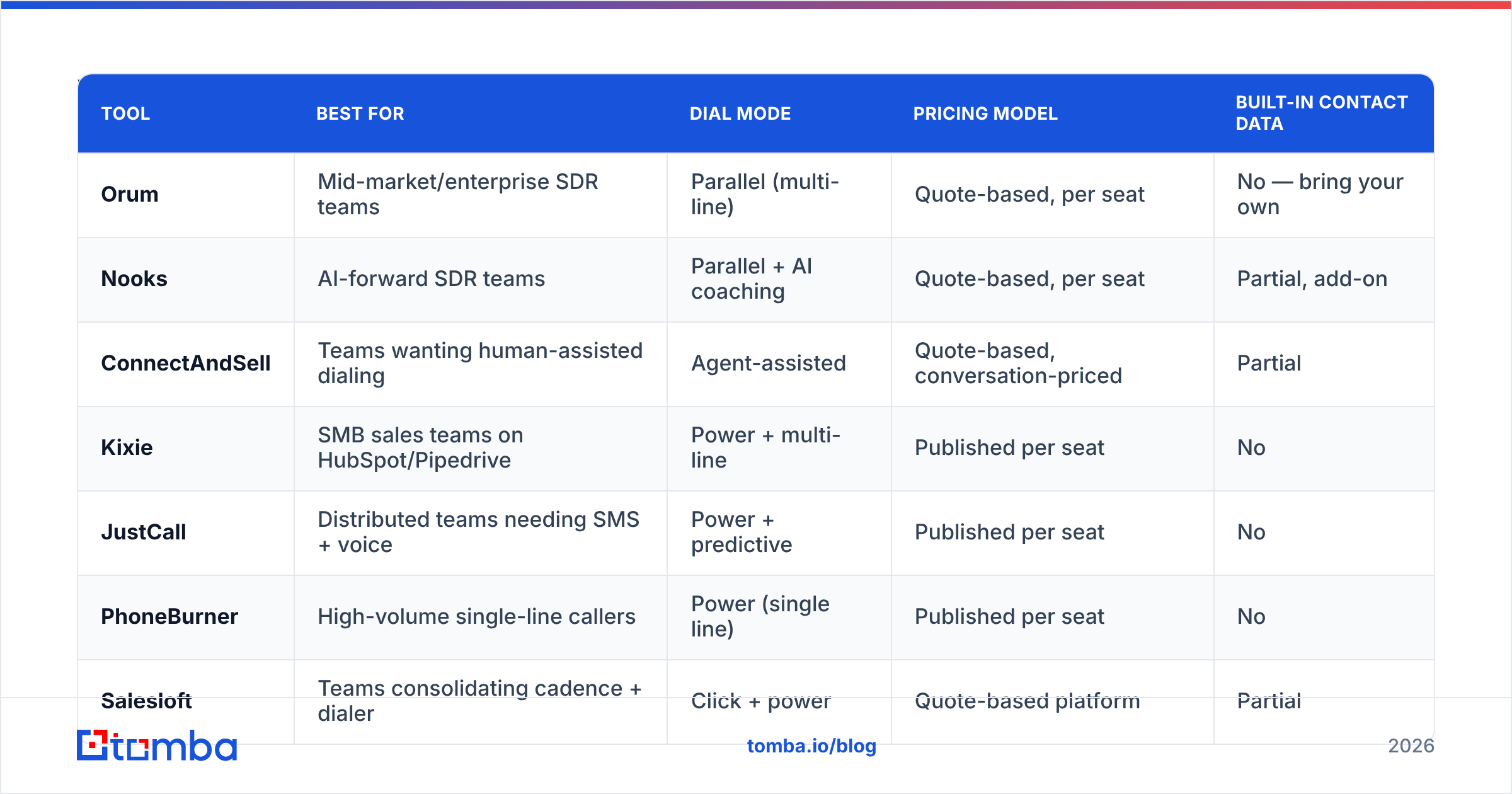
| Tool | Best for | Dial mode | Pricing model | Built-in contact data |
|---|---|---|---|---|
| Orum | Mid-market/enterprise SDR teams | Parallel (multi-line) | Quote-based, per seat | No — bring your own |
| Nooks | AI-forward SDR teams | Parallel + AI coaching | Quote-based, per seat | Partial, add-on |
| ConnectAndSell | Teams wanting human-assisted dialing | Agent-assisted | Quote-based, conversation-priced | Partial |
| Kixie | SMB sales teams on HubSpot/Pipedrive | Power + multi-line | Published per seat | No |
| JustCall | Distributed teams needing SMS + voice | Power + predictive | Published per seat | No |
| PhoneBurner | High-volume single-line callers | Power (single line) | Published per seat | No |
| Salesloft | Teams consolidating cadence + dialer | Click + power | Quote-based platform | Partial |
| Close | Startups wanting CRM + dialer in one | Power + predictive | Published per seat | No |
| Aircall | Support-plus-sales phone systems | Power (via app) | Published per seat | No |
Notice the last column. Eight of nine expect you to bring your own numbers. That's the real cost line most buyers underestimate.
Orum#
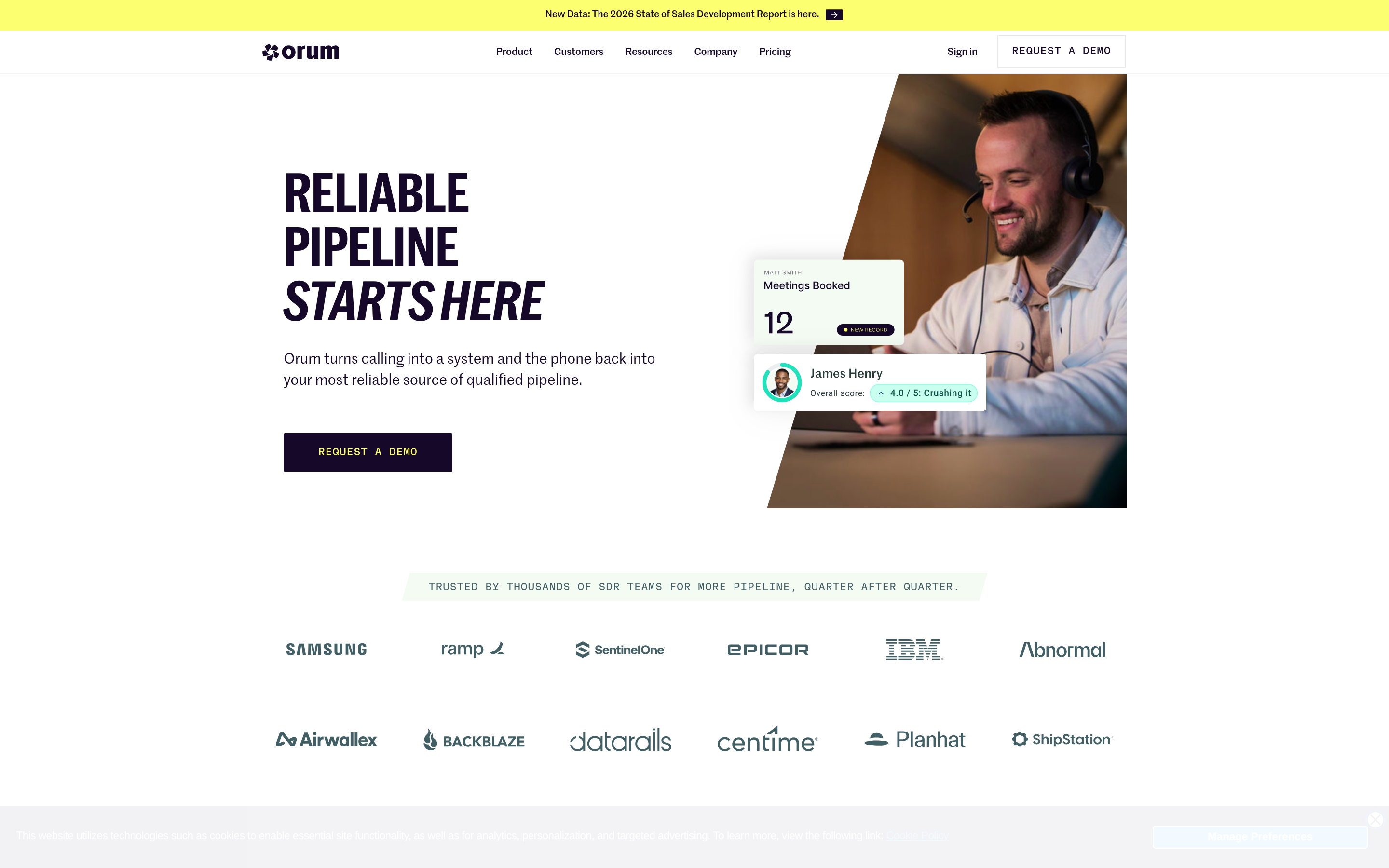
The most common head-to-head against Koncert's parallel dialer. Orum focuses narrowly on live-conversation volume: multi-line dialing, AI voicemail detection, and a virtual "salesfloor" for remote teams. It does not try to be your sequencer, which is exactly what teams running Outreach or Salesloft want. Pricing is quote-only and skews mid-market and up.
Pick it if: you want the highest-ceiling parallel dialer and already own your cadence tool.
Nooks#
Nooks pairs parallel dialing with AI call analysis, objection coaching and a persistent virtual room. It has become the default choice for SDR teams that treat call review as a daily ritual rather than a monthly QBR. The AI layer is genuinely useful for ramping new reps.
Pick it if: rep ramp time is your bottleneck, not raw dial volume.
ConnectAndSell#
The oldest agent-assisted model on this list — human agents navigate phone trees and gatekeepers, then bridge a live human to your rep. Expensive per conversation, but the conversation quality is high because your rep never hears a dial tone.
Pick it if: your reps' time is worth more than the per-conversation premium, and your target accounts have heavy gatekeeping.
Kixie#
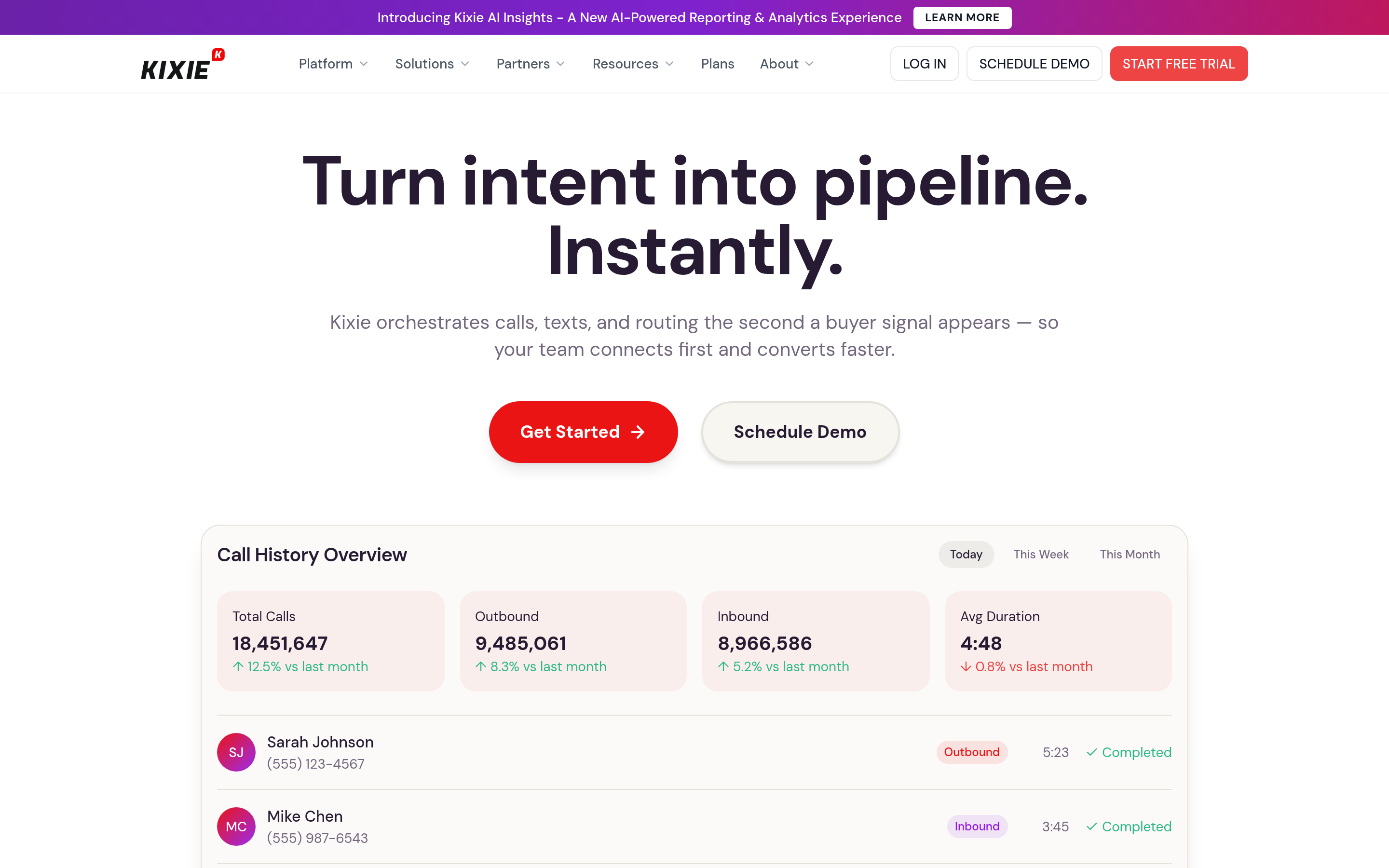
Published pricing, fast setup, and the tightest native HubSpot and Pipedrive integrations in this group. Kixie offers multi-line power dialing on higher tiers, local presence and SMS automation. It won't match Orum's parallel ceiling, but for a ten-rep SMB team it's a fraction of the cost and live in a day.
Pick it if: you want 80% of the outcome at published SMB pricing.
JustCall#

A cloud phone system that grew into a sales dialer. Strong on SMS, WhatsApp and international numbers, which makes it a good fit for teams selling across regions. Predictive dialing sits on upper tiers.
Pick it if: voice is only part of your channel mix and you need real international coverage.
PhoneBurner#
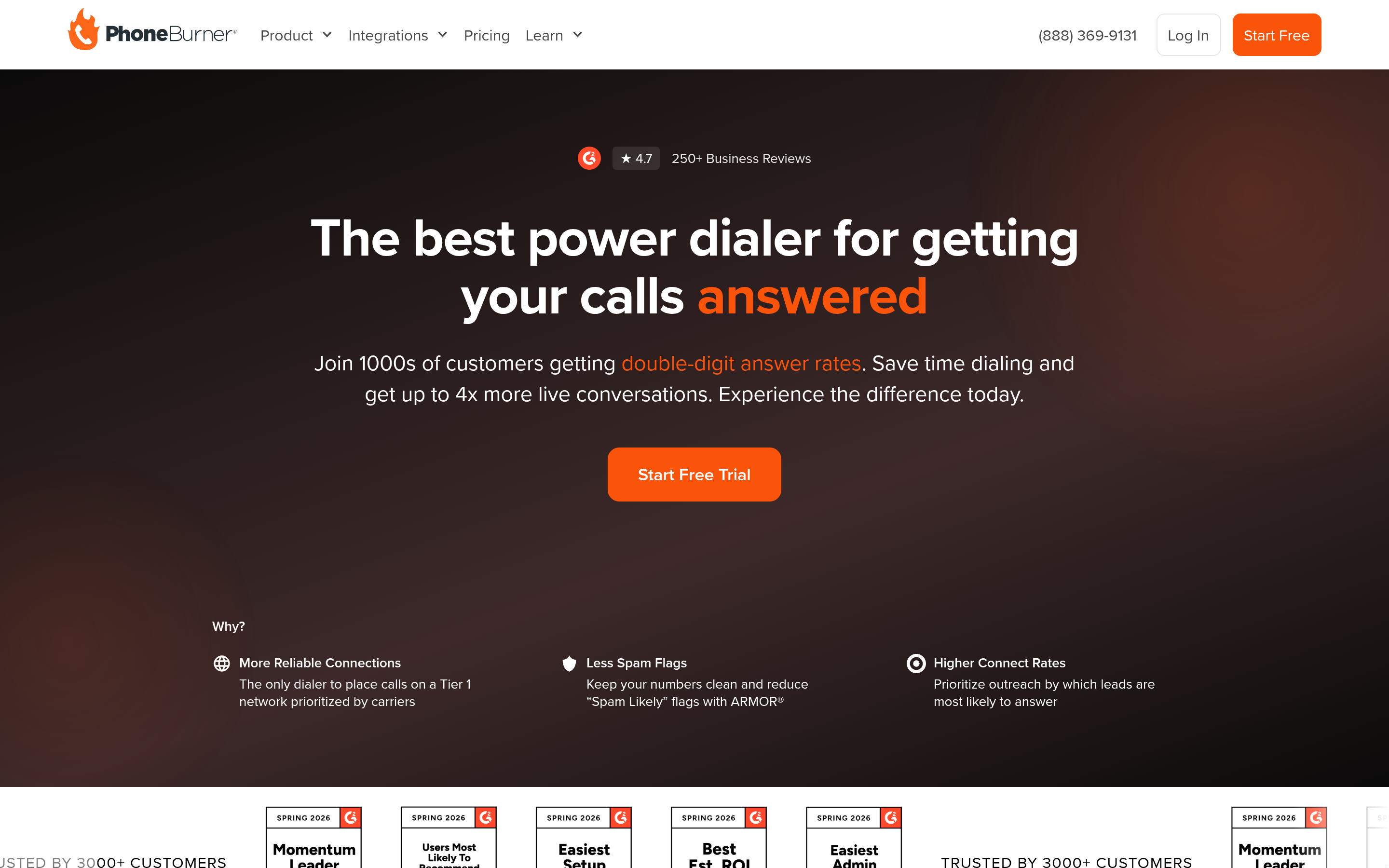
Single-line power dialing done extremely well: no connect delay, instant voicemail drop, one-click email follow-up. It deliberately avoids parallel dialing to sidestep the awkward bridge pause.
Pick it if: your list is small and high-value, and you refuse to risk a dropped hello.
Salesloft#
Not a dialer replacement so much as a consolidation play. If Koncert Cadence and Koncert's click dialer are your main uses, moving everything into a sequencer with a built-in dialer removes a vendor. You lose parallel dialing ceiling; you gain one system of record.
Pick it if: you're consolidating tools, not maximising dials. See the Salesloft alternative landscape if you want to compare the sequencer layer too.
Close#
A CRM with a competent built-in dialer, including power and predictive modes. For a startup running eight reps, buying Close means one subscription instead of three.
Pick it if: you haven't committed to Salesforce or HubSpot yet.
Aircall#
Primarily a business phone system with a sales layer. Good call quality, good app ecosystem, weaker as a pure outbound volume machine.
Pick it if: the same team handles inbound support and outbound calls.
Is a parallel dialer better than a power dialer?#
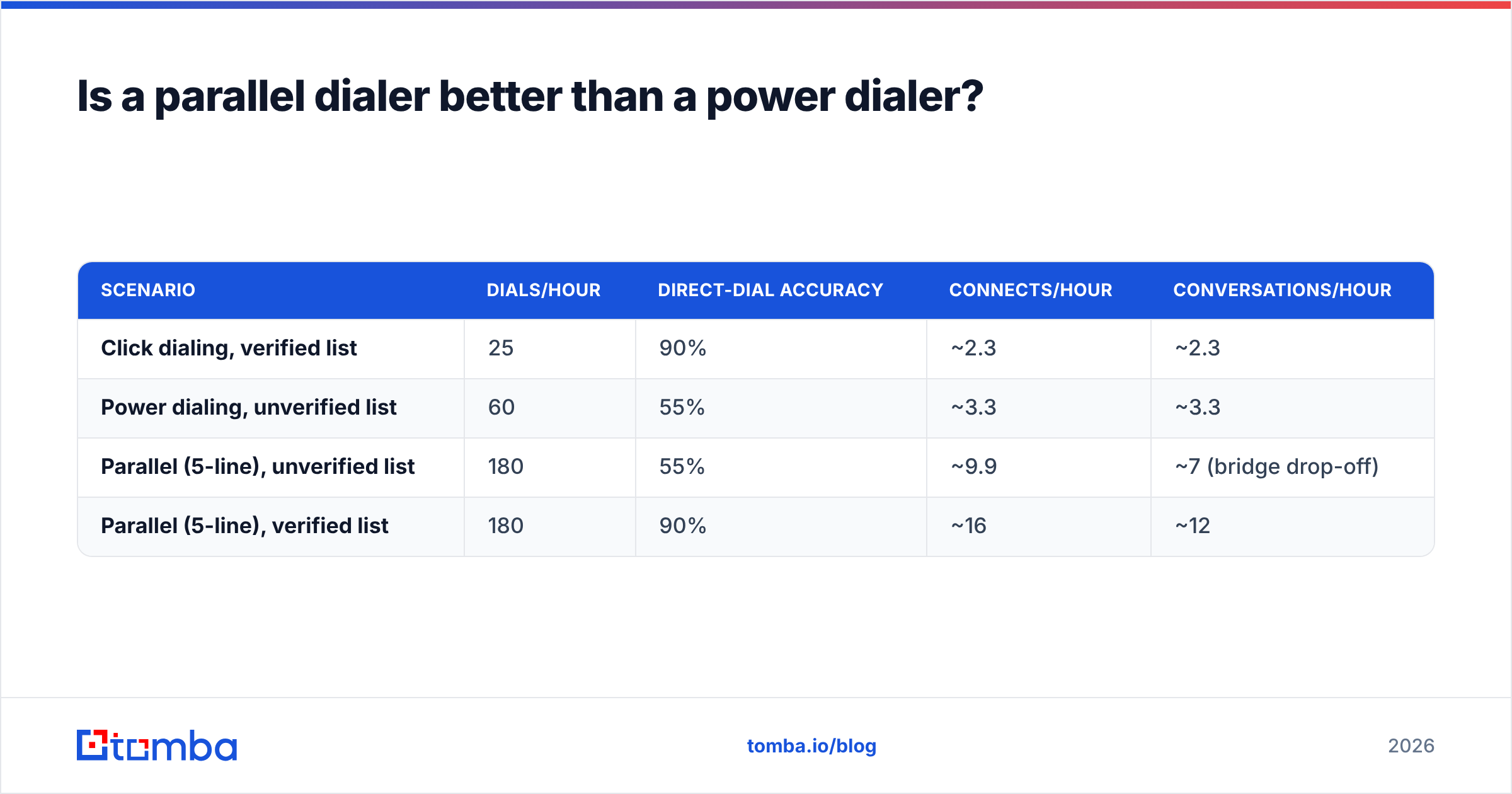
Only when your list is large and your data is clean. Here is the arithmetic that vendors skip.
| Scenario | Dials/hour | Direct-dial accuracy | Connects/hour | Conversations/hour |
|---|---|---|---|---|
| Click dialing, verified list | 25 | 90% | ~2.3 | ~2.3 |
| Power dialing, unverified list | 60 | 55% | ~3.3 | ~3.3 |
| Parallel (5-line), unverified list | 180 | 55% | ~9.9 | ~7 (bridge drop-off) |
| Parallel (5-line), verified list | 180 | 90% | ~16 | ~12 |
The jump from unverified to verified on the same parallel dialer is bigger than the jump from power to parallel on bad data. That's the point most "Koncert vs Orum" comparisons never make: the dialer multiplies whatever your data quality already is. Multiply a small number fast and you still have a small number.
This is also why the bridge-delay question matters. Parallel dialing trades a fraction of conversation quality for volume. If your list is 300 accounts, that trade is bad. If it's 30,000, it's obviously good.
Does your dialer matter more than your data?#
No — and any honest vendor will tell you the same thing.
Direct-dial data decays fast. People change roles, companies consolidate phone systems, and mobile numbers get reassigned. A list sourced eighteen months ago will have a meaningful share of dead or wrong-person numbers regardless of which logo sits on the dialer.
Two practical fixes:
- Verify before you dial. Running numbers through a phone validator strips disconnected and invalid lines before they burn parallel-dial capacity. Every dead number you remove is capacity returned to real prospects.
- Source fresh, don't recycle. Pull direct dials at campaign time rather than working a static export. A phone finder keyed to the company domain and contact name gives you current numbers, and pairing each one with a verified email means a no-answer still has a follow-up path.
On the list-building side, dedicated B2B data providers generally beat the thin bundled datasets inside dialer platforms. BookYourData is a strong option if you want pay-as-you-go verified contact lists without a platform commitment — it sits comfortably alongside a dialer rather than competing with one. For domain-driven prospecting and enrichment inside your own workflow, Tomba's data enrichment and domain search cover the email side of the same record.
The rule of thumb: spend on data first, dialer second. A $99/seat dialer on great data beats a $250/seat dialer on stale data every quarter.
How much do Koncert alternatives cost?#
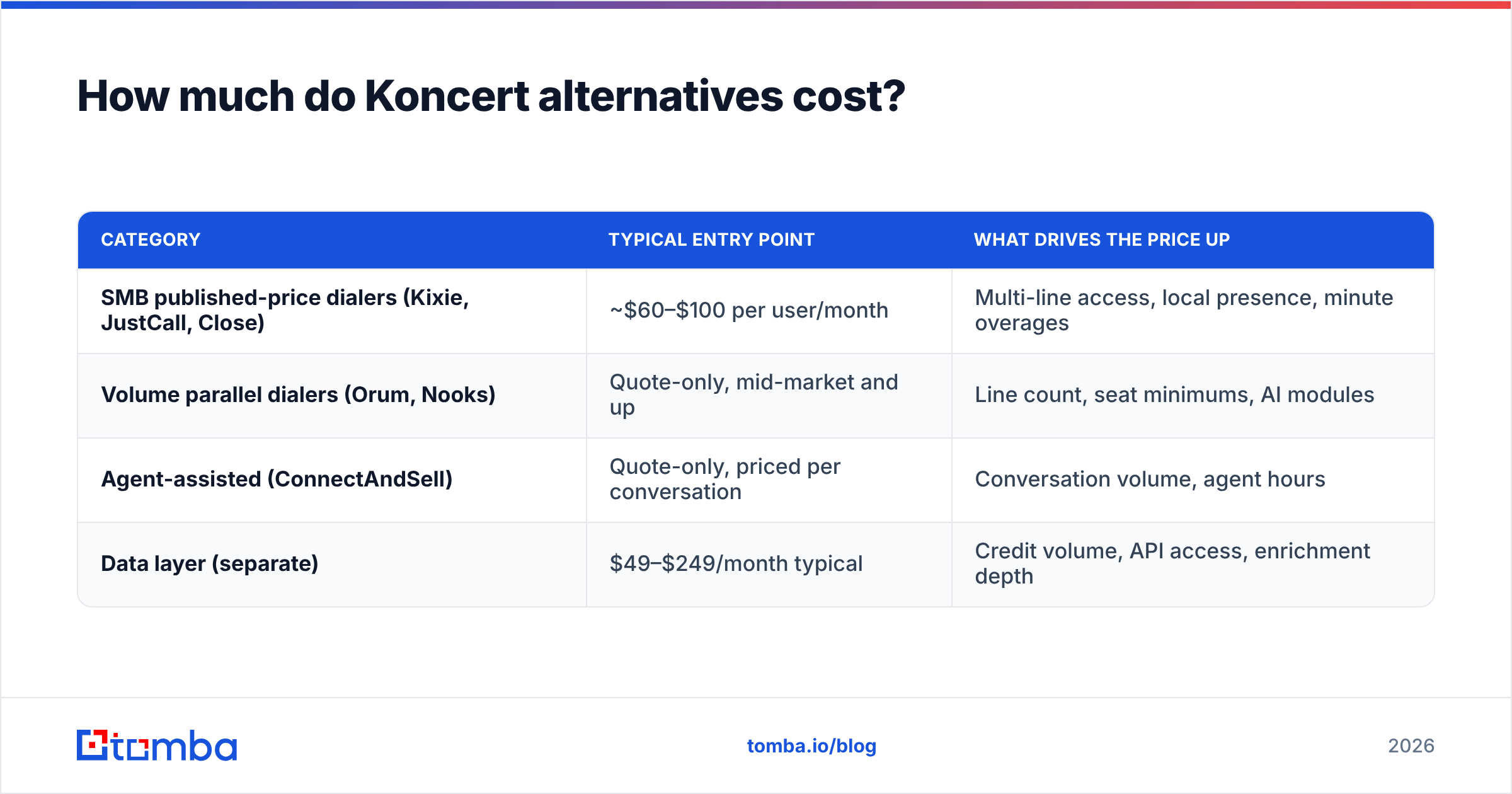
Published pricing across this category is inconsistent, so treat any number as a starting point and confirm with the vendor. Roughly:
| Category | Typical entry point | What drives the price up |
|---|---|---|
| SMB published-price dialers (Kixie, JustCall, Close) | ~$60–$100 per user/month | Multi-line access, local presence, minute overages |
| Volume parallel dialers (Orum, Nooks) | Quote-only, mid-market and up | Line count, seat minimums, AI modules |
| Agent-assisted (ConnectAndSell) | Quote-only, priced per conversation | Conversation volume, agent hours |
| Data layer (separate) | $49–$249/month typical | Credit volume, API access, enrichment depth |
For the data line specifically, Tomba pricing runs a free tier at 25 searches a month, Starter at $49/month, Growth at $99/month and Pro at $249/month, with Enterprise on quote. That sits below most dialer seat costs and is usually the higher-leverage spend.
Add one more line to your model that nobody quotes you: ramp cost. A tool that takes six weeks to configure costs you six weeks of pipeline. Published-price SMB tools typically go live in days; enterprise parallel dialers take longer and need admin ownership.
How do you migrate off Koncert without losing pipeline?#
Run it as a controlled overlap, not a cutover:
- Export your dispositions and call outcomes first. Call history often lives in the dialer, not the CRM. Confirm write-back coverage before you cancel anything.
- Audit the list, not the tool. Before you blame Koncert for connect rates, validate a sample of 500 numbers. If 40% are dead, you have a data problem and switching vendors changes nothing.
- Pilot with two reps for three weeks. Same list, same script, same hours. Compare conversations per hour, not dials per hour.
- Check compliance parity. DNC scrubbing, recording consent by state, calling windows. Do not assume the new vendor matches your current configuration.
- Keep one seat on the old tool for 30 days. Cheap insurance against a config gap you only discover in week five.
Which Koncert alternative is right for you?#
- Enterprise SDR floor, high list volume: Orum or Nooks. Keep your sequencer.
- Heavy gatekeeping, high ACV: ConnectAndSell.
- SMB team on HubSpot or Pipedrive: Kixie.
- International or SMS-heavy motion: JustCall.
- Small, high-value list: PhoneBurner.
- Consolidating vendors: Salesloft, or Close if you're also replacing the CRM.
And if your connect rate is the actual complaint — not the interface, not the price — fix the numbers before you sign anything new.
Fix the data layer before you switch dialers#
Whichever tool you land on, it dials what you feed it. Build the list from verified contacts first: use Tomba Email Finder to pull accurate, verified professional emails by domain, name or company, pair each contact with a validated direct dial, and give your reps a list where every record is worth a ring. Start free with 25 searches a month, or run bulk campaigns from $49/month — then let the dialer do what it's good at.
Related guides#
// get started
Find, verify and enrich your first contacts today
Start on the free plan with 25 searches a month, then scale when your team is ready.
Free plan · No credit card required · GDPR & CCPA
// about the author