KooKoo Ozonetel Pricing 2026: Reviews, Pros and Cons
KooKoo Ozonetel pricing looks cheap per agent. Then the call minutes, number rentals and add-ons land on the invoice. Here is what the platform really costs, what reviewers complain about, and when a lighter stack wins.
TL;DR — what KooKoo Ozonetel pricing really costs
- KooKoo Ozonetel pricing has two layers. KooKoo is the developer side: call APIs, IVR and programmable voice. CloudAgent is the ready-made contact centre on top. Most teams buy both.
- Every quote is usage-based. You pay a per-agent fee, plus per-minute call charges, plus number rental, plus add-ons. The seat price is rarely half the bill.
- G2 and Capterra reviewers praise uptime, Indian network coverage and fast support. They flag weak reporting, dated screens and invoices that are hard to predict.
- Ozonetel is a strong pick if you sell into India. It is a weak pick if you want prices on a web page.
- The biggest hidden cost is not the platform. It is dialling bad numbers. Clean your list first.
What is KooKoo, and how does it relate to Ozonetel?#
Think of Ozonetel as the car maker and KooKoo as the engine. You can buy the engine alone and build your own car around it. Or you can buy the finished car. That single choice shapes KooKoo Ozonetel pricing more than any other factor.
KooKoo started as Ozonetel's programmable voice platform. It gives you APIs and a simple markup for call flows. You can build an IVR, trigger outbound calls, run missed-call services or add click-to-call. Your app hits an endpoint, KooKoo places the call, and your code decides what happens next. If you know Twilio voice, the model is the same. KooKoo just grew up inside India's telecom rules instead of the US ones.
Ozonetel later built CloudAgent on top. CloudAgent is the full contact centre: agent desktop, predictive and preview dialling, call recording, quality checks, CRM screen-pops and chat routing. Most buyers in 2026 come for CloudAgent. They find KooKoo underneath when they need a custom call flow.
The split matters at invoice time. KooKoo APIs bill close to pure usage. CloudAgent bills per live agent seat, with usage stacked on top.
How does KooKoo Ozonetel pricing actually work?#
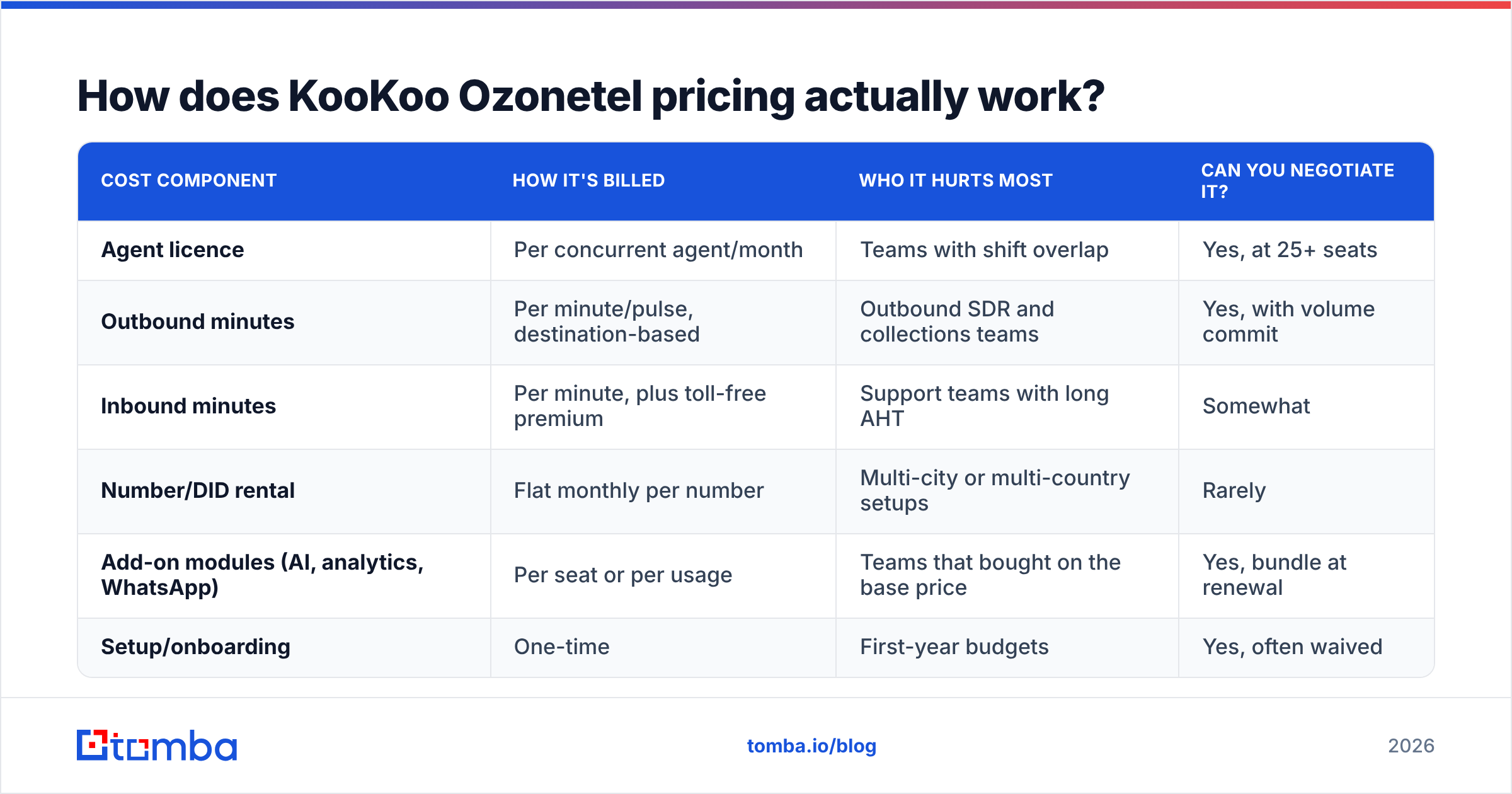
Ozonetel does not publish a price list. Sales builds a quote from parts, and the mix decides your bill. Model these five lines before you sign.
- Agent licence — the sticker price. You pay per live agent, per month. Reported CloudAgent rates start near $25 per agent in USD markets, and lower in rupees. Sales leads with this number.
- Call minutes. Billed per minute or per pulse. Inbound, outbound, mobile, landline and international all price differently. This line breaks most budgets.
- Number rental. Toll-free numbers, virtual numbers and DIDs each carry a monthly fee. Add cities or countries and it multiplies fast.
- Add-ons. Speech analytics, AI agent assist, WhatsApp, chat and some CRM connectors sit outside the seat price. Treat each as its own line.
- Setup and minimums. One-time setup fees and yearly minimums are normal on larger deals. Ask if unused minutes roll over. They usually do not.
Two firms with the same seat count can get bills that differ by 3x. A 20-seat support team with short calls looks nothing like a 20-seat outbound team. The outbound team burns 200 dial-minutes per agent per day. That gap is the heart of KooKoo Ozonetel pricing.
| Cost component | How it's billed | Who it hurts most | Can you negotiate it? |
|---|---|---|---|
| Agent licence | Per concurrent agent/month | Teams with shift overlap | Yes, at 25+ seats |
| Outbound minutes | Per minute/pulse, destination-based | Outbound SDR and collections teams | Yes, with volume commit |
| Inbound minutes | Per minute, plus toll-free premium | Support teams with long AHT | Somewhat |
| Number/DID rental | Flat monthly per number | Multi-city or multi-country setups | Rarely |
| Add-on modules (AI, analytics, WhatsApp) | Per seat or per usage | Teams that bought on the base price | Yes, bundle at renewal |
| Setup/onboarding | One-time | First-year budgets | Yes, often waived |
What do real Ozonetel and KooKoo reviews say?#
Read the reviews on G2 and Capterra and a clear shape appears. Ozonetel scores well, usually in the low-to-mid 4s out of 5. The praise and the gripes both cluster tightly.
What reviewers praise:
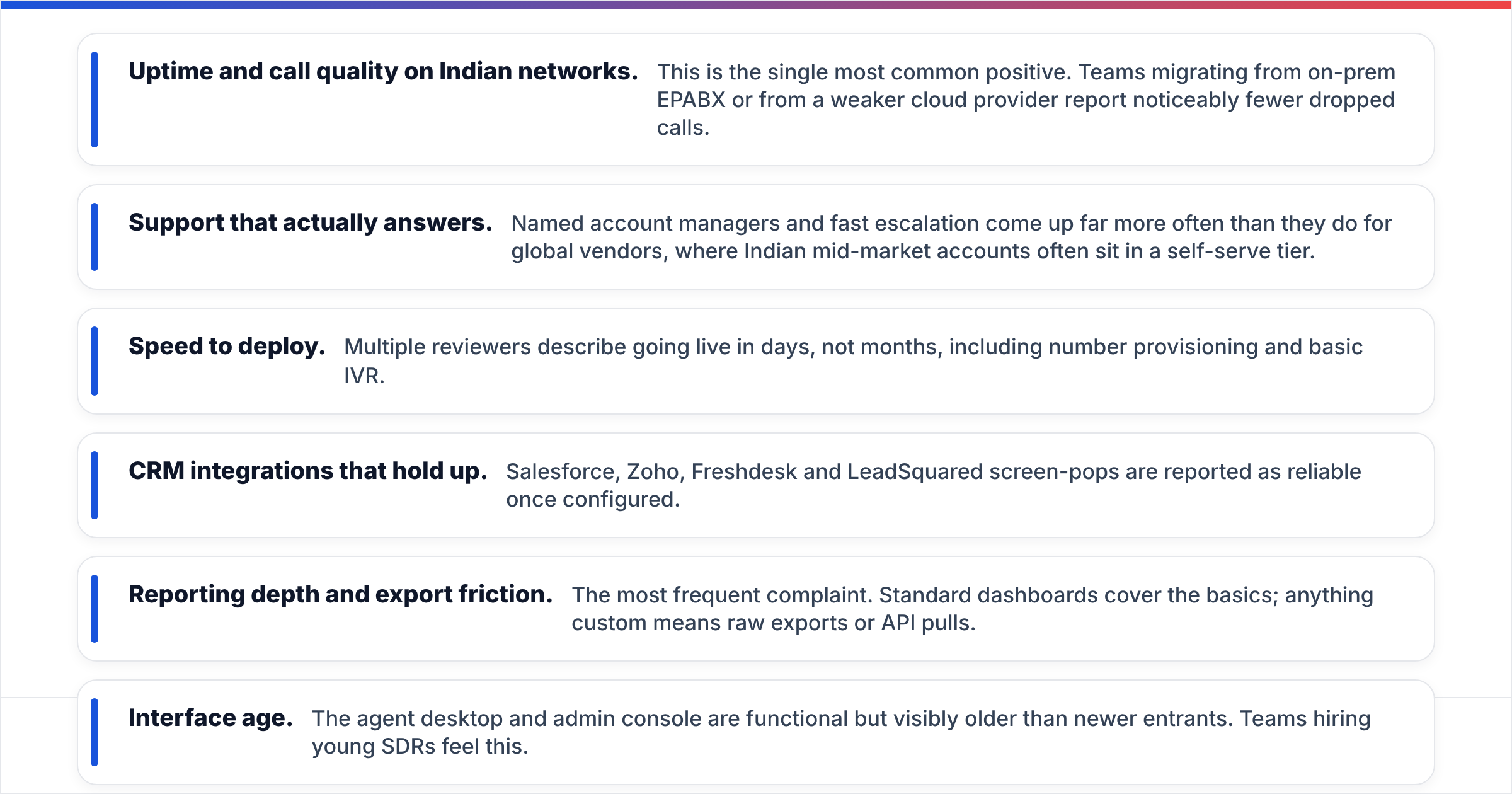
- Call quality on Indian networks. This is the top plus. Teams moving off old on-prem kit report far fewer dropped calls.
- Support that answers. You get a named manager and fast escalation. Global vendors often park mid-market Indian accounts in a self-serve tier.
- Speed to launch. Many teams go live in days, numbers and basic IVR included.
- CRM links that hold. Salesforce, Zoho, Freshdesk and LeadSquared screen-pops work well once set up.
What reviewers criticise:
- Reporting. The top gripe. Stock dashboards cover the basics. Anything custom means raw exports or API pulls.
- Dated screens. The agent desktop works, but it looks old next to newer tools. Young SDRs notice.
- Billing clarity. This is where KooKoo Ozonetel pricing takes its worst hits. Invoices are hard to match to usage without call logs. Toll-free and international rates can surprise you.
- Thin API docs. Developers say some examples lag the live API. That costs a sprint.
None of this is a deal-breaker. The pattern is simple. Ozonetel is a solid telecom firm with software that trails the best SaaS design. Your buying team may care more about calls connecting than about pretty screens. If so, the trade works.
What are the pros and cons of KooKoo by Ozonetel?#
Pros
- Deep carrier ties and clean India compliance, including the TRAI and DLT rules that global vendors handle poorly.
- One vendor for call APIs (KooKoo) and the packaged contact centre (CloudAgent). You can start small and grow without a replatform.
- Numbers and IVR flows go live fast.
- Seat costs beat Genesys, Five9 and NICE for the same core work.
- Native predictive dialling, not a bolt-on. Inbound and outbound both get first-class support.
Cons
- No public price page, so every deal needs a sales cycle. That slows buying and makes benchmarks hard.
- Usage billing is hard to forecast, above all for outbound teams with swingy volume.
- Reporting needs workarounds past the standard metrics.
- The global footprint is thinner than Twilio's if you need a dozen countries.
- Add-ons mean the quoted seat price understates the true cost. KooKoo Ozonetel pricing almost always lands above the first number you hear.
How does Ozonetel compare to Exotel, Knowlarity and Twilio?#
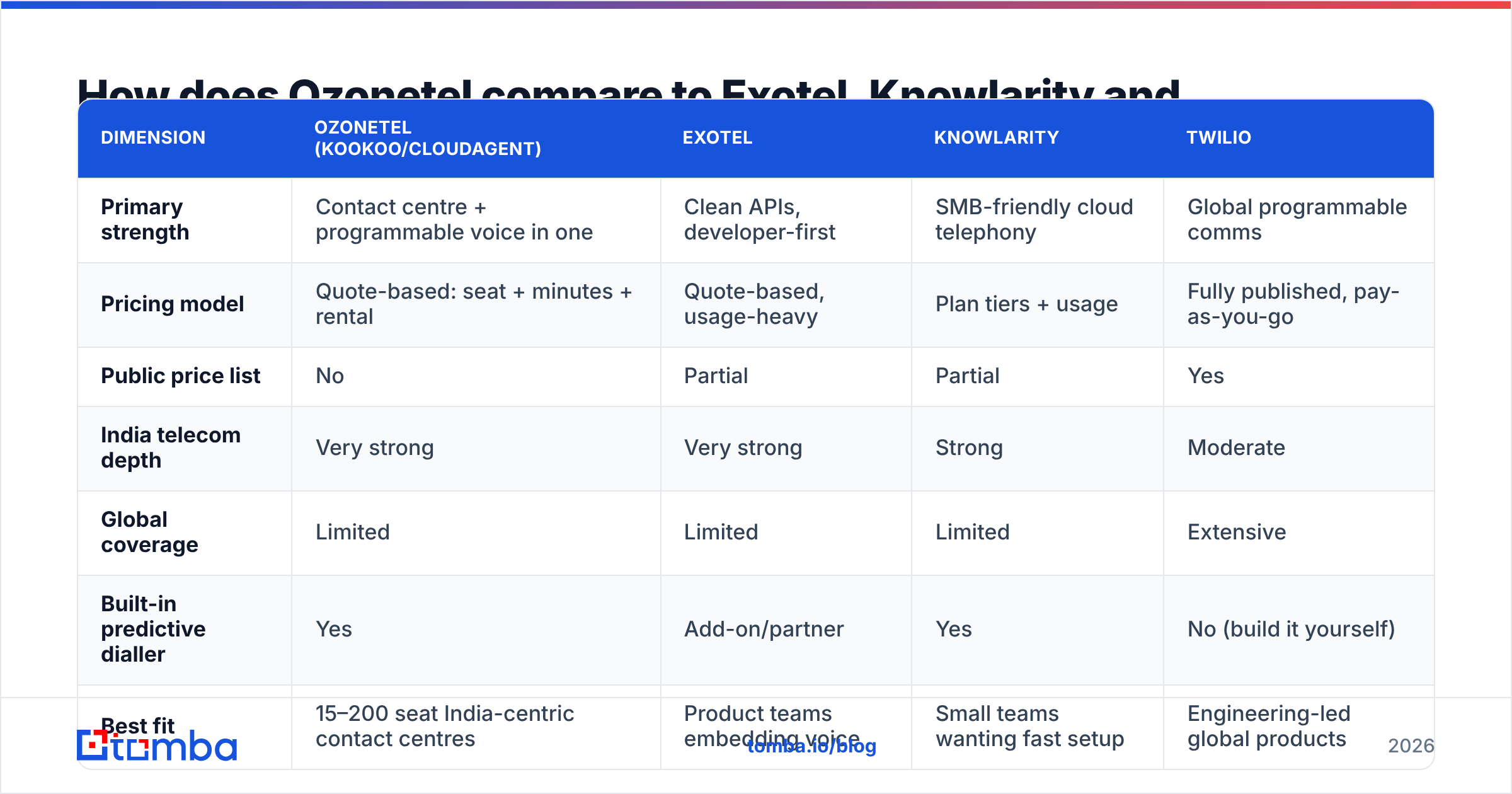
The honest answer depends on what you are buying: an API or a contact centre. Here is how the four compare on the points that decide it.
| Dimension | Ozonetel (KooKoo/CloudAgent) | Exotel | Knowlarity | Twilio |
|---|---|---|---|---|
| Primary strength | Contact centre + programmable voice in one | Clean APIs, developer-first | SMB-friendly cloud telephony | Global programmable comms |
| Pricing model | Quote-based: seat + minutes + rental | Quote-based, usage-heavy | Plan tiers + usage | Fully published, pay-as-you-go |
| Public price list | No | Partial | Partial | Yes |
| India telecom depth | Very strong | Very strong | Strong | Moderate |
| Global coverage | Limited | Limited | Limited | Extensive |
| Built-in predictive dialler | Yes | Add-on/partner | Yes | No (build it yourself) |
| Best fit | 15–200 seat India-centric contact centres | Product teams embedding voice | Small teams wanting fast setup | Engineering-led global products |
| Weakest point | Reporting, billing clarity | Contact-centre feature depth | Enterprise scale | Cost at high volume, no CC suite |
Read that table as a fork, not a ranking. Say you are an engineering team shipping voice worldwide. Twilio's public rates and docs win on speed alone. Say you dial Indian mobiles all day with 40 agents and DLT rules to meet. Then Ozonetel is the better answer, even with opaque KooKoo Ozonetel pricing.

Who should buy KooKoo, and who should skip it?#
Buy it if:
- Most of your calls land in India or South Asia, and compliance is a live worry.
- You run 15 or more live agents. You want dialler, recording, QA and routing from one vendor.
- You need custom IVR logic, with the API and the agent desktop on one backend.
- You value a named support contact over a slick self-serve console.
Skip it if:
- You have fewer than five agents and want to pay by card today.
- You mostly reach out by email and LinkedIn. A light dialler inside your CRM costs far less.
- You need deep self-serve analytics as a core feature.
- Your buyers sit in North America or Europe, where a global provider gives better rates.
What's the hidden cost most teams miss when pricing a dialler?#
Here is the part no quote shows: the cost of calling numbers that were never going to connect.
Do the math. Say your dialler makes 40 calls per agent-hour. Say 30% of your list is wrong, dead or switchboard-only. That is 12 wasted calls an hour. Across 20 agents and a 20-day month, you get tens of thousands of dead dials. Each one is metered. Each one ties up a channel. Each one drags down your answer rate and pushes the dialler to dial harder.
No discount wins that money back. Clean data does. This is the one part of KooKoo Ozonetel pricing you can fix without a sales call.
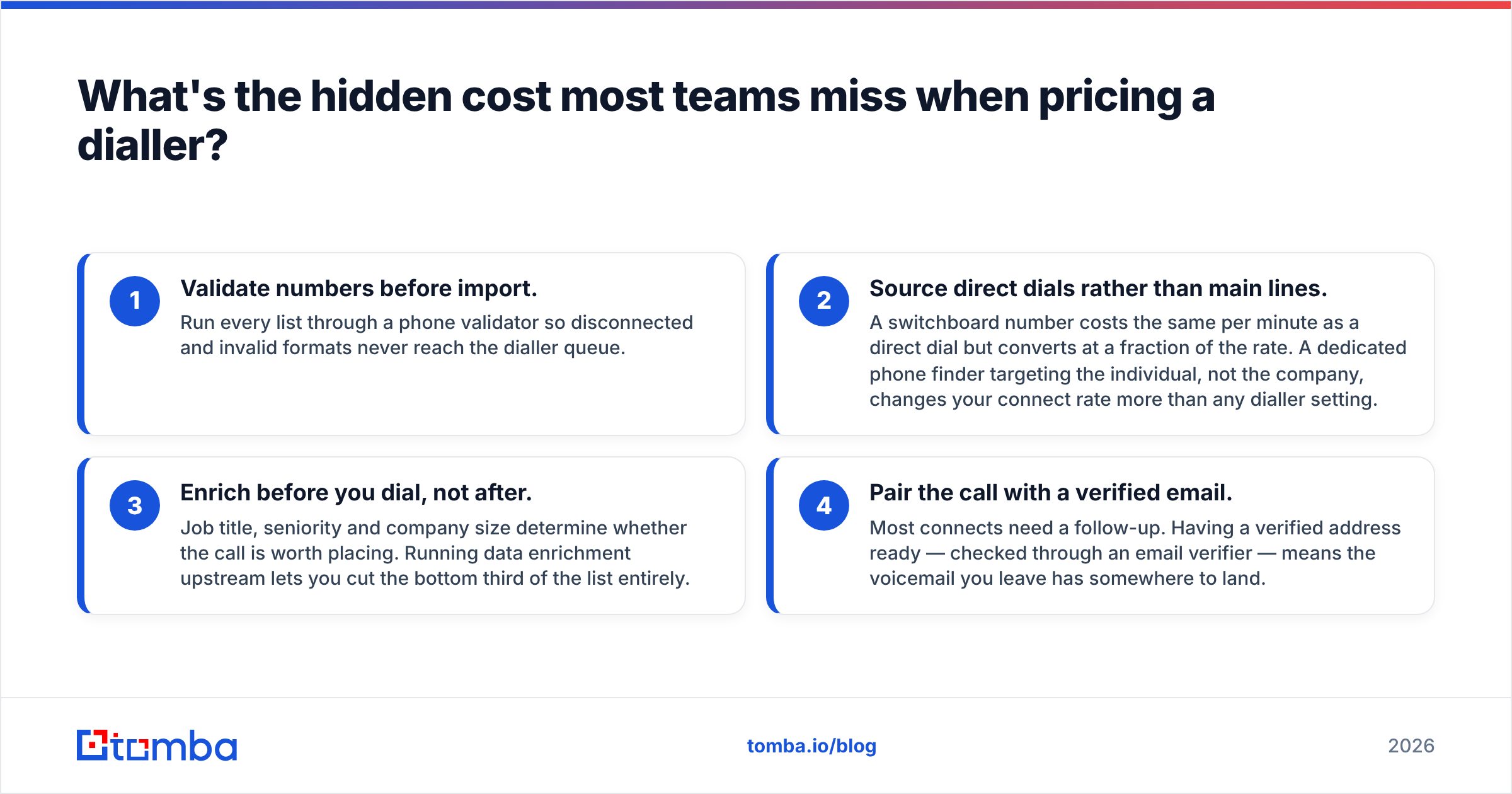
Four fixes, best return first:
- Check numbers before import. Run each list through a phone validator so dead and malformed numbers never reach the queue.
- Find direct dials, not main lines. A switchboard number costs the same per minute but converts far worse. A phone finder that targets the person beats any dialler setting.
- Enrich before you dial. Job title, seniority and company size tell you if the call is worth placing. Run data enrichment first and cut the bottom third of the list.
- Pair each call with a verified email. Most connects need a follow-up. An email verifier makes sure your voicemail has somewhere to land.
The math is blunt. Minutes are a variable cost, and you pay them even when the number is fake. Contact data is a fixed cost you pay once. Move spend from the first bucket to the second. It beats haggling over the seat price.
How should you negotiate KooKoo Ozonetel pricing?#
Bring numbers, not questions. Five moves work:
- Bring a 90-day usage model. Total dial-minutes, average call length, destination mix and peak concurrency. Vendors discount for committed volume, not for keenness.
- Price live seats, not headcount. If 30 agents work shifts but only 18 are ever live, you buy 18 seats. Put that in the contract.
- Get minute rates in writing. Mobile, landline, toll-free and international, as a rate card attached to the deal.
- Ask about renewal. A cap on the yearly rise beats a year-one discount.
- Cap the add-ons now. Price speech analytics and AI assist today, even if you buy them later. Your leverage ends the day you go live.
Do the same on the data side of your stack. Tools with flat public prices give you a fixed anchor. You can read Tomba pricing with no sales call: free at 25 searches a month, then $49 a month on Starter. Your telephony line stays variable, so it helps to pin down the rest.
The verdict#
KooKoo and Ozonetel still make sense in 2026 for India-first contact centres. You get carrier-grade voice, a native dialler and one vendor across API and desktop. The trade is clarity. KooKoo Ozonetel pricing stays hidden until you take the call, and the seat fee is the smaller half of the story. Happy reviewers talk about uptime and support. Unhappy ones talk about reports and invoices. Pick the pain you can live with.
Whichever dialler you pick, it is only as good as the list you feed it. Fix who you call before you fix cost per minute. Start with Tomba Email Finder to build a verified, enriched list. Accurate direct contacts, checked before they reach your queue, mean every paid minute goes to someone who can say yes.
Related guides#
// get started
Find, verify and enrich your first contacts today
Start on the free plan with 25 searches a month, then scale when your team is ready.
Free plan · No credit card required · GDPR & CCPA
// about the author