KrispCall Pricing, Reviews, Pros and Cons: 2026 Breakdown
KrispCall looks cheap on the pricing page, but per-number fees, call rates and minimum seat counts change the math. Here is the honest cost breakdown, what reviewers complain about, and who should pick something else.
TL;DR
- KrispCall is a cloud phone system (VoIP, virtual numbers, shared inbox, CRM sync) aimed at small sales and support teams, not an all-in-one sales engagement platform.
- Entry pricing starts in the ~$15/user/month range on annual billing, with a mid tier around ~$40/user/month and a custom enterprise tier. Verify current numbers on the vendor's page before you budget.
- The sticker price is not the real price. Virtual numbers, per-minute call rates, SMS, extra integrations and minimum seat counts are billed on top.
- Reviewers consistently praise the price-to-feature ratio and the unified callbox; they consistently criticize occasional call-quality dips, mobile app bugs, and support response times.
- KrispCall solves dialing. It does not solve who to dial. Pair it with a contact-data layer if your reps are still hunting for numbers and emails manually.
What is KrispCall and who is it actually for?#
KrispCall is a cloud telephony platform: you buy virtual phone numbers in 100+ countries, assign them to reps, and make and receive calls from a browser, desktop app or mobile app. Around that core it bundles a shared "unified callbox" inbox, call recording, IVR, call monitoring, SMS/MMS, and integrations with CRMs like HubSpot and Pipedrive.
The honest positioning: it is a budget-to-midmarket business phone system. It competes with RingCentral, Dialpad, Aircall, JustCall and CloudTalk — mostly on price. It is not a power dialer platform with deep cadence automation, and it is not a conversation intelligence tool.
Who it fits:
- Small outbound sales teams (3-25 reps) who need local presence numbers in multiple countries without enterprise contracts.
- Support teams that want shared numbers, call routing and a single inbox for calls plus SMS.
- Remote-first companies replacing desk phones entirely, where everyone works from a laptop and a headset.
- Agencies and BPOs managing several client numbers under one account with separate workspaces.
- Founders doing their own sales who need a real business line without a $500/month floor.
Who it does not fit: teams that need 500+ dials per rep per day with local presence rotation, heavy compliance recording requirements, or native multi-channel sequencing. Those buyers end up on Outreach, Salesloft or a dedicated parallel dialer.
How much does KrispCall pricing cost in 2026?#
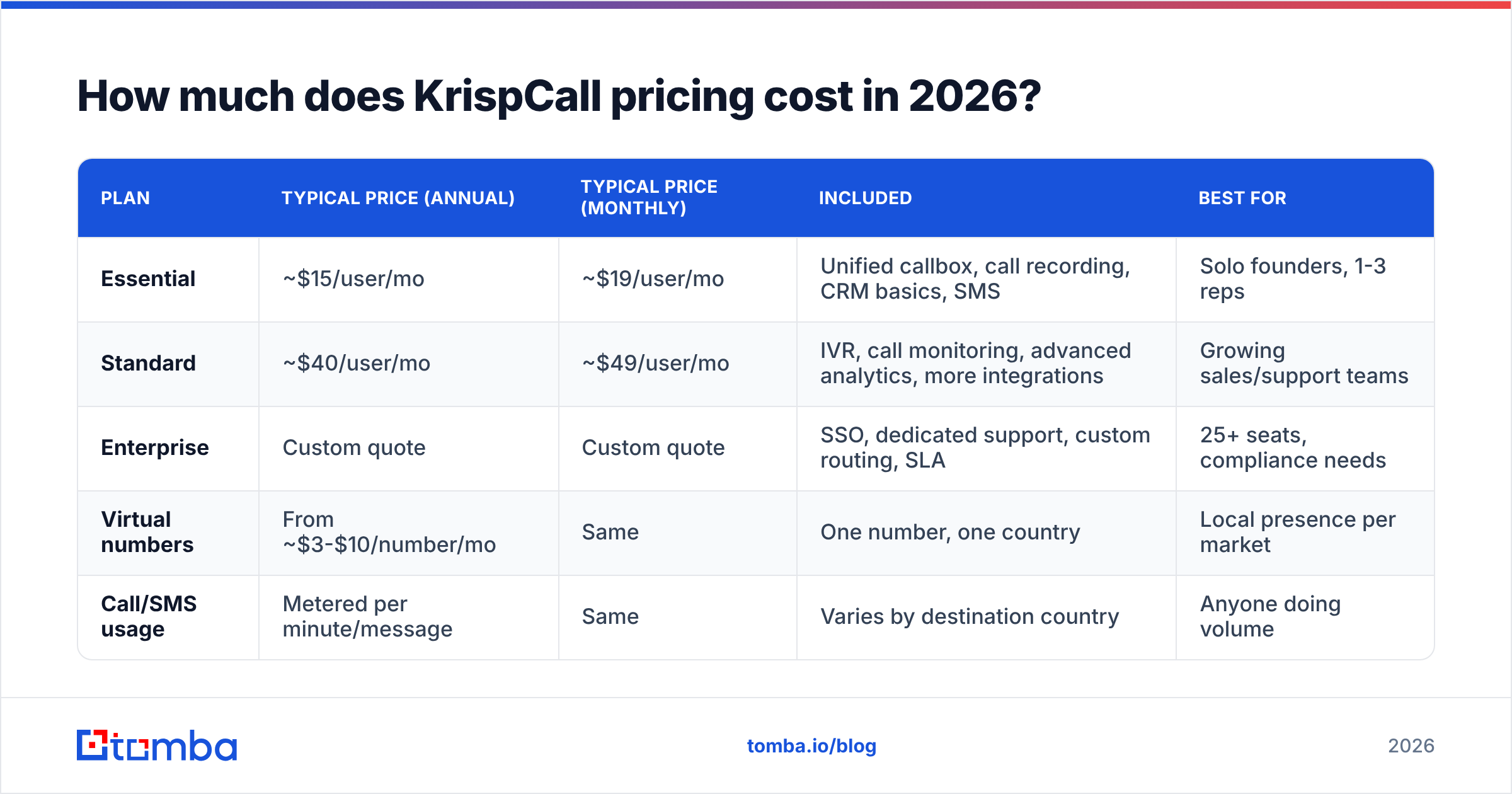
Here is the structure as advertised on KrispCall's own site. Treat exact figures as approximate — cloud telephony vendors repackage tiers often, and annual-vs-monthly gaps are large.
| Plan | Typical price (annual) | Typical price (monthly) | Included | Best for |
|---|---|---|---|---|
| Essential | ~$15/user/mo | ~$19/user/mo | Unified callbox, call recording, CRM basics, SMS | Solo founders, 1-3 reps |
| Standard | ~$40/user/mo | ~$49/user/mo | IVR, call monitoring, advanced analytics, more integrations | Growing sales/support teams |
| Enterprise | Custom quote | Custom quote | SSO, dedicated support, custom routing, SLA | 25+ seats, compliance needs |
| Virtual numbers | From ~$3-$10/number/mo | Same | One number, one country | Local presence per market |
| Call/SMS usage | Metered per minute/message | Same | Varies by destination country | Anyone doing volume |
Two structural details matter more than the headline number:
- Annual billing is where the discount lives. The monthly-billed price is materially higher across tiers. If you commit annually for a team that churns reps, you eat the seats.
- Minimum seat counts. Some tiers and some number types require a minimum purchase. Ask in the sales call, in writing, before you sign.

What hidden costs should you budget for?#
This is where most KrispCall pricing reviews get shallow. The plan price is the cost of the software seat. The cost of actually making calls is separate. Budget for:
- Per-number rental. Every virtual number — every country, every city code — is a recurring line item. A team running local presence in six markets is paying six rentals per pool, not one.
- Per-minute call rates. Outbound to mobile numbers in many countries costs multiples of landline rates. A rep doing 3 hours of talk time a day generates real usage charges. Model it: 60 connected minutes/day × 22 days × your blended rate.
- SMS and MMS. Priced per segment. A/2P registration fees in the US (10DLC brand and campaign registration) are an extra pass-through cost that surprises first-time buyers.
- Number verification and porting. Porting existing numbers in is usually free-ish; regulatory documentation for certain countries (proof of address, business registration) costs you time, not money, but it delays go-live by days or weeks.
- Integration gaps. If your CRM is not natively supported, you are paying for Zapier or Make operations on top. Check the native list before assuming parity with Aircall or Dialpad.
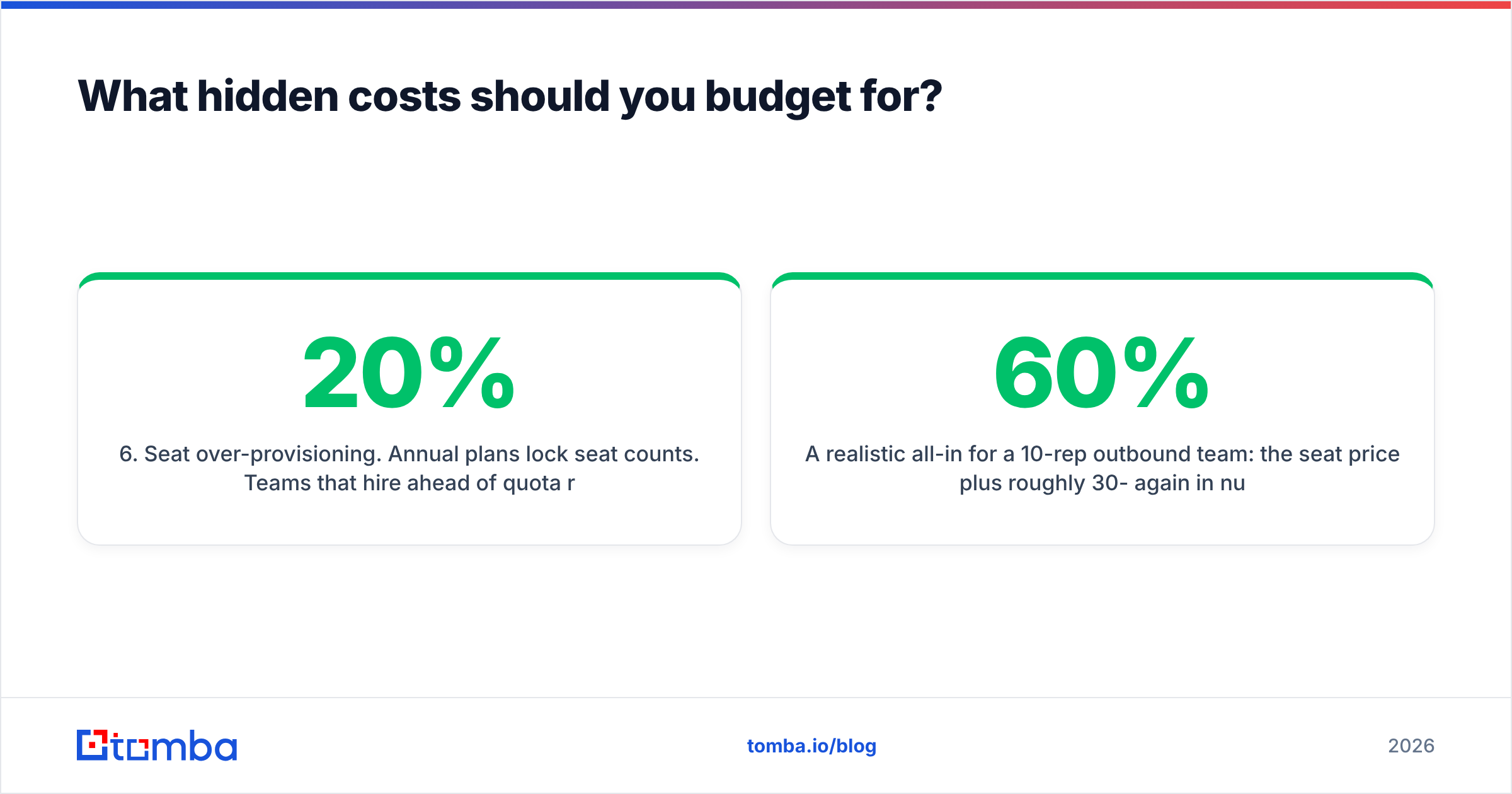
- Seat over-provisioning. Annual plans lock seat counts. Teams that hire ahead of quota routinely pay for 20% empty seats for a year.
A realistic all-in for a 10-rep outbound team: the seat price plus roughly 30-60% again in numbers and usage. Plan on that, not the $15 figure.
What do KrispCall reviews actually say?#
Aggregate sentiment on public review sites is positive but not uncritical. Scanning G2's VoIP provider category and Capterra for this segment, the same themes repeat across KrispCall and its direct competitors:
Consistent praise:
- Price-to-feature ratio versus RingCentral and Aircall, especially for international numbers.
- The unified callbox — calls, SMS and contact history in one pane — reduces tab-switching for small teams.
- Fast onboarding. Most reviewers describe going live in under a day for a simple setup.
- Breadth of country coverage for the price.
Consistent criticism:
- Call quality variance. Reports of jitter or dropped calls on certain routes, usually resolved but disruptive when they hit a live demo.
- Mobile app reliability. The desktop and web clients get better marks than mobile.
- Support latency. Lower-tier customers describe slow first-response times; enterprise customers report the opposite.
- Analytics depth. Reporting is adequate for activity metrics, thin for coaching and conversation analysis.
Read reviews with a filter: a VoIP call-quality complaint is often a network problem on the reviewer's side, not the vendor's. Weight complaints that mention specific routes or countries over generic "calls drop sometimes."
What are the real pros and cons of KrispCall?#
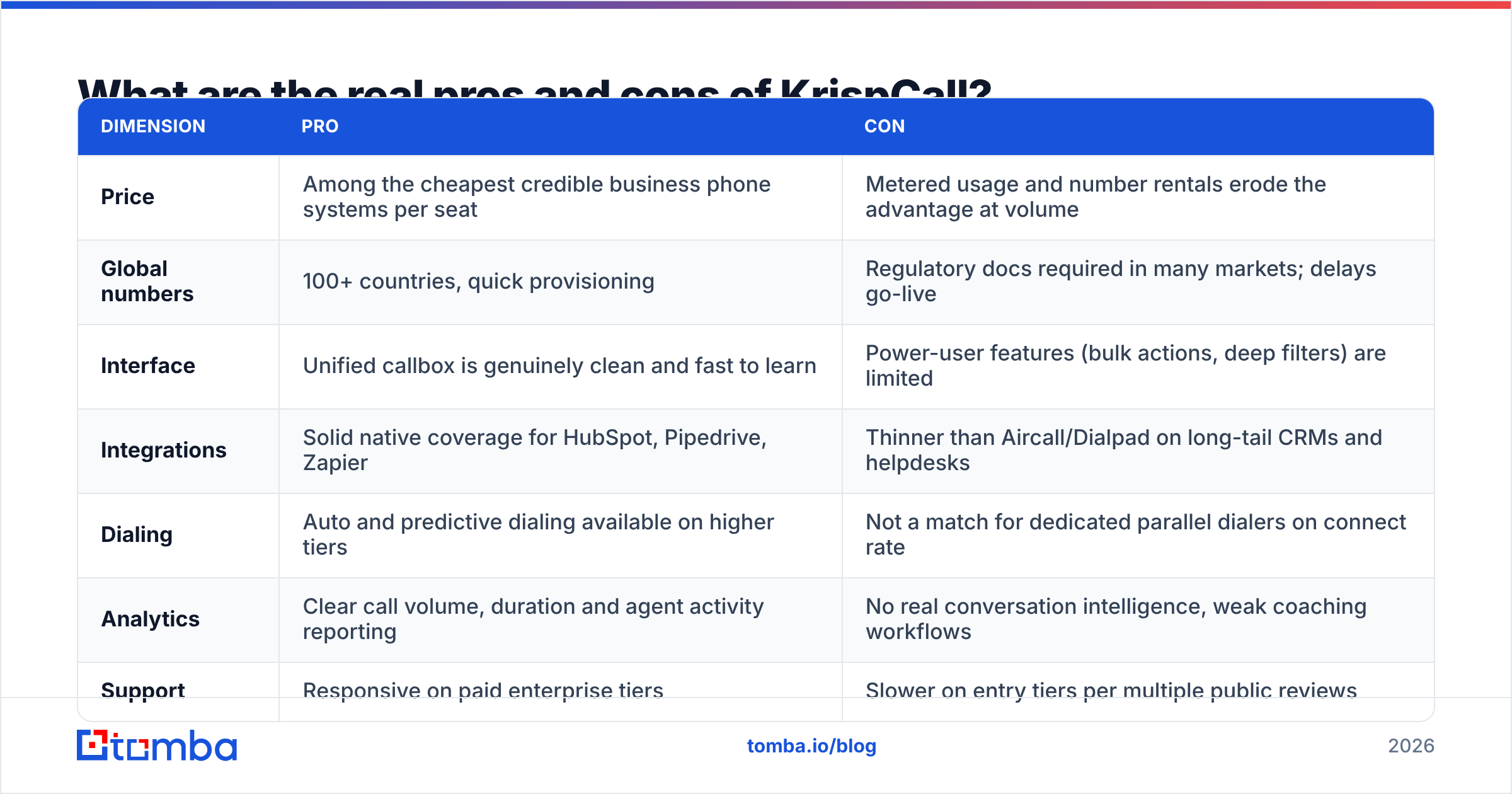
| Dimension | Pro | Con |
|---|---|---|
| Price | Among the cheapest credible business phone systems per seat | Metered usage and number rentals erode the advantage at volume |
| Global numbers | 100+ countries, quick provisioning | Regulatory docs required in many markets; delays go-live |
| Interface | Unified callbox is genuinely clean and fast to learn | Power-user features (bulk actions, deep filters) are limited |
| Integrations | Solid native coverage for HubSpot, Pipedrive, Zapier | Thinner than Aircall/Dialpad on long-tail CRMs and helpdesks |
| Dialing | Auto and predictive dialing available on higher tiers | Not a match for dedicated parallel dialers on connect rate |
| Analytics | Clear call volume, duration and agent activity reporting | No real conversation intelligence, weak coaching workflows |
| Support | Responsive on paid enterprise tiers | Slower on entry tiers per multiple public reviews |
How does KrispCall compare to other business phone systems?#
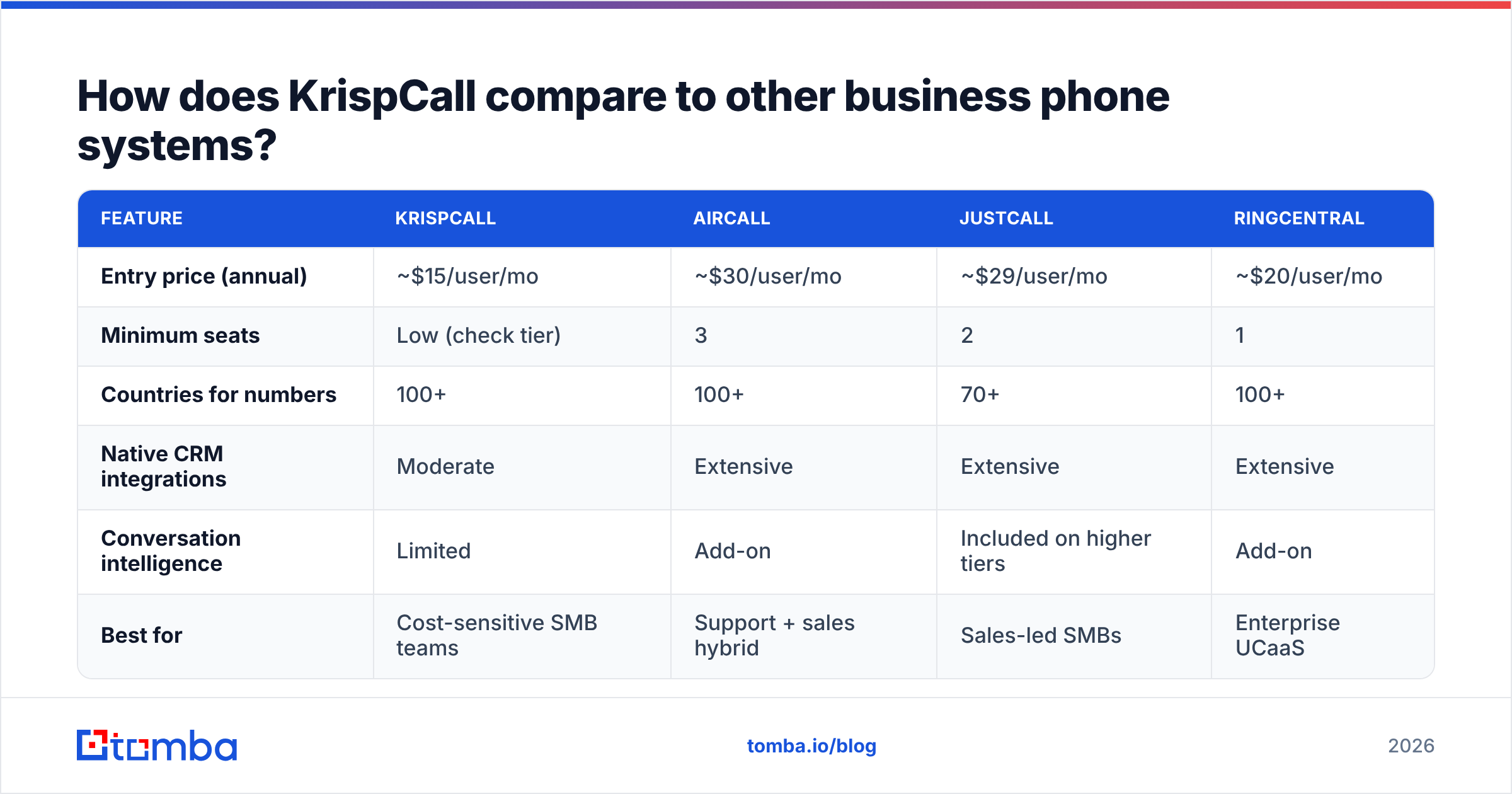
| Feature | KrispCall | Aircall | JustCall | RingCentral |
|---|---|---|---|---|
| Entry price (annual) | ~$15/user/mo | ~$30/user/mo | ~$29/user/mo | ~$20/user/mo |
| Minimum seats | Low (check tier) | 3 | 2 | 1 |
| Countries for numbers | 100+ | 100+ | 70+ | 100+ |
| Native CRM integrations | Moderate | Extensive | Extensive | Extensive |
| Conversation intelligence | Limited | Add-on | Included on higher tiers | Add-on |
| Best for | Cost-sensitive SMB teams | Support + sales hybrid | Sales-led SMBs | Enterprise UCaaS |
The pattern is clear: KrispCall wins on price and international number breadth. It loses on ecosystem depth and analytics sophistication. If your evaluation criteria are "cheapest credible multi-country calling," it is a strong candidate. If they are "the phone system our RevOps team will build reporting on for three years," look harder at the analytics gap first.
Is KrispCall worth it for an outbound sales team?#
Conditionally yes — with one caveat that has nothing to do with KrispCall.
A dialer improves the efficiency of calls you already know how to place. It does nothing for the input problem: the list. Teams that buy telephony to fix pipeline usually discover within a quarter that the bottleneck was never dial speed. It was that 30-40% of their phone numbers were wrong, stale, or belonged to someone who left the company 14 months ago.
Run the math on your own data before you scale seats:
- If your connect rate is under 4%, the problem is list quality, not dial volume.
- If your wrong-number rate is above 10%, you are burning rep hours and damaging your caller reputation on every pass.
- If reps spend more than 20 minutes a day looking up contacts, the data layer is the constraint.
Fixing that is a separate purchase. A phone finder pulls verified B2B direct numbers for named contacts, and a phone validator checks line status before the dialer ever fires — which keeps your KrispCall usage bill attached to conversations instead of dead routes. The same logic applies on the email side: verify emails before a sequence rather than after the bounce report.
Put differently: KrispCall is the plumbing. The water still has to come from somewhere.
Who should skip KrispCall?#
Skip it if any of these describe you:
- You need enterprise compliance. HIPAA, FINRA or strict regional recording-retention requirements push you toward vendors with mature compliance programs and signed BAAs.
- You run high-volume parallel dialing. 300+ dials per rep per day with local presence rotation is a different product category.
- Conversation intelligence is a must-have. If your sales manager coaches from call transcripts and talk-ratio scores, budget for a platform built around that.
- Your CRM is unusual. Check the native integration list. A missing connector means glue code or automation credits forever.
- You bill clients for telephony. Metered usage across many sub-accounts gets messy to reconcile.
What should you ask before you sign?#
Bring this list to the sales call. Get answers in writing:
- What is the total first-year cost for our seat count, our number count, and our projected minutes to our top three destination countries?
- What happens to seats mid-contract if we downsize — pro-rated refund, credit, or nothing?
- Which features are tier-gated that we are assuming are included (IVR, call monitoring, analytics retention window)?
- What is the documented support SLA on our tier, not the enterprise tier?
- What is the porting timeline for our existing numbers, per country?
- What are the data retention and export terms for call recordings if we leave?
If a vendor will not put the total-cost answer in writing, that is your answer.
The verdict#
KrispCall earns its reviews. It is a well-priced, competent cloud phone system that punches above its tier on international coverage and interface quality, and it is honestly weaker on analytics depth, mobile reliability and low-tier support. For a 3-25 person team that needs real business lines in multiple countries without an enterprise contract, it belongs on the shortlist. For enterprise compliance, heavy dialing volume, or coaching-driven sales orgs, it will feel thin within two quarters.
Just do not confuse a dialer purchase with a pipeline fix. Compare Tomba pricing tiers — Free at 25 searches/month, Starter at $49/month, Growth at $99/month, Pro at $249/month — against what you are about to spend on seats, and decide which constraint is actually costing you deals.
Fix the input before you scale the dialer. If your reps are still hunting for contacts between calls, start with the Tomba Email Finder — find verified professional email addresses by name, domain or company, then push clean records into whatever phone system you land on. The free tier gives you 25 searches a month to test the accuracy against your own target list before you pay anyone anything.
Related guides#
// get started
Find, verify and enrich your first contacts today
Start on the free plan with 25 searches a month, then scale when your team is ready.
Free plan · No credit card required · GDPR & CCPA
// about the author