Kular AI Pricing, Reviews, Pros and Cons (2026 Guide)
Kular AI sells outcomes, not seats — you pay per qualified lead instead of a monthly subscription. Here is how that model actually prices out, what reviewers praise and complain about, and when a data-plus-sequencer stack costs far less.
TL;DR
- Kular AI does not sell seats or credits. It sells outcomes: you pay when a prospect replies positively or a meeting is booked, so there is no meaningful monthly floor and no shelf-ware risk.
- That flips the math. Cost per lead is transparent, but cost per pipeline dollar depends entirely on how loosely "qualified" is defined in your contract — read that clause before you sign anything.
- Publicly discussed rates cluster in the low-to-mid hundreds of dollars per qualified lead. Kular does not publish a fixed price list, so every number below is a reported range you must confirm with their team.
- Reviews are consistent on two points: setup is genuinely hands-off, and you give up control over targeting, copy, and the sending domains.
- If your ACV is under roughly $5K or you already have an SDR, a data-plus-sequencer stack (verified contacts, your own domains, your own copy) typically lands 3–10x cheaper per booked meeting.
What is Kular AI?#
Kular AI is an outbound sales service wrapped in a product. You hand it an ideal customer profile, it sources contacts, writes and sends cold email on your behalf, and hands back leads that have raised their hand. The pitch on Kular's site is straightforward: skip the SDR hiring cycle, skip the tool stack, pay only for results.
Think of it like the difference between buying a kitchen and ordering takeout. Traditional outbound tooling sells you the kitchen — a data provider, a verifier, a sequencer, a warmup service — and you cook. Kular delivers the meal and charges by the plate. The food arrives faster and you never touch a pan, but you also do not pick the recipe, and the per-plate price is higher than ingredients ever were.
That distinction matters more than any feature comparison, because it determines who Kular is actually for. Performance-priced outbound is a bet that your margin per customer is fat enough to absorb a fixed cost per conversation. When that is true, it is an excellent bet. When it is not, the model quietly eats your unit economics.
How does Kular AI pricing actually work?#
Kular AI pricing is performance-based. There is no published $X/month tier, no credit pack, and no seat count. Instead, a commercial conversation sets a price per qualified lead, and you are billed as leads land.
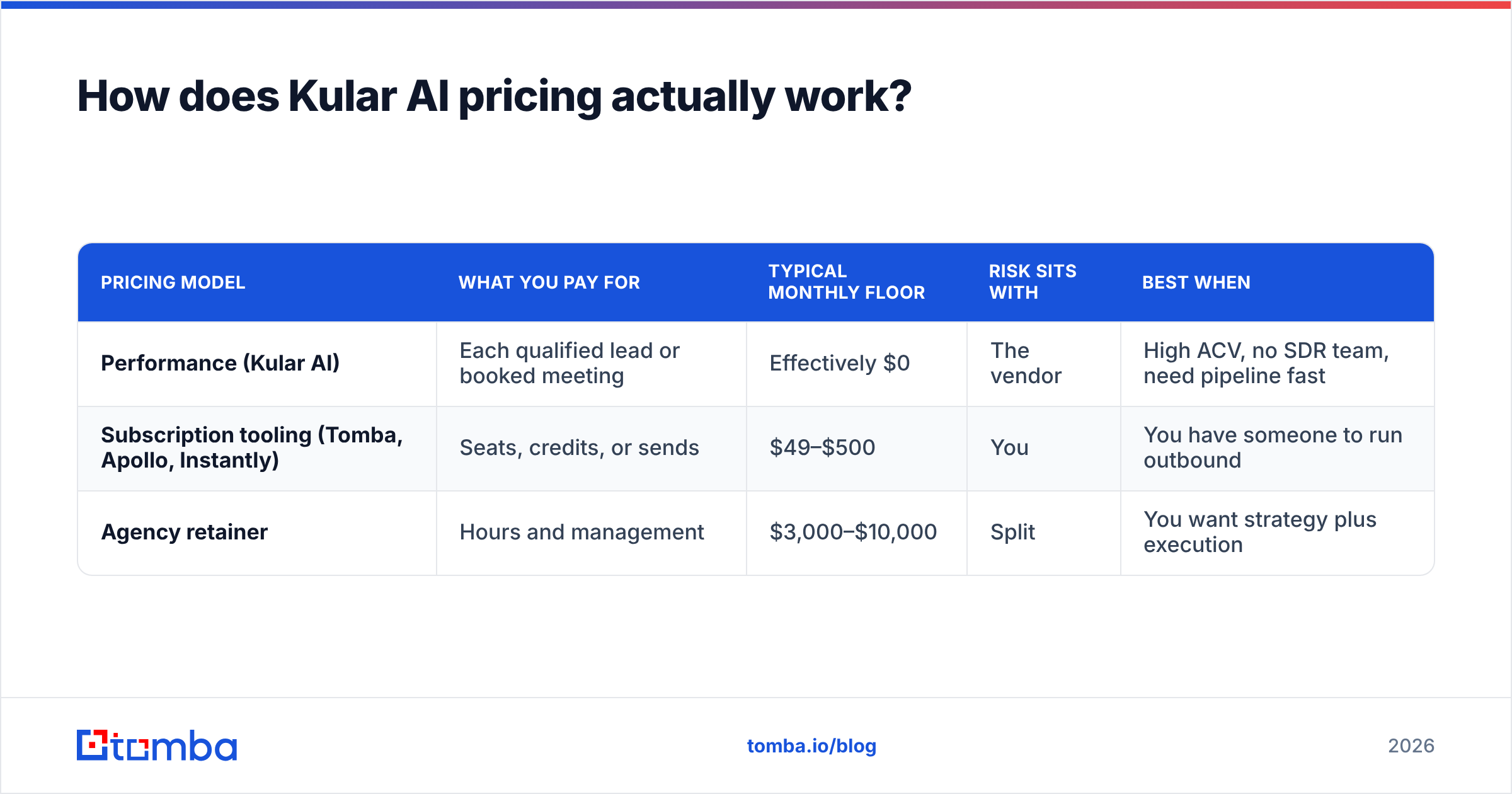
Here is how the three common B2B outbound pricing models compare in structure:
| Pricing model | What you pay for | Typical monthly floor | Risk sits with | Best when |
|---|---|---|---|---|
| Performance (Kular AI) | Each qualified lead or booked meeting | Effectively $0 | The vendor | High ACV, no SDR team, need pipeline fast |
| Subscription tooling (Tomba, Apollo, Instantly) | Seats, credits, or sends | $49–$500 | You | You have someone to run outbound |
| Agency retainer | Hours and management | $3,000–$10,000 | Split | You want strategy plus execution |
The important nuance: "effectively $0" is not the same as free. Reported Kular engagements involve a per-lead rate commonly discussed in the $150–$400 range, with the exact figure varying by target persona, geography, and volume commitment. Enterprise or heavily-regulated ICPs sit at the top of that band; SMB targets sit at the bottom. Treat those numbers as directional and get the rate in writing — Kular quotes per campaign, and public review snippets are not a substitute for a quote.
There are three contract details that move your real cost more than the headline rate:
- The qualification definition. Does a "positive reply" count? A reply that says "send me info"? Only a calendar booking? A loose definition can double your effective cost per opportunity even at an attractive headline rate.
- The dispute and credit process. Every performance vendor has junk leads occasionally. What matters is whether you can reject them, how quickly, and whether rejections are capped per month.
- Volume commitments. Some performance deals require a minimum lead volume per month, which reintroduces exactly the fixed cost the model claims to eliminate.

What do Kular AI reviews say?#
Review coverage for Kular is thinner than for entrenched platforms — it is a younger product, so you will find fewer entries on G2 and Capterra than you would for Apollo or Outreach. Read what exists with that sample-size caveat in mind, and weight recent reviews heavily since the product has shipped significant changes.
The recurring praise:
- Time-to-first-meeting is fast. Onboarding-to-pipeline is measured in weeks, not the quarter a new SDR needs to ramp.
- No deliverability babysitting. Kular manages sending infrastructure, warmup, and domain rotation. Founders who have burned a primary domain on a bad cold campaign rate this highly.
- The invoice is legible. Finance teams like a line item that maps to a countable outcome. "17 qualified leads" survives a board meeting better than "sequencer license."
The recurring complaints:
- Limited control over messaging. You approve the angle; you do not typically own every line of copy or every send decision.
- Lead quality variance. The same complaint attaches to every pay-per-lead vendor in the category. Some replies are genuinely interested; some are polite curiosity that your team still has to triage.
- Targeting opacity. You often cannot inspect the full contact list before it is worked, which makes it harder to protect strategic accounts or avoid overlap with your own outbound.
- You do not keep the data. When the engagement ends, the pipeline ends. There is no enriched contact database left behind that you own outright.
That last point is the strategic one. Subscription tooling leaves you with an asset — a cleaned, verified, owned contact list. Performance outbound leaves you with meetings and nothing else. Neither is wrong; they are different purchases.
What are the pros and cons of Kular AI?#
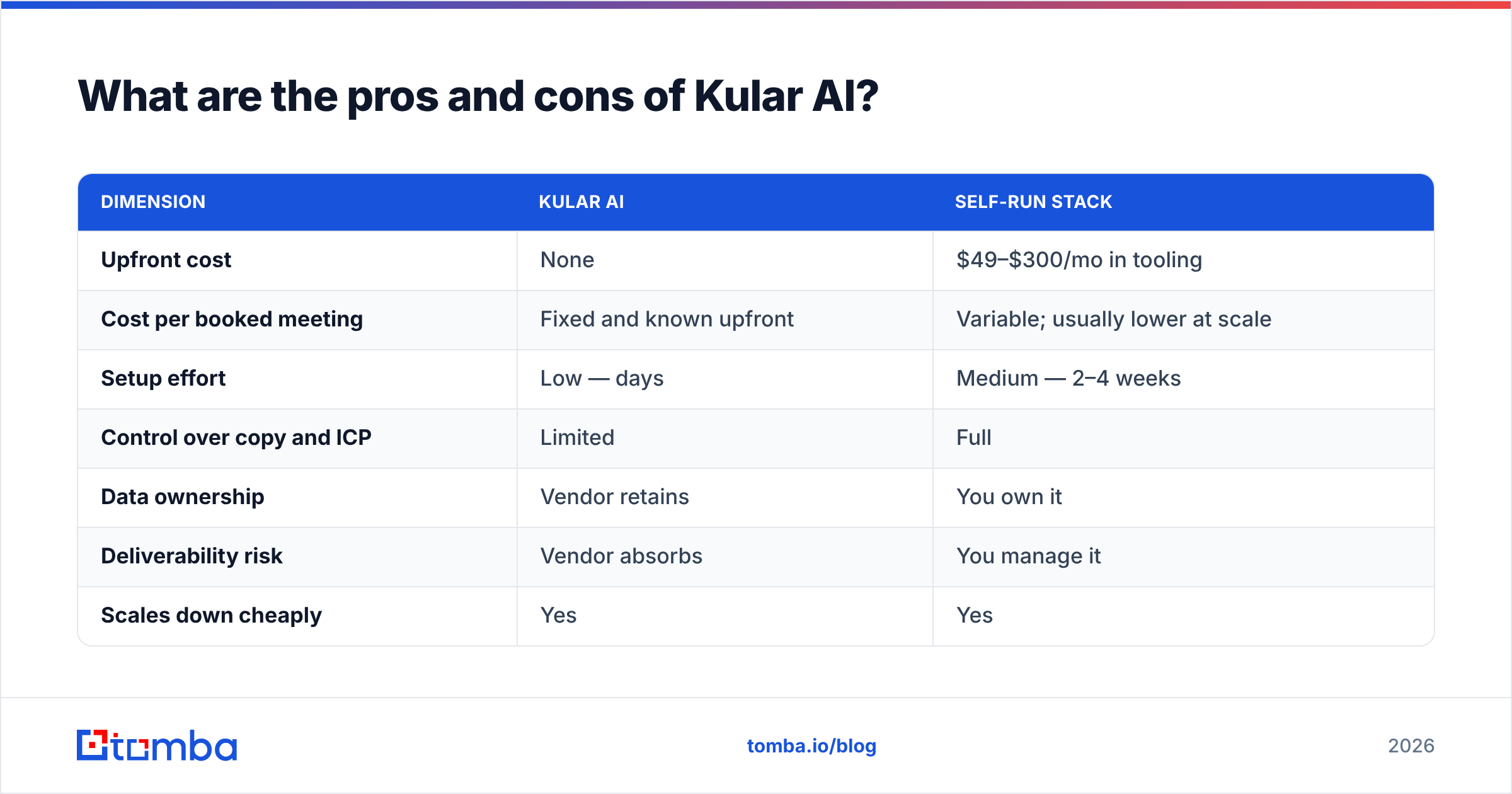
| Dimension | Kular AI | Self-run stack |
|---|---|---|
| Upfront cost | None | $49–$300/mo in tooling |
| Cost per booked meeting | Fixed and known upfront | Variable; usually lower at scale |
| Setup effort | Low — days | Medium — 2–4 weeks |
| Control over copy and ICP | Limited | Full |
| Data ownership | Vendor retains | You own it |
| Deliverability risk | Vendor absorbs | You manage it |
| Scales down cheaply | Yes | Yes |
| Scales up cheaply | No — cost is linear | Yes — cost flattens |
The shape of that last row is the whole argument. Performance pricing is linear forever: 10 meetings cost 10x what one meeting costs. A tooling stack has a fixed cost and a near-zero marginal cost, so cost per meeting falls as volume rises. The crossover point is usually somewhere between 15 and 30 booked meetings per month, depending on your list quality and reply rate.
Run the arithmetic for your own numbers before you commit. At $250 per qualified lead and 20 leads a month, you are spending $5,000/month — real agency money. The same 20 leads from a self-run stack needs roughly 4,000–6,000 verified contacts, a sequencer, and a person. Verified contact sourcing at that volume runs about $99/month on a mid-tier plan; the sequencer runs $30–$100; the person is your real cost. If you already employ that person, the tooling path wins decisively. If you do not, Kular's model is genuinely competitive with a $70K SDR salary.
What are the best Kular AI alternatives in 2026?#
There are three escape routes from performance pricing, and they are not interchangeable.
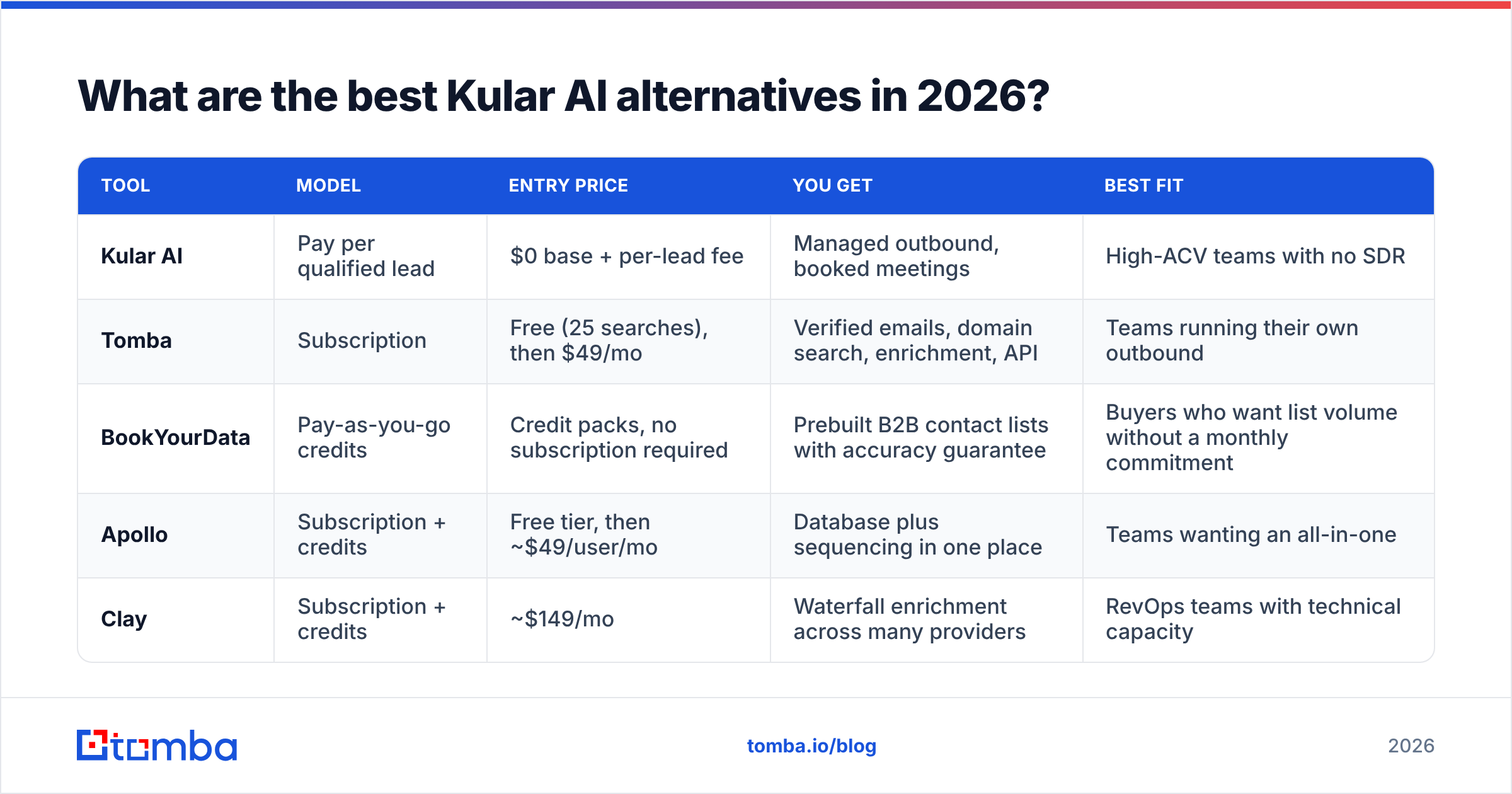
| Tool | Model | Entry price | You get | Best fit |
|---|---|---|---|---|
| Kular AI | Pay per qualified lead | $0 base + per-lead fee | Managed outbound, booked meetings | High-ACV teams with no SDR |
| Tomba | Subscription | Free (25 searches), then $49/mo | Verified emails, domain search, enrichment, API | Teams running their own outbound |
| BookYourData | Pay-as-you-go credits | Credit packs, no subscription required | Prebuilt B2B contact lists with accuracy guarantee | Buyers who want list volume without a monthly commitment |
| Apollo | Subscription + credits | Free tier, then ~$49/user/mo | Database plus sequencing in one place | Teams wanting an all-in-one |
| Clay | Subscription + credits | ~$149/mo | Waterfall enrichment across many providers | RevOps teams with technical capacity |
A note on the credit-based options: BookYourData sits in an interesting middle position — no subscription lock-in, but you keep the records you buy, which addresses the data-ownership gap in the performance model. If your objection to Kular is "I want to own the contacts," that is a reasonable first stop alongside a verification layer.
If your objection is "I want control and low cost," the build path is the answer. The modern version of that stack is unrecognizable from the 2019 version — you do not need a data analyst to run it.
How do you build the same pipeline for less?#
Five components, in order. Skip any of them and your deliverability collapses, which is the actual reason most self-run outbound underperforms managed outbound.
- Define the ICP narrowly. Performance vendors win partly because they force ICP discipline. Do the same: one persona, one industry, one trigger event. A 500-contact list you understand beats a 50,000-contact list you do not.
- Source contacts, don't buy stale lists. Use a domain search to pull the actual people at target companies, then fill gaps with an email finder on named prospects. Fresh sourcing at send-time beats a database export that aged six months on someone's shelf.
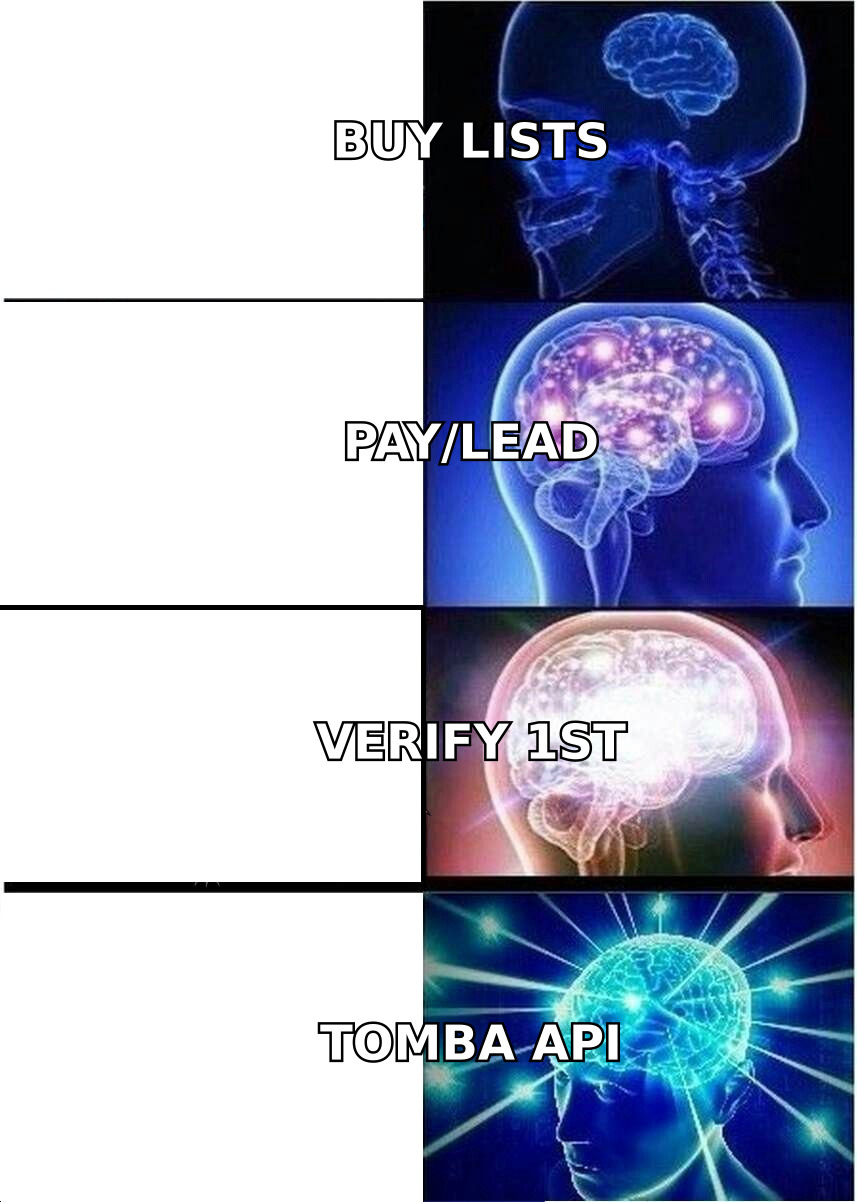
- Verify everything before it enters the sequencer. This is non-negotiable. Run the list through an email verifier and drop anything that is not deliverable. Bounce rate above 3% is what triggers filtering at the mailbox provider, and it is the single most common reason a self-run campaign underperforms a managed one.
- Warm the domains, and never send from your primary. Buy lookalike domains, warm them for three to four weeks, and cap daily volume per mailbox. Kular's biggest structural advantage is that they have already absorbed this cost — replicate it or you will pay for it in reply rate.
- Write like a human, sequence like a machine. Three touches, spaced, each adding information rather than repeating the ask. Automation handles delivery and timing; it should not handle the thinking.
Step three is where most teams cut corners and where the entire economics of the DIY path are won or lost. Every undeliverable address you send to costs you twice: once in wasted send capacity, and again in sender reputation that takes weeks to rebuild. There are good general references on why list hygiene drives inbox placement — HubSpot's marketing resources cover the deliverability fundamentals well — but the operational rule is simple: verify at the moment of send, not at the moment of purchase.
Is Kular AI worth it?#
Kular AI is worth it under three conditions, and it is a poor fit outside them.
It is worth it when:
- Your average contract value clears roughly $15K, so a few hundred dollars per lead is a rounding error against deal size.
- You have no SDR, no RevOps resource, and no appetite to hire either this quarter.
- You need pipeline in 30 days for a board meeting, a fundraise, or a launch, and speed beats efficiency.
- Your finance team prefers variable cost to fixed cost — a real preference in a tight budget year.
It is not worth it when:
- Your ACV is under about $5K. The per-lead fee will consume too much of your gross margin.
- You already employ someone who runs outbound. You are paying twice for the same function.
- Your ICP is genuinely niche and you know the accounts by name. In that case, targeted manual sourcing plus data enrichment outperforms any volume approach.
- You want to build an owned data asset. Performance outbound rents you meetings; it does not sell you a database.
The honest verdict: Kular AI is not overpriced. Performance pricing is priced correctly for the risk the vendor absorbs — they front the infrastructure, the sending reputation, and the labor, and they only get paid if it works. What you are really deciding is whether you want to buy outcomes or build capability. Companies that buy outcomes forever never develop an outbound muscle. Companies that build capability spend more in month one and less in month twelve.
Frequently asked questions#
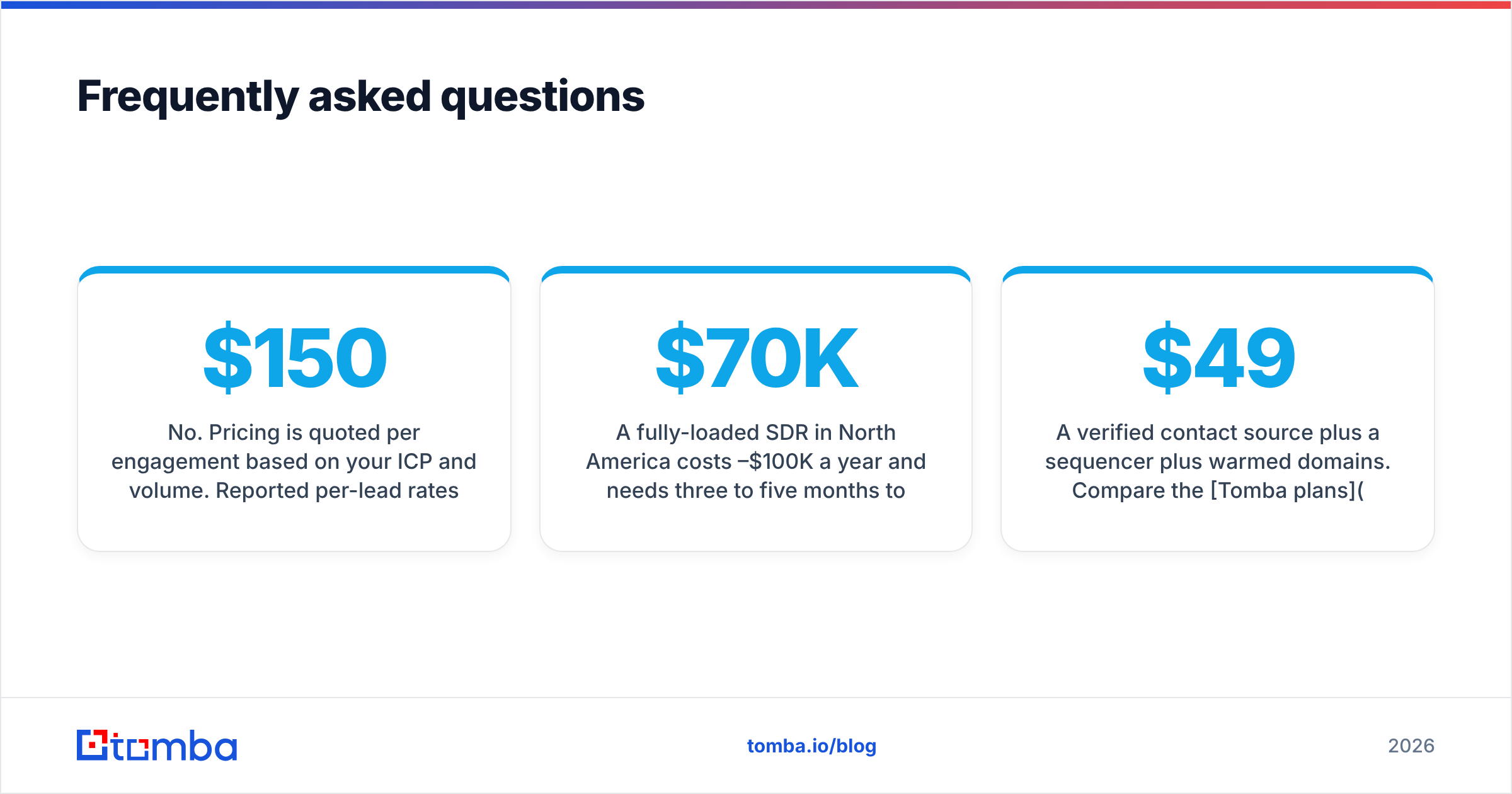
Does Kular AI publish a public price list? No. Pricing is quoted per engagement based on your ICP and volume. Reported per-lead rates cluster in the $150–$400 range, but you should get a written quote rather than rely on secondhand figures.
Is there a free trial? Kular's model is itself a form of risk reversal — you are not billed until leads arrive — so a conventional free trial is less relevant. Ask specifically about the minimum commitment and any onboarding fee.
Who owns the contact data Kular sources? Kular does, in practice. If owning the data matters to you, either negotiate it explicitly or run sourcing yourself with a bulk email finder so the records land in your own systems.
How does Kular compare to hiring an SDR? A fully-loaded SDR in North America costs $70K–$100K a year and needs three to five months to ramp. At $250 per lead, that budget buys roughly 300 qualified leads with no ramp time. The SDR builds institutional knowledge; Kular does not. Pick based on whether you are optimizing for this quarter or the next three years.
What is the cheapest credible alternative? A verified contact source plus a sequencer plus warmed domains. Compare the Tomba plans against your projected per-lead spend — Free covers 25 searches a month for testing, Starter is $49/mo, and Growth at $99/mo handles most single-rep outbound volume.
Start with the data layer#
Before you commit to a per-lead contract, find out what your outbound actually costs when you run it yourself. The variable that decides it is contact accuracy — verified addresses protect your domain, keep bounce rates under the 3% threshold, and make every downstream number look better.
Run a test list through the Tomba Email Finder on the free tier, sequence it from a warmed domain, and measure your real cost per booked meeting over 30 days. If it comes in under Kular's quoted rate, you have your answer. If it does not, you now have a defensible reason to buy outcomes instead — and that is a much better position than guessing.
Related guides#
Ready to find emails that actually work?
Join 150,000+ professionals who stopped guessing and started sending. Free credits on signup — no credit card required.
Get the Tomba newsletter
Practical outbound tactics and product updates — once every two weeks.
About the author