Kylas Alternatives: 9 Better CRM Options Compared (2026)
Kylas wins on flat-fee unlimited users, but loses on ecosystem depth and built-in data. Here are 9 Kylas alternatives compared on price, scale, and the contact data that actually fills the pipeline.
TL;DR
- Kylas is a flat-fee, unlimited-user CRM built primarily for Indian SMBs. Its pricing model is genuinely unusual and genuinely good if you have 15+ reps.
- You outgrow it for three reasons: ecosystem depth, reporting flexibility, and the fact that no CRM — Kylas included — fills itself with contacts.
- Best swaps by situation: Zoho CRM (same region, deeper stack), Pipedrive (simplest pipeline), HubSpot (marketing + sales in one), Freshsales (AI scoring), EngageBay (cheapest all-in-one).
- Per-seat CRMs beat flat-fee once your team is under ~8 reps. Flat-fee wins past ~20. Run the math before you migrate anything.
- Whichever CRM you land on, the record quality problem is separate. Pair it with a dedicated email finder and verification layer or you'll just move bad data into a nicer interface.
What is Kylas and who actually buys it?#
Kylas is a sales CRM from the team behind Sell.Do, aimed at small and mid-sized businesses that got burned by per-seat pricing. Its pitch is one line long: pay a flat monthly fee, add unlimited users. No "that'll be another $50/user" conversation every time you hire an SDR.
That single decision shapes everything else about the product. Kylas is built for teams with a lot of bodies and a modest budget — real estate brokerages, education counselling firms, insurance agencies, staffing shops, B2B distributors. Industries where the sales floor has 25 people and the software budget has four figures.
It covers the standard sales CRM surface: lead capture, deal pipelines, activity logging, quotes, workflow automation, call and WhatsApp integrations, and role-based reporting. The onboarding is hands-on, the support is India-timezone native, and the UI is deliberately unintimidating. For a 30-person team moving off spreadsheets, that combination is hard to beat.
So why look at Kylas alternatives at all?
Why do teams start searching for Kylas alternatives?#
Four patterns show up over and over in switch conversations:
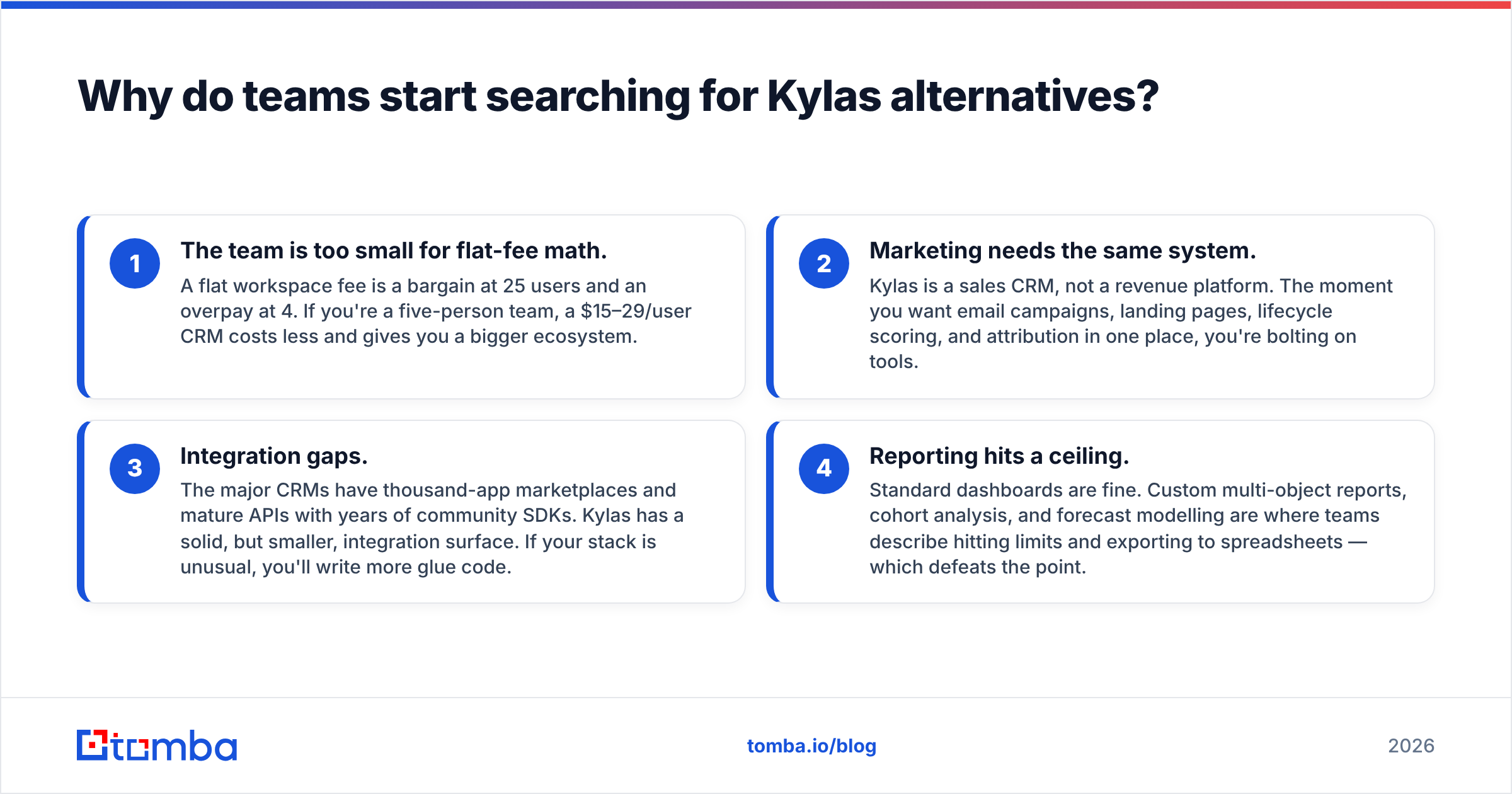
- The team is too small for flat-fee math. A flat workspace fee is a bargain at 25 users and an overpay at 4. If you're a five-person team, a $15–29/user CRM costs less and gives you a bigger ecosystem.
- Marketing needs the same system. Kylas is a sales CRM, not a revenue platform. The moment you want email campaigns, landing pages, lifecycle scoring, and attribution in one place, you're bolting on tools.
- Integration gaps. The major CRMs have thousand-app marketplaces and mature APIs with years of community SDKs. Kylas has a solid, but smaller, integration surface. If your stack is unusual, you'll write more glue code.
- Reporting hits a ceiling. Standard dashboards are fine. Custom multi-object reports, cohort analysis, and forecast modelling are where teams describe hitting limits and exporting to spreadsheets — which defeats the point.
None of those are product defects. They're sizing mismatches. The question isn't "is Kylas bad" — it isn't — it's "does my shape still fit it."
How do the main Kylas alternatives compare on price and fit?#
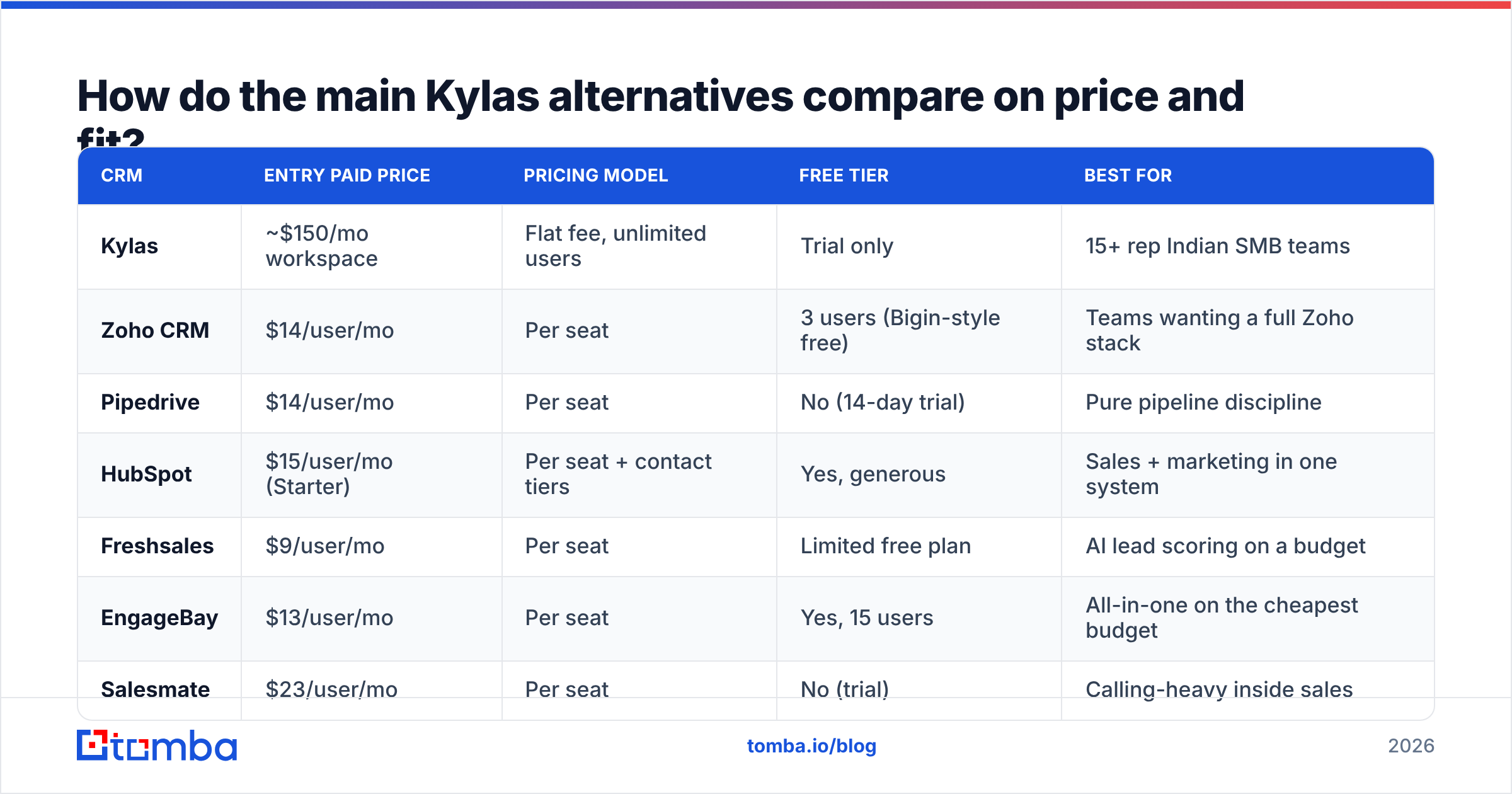
Here's the honest side-by-side. Pricing is list price for the entry paid tier as of early 2026 — always confirm on the vendor's own page, since CRM pricing moves quarterly and regional (INR) pricing differs from USD.
| CRM | Entry paid price | Pricing model | Free tier | Best for |
|---|---|---|---|---|
| Kylas | ~$150/mo workspace | Flat fee, unlimited users | Trial only | 15+ rep Indian SMB teams |
| Zoho CRM | $14/user/mo | Per seat | 3 users (Bigin-style free) | Teams wanting a full Zoho stack |
| Pipedrive | $14/user/mo | Per seat | No (14-day trial) | Pure pipeline discipline |
| HubSpot | $15/user/mo (Starter) | Per seat + contact tiers | Yes, generous | Sales + marketing in one system |
| Freshsales | $9/user/mo | Per seat | Limited free plan | AI lead scoring on a budget |
| EngageBay | $13/user/mo | Per seat | Yes, 15 users | All-in-one on the cheapest budget |
| Salesmate | $23/user/mo | Per seat | No (trial) | Calling-heavy inside sales |
| Close | $19/user/mo | Per seat | No (trial) | High-volume outbound SDR teams |
| monday CRM | $12/user/mo | Per seat (3-seat min) | Trial only | Ops teams already on monday.com |
| Salesforce Starter | $25/user/mo | Per seat | No | Companies that will scale into Sales Cloud |
The pattern is obvious once it's in a table: Kylas gets cheaper per head as you grow; everything else gets more expensive. The crossover point for most of these lands somewhere between 8 and 15 users. Above that line, Kylas is the value play. Below it, you're paying for seats you don't have.
Which Kylas alternative fits which team?#
Rather than ranking them 1–9 like every other listicle, sort by the problem you're actually solving.
- You want the same regional fit with more product depth → Zoho CRM. Zoho is the closest philosophical cousin: India-headquartered, aggressively priced, obsessive about not gouging SMBs. The difference is the surrounding universe — Books, Desk, Campaigns, Analytics, Flow. You can run an entire company inside it. Downside: the breadth is also the complexity, and Zoho admin work is a real job. Start with Zoho CRM and only add modules when a specific pain demands one.
- You want the simplest pipeline your reps will actually update → Pipedrive. Pipedrive is a deal board with a CRM attached, and that constraint is the feature. Adoption rates are high because there's almost nothing to learn. It's weaker on marketing, quoting, and complex permissions. If your sales motion is "qualify, demo, negotiate, close," it's excellent.
- You want sales and marketing on one contact record → HubSpot. The HubSpot CRM free tier is the best on-ramp in the category, and the Starter bundle is legitimately cheap. The trap is the upgrade curve: Professional tiers jump hard, and contact-tier pricing means your bill grows with your database, not your team. Budget for that before you commit. If you go this route, wire enrichment straight into it with a HubSpot integration so new records arrive complete.
- You want AI scoring without enterprise pricing → Freshsales. Freddy AI scoring, built-in phone, and a genuinely low entry price. The reporting is mid-tier and the automation builder is less flexible than Zoho's, but for a 10-rep inside sales team it punches above its weight.
- You want everything for almost nothing → EngageBay. Marketing automation, helpdesk, and CRM bundled at a price that undercuts nearly everyone. The UI feels a generation behind and support is asynchronous, but the feature-per-dollar ratio is the best on this list.
- You run high-volume outbound → Close. Built for SDRs who live in a dialer. Power dialing, call coaching, and sequences are native rather than bolted on. It's the priciest per seat here, which is exactly why it's a bad Kylas swap for a 25-person floor and a great one for a focused 6-rep outbound pod.
Is the CRM even the bottleneck?#
Usually not. This is the part most alternatives posts skip.
A CRM is a filing cabinet with workflow rules. It stores what you put in it, reminds you to follow up, and reports on what happened. It does not know who your next 500 buyers are, and it does not know whether the email address on a record still routes to a human.
Migrating from Kylas to HubSpot because your pipeline is thin is like reorganizing your kitchen because you're out of groceries. The cabinet was never the problem.
Two things actually move pipeline numbers:
- Contact acquisition — finding the right people at the right companies, with current titles and reachable addresses.
- Data hygiene — keeping those records from rotting. B2B contact data decays roughly 22–30% per year through job changes, domain migrations, and company churn. Every CRM on this list inherits that decay silently.
That's why serious teams run a data layer alongside the CRM rather than expecting the CRM to be one. Tools like Tomba, Apollo, and BookYourData each solve a slice of it — Tomba on pattern-based discovery and verification, Apollo on an all-in-one prospecting database, BookYourData on pre-built verified lists you can buy by segment. All three feed the same CRM.
What should your CRM plus data stack actually look like?#
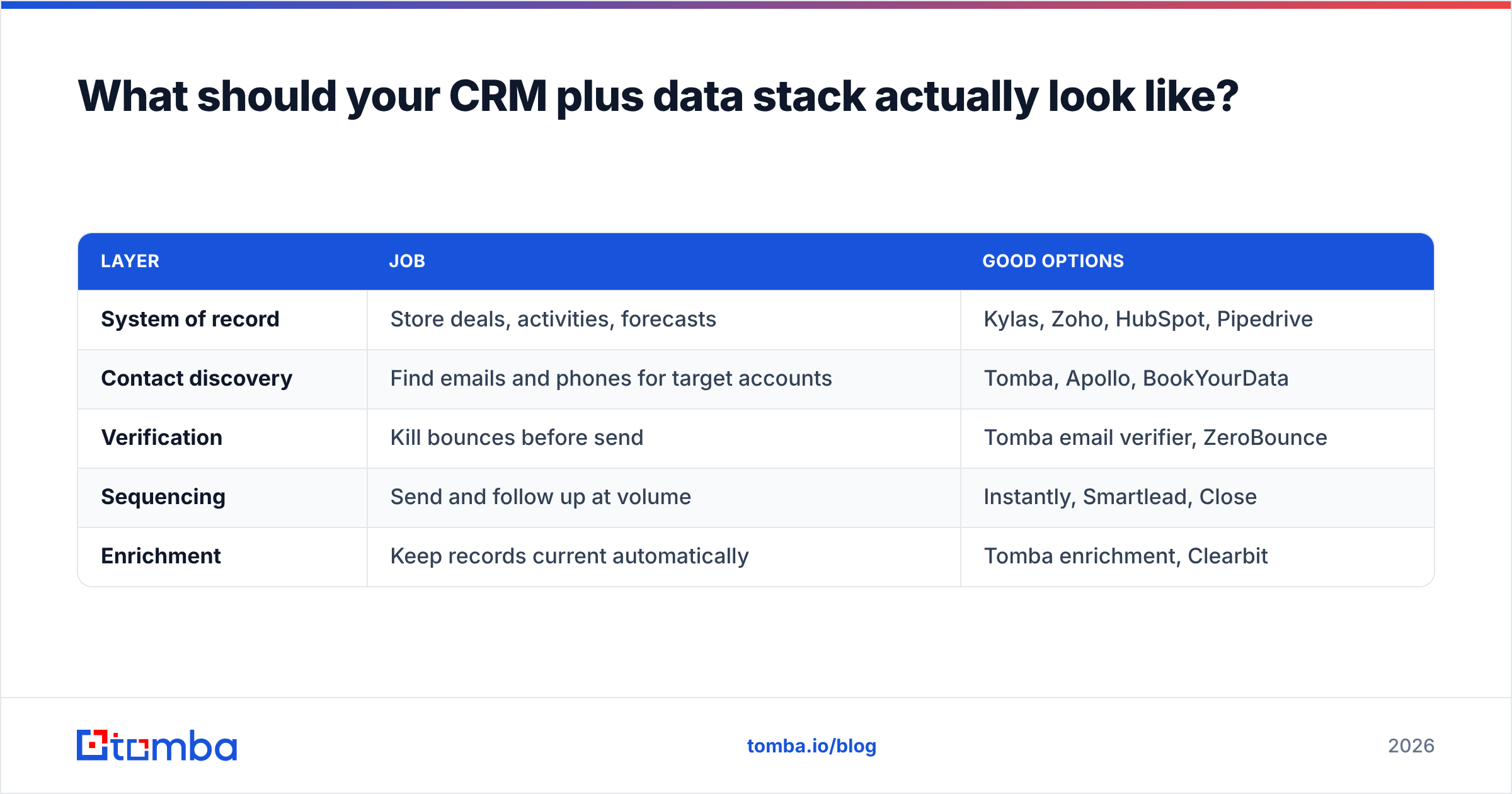
Here's the split that holds up across team sizes:
| Layer | Job | Good options |
|---|---|---|
| System of record | Store deals, activities, forecasts | Kylas, Zoho, HubSpot, Pipedrive |
| Contact discovery | Find emails and phones for target accounts | Tomba, Apollo, BookYourData |
| Verification | Kill bounces before send | Tomba email verifier, ZeroBounce |
| Sequencing | Send and follow up at volume | Instantly, Smartlead, Close |
| Enrichment | Keep records current automatically | Tomba enrichment, Clearbit |
Four practical rules for wiring it:
- Verify before import, not after. A bad address that reaches your CRM will get emailed by someone eventually. Run lists through email verification at the entry point.
- Enrich on create, not on a quarterly cleanup. Use a webhook or Zapier step so every new record gets company size, domain, and title attached the moment it lands. Contact enrichment via API costs less than a rep manually Googling.
- Never let reps free-type company names. Normalize on domain. It's the only field that survives rebrands, and it's what every enrichment tool keys on.
- Re-verify quarterly. Pull the segments you're actively emailing, re-run them, and suppress the dead ones. Your sender reputation is a compounding asset — protect it.
- Measure data cost per meeting, not per credit. A $0.02 credit that produces a bounce costs more than a $0.08 credit that produces a reply. Compare vendors on delivered meetings, not on list price.
Should you switch from Kylas at all?#
Stay on Kylas if: your team is over 15 users, your sales process is straightforward, you value India-timezone onboarding and support, and your budget prefers a predictable flat line over a headcount-linked one. It's a well-built product doing exactly what it promises.
Switch if: you're under 8 users (per-seat is cheaper), you need marketing automation on the same records, you have a complex integration stack, or your reporting demands have outgrown standard dashboards. In that case the shortlist is short — Zoho CRM for depth at the same price philosophy, Pipedrive for simplicity, HubSpot if marketing is joining the party.
Before you migrate anything, do two things. First, export your current object counts and custom fields and check whether the target CRM supports them at your intended tier — that's where migrations die. Second, read recent reviews on G2's CRM category and the vendor's own docs rather than a comparison page written by their competitor. Kylas publishes its current feature set and regional pricing at kylas.io; check it directly rather than trusting any third-party table, including this one.
And be honest about what a CRM swap will and won't fix. A new pipeline view doesn't create prospects.
Fill the CRM you choose — not just the one you leave#
Whichever CRM wins your evaluation, it arrives empty. The fastest way to make it worth paying for is to load it with contacts that are real, current, and reachable.
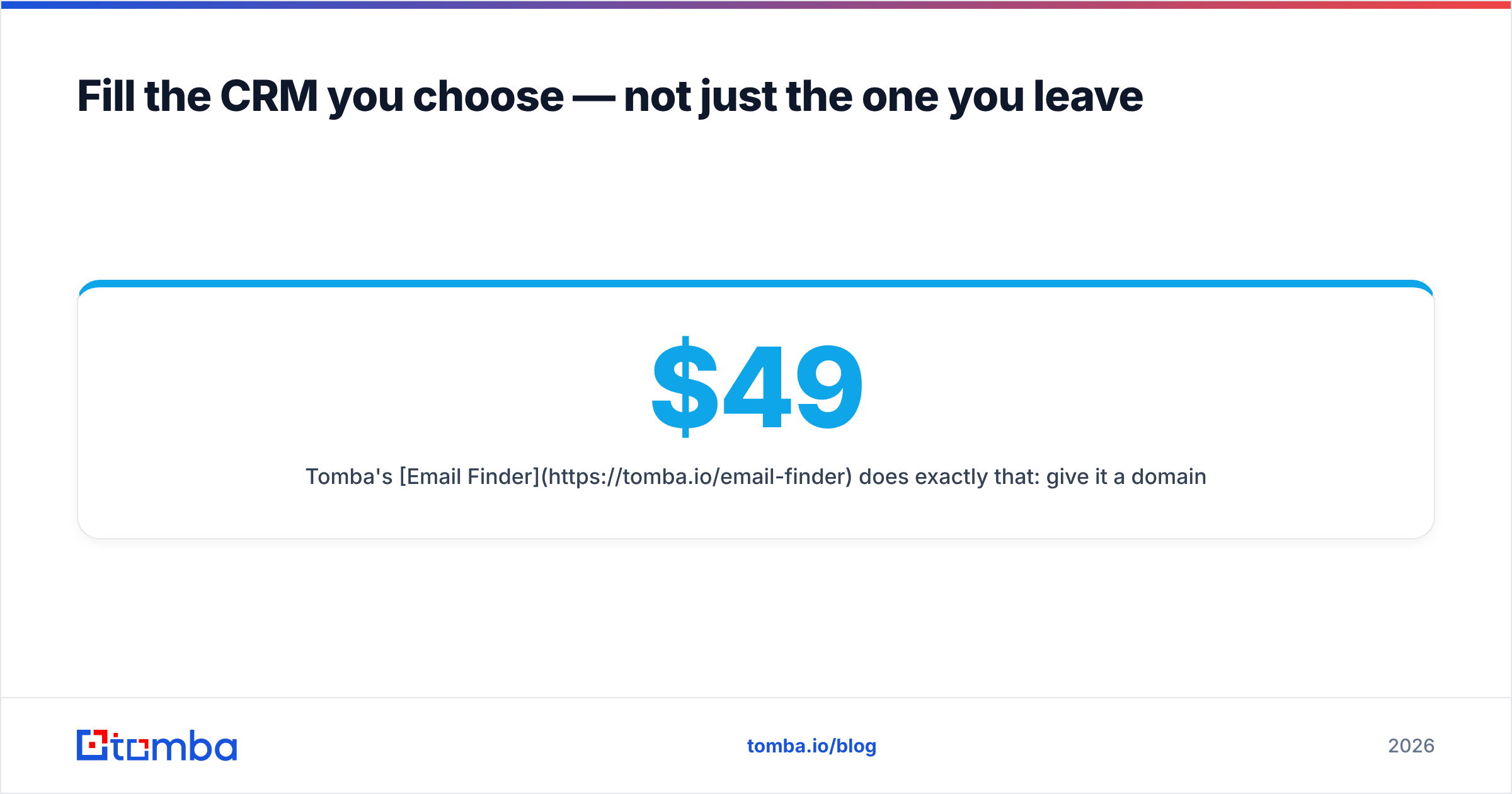
Tomba's Email Finder does exactly that: give it a domain or a name-plus-company and it returns verified professional addresses, with SMTP-level verification, catch-all handling, and confidence scoring built in. It plugs into HubSpot, Pipedrive, Salesforce, Zapier, Sheets, and Airtable, so enrichment happens at record creation instead of in a quarterly cleanup sprint. The free tier gives you 25 searches a month to test accuracy on your own target accounts; paid plans start at $49/mo, with Growth at $99/mo and Pro at $249/mo — full breakdown on Tomba pricing.
Pick your CRM on workflow fit. Pick your data layer on accuracy. They're two different decisions, and only one of them changes how many meetings you book next quarter.
Related guides#
Ready to find emails that actually work?
Join 150,000+ professionals who stopped guessing and started sending. Free credits on signup — no credit card required.
Get the Tomba newsletter
Practical outbound tactics and product updates — once every two weeks.
About the author