La Growth Machine Pricing 2026: Real Costs, Limits & Value
La Growth Machine charges per identity, not per seat — and that changes the math fast. Here's what the 2026 plans actually cost once you add enrichment credits, extra identities, and the email data you still have to buy elsewhere.
TL;DR
- La Growth Machine (LGM) prices per identity — one LinkedIn account plus its connected mailboxes — not per user seat. That single detail is what makes quotes surprising.
- Public list pricing in 2026 sits around €60/identity/month (Basic), €100/identity/month (Pro), and €120/identity/month (Ultimate) on annual billing, with monthly billing roughly 25-30% higher.
- Enrichment is credit-metered on top of the subscription. LGM's built-in waterfall is convenient but priced as a consumable, so heavy prospecting teams blow through the included allowance.
- The cheapest real-world stack is usually a dedicated data provider + LGM for multichannel sequencing — you pay list price for the channel orchestration and far less per contact for the data.
- If you only need verified B2B emails and enrichment (no LinkedIn automation), LGM is the wrong line item. A dedicated email finder starting at $49/mo does that job for a fraction of the cost.
What is La Growth Machine and who actually uses it?#
La Growth Machine is a French multichannel outbound automation platform. You build a sequence that mixes LinkedIn actions (visit, connect, message, voice note), email, and manual call tasks, then drop leads into it. The product's reputation rests on two things: the visual sequence builder, and the fact that LinkedIn and email live in the same campaign rather than in two disconnected tools.
The typical buyer is a small revenue team — 2 to 10 people — running founder-led or SDR-led outbound in Europe, where LinkedIn-first prospecting converts better than pure cold email. Agencies use it too, because one workspace can hold many identities.
That word, identity, is the key to the whole pricing page. An identity is a persona you send from: one LinkedIn profile plus the email accounts attached to it. If three SDRs each prospect from their own LinkedIn profile, that is three identities. If one SDR runs two LinkedIn accounts, that is also two identities. The billing model doesn't count humans. It counts sending personas.

How much does La Growth Machine cost in 2026?#
Here's the published structure. Prices are in euros because LGM lists in EUR; USD conversion floats.
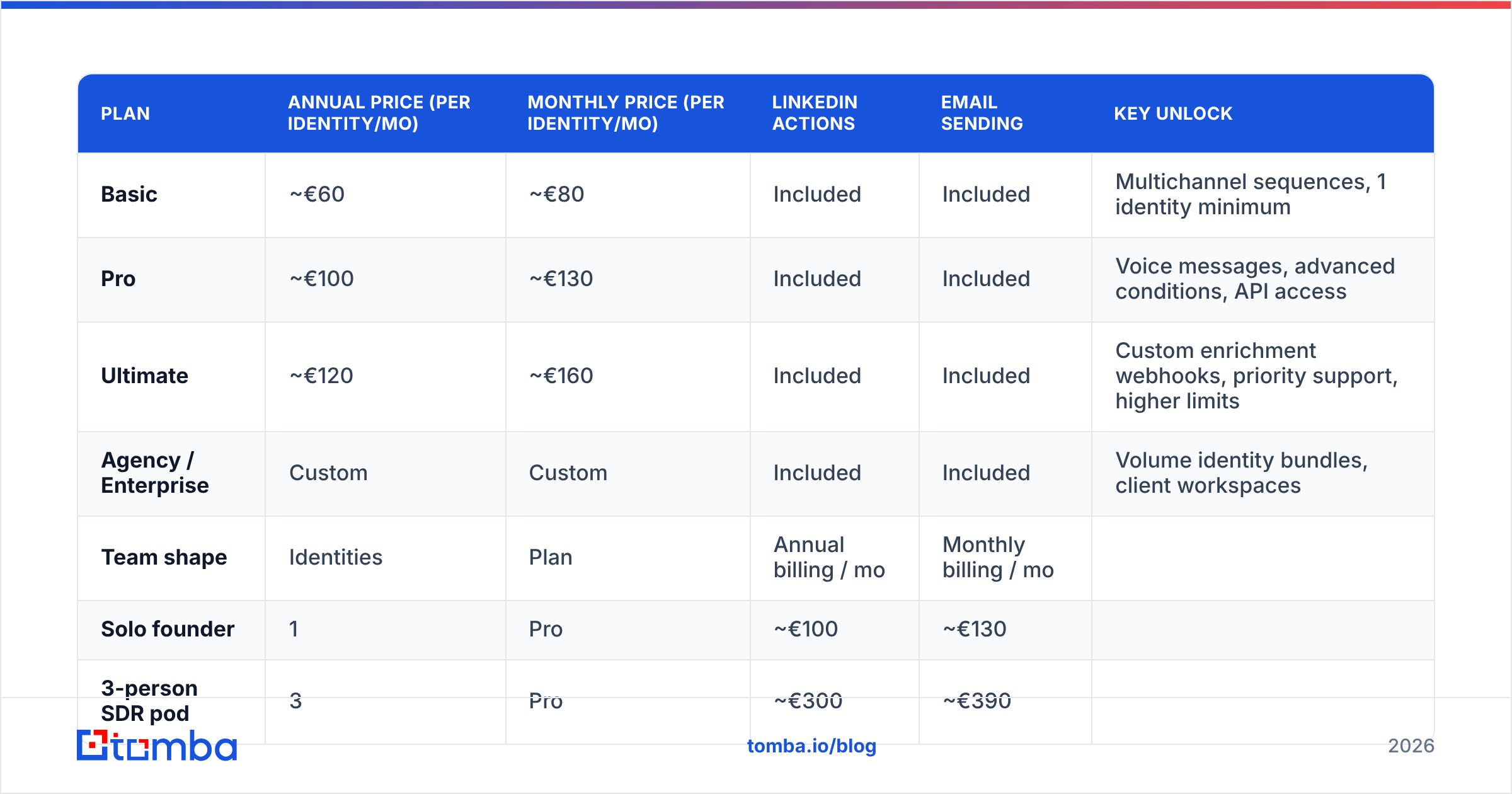
| Plan | Annual price (per identity/mo) | Monthly price (per identity/mo) | LinkedIn actions | Email sending | Key unlock |
|---|---|---|---|---|---|
| Basic | ~€60 | ~€80 | Included | Included | Multichannel sequences, 1 identity minimum |
| Pro | ~€100 | ~€130 | Included | Included | Voice messages, advanced conditions, API access |
| Ultimate | ~€120 | ~€160 | Included | Included | Custom enrichment webhooks, priority support, higher limits |
| Agency / Enterprise | Custom | Custom | Included | Included | Volume identity bundles, client workspaces |
Two things to internalize before you budget:
- The number you see is not the invoice. A three-person team on Pro is not €100/month, it's €300/month — and that's annual-commitment pricing.
- Monthly billing carries a real premium. Expect roughly 25-30% more than the annual rate. If you're piloting, budget the monthly number, not the marketing number.
What does that mean for a real team?#
| Team shape | Identities | Plan | Annual billing / mo | Monthly billing / mo |
|---|---|---|---|---|
| Solo founder | 1 | Pro | ~€100 | ~€130 |
| 3-person SDR pod | 3 | Pro | ~€300 | ~€390 |
| 5-person team, voice + API | 5 | Ultimate | ~€600 | ~€800 |
| Agency, 10 client personas | 10 | Custom | ~€900-1,200 | Negotiated |
At five identities you are into four-figure territory annually — before a single enrichment credit or mailbox warmup subscription. That's not a knock on LGM; it's just the shape of per-identity pricing, and it's the number most reviews skip.
What are the hidden costs in La Growth Machine pricing?#
Nothing here is deceptive. These are simply line items that sit outside the headline price and surprise teams during month two.
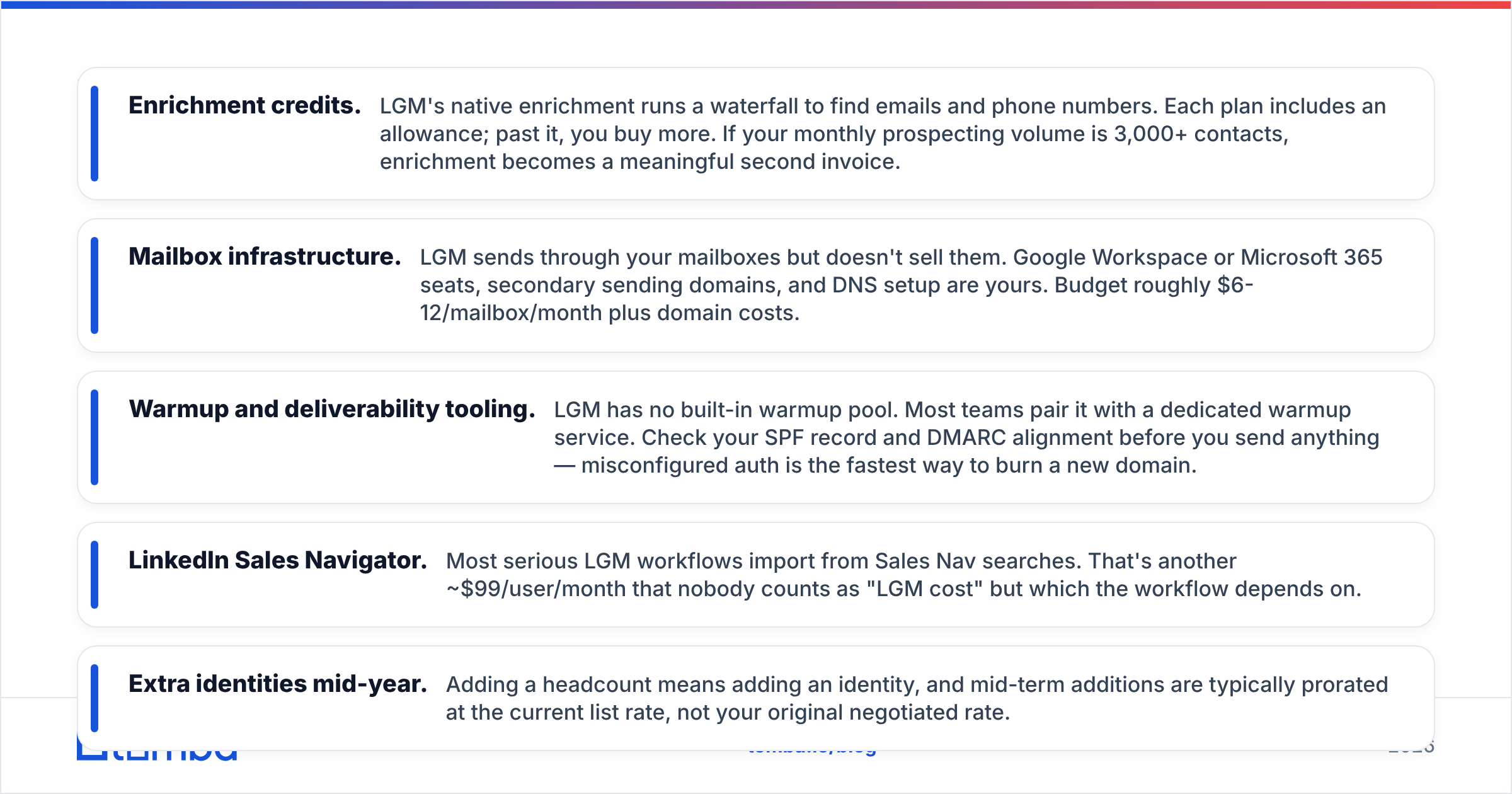
- Enrichment credits. LGM's native enrichment runs a waterfall to find emails and phone numbers. Each plan includes an allowance; past it, you buy more. If your monthly prospecting volume is 3,000+ contacts, enrichment becomes a meaningful second invoice.
- Mailbox infrastructure. LGM sends through your mailboxes but doesn't sell them. Google Workspace or Microsoft 365 seats, secondary sending domains, and DNS setup are yours. Budget roughly $6-12/mailbox/month plus domain costs.
- Warmup and deliverability tooling. LGM has no built-in warmup pool. Most teams pair it with a dedicated warmup service. Check your SPF record and DMARC alignment before you send anything — misconfigured auth is the fastest way to burn a new domain.
- LinkedIn Sales Navigator. Most serious LGM workflows import from Sales Nav searches. That's another ~$99/user/month that nobody counts as "LGM cost" but which the workflow depends on.
- Extra identities mid-year. Adding a headcount means adding an identity, and mid-term additions are typically prorated at the current list rate, not your original negotiated rate.
Add it up honestly: a three-person team running LGM Pro with Sales Navigator, warmup, and modest enrichment lands somewhere near €700-900/month all-in. That can be excellent value if LinkedIn is your primary channel. It's poor value if you're really just buying contact data.
Is La Growth Machine worth it compared to the alternatives?#
Depends entirely on whether you need orchestration or data. Those are different products that get shopped in the same browser tab.
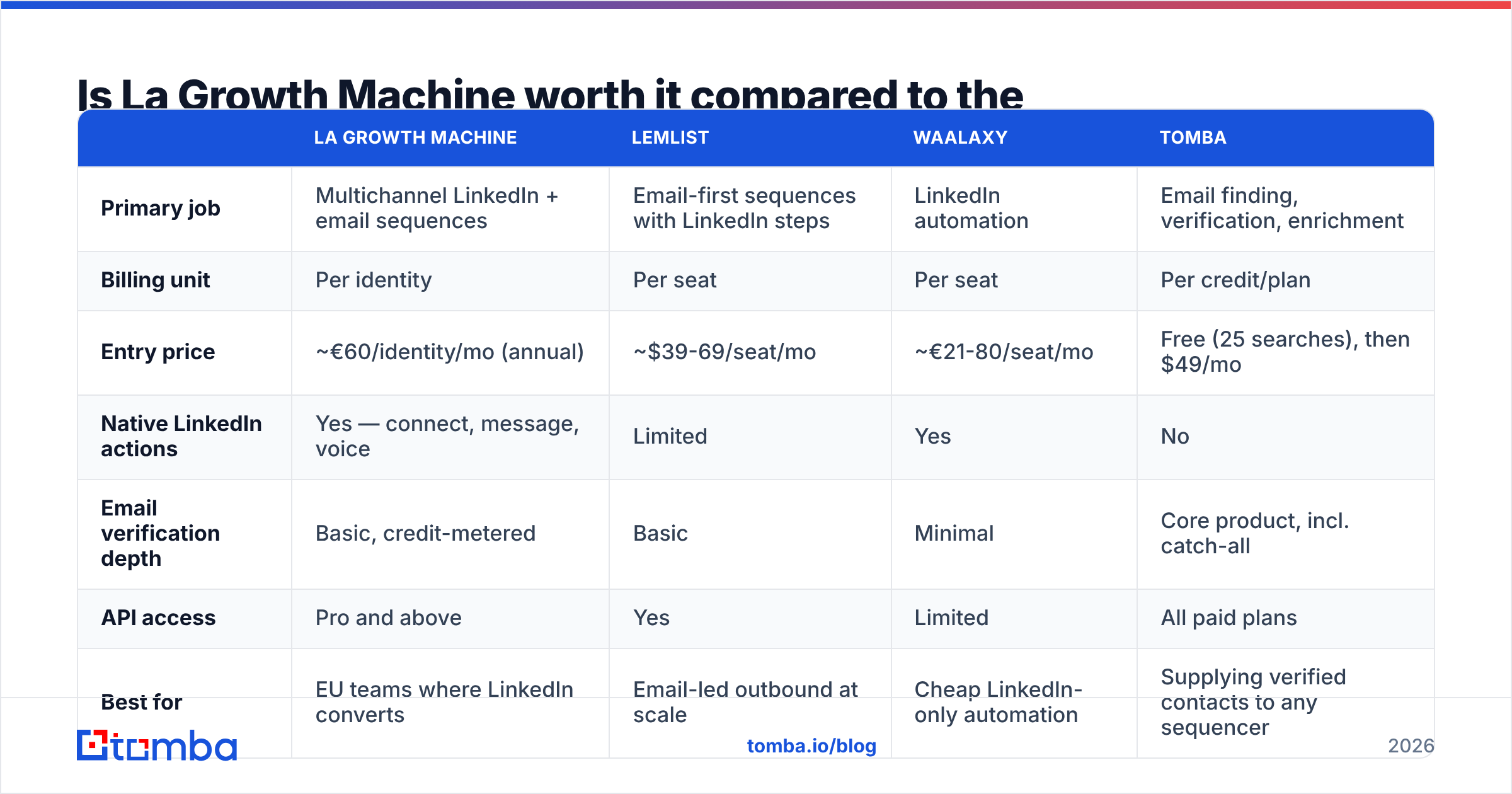
| La Growth Machine | Lemlist | Waalaxy | Tomba | |
|---|---|---|---|---|
| Primary job | Multichannel LinkedIn + email sequences | Email-first sequences with LinkedIn steps | LinkedIn automation | Email finding, verification, enrichment |
| Billing unit | Per identity | Per seat | Per seat | Per credit/plan |
| Entry price | ~€60/identity/mo (annual) | ~$39-69/seat/mo | ~€21-80/seat/mo | Free (25 searches), then $49/mo |
| Native LinkedIn actions | Yes — connect, message, voice | Limited | Yes | No |
| Email verification depth | Basic, credit-metered | Basic | Minimal | Core product, incl. catch-all |
| API access | Pro and above | Yes | Limited | All paid plans |
| Best for | EU teams where LinkedIn converts | Email-led outbound at scale | Cheap LinkedIn-only automation | Supplying verified contacts to any sequencer |
The honest read: LGM is genuinely strong at what it does. The voice-note step and the LinkedIn-to-email fallback logic are differentiated, and the sequence builder is one of the cleanest in the category. If your ICP lives on LinkedIn and your reps send from their own profiles, per-identity pricing is defensible.
Where it stops making sense is when you're buying LGM primarily for its enrichment waterfall. You're paying orchestration prices for data, and data has a much cheaper market rate.
Worth noting alongside this: teams that want purchased, pre-verified lists rather than on-demand lookups often compare against providers like BookYourData, which sells contact records outright. That's a third model again — neither per-identity nor per-credit — and for some list-building workflows it's the cleanest fit. See how other buyers weigh these categories on G2.

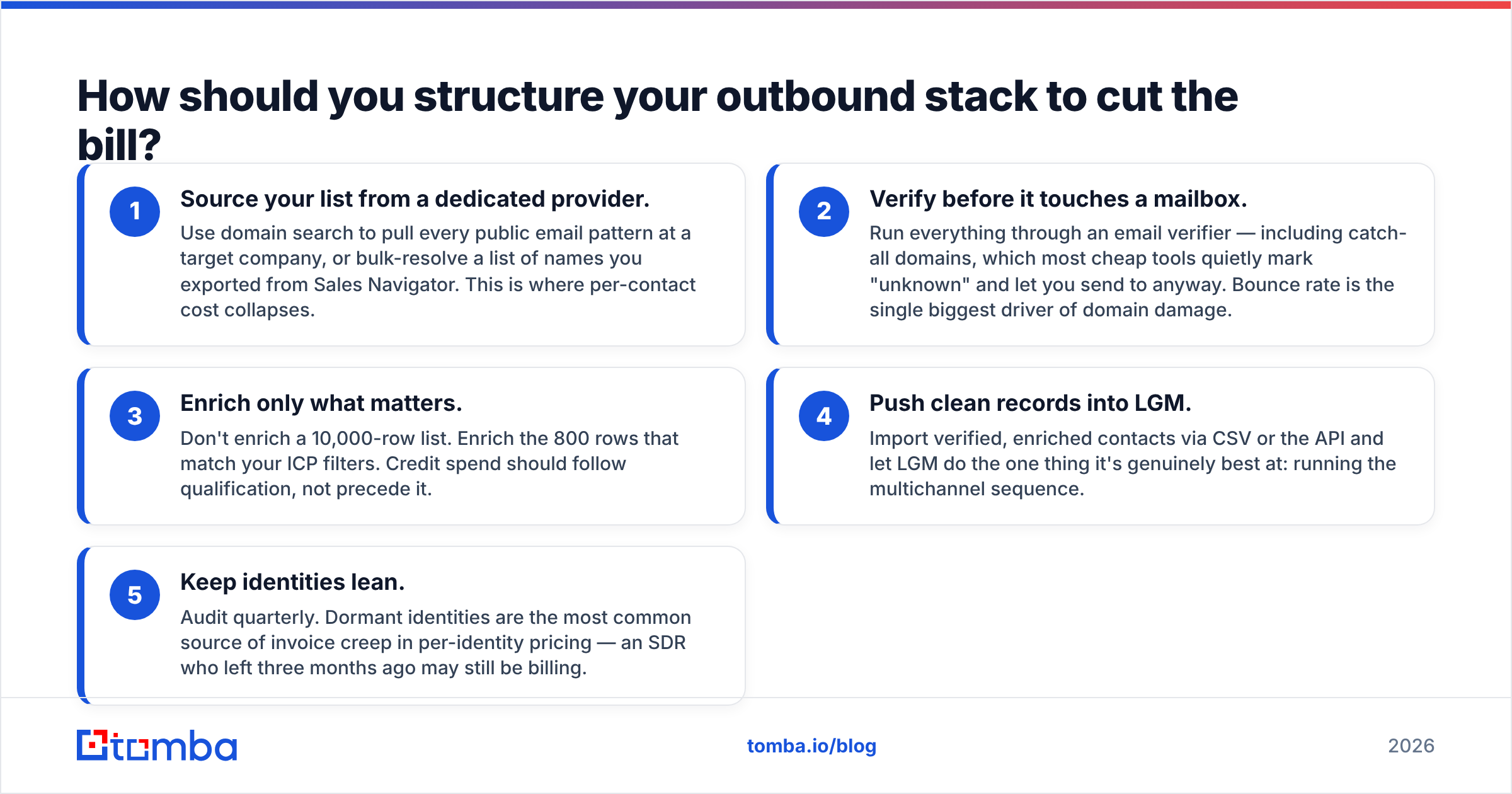
How should you structure your outbound stack to cut the bill?#
The pattern that consistently lowers cost per booked meeting is separating the data layer from the sending layer. Four steps:
- Source your list from a dedicated provider. Use domain search to pull every public email pattern at a target company, or bulk-resolve a list of names you exported from Sales Navigator. This is where per-contact cost collapses.
- Verify before it touches a mailbox. Run everything through an email verifier — including catch-all domains, which most cheap tools quietly mark "unknown" and let you send to anyway. Bounce rate is the single biggest driver of domain damage.
- Enrich only what matters. Don't enrich a 10,000-row list. Enrich the 800 rows that match your ICP filters. Credit spend should follow qualification, not precede it.
- Push clean records into LGM. Import verified, enriched contacts via CSV or the API and let LGM do the one thing it's genuinely best at: running the multichannel sequence.
- Keep identities lean. Audit quarterly. Dormant identities are the most common source of invoice creep in per-identity pricing — an SDR who left three months ago may still be billing.
Done this way, your LGM invoice becomes predictable (identities × plan) and your data cost scales with actual prospecting volume rather than with headcount. For teams running this in spreadsheets, the Google Sheets add-on handles the resolve-and-verify step without leaving the sheet.
Does La Growth Machine's free trial tell you enough?#
LGM offers a 14-day trial, no card required. It's a real trial — you can build and run sequences. But two weeks isn't long enough to judge the thing that actually matters, which is reply rate over a full sequence cycle.
Use the trial to answer specific questions instead:
- Does the LinkedIn automation stay within safe daily limits for your account age? New or low-activity profiles get restricted faster.
- How good is the native enrichment on your specific ICP? Run 100 known contacts through it and measure the hit rate. European mid-market data quality varies widely by vendor.
- Does the conditional logic handle your real sequence? Most teams discover their branching is more complex than the demo.
- Can your mailboxes handle the volume? If they're not warmed, nothing else in the trial matters.
If the enrichment hit rate disappoints on your ICP — and for many niches it will — that's your signal to split data and sending rather than to abandon LGM.
What's the verdict on La Growth Machine pricing?#
Worth it if: LinkedIn is a primary channel, your reps prospect from personal profiles, you're in EU/UK markets, and you have 1-5 identities. The per-identity model is fair at that scale and the product quality justifies the premium over LinkedIn-only tools.
Not worth it if: You're email-first, you have more identities than you have genuinely active prospectors, or you're mainly paying for enrichment. In those cases you're funding capability you don't use.
The middle path most teams land on: keep LGM at the smallest identity count that covers your active senders, move all data sourcing to a purpose-built provider, and treat enrichment credits as an emergency reserve rather than a workflow. That typically cuts 30-40% off the combined stack cost with no loss in output.
One more budgeting note: negotiate at renewal, not at signup. Per-identity vendors have limited room on a one-identity deal and considerable room on a five- or ten-identity renewal. Ask for the annual rate on monthly terms, or for bundled identities at the Pro tier instead of a forced Ultimate upgrade.
Where should your data budget actually go?#
If you strip outbound down to its two costs, they are: the software that sends, and the data that makes sending worth doing. Overpaying on the first is annoying. Overpaying on the second is structural, because data cost scales with every campaign you run forever.
Start with Tomba's Email Finder — the free tier gives you 25 searches a month to test hit rate on your own ICP before spending anything, and paid plans start at $49/mo with verification, catch-all handling, and API access included rather than metered separately. Resolve and verify your list there, then feed the clean records into La Growth Machine and let each tool do the job it's actually priced for. Full Tomba pricing is public, per-credit, and doesn't change when you hire.
Related guides#
// get started
Find, verify and enrich your first contacts today
Start on the free plan with 25 searches a month, then scale when your team is ready.
Free plan · No credit card required · GDPR & CCPA
Get the Tomba newsletter
Product and data updates
// about the author