La Growth Machine Pros and Cons: Honest 2026 Review
La Growth Machine runs slick multichannel sequences across LinkedIn, email, and X — but the credit math, data quality, and LinkedIn risk profile decide whether it fits your team. Here is the honest breakdown.
TL;DR
- La Growth Machine (LGM) is a multichannel outbound sequencer: LinkedIn + email + X (Twitter) in one automated workflow, with native enrichment and a visual campaign builder.
- The strongest pros are the multichannel orchestration, the "Magic Messages" AI writer, the inbox-style conversation view, and genuinely good LinkedIn-to-email identity resolution.
- The real cons are per-seat pricing that scales badly for larger teams, enrichment credits that burn faster than you expect, dependence on LinkedIn automation (an account-risk surface Microsoft keeps tightening), and weak fit if email-only outbound is your model.
- LGM's built-in enrichment is convenient but not best-in-class. Most teams get better coverage and lower cost pairing a dedicated email finder with LGM's sequencing.
- Choose LGM if LinkedIn is a primary channel and you run small, high-touch, multichannel plays. Choose email-first tooling if you run volume outbound or need cheap, accurate contact data at scale.
What Is La Growth Machine?#
La Growth Machine is a French-built multichannel sales-automation platform. Think of it as an air-traffic controller for outreach: instead of one runway (email), it sequences LinkedIn visits, connection requests, LinkedIn messages, emails, and X DMs on the same flight plan, and reroutes a prospect automatically when one channel goes quiet.
Technically, it's a workflow engine plus a lightweight CRM layer. You import an audience (LinkedIn Sales Navigator search, CSV, or CRM sync), LGM enriches each lead with a business email and profile data, and then a visual sequence builder fires actions with conditional branches — "if no LinkedIn reply after 3 days, send email 1; if profile has no email, skip to connection request."
The product has been around since 2019 and sits in the same mental bucket as Lemlist, Waalaxy, Expandi, and Reply.io. It is not a data vendor, not a CRM, and not a deliverability suite — though it touches all three. That boundary matters a lot when you evaluate the la growth machine pros and cons honestly, because several of its weaknesses are just "this is a sequencer, not a database."

What Are the Main Pros of La Growth Machine?#
Here's what LGM does better than most of its competitors, ranked by how often it actually changes outcomes:
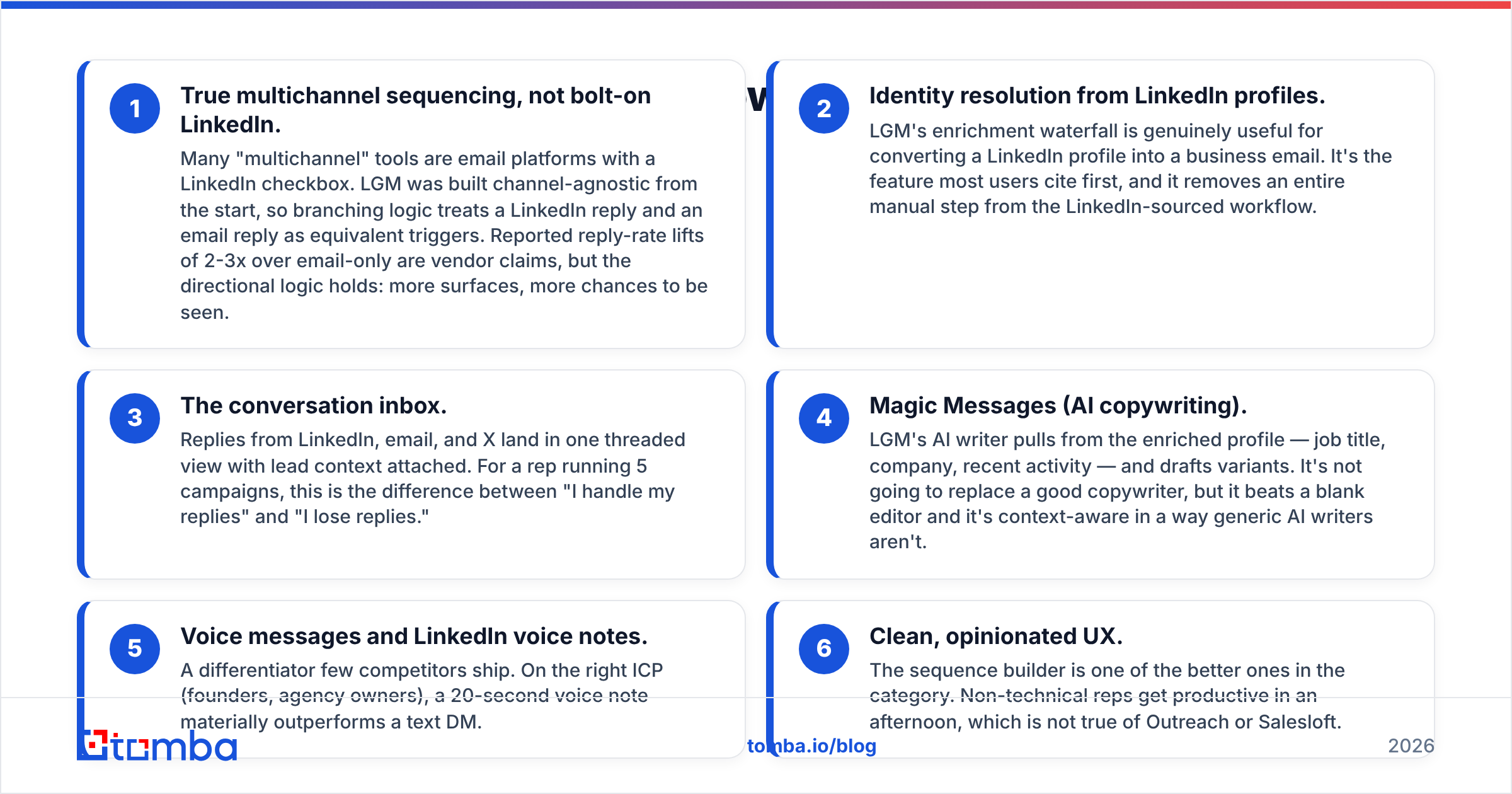
- True multichannel sequencing, not bolt-on LinkedIn. Many "multichannel" tools are email platforms with a LinkedIn checkbox. LGM was built channel-agnostic from the start, so branching logic treats a LinkedIn reply and an email reply as equivalent triggers. Reported reply-rate lifts of 2-3x over email-only are vendor claims, but the directional logic holds: more surfaces, more chances to be seen.
- Identity resolution from LinkedIn profiles. LGM's enrichment waterfall is genuinely useful for converting a LinkedIn profile into a business email. It's the feature most users cite first, and it removes an entire manual step from the LinkedIn-sourced workflow.
- The conversation inbox. Replies from LinkedIn, email, and X land in one threaded view with lead context attached. For a rep running 5 campaigns, this is the difference between "I handle my replies" and "I lose replies."
- Magic Messages (AI copywriting). LGM's AI writer pulls from the enriched profile — job title, company, recent activity — and drafts variants. It's not going to replace a good copywriter, but it beats a blank editor and it's context-aware in a way generic AI writers aren't.
- Voice messages and LinkedIn voice notes. A differentiator few competitors ship. On the right ICP (founders, agency owners), a 20-second voice note materially outperforms a text DM.
- Clean, opinionated UX. The sequence builder is one of the better ones in the category. Non-technical reps get productive in an afternoon, which is not true of Outreach or Salesloft.
What Are the Real Cons of La Growth Machine?#
Now the uncomfortable half. None of these are dealbreakers on their own; together they define who LGM is wrong for.
- Per-seat pricing punishes teams. LGM licenses by "identity" (a connected LinkedIn/email persona). A 10-rep team pays roughly ten times a 1-rep team, with no meaningful volume discount at the low-to-mid tiers. Compare that to credit-pooled data tools where the marginal rep costs nothing.
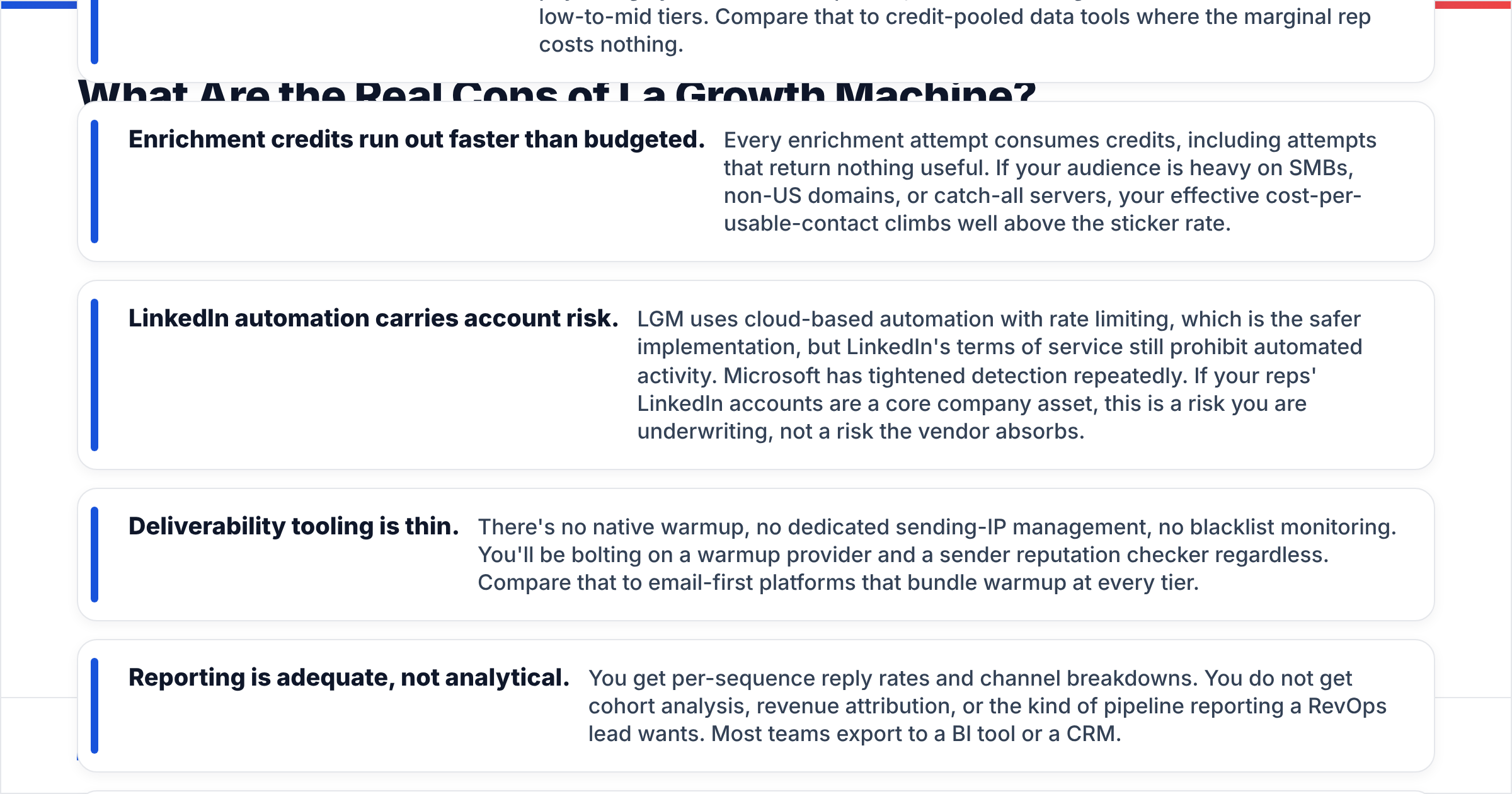
- Enrichment credits run out faster than budgeted. Every enrichment attempt consumes credits, including attempts that return nothing useful. If your audience is heavy on SMBs, non-US domains, or catch-all servers, your effective cost-per-usable-contact climbs well above the sticker rate.
- LinkedIn automation carries account risk. LGM uses cloud-based automation with rate limiting, which is the safer implementation, but LinkedIn's terms of service still prohibit automated activity. Microsoft has tightened detection repeatedly. If your reps' LinkedIn accounts are a core company asset, this is a risk you are underwriting, not a risk the vendor absorbs.
- Deliverability tooling is thin. There's no native warmup, no dedicated sending-IP management, no blacklist monitoring. You'll be bolting on a warmup provider and a sender reputation checker regardless. Compare that to email-first platforms that bundle warmup at every tier.
- Reporting is adequate, not analytical. You get per-sequence reply rates and channel breakdowns. You do not get cohort analysis, revenue attribution, or the kind of pipeline reporting a RevOps lead wants. Most teams export to a BI tool or a CRM.
- Limited native integrations. HubSpot and Pipedrive sync well. Salesforce is workable. Beyond that you're in Zapier/Make/webhook territory, which is fine but adds maintenance overhead.
- English is a second language in the product. Support and documentation are strong, but occasional UI copy and help articles read like translations. Minor, but real.
How Does La Growth Machine Compare to the Alternatives?#
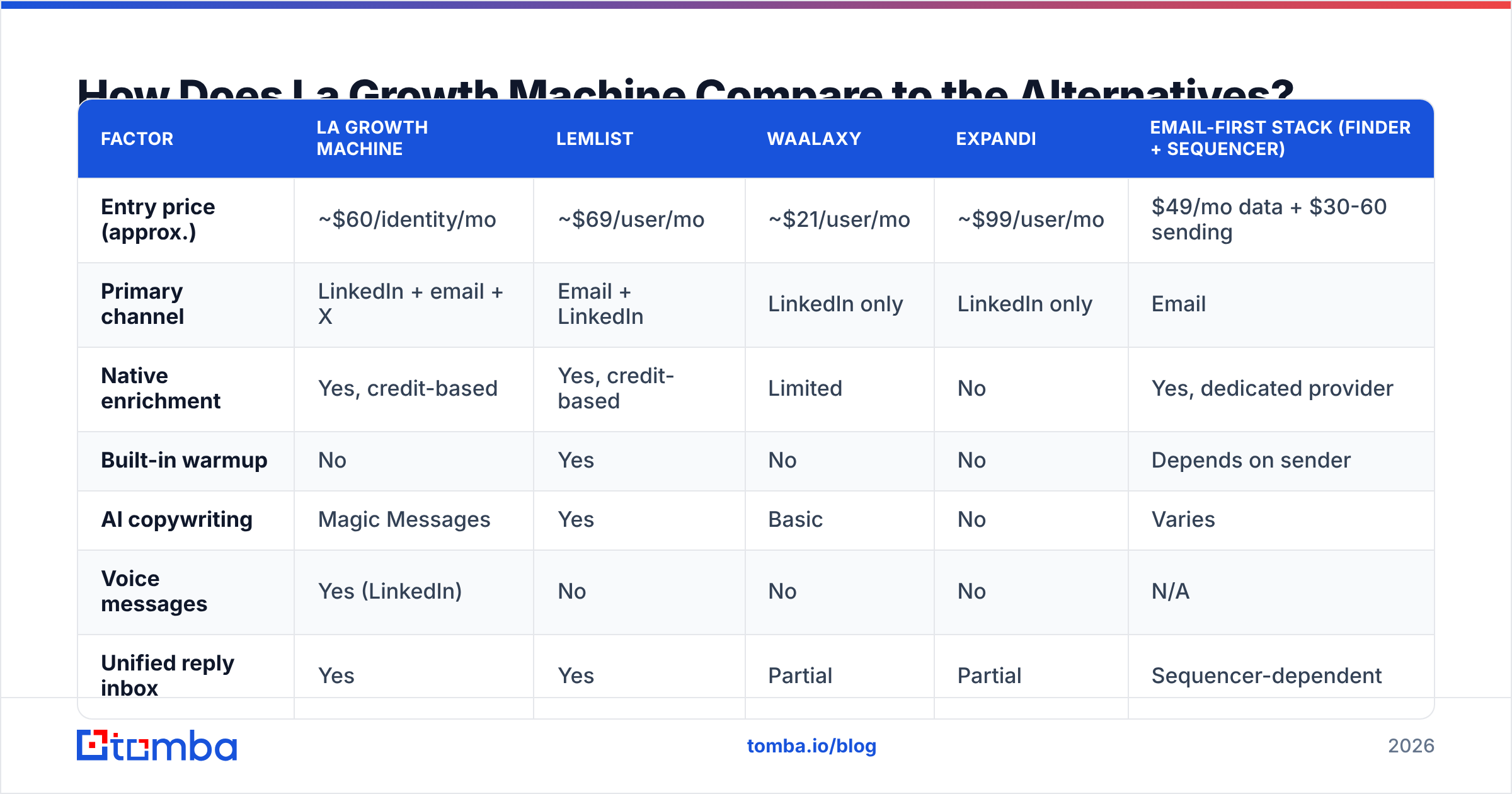
The honest framing: LGM competes on channel breadth, not on data quality or price. Here's how the category actually splits.
| Factor | La Growth Machine | Lemlist | Waalaxy | Expandi | Email-first stack (finder + sequencer) |
|---|---|---|---|---|---|
| Entry price (approx.) | ~$60/identity/mo | ~$69/user/mo | ~$21/user/mo | ~$99/user/mo | $49/mo data + $30-60 sending |
| Primary channel | LinkedIn + email + X | Email + LinkedIn | LinkedIn only | LinkedIn only | |
| Native enrichment | Yes, credit-based | Yes, credit-based | Limited | No | Yes, dedicated provider |
| Built-in warmup | No | Yes | No | No | Depends on sender |
| AI copywriting | Magic Messages | Yes | Basic | No | Varies |
| Voice messages | Yes (LinkedIn) | No | No | No | N/A |
| Unified reply inbox | Yes | Yes | Partial | Partial | Sequencer-dependent |
| Team scaling cost | Poor (per identity) | Poor (per user) | Moderate | Poor | Good (pooled credits) |
| LinkedIn ToS exposure | Yes | Yes | Yes | Yes | None |
| Best for | Multichannel SMB/agency | Email-led with LI assist | Cheap LinkedIn volume | Advanced LI operators | Volume email outbound |
Two takeaways. First, if you strip LinkedIn out of your motion, LGM loses most of its reason to exist and you're overpaying versus a plain email sequencer. Second, if LinkedIn is central, LGM and Expandi-style tools are your real shortlist, and LGM wins on breadth while Expandi wins on LinkedIn depth.
Worth noting for teams evaluating this stack: if your bottleneck is contact data rather than sequencing, a dedicated B2B database like BookYourData or a per-lookup finder often solves more of the problem than switching sequencers. Sequencers don't fix bad lists.
What Does La Growth Machine Actually Cost?#
LGM publishes tiered plans priced per identity per month, with enrichment credits allocated per tier and billed separately when you exceed them. Check the official La Growth Machine pricing page for current numbers — they've changed more than once and any figure quoted in a blog post ages badly.
The number that matters isn't the sticker price, it's your fully loaded cost per booked meeting. Model it like this:
Seat cost + enrichment overage + warmup/deliverability tooling + the hours spent cleaning bad enrichment results = real cost.
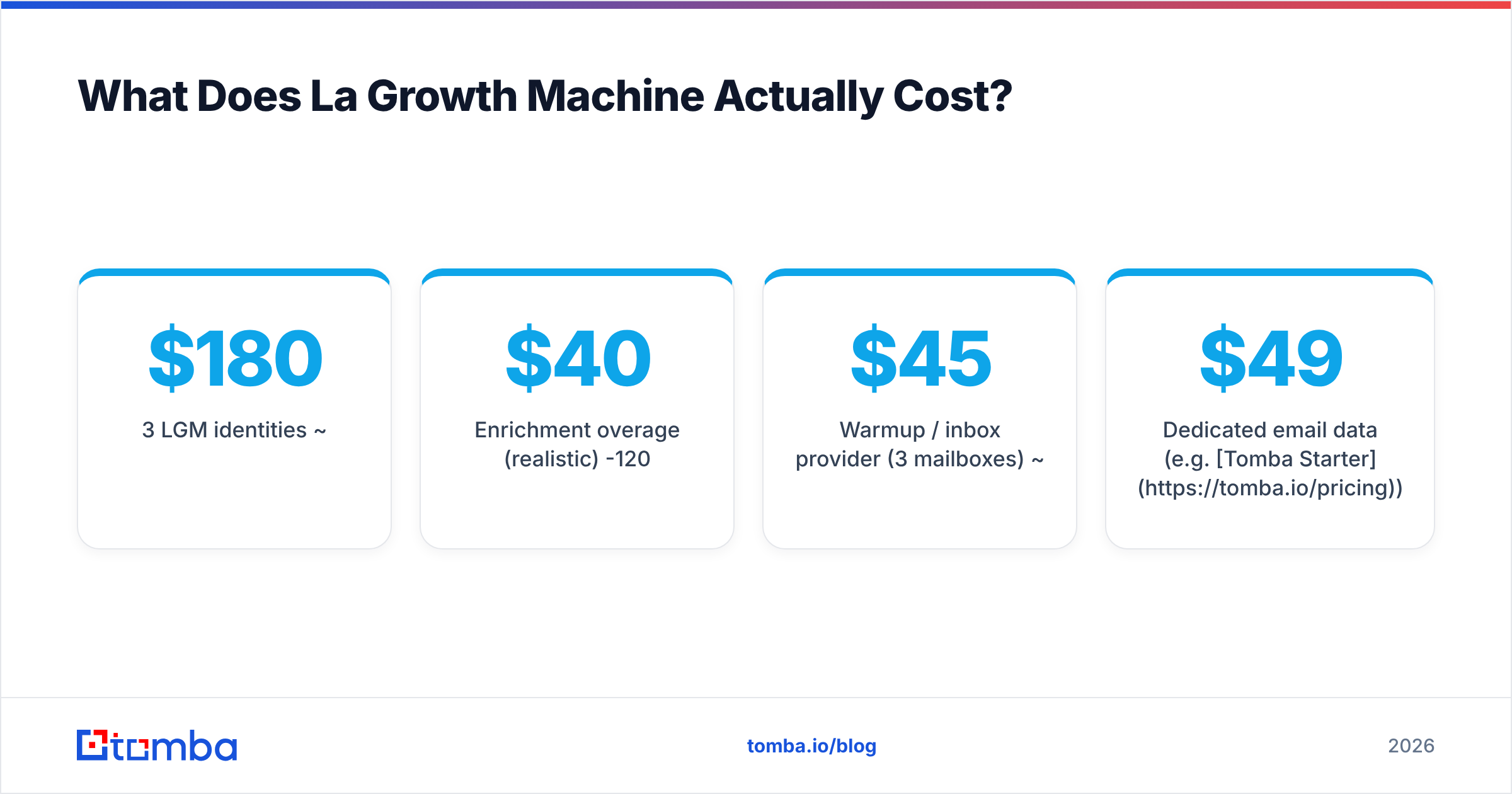
A worked example for a 3-rep team:
| Line item | Monthly cost |
|---|---|
| 3 LGM identities | ~$180 |
| Enrichment overage (realistic) | $40-120 |
| Warmup / inbox provider (3 mailboxes) | ~$45 |
| Dedicated email data (e.g. Tomba Starter) | $49 |
| Realistic total | $314-394/mo |
That last line is the one most evaluations skip. Teams add a dedicated data provider anyway, because LGM's enrichment misses on exactly the segments where a miss is expensive — smaller companies, non-English domains, and catch-all mail servers that need a catch-all verifier to resolve. Budgeting for it up front makes the comparison honest.

Is La Growth Machine's Data Quality Good Enough?#
Good enough for LinkedIn-sourced prospecting, not good enough as your only data source.
LGM's enrichment is a waterfall: it tries multiple sources per lead and returns the best hit. That design is right, and it's why LGM out-enriches single-source competitors. But waterfalls are only as good as the providers underneath them, and a sequencer's enrichment layer is a side business, not the core product. Dedicated providers invest more in crawl coverage, SMTP verification depth, and catch-all handling.
Three practical gaps show up repeatedly:
- Catch-all domains. Many enterprise domains accept all mail at the SMTP layer, so a naive verifier returns "valid" for addresses that bounce. Resolving these needs specialized logic — the kind in a purpose-built email verifier.
- Non-US and non-English companies. Coverage thins noticeably outside the US/UK/FR core.
- Role-based and departed contacts. Stale records for people who changed jobs 6+ months ago are common across the category, LGM included.
The practical fix is a two-step workflow: source and verify contacts with a dedicated provider, then push the clean list into LGM for sequencing. You can do this via CSV, via Zapier, or programmatically with an email finder API if you're running lists at volume. You pay for two tools, but you stop paying for bounces, damaged email deliverability, and reps chasing dead addresses.
Who Should Use La Growth Machine — and Who Shouldn't?#
Good fit:
- Agencies and consultancies running high-touch multichannel plays for a handful of clients, where 50 well-researched prospects beat 5,000 sprayed ones.
- Founder-led sales at seed to Series A, where the founder's LinkedIn presence is the actual asset and the personal brand does half the selling.
- Recruiters and talent teams, where LinkedIn is the native habitat and email is the follow-up channel.
- European SMB sales teams, where GDPR posture matters and LGM's EU base is a procurement advantage.
Poor fit:
- Volume email outbound. If you're sending thousands of emails a week across dozens of mailboxes, you need warmup, inbox rotation, and deliverability monitoring baked in. LGM doesn't have them.
- Enterprise sales orgs. Per-identity pricing, thin reporting, and limited Salesforce depth make it a hard sell past ~20 reps. Outreach or Salesloft exist for a reason.
- Teams that can't risk LinkedIn accounts. Any automation on LinkedIn violates the ToS. If a restricted account would be a business-level incident, the calculus changes.
- Data-first teams. If your core need is finding and verifying contacts rather than sequencing them, you're buying the wrong layer of the stack. Start with a B2B database and add a sequencer later.
What's the Verdict on La Growth Machine in 2026?#
LGM is a well-built tool with a clear point of view, priced for small teams that treat LinkedIn as a primary channel. The pros — genuine multichannel orchestration, a unified reply inbox, voice notes, an AI writer that actually uses enriched context — are real and hard to replicate elsewhere at this price. The cons — per-seat scaling, credit burn, no warmup, LinkedIn exposure, and merely adequate enrichment — are equally real and cluster around the same theme: it's a sequencer, and everything outside sequencing is a second-tier feature.
The question to ask isn't "is LGM good?" It's "is LinkedIn central to how we sell, and are we willing to run our data layer separately?" Two yeses make LGM a strong buy. A no on the first makes it an expensive email tool. A no on the second means you'll fight your enrichment bill every month.
If you decide LGM is your sequencer, don't let its enrichment be your only data source. Feed it verified contacts from the start: the Tomba Email Finder finds professional email addresses by name, domain, or company with SMTP-level verification and catch-all handling, starting free at 25 searches a month and $49/mo on Starter. Build the list clean, then let La Growth Machine do what it's genuinely good at — running the conversation across every channel your prospect actually reads.
Related guides#
Ready to find emails that actually work?
Join 150,000+ professionals who stopped guessing and started sending. Free credits on signup — no credit card required.
Get the Tomba newsletter
Practical outbound tactics and product updates — once every two weeks.
About the author