La Growth Machine Reviews 2026: Pricing, Pros, Cons & Verdict
La Growth Machine is one of the slickest LinkedIn + email sequencers on the market — and one of the easiest to overspend on. Here's what the reviews get right, what they miss, and who should actually buy it.
TL;DR
- La Growth Machine (LGM) is a French multichannel outreach tool that sequences LinkedIn actions, email, and X/Twitter from one workflow builder. The builder is genuinely best-in-class.
- Pricing is charged per identity (per sending persona), not per seat's worth of contacts. That model is the single biggest reason teams overspend — a 4-rep team on the mid tier costs roughly 4x what a solo founder pays.
- Reviews on G2 and Capterra cluster in the mid-4s. The praise is consistent (UX, LinkedIn automation, support); the complaints are also consistent (price scaling, enrichment credit burn, no native warmup).
- LGM's built-in enrichment is convenient but inconsistent on non-obvious domains. Most serious users pipe in verified emails from a dedicated finder instead of paying twice for guesses.
- Buy it if LinkedIn is more than 40% of your channel mix and you run 1–3 identities. Skip it if you're doing pure cold email at volume — cheaper sequencers win on cost per send.
What is La Growth Machine, and who actually uses it?#
La Growth Machine is a multichannel sales engagement platform built around one idea: a prospect who ignores your email might accept your LinkedIn connection request, and the same sequence should handle both without you copying rows between tools.
You import a list (CSV, LinkedIn search, Sales Navigator, or an integration), LGM enriches the contacts with emails and profile data, and then you drop them into a visual sequence that can mix LinkedIn profile visits, connection requests, DMs, voice notes, emails, and X/Twitter actions — with conditional branches based on what the lead does.
The typical buyer is a founder-led sales team, an agency running outbound for clients, or a 2–8 person SDR pod in Europe. It skews heavily toward teams whose ICP actually lives on LinkedIn: SaaS, recruiting, consulting, and agency services. If you're selling to warehouse managers or dentists, LinkedIn-first automation is the wrong hammer and LGM's main advantage evaporates.
The product sits in the same conceptual bucket as sales automation tools like Lemlist, Expandi, and Waalaxy — but LGM leans harder into the "one workflow, many channels" positioning than any of them. You can see the current feature set and plan structure on lagrowthmachine.com.
How does a La Growth Machine sequence actually run?#
Understanding the mechanics explains both the praise and the complaints in most reviews. Here's the real lifecycle of a lead inside LGM:
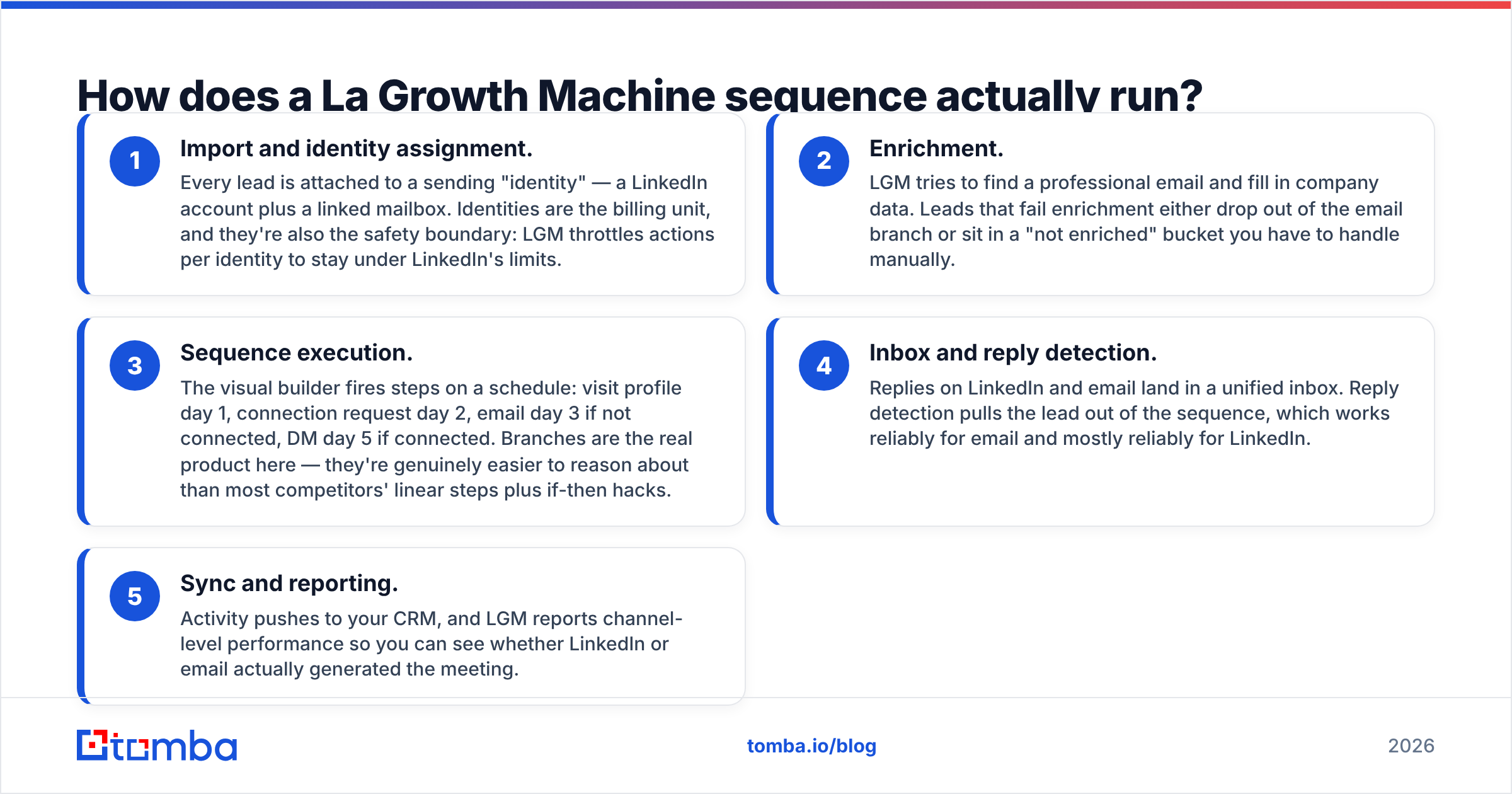
- Import and identity assignment. Every lead is attached to a sending "identity" — a LinkedIn account plus a linked mailbox. Identities are the billing unit, and they're also the safety boundary: LGM throttles actions per identity to stay under LinkedIn's limits.
- Enrichment. LGM tries to find a professional email and fill in company data. Leads that fail enrichment either drop out of the email branch or sit in a "not enriched" bucket you have to handle manually.
- Sequence execution. The visual builder fires steps on a schedule: visit profile day 1, connection request day 2, email day 3 if not connected, DM day 5 if connected. Branches are the real product here — they're genuinely easier to reason about than most competitors' linear steps plus if-then hacks.
- Inbox and reply detection. Replies on LinkedIn and email land in a unified inbox. Reply detection pulls the lead out of the sequence, which works reliably for email and mostly reliably for LinkedIn.
- Sync and reporting. Activity pushes to your CRM, and LGM reports channel-level performance so you can see whether LinkedIn or email actually generated the meeting.
That step-2 dependency is the fault line. Everything downstream — deliverability, response rate, cost per meeting — is capped by how good the enrichment is. We'll come back to it.
How does La Growth Machine pricing work in 2026?#
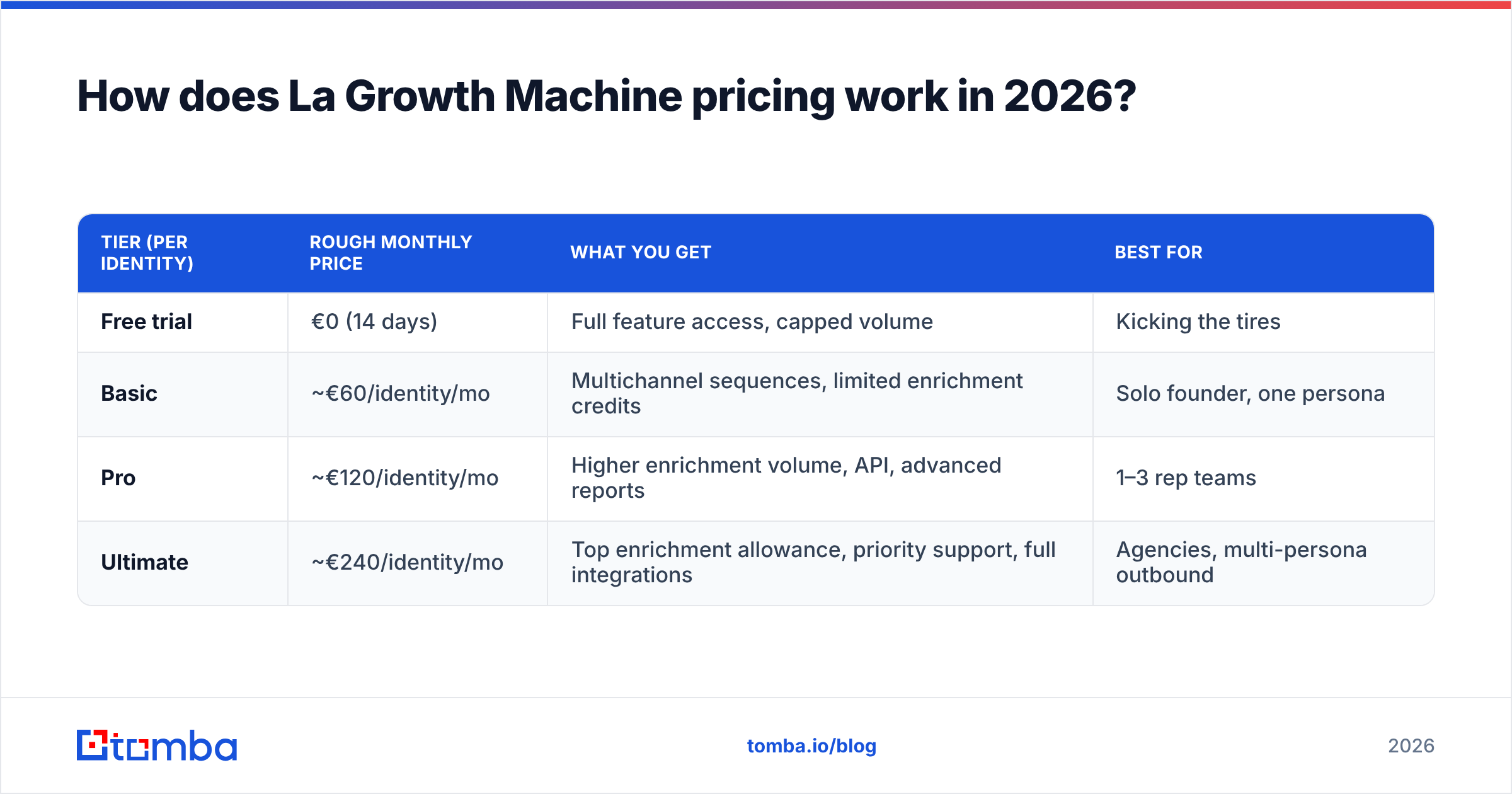
This is where reviews get emotional. LGM does not price per contact or per seat in the ordinary sense. It prices per identity, and each identity is one LinkedIn account plus its mailbox.
| Tier (per identity) | Rough monthly price | What you get | Best for |
|---|---|---|---|
| Free trial | €0 (14 days) | Full feature access, capped volume | Kicking the tires |
| Basic | ~€60/identity/mo | Multichannel sequences, limited enrichment credits | Solo founder, one persona |
| Pro | ~€120/identity/mo | Higher enrichment volume, API, advanced reports | 1–3 rep teams |
| Ultimate | ~€240/identity/mo | Top enrichment allowance, priority support, full integrations | Agencies, multi-persona outbound |
Two honest caveats. First, LGM has repositioned its tiers more than once, and annual billing knocks a meaningful chunk off these numbers — check the vendor's live pricing page before you budget. Second, the per-identity model compounds fast: three reps on Pro is not €120, it's roughly €360/month before you've bought a single warmup tool, a data vendor, or a CRM seat.

Compare that to a stack where you pay one flat data bill. Tomba pricing runs Free (25 searches/mo), Starter $49/mo, Growth $99/mo, Pro $249/mo — priced on volume, not on how many humans are sending. For a team of four, the difference between "per identity" and "per volume" is usually the difference between a $99 line item and a €480 one.
What do real La Growth Machine reviews say?#
Aggregate ratings on G2 and Capterra sit in the mid-4s, which puts LGM comfortably in the "well-liked, not universally loved" band. Reading through the actual text rather than the stars, the same themes repeat.
What reviewers consistently praise:
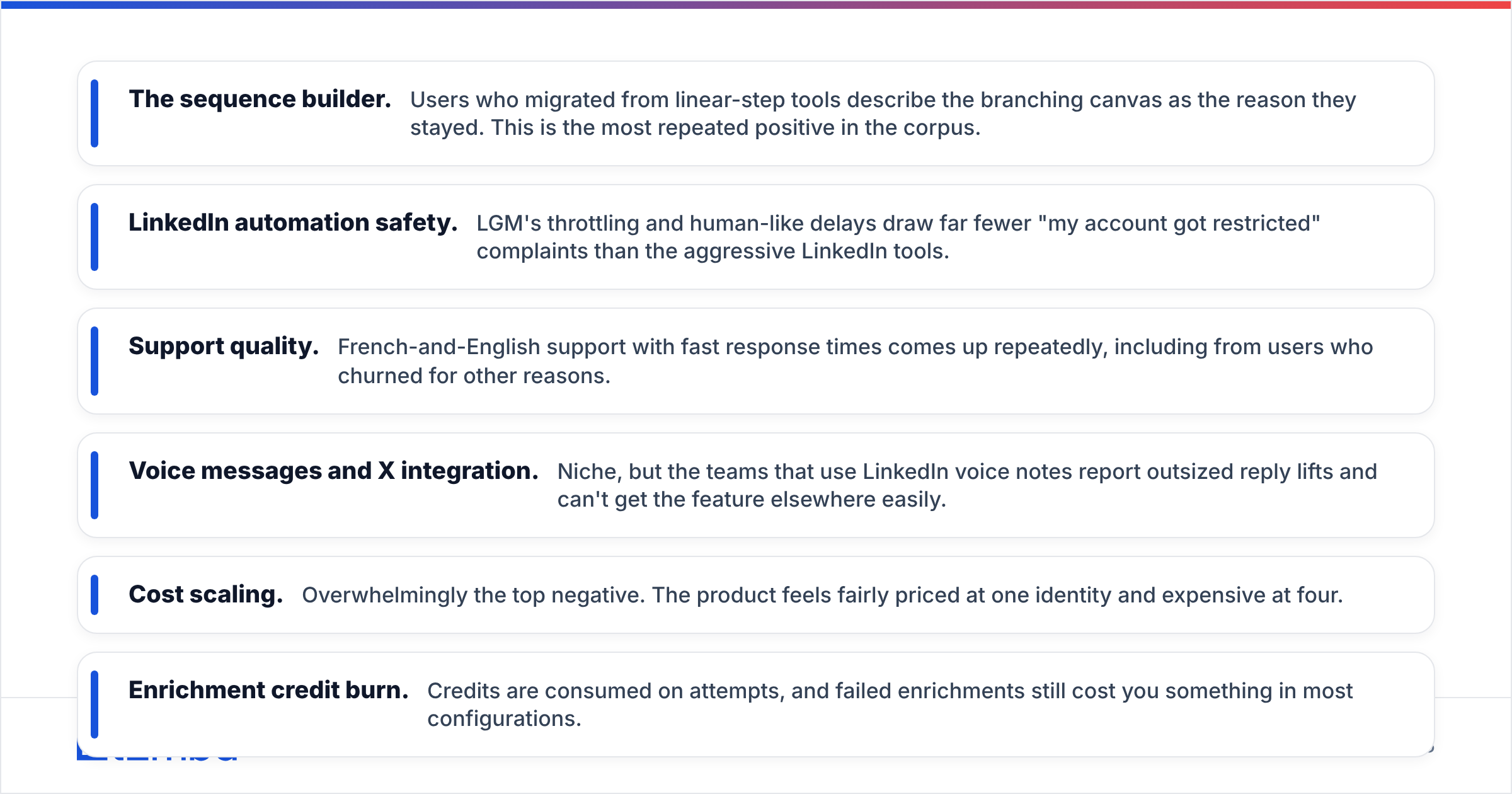
- The sequence builder. Users who migrated from linear-step tools describe the branching canvas as the reason they stayed. This is the most repeated positive in the corpus.
- LinkedIn automation safety. LGM's throttling and human-like delays draw far fewer "my account got restricted" complaints than the aggressive LinkedIn tools.
- Support quality. French-and-English support with fast response times comes up repeatedly, including from users who churned for other reasons.
- Voice messages and X integration. Niche, but the teams that use LinkedIn voice notes report outsized reply lifts and can't get the feature elsewhere easily.
What reviewers consistently complain about:
- Cost scaling. Overwhelmingly the top negative. The product feels fairly priced at one identity and expensive at four.
- Enrichment credit burn. Credits are consumed on attempts, and failed enrichments still cost you something in most configurations.
- No native email warmup. You must bring your own warmup and monitoring — LGM sends, it does not protect your domain.
- Learning curve on the first sequence. Power comes with knobs. Expect a real afternoon, not a ten-minute setup.
- Reporting depth. Channel-level attribution is good; cohort and deal-level analysis is thin without a CRM doing the heavy lifting.
None of these are dealbreakers on their own. Together they describe a specific shape of buyer: someone who values workflow sophistication more than they value a low, predictable bill.
Is La Growth Machine's built-in enrichment good enough?#
Short answer: good enough to start, not good enough to rely on.
Bundled enrichment inside an outreach tool is a convenience feature, not a data business. The provider's incentive is to return an email fast so your sequence doesn't stall — not to refuse when confidence is low. On common patterns (first.last@company.com at a 200-person SaaS company) you'll get clean hits. On smaller domains, rebranded companies, holding-company mail routing, or catch-all email domains, hit quality drops and you start sending to addresses that technically resolve but belong to nobody.
That's how teams end up with a 15–25% bounce rate on a campaign that looked fine in the dashboard. And bounces don't just waste sends — they damage sender reputation for every future campaign from that domain, including the ones that would have worked.

The fix is unglamorous and cheap: enrich and verify outside the sequencer, then import only addresses that passed. A dedicated email verifier plus a real finder costs less than the enrichment credits you'd burn guessing, and it moves the failure point from "after you hit send" to "before you built the list." If you're pulling prospects straight off LinkedIn profiles, a LinkedIn finder does the same job at the source.
Run your list through verification, then let LGM do what it's actually best at — orchestrating the touches.
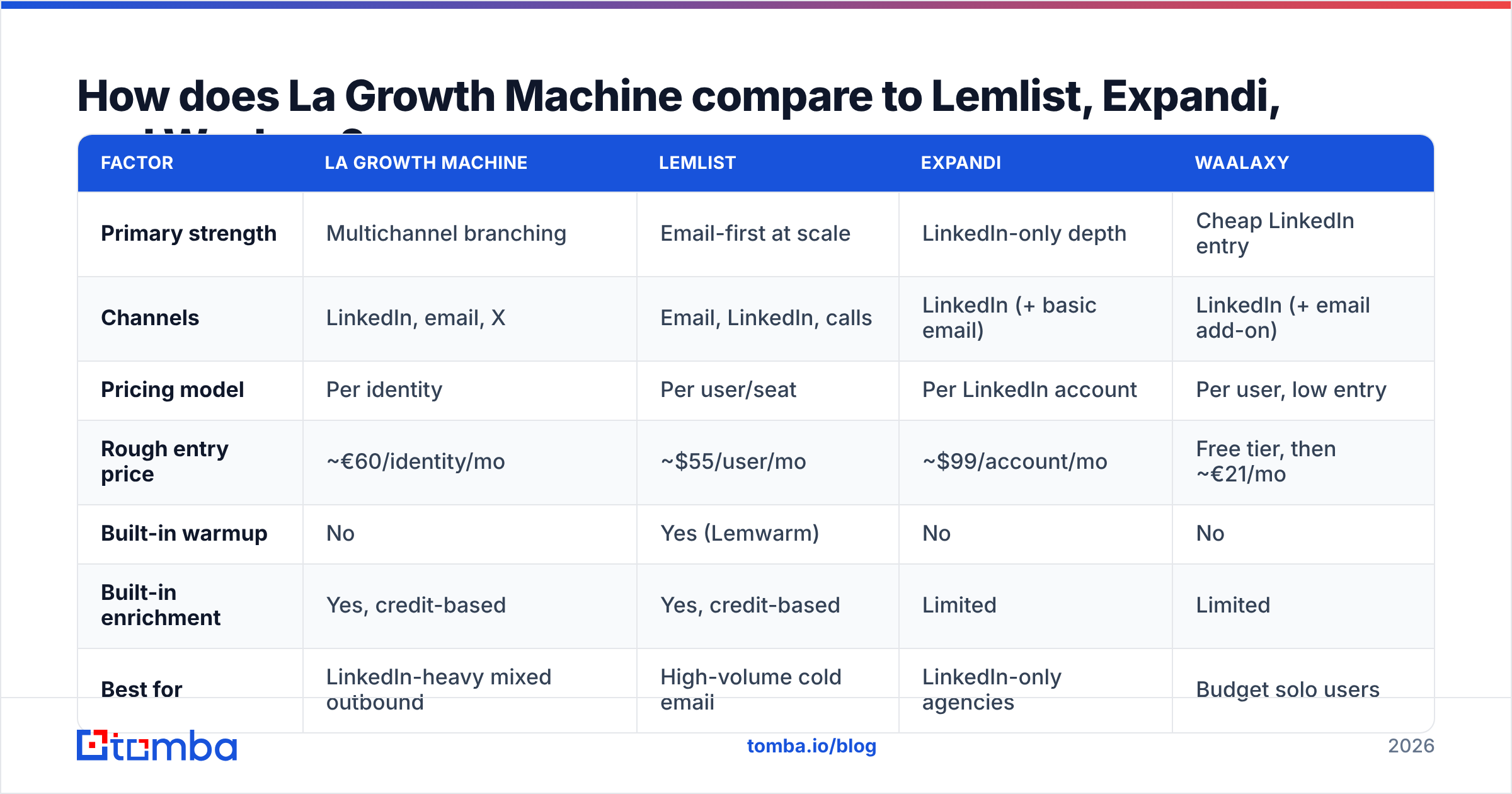
How does La Growth Machine compare to Lemlist, Expandi, and Waalaxy?#
| Factor | La Growth Machine | Lemlist | Expandi | Waalaxy |
|---|---|---|---|---|
| Primary strength | Multichannel branching | Email-first at scale | LinkedIn-only depth | Cheap LinkedIn entry |
| Channels | LinkedIn, email, X | Email, LinkedIn, calls | LinkedIn (+ basic email) | LinkedIn (+ email add-on) |
| Pricing model | Per identity | Per user/seat | Per LinkedIn account | Per user, low entry |
| Rough entry price | ~€60/identity/mo | ~$55/user/mo | ~$99/account/mo | Free tier, then ~€21/mo |
| Built-in warmup | No | Yes (Lemwarm) | No | No |
| Built-in enrichment | Yes, credit-based | Yes, credit-based | Limited | Limited |
| Best for | LinkedIn-heavy mixed outbound | High-volume cold email | LinkedIn-only agencies | Budget solo users |
| Weakest point | Cost at 3+ identities | Weaker LinkedIn depth | Single-channel ceiling | Shallow automation |
The honest read: if your channel mix is 70% email, Lemlist or a cheaper sequencer wins on cost per send and gives you warmup in the box. If it's 70% LinkedIn and you only need one account, Waalaxy or Expandi is cheaper. LGM wins specifically in the middle — genuinely mixed outbound where the branching logic between channels is doing real work. That middle is a narrower band than LGM's marketing suggests, but it's a real one, and inside it nothing else is as pleasant to use. If you're weighing the data layer separately, our La Growth Machine alternative breakdown covers the swap in more detail.
What are the hidden costs nobody mentions in the reviews?#
Budget for these before you sign an annual contract:
- Warmup tooling. $30–60/month per mailbox for a dedicated warmup service, because LGM doesn't include one.
- Extra mailboxes and domains. Serious volume means secondary sending domains. Domain + Google Workspace seat runs ~$10–15/month each, and each one needs its own warmup.
- Data top-ups. When enrichment credits run out mid-month, you either upgrade the tier or buy credits — both at outreach-tool margins rather than data-vendor margins.
- A second identity you didn't plan for. The moment a second person wants to send, you're paying a second full subscription. This is the line item that breaks most budgets.
- Deliverability monitoring. Postmaster tools are free, but somebody's time isn't. Plan for a weekly 30-minute check on reputation and bounce trends.
Add it up and a "€120/month tool" for a three-person team realistically lands between €500 and €700/month all-in. That's not a scandal — it's just not the number on the pricing page.
Who should buy La Growth Machine, and who should skip it?#
Buy it if:
- LinkedIn drives 40%+ of your pipeline and you need email as a parallel channel, not an afterthought.
- You run one to three sending identities and can absorb the per-identity math.
- Your sequences need real conditional logic — different paths for connected vs. not connected, replied vs. opened.
- You value a polished European product with responsive support over the cheapest possible tool.
Skip it if:
- You're running pure cold email at 2,000+ sends/day. You'll pay a multichannel premium for a channel you barely use.
- You have five or more reps sending. The per-identity model becomes the dominant cost in your stack.
- Your ICP isn't reliably findable on LinkedIn.
- You need warmup, deliverability monitoring, and sending in one bill — that's a different category of tool.
The verdict: La Growth Machine is a very good product with a pricing model that punishes growth. The software deserves its mid-4s rating. Whether it deserves your budget depends almost entirely on how many identities you need and how much of your outbound genuinely runs through LinkedIn. Test it with one identity for a month, measure meetings per euro against your current stack, and only then decide about annual billing.
One thing that's true regardless of which sequencer you pick: the tool is downstream of the list. A perfect branching sequence sent to guessed addresses still bounces, and no amount of copywriting fixes bad data.
That's the gap worth closing first. Build your list with the Tomba Email Finder, verify every address before it enters a sequence, and import only confirmed contacts into La Growth Machine. Start free with 25 searches a month, or run a full list through bulk email finder on Starter at $49/mo — then let LGM's branching do the work it's actually good at, on data that won't torch your domain.
Related guides#
// get started
Find, verify and enrich your first contacts today
Start on the free plan with 25 searches a month, then scale when your team is ready.
Free plan · No credit card required · GDPR & CCPA
// about the author