La Growth Machine vs Lemlist: Which Wins for Outbound in 2026?
La Growth Machine and Lemlist both promise multichannel outbound, but they win on different ground. Here is the honest pricing, deliverability, and data breakdown — plus which one fits your team.
TL;DR
- La Growth Machine (LGM) is the stronger LinkedIn-first sequencer. Its multichannel logic — LinkedIn visit, connect, message, then email, then Twitter/X — is genuinely native, not bolted on. Plans run roughly €60–€240/month per identity.
- Lemlist is the stronger email-first platform. Better deliverability tooling (lemwarm), a larger template ecosystem, a bigger integration surface, and plans from about $39 to $99+ per user per month.
- Neither is a great data provider. Both bundle a contact database as a convenience layer, and both leak credits on bounces. Pairing either one with a dedicated email finder is almost always cheaper than buying their top data tier.
- Pick LGM if LinkedIn is your primary channel and you run small, surgical lists. Pick Lemlist if email volume is your engine and deliverability is your bottleneck.
- Both charge per seat or per identity, so cost scales with headcount — model that before you commit to annual billing.
If you are evaluating outbound sequencers in 2026, La Growth Machine and Lemlist end up on the same shortlist constantly. They look similar from the pricing page: multichannel sequences, LinkedIn automation, email sending, a built-in lead database, AI copy assistance. Once you actually run campaigns in both, the difference is obvious — and it is not a feature-count difference. It is a philosophy difference.
This breakdown is based on how each tool behaves in production: what it costs at real team sizes, where credits evaporate, how each handles deliverability, and what happens when your data is bad.
What is La Growth Machine?#
La Growth Machine is a French multichannel outbound tool built around identities rather than seats. An identity is one persona — a LinkedIn account plus its connected email inbox — and you pay per identity, not per human.
That distinction matters more than it sounds. If one SDR runs outreach from three founder personas, you pay for three identities. If three SDRs share one brand persona, you pay for one. Most agencies and founder-led sales teams end up on the cheaper side of this model; large SDR pods end up on the expensive side.
The product's core strength is its sequence builder. LGM treats LinkedIn as a first-class channel with real actions:
- Profile visit — a soft warm-up signal before any message lands.
- Connection request — with or without a note, conditional on prior acceptance.
- LinkedIn message — sent only if the connection was accepted, otherwise the branch skips.
- Email — fires on a delay, or as a fallback when LinkedIn stalls.
- Twitter/X actions — follow and DM, available as an extra touch in the same flow.
- Voice message — a native LinkedIn voice note step, which almost no competitor offers.
The conditional logic is where LGM earns its price. "If connection accepted, send LinkedIn message; if not accepted after 5 days, send email" is a two-click setup, not a Zapier workaround.
LGM also ships Magic Messages (AI copy generation trained on your voice), a Chrome extension for importing from LinkedIn and Sales Navigator, and an enrichment layer that tries to find business emails and phone numbers for imported profiles.

What is Lemlist?#
Lemlist is an email-first outbound platform from the same broad European cohort, and it has been in market longer. Its center of gravity is cold email at volume, with LinkedIn and calling attached as supporting channels.
Three things define it:
- lemwarm — the warmup and deliverability product. It was one of the first mainstream warmup tools and is still among the better ones, with a deliverability booster network, DNS checks, and per-inbox health scoring.
- Personalization at scale — dynamic text, custom liquid-style variables, personalized images, and video thumbnails. The image personalization feature (dropping a prospect's logo or website screenshot into a visual) is still a Lemlist signature.
- The lemlist database — a B2B contact dataset (marketed around 450M+ contacts) bundled into higher tiers, plus a waterfall enrichment option that chains multiple data vendors.
Lemlist's LinkedIn automation exists and works, but it is a lighter implementation than LGM's. You get connect, message, visit, and like-post actions. What you do not get is the same depth of conditional branching across channels.
Lemlist also leans harder on the ecosystem: a large template library, an active community, native integrations with HubSpot, Salesforce, Pipedrive, and a public API.
La Growth Machine vs Lemlist: how do they compare on features and price?#
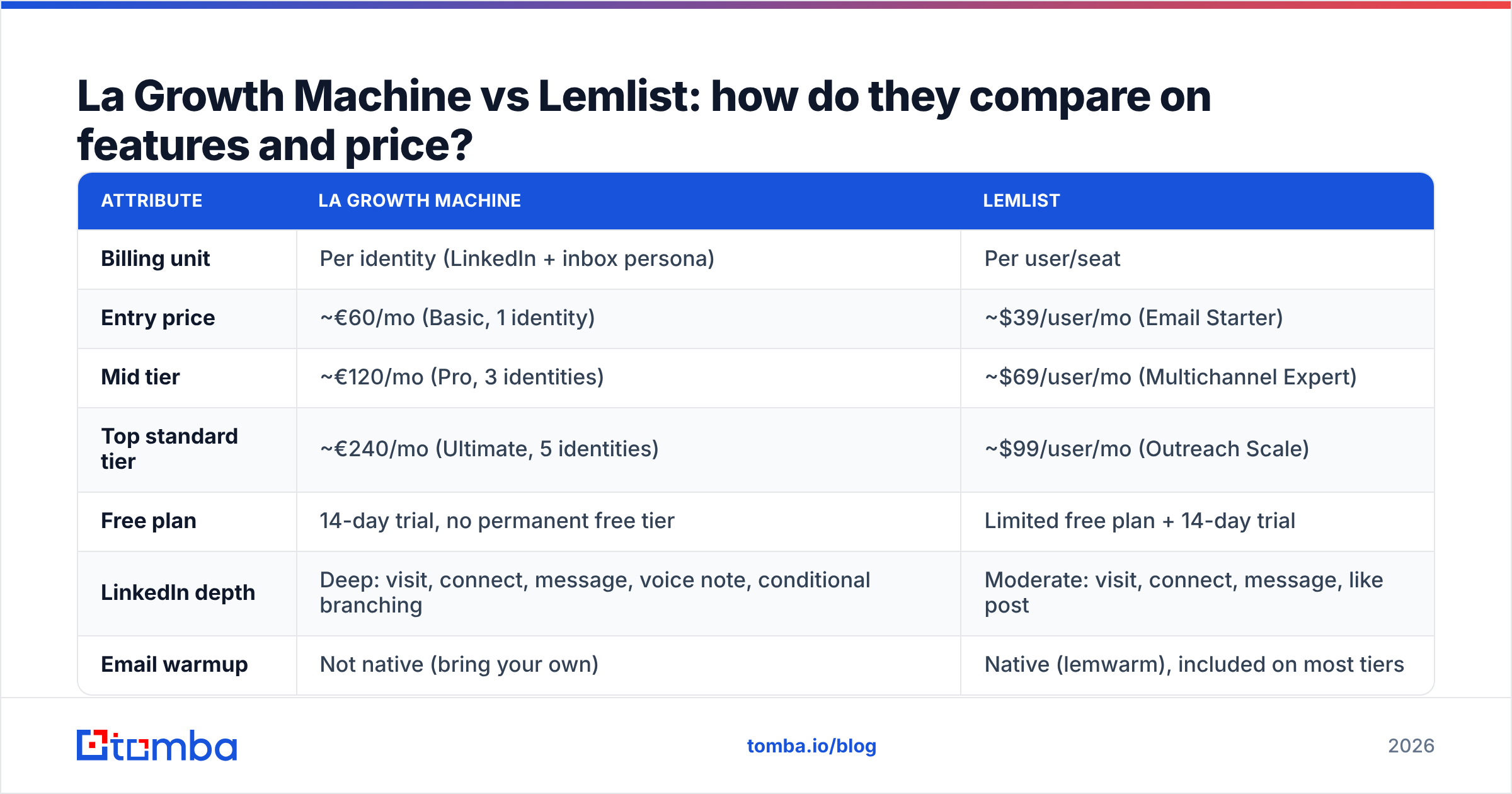
Here is the side-by-side. Prices are list prices as published on each vendor's site and move with promotions and annual discounts — check lagrowthmachine.com and lemlist.com before you buy.
| Attribute | La Growth Machine | Lemlist |
|---|---|---|
| Billing unit | Per identity (LinkedIn + inbox persona) | Per user/seat |
| Entry price | ~€60/mo (Basic, 1 identity) | ~$39/user/mo (Email Starter) |
| Mid tier | ~€120/mo (Pro, 3 identities) | ~$69/user/mo (Multichannel Expert) |
| Top standard tier | ~€240/mo (Ultimate, 5 identities) | ~$99/user/mo (Outreach Scale) |
| Free plan | 14-day trial, no permanent free tier | Limited free plan + 14-day trial |
| LinkedIn depth | Deep: visit, connect, message, voice note, conditional branching | Moderate: visit, connect, message, like post |
| Email warmup | Not native (bring your own) | Native (lemwarm), included on most tiers |
| Contact database | Enrichment on imported leads | 450M+ contact database on higher tiers |
| Waterfall enrichment | Multi-provider enrichment built in | Available on higher tiers |
| Twitter/X channel | Yes (follow + DM) | No |
| Cold calling | No | Yes (lemcall, higher tiers) |
| Unibox / shared inbox | Yes | Yes |
| CRM sync | HubSpot, Pipedrive, Salesforce (via plan) | HubSpot, Salesforce, Pipedrive, Zoho |
| Best fit | LinkedIn-led, low-volume, high-touch | Email-led, higher volume, deliverability-sensitive |
The cost story flips depending on team shape. One founder running three personas pays LGM roughly €120/month and Lemlist roughly $39–69/month for one seat. A five-person SDR team each running one persona pays LGM around €240/month total (Ultimate, 5 identities) versus Lemlist at roughly $345–495/month for five seats. LGM gets relatively cheaper as headcount grows; Lemlist gets cheaper when one person runs many personas is not the use case.
Which one handles deliverability better?#
Lemlist, clearly — and it is not close.
Think of deliverability like a restaurant's health inspection. You can have the best menu in town, but if the kitchen fails inspection, nobody eats. Lemlist built its kitchen inspection into the product. La Growth Machine assumes you hired an inspector separately.
Lemlist gives you:
- lemwarm ramping new inboxes with real-looking conversations across its network
- DNS/technical checks for SPF, DKIM, and DMARC before you send
- Per-inbox deliverability scores and sending-limit guardrails
- Automatic pausing when bounce rates spike on a campaign
La Growth Machine sends from your connected mailbox and expects you to bring your own warmup, your own SPF record hygiene, and your own bounce monitoring. That is a legitimate design choice — many teams already run a dedicated warmup stack — but it is an extra line item and an extra thing to forget.
Either way, warmup does not fix a bad list. Google and Microsoft both tightened bulk-sender requirements in 2024 and have kept ratcheting since; a spam-complaint rate above 0.3% now gets you throttled regardless of how warm the inbox is. The cheapest deliverability upgrade available to any team is not a warmup subscription — it is running the list through an email verifier before the first send so hard bounces never happen. A 4% bounce rate on a 5,000-contact campaign is 200 hard bounces that no amount of lemwarm will absorb.
If you want the reference material rather than vendor blogs, Google's bulk sender guidelines are the primary source, and both platforms' own docs defer to them.
Is the built-in contact data good enough?#
This is where both tools have the same weakness, and where budgets quietly bleed.
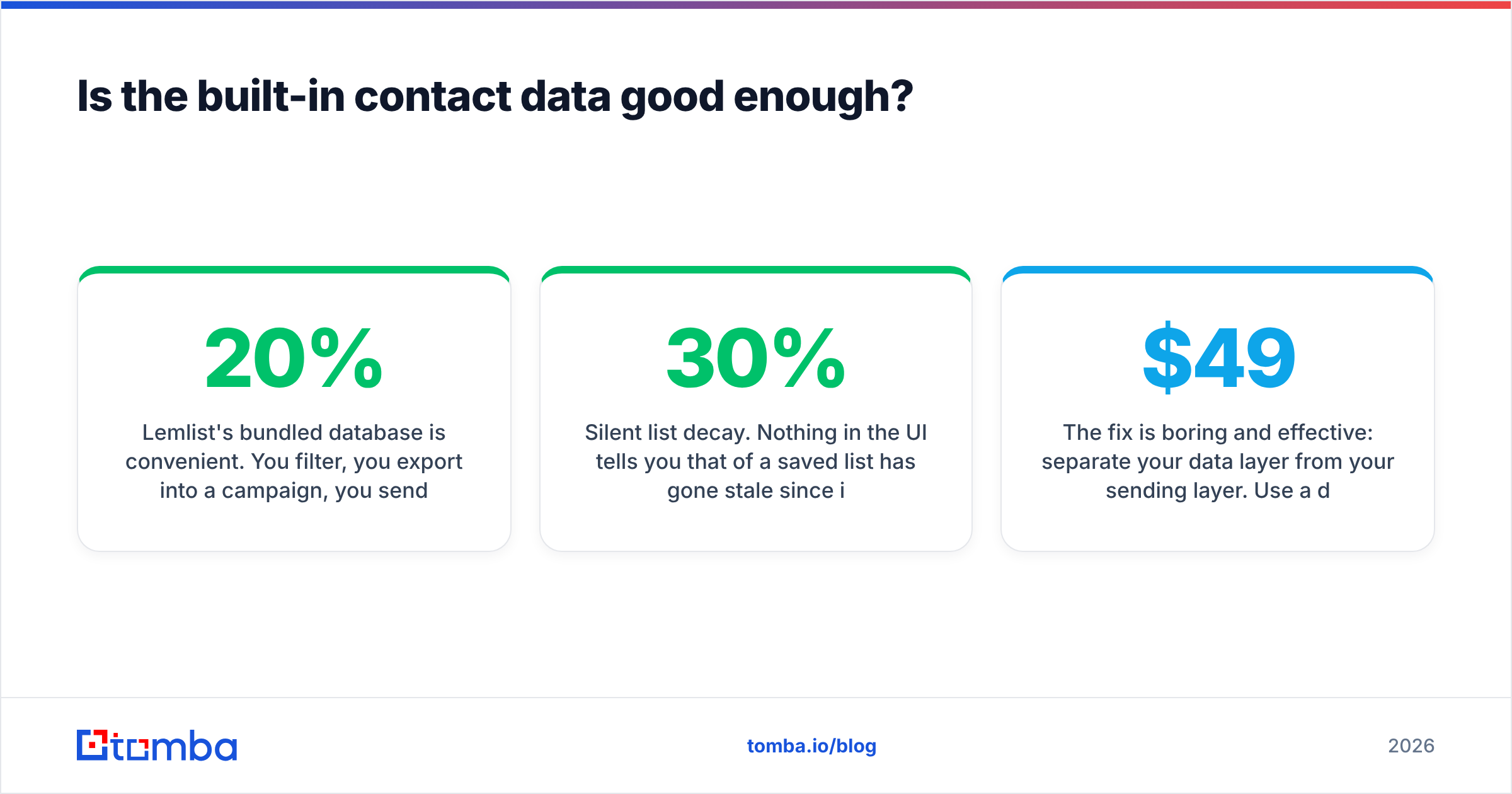
Lemlist's bundled database is convenient. You filter, you export into a campaign, you send. The convenience is real. The problem is that bundled databases inside sequencing tools are a secondary product for the vendor — the sequencing engine gets the roadmap attention, and the data layer gets refreshed on someone else's schedule. Titles go stale. People change jobs at roughly 20% per year in tech sales, which means a snapshot from 18 months ago is wrong about one contact in three.
La Growth Machine's enrichment is a waterfall — it queries providers in sequence until one returns a hit. That is the right architecture, and it produces decent coverage. But the credits are consumed per enrichment attempt, and you do not get granular control over which provider fires first or a confidence score you can threshold on.
Practical consequences of thin data in either tool:
- Wasted credits. You pay to enrich a contact, then pay again in deliverability damage when it bounces.
- Silent list decay. Nothing in the UI tells you that 30% of a saved list has gone stale since import.
- No catch-all handling. Catch-all domains accept everything at SMTP and reveal nothing. Without a dedicated catch-all verifier, you are guessing on a meaningful slice of enterprise domains.
- Format guessing. Both tools infer patterns like first.last@ — fine until the company uses initials, or runs two patterns after an acquisition.

The fix is boring and effective: separate your data layer from your sending layer. Use a dedicated finder and verifier to build a clean list, then push it into whichever sequencer you chose. Tomba pricing starts at a free tier with 25 searches a month, with Starter at $49/mo and Growth at $99/mo — roughly the cost of one Lemlist seat, but the credits go to data accuracy rather than a bundled convenience feature. The domain search route also lets you build a company list first and enrich by role, which neither sequencer does well.
Which tool wins for LinkedIn-led outbound?#
La Growth Machine, and the gap is wide enough that it should decide your choice if LinkedIn is your primary channel.
Concretely, LGM does things Lemlist does not:
- Conditional multichannel branching. Sequences that genuinely fork on LinkedIn acceptance rather than just time delays.
- Native voice notes. A LinkedIn voice message step inside the sequence — an underused format with unusually high reply rates because almost nobody sends them.
- Identity-based billing. Running five personas from one operator costs one Ultimate plan, not five seats.
- Twitter/X as a third channel. Follow-then-DM as a warming touch before the LinkedIn connect.
- Sales Navigator import depth. Cleaner list import and de-duplication from Sales Navigator searches.
- Per-identity sending limits that respect LinkedIn's own thresholds rather than a global account cap.
Lemlist's LinkedIn actions are fine for a supporting touch — a connection request layered onto an email sequence. They are not a foundation for a LinkedIn-first motion. If your ICP lives on LinkedIn and your reply rates come from LinkedIn outreach rather than the inbox, LGM is the better engine.
One caveat that applies to both: LinkedIn's own automation policy has not changed, and account restrictions are a real risk. Neither vendor can indemnify you. Keep daily action volumes conservative regardless of what the tool permits.
Which tool wins for high-volume cold email?#
Lemlist, for four reasons.
Sending infrastructure. Lemlist supports multiple sending accounts per campaign with rotation, so you can spread 1,000 daily sends across eight inboxes at conservative per-inbox volume. LGM's identity model makes this clumsier and more expensive.
Warmup is included. No separate subscription, no separate dashboard to check.
Personalization depth. Dynamic images, custom variables, and liquid syntax give you more levers when a campaign underperforms. Lemlist's personalized-image feature still produces measurable lift on first-touch reply rates for visual-product companies.
Ecosystem. More integrations, more templates, a bigger community, and stronger presence in review sites like G2 where you can sanity-check current user sentiment rather than trusting a vendor page.
Where Lemlist disappoints at volume: seat-based pricing punishes you as you hire, and the higher tiers that unlock the database and waterfall enrichment push per-seat cost up quickly. A six-person team on the top tier is a four-figure monthly line item before you have sent a single email.
What about the alternatives neither vendor mentions?#
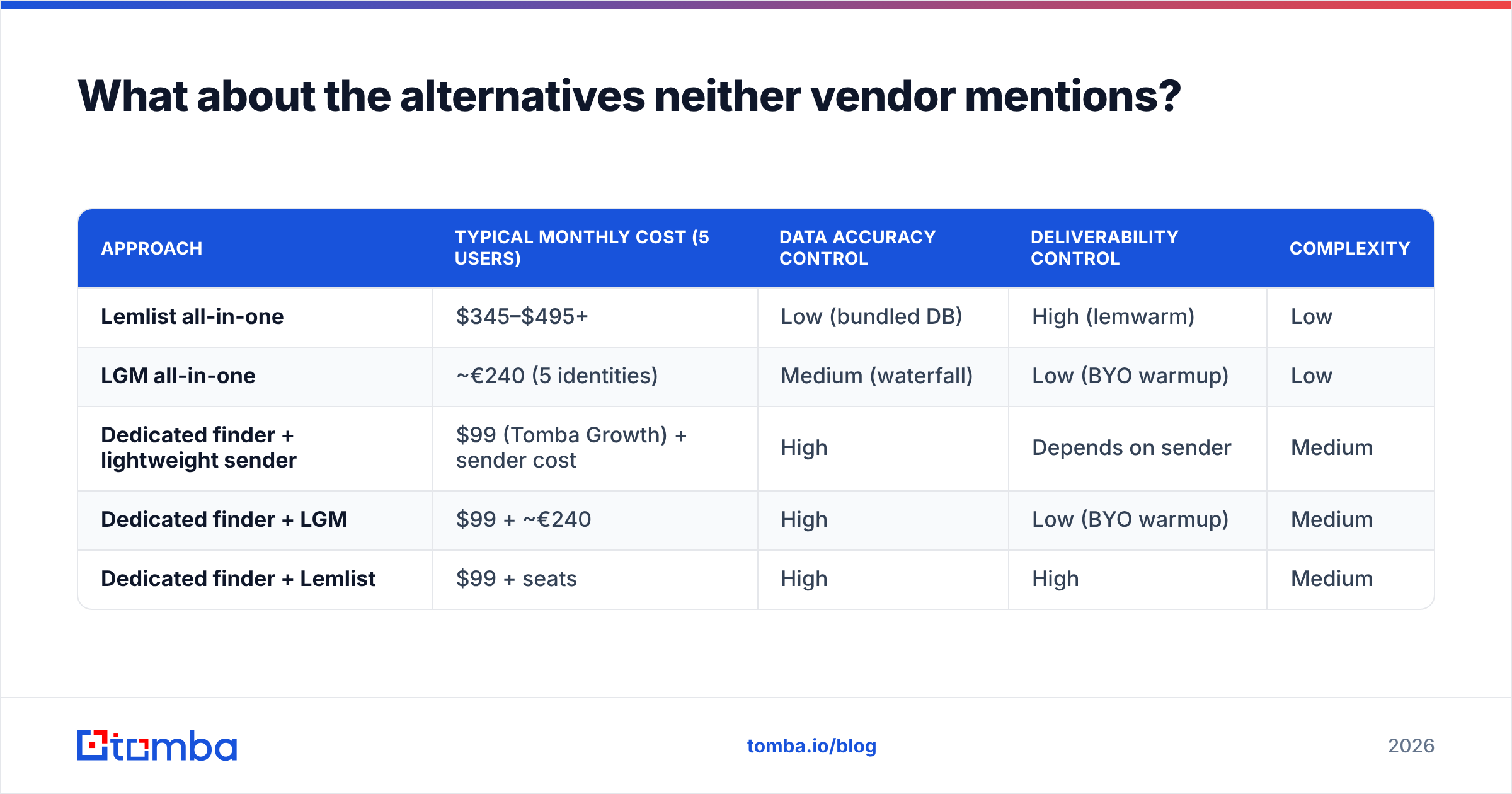
Both LGM and Lemlist are sequencers that added data. The alternative architecture is to buy data and sending separately, which is usually cheaper and always more accurate.
| Approach | Typical monthly cost (5 users) | Data accuracy control | Deliverability control | Complexity |
|---|---|---|---|---|
| Lemlist all-in-one | $345–$495+ | Low (bundled DB) | High (lemwarm) | Low |
| LGM all-in-one | ~€240 (5 identities) | Medium (waterfall) | Low (BYO warmup) | Low |
| Dedicated finder + lightweight sender | $99 (Tomba Growth) + sender cost | High | Depends on sender | Medium |
| Dedicated finder + LGM | $99 + ~€240 | High | Low (BYO warmup) | Medium |
| Dedicated finder + Lemlist | $99 + seats | High | High | Medium |
Two honest notes on this table. First, the split-stack approach costs you integration work — you are moving lists between systems, which is a Zapier integration or a Tomba API call rather than a single click. Second, if your team is two people sending 200 emails a month, the all-in-one convenience genuinely wins. Split stacks pay off above roughly 2,000 contacts per month.
It is also worth naming the peers in this space honestly. BookYourData is a solid option if what you want is a pay-as-you-go B2B list with a bounce guarantee rather than a subscription — a different purchase shape from either sequencer, and a reasonable one for teams that buy data in bursts. Instantly, Smartlead, and Saleshandy each compete on sending volume and price. None of them change the underlying rule: the sequencer is not your data provider.
Which should you actually buy?#
Short answer, by situation:
- Founder-led sales, LinkedIn-heavy, under 500 contacts/month: La Growth Machine. The conditional branching and voice notes matter more than warmup at this volume, and identity pricing fits a solo operator running multiple personas.
- Agency running outbound for clients: La Growth Machine, because identity-based billing lets you separate client personas without buying seats.
- SDR team sending 3,000+ emails/month: Lemlist. Warmup, inbox rotation, and deliverability tooling are the constraint at that volume, and Lemlist owns them.
- Deliverability already broken (bounces above 3%): Neither, yet. Fix the list first, then choose. The sequencer is not your problem.
- Budget-constrained and technical: Split stack. Dedicated data provider plus the cheapest sender you can tolerate.
The mistake to avoid is treating the sequencer purchase as a data purchase. Both tools will happily sell you a higher tier on the strength of a contact database that is not their core competency — and the bounces from that database will then degrade the deliverability you are also paying them to protect. That is a loop worth stepping out of.
Fix the data layer before you pick a sequencer#
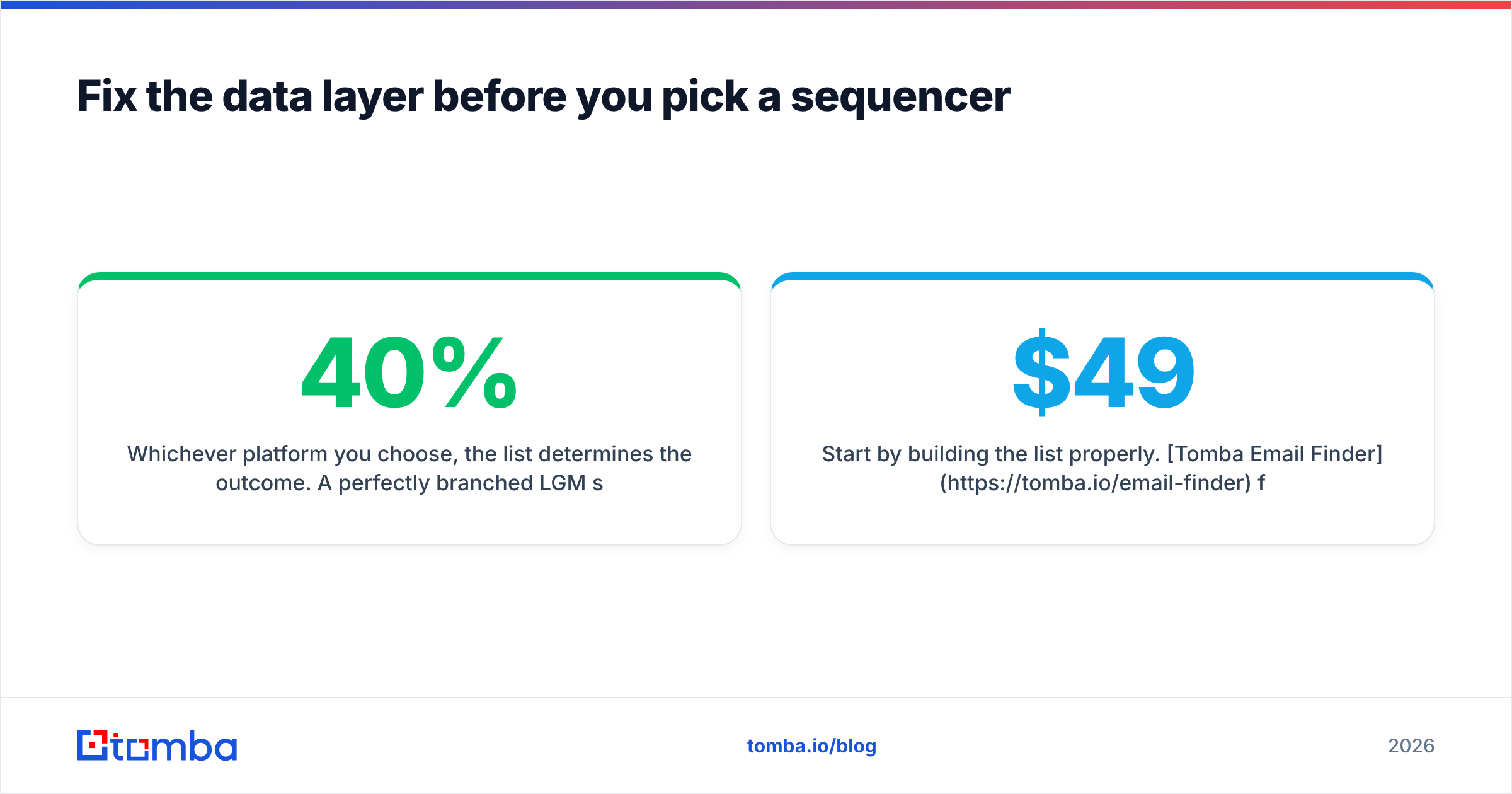
Whichever platform you choose, the list determines the outcome. A perfectly branched LGM sequence sent to 40% stale contacts loses to a plain three-step Lemlist campaign sent to a verified list — every time.
Start by building the list properly. Tomba Email Finder finds professional email addresses by domain, name, or company, with SMTP-level verification and confidence scoring before anything enters your sequencer. The free tier gives you 25 searches a month to test coverage on your own ICP; Starter is $49/mo and Growth is $99/mo when you are ready to scale. Push the verified output into La Growth Machine or Lemlist via the Tomba API, CSV, or a native integration — and let the sequencer do the one job it is actually good at.
Related guides#
// get started
Find, verify and enrich your first contacts today
Start on the free plan with 25 searches a month, then scale when your team is ready.
Free plan · No credit card required · GDPR & CCPA
// about the author