Labnify vs Salesbot: Which Outbound Tool Wins in 2026?
Labnify and Salesbot get compared constantly, but they solve different halves of the outbound problem. Here's an honest breakdown of sending infrastructure vs conversational automation — and which one your team actually needs first.
TL;DR
The short answer on Labnify vs Salesbot: they are not real substitutes.
- Labnify is sending infrastructure. It pushes high volumes of cold email out of your own domains and into inboxes.
- Salesbot is conversational automation. It drafts AI replies, qualifies leads, and routes them.
- If your email is not landing, Labnify is the relevant half. If replies sit unanswered, Salesbot is.
Two more things to weigh before you pay for either one.
- Neither tool fixes your data problem. Both assume your contact list is already clean. Feed either one a scraped CSV and you will burn domains.
- Budget for three line items, not one: data, sending, and a CRM or conversation layer. Small teams tend to over-buy the AI layer and under-invest in list quality.
What are Labnify and Salesbot, actually?#
Start with the category, not the feature list. That is where most buyers go wrong.
Labnify sits in the cold email infrastructure category. Its pitch is volume and control. You connect your own sending domains, rotate mailboxes, run warmup, and push out sequences. There is no per-seat price like the big sales engagement platforms charge.
Think of it as owning a delivery van fleet instead of paying a courier per parcel. You take on the route yourself. In exchange, your cost per send drops toward zero.
Salesbot sits in the conversational sales automation category. Its pitch is response handling. An AI layer reads inbound replies or site chats and answers routine questions. It scores intent, books meetings, and hands off to a human when the deal gets real. It is less "get the message out" and more "do not drop the ball when someone answers."
So why does Labnify vs Salesbot get searched at all? Both vendors sell the same outcome: more meetings, less manual work. But they work at opposite ends of the funnel. One is the megaphone. The other is the receptionist.
Here is a fast way to sanity-check any vendor in this space. Ask which of the three outbound layers it owns.
- Data layer — who to contact, whether the address is real, and what you know about them. Owned by tools like Tomba Email Finder, enrichment vendors, or a bought database.
- Sending layer — domains, mailboxes, warmup, throttling, sequence delivery. This is Labnify's home turf.
- Conversation layer — reply sorting, AI drafting, meeting booking, CRM sync. This is Salesbot's home turf.
Most "which tool is better" arguments fall apart right here. The two products do not compete for the same layer.

Labnify vs Salesbot: how do they compare head-to-head?#
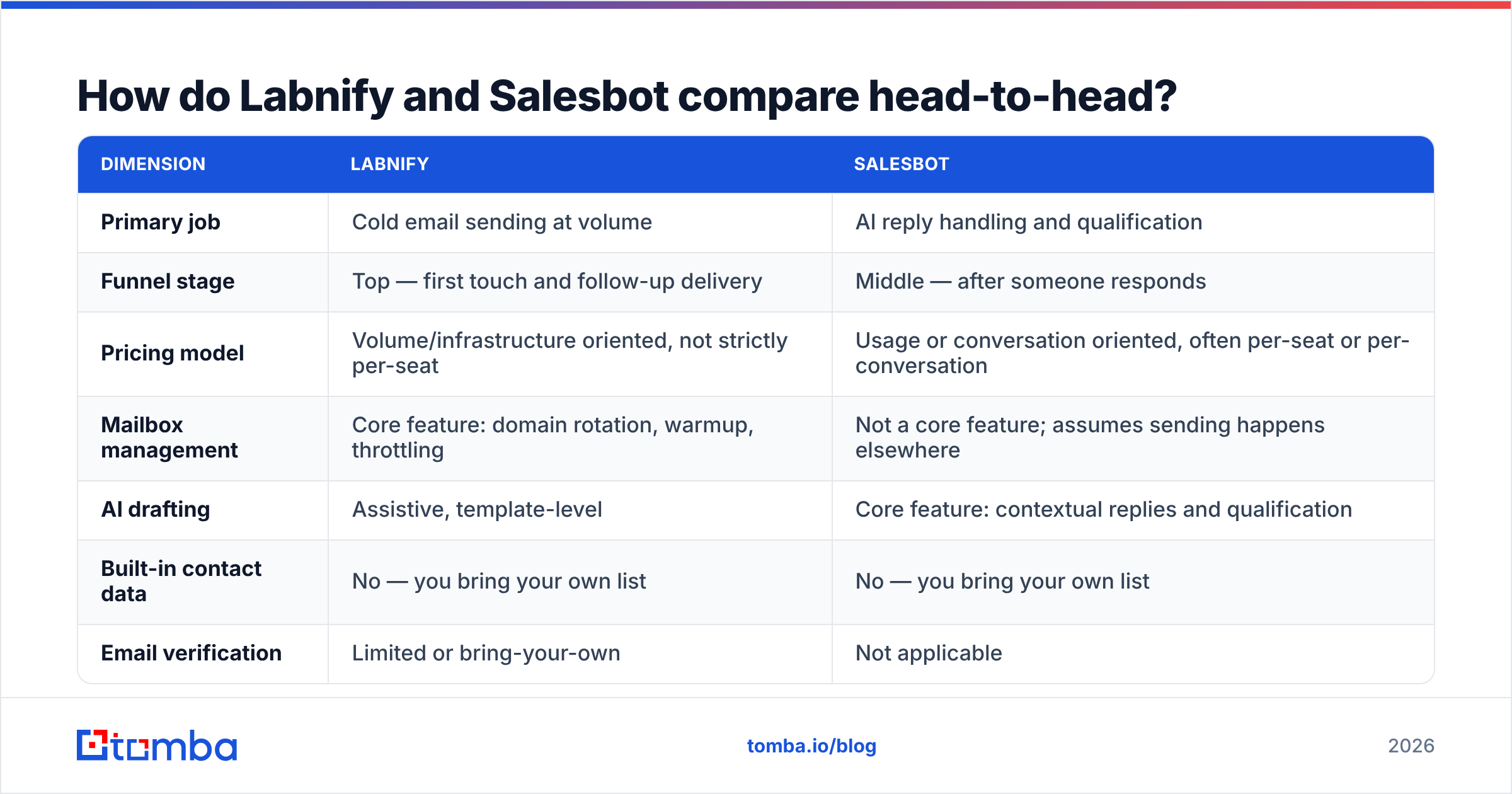
Here is the honest side-by-side. Vendor numbers change often, so check the pricing page before you commit. Pricing in this category moved twice in 2025 alone.
| Dimension | Labnify | Salesbot |
|---|---|---|
| Primary job | Cold email sending at volume | AI reply handling and qualification |
| Funnel stage | Top — first touch and follow-up delivery | Middle — after someone responds |
| Pricing model | Volume/infrastructure oriented, not strictly per-seat | Usage or conversation oriented, often per-seat or per-conversation |
| Mailbox management | Core feature: domain rotation, warmup, throttling | Not a core feature; assumes sending happens elsewhere |
| AI drafting | Assistive, template-level | Core feature: contextual replies and qualification |
| Built-in contact data | No — you bring your own list | No — you bring your own list |
| Email verification | Limited or bring-your-own | Not applicable |
| CRM sync | Typically via integration or API | Usually deeper, since conversations must land in the CRM |
| Best for | Agencies, lead-gen shops, high-volume SDR teams | Inbound-heavy teams, SMB sales, support-adjacent sales |
| Biggest risk | Volume without list quality destroys domains | Automating replies to leads you never qualified |
Notice the two rows that match. Neither product gives you contacts. Neither one promises the addresses you import will land. That is not a knock on either vendor. It is how the category is built. Both types of platform assume the data layer is already solved.
Which problem do you actually have?#
Every Labnify vs Salesbot decision starts with your bottleneck, not a feature grid. Ask these four questions, in order.
- Are you sending enough? Fewer than a few hundred targeted emails a week, with thin pipeline, means volume is the constraint. Infrastructure tooling like Labnify fixes that.
- Are the sends landing? Open rates under 20% on a cold list usually point to placement, not copy. Check SPF, DKIM, DMARC alignment, and domain age first. Our email deliverability primer covers the failure modes.
- Are replies handled fast? If your median first reply takes days, an AI layer pays for itself quickly. Speed drives conversion, as HubSpot's sales data has shown for years.
- Is the list any good? A bounce rate above 3% means the data layer is broken. Neither tool will save you.
Now match your answer to a purchase. Volume problems point to Labnify. Slow replies point to Salesbot. A bad list means neither purchase is urgent yet.
Is Labnify worth it for high-volume outbound?#
For sending a lot of cold email from infrastructure you control, yes — with caveats.
What works well: cost stops tracking seat count. A three-person agency runs campaigns for eight clients. It should not pay per-seat rates built for a 60-rep enterprise team. Infrastructure pricing fixes that mismatch. Mailbox rotation, per-domain throttling, and built-in warmup also remove real busywork. Anyone who has hand-managed 40 Google Workspace mailboxes across six domains knows the spreadsheet involved.
What to watch: these tools give you enough rope to hang yourself. When sending is cheap, the urge is to send more rather than send better. The Simple Mail Transfer Protocol does not care about your quota. Mailbox providers score you on engagement and complaints. Those scores build up per domain over weeks. Push 10,000 daily sends to an unverified list and you will burn your root domain.
The practical guardrail is simple. Keep hard bounces under 2%. Ramp new domains over three to four weeks. Run every import through an email verifier before the first send. Volume tooling multiplies whatever quality you feed it, in both directions.
Is Salesbot worth it for reply automation?#
For teams buried in replies, an AI conversation layer is an easy ROI case. Two conditions have to hold.
Condition one: you have enough conversation volume. Automating twelve replies a week solves nothing. A rep handles that in twenty minutes. The math changes around a few hundred conversations a month. That is where speed and consistency beat human bandwidth.
Condition two: the replies are worth automating. AI qualification works when your ICP is clear and the questions are stable: team size, current tool, timeline. It works badly when every deal is custom and the first reply needs judgment. High contract value with few deals still favors human handling.
One limit applies to every product in this category, Salesbot included. Reply handling sits downstream of targeting. It can qualify a lead fast. It cannot turn a badly targeted lead into a good one. Bad conversations just get processed sooner.

What does neither tool give you?#
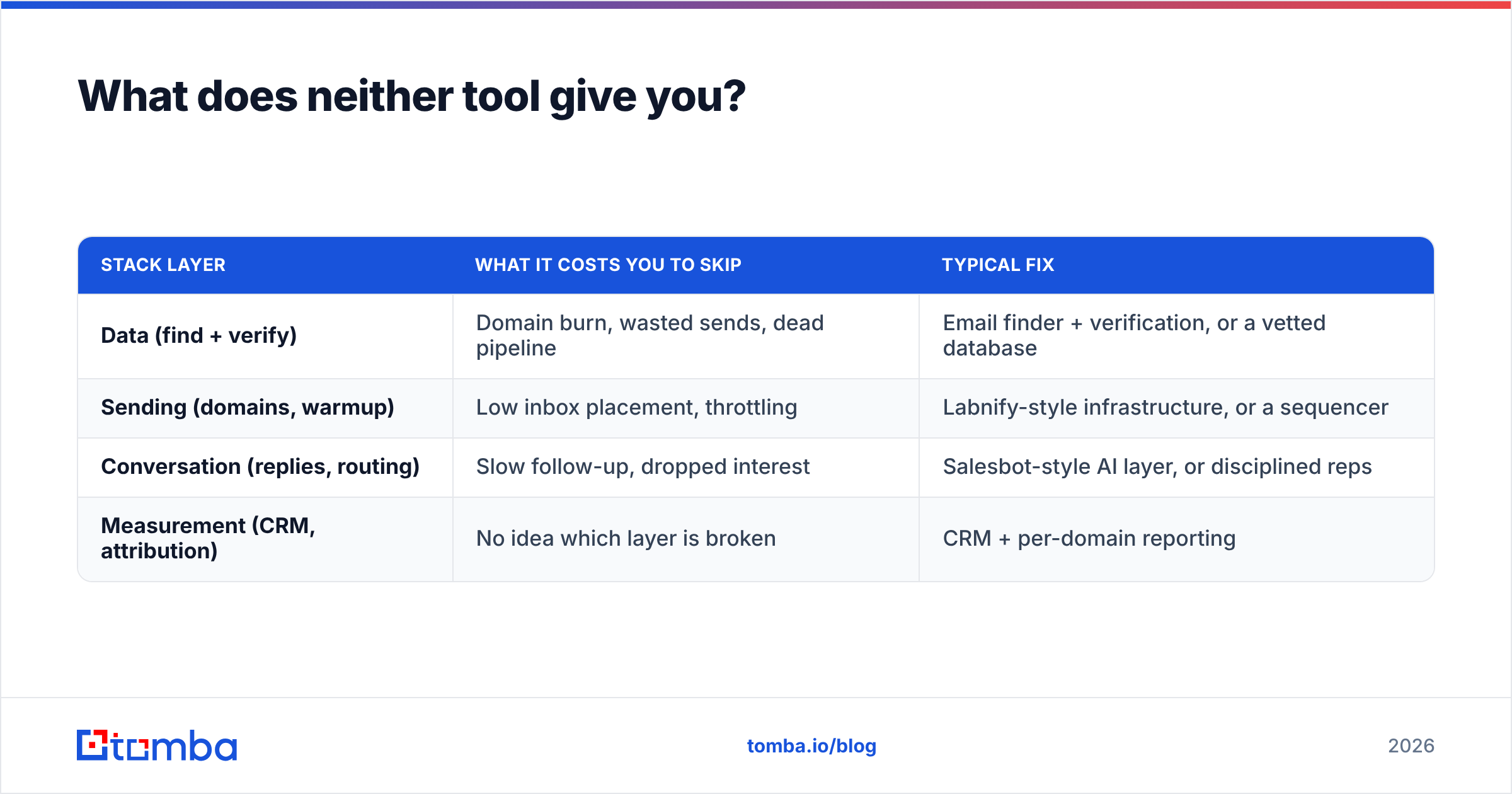
The Labnify vs Salesbot debate skips the layer that matters most: the contact data. That layer decides whether the other two are worth paying for.
Run the arithmetic. Say you buy sending infrastructure and push 20,000 emails a month. On an unverified list at a 12% bounce rate, that is 2,400 hard bounces. Providers throttle you long before the month ends. Delivered volume collapses, and reply volume collapses with it. The conversation layer you also bought has nothing to process. You paid for two tools and got the output of neither.
Now run it with a verified list at a 1.5% bounce rate. Same spend, same platform. Roughly 10% more messages reach real people, and your domain reputation survives into month two.
That is why the data layer is not a nice-to-have. It is the multiplier on everything else.
| Stack layer | What it costs you to skip | Typical fix |
|---|---|---|
| Data (find + verify) | Domain burn, wasted sends, dead pipeline | Email finder + verification, or a vetted database |
| Sending (domains, warmup) | Low inbox placement, throttling | Labnify-style infrastructure, or a sequencer |
| Conversation (replies, routing) | Slow follow-up, dropped interest | Salesbot-style AI layer, or disciplined reps |
| Measurement (CRM, attribution) | No idea which layer is broken | CRM + per-domain reporting |
Some teams prefer to buy lists outright rather than build them. BookYourData is a solid option in the prepackaged B2B contact space. Search-and-verify tends to win when your ICP is narrow and you target named accounts. A prepackaged database wins when you need breadth fast.
Review sites like G2 help you sanity-check vendor claims. Read the review dates, though. This category churns quickly, and a 2023 review may describe a product that no longer exists.
How should you sequence the purchase?#
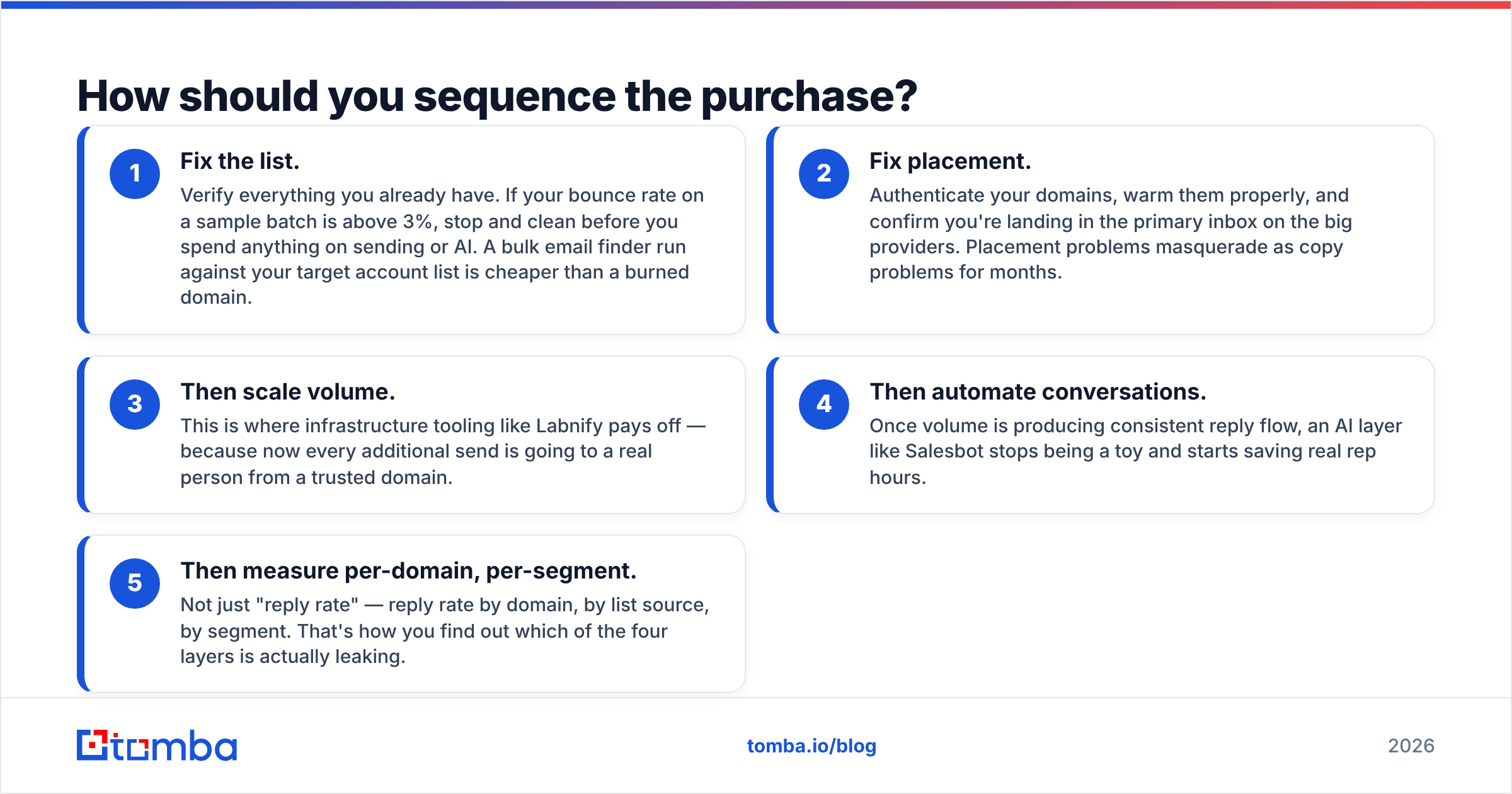
Most Labnify vs Salesbot buyers get the order wrong. Buy in these steps, and move on only when the current one is measurably working.
- Fix the list. Verify what you already have. If a sample batch bounces above 3%, clean it first. A bulk email finder run costs less than a burned domain.
- Fix placement. Authenticate your domains and warm them properly. Confirm you land in the primary inbox. Placement problems look like copy problems for months.
- Then scale volume. This is where Labnify pays off. Every extra send goes to a real person from a trusted domain.
- Then automate conversations. Steady reply flow makes an AI layer like Salesbot worth its price.
- Then measure per domain and per segment. Not just reply rate, but reply rate by domain, by list source, by segment.
Teams that follow this order spend less and reach predictable pipeline sooner. Teams that start at step 4 buy the AI and hope it fixes outbound. They usually churn within two quarters.
Labnify vs Salesbot: so which one wins?#
It depends on your bottleneck. For most teams, the honest answer is "neither, yet."
- Pick Labnify if you are an agency, lead-gen shop, or high-volume SDR team. Your constraint is sending capacity and per-seat cost. You still have to bring list hygiene yourself.
- Pick Salesbot if you have real conversation volume and a clear ICP. Follow-up speed is visibly costing you deals. You still need an upstream source of those conversations.
- Pick both only at high volume with replies that overwhelm your reps. That is a real scenario at scale, but not a starting setup.
- Pick neither yet if your bounce rate is above 3%. Fix the data, then revisit in 60 days.
The comparison that predicts outbound results is not Labnify vs Salesbot. It is verified data vs assumed data. That gap is worth more than any feature difference between the two platforms.
Start where the leverage is#
Before you add a sending platform or an AI layer, make sure the contacts underneath are real. Tomba Email Finder finds professional email addresses by domain, name, or company. It validates them before they reach your sequencer. Your infrastructure then carries real messages to real people instead of grinding down your domain reputation.
The free tier gives you 25 searches a month. Test it against your own known-good contacts. Paid plans start at $49/month on Starter, $99/month on Growth, and $249/month on Pro. See the full Tomba pricing breakdown, run a sample of your list, and compare the bounce rate to what you get today. If the gap is meaningful, you just found the cheapest fix in your stack.
Related guides#
// get started
Find, verify and enrich your first contacts today
Start on the free plan with 25 searches a month, then scale when your team is ready.
Free plan · No credit card required · GDPR & CCPA
Get the Tomba newsletter
Product and data updates
// about the author