Labnify vs ZoomInfo: Full 2026 Comparison and Verdict
Labnify sends email at volume. ZoomInfo sells the contact data. They are not the same product, and most teams buying one actually need the other. Here is the honest breakdown, with pricing, data quality, and a clear pick per team size.
TL;DR
- Labnify and ZoomInfo are not competitors in the strict sense. Labnify is cold email sending infrastructure; ZoomInfo is a B2B contact and intent database. One moves messages, the other supplies the people to message.
- If your problem is "my emails land in spam" or "I need to send 20,000 messages a month across many inboxes," Labnify is the relevant category. If your problem is "I don't know who to contact," ZoomInfo is the relevant category.
- ZoomInfo is quote-based and annual. Buyer reports on G2 and procurement marketplaces consistently put entry contracts in the five figures per year, with seat minimums and export credit caps. Labnify sells self-serve monthly plans at a fraction of that.
- Most small and mid-market teams over-buy on the data side and under-invest on the sending side. A focused email finder plus a verifier typically covers 80% of what an SMB actually used ZoomInfo for, at under $100/month.
- Our pick: pair a self-serve data layer (Tomba at $49/mo) with a sending layer you control. Only buy ZoomInfo when you need intent signals, org charts, and CRM-native workflows at enterprise scale.
What are Labnify and ZoomInfo, actually?#
Think of outbound like a restaurant. ZoomInfo is the supplier who delivers the ingredients: names, titles, emails, phone numbers, firmographics, buying-intent signals. Labnify is the kitchen and the delivery fleet: it takes what you wrote and gets it in front of people without the food arriving cold, or in this case, in the spam folder.
Labnify positions itself as an email sending and cold outreach platform. Its pitch is volume plus deliverability: multi-inbox rotation, warmup, SMTP/API sending, sequence automation, and reply handling. It competes with Instantly, Smartlead, and Saleshandy far more directly than it competes with any data vendor.
ZoomInfo is the incumbent B2B data platform. Its product surface is enormous: contact and company records, technographics, intent data via Bidstream and Website Visitor tracking, conversation intelligence (Chorus), and a sales engagement layer (ZoomInfo Engage / Copilot). Sending email is a feature bolted onto a data platform, not the core promise.
So the honest framing of "Labnify vs ZoomInfo" is this: you are comparing a sending engine to a data warehouse. They overlap in exactly one narrow strip — both can technically fire a sequence — and they are wildly different everywhere else.
How do Labnify and ZoomInfo compare head to head?#
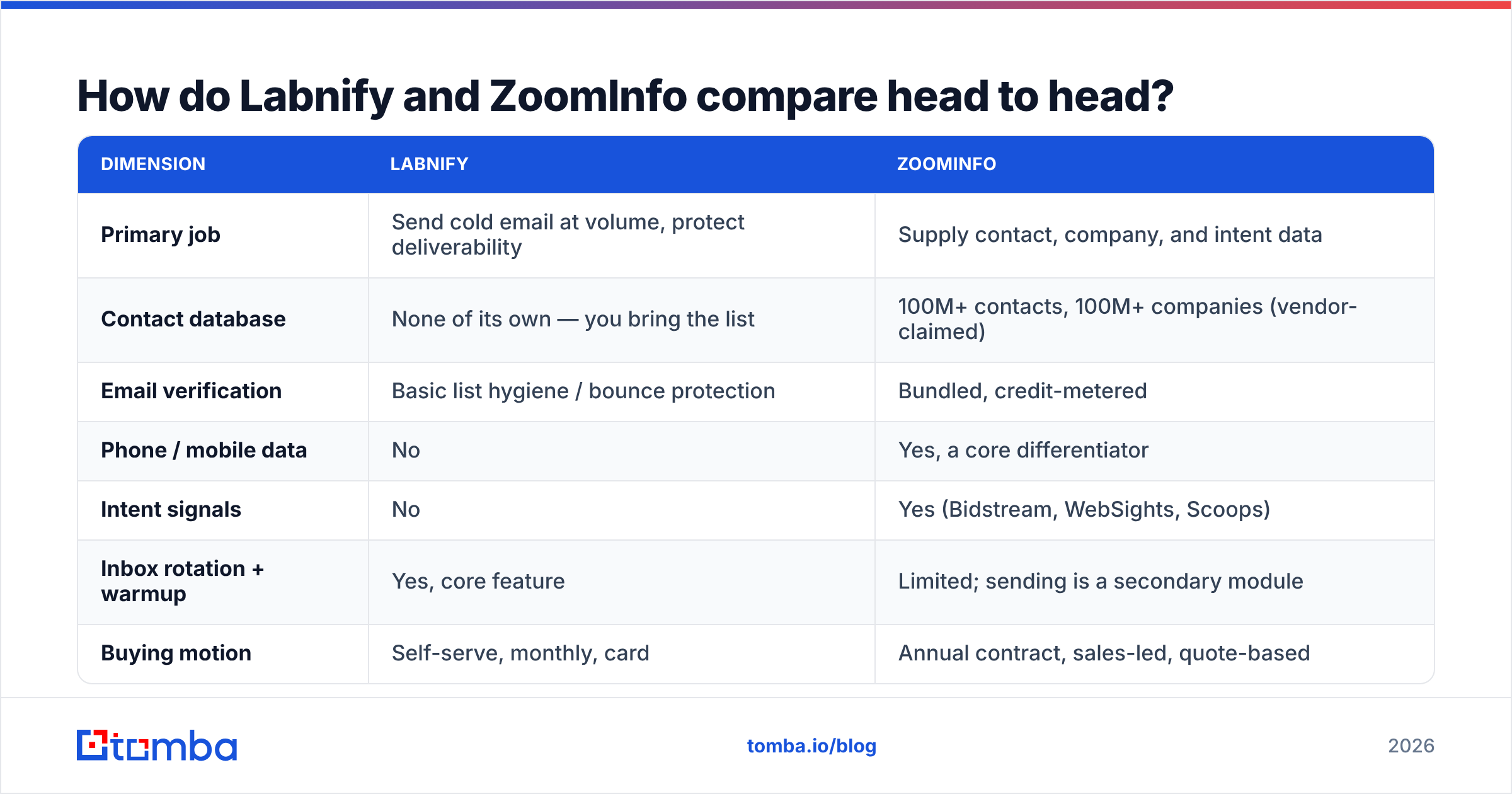
| Dimension | Labnify | ZoomInfo |
|---|---|---|
| Primary job | Send cold email at volume, protect deliverability | Supply contact, company, and intent data |
| Contact database | None of its own — you bring the list | 100M+ contacts, 100M+ companies (vendor-claimed) |
| Email verification | Basic list hygiene / bounce protection | Bundled, credit-metered |
| Phone / mobile data | No | Yes, a core differentiator |
| Intent signals | No | Yes (Bidstream, WebSights, Scoops) |
| Inbox rotation + warmup | Yes, core feature | Limited; sending is a secondary module |
| Buying motion | Self-serve, monthly, card | Annual contract, sales-led, quote-based |
| Typical entry cost | Tens of dollars per month | Five figures per year (buyer-reported) |
| Contract flexibility | Cancel monthly | 12-month minimum, seat-based, auto-renew clauses common |
| Best fit | Agencies, founders, lean SDR teams | Enterprise RevOps with CRM and intent needs |
| Weak spot | You still need a data source | Cost, procurement drag, credit ceilings |
The table makes the decision easier than most vendor pages do. If two of the rows you care most about are "contact database" and "phone data," Labnify is not on your shortlist at all. If the rows you care about are "inbox rotation" and "monthly cancel," ZoomInfo is not on your shortlist.

Which problem are you actually trying to solve?#
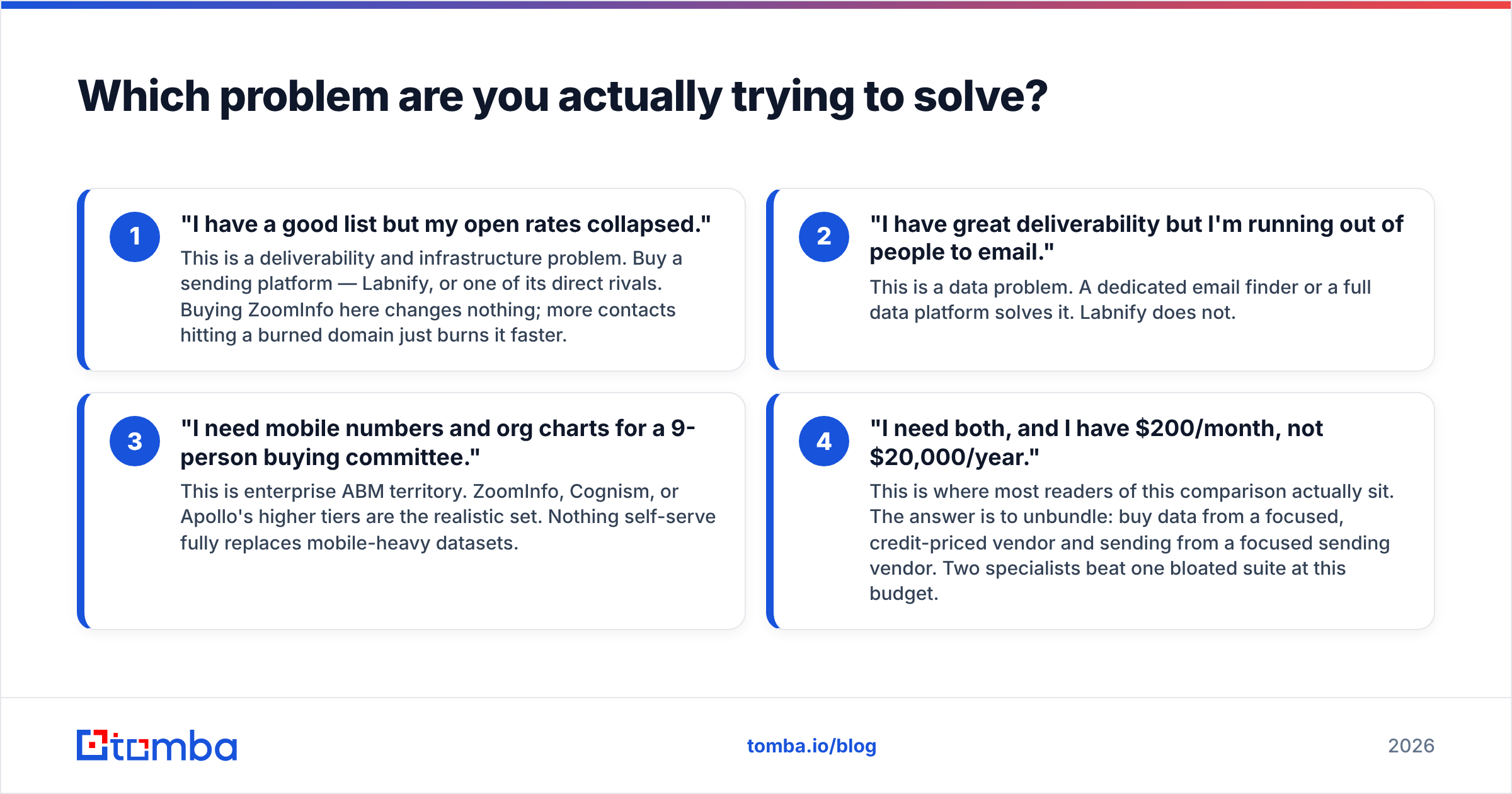
Before comparing feature grids, sort yourself into one of these four buckets. The right answer falls out immediately.
- "I have a good list but my open rates collapsed." This is a deliverability and infrastructure problem. Buy a sending platform — Labnify, or one of its direct rivals. Buying ZoomInfo here changes nothing; more contacts hitting a burned domain just burns it faster.
- "I have great deliverability but I'm running out of people to email." This is a data problem. A dedicated email finder or a full data platform solves it. Labnify does not.
- "I need mobile numbers and org charts for a 9-person buying committee." This is enterprise ABM territory. ZoomInfo, Cognism, or Apollo's higher tiers are the realistic set. Nothing self-serve fully replaces mobile-heavy datasets.
- "I need both, and I have $200/month, not $20,000/year." This is where most readers of this comparison actually sit. The answer is to unbundle: buy data from a focused, credit-priced vendor and sending from a focused sending vendor. Two specialists beat one bloated suite at this budget.
Bucket four is the interesting one, and it is where the "Labnify vs ZoomInfo" question usually comes from. The searcher is not really choosing between them — they are trying to assemble a stack without signing an enterprise contract.
Is ZoomInfo worth the price in 2026?#
Short answer: yes for a specific profile, no for everyone else.
ZoomInfo does not publish list pricing. What buyers report on G2 and public procurement marketplaces is remarkably consistent: entry packages starting around the mid five figures annually once you add seats and credits, with the Copilot and intent modules pushing it higher. Renewal increases are a recurring theme in reviews, as are export credit limits that feel generous in the demo and tight in month four.
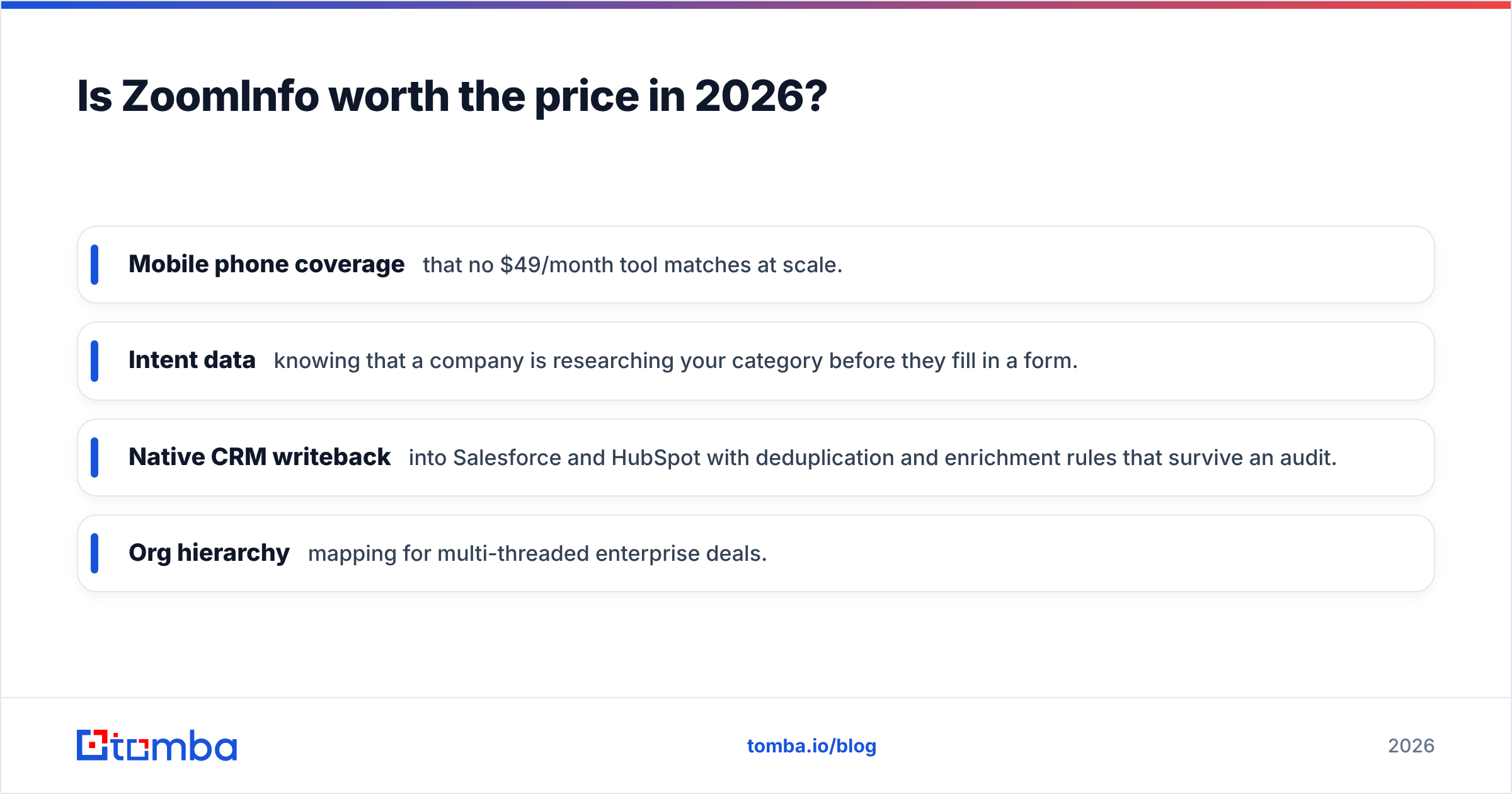
What you get for that is genuinely hard to replicate:
- Mobile phone coverage that no $49/month tool matches at scale.
- Intent data — knowing that a company is researching your category before they fill in a form.
- Native CRM writeback into Salesforce and HubSpot with deduplication and enrichment rules that survive an audit.
- Org hierarchy mapping for multi-threaded enterprise deals.
If you run a 40-person sales org selling six-figure deals, that bundle pays for itself on one closed contract. If you run a 4-person team selling a $500/month product, you are financing features you will never open. The credit ceiling problem is real too: teams routinely hit export caps mid-quarter and discover that more data means another conversation with an account executive.
One underrated cost is procurement time. A ZoomInfo cycle — demo, security review, legal, finance — commonly runs six to ten weeks. A self-serve tool runs six to ten minutes. For a team testing whether outbound works at all, that difference matters more than any feature.
Can Labnify replace ZoomInfo?#
No, and Labnify does not claim it can. This is worth saying plainly because search intent around "Labnify vs ZoomInfo" implies substitutability that doesn't exist.
Labnify replaces the sending half of ZoomInfo Engage. It does not replace the database. If you cancel ZoomInfo and buy Labnify, you will have an excellent delivery pipeline and nothing to put in it.
What Labnify does well, and what ZoomInfo's sending module does not do well:
- Inbox rotation across dozens of sending accounts, so no single mailbox carries the whole volume.
- Automated warmup that ramps new domains instead of blasting from day one.
- Per-domain and per-inbox deliverability telemetry, rather than a single aggregate open rate.
- Monthly pricing that scales with sending volume instead of seats.
That last point matters more than it sounds. ZoomInfo's seat-based model punishes you for adding a junior SDR. Volume-based sending tools punish you only for sending more, which is the thing that actually generates pipeline.
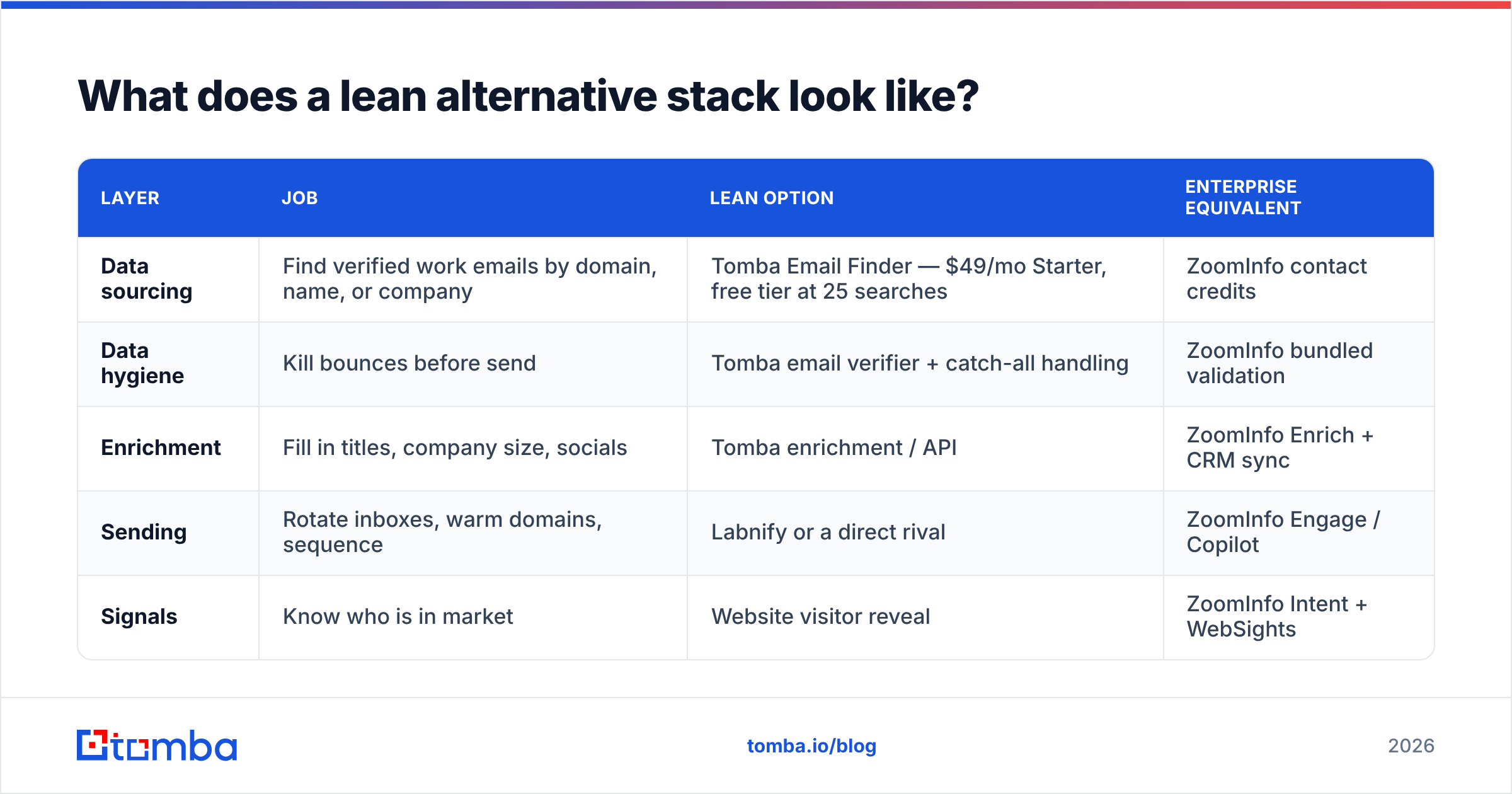
What does a lean alternative stack look like?#
Here is the configuration we see working repeatedly for teams under 25 people. It is deliberately unbundled.
| Layer | Job | Lean option | Enterprise equivalent |
|---|---|---|---|
| Data sourcing | Find verified work emails by domain, name, or company | Tomba Email Finder — $49/mo Starter, free tier at 25 searches | ZoomInfo contact credits |
| Data hygiene | Kill bounces before send | Tomba email verifier + catch-all handling | ZoomInfo bundled validation |
| Enrichment | Fill in titles, company size, socials | Tomba enrichment / API | ZoomInfo Enrich + CRM sync |
| Sending | Rotate inboxes, warm domains, sequence | Labnify or a direct rival | ZoomInfo Engage / Copilot |
| Signals | Know who is in market | Website visitor reveal | ZoomInfo Intent + WebSights |
Costed out, that stack lands between roughly $100 and $250 per month depending on volume. The enterprise column lands north of $2,000 per month. The gap is not fraud — you genuinely lose intent depth and mobile coverage — but for a team whose ICP is "SaaS companies, 50–500 employees, in North America," the lean stack finds the same humans.
The critical dependency is verification. Cheap data with a 12% bounce rate is not cheap; it costs you the domain. Run every list through an email verifier before it touches a sending platform, and treat catch-all domains as a separate risk bucket rather than lumping them in with valid addresses.

How accurate is the data you get from each path?#
Accuracy is where the "expensive equals better" assumption deserves scrutiny.
ZoomInfo's advantage is breadth and freshness on large, well-covered companies, plus a contributory network that refreshes records. Its weak spots, consistently reported by users, are smaller companies, non-US regions, and job-change lag — records that were correct nine months ago and quietly are not now.
Self-serve finders work differently. Instead of serving a pre-built record, they resolve a pattern against a domain in real time and verify it at request time. That approach tends to win on freshness for SMB targets and lose on exotic data types like direct dials.
Three practical rules regardless of which path you pick:
- Judge on verified deliverable rate, not database size. "100M contacts" is a marketing number. "94% of what I exported did not bounce" is an operational one.
- Re-verify anything older than 60 days. Job change velocity in B2B roles makes stored data decay fast.
- Test on your actual ICP, not the vendor's demo list. Run 100 of your own target accounts through a trial. Coverage on Fortune 500 logos tells you nothing about coverage on 80-person agencies in Manchester.
If you want to run that test cheaply, a domain search across 20 of your real target accounts takes about ten minutes and tells you more than a 45-minute demo.
Which should you choose in 2026?#
Choose ZoomInfo if: you have enterprise deal sizes, a RevOps function to maintain the integration, a genuine need for intent data and mobile numbers, and a budget line that already absorbs five figures annually. Its value is real at that altitude, and no unbundled stack fully substitutes for intent plus org charts.
Choose Labnify if: your bottleneck is delivery, not discovery. You already have a list source, you send high volume across multiple domains, and you want monthly terms. Just don't expect it to fill your list.
Choose an unbundled stack if: you are a founder, agency, or lean SDR team. Buy sending from a sending specialist and data from a data specialist, keep both on monthly terms, and revisit in a year when your volume justifies a platform. You will spend roughly a tenth as much and keep the ability to swap either layer without a legal review.
The failure mode to avoid is the middle: paying enterprise prices for a suite while using 10% of it, or paying for great sending infrastructure with no data engine behind it. Both leave pipeline on the table.
Start with the data layer, cheaply#
If you landed here trying to decide between Labnify and ZoomInfo, the most likely truth is that you need a data source first and a sending platform second — and you don't need to sign an annual contract to get either.
Run your real target accounts through the Tomba Email Finder. The free tier gives you 25 searches to test coverage on your own ICP before paying anything, Starter is $49/mo, and Growth is $99/mo with no annual commitment and no seat minimums. Verification, catch-all checks, domain search, and the API are all on the same account, so the output plugs straight into whichever sending platform you settle on. Check the full Tomba pricing breakdown, or pull a hundred contacts today and see what your actual deliverable rate looks like before anyone asks you for a purchase order.
Related guides#
Ready to find emails that actually work?
Join 150,000+ professionals who stopped guessing and started sending. Free credits on signup — no credit card required.
Get the Tomba newsletter
Practical outbound tactics and product updates — once every two weeks.
About the author