Lace Alternatives: 7 Revenue Intelligence Tools for 2026
Lace turns inbound calls into revenue attribution — but it is not the only option, and it does not fill your pipeline. Here are seven Lace alternatives compared on scope, pricing transparency, and the jobs they actually do well.
TL;DR
- Lace (lace.ai) is AI revenue-intelligence software that listens to inbound calls, ties them back to marketing spend, and flags revenue you lost on calls that never got booked. It is strongest for home-services and other call-heavy, local-demand businesses.
- Most people searching for Lace alternatives want one of three different things: cheaper call tracking, deeper conversation coaching, or a way to create demand instead of just measuring it.
- Call-tracking platforms (CallRail, Invoca) compete on attribution. Conversation-intelligence platforms (Gong, Balto, Avoma) compete on coaching. They are not interchangeable.
- If your real problem is "not enough calls coming in," no Lace alternative in the call-analytics category fixes that — outbound contact data does.
- Pricing transparency is the fastest filter: CallRail, Avoma, and Tomba publish numbers. Lace, Invoca, Balto, and Gong route you to a demo.
What is Lace and what does it actually do?#
Lace is an AI layer on top of your inbound phone calls. It transcribes and scores every call, connects the outcome back to the ad, campaign, or channel that produced it, and surfaces the calls where a booking was clearly on the table and nobody closed it. The company raised a $14M round in 2025 and is led by an ex-Meta engineer, which shows in the product's centre of gravity: it thinks like an ad-attribution system that happens to speak English, not like a CRM.
The typical Lace customer is a home-services operator — HVAC, plumbing, electrical, pest control, roofing — spending real money on local demand generation and losing a meaningful slice of it at the front desk. For that profile, the pitch is sharp: you already bought the call, so stop leaking it.
That framing matters, because it explains why "Lace alternatives" is such a messy search. Half the tools people compare it to solve attribution. The other half solve conversation quality. And a third group, which rarely shows up in these listicles, solves the problem sitting underneath both: not enough qualified conversations in the first place.
Why do teams look for Lace alternatives?#
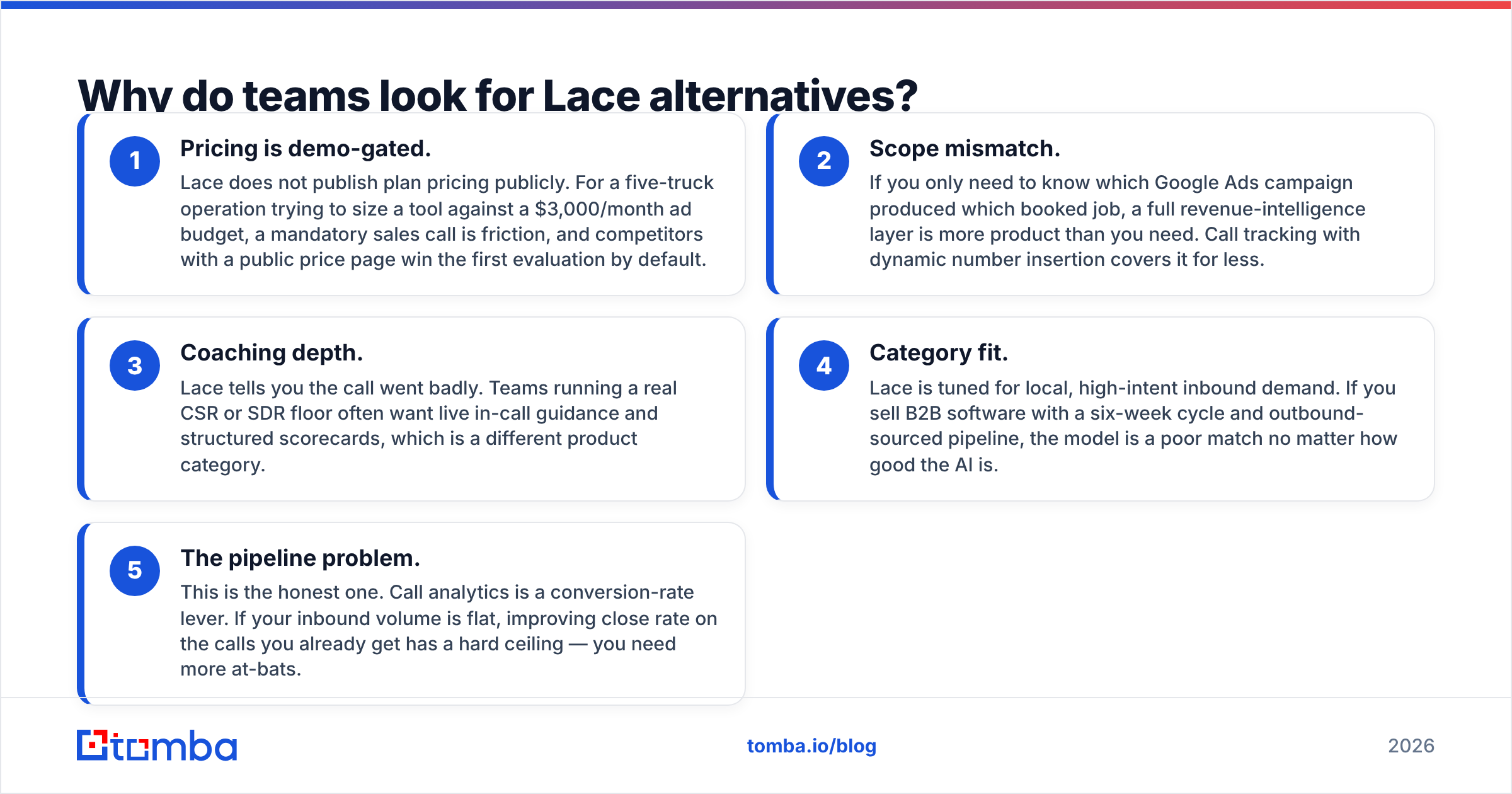
Four reasons come up repeatedly when operators start shopping around.
- Pricing is demo-gated. Lace does not publish plan pricing publicly. For a five-truck operation trying to size a tool against a $3,000/month ad budget, a mandatory sales call is friction, and competitors with a public price page win the first evaluation by default.
- Scope mismatch. If you only need to know which Google Ads campaign produced which booked job, a full revenue-intelligence layer is more product than you need. Call tracking with dynamic number insertion covers it for less.
- Coaching depth. Lace tells you the call went badly. Teams running a real CSR or SDR floor often want live in-call guidance and structured scorecards, which is a different product category.
- Category fit. Lace is tuned for local, high-intent inbound demand. If you sell B2B software with a six-week cycle and outbound-sourced pipeline, the model is a poor match no matter how good the AI is.
- The pipeline problem. This is the honest one. Call analytics is a conversion-rate lever. If your inbound volume is flat, improving close rate on the calls you already get has a hard ceiling — you need more at-bats.
What should you compare Lace alternatives on?#
Score every option on the same five axes before you look at a single demo.
- Job to be done — Attribution (which spend made money?), coaching (how do reps get better?), or sourcing (where do new conversations come from?). Buying the wrong category is the most expensive mistake here, not overpaying inside the right one.
- Pricing transparency — Published per-seat or per-plan pricing lets you model cost against pipeline before you spend an hour on a call. Quote-only vendors are not automatically worse, but budget cycles are.
- Data ownership and export — Can you pull transcripts, outcomes, and contact records out cleanly, or is the insight trapped behind a dashboard? Check the API before you sign.
- Integration surface — Your CRM, field-service software, and ad platforms all need to line up, or attribution becomes a manual reconciliation job.
- Time to first signal — Some tools need 60–90 days of call volume to say anything useful. Others produce a usable list in an afternoon. Match that to how fast you need a decision.
How do the 7 best Lace alternatives compare?#
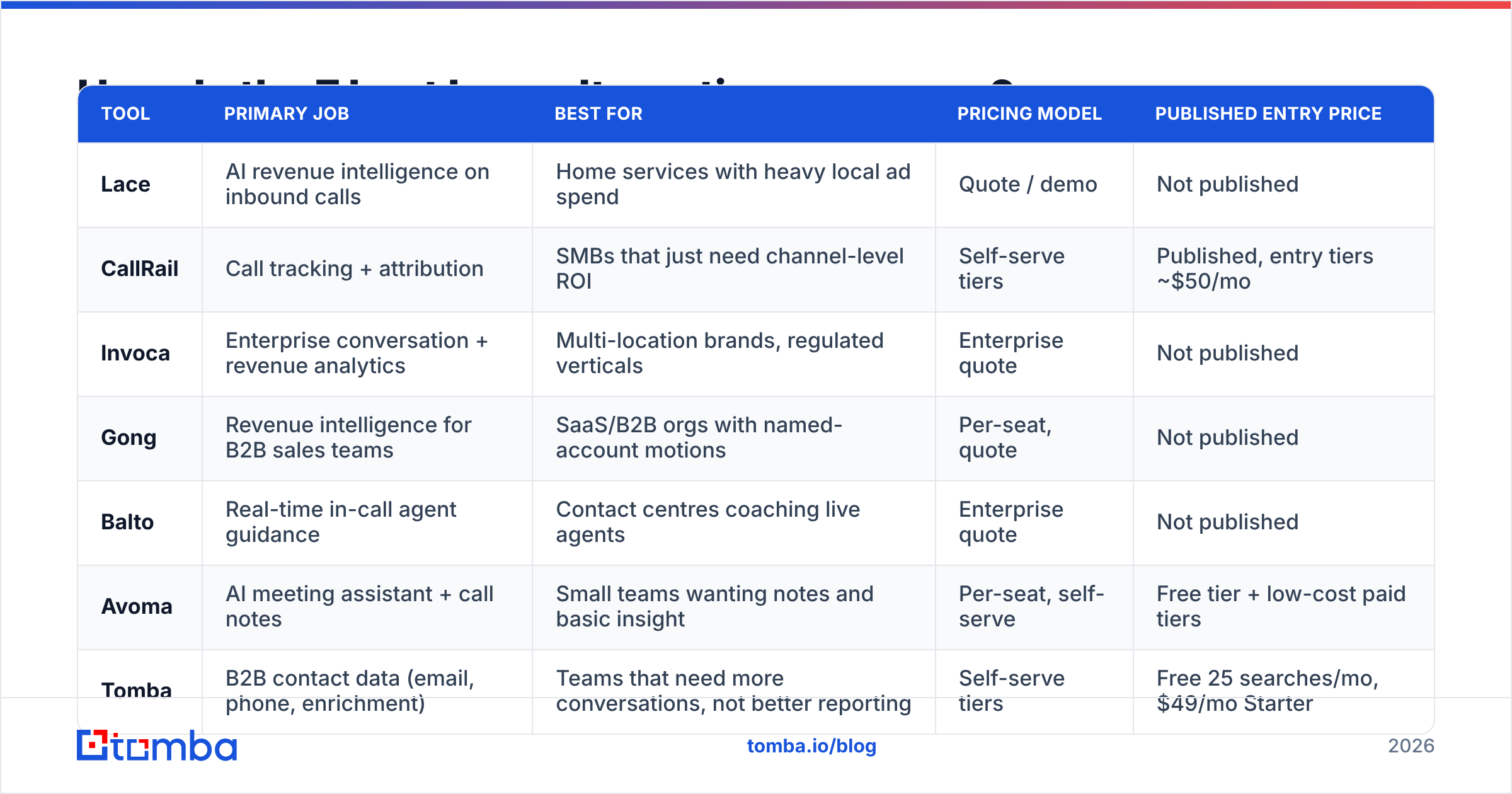
| Tool | Primary job | Best for | Pricing model | Published entry price |
|---|---|---|---|---|
| Lace | AI revenue intelligence on inbound calls | Home services with heavy local ad spend | Quote / demo | Not published |
| CallRail | Call tracking + attribution | SMBs that just need channel-level ROI | Self-serve tiers | Published, entry tiers ~$50/mo |
| Invoca | Enterprise conversation + revenue analytics | Multi-location brands, regulated verticals | Enterprise quote | Not published |
| Gong | Revenue intelligence for B2B sales teams | SaaS/B2B orgs with named-account motions | Per-seat, quote | Not published |
| Balto | Real-time in-call agent guidance | Contact centres coaching live agents | Enterprise quote | Not published |
| Avoma | AI meeting assistant + call notes | Small teams wanting notes and basic insight | Per-seat, self-serve | Free tier + low-cost paid tiers |
| Tomba | B2B contact data (email, phone, enrichment) | Teams that need more conversations, not better reporting | Self-serve tiers | Free 25 searches/mo, $49/mo Starter |
Two notes on reading that table honestly. First, Tomba is not a competitor to Lace in the literal sense — it does not analyse calls. It is on the list because a large share of people searching for Lace alternatives describe a demand problem and get sold a measurement product. Second, "not published" is a data point about sales motion, not product quality. Gong and Invoca are excellent at what they do; they are simply built for buyers with procurement processes.
CallRail — the budget attribution swap#
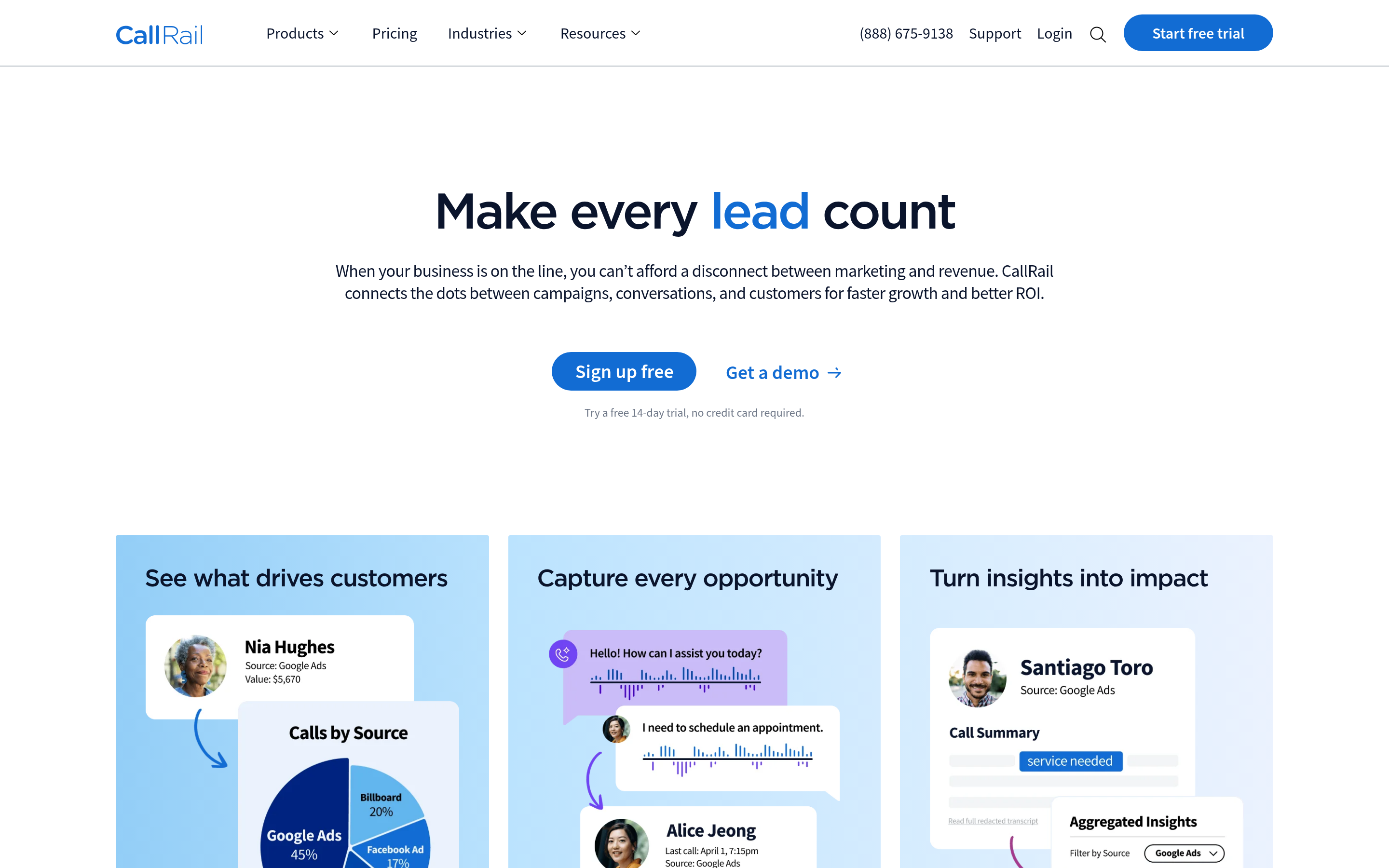
If your entire use case is "which campaign produced this booked job," CallRail covers it with dynamic number insertion, recordings, and campaign-level reporting at a self-serve price. You lose Lace's deeper revenue scoring and its opinionated "missed opportunity" detection. For a single-location operator spending under $10k/month on ads, that trade is usually correct.
Invoca — the enterprise upgrade#
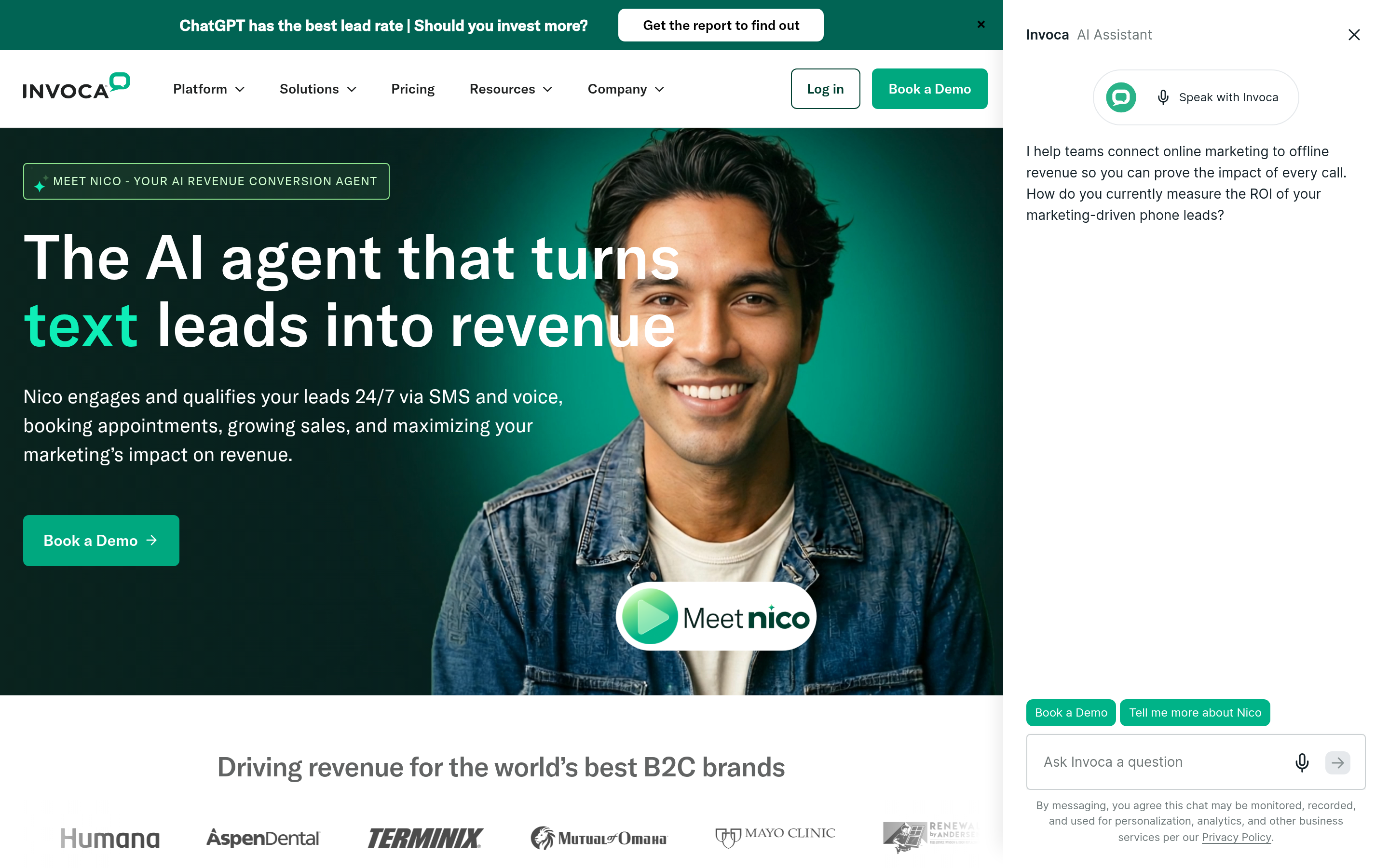
Invoca plays in the same conceptual space as Lace but at the multi-location, multi-brand end. Signal quality and compliance controls are the selling points. Expect an enterprise contract, a longer implementation, and a genuine integration project rather than a weekend setup.
Gong — if you are actually B2B#
Gong is the wrong answer for an HVAC company and often the right one for a B2B sales team. It analyses the full deal, not just the call: email threads, meeting patterns, deal risk, forecast accuracy. If you landed on Lace because you wanted "AI that tells me why deals die," and you sell to businesses on multi-touch cycles, Gong is the closer category match.
Balto — coaching in real time#
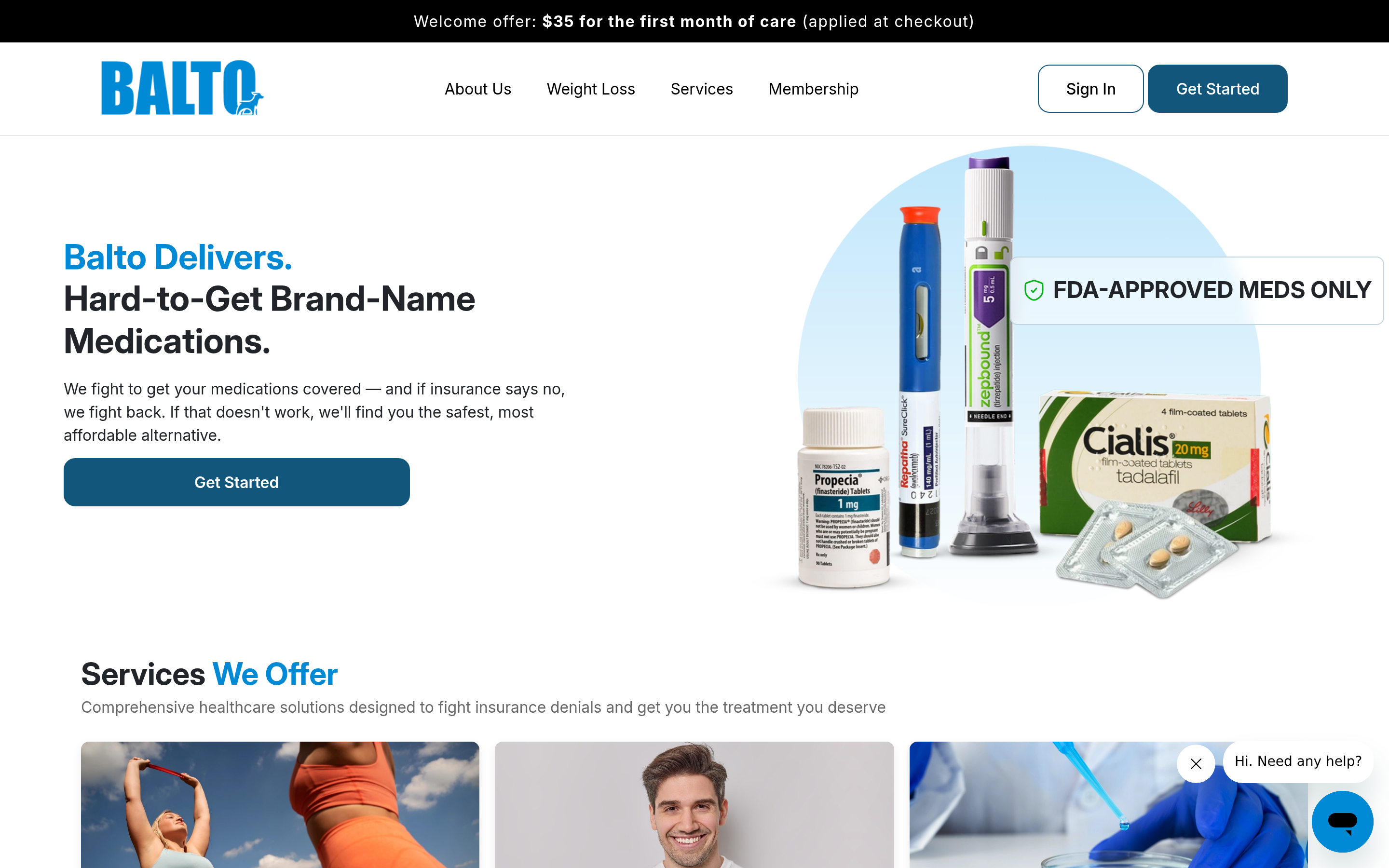
Balto sits in the agent's ear during the call with live prompts and checklists. It is a behaviour-change tool rather than an analytics tool. The payoff shows up when you have enough agents that consistency is the bottleneck — five CSRs following five different scripts is Balto's ideal problem.
Avoma — the lightweight option#
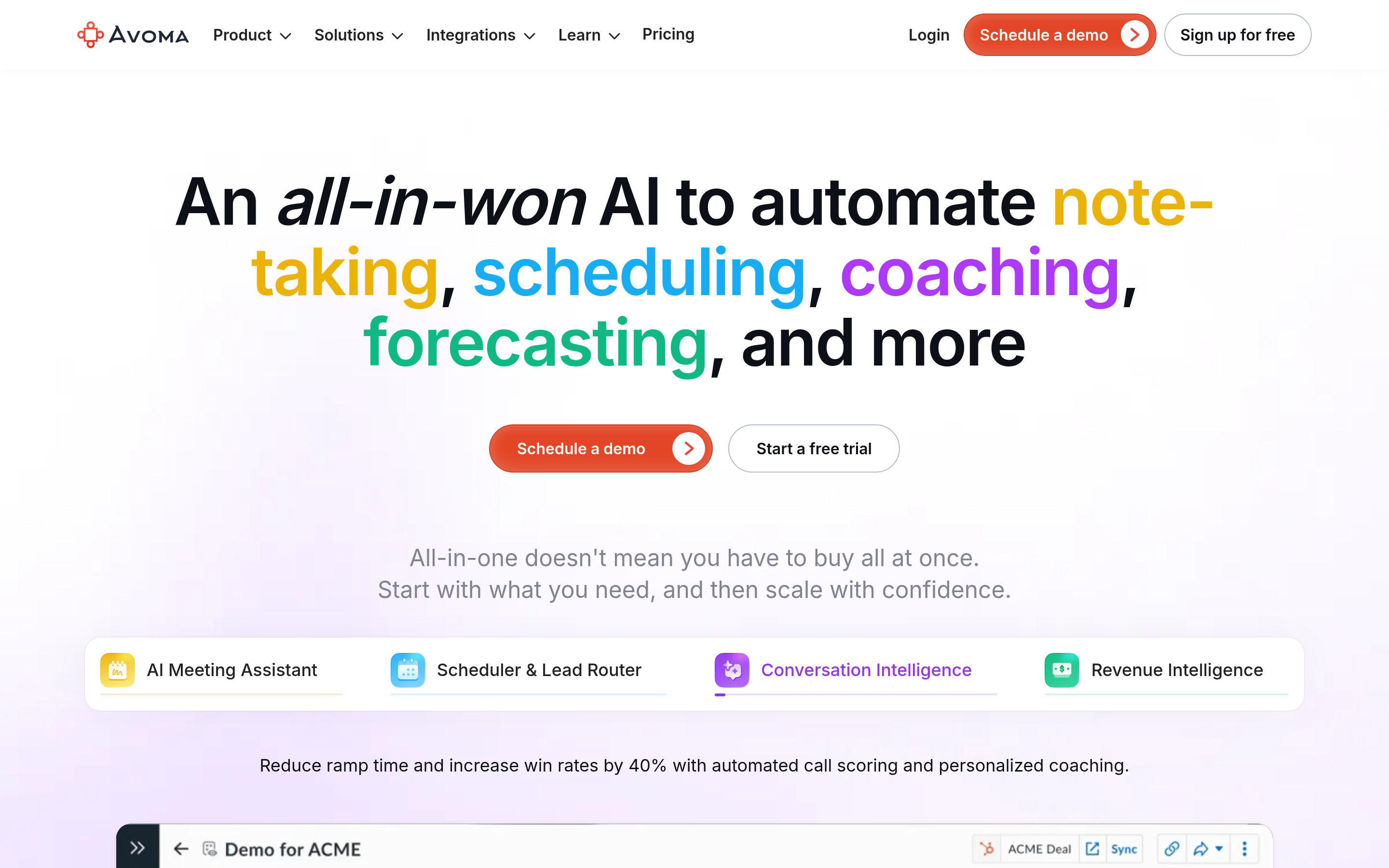
Avoma gives you recording, transcription, summaries, and basic conversation analytics with a free tier to start. It will not do marketing attribution and it is not built for inbound call centres, but for a small team that just wants call notes to stop being a manual chore, it is the lowest-friction entry point on the list.
Cresta and the AI-agent tier#
A newer group of vendors — Cresta and various AI voice-agent products — promise to answer or assist on the call itself rather than grade it afterwards. Evaluate these separately and carefully: the failure mode is not a bad dashboard, it is a bad customer experience on a live call.
Tomba — fixing the input, not the output#
Every tool above makes your existing conversations more measurable. None of them creates a new one. If you sell B2B and your pipeline is the constraint, find email addresses and B2B phone numbers for the accounts you want, verify them, and run outbound. That is a different lever, and it is the one most "Lace alternatives" searches are secretly about.

Is call intelligence enough without outbound pipeline?#
No — and this is the section most comparison posts skip.
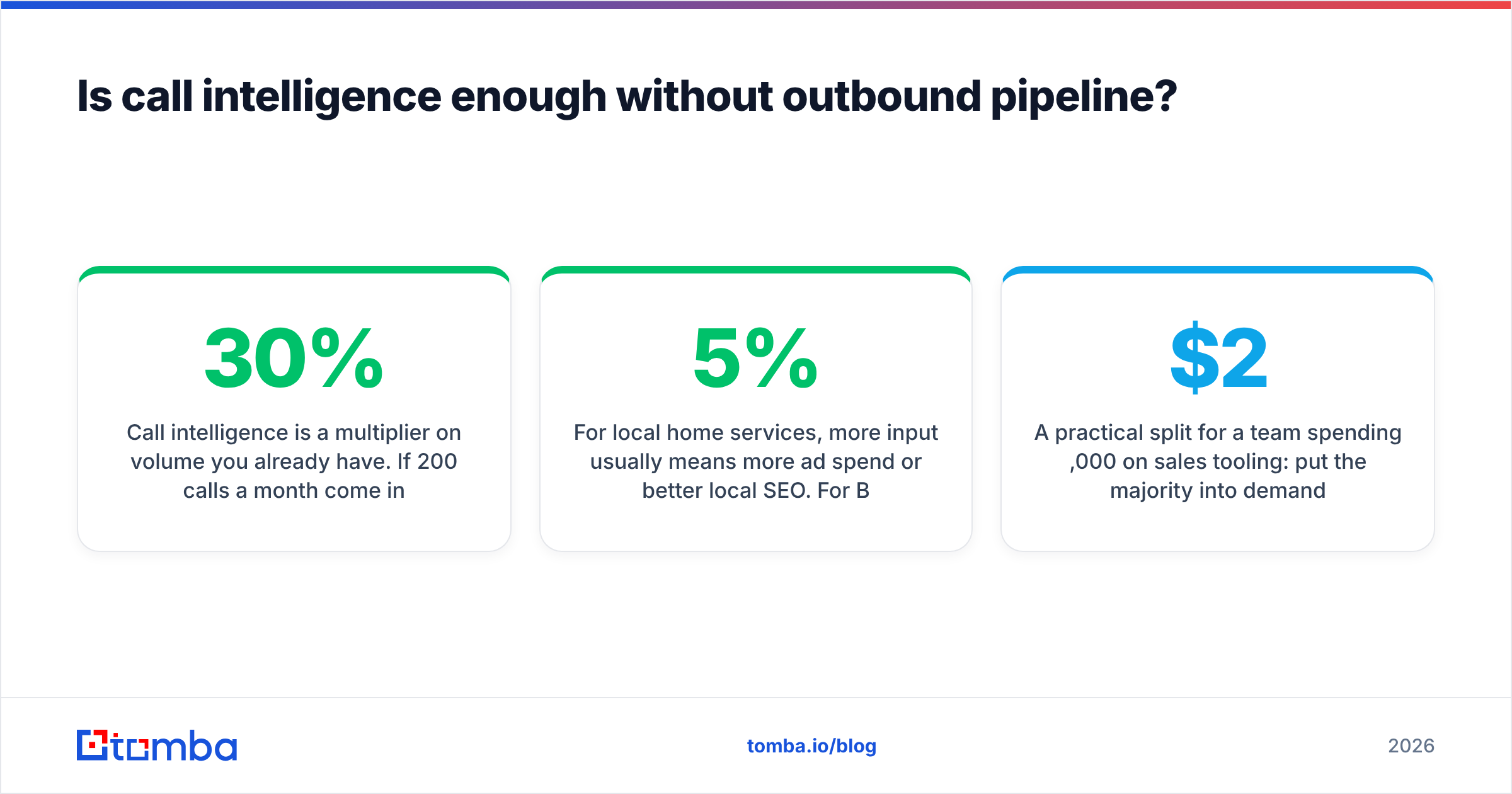
Call intelligence is a multiplier on volume you already have. If 200 calls a month come in and you close 30%, a great analytics layer might move you to 38%. That is 16 extra jobs, and it is real money. But it is bounded by the 200. Double the input and the same close rate produces more revenue than any coaching program will.
For local home services, more input usually means more ad spend or better local SEO. For B2B, it means outbound: building a target list, finding verified contacts, and running sequences. Those need accurate data more than they need AI. Bounce rates above 5% damage sender reputation fast, and a bad phone list burns rep hours before it burns budget.
Where you source that data matters. Self-serve finders like Tomba work per-domain and per-contact, so you pay for what you pull. List vendors such as BookYourData sell pre-built, filterable datasets, which suits teams that want volume up front rather than search-by-search precision. Both models are legitimate — the question is whether you are building a targeted account list or filling a territory.
A practical split for a team spending $2,000/month on sales tooling: put the majority into demand creation (data, ads, SEO), and a smaller, fixed slice into measurement. Measurement that consumes half your tooling budget while pipeline stays flat is a very expensive dashboard.
How do you choose between these Lace alternatives?#
Work through it in this order:
- Inbound-heavy, local, ad-funded? Lace or Invoca if you want revenue intelligence, CallRail if you only want attribution.
- Contact centre with 10+ agents? Balto for live guidance, Invoca for analytics, or both.
- B2B with multi-touch deals? Gong, not Lace. Different category entirely.
- Small team, tight budget, just want notes? Avoma's free tier, and revisit in six months.
- Pipeline is the bottleneck? Spend on contact data and outreach first. Buy the analytics layer once there is enough volume for it to have an opinion.
- Unsure which of the above you are? Pull last quarter's numbers. If close rate is below 25%, you have a conversion problem. If call volume is flat quarter over quarter, you have a demand problem. Fix the bigger one.
Run a 30-day trial with a single, pre-declared success metric before committing annually. Write the metric down before the trial starts — "booked-job rate on first-time callers goes from X to Y" — otherwise every tool looks like it worked.
What does this cost across a year?#
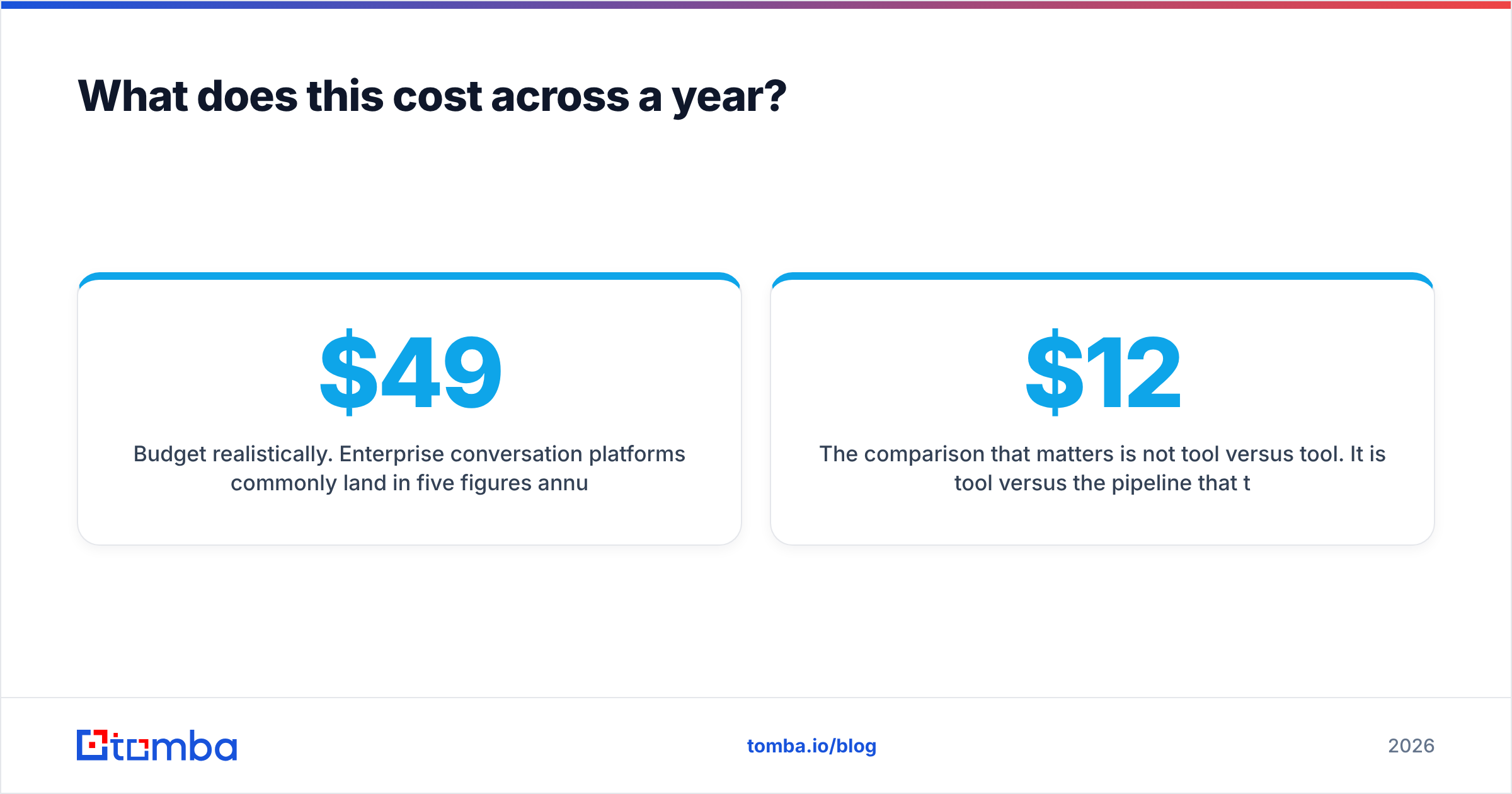
Budget realistically. Enterprise conversation platforms commonly land in five figures annually once seats and implementation are counted. Self-serve call tracking runs a few hundred to a few thousand a year for a single location. Contact data sits between: Tomba pricing starts free at 25 searches a month, moves to $49/mo on Starter, $99/mo on Growth, and $249/mo on Pro, with data enrichment and API access included in the paid tiers.
The comparison that matters is not tool versus tool. It is tool versus the pipeline that tool is supposed to influence. A $12,000/year analytics contract against $80,000 of ad spend is defensible. The same contract against $15,000 of spend is not.
For further reading, check the Lace AI competitor listings on G2 for current user reviews, the Lace product site for the vendor's own framing, and TechCrunch's funding coverage for background on where the company is heading.
Ready to fix the input side?#
If your evaluation of Lace alternatives ended with "the calls are fine, there just aren't enough of them," the tool you need is not another analytics dashboard. Start with the Tomba Email Finder: search by domain, name, or company, get verified professional email addresses with confidence scores and sources, and push them straight into your CRM or sequencer. The free tier gives you 25 searches a month to test list quality before you spend anything — enough to build a first target list this week and see whether more conversations, not better reporting, is what actually moves your number.
Related guides#
// get started
Find, verify and enrich your first contacts today
Start on the free plan with 25 searches a month, then scale when your team is ready.
Free plan · No credit card required · GDPR & CCPA
// about the author