LakeB2B vs Lead411 (2026): Which B2B Data Provider Wins?
LakeB2B sells custom-built contact lists. Lead411 sells a self-serve sales intelligence subscription. They solve different problems at very different prices — here is how to pick, and when neither is the right buy.
TL;DR
- These two are not the same category. LakeB2B is a managed data vendor that builds and sells custom contact lists (plus appending and campaign services). Lead411 is a self-serve sales intelligence SaaS with a Chrome extension, direct dials, and intent signals.
- Lead411 is cheaper to start and easier to test. Published entry pricing sits around $99/user/month on an annual commitment. LakeB2B is quote-only, and quotes typically start in the low thousands.
- LakeB2B wins on niche and international coverage — healthcare, education, manufacturing, and custom-researched segments that no self-serve database indexes well.
- Lead411 wins on workflow — you prospect inside your browser and CRM instead of waiting on a delivery file.
- Neither is a great fit if you already know who you want to reach. If your target accounts come from your own research, a pay-per-lookup email finder costs a fraction of both.
What are LakeB2B and Lead411, really?#
Think of it like buying furniture. LakeB2B is the custom cabinet shop: you describe the dimensions, they build it, you wait, you pay a project fee. Lead411 is IKEA with a membership card: you walk the aisles yourself, grab what you need, and assemble it the same afternoon.
LakeB2B is a data services company. You submit an ideal customer profile — industry, title, geography, technology, firmographics — and their team assembles a list, often blending licensed databases with human research. They also do data appending (you send incomplete records, they fill in emails and phones), data cleansing, and in some tiers, campaign execution. Healthcare and education verticals are where they have the strongest reputation.
Lead411 is a sales intelligence platform. You log in, filter a contact database by title, company size, location, tech stack, or hiring signals, and export or push contacts into your CRM. Its differentiators are verified direct-dial phone numbers, Bombora-powered intent data on higher tiers, and "growth intent" triggers like funding rounds and headcount jumps.
The practical difference: one delivers a file, the other delivers access.
How do LakeB2B and Lead411 compare head-to-head?#
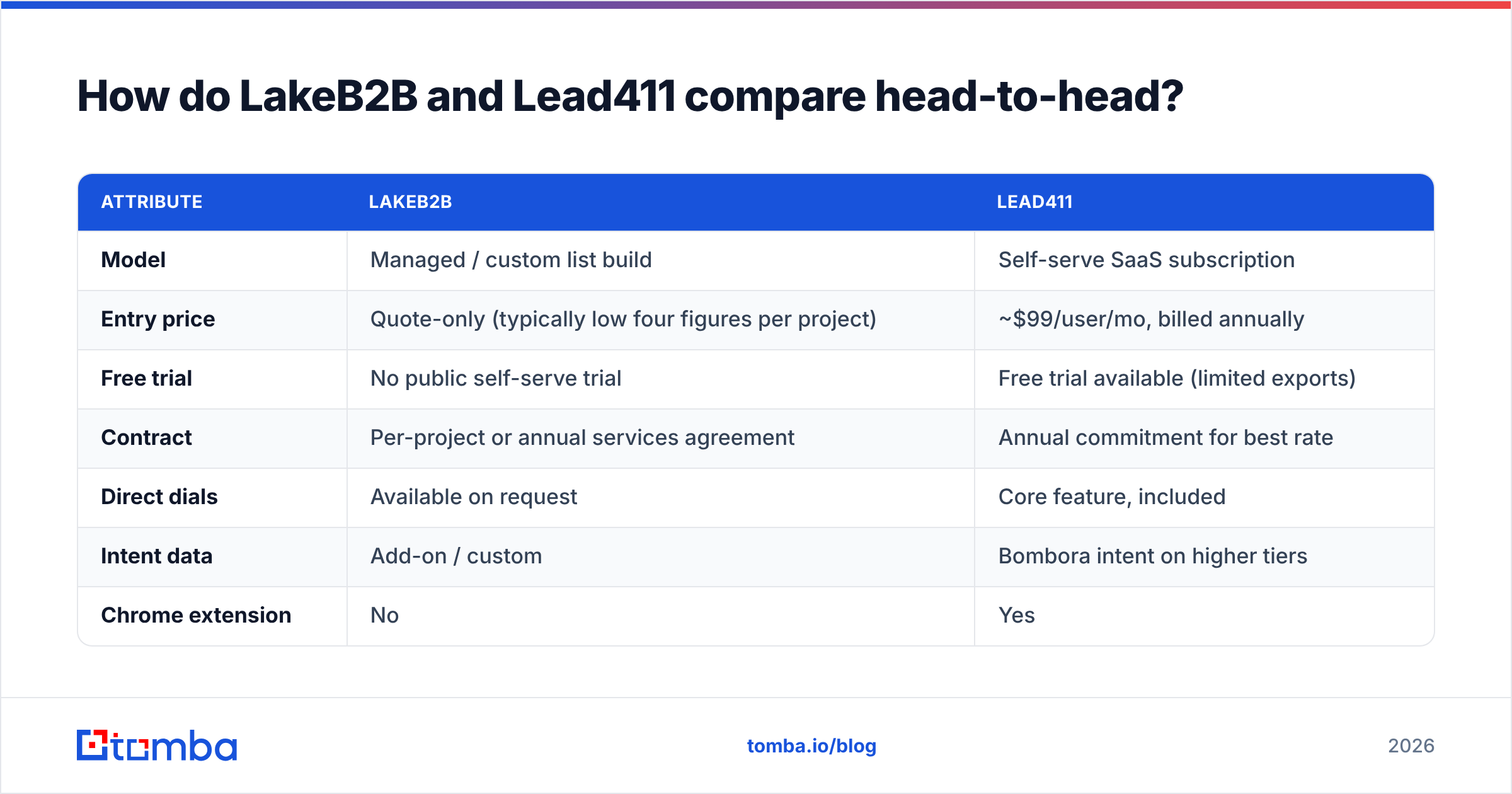
| Attribute | LakeB2B | Lead411 |
|---|---|---|
| Model | Managed / custom list build | Self-serve SaaS subscription |
| Entry price | Quote-only (typically low four figures per project) | ~$99/user/mo, billed annually |
| Free trial | No public self-serve trial | Free trial available (limited exports) |
| Contract | Per-project or annual services agreement | Annual commitment for best rate |
| Direct dials | Available on request | Core feature, included |
| Intent data | Add-on / custom | Bombora intent on higher tiers |
| Chrome extension | No | Yes |
| CRM push | Via file import or custom integration | Native Salesforce, HubSpot, Pipedrive |
| Turnaround | Days to weeks per list | Instant |
| Best for | Niche verticals, international, appending | SDR teams doing daily prospecting |
| Weak spot | No live UI, slow iteration, opaque pricing | Thin coverage outside US/mid-market |

Read that table once more and notice what it implies about iteration speed. If your ICP is settled and unlikely to change for six months, a delivered list is fine. If you are still figuring out who buys — which is true for most companies under $10M ARR — you need to re-cut your target list weekly. That is a workflow problem, not a data problem, and it is the single biggest reason teams churn off managed list vendors.

What does each one actually cost in 2026?#
Here is where the comparison gets uncomfortable, because only one of these vendors publishes numbers.
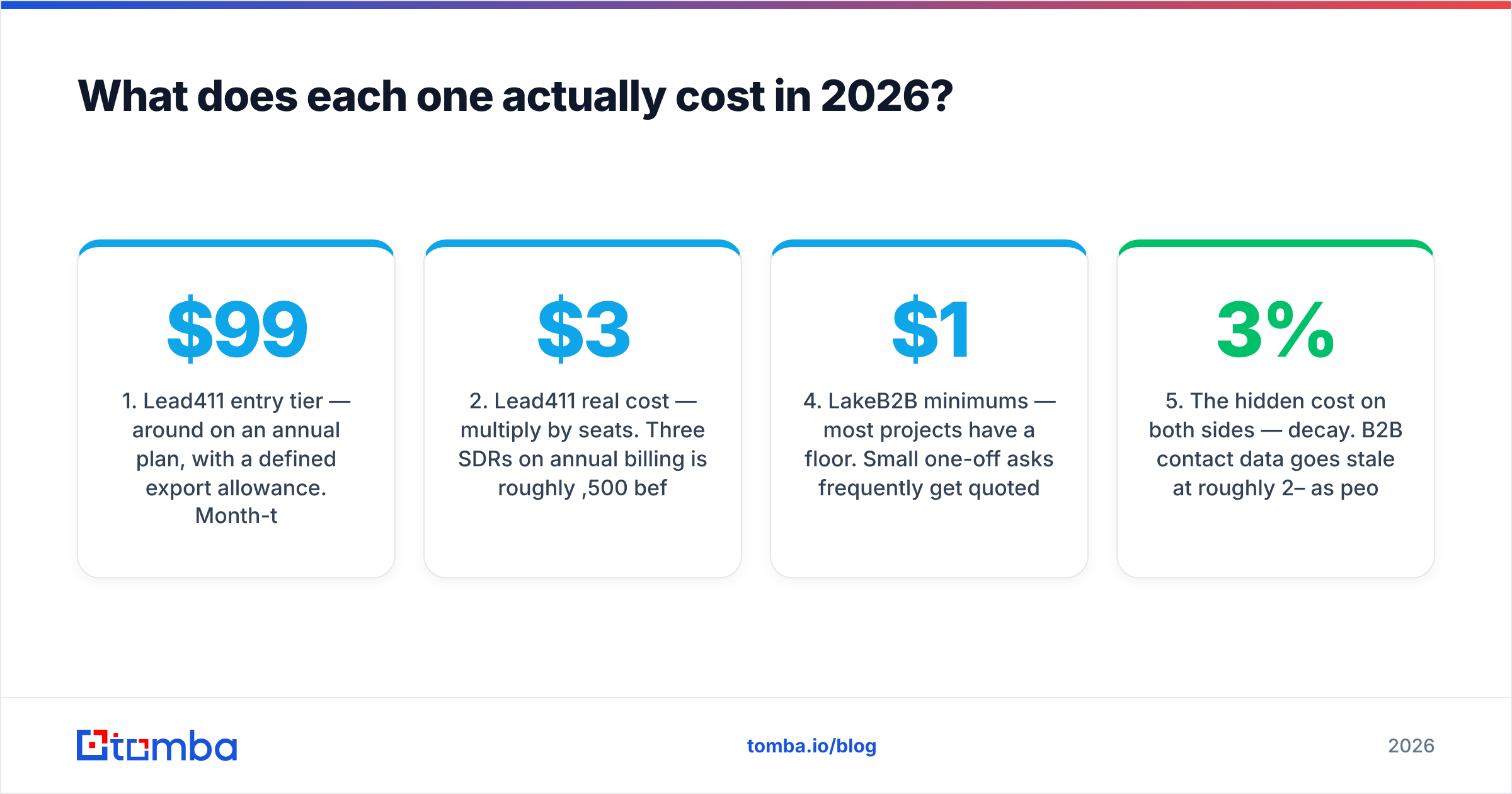
- Lead411 entry tier — around $99 per user per month on an annual plan, with a defined export allowance. Month-to-month is higher. Enterprise tiers with unlimited-style exports and full intent data are quoted individually.
- Lead411 real cost — multiply by seats. Three SDRs on annual billing is roughly $3,500/year before intent add-ons. Exports are capped, so heavy list-builders hit overage conversations quickly.
- LakeB2B per-record pricing — quoted per record, and the rate falls as volume rises. Highly specific segments (verified hospital procurement titles, for example) cost more per record than generic SMB contacts.
- LakeB2B minimums — most projects have a floor. Small one-off asks frequently get quoted in the $1,500–$5,000 range, which makes a cheap pilot hard.
- The hidden cost on both sides — decay. B2B contact data goes stale at roughly 2–3% per month as people change jobs. A list you bought in January is measurably worse in June, and a subscription database you never re-check is no better.
That last point deserves emphasis. Neither vendor eliminates the need to re-verify before a send. Any serious outbound motion runs a verification pass on the day of the campaign, not the day of purchase. A standalone email verifier step costs pennies per record and protects the sender reputation you spent months building.

How accurate is the data from each provider?#

Both vendors advertise accuracy in the 90%+ range. Treat those numbers as marketing until you test them, because vendors measure accuracy differently — some count "syntactically valid," some count "did not hard bounce," some count "SMTP-confirmed deliverable." Those are three very different bars.
What buyers consistently report on G2 and similar review sites:
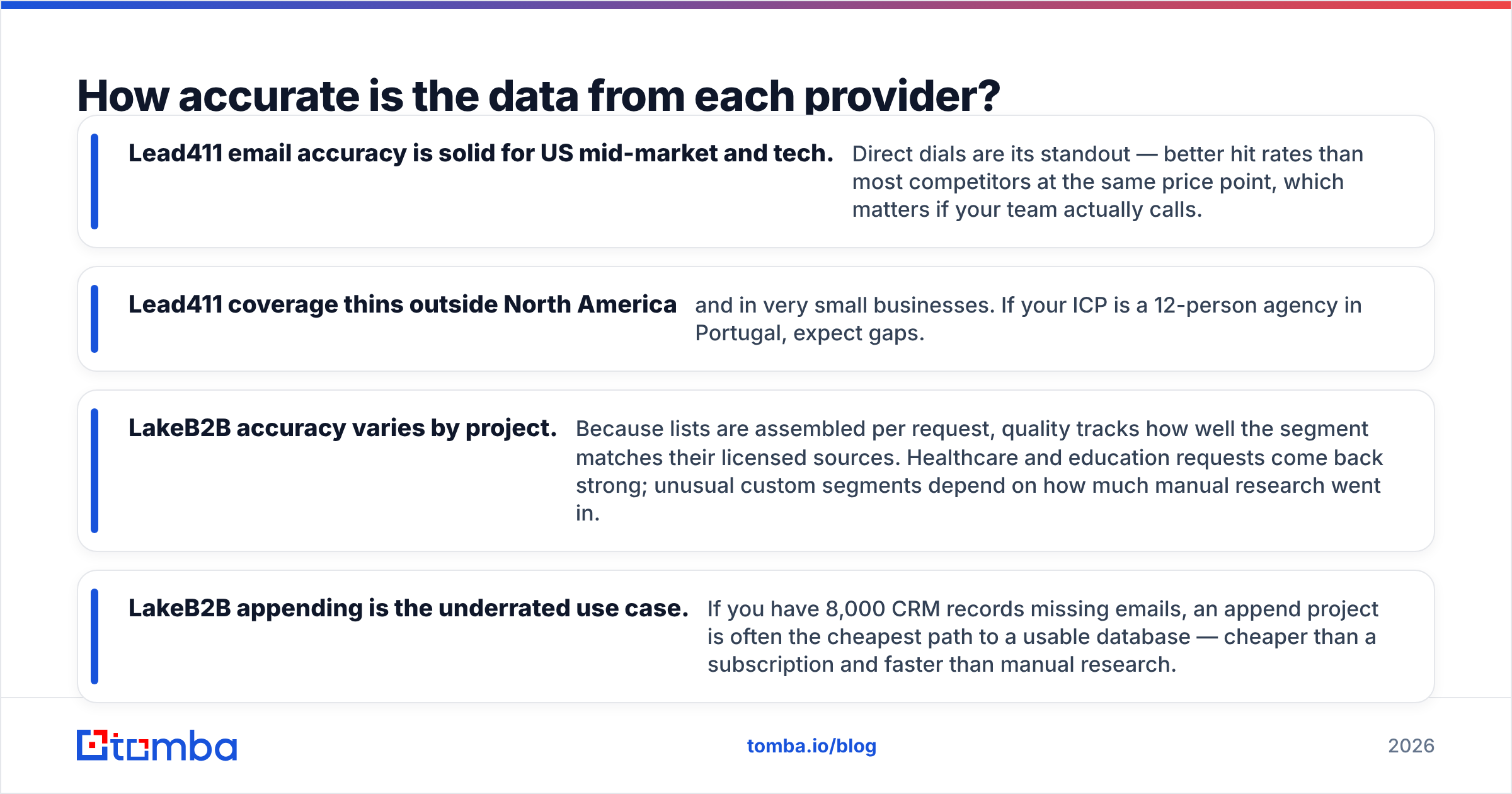
- Lead411 email accuracy is solid for US mid-market and tech. Direct dials are its standout — better hit rates than most competitors at the same price point, which matters if your team actually calls.
- Lead411 coverage thins outside North America and in very small businesses. If your ICP is a 12-person agency in Portugal, expect gaps.
- LakeB2B accuracy varies by project. Because lists are assembled per request, quality tracks how well the segment matches their licensed sources. Healthcare and education requests come back strong; unusual custom segments depend on how much manual research went in.
- LakeB2B appending is the underrated use case. If you have 8,000 CRM records missing emails, an append project is often the cheapest path to a usable database — cheaper than a subscription and faster than manual research.
The honest test for either: ask for a 100-record sample matching your exact ICP, run it through independent verification, and count deliverables yourself. Any vendor unwilling to provide a sample is telling you something. Run the sample through a neutral checker such as Tomba's free email checker rather than the vendor's own validation, so the grader is not also the seller.
Is LakeB2B better than Lead411 for your use case?#
Ask three questions in order.
Do you need records that no self-serve database has? If yes, LakeB2B. Regulated verticals, non-English markets, physical-address-heavy segments, and job titles that do not map cleanly to LinkedIn taxonomy are exactly where custom research beats an indexed database. No amount of filtering in a SaaS UI conjures data that was never collected.
Do reps need to prospect live, every day? If yes, Lead411. A delivered CSV has no answer for "I'm on this company's site right now and need the VP of Ops." The Chrome extension and CRM push are the whole product for a working SDR, and they save more hours than the price difference.
Do you already know your target accounts? If yes, neither is the efficient buy. This is the case most teams get wrong. If your pipeline comes from event lists, inbound signups, partner referrals, or a hand-built account list, you are not buying discovery — you are buying contact resolution for names you already have. Paying subscription or project pricing for that is overkill.
For that third scenario, a domain search or bulk lookup against a known account list gets you the same outcome for a fraction of the spend. You supply the company, the tool returns the pattern and the people.
What are the main alternatives to both?#
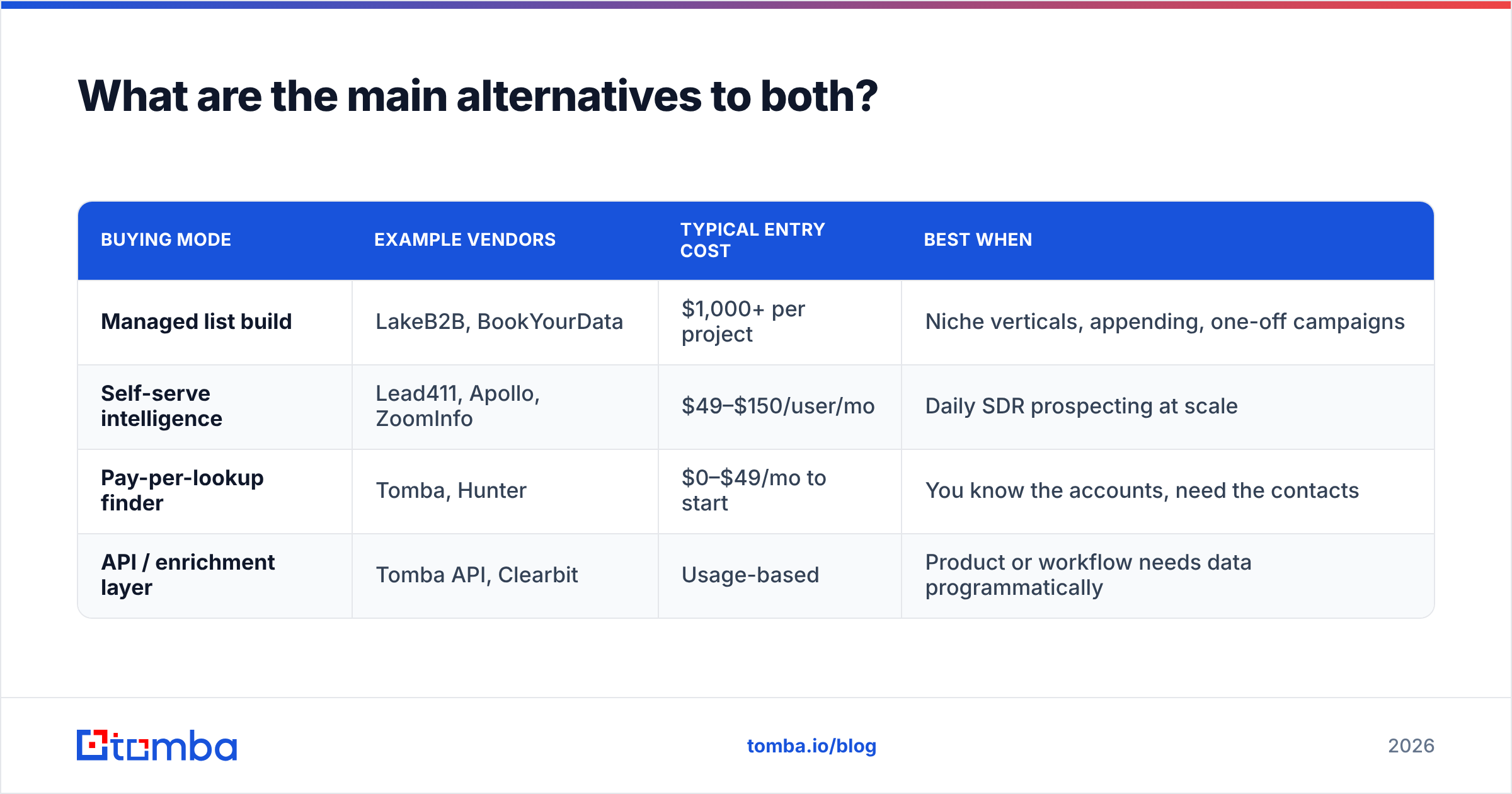
The LakeB2B vs Lead411 decision is often framed too narrowly. The wider market splits into four buying modes.
| Buying mode | Example vendors | Typical entry cost | Best when |
|---|---|---|---|
| Managed list build | LakeB2B, BookYourData | $1,000+ per project | Niche verticals, appending, one-off campaigns |
| Self-serve intelligence | Lead411, Apollo, ZoomInfo | $49–$150/user/mo | Daily SDR prospecting at scale |
| Pay-per-lookup finder | Tomba, Hunter | $0–$49/mo to start | You know the accounts, need the contacts |
| API / enrichment layer | Tomba API, Clearbit | Usage-based | Product or workflow needs data programmatically |
BookYourData sits alongside LakeB2B in the first row and is worth a look if you want purchased lists with a pay-as-you-go structure rather than a services engagement — it removes the minimum-commitment friction that makes managed vendors hard to pilot.
Row three is where most small teams should start, because it is the only mode with a genuinely low cost of being wrong. Tomba pricing runs a free tier at 25 searches/month, Starter at $49/mo, Growth at $99/mo, and Pro at $249/mo. You can validate whether the data works for your ICP before any money moves — something neither LakeB2B's quote process nor Lead411's annual commitment makes easy.
Row four matters if you are building, not just selling. If contact resolution needs to happen inside your product, your onboarding flow, or a nightly enrichment job, a services vendor cannot help you. An email finder API can, and you pay only for calls you make.
What should you actually buy?#
Here is the decision compressed.
- Buy LakeB2B if you need a healthcare, education, or international segment that self-serve tools cover badly, or if you need to append emails to a few thousand existing CRM records. Insist on a sample. Negotiate the per-record rate — it moves.
- Buy Lead411 if you have two or more full-time reps prospecting US mid-market accounts daily and calling is part of the motion. The direct dials justify the price in a way the emails alone do not.
- Buy neither, yet, if you are one to three people, your ICP is still moving, or your target accounts already exist in a spreadsheet. Start with a per-lookup finder, prove the motion converts, then graduate to a subscription when seat count makes the math work.
And regardless of what you buy: verify before you send. Bounce rate is the fastest way to destroy a sending domain, and no vendor's accuracy claim survives contact with a real mailbox provider. Pair whatever source you choose with a verification step and a bulk email finder run for the accounts you already know.
Ready to test the data before you commit?#
If the honest answer is "I already know which companies I want — I just need the right people at them," skip the annual contract entirely. Start with the Tomba Email Finder: enter a name and domain, get a verified professional email with a confidence score and the sources behind it. The free tier gives you 25 searches a month, which is enough to run the exact 100-record sample test described above against your real ICP — before you spend a dollar with LakeB2B, Lead411, or anyone else.
Test the data first. Sign the contract second.
Related guides#
// get started
Find, verify and enrich your first contacts today
Start on the free plan with 25 searches a month, then scale when your team is ready.
Free plan · No credit card required · GDPR & CCPA
// about the author