LakeB2B vs Ocean.io (2026): Which B2B Data Source Wins?
One sells you curated contact lists by the record. The other maps lookalike accounts from a company graph. Here is how LakeB2B and Ocean.io actually compare in 2026 — pricing models, data freshness, compliance, and who each one really fits.
LakeB2B vs Ocean.io comes down to one question: do you want to buy a list, or find the right accounts? LakeB2B sells contact records by the file. Ocean.io finds companies that look like your best ones. This guide compares both on price, data freshness, compliance, and fit.
TL;DR
- LakeB2B is a list vendor. You describe an audience, they quote you a file. Pricing is per-record or per-campaign, sales-led, and the deliverable is usually a CSV or a CRM push.
- Ocean.io is a company-graph platform. You feed it your best accounts, it finds lookalikes using website and firmographic signals, then layers contacts on top. It is a subscription, not a purchase.
- They are not really competitors. LakeB2B answers "who can I email tomorrow?" Ocean.io answers "which 2,000 companies should I even care about?"
- Neither publishes pricing. Both are quote-only in 2026, which means your cost depends on how well you negotiate, not on a published tier.
- Both need a verification layer. Bought or inferred contact data decays 25-30% a year. Running the file through an email verifier before you send is non-optional.
What is LakeB2B?#
LakeB2B (lakeb2b.com) is a B2B data and demand-generation company that has been selling list products since the mid-2000s. Think of it as a data agency, not a software tool. You tell a rep you want "IT directors at US hospitals with 500+ beds." They come back with a count, a price, and a file.
The catalogue is built around industry and role verticals — healthcare, technology, education, manufacturing — plus attendee lists, technology-install lists, and intent-flavoured segments. Alongside raw data, LakeB2B sells services: appointment setting, email campaign execution, data appending, and CRM hygiene projects.
The mental model matters. Buying from LakeB2B is like ordering a custom mailing list from a printer. You get a finished artifact. It is accurate on the day it ships, it is yours forever, and it starts going stale immediately.
What is Ocean.io?#
Ocean.io (ocean.io) is a European B2B data platform built around a company graph rather than a contact database. Its signature feature is lookalike search. You upload a list of your closed-won accounts. Ocean.io then scans company websites, descriptions, and firmographics to surface similar companies you have never heard of.
That website-content angle is the differentiator. Traditional databases sort companies by SIC or NAICS code. That is a blunt tool: a robotics startup and a bolt maker can land in the same bucket. Ocean.io reads what the company actually says about itself, which tends to produce tighter segments for niche ICPs.
Contacts exist in Ocean.io, but they are the second layer. You find accounts first, then pull people inside them. If your problem is "I have no idea who my ICP is beyond a gut feeling," that ordering is genuinely useful.
LakeB2B vs Ocean.io: how do they compare head to head?#
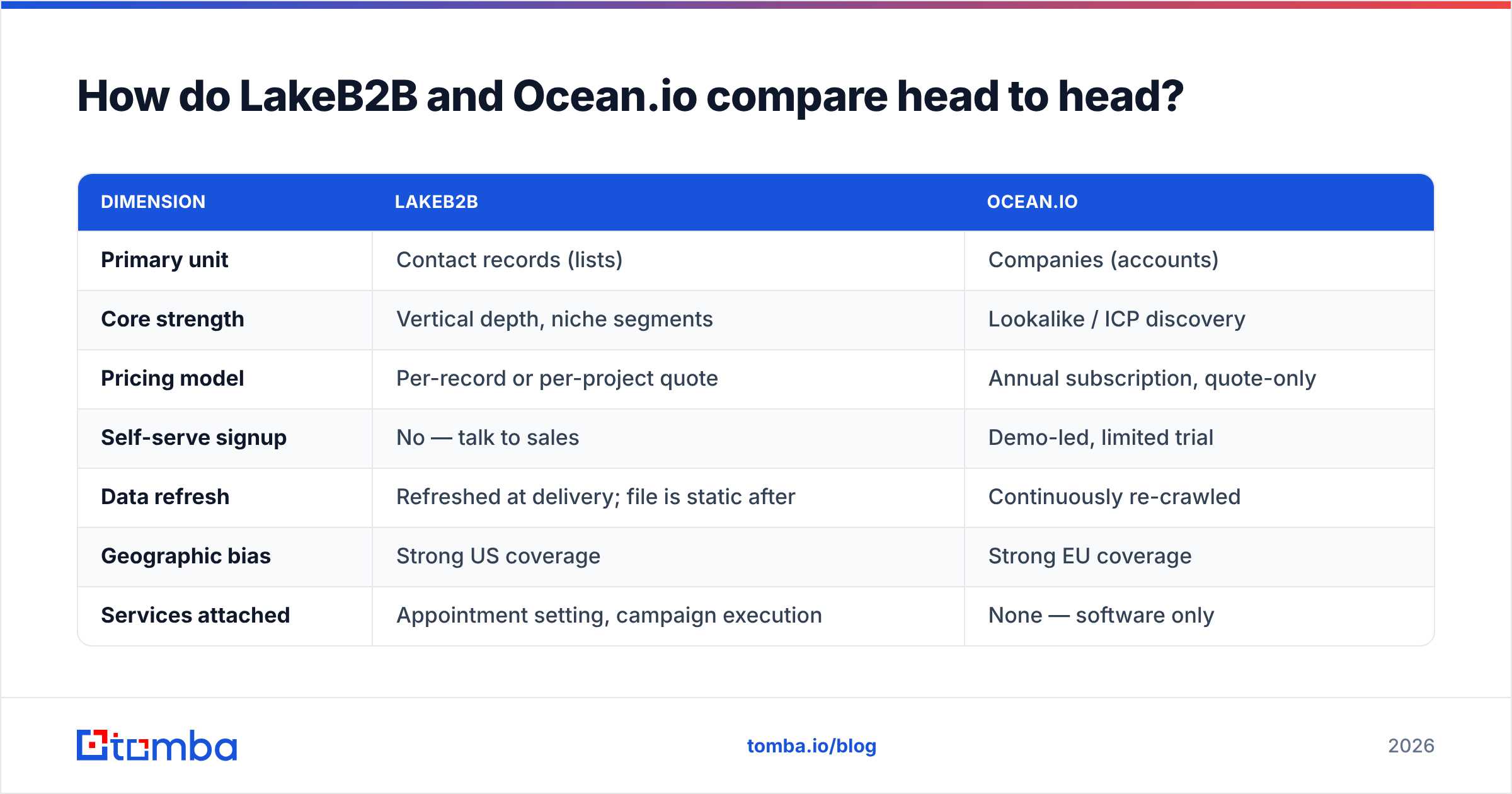
| Dimension | LakeB2B | Ocean.io |
|---|---|---|
| Primary unit | Contact records (lists) | Companies (accounts) |
| Core strength | Vertical depth, niche segments | Lookalike / ICP discovery |
| Pricing model | Per-record or per-project quote | Annual subscription, quote-only |
| Self-serve signup | No — talk to sales | Demo-led, limited trial |
| Data refresh | Refreshed at delivery; file is static after | Continuously re-crawled |
| Geographic bias | Strong US coverage | Strong EU coverage |
| Services attached | Appointment setting, campaign execution | None — software only |
| Best fit | Bulk campaigns, event pushes, appending | ABM, territory planning, ICP expansion |
| Weak spot | File decays; no live re-query | Contact-level depth thinner than list vendors |
| Compliance posture | GDPR/CCPA claims, opt-out handling | EU-headquartered, GDPR-native |
The table makes the split obvious. LakeB2B optimises for volume and reach. Ocean.io optimises for precision and targeting. A team that buys from LakeB2B and then complains it did not get lookalike intelligence bought the wrong product, and vice versa.
Which data model should you actually buy?#
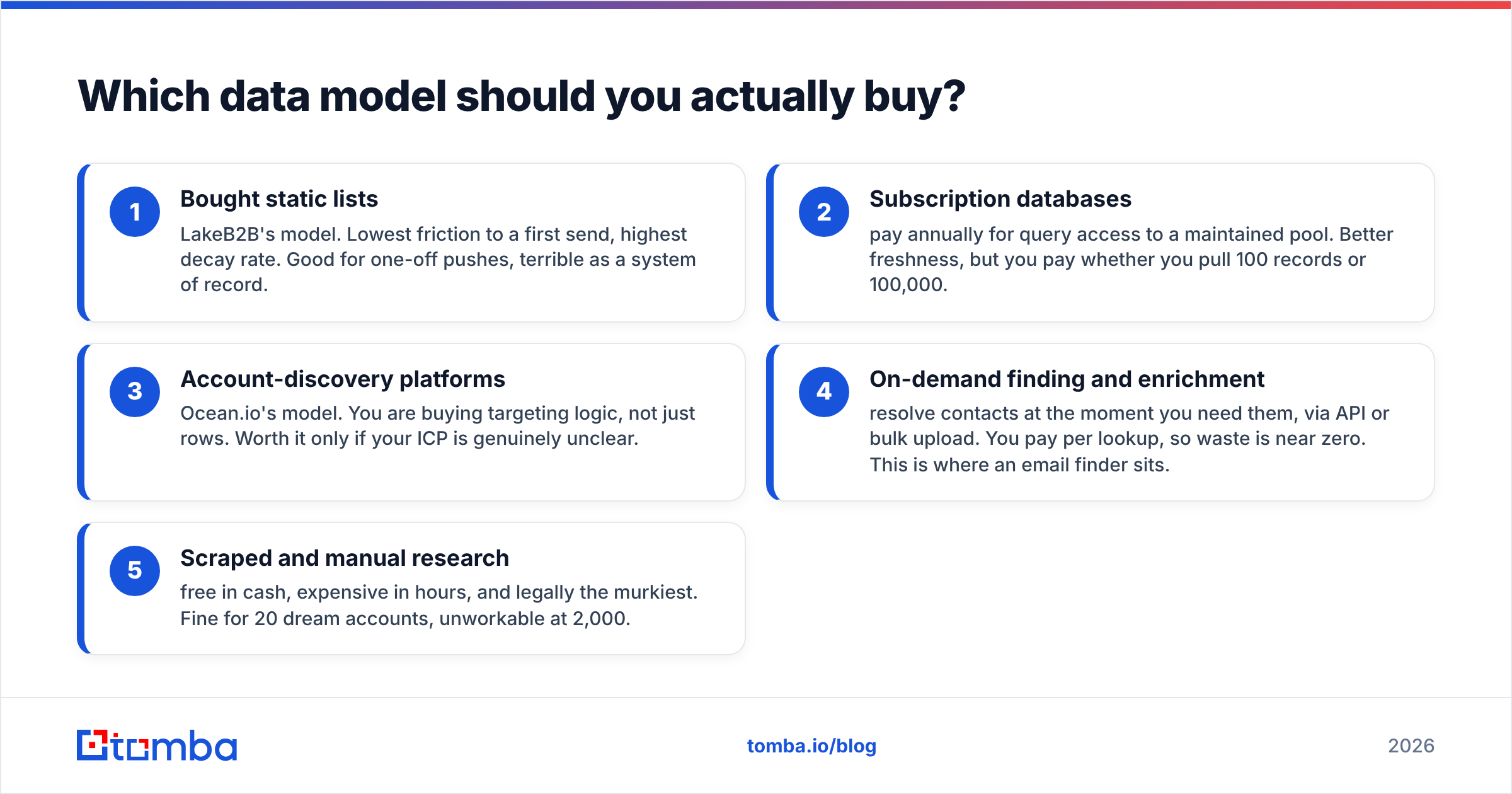
Before you compare vendors, pick the model. There are five ways B2B teams source contact data in 2026, and the vendor shortlist falls out of the choice:
- Bought static lists — LakeB2B's model. Lowest friction to a first send, highest decay rate. Good for one-off pushes, terrible as a system of record.
- Subscription databases — pay annually for query access to a maintained pool. Better freshness, but you pay whether you pull 100 records or 100,000.
- Account-discovery platforms — Ocean.io's model. You are buying targeting logic, not just rows. Worth it only if your ICP is genuinely unclear.
- On-demand finding and enrichment — resolve contacts at the moment you need them, via API or bulk upload. You pay per lookup, so waste is near zero. This is where an email finder sits.
- Scraped and manual research — free in cash, expensive in hours, and legally the murkiest. Fine for 20 dream accounts, unworkable at 2,000.
Most teams that feel burned by a data vendor picked model 1 when they needed model 4, or model 3 when they already knew their ICP cold and just needed contacts.
LakeB2B vs Ocean.io pricing: what do they cost?#
Neither publishes a price page, which is the single most useful fact in this comparison.
LakeB2B quotes per project. Pricing scales with record count and how many appended fields you want. Email only is cheapest. Email plus direct dial plus technographics costs more. Small custom files typically land in the low four figures. Large multi-vertical builds or bundled campaign services run much higher. Because it is negotiated, two buyers with identical specs can pay very different amounts.
Ocean.io sells annual seats with credit allowances, quoted after a demo. Expect a mid-four to five-figure annual commitment depending on seats, export volume, and CRM integrations. There is no meaningful free tier to evaluate against, so your only real diligence path is a scoped trial plus your own verification pass.
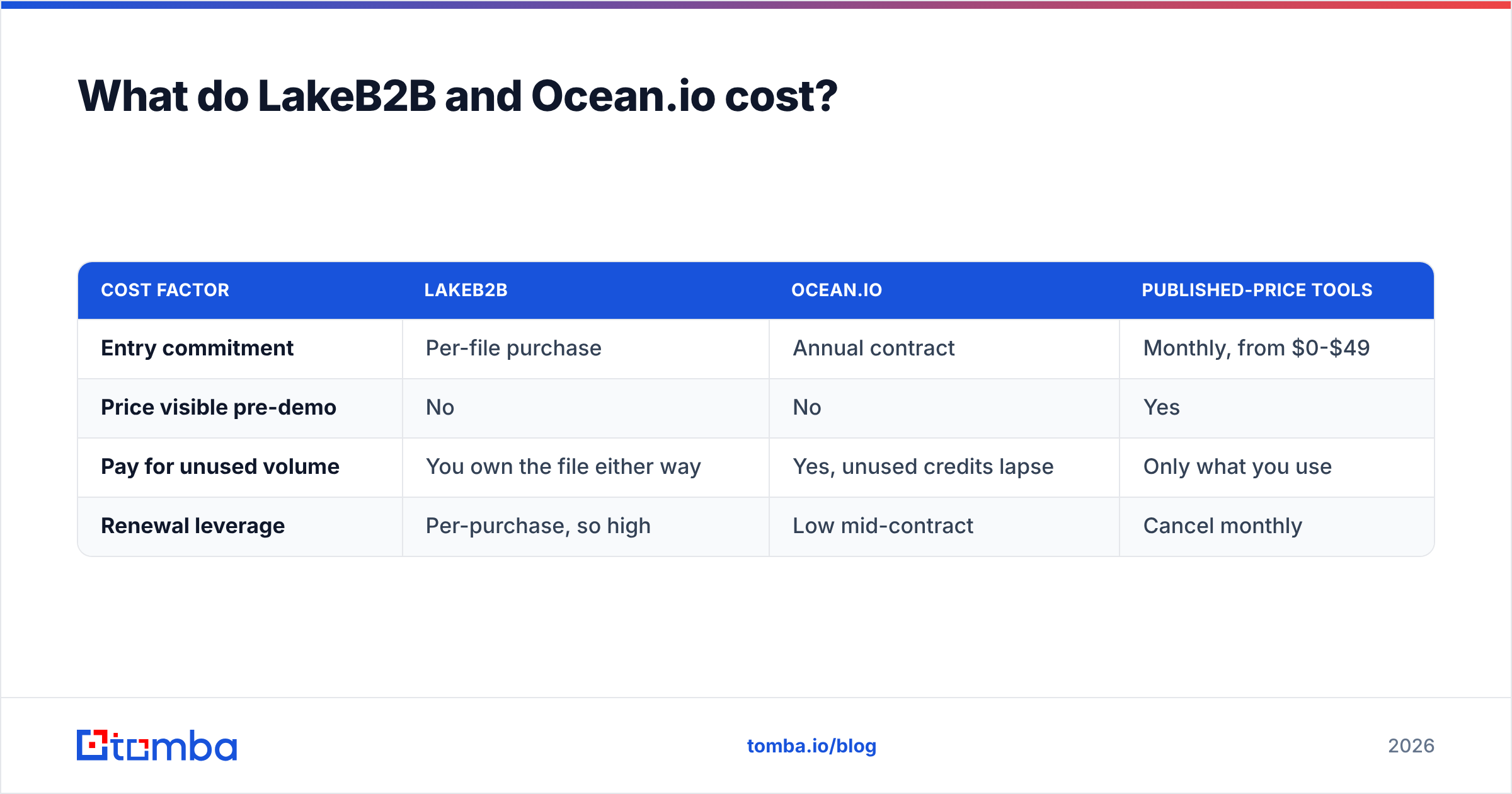
Compare that to tools with published pricing. Tomba's plans start free at 25 searches a month, then $49/mo Starter, $99/mo Growth, and $249/mo Pro, with Enterprise custom. You can test the data before anyone learns your budget. That gap is not a minor convenience. When a vendor knows your headcount and funding stage first, the quote reflects it.
| Cost factor | LakeB2B | Ocean.io | Published-price tools |
|---|---|---|---|
| Entry commitment | Per-file purchase | Annual contract | Monthly, from $0-$49 |
| Price visible pre-demo | No | No | Yes |
| Pay for unused volume | You own the file either way | Yes, unused credits lapse | Only what you use |
| Renewal leverage | Per-purchase, so high | Low mid-contract | Cancel monthly |
Which one has more accurate data?#
Neither vendor will hand you an independently audited accuracy figure. Be suspicious of any B2B data company that quotes one without naming its method. What you can reason about is structural accuracy.
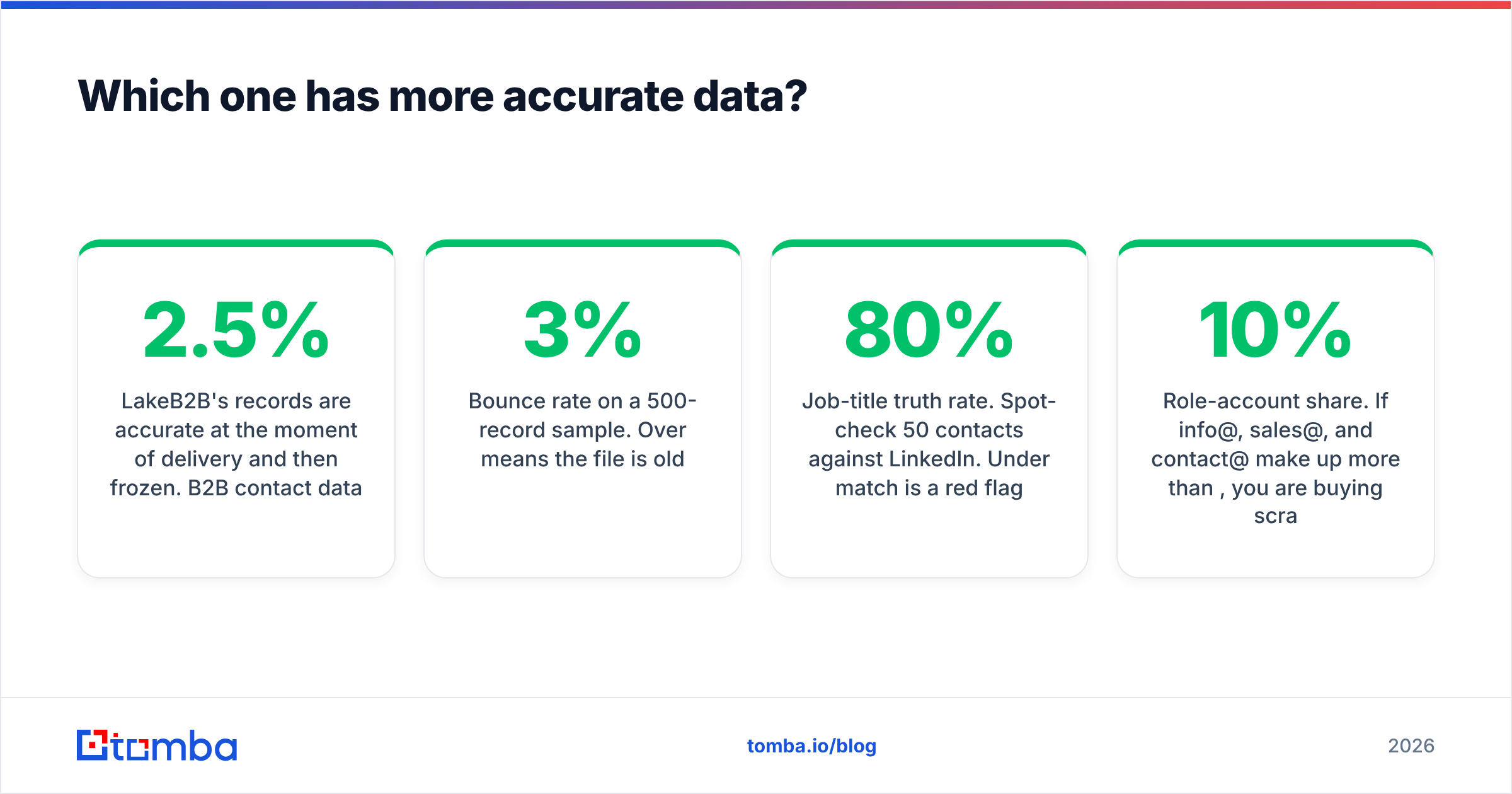
LakeB2B's records are accurate at the moment of delivery and then frozen. B2B contact data decays roughly 2-2.5% per month through job changes, domain migrations, and company closures. A file bought in January is measurably worse by June and materially worse by December. That is not a knock on LakeB2B specifically — it is what a static file is.
Ocean.io re-crawls continuously, so company-level data stays fresher. Contact-level coverage is the softer spot: for smaller companies and non-English markets outside its EU core, you will hit gaps where the account is right but the person is missing.
The practical consequence is identical for both: verify before you send. A single hard-bounce spike on a cold domain can undo months of warmup. Check the file for role accounts, catch-all domains, and dead MX records first. A catch-all verifier matters more than people expect here, since a large share of enterprise domains accept everything at the SMTP layer and tell you nothing useful.
Real check you can run on any vendor sample before signing:
- Bounce rate on a 500-record sample. Over 3% means the file is old.
- Job-title truth rate. Spot-check 50 contacts against LinkedIn. Under 80% match is a red flag.
- Domain-level duplication. Fifteen contacts at one company inflates your count and your invoice.
- Role-account share. If
info@,sales@, andcontact@make up more than 10%, you are buying scraped web data dressed as a contact list.

When is LakeB2B the right call?#
Pick LakeB2B when the following are all true:
- You need volume in a specific vertical — healthcare, education, and manufacturing lists are its traditional strength, and generic databases are thin there.
- You want services bundled with the data. If you have no SDR team and want someone else to run the campaign or book the meetings, a list vendor with an agency arm removes a hiring problem.
- Your campaign is time-boxed. Event pre-promotion, a product launch, a regional expansion push — cases where a static file is fine because the use is over in eight weeks.
- You need appending, not discovery. You already have 40,000 company names from a trade show and need emails and phones attached.
Skip it when you need an always-current source of truth. Buying a list and treating it as your CRM's backbone is how databases rot.
When is Ocean.io the right call?#
Pick Ocean.io when:
- Your ICP is a hypothesis, not a fact. You have 30 closed-won logos and a suspicion they share something. Lookalike search is genuinely good at surfacing what.
- You sell into Europe. EU coverage and GDPR-native handling are real advantages over US-centric providers.
- You run account-based motions. Territory carving, account scoring, and tiering all want a company graph, not a contact dump.
- Your niche defies SIC codes. Website-content classification beats industry codes for "companies that do X," where X is a capability rather than an industry.
Skip it if you already know exactly which 500 accounts you want. Paying for targeting intelligence you do not need is the most common way teams overspend on this category.
What are the alternatives to both?#
The honest answer for most small and mid-size teams: you may not need either.
If your workflow is "I know the company, I need the person," an on-demand finder is cheaper and fresher than both models. Domain search returns the contacts at a company in seconds, and a bulk email finder handles a 5,000-row list without a procurement cycle. You are paying for lookups, not for rows you will never touch.
Other options worth a look depending on your motion:
- BookYourData — a well-regarded self-serve list marketplace with published per-record pricing and a bounce guarantee. If you like LakeB2B's model but want transparent pricing and no sales call, it is a strong peer in the same space.
- Apollo, Cognism, ZoomInfo — subscription databases with large pools and sequencing built in, if you want the whole stack from one vendor.
- Clay and similar orchestration tools — if you would rather waterfall across several providers and only pay when one returns a hit.
For teams already running a stack, data enrichment against your existing CRM often beats buying new records outright. Most companies have thousands of half-complete rows sitting in Salesforce or HubSpot that are cheaper to complete than to replace. You can see how vendors compare on independent user reviews at G2 before you take any demo.
What is the verdict?#
If you need reach, LakeB2B. If you need targeting, Ocean.io. If you need neither, do not buy either.
LakeB2B vs Ocean.io is not a tie-break between two versions of the same tool. They fix different gaps. LakeB2B wins on vertical depth, bundled services, and the ability to go from a conversation to a usable file quickly. It loses on freshness and on price opacity. Ocean.io wins on ICP discovery, European coverage, and continuously refreshed company data. It loses on contact depth and on annual-commitment risk for teams that cannot forecast usage.
Both lose to a pay-per-lookup workflow for the very common case where you already know your accounts and just need verified contact details this week. That case is more common than either vendor's marketing assumes.
Before you sign anything, run the four-point sample audit above. A vendor confident in its data will hand you 500 records to test. One that will not is telling you something.
Start with the cheapest test. Before you commit to a five-figure data contract, pull the contacts you need on demand and see how they perform. The Tomba Email Finder finds professional email addresses by name, domain, or company, with verification built into the same call — free for your first 25 searches, $49/mo when you scale. Test it against a LakeB2B sample or an Ocean.io export and let the bounce rate decide your budget.
Related guides#
Ready to find emails that actually work?
Join 150,000+ professionals who stopped guessing and started sending. Free credits on signup — no credit card required.
Get the Tomba newsletter
Practical outbound tactics and product updates — once every two weeks.
About the author