LakeB2B vs RocketReach: Which B2B Data Tool Wins in 2026?
LakeB2B sells curated list builds; RocketReach sells self-serve contact lookups. We compare pricing, data accuracy, workflow fit, and who each one actually suits in 2026.
LakeB2B vs RocketReach is not a fair fight, because they are not the same kind of product. One sells you a finished list. The other sells you a tool that finds contacts on demand.
TL;DR
- LakeB2B is a data vendor. RocketReach is a data tool. LakeB2B builds a list to your spec and hands you the file, often as a one-time purchase or an annual license. RocketReach gives you a self-serve seat with monthly lookup credits. They compete for budget, not for workflow.
- RocketReach wins on speed and transparency. Public pricing, instant signup, a Chrome extension, and an API. You can be pulling contacts within ten minutes.
- LakeB2B wins on niche coverage and custom builds. Healthcare, education, and technology install lists with custom fields are its real specialty. Self-serve tools go thin in those segments.
Two more things are worth knowing before you compare price:
- Both have the same weakness: freshness. A list you bought in January is wrong by June. Roughly 25–30% of B2B contact data decays every year, and neither model fixes that without verification on send.
- The cheapest honest setup for most SMB teams is a self-serve finder plus a verifier in the sending pipeline. A per-credit tool like Tomba Email Finder at $49/mo lands well below either option.
What are LakeB2B and RocketReach, actually?#
They are not the same category of product, and most comparison posts skip that.
LakeB2B is a B2B data provider founded around 2000. It is headquartered in Delaware and runs operations in India. The model works like an agency: you tell a rep your ICP — say, "IT directors at US hospitals with 200+ beds" — and they scope, build, and deliver the list.
Delivery is usually a CSV or a CRM push. Some deals bundle append and enrichment services, or even outsourced campaign execution. Pricing is quoted, never published. You talk to sales first, always.
RocketReach is a self-serve contact lookup platform launched in 2015. It runs on a large index of professional profiles, and claims coverage across hundreds of millions of people and tens of millions of companies. You search a person or company, it returns emails and phone numbers, and each reveal burns a credit. There's a Chrome extension, a bulk lookup tool, and a REST API. You can sign up with a card and never speak to a human.
The practical difference: LakeB2B hands you a finished list. RocketReach hands you a machine that produces contacts on demand. That one line predicts almost every other gap in price, accuracy, and risk.
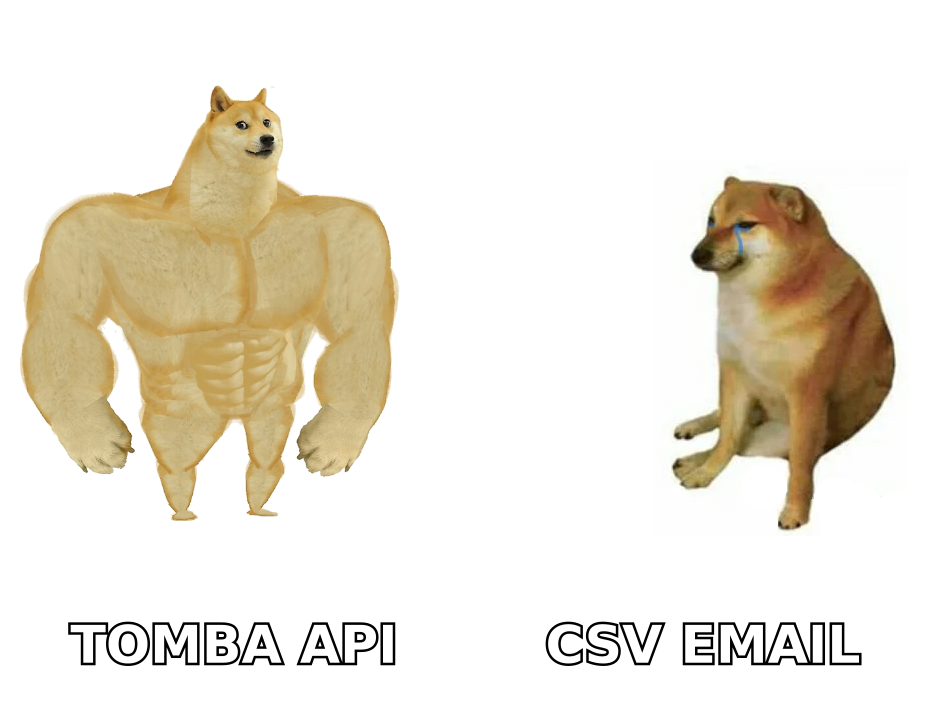
LakeB2B vs RocketReach: how do they compare head-to-head?#
Here's the side-by-side on the attributes that actually change a buying decision.
| Attribute | LakeB2B | RocketReach |
|---|---|---|
| Model | Managed list build / data services | Self-serve lookup platform |
| Pricing transparency | Quote only, no public rates | Published tiers, card signup |
| Typical entry cost | Four figures for a custom build | ~$70–$80/mo billed annually (Essentials) |
| Free tier | No — demo/sample file on request | Limited free lookups per month |
| Time to first contact | Days to weeks (scoping + delivery) | Minutes |
| API access | Limited / via services agreement | Yes, on higher tiers |
| Chrome extension | No | Yes |
| Phone numbers | Yes, on request | Yes, credit-gated (mobile costs more) |
| Custom/niche fields | Strong — this is the core pitch | Weak — fixed schema |
| Healthcare & education depth | Strong (NPI-style targeting) | Moderate |
| Data refresh cadence | Point-in-time at delivery | Continuous index updates |
| Best for | One-off ABM list, niche vertical | Ongoing rep-level prospecting |
| Worst for | Daily rep workflows | Deep niche segmentation |
Read the table as two different purchases, not two competing SKUs. If your question is "how do I get 4,000 verified contacts at dialysis clinics by Q2," LakeB2B is the shape of the answer. If it's "how do my eight SDRs pull contacts every day without filing a ticket," RocketReach is.
Which one has better data accuracy?#
Neither company publishes an audited accuracy figure you should trust. Be suspicious of any vendor that does.
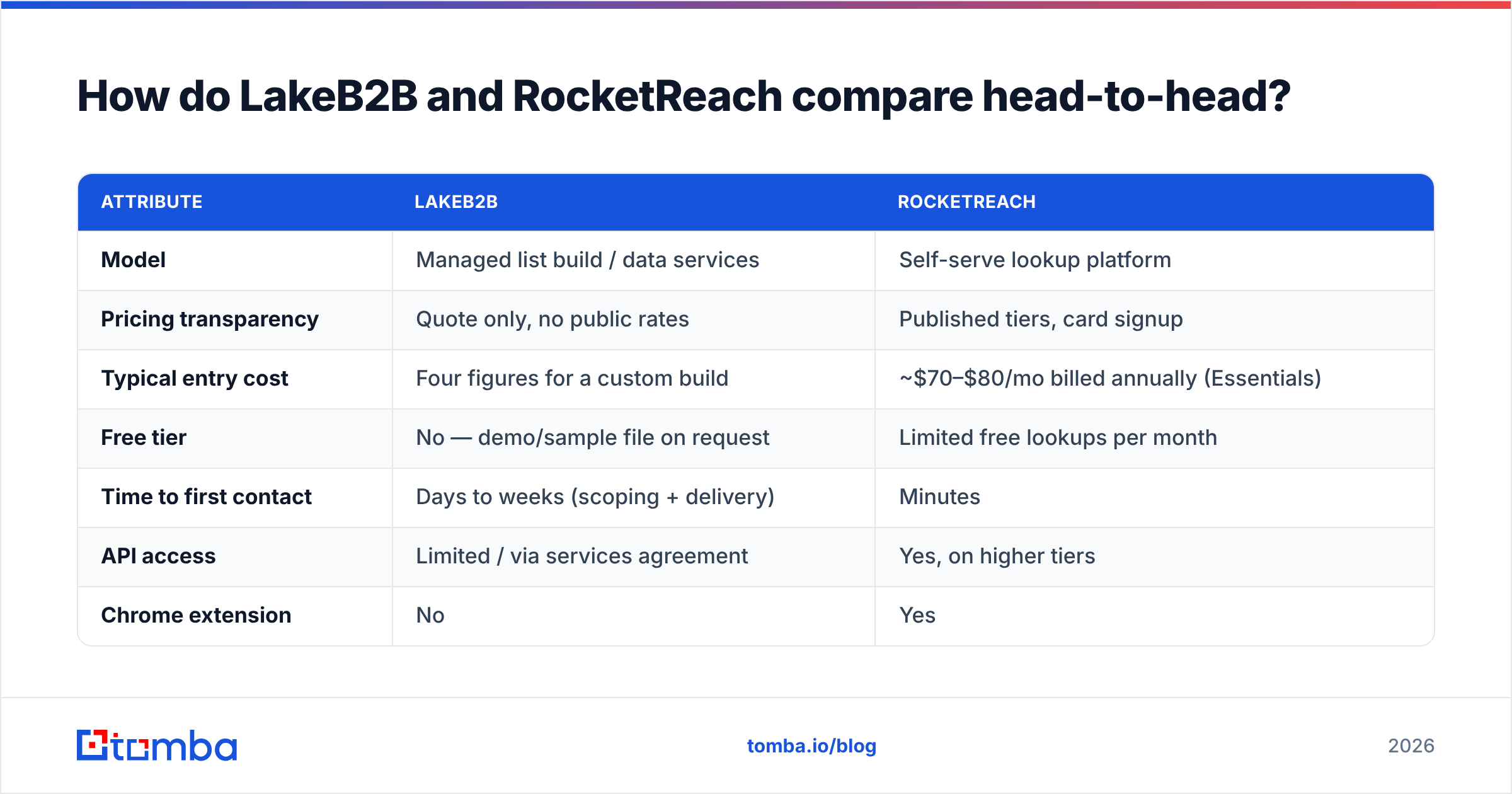
LakeB2B markets accuracy in the 85–95% range, with a replacement guarantee on bounces above an agreed threshold. That guarantee is the real product feature. The number itself is a promise made during scoping, not a measurement. It also applies to the file on the day it ships. A list scoped in March and delivered in April starts decaying right away.
RocketReach accuracy swings by segment. Executive and tech contacts at mid-to-large companies are strong. SMB, non-English markets, and recently changed roles are much weaker. RocketReach is also more likely than most tools to return a guessed address without flagging how confident it is. Under a credit model, a wrong result still costs you.
Both share the same limit. HubSpot's research on database decay puts B2B contact rot at roughly 22–30% per year. Job changes, domain migrations, and company churn drive it. That number is worse in 2026 than it was in 2019, after years of layoffs and role reshuffling across tech.
The takeaway is boring but true: re-verify before you send, whatever source you buy from. A bounce rate above 3% starts damaging sender reputation. Mailbox providers tightened enforcement again after the 2024 Google and Yahoo bulk-sender rules. Running a list through an email verifier costs a fraction of a cent per record. It is the highest-ROI step in the whole chain.
What does each one actually cost?#
This is where the comparison gets uncomfortable for LakeB2B.
RocketReach publishes rates. As of 2026, its self-serve tiers run roughly:
- Free — a handful of lookups per month, enough to test match rates on your own ICP.
- Essentials — roughly $70–$80/mo annual, email-only lookups, single seat.
- Pro — roughly $140–$170/mo annual, adds phone numbers and higher credit volume.
- Ultimate — roughly $300+/mo annual, full credit allowance, API access, bulk lookups.
- Custom/Enterprise — team seats, SSO, negotiated credit pools.
LakeB2B publishes nothing. Buyers report per-record pricing that scales with how exotic the filters are. A plain "marketing managers in SaaS" pull is cheap per record. An NPI-matched clinician list with license fields is not. Minimum engagements usually land in the low four figures, and there is no real way to test before you commit. You can request a sample file, and that's about it.
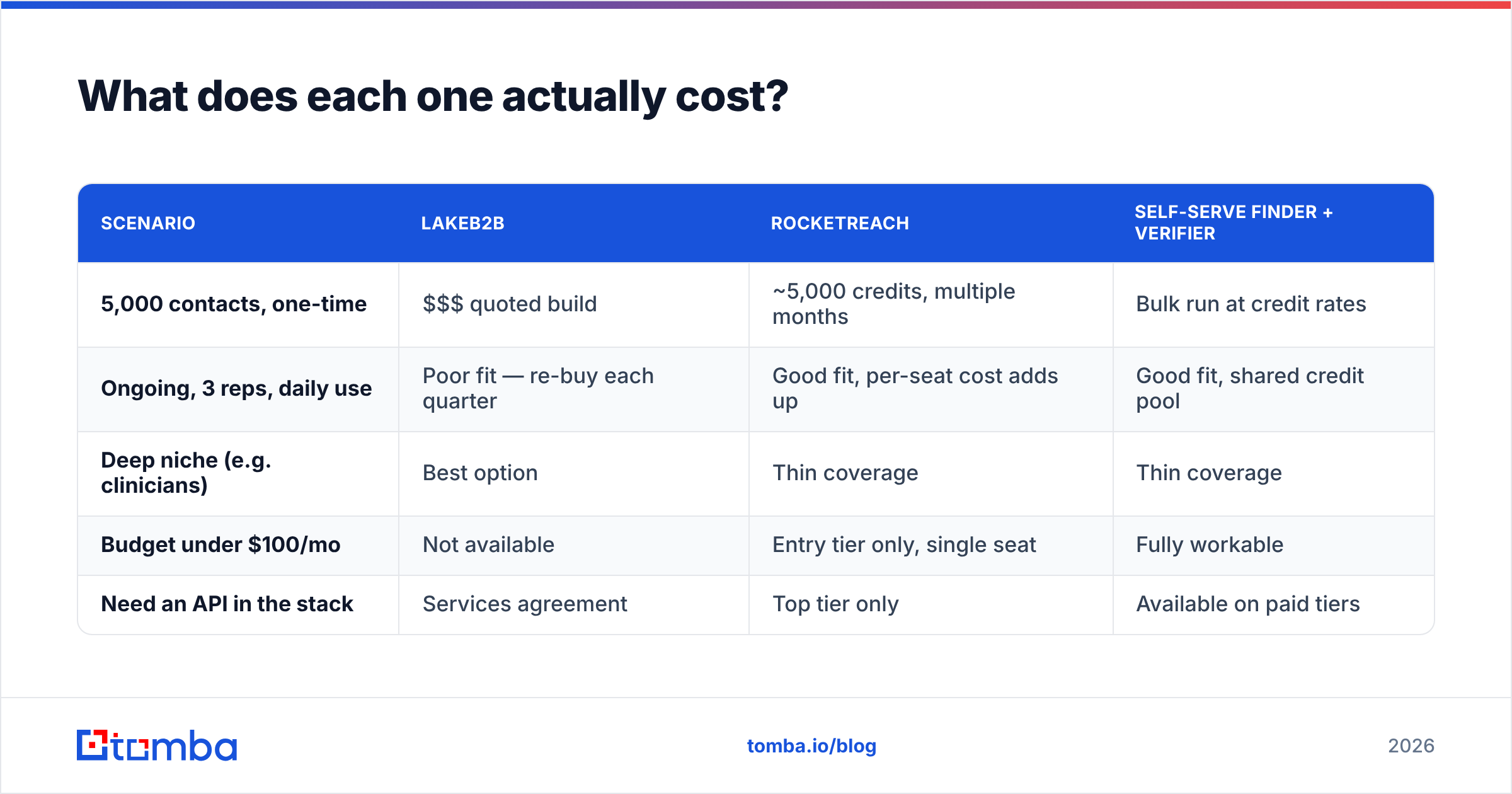
Here's the cost framing that matters more than the sticker:
| Scenario | LakeB2B | RocketReach | Self-serve finder + verifier |
|---|---|---|---|
| 5,000 contacts, one-time | $$$ quoted build | ~5,000 credits, multiple months | Bulk run at credit rates |
| Ongoing, 3 reps, daily use | Poor fit — re-buy each quarter | Good fit, per-seat cost adds up | Good fit, shared credit pool |
| Deep niche (e.g. clinicians) | Best option | Thin coverage | Thin coverage |
| Budget under $100/mo | Not available | Entry tier only, single seat | Fully workable |
| Need an API in the stack | Services agreement | Top tier only | Available on paid tiers |
For reference, Tomba pricing starts with a free tier of 25 searches/mo, then $49/mo (Starter), $99/mo (Growth), and $249/mo (Pro). Tomba does not replace a custom healthcare list build — it isn't built for that. The point is narrower: most teams weighing these two are really shopping for per-contact lookup volume, and they are overpaying for it.
When should you buy a list instead of using a finder?#
Buying a built list is the right call less often than vendors imply. It isn't never. Buy a list when:
- The attributes are exotic. Medical specialty codes, school district enrollment bands, installed-technology signals, franchise ownership. No self-serve tool indexes these. You're paying for research labor, not for email addresses.
- You need volume now for one defined campaign and have no ops capacity to build it. A one-time $4,000 file that saves 80 hours of SDR research can pay off.
Use a self-serve finder when:
- Targeting is ordinary. Role, seniority, industry, headcount, geography. Every self-serve tool covers this, and you'll pay a fraction of a custom build.
- Your motion is account-first. If reps already know the 300 companies, you don't need a list. You need a domain search that returns every contact at those domains on demand.
- Freshness matters more than breadth. A contact pulled today beats a contact pulled in Q1, full stop.
Either way, verify. Both paths feed the same sending infrastructure, and that infrastructure punishes bounces no matter what you paid for the data.

Is RocketReach worth it compared to the alternatives?#
RocketReach is a reasonable product with two specific frustrations. Both show up in nearly every review thread on G2 and Capterra.
First, credits expire. Unused monthly lookups generally don't roll over on lower tiers. That turns your subscription into a use-it-or-lose-it treadmill. Teams with spiky prospecting cycles — heavy at quarter start, quiet mid-quarter — buy for their peak and waste their trough.
Second, annual billing is the real price. The headline numbers are annual-commit rates, and month-to-month costs meaningfully more. That's standard SaaS practice, but it means "try it for a month" costs more than the marketing implies.
On coverage, RocketReach is solid for North American tech and executive contacts, and thinner elsewhere. If you sell into EMEA mid-market or non-tech verticals, test the match rate on 100 of your own known accounts before you commit to an annual plan. That test takes an hour and has saved a lot of teams a lot of money.
It's also worth naming the wider field honestly. BookYourData sits in a genuinely useful middle position: self-serve like RocketReach, but with pay-as-you-go list building and a verified-on-download guarantee. That suits teams who want a built list without the enterprise sales cycle. Apollo bundles data with sequencing. ZoomInfo sits above all of them on price and intent data. If one option prices you out, look sideways before you look up — our RocketReach alternative breakdown covers the per-credit math in more detail.
How do you build a stack that doesn't rot?#
The teams that stop having this argument stop treating contact data as an asset. They treat it as a perishable input instead.
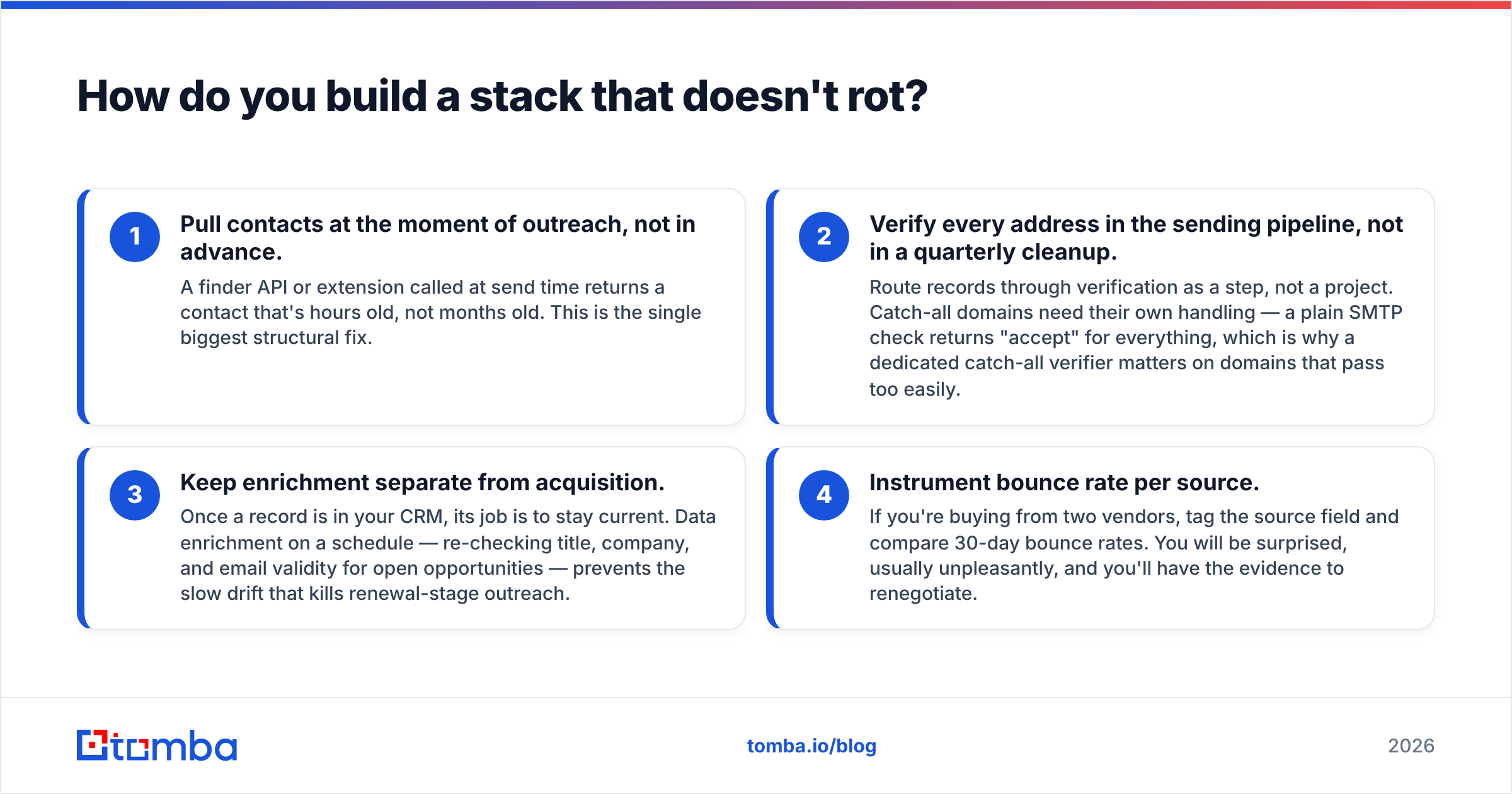
That looks like four habits. The first two are about how contacts enter your pipeline:
- Pull contacts at the moment of outreach, not in advance. A finder API or extension called at send time returns a contact that's hours old, not months old. This is the single biggest structural fix.
- Verify every address in the sending pipeline, not in a quarterly cleanup. Route records through verification as a step, not a project. Catch-all domains need their own handling, because a plain SMTP check returns "accept" for everything. That's why a dedicated catch-all verifier matters on domains that pass too easily.
The other two are about what happens once a record is already in your CRM:
- Keep enrichment separate from acquisition. Once a record is in your CRM, its job is to stay current. Data enrichment on a schedule re-checks title, company, and email validity for open opportunities. That prevents the slow drift that kills renewal-stage outreach.
- Instrument bounce rate per source. If you buy from two vendors, tag the source field and compare 30-day bounce rates. You will be surprised, usually unpleasantly. You will also have the evidence to renegotiate.
None of that needs a six-figure data contract. It needs a lookup source with an API, a verifier, and the discipline to run both on a schedule.
LakeB2B vs RocketReach: which should you pick?#
Pick LakeB2B if you're running a defined campaign into a genuinely specialized vertical — healthcare, education, government, or anything that needs attributes outside a standard firmographic schema. You'll also need the budget and the patience for a scoping call. Get the bounce guarantee in writing, ask for a 200-record sample before you sign, and assume the file is stale within 90 days.
Pick RocketReach if you have reps who need contacts every day, you target mainstream North American tech and mid-market, and you value self-serve speed over depth. Run a 100-account match-rate test first. Budget for annual, because monthly pricing makes the math worse.
Pick neither if what you actually want is reliable emails at a predictable per-contact cost, with an API you can call from your own workflow. That's a third category, and it's where most teams in this comparison belong. They just started the search at the wrong shelf.
Most teams comparing LakeB2B vs RocketReach want to solve one problem: get a working email address for a person at a company, reliably, without paying enterprise rates or waiting on a sales call. That's what Tomba Email Finder does. Search by domain, name, or company, get confidence-scored results, and verify before you send. Start free with 25 searches a month, scale to $49/mo when the volume justifies it, and skip the scoping call entirely.
Related guides#
// get started
Find, verify and enrich your first contacts today
Start on the free plan with 25 searches a month, then scale when your team is ready.
Free plan · No credit card required · GDPR & CCPA
Get the Tomba newsletter
Product and data updates
// about the author