LakeB2B vs Salesbot: Which B2B Sales Tool Wins in 2026?
LakeB2B sells lists. Salesbot automates conversations. Comparing them head-to-head only makes sense once you know which half of the pipeline you're actually missing — here's the honest breakdown.
TL;DR
- LakeB2B and Salesbot are not really competitors. LakeB2B is a data vendor that sells pre-built and custom contact lists; Salesbot is a conversation automation layer (most commonly Kommo's Salesbot) that replies to leads inside a CRM or chat widget.
- If your problem is "I don't have enough qualified contacts," LakeB2B is the closer fit. If your problem is "leads come in and nobody follows up fast enough," Salesbot is the closer fit.
- Neither tool solves the hardest part of outbound in 2026: keeping contact data fresh enough that your sends don't bounce. Purchased lists decay 25-30% per year, and a bot can only be as good as the record it's acting on.
- Pricing transparency is the sharpest difference. Salesbot-style tools publish per-seat pricing; LakeB2B is quote-only, priced per record and per campaign.
- The pragmatic 2026 stack: a verified, on-demand contact source feeding a lightweight automation layer — not a six-figure list purchase and not a bot with nothing to talk to.
What is LakeB2B, exactly?#
LakeB2B is a B2B data and demand-generation company. It sells contact and company databases segmented by industry, job function, technology installed, and geography, with a strong historical concentration in healthcare, pharma, technology, and education verticals. Alongside raw lists, it sells services: data appending, data cleansing, intent-based lead generation, and outsourced campaign execution.
The buying motion is agency-flavored, not self-serve. You describe a target audience, a rep builds a count, you get a quote, and you receive a file (or a CRM push) with the records. There's no free tier, no credit meter, and no public price list on lakeb2b.com.
That model has real advantages. Custom-built lists can reach segments that self-serve databases genuinely don't cover well — hospital procurement titles, niche manufacturing SIC codes, non-English-speaking mid-market. It also has a well-known drawback: you're buying a snapshot. The moment the CSV lands, it starts aging. B2B job-change rates run roughly 20-30% annually, which means a list purchased in January is meaningfully wrong by autumn.
What is Salesbot, exactly?#
Here's where the comparison gets slippery, and it's worth being blunt about it: "Salesbot" is not one product.
The dominant meaning is Kommo's Salesbot — the no-code conversation builder inside Kommo (the CRM formerly known as amoCRM), documented at kommo.com. It's a visual flow builder that triggers on events — a new WhatsApp message, an inbound form, a deal moving stages — and then sends templated or AI-generated replies, asks qualifying questions, books meetings, and updates CRM fields.
There are also several unrelated products using "salesbot" as a name or a category label: AI SDR tools, website chat widgets, and Telegram/WhatsApp bot builders. Before you compare anything, confirm which one a colleague or a G2 listing actually means. Checking the vendor directly on G2 takes two minutes and prevents a genuinely expensive mix-up.
For this comparison, Salesbot = CRM-native conversational automation. That's the meaning that matters to a sales team evaluating it against a data vendor.
Why does comparing LakeB2B vs Salesbot even make sense?#
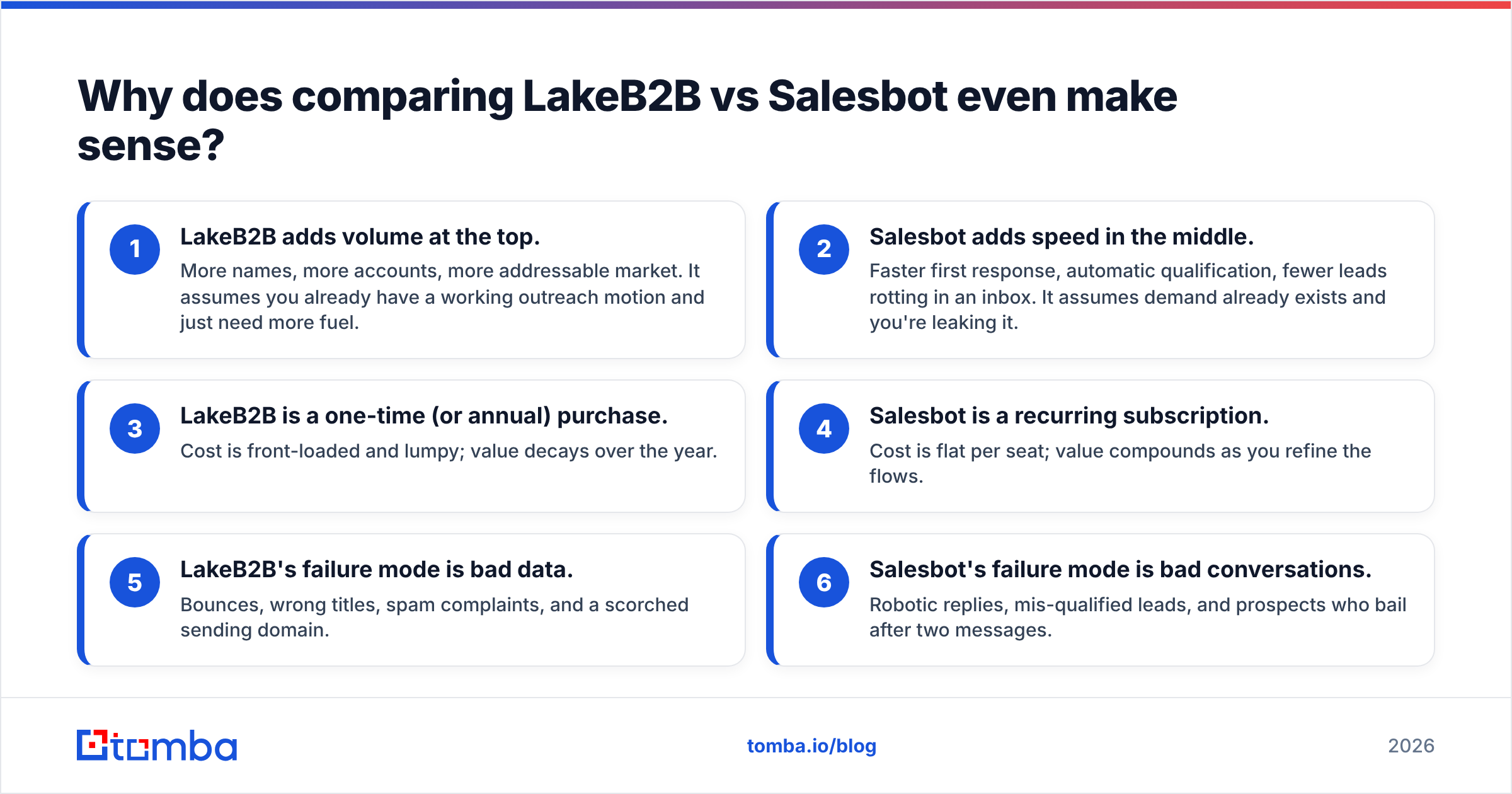
Because both get pitched as the answer to the same complaint: "Our pipeline is too thin."
They attack it from opposite ends:
- LakeB2B adds volume at the top. More names, more accounts, more addressable market. It assumes you already have a working outreach motion and just need more fuel.
- Salesbot adds speed in the middle. Faster first response, automatic qualification, fewer leads rotting in an inbox. It assumes demand already exists and you're leaking it.
- LakeB2B is a one-time (or annual) purchase. Cost is front-loaded and lumpy; value decays over the year.
- Salesbot is a recurring subscription. Cost is flat per seat; value compounds as you refine the flows.
- LakeB2B's failure mode is bad data. Bounces, wrong titles, spam complaints, and a scorched sending domain.
- Salesbot's failure mode is bad conversations. Robotic replies, mis-qualified leads, and prospects who bail after two messages.
Diagnose which failure you're currently living with, and the decision mostly makes itself.
How do LakeB2B and Salesbot compare head-to-head?#
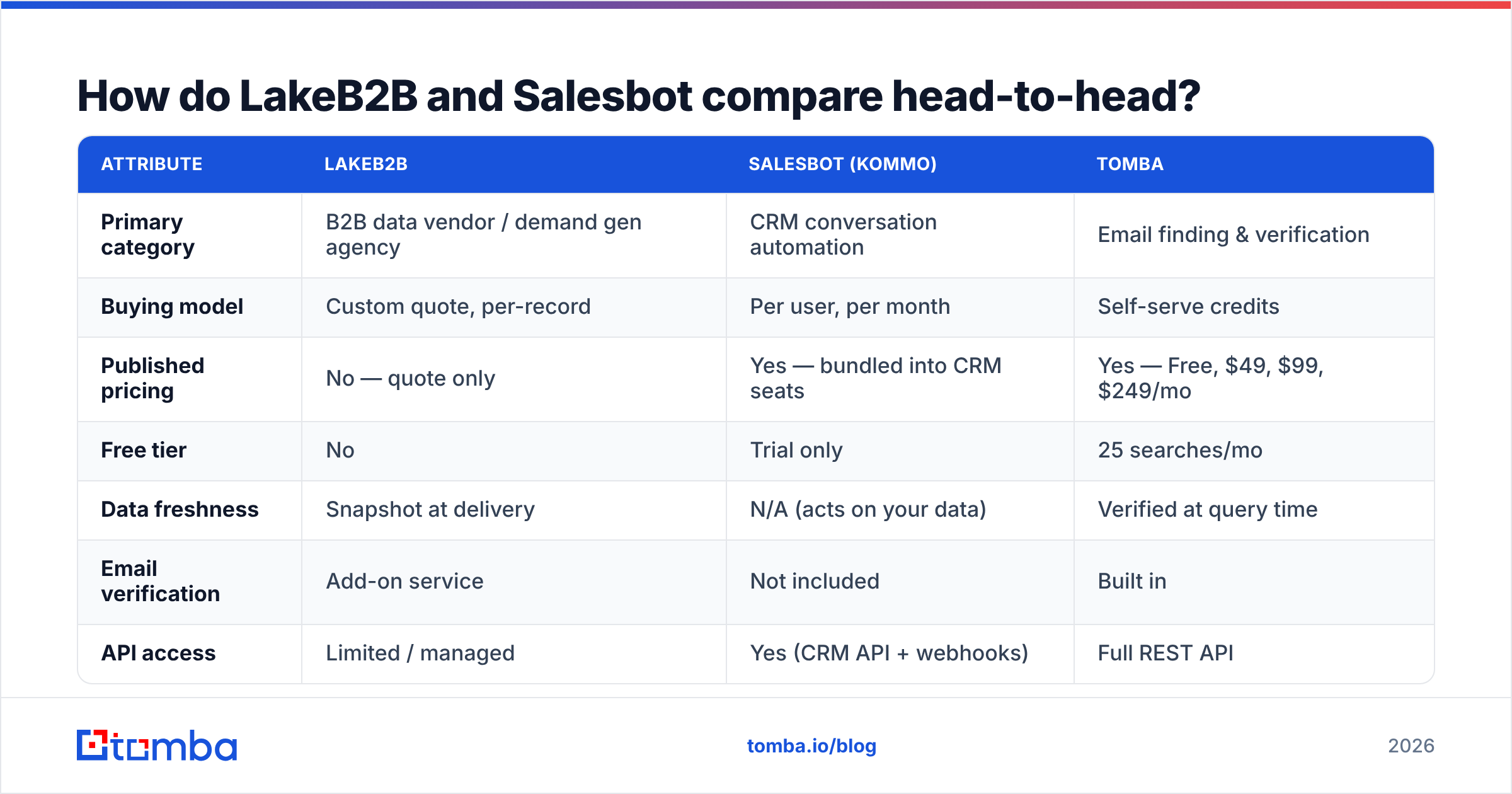
| Attribute | LakeB2B | Salesbot (Kommo) | Tomba |
|---|---|---|---|
| Primary category | B2B data vendor / demand gen agency | CRM conversation automation | Email finding & verification |
| Buying model | Custom quote, per-record | Per user, per month | Self-serve credits |
| Published pricing | No — quote only | Yes — bundled into CRM seats | Yes — Free, $49, $99, $249/mo |
| Free tier | No | Trial only | 25 searches/mo |
| Data freshness | Snapshot at delivery | N/A (acts on your data) | Verified at query time |
| Email verification | Add-on service | Not included | Built in |
| API access | Limited / managed | Yes (CRM API + webhooks) | Full REST API |
| Best for | Niche vertical list builds | Inbound speed-to-lead | Accurate outbound contact data |
| Typical time to value | 1-3 weeks (scoping + delivery) | Days (flow building) | Minutes |
| Main risk | List decay, no refund on bounces | Automation feels impersonal | Requires your own sequencer |
Prices and packaging change; treat the vendor columns as directional and confirm current terms directly with each company before you sign. Tomba's numbers are published on the Tomba pricing page.
What does LakeB2B actually cost?#
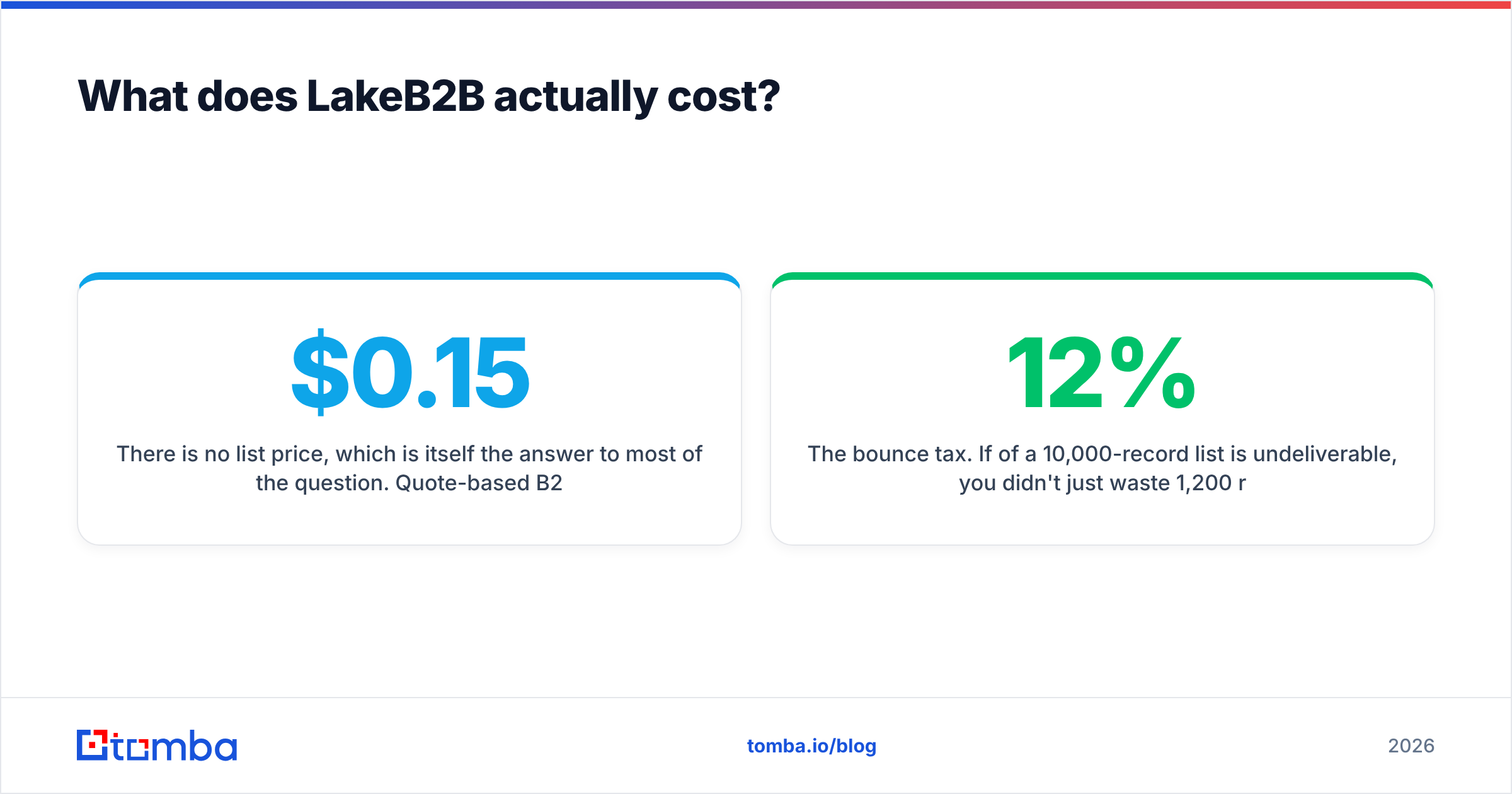
There is no list price, which is itself the answer to most of the question. Quote-based B2B data pricing in this tier generally lands somewhere between $0.15 and $1.20 per record depending on volume, verticality, and whether you're buying emails only or full contact profiles with direct dials and firmographics. Custom appends and intent data push the top of that range higher.
Three cost lines buyers routinely under-model:
- Minimum commitments. Many custom-list vendors won't quote under a few thousand records, so a 400-contact pilot isn't really on the menu.
- The re-buy. Because a list decays, the "one-time" purchase quietly becomes an annual line item.
- The bounce tax. If 12% of a 10,000-record list is undeliverable, you didn't just waste 1,200 records — you took a hit to email deliverability that affects every campaign you run for the next month. That is the invisible, expensive part.
This is why anything you buy in bulk should go through an independent email verifier before the first send, regardless of vendor promises. Verifying 10,000 records costs a fraction of what a burned sending domain costs.
What does Salesbot actually cost?#
Salesbot isn't sold standalone — it's a capability inside the CRM. Kommo's plans have historically been priced per user per month in roughly the $15-$45 band, billed annually, with bot capabilities and message volume tiering upward. AI-assisted replies typically consume a separate credit pool.
So the honest math for a five-rep team is a low-hundreds monthly subscription, plus implementation time. The flows themselves are the real cost: a genuinely good qualification bot takes a week of iteration, not an afternoon. Teams that treat it as "turn it on and walk away" get exactly the mediocre results that give chatbots their reputation.
Which one is better for cold outbound in 2026?#
Neither, on its own — and this is the part most comparison posts dodge.
Cold outbound in 2026 is gated by three things: inbox placement, relevance, and contact accuracy. Google and Microsoft's bulk-sender enforcement made spam-rate thresholds a hard ceiling rather than a guideline. That changes the economics:
- A purchased list with a 10%+ bounce rate is now an active liability, not merely inefficient.
- A bot that blasts identical opening lines gets pattern-matched by filters and by humans.
- The teams winning are sending less and targeting better, which favors on-demand lookup over bulk acquisition.
The practical pattern that works: build a tight account list, find the specific people you actually want at those accounts, verify them at the moment of send, personalize on something real, and only then automate the follow-up. An email finder that returns a confidence score per address does more for your deliverability than any list guarantee, because it's evaluating the address today rather than whenever the file was compiled.

What about data accuracy and compliance?#
Ask any vendor these four questions in writing before money moves:
- Where does the data originate? Public sources, opt-in partnerships, panel data, or scraping? "Proprietary" is not an answer. Tomba documents its data sources publicly for exactly this reason.
- When was each record last validated? A per-record timestamp is the single most useful field in any B2B file, and its absence tells you something.
- What's the bounce guarantee, and how is it enforced? Credit-back on bounces above X% is standard; make sure the claim survives contact with a support ticket.
- What's the GDPR/CCPA basis for EU and California records? If you're emailing Europe, legitimate-interest documentation isn't optional and the fines aren't theoretical.
Vendors that answer all four crisply are rare enough that it's a useful filter by itself.
Are there better alternatives to both?#
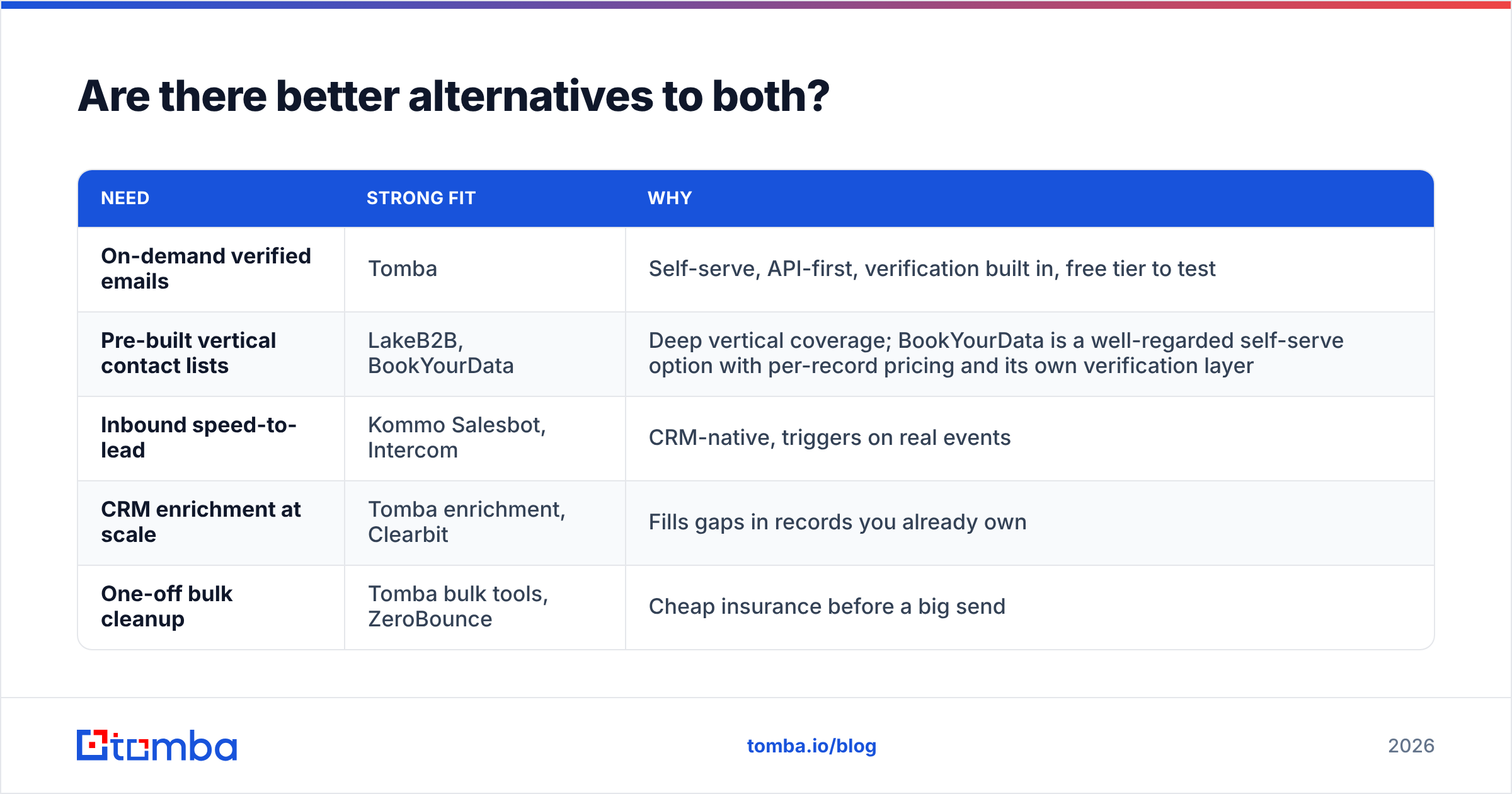
Depends entirely on which gap you're filling. A few that come up repeatedly in evaluations:
| Need | Strong fit | Why |
|---|---|---|
| On-demand verified emails | Tomba | Self-serve, API-first, verification built in, free tier to test |
| Pre-built vertical contact lists | LakeB2B, BookYourData | Deep vertical coverage; BookYourData is a well-regarded self-serve option with per-record pricing and its own verification layer |
| Inbound speed-to-lead | Kommo Salesbot, Intercom | CRM-native, triggers on real events |
| CRM enrichment at scale | Tomba enrichment, Clearbit | Fills gaps in records you already own |
| One-off bulk cleanup | Tomba bulk tools, ZeroBounce | Cheap insurance before a big send |
If you want the list-buying experience with transparent, self-serve pricing, BookYourData is worth a look alongside LakeB2B — it solves the same job with far less procurement friction. If you'd rather never own a stale file again, the enrichment route wins: push a company domain and a name through an API and get back a verified address on demand. Tomba's data enrichment and bulk email finder cover both the single-record and the ten-thousand-record versions of that workflow.
What's the verdict: LakeB2B vs Salesbot?#
Buy LakeB2B if you need a hard-to-reach vertical segment (healthcare titles, specific NPI-linked contacts, regional manufacturing), you have budget for a scoped project, and you have the discipline to verify everything on arrival. Budget for re-buying annually.
Buy Salesbot if inbound leads are already arriving and your response time is measured in hours instead of minutes. It's cheap relative to a single lost deal and it pays back fastest on high-volume, low-ACV inbound.
Buy neither if your actual constraint is that you can't reliably reach the 300 specific people who matter this quarter. That's a lookup-and-verify problem, and a per-record list purchase or a chat flow is an expensive way to not solve it.
The sequencing that works for most teams: fix contact accuracy first, then automate. Automation applied to bad data just produces wrong messages faster.
Where should you start?#
Start by measuring your current bounce rate on a 200-record sample. If it's above 4%, your data is the bottleneck and no amount of conversational automation will move the number.
Tomba Email Finder gives you 25 free searches a month — enough to spot-check a vendor file, test coverage on your actual ICP, or build a pilot list before committing to anything. Every result comes back with a confidence score and verification status, and paid plans start at $49/mo with full API access when you're ready to wire it into your stack. Run your next 50 target accounts through it and compare the hit rate against whatever quote is sitting in your inbox.
Related guides#
// get started
Find, verify and enrich your first contacts today
Start on the free plan with 25 searches a month, then scale when your team is ready.
Free plan · No credit card required · GDPR & CCPA
// about the author