LakeB2B vs TAMI AI (2026): Which B2B Data Tool Wins?
LakeB2B sells curated list builds; TAMI AI sells self-serve intent and tech-stack search. They solve different problems. Here's the honest breakdown of pricing, data freshness, and which one actually fits your outbound motion.
TL;DR
- LakeB2B is a managed data vendor: you brief them, they deliver a curated contact list (often bundled with append, verification, and sometimes email-send services). Pricing is quote-based and usually annual or per-record.
- TAMI AI is a self-serve B2B search platform with a technographic and buying-signal angle — you log in, filter, and pull contacts yourself. Pricing is seat-based subscription.
- They are not really competitors in the same lane. LakeB2B wins when you need a one-off niche list (healthcare, education, manufacturing) with human curation. TAMI wins when you need continuous, self-directed prospecting.
- Both share the same weak spot: record freshness. Any list you buy or export decays 2-3% per month, so an independent verification layer is non-negotiable.
- If your real requirement is "accurate work emails on demand, no annual contract," a per-credit tool like Tomba covers the finding-and-verifying job for a fraction of either platform's commitment.
What is LakeB2B and who actually buys it?#
LakeB2B (lakeb2b.com) is a data services company, not a SaaS tool in the usual sense. The core offering is custom-built contact lists assembled against a brief: industry, job function, geography, company size, sometimes technology or license data.
The buyer profile is specific. It skews toward teams running campaigns into verticals where general-purpose databases are thin — healthcare practitioners, education administrators, industrial buyers, international markets outside the US-tech bubble. LakeB2B also packages adjacent services: data append (you send a partial file, they fill gaps), data cleansing, and in some engagements outsourced campaign execution.
What you get in practice:
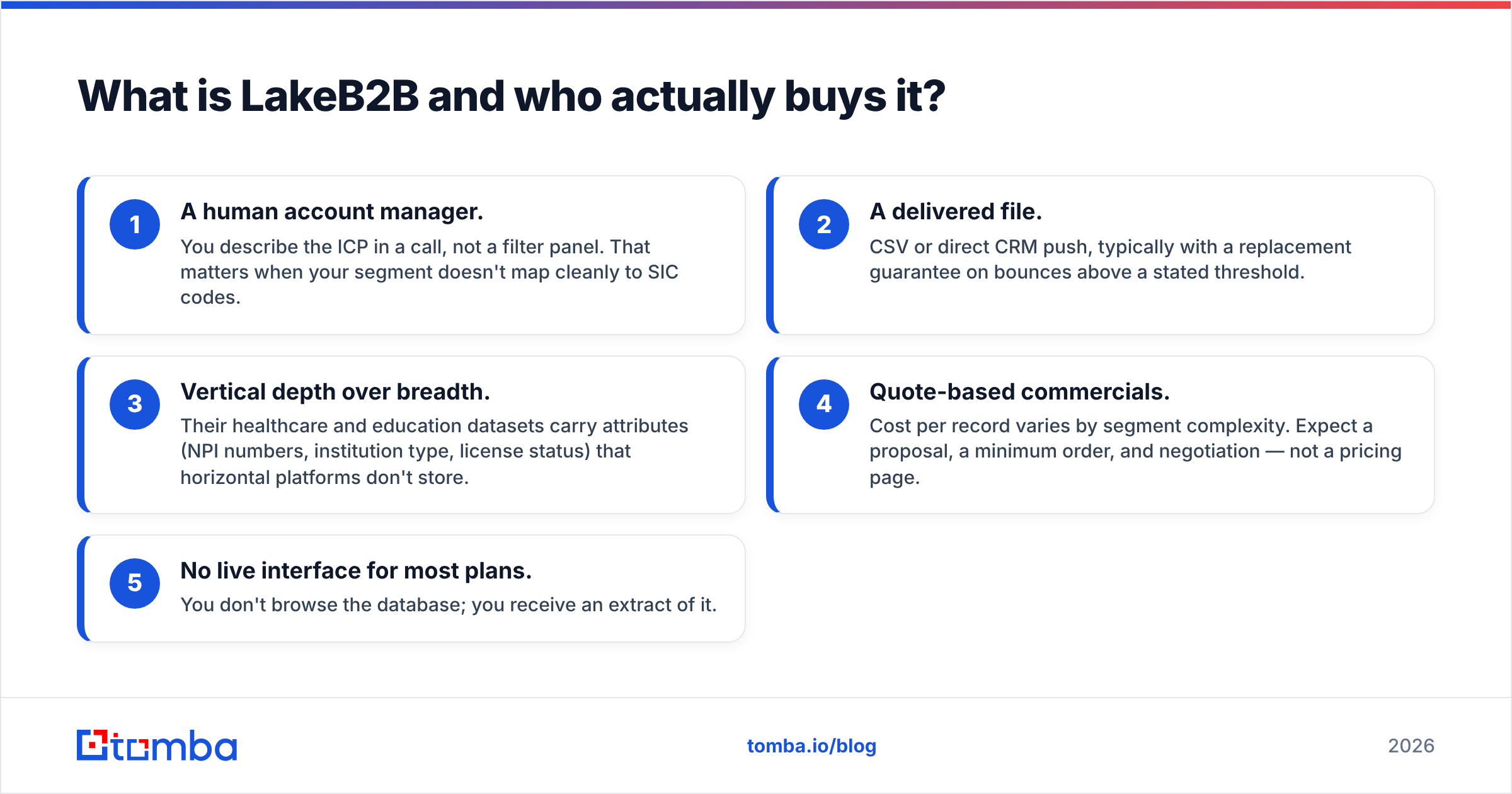
- A human account manager. You describe the ICP in a call, not a filter panel. That matters when your segment doesn't map cleanly to SIC codes.
- A delivered file. CSV or direct CRM push, typically with a replacement guarantee on bounces above a stated threshold.
- Vertical depth over breadth. Their healthcare and education datasets carry attributes (NPI numbers, institution type, license status) that horizontal platforms don't store.
- Quote-based commercials. Cost per record varies by segment complexity. Expect a proposal, a minimum order, and negotiation — not a pricing page.
- No live interface for most plans. You don't browse the database; you receive an extract of it.
That last point is the crux of the comparison. LakeB2B is a delivery model, TAMI is an access model.
What is TAMI AI and how does it differ?#
TAMI (tami.com) positions itself as a B2B prospecting and market-intelligence platform with a strong technographic bias. Its pitch is that it crawls the web continuously to detect what technologies companies run, what they're hiring for, and what changed recently — then lets you filter companies and contacts on those signals.
Operationally, it looks like Apollo or Cognism: log in, build a search, export or push to CRM. The differentiators TAMI leans on are:
- Technographic filters — find every company running a specific CMS, payment processor, ad pixel, or analytics tag. Useful if you sell an integration, a migration, or a replacement for a known tool.
- Signal-based lists — hiring activity, site changes, funding, tech adds and drops, surfaced as triggers rather than static attributes.
- European coverage — TAMI has UK/EU roots and its non-US data is generally stronger than the average US-first platform, though GDPR constraints shape what contact fields you actually see.
- Self-serve seats — your SDR opens the tool, builds the list, and works it the same afternoon. No procurement round-trip.
The tradeoff is that technographic detection is inference. A pixel on a page tells you a tool is installed, not that it's actively used, budgeted, or owned by the person you're emailing. Treat it as a strong prior, not a fact.
LakeB2B vs TAMI AI: how do they compare head to head?#
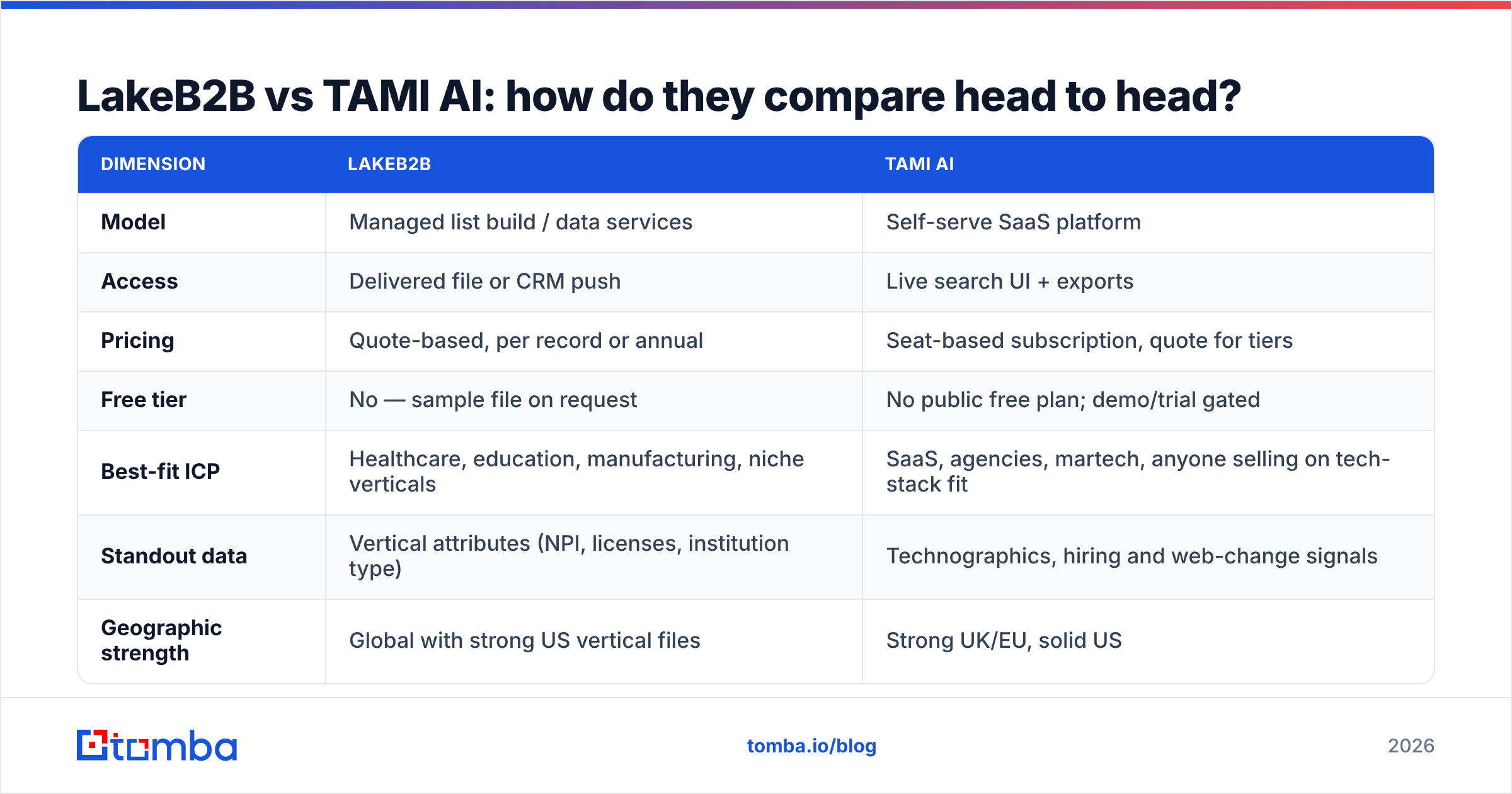
| Dimension | LakeB2B | TAMI AI |
|---|---|---|
| Model | Managed list build / data services | Self-serve SaaS platform |
| Access | Delivered file or CRM push | Live search UI + exports |
| Pricing | Quote-based, per record or annual | Seat-based subscription, quote for tiers |
| Free tier | No — sample file on request | No public free plan; demo/trial gated |
| Best-fit ICP | Healthcare, education, manufacturing, niche verticals | SaaS, agencies, martech, anyone selling on tech-stack fit |
| Standout data | Vertical attributes (NPI, licenses, institution type) | Technographics, hiring and web-change signals |
| Geographic strength | Global with strong US vertical files | Strong UK/EU, solid US |
| Turnaround | Days to weeks per brief | Minutes per search |
| Refresh cadence | Refreshed at build time | Continuous crawl |
| Verification included | Bounce guarantee, varies by contract | Platform-level validation, varies by record |
| Contract friction | High — MSA, minimums, negotiation | Medium — annual seats typical |
| Who it frustrates | Teams needing fast iteration on ICP | Teams needing niche non-tech verticals |
The pattern is clear once you line it up. LakeB2B optimizes for segments you can't self-serve. TAMI optimizes for iteration speed on segments you can.
If you're selling clinical software to hospital procurement in three countries, a filter panel will not find your list — a researcher will. If you're selling a Shopify app and want every DTC brand that added Klaviyo in the last 90 days, no account manager can beat a live technographic query.
Which one is more accurate in practice?#
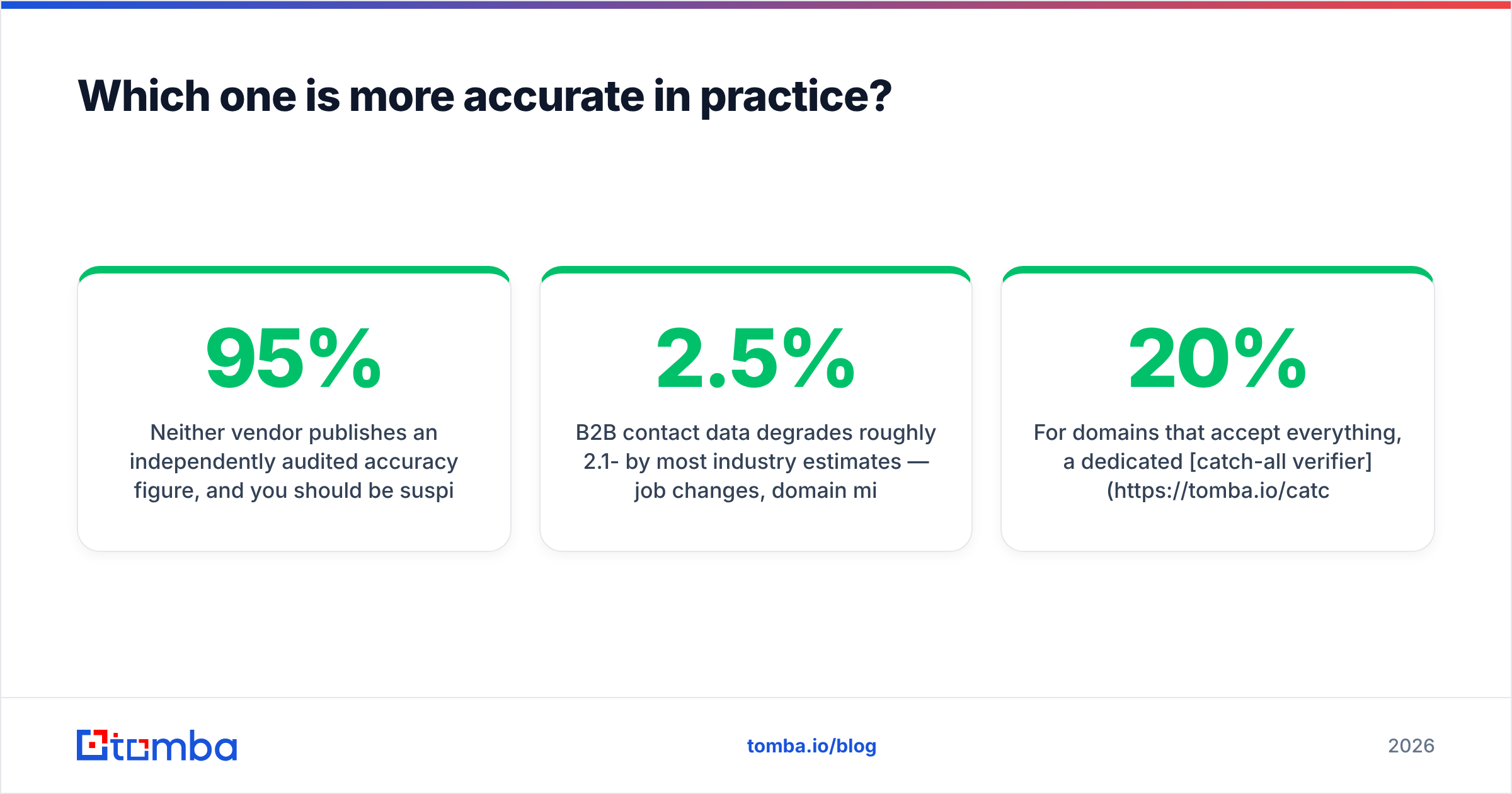
Neither vendor publishes an independently audited accuracy figure, and you should be suspicious of any B2B data company that claims 95%+ without naming the methodology. What's verifiable is the decay math, and it applies to both.
B2B contact data degrades roughly 2.1-2.5% per month by most industry estimates — job changes, domain migrations, restructures, mailbox deprecation. Over a year that's a quarter to a third of any file. Gartner and other analyst coverage of sales data hygiene has been consistent on this for years: the acquisition source matters less than the refresh discipline.
That produces two different risk profiles:
- LakeB2B risk is point-in-time. The file is as good as the day it was built. Buy 20,000 records in January, start sending in April, and you've already lost several percent before the first touch. Mitigate by negotiating a re-verification clause and by sending fast after delivery.
- TAMI risk is inference-based. The crawl is fresh, but the contact attached to a technographic signal may be the wrong person, may have left, or may be a role-based catch-all address that never reaches a human.
Both risks are solved the same way: verify at the point of send, not at the point of purchase. Running any imported file through an independent email verifier before it touches your sequencing tool is the single cheapest insurance in outbound. It costs fractions of a cent per record and protects the asset that actually matters — your sender reputation.
For domains that accept everything, a dedicated catch-all verifier is the difference between a usable segment and a blind gamble. Roughly 15-20% of B2B domains are catch-all configured, and most bulk validators simply return "unknown" and hand the risk back to you.
What does each one actually cost?#
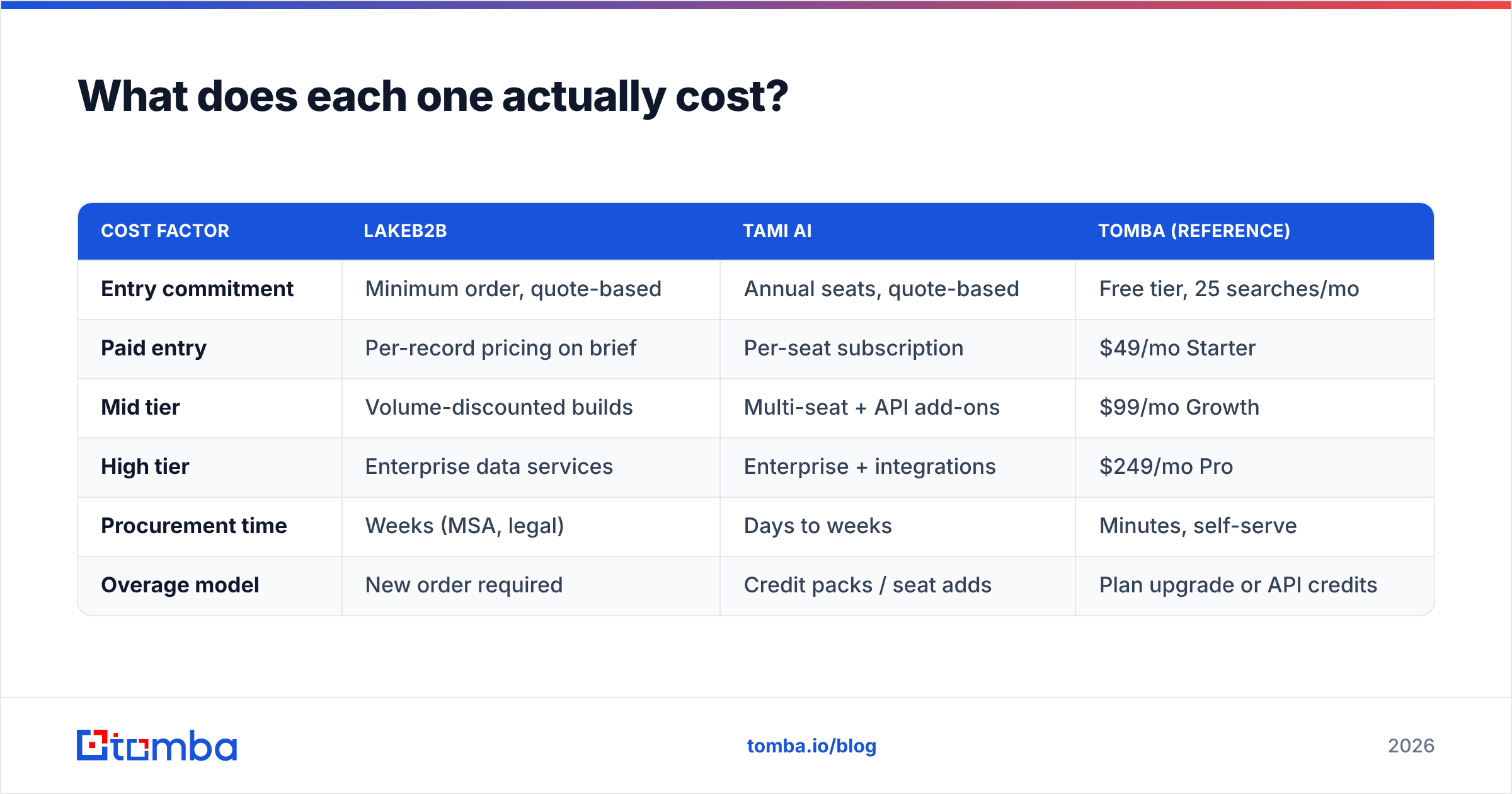
Neither publishes transparent pricing, which is itself a data point about the buying process.
| Cost factor | LakeB2B | TAMI AI | Tomba (reference) |
|---|---|---|---|
| Entry commitment | Minimum order, quote-based | Annual seats, quote-based | Free tier, 25 searches/mo |
| Paid entry | Per-record pricing on brief | Per-seat subscription | $49/mo Starter |
| Mid tier | Volume-discounted builds | Multi-seat + API add-ons | $99/mo Growth |
| High tier | Enterprise data services | Enterprise + integrations | $249/mo Pro |
| Procurement time | Weeks (MSA, legal) | Days to weeks | Minutes, self-serve |
| Overage model | New order required | Credit packs / seat adds | Plan upgrade or API credits |
The practical implication: both LakeB2B and TAMI require you to commit budget before you've validated that their data works for your ICP. That's normal for enterprise data, but it's a real cost — the time-to-first-email is measured in weeks, not hours.
If you're at the stage where you're still testing whether a segment responds at all, paying an annual contract to find out is the wrong sequencing. Prove the segment with a cheap, per-credit tool first. Then buy the big file once you know the ICP converts. Transparent Tomba pricing exists precisely for that validation phase.
When should you choose LakeB2B?#
Pick LakeB2B when at least two of these are true:
- Your vertical is underserved by horizontal databases. Healthcare, education, government, manufacturing, and international markets are where curated builds earn their premium.
- You need non-standard attributes. License numbers, accreditation status, bed counts, enrollment figures — data that no filter panel in a generic tool exposes.
- You have budget approval and a defined campaign. The model works when you know exactly what you want. It fails when your ICP is still moving.
- You want the append service. If you already have 50,000 partial records and need firmographics or contacts filled in, a managed append is often cheaper than rebuilding from scratch.
- You don't have internal research capacity. Paying for someone else's researchers is legitimate when your team is three people.
What to negotiate before signing: bounce replacement thresholds in writing, a re-verification window, sample file before payment (not after), and clarity on whether records are exclusive or resold.
When should you choose TAMI AI?#
Pick TAMI when:
- Tech stack is your qualifying signal. If "uses X" or "recently dropped Y" is the strongest predictor of fit in your funnel, technographic search is the whole product.
- Your reps need to self-serve daily. SDR-driven motions break when list requests take a week. A seat per rep removes the bottleneck.
- You sell into UK/EU. TAMI's non-US coverage is a genuine strength relative to US-first platforms.
- You iterate on ICP frequently. Early-stage teams that change target segments monthly need a filter panel, not a procurement cycle.
- You want signals, not snapshots. Hiring spikes and tech changes are timing data; a static file has none.
Where TAMI disappoints: deep vertical files, direct-dial coverage compared to phone-specialist vendors, and contact-level completeness in GDPR-restricted geographies. If you need B2B phone numbers at scale, neither of these platforms is your primary source.
What about the third option — building lists yourself?#
There's a category both vendors would prefer you skip: assembling the list with cheap composable tools.
The workflow looks like this:
- Source companies from a signal you already trust — funding databases, job boards, review sites like G2, your own website visitors.
- Find contacts per domain with a domain search that returns every public work address on a company domain, with role and confidence score.
- Fill named prospects via an email finder when you already have first name, last name, and company.
- Enrich the rest with data enrichment to add titles, seniority, and firmographics.
- Verify everything before it enters your sending tool.
This is slower per record than a delivered file and requires someone to own the process. But it's dramatically cheaper, the data is fresh at the moment of use rather than at the moment of purchase, and you're never renegotiating a contract to test a new segment. For teams under 20 reps, this is usually the right answer — and it composes with either vendor rather than replacing them.
Worth noting: providers like BookYourData occupy a useful middle ground here, offering pay-as-you-go list building with verification included, which removes the annual-contract friction that both LakeB2B and TAMI carry. If your objection to both platforms is commercial rather than technical, that middle tier is worth a look before you default to enterprise procurement.
Which should you actually pick?#
Choose LakeB2B if you sell into a specialized vertical, need attributes generic platforms don't carry, and have the budget and timeline for a managed engagement. Negotiate hard on verification terms.
Choose TAMI AI if technographics or buying signals drive your qualification, your reps need daily self-serve access, and UK/EU coverage matters. Budget for a verification layer on top.
Choose neither, yet, if you're still proving that the segment responds. Both platforms are answers to "scale this known-good motion," not "discover whether this motion works."
The honest summary is that this comparison is less about which vendor is better and more about which purchasing model matches your stage. A seed-stage team signing an enterprise data contract to test three ICPs will burn budget it can't recover. An enterprise team trying to build 40,000 healthcare records by hand will burn months.
Whichever you land on, the verification step is not optional. Every list — curated, crawled, or hand-built — arrives with dead records in it, and your domain pays the price for each one you send to.
Ready to test your ICP before you sign anything?#
Start with the part of the stack that doesn't require a contract. The Tomba Email Finder returns verified professional email addresses by name, domain, or company, with a confidence score and the sources behind every result. The free tier gives you 25 searches a month to prove a segment responds; Starter is $49/mo when you're ready to scale, and the API drops into whatever sourcing workflow you already run.
Validate the ICP first. Buy the big file second. That order saves most teams a year of budget.
Related guides#
// get started
Find, verify and enrich your first contacts today
Start on the free plan with 25 searches a month, then scale when your team is ready.
Free plan · No credit card required · GDPR & CCPA
// about the author