LakeB2B vs Zintlr: Which B2B Data Provider Wins in 2026?
LakeB2B sells custom-built contact lists. Zintlr sells self-serve sales intelligence with personality data. They solve different problems — here is which one actually fits your outbound motion, and what both cost you in wasted sends.
TL;DR
- LakeB2B is a list vendor, Zintlr is a software platform. LakeB2B builds and sells custom contact files (often with campaign services attached); Zintlr gives you a self-serve database, a Chrome extension, and personality-profiling layered on top. Comparing them like-for-like is the first mistake most buyers make.
- LakeB2B wins on niche verticals — healthcare/NPI, higher-ed, industry-specific technology-user files that no self-serve tool indexes properly.
- Zintlr wins on speed and cost of entry. You can sign up, install the extension, and pull contacts the same afternoon. No sales call, no minimum order.
- Neither is a substitute for verification. Purchased lists and database exports both decay; if you send without re-verifying at the point of use, you eat the bounce.
- If your real job is "find and verify work emails for a named list of companies," a dedicated email finder at $49/mo will outperform both on cost per usable contact.
What are LakeB2B and Zintlr, exactly?#
They sit at opposite ends of the B2B data market.
LakeB2B is a data-services company in the classic sense. You describe an audience — "IT directors at US hospitals with 200+ beds," "Salesforce admins in manufacturing" — and its team assembles a file from its own databases plus partner sources, appends the fields you asked for, and delivers it as a CSV or pushes it into your CRM. Pricing is quote-based and typically scales with record count and how many enrichment fields you want. Many engagements bundle in managed campaign services: LakeB2B will run the email send, the appointment setting, or the webinar recruitment for you.
Zintlr is a sales-intelligence SaaS product. You get a searchable contact and company database with filters (title, industry, geography, headcount), a browser extension that surfaces contact details on LinkedIn and company sites, and its differentiator: Zint Personality AI, which infers a prospect's likely communication style — assertive, analytical, relationship-driven — and suggests how to phrase your opener. Plans are published, self-serve, and priced per user per month, with entry tiers that are genuinely cheap by US standards (Zintlr is an India-based company and prices accordingly). Verify current tiers on their pricing page before you budget — they've changed packaging more than once.
So the honest framing of lakeb2b vs zintlr is not "which database is bigger." It's: do you want a done-for-you file, or a tool your reps operate themselves?

How do LakeB2B and Zintlr compare head-to-head?#
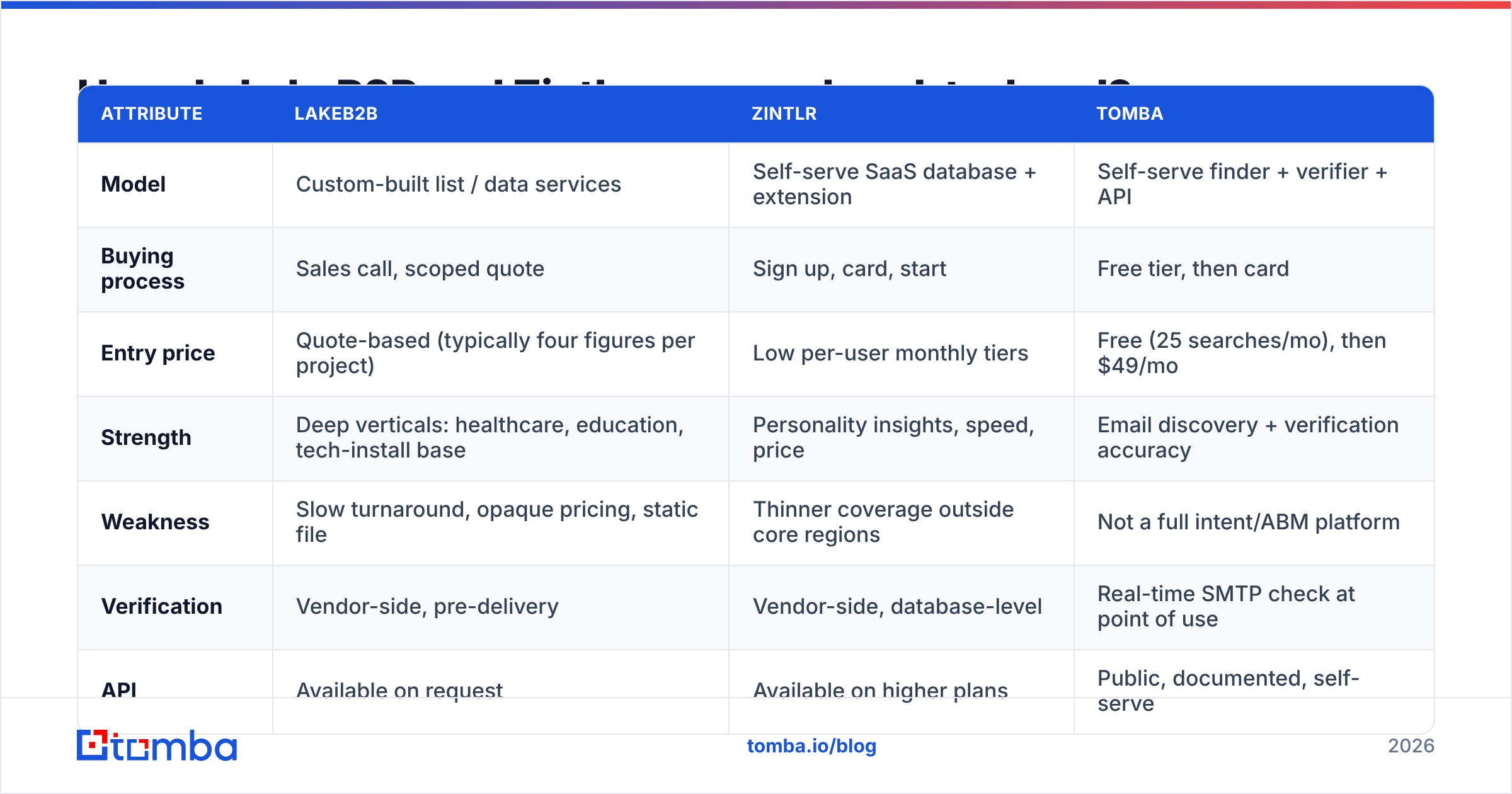
| Attribute | LakeB2B | Zintlr | Tomba |
|---|---|---|---|
| Model | Custom-built list / data services | Self-serve SaaS database + extension | Self-serve finder + verifier + API |
| Buying process | Sales call, scoped quote | Sign up, card, start | Free tier, then card |
| Entry price | Quote-based (typically four figures per project) | Low per-user monthly tiers | Free (25 searches/mo), then $49/mo |
| Strength | Deep verticals: healthcare, education, tech-install base | Personality insights, speed, price | Email discovery + verification accuracy |
| Weakness | Slow turnaround, opaque pricing, static file | Thinner coverage outside core regions | Not a full intent/ABM platform |
| Verification | Vendor-side, pre-delivery | Vendor-side, database-level | Real-time SMTP check at point of use |
| API | Available on request | Available on higher plans | Public, documented, self-serve |
| Best for | One-off ABM list for a niche segment | SDR teams doing daily self-serve prospecting | Teams who already know their target accounts |
The table makes the trade-off obvious. LakeB2B is a procurement decision; Zintlr is a tool adoption decision. One goes through legal and takes two weeks. The other goes on a corporate card and takes twenty minutes.
How do these two source their data?#
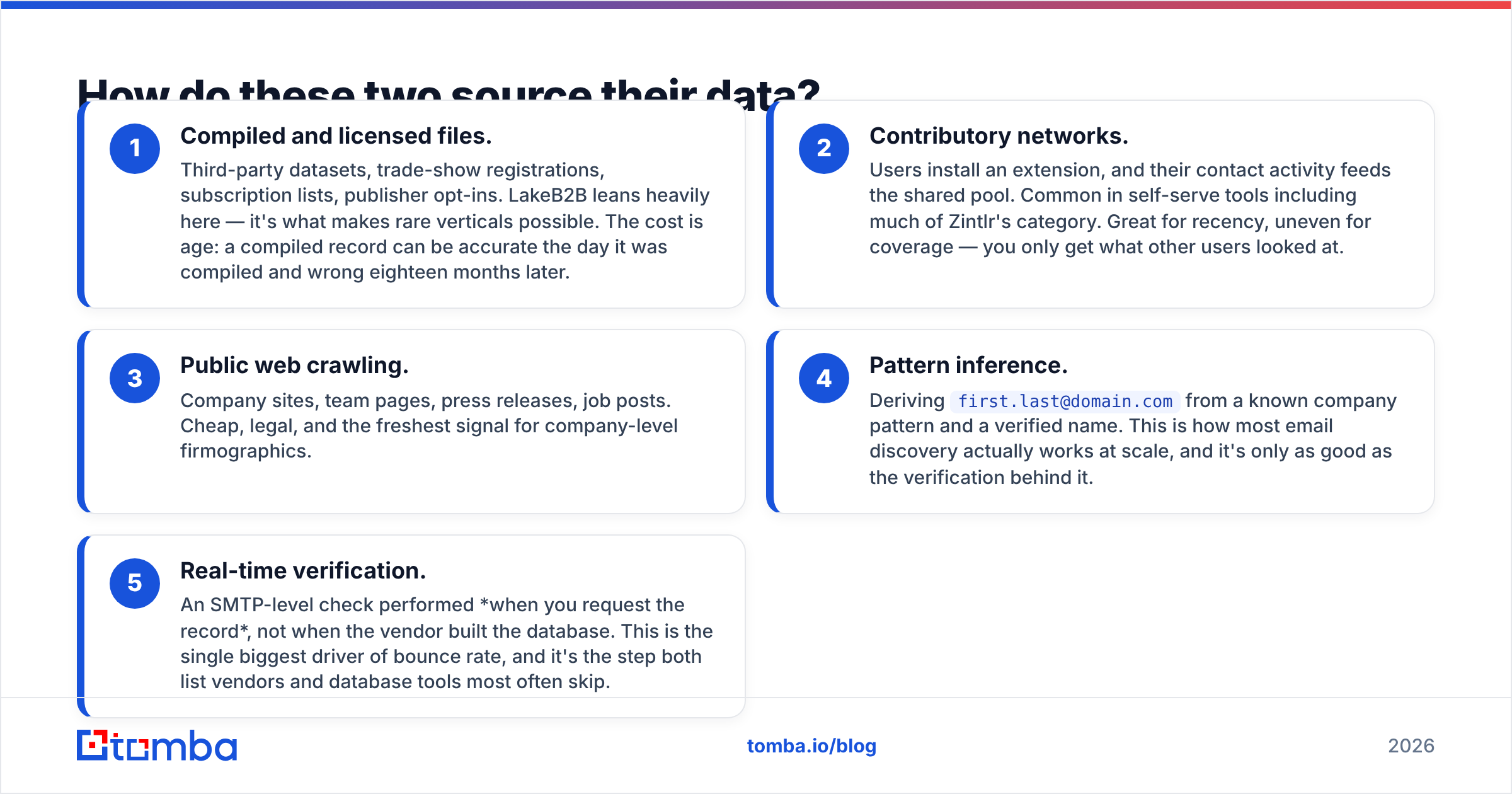
Understanding the sourcing model tells you more about accuracy than any vendor-published percentage. There are five mechanisms in play, and each provider leans on a different mix:
- Compiled and licensed files. Third-party datasets, trade-show registrations, subscription lists, publisher opt-ins. LakeB2B leans heavily here — it's what makes rare verticals possible. The cost is age: a compiled record can be accurate the day it was compiled and wrong eighteen months later.
- Contributory networks. Users install an extension, and their contact activity feeds the shared pool. Common in self-serve tools including much of Zintlr's category. Great for recency, uneven for coverage — you only get what other users looked at.
- Public web crawling. Company sites, team pages, press releases, job posts. Cheap, legal, and the freshest signal for company-level firmographics.
- Pattern inference. Deriving
first.last@domain.comfrom a known company pattern and a verified name. This is how most email discovery actually works at scale, and it's only as good as the verification behind it. - Real-time verification. An SMTP-level check performed when you request the record, not when the vendor built the database. This is the single biggest driver of bounce rate, and it's the step both list vendors and database tools most often skip.
A purchased file is a snapshot of steps 1-4. A verifier is step 5. If you buy from either LakeB2B or Zintlr and load the file straight into a sequencer, you are trusting somebody else's step 5 from an unknown date.
How accurate is the data from each?#
Nobody in this market publishes an audited accuracy figure, and you should be suspicious of the ones who claim to. What you can do is benchmark on your own ICP: take 200 contacts you already know are valid, run them through each source, and count matches and bounces.

Two patterns show up consistently when teams run that test:
LakeB2B's delivered files hold up well in the verticals it specialises in and degrade sharply outside them. Ask for hospital CIOs and you'll likely get a usable file. Ask for Series A SaaS founders in Berlin and you're getting a generic compile that any self-serve tool could match for a fraction of the cost. Buyers on G2 consistently flag the same two things: the vertical data is genuinely differentiated, and the sales process is heavier than they expected.
Zintlr's coverage is strongest in India, APAC, and mid-market global tech, thinner in European SMB. The personality layer is a real differentiator — it is not a gimmick if your reps actually adapt their openers — but it is a writing aid, not a deliverability aid. A brilliantly personalised email to a dead mailbox still bounces.
That's the gap. Both are selling you discovery. Neither is primarily selling you certainty that the address is live today. Running the final list through an email verifier before the first send is the cheapest insurance in the entire stack — typically a fraction of a cent per record against a bounce rate that can cost you the domain.
Which is cheaper in practice?#
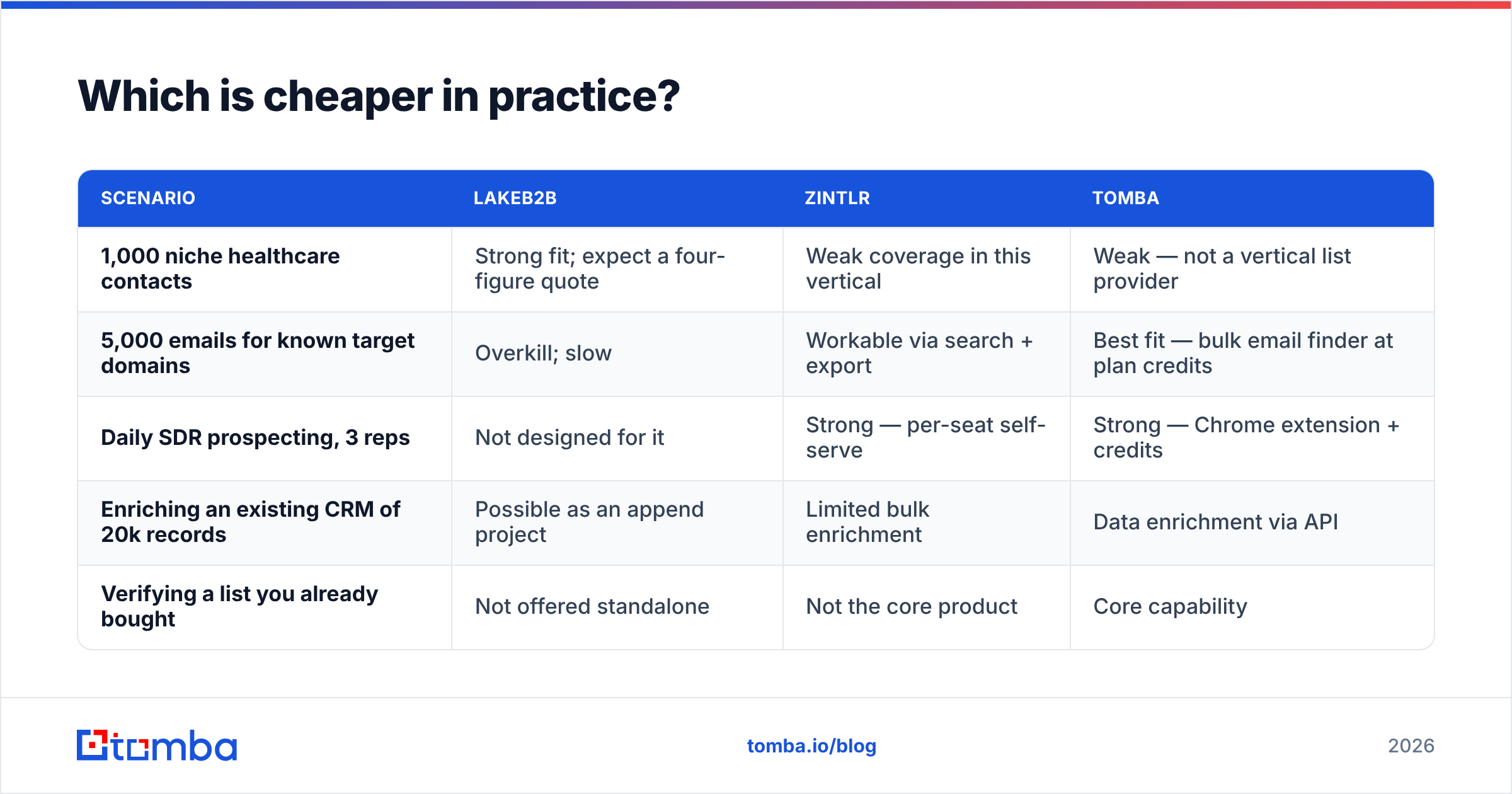
Compare cost per usable contact, not sticker price.
| Scenario | LakeB2B | Zintlr | Tomba |
|---|---|---|---|
| 1,000 niche healthcare contacts | Strong fit; expect a four-figure quote | Weak coverage in this vertical | Weak — not a vertical list provider |
| 5,000 emails for known target domains | Overkill; slow | Workable via search + export | Best fit — bulk email finder at plan credits |
| Daily SDR prospecting, 3 reps | Not designed for it | Strong — per-seat self-serve | Strong — Chrome extension + credits |
| Enriching an existing CRM of 20k records | Possible as an append project | Limited bulk enrichment | Data enrichment via API |
| Verifying a list you already bought | Not offered standalone | Not the core product | Core capability |

The arithmetic that matters: if a $3,000 LakeB2B file returns 60% reachable contacts, you paid $5 per usable contact. If a $40/user/month Zintlr seat produces 400 usable contacts that month, you paid $0.10. Those are wildly different unit economics — and they're only comparable if the two datasets actually cover the same audience. Usually they don't, which is exactly why the comparison confuses people.
For reference, Tomba pricing runs Free (25 searches/mo), Starter $49/mo, Growth $99/mo, Pro $249/mo, and Enterprise on request — with the finder, verifier, domain search, and API included rather than sold as separate line items.
Who should choose LakeB2B?#
Pick LakeB2B when all three of these are true:
- Your segment is genuinely hard to compile. Licensed healthcare practitioner data, accredited education contacts, install-base data for a specific enterprise platform. These aren't sitting in a self-serve index.
- You have budget and lead time. A scoped list project is weeks, not hours. If your campaign launches Monday, this isn't your vendor.
- You want services attached. If you need someone to actually run the appointment setting, a data-services firm bundles that in a way a SaaS tool never will.
Ask for a sample file before signing, and insist on knowing the refresh date of the records, not just the delivery date. A file "delivered in 2026" built from a 2023 compile is a very different product.
Who should choose Zintlr?#
Pick Zintlr when:
- Your reps need to self-serve daily. Search, filter, export, repeat — no procurement loop.
- Your ICP skews India/APAC or global mid-market tech. That's where the coverage is densest.
- You want the personality layer. If your team is inexperienced at writing openers, having a structured read on a prospect's communication style is a real crutch — and a useful one. Pair it with a subject line generator and you've got a decent first-touch workflow for junior SDRs.
- You're price-sensitive. Entry tiers undercut most US competitors substantially.
Where it struggles: European SMB coverage, bulk enrichment at scale, and the same problem every database has — record freshness at the moment of send.

Is there a third option that beats both?#
For one specific — and very common — job, yes.
If your motion is "we already know the 500 companies we want; get us the right people and valid emails," you don't need a compiled vertical file and you don't need personality profiling. You need accurate discovery plus verification, and you need it cheap and scriptable.
That's the lane where a focused tool wins on unit cost:
- Domain-first discovery — feed a domain, get the people and the company email pattern, rather than hoping a static database happens to have that account.
- Verification at request time — the SMTP check happens when you pull the record, not whenever the vendor last refreshed.
- Catch-all handling — most B2B domains are catch-all, which breaks naive verification. A dedicated catch-all verifier distinguishes "accepts everything" from "this mailbox exists."
- API-first workflow — the Tomba API drops into your enrichment job, so records refresh continuously instead of rotting in a CSV.
- Transparent sourcing — you can read exactly where the data comes from instead of getting "proprietary multi-source methodology."
Realistic stack for most teams: use LakeB2B only when you need a vertical nobody else covers. Use Zintlr or a similar self-serve tool for daily rep prospecting and pre-call research. Run everything — bought, exported, or scraped — through verification before it touches your sending domain. The verification step costs pennies and protects an asset that takes months to rebuild if you burn it. HubSpot's own deliverability guidance makes the same point from the marketing side: list hygiene beats list size, every time.
FAQ#
Is LakeB2B GDPR compliant? LakeB2B states it maintains compliance processes for GDPR and CCPA, and offers region-specific opt-in data. As with any list vendor, get the lawful-basis documentation for the specific file you're buying in writing — compliance is per-record, not per-company.
Does Zintlr have a free plan? Zintlr has historically offered a free/trial tier with limited credits. Packaging changes, so confirm on their site rather than trusting a blog post — including this one.
Can I use both together? Yes, and plenty of teams do. Use LakeB2B for the hard vertical file, Zintlr for day-to-day rep prospecting, and a verifier as the shared gate before anything enters your sequencer.
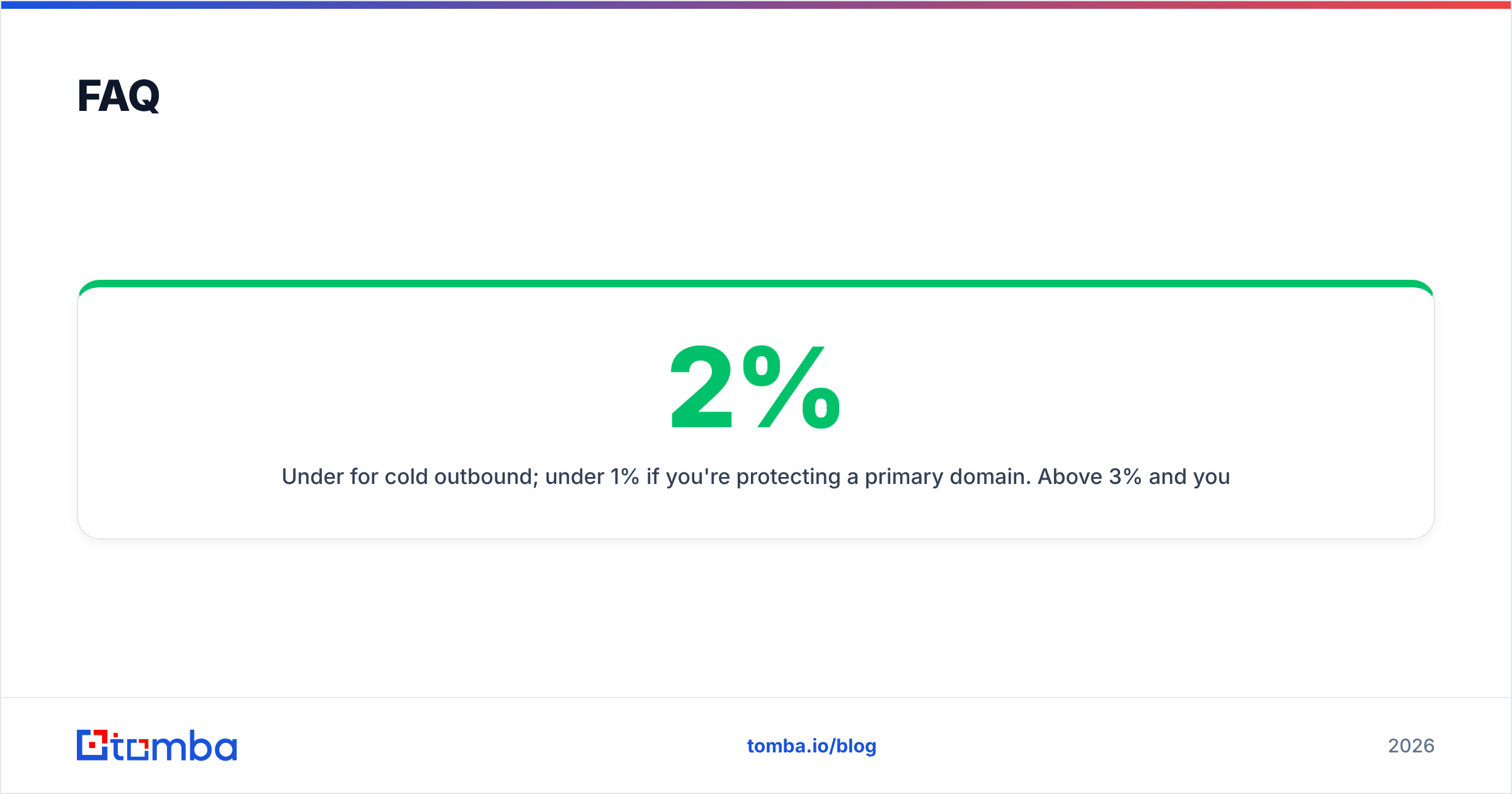
What bounce rate should I accept? Under 2% for cold outbound; under 1% if you're protecting a primary domain. Above 3% and you should stop sending and re-verify the entire list.
Which is better for LinkedIn-sourced prospecting? Zintlr, by design — its extension is built for that workflow. If you're working from LinkedIn profiles specifically, a dedicated LinkedIn finder will also convert profiles to verified work emails without a per-seat platform commitment.
The bottom line#
LakeB2B and Zintlr aren't really competitors — they're answers to different questions. Buy LakeB2B when the audience is genuinely unbuyable elsewhere and you have the budget and runway. Buy Zintlr when you want your reps prospecting this week at a per-seat price that won't need board approval.
But before either purchase, be honest about what you actually need. If the answer is "valid work emails for companies we've already picked," you're about to overpay for features you won't use.
Start with the cheap test: run 25 of your target accounts through the Tomba Email Finder on the free tier, check the hit rate and the verification status against what you already know, then decide whether a four-figure list project or a per-seat platform is still worth it. It takes ten minutes and it will save you a quarter of guesswork.
Related guides#
// get started
Find, verify and enrich your first contacts today
Start on the free plan with 25 searches a month, then scale when your team is ready.
Free plan · No credit card required · GDPR & CCPA
// about the author